Introduction to the book of Numbers: Barthel, a confused commentator, writes: The fourth book of Moses,
Numbers, also does not have much to offer the modern reader. As its name implies, it is a detailed census report
of the twelve tribes of Israel, along with a checklist of the dates prescribed for certain sacrifices and festivals, a
survey of the boundaries between the grazing grounds allotted to the various tribes, and a complete itinerary of
their early migrations. As usual, the unbeliever does not even have a clue.
 Much of Numbers, like the book of
Leviticus, is a set of direct quotes from God, and therefore has been all but eliminated from the teaching in God's
churches, slandered as we have here, and poorly and inconsistently rendered. All of this is unfortunate because
the content of the book of Numbers is fascinating and completely relevant to our lives today. The NIV Study Bible
calls Numbers theologically significant;
which is an understatement. As I write this introduction, my personal
notes on this book exceed four hundred pages. This will not be some dusty book that, in your program to read
through the Bible in one year, that you spend three hours with, recall little or nothing, and have moved on. We
will, for awhile, live and breathe this book, and our lives will be the richer for it.
Much of Numbers, like the book of
Leviticus, is a set of direct quotes from God, and therefore has been all but eliminated from the teaching in God's
churches, slandered as we have here, and poorly and inconsistently rendered. All of this is unfortunate because
the content of the book of Numbers is fascinating and completely relevant to our lives today. The NIV Study Bible
calls Numbers theologically significant;
which is an understatement. As I write this introduction, my personal
notes on this book exceed four hundred pages. This will not be some dusty book that, in your program to read
through the Bible in one year, that you spend three hours with, recall little or nothing, and have moved on. We
will, for awhile, live and breathe this book, and our lives will be the richer for it.
In the final four books of Moses, there is an interesting checkerboarding which occurs. The Exodus covers a
period of eighty years,
the last forty years of which is covered in detail. The book of Leviticus does not even cover
a period of a month. Then Numbers covers a time period of almost forty years and Deuteronomy is only a few
days long in its scope. However, its scope in time does not take from the direct quotes from God, which are
plentiful in this book.
Theme: The book of Numbers deals with the various responsibilities of the sons of Israel—it is in this book where
we see where the various tribes are stationed with regards to the tabernacle; we are given more specifics
concerning the service of the sons of Aaron; and the responsibilities of the Levites are delineated in this book, not
in the book of Leviticus.
Another theme found in this book is, and I attribute this to Zodhiates, is that it was easier for God to get Israel out
of Egypt than it was for Him to get the Egypt out of Israel. We will find Israel on many occasions in this book
recalling their idyllic life in Egypt, resplendent with great foods (Num. 11:4–6 14:2–4 20:4–5 21:5). It is as though
they had completely forgotten that the Egyptians compelled the sons of Israel to labor rigorously; and they made
their lives bitter with hard labor in mortar and bricks and field labor [with] all their labors which they rigorously
imposed upon them...and the sons of Israel sighed because of the bondage and they cried out; and their cry for
help because of bondage rose up to God (Ex. 1:13–14 2:23b).
The Title: The Jewish Scribes knew this portion of the Pentateuch as In the Wilderness (or, In the Desert), which
is the Hebrew word Bemîdebar (ר ַ ׃ד ̣מ ׃ ) [pronounced b'meede-BAHR] (?), which is the fifth word in this Num. 1:1.
This is a better description of this book than our name, Numbers. In the Wilderness gives us a feel for the entire
book of Numbers, as this is where the Israelites spent their time. Our English name is derived from the two
censuses which were taken in this book (the Greek and Latin designations are similarly named). In the Greek,
the title is arithmoi (AΡIθΜOI), from whence we obviously derive our word arithmetic. Although the numbering of
the people for battle—the numbering of the first and second generations—was important, still, this is not the thrust
of the book. Although the men were numbered for battle at the beginning of the book of Numbers, that generation
failed in every respect in battle. The second generation was also numbered and they enter into several short wars
with several peoples, emerging victorious. However, the actually numbering of these Israelites is but two
significant events in a book which is packed with important doctrines.
The date of writing: The time during which the book of Numbers was written is dependent upon the time of the
Exodus. Unfortunately, that time period is hotly disputed, being dated between 1440 b.c. and 1260 b.c.
Conservative Biblical scholars lean toward the earl date, archeologists toward the later. One reknown
archeologist—Nelson Glueck—spent ten years (1930–1940) studying the Negev and the Trans-Jordanian area
and his conclusions were that the regions mentioned, particularly in Numbers, were large unihabited during the
time period quoted by conservative theologians. In fact, it is his contention that that area was populated by other
than nomads no sooner than 1300 bc. However, his conclusions were based on surface observations and climatic
considerations made several thousand years after the fact, making his conclusions scientifically unviable. As I
will state later, the climate during that time was very likely different than the climate is now. There were some dry
areas and some areas where Israel went without water; however, they went for a long time when that was not an
issue. You cannot judge the state of the Mideast then by how it is today. Since Glueck had published his findings,
L. Harding has shown that during the Hyksos period of Egypt (1750–1550 bc), there were well--stocked tombs
in the area of Amman (known in the Bible as Rabbath-Ammon). Nomads do not tend to bury their dead in tombs,
so this calls into question Glueck's stand for the late date of the Exodus
.
There are other considerations which point toward the earlier date. Egypt had very little influence outside her
realm during this time period (thought to be during the rule of Ikhnaton); which would make sense, since God all
but decimated the army of Egypt prior to the Exodus. Furthermore, the run-ins with Midian as recorded in the book
of Numbers, is consistant with the historical Midians of this era, but not of any other. During this time period, they
did not own much territory, but they exercised control over a lot of territory due to their commercial enterprises
which were protected by their military
.
As I will state in the chronology section, I believe that Moses did the majority of his final draft while Israel cooled
her heals in Kadesh-barnea after their spectacular failure in Num. 13–14. This would place the date of writing
between 1438 bc and 1400 bc. The events herein described would have taken place between 1439 bc and
1400 bc.
Content: We begin the book of Numbers right after the majority of the Mosaic Law had been given and the
construction of the tabernacle had been completed. The children of Israel are at the foot of Mount Sinai and will
march into the Land of Promise with the intention of taking the land. Along this march, they are continually beset
by their own mental attitude sins and lack of trust in God. Once they reach the land, the size of the occupants
frightens them and they fall into serious disfavor with God (this is putting it mildly—God will kill every man, twenty
years and older with the sin unto death). So Israel settles into a period of stagnation while God kills many of them
off. Once most of that evil generation are destroyed, they approach the land once more, traveling in a much more
circuitous route (however, in accordance with God's leading). The book of Numbers takes them right to the Jordan
Jericho, just due east of their land, poised and prepared for combat.
Allow me to quote from Scofield's introduction: Redeemed from Egypt, possessing the law, led by Moses, daily
loking upon the Tabernacle, and supernaturally guided by cloud and pillar of fire, Israel should have walked
triumphantly in in the perfect will of God. Instead they failed repeatedly, as this book records
.
Like the book of Leviticus, much of the book of Numbers is quoted directly from God. To the untrained eye, the
book of Numbers might seem to be an hodgepodge of events, battles, movement, laws and legal addendums.
This may be attributed to the authorship of a man who has recently experienced the events herein found and has
more to write about than he has time to write. Nevertheless, the book of Numbers tends to be generally
chronological, the ordinances and laws recorded here are often an integral part of the events which were occuring
at this time. For instance, the Exodus generation, generation X, were dying off in large numbers due to the sin
unto death. Therefore, it would make sense to include here laws which dealt specifically with the uncleanness
incurred when coming into contact with a dead body—a very common event of that time period only (Num. 9).
Like all of the Old Testament, there are incidents and their meanings which are not completely perspicuous until
after the death and resurrection of our Lord. The bronze serpent event, the movement toward and promise of the
land of Canaan, the budding of Aaron's rod (Num. 17), the seriousness of the mistake of Moses when he struck
the rock twice instead of merely speaking to it (Num. 20), the horrible infiltration of other religions into the life of
Israel (Num. 25) and the cities of refuge (Num. 35) all have meaning which go beyond their simple historic
recording. All of these events forshadow and foretell the death of our Lord and His resurrection. Their complete
meaning is easy to ascertain today, whereas the full import of these events would be less understood, even by
their author, Moses. What I am telling you is that you, an individual Christian with whatever background you have,
are in a position to have a better grasp of the events of this book and their spiritual import, guided by the ministry
of God the Holy Spirit, than even Moses did, likely the greatest man in the history of Israel, and one of the greatest
men in the history of the world.
One of the themes running throughout this book is one of the blessings of obedience to Yehowah and the cursing
and discipline attendant to disobedience. When Israel listened to and obeyed God's Word, they received
protection and blessing (Num. 21:21–35). When they rebelled against God and His Laws, God punished them
(Num. 21:4–9).
Near the end of the book of Numbers, we not only see the deaths of the faithless Exodus generation, but we read
of the unceremonial death of Miriam (she will also be involved in her own little rebellion against God's authority)
as well as the death of Aaron, who was revered of the people and who was an honorable man, despite several
glaring errors of judgment. Even Moses, in this book, will make one grave mistake—the extent of which, he will
not fully understand in his own lifetime—but a mistake, nonetheless, which will keep him from even entering into
the Promised Land with those he has led for forty years.
Throughout the Pentateuch, as well as from Joshua to Samuel, the Jews were under a theocracy—that is, they
were ruled by God. They did not have a king as did the other nations.
However, there was always someone who
stood between the people and God, and, throughout their early history, this was Moses. God began right from
the very start to teach that there is a mediator between God and man. We know that Mediator today as Jesus
Christ; the Jews had their first mediator in the person of Moses, who, in occupying that office, was a shadow of
Jesus Christ.
The more specific content can be found immediately below in the outline.
Outline of Chapter 1: The book of Numbers can essentially be divided into two parts: Part I:Generation X—the
Exodus generation. Part II: The Second Generation. Throughout this book, we have a contrast between the
fathers and the sons.
Generation X
I. Israel is organized (Num. 1:1–10:10)
A. A census is taken of the adult members of eleven tribes of Israel (Num. 1:1–46)
B. The Levites are not included in this census and their general duties are given (Num. 1:47–54)
C. The camps are arrange around the tabernacle (Num. 2)
D. The Levites are a gracious gift to the Aaronic priesthood (Num. 3:1–13)
E. The Levites are numbered, all males of a month of age and older and given duties (Num. 3:14–39)
F. The first-born of the Levites are numbered and redeemed (Num. 3:40–51)
G. Specific Levitical responsibilities (Num. 4:1–33)
1. Those of the Kohathites (vv. 1–20)
2. Those of the Gershonites (vv. 21–28)
3. Those of the Merarites (vv. 29–33)
H. The three Levitical families are numbered according to those who will actually serve (Num. 4:34–49)
I. Sets of laws and customs (mostly peculiar to the Age of Israel) (Num. 5–6)
1. Concerning defilement (Num. 5:1–4)
2. Concerning confessions of sin and restitution (Num. 5:5–10)
3. The test for adultery (Num. 5:11–31)
4. Nazirite vows (Num. 6:1–21)
5. A blessing for Aaron to invoke (Num. 6:22–27)
J. Rituals (Num. 7:1–10:10)
1. The leaders of the tribes bring offerings (Num. 7:1–88)
2. The lampstands (Num. 7:89–8:4)
3. The cleansing of the Levites (Num. 8:5–26)
4. The second Passover (Num. 9:1–15)
5. Erection of the tabernacle and the guidance of Yehowah (Num. 9:16–23)
6. The silver trumpets (Num. 10:1–10)
II. Israel moves out (Num. 10:11–19:22)
A. The people leave Sinai (Num. 10:11–36)
B. Complaints along the journey (Num. 11–12)
1. The people complain to Moses about being tired of manna (Num. 11:1–9)
2. Moses complains to leadership God about his position of leadership (Num. 11:10–15)
3. God provides leaders to assist Moses, quail for the people and the Holy Spirit (Num. 11:16–35)
4. Miriam, and Aaron, complain to Moses about their authority and God disciplines Miriam (Num. 12)
C. The people at the edge of the Land of Promise (Num. 13–14)
1. Moses sends spies into the land (Num. 13:1–24)
2. The spies bring back their report (the majority report is that the inhabitants of the land are too big
for Israel to oppose; the minority report is that the land is just as Yehowah said it it is; let's go and
take it (Num. 13:25–33)
3. The people whine and bitch and refuse to go into the land (Num. 14:1–10)
4. God threatens to destroy all of the sons of Israel; Moses intercedes; God will just kill those who are
twenty years old and up (Num. 14:11–38)
5. The Israelites, in a burst of emotion, attack the Amalekites and the Canaanites, and Israel is struck
down and forced back to Hormah (Num. 14:39–45)
D. God's marvelous grace; His laws for entering into the Land of Canaan (Num. 15:1–31)
1. Offerings to be brought before God upon entering into the land (Num. 15:1–13)
2. God's laws apply to the temporary immigrant as well (Num. 15:14–31)
E. An incident of Sabbath-breaking occurs (Num. 15:32–41)
F. Korah's rebellion against Moses and subsequent actions
1. Korah, Dathan and Abiram all point to Moses as the reason that the Jews could not take the land of
Promise (Num. 16:1–14)
2. Moses and his rebels face off; an earthquake envelops the rebels and lightening kills some of them
(Num. 16:15–35)
3. The bronze incense burners of the rebels are hammered into sheets and used upon the altar as a
sign to suceeding generations (Num. 16:36–40)
4. The people complain to Moses because of the harsh treatment of the rebels and God disciplines
them with a plague (Num. 16:41–50)
5. Aaron's rod that buds is a sign to the rebels (Num. 17)
G. Spiritual ordinances (Num. 18–19)
1. Levitical assistance (Num. 18:1–7)
2. The portion of the priests (Num. 18:8–20)
3. The portions and obligations of the Levites (Num. 18:21–32)
4. The red heifer sacrifice (Num. 19:1–12)
5. Personal contact with dead body (Num. 19:13–22)
The Second Generation (the Generation of Hope)
I. From Kadesh to Jazer: several victories and two deaths (Num. 20–21)
A. The death of Miriam and the second generation's no-water test (Num. 20:1–13)
B. Negotiations to transverse Edom fail (Num. 20:14–23)
C. Aaron's death (Num. 20:24–29)
D. The Israelites defeat the king of Arad of the Negev (Num. 21:1–3)
E. The long additional journey causes the people to complain; the bronze serpent (Num. 21:4–9)
F. Israel continues to advance (Num. 21:10–20)
G. Victory over the Amorites (Num. 21:21–32)
H. Victory over Og, the king of Bashan (Num. 21:33–35)
II. Israel, Balak and Balaam (Num. 22–24)
A. Balak, king of Moab, sends for Balaam (Num. 22:1–21)
B. Balaam goes to Balak (Num. 22:22–41)
C. Balaam blesses Israel instead of cursing her (Num. 23–24)
III. The last of Generation X dies (Num. 25)
A. The influence of the cults of the women of Moab and Midian and the subsequent plague (Num. 25:1–9)
B. Phinehas stops the plague (Num. 25:10–18)
IV. Preparations for entrance into the Land of Promise (Num. 26–36)
A. The second major census (Num. 26)
B. Inheritance laws (Num. 27:11–14)
C. Joshua is to succeed Moses (Num. 27:15–23)
D. Offerings and vows (Num. 28–30)
1. The accompnaying bread offerings (Num. 28)
2. Special offerings for the seventh month (Num. 29)
3. Special voluntary vows (Num. 30)
E. The slaughter of Midian
1. Preparation (Num. 31:1–6)
2. War (Num. 31:7–10)
3. The spoil and prey (Num. 31:11–18)
4. Purification of the men of war (Num. 31:19–24)
5. The division of the spoil (Num. 31:25–54)
F. Reuben and Gad settle in the lands recently conquered (Jazer and Gilead) (Num. 32)
1. Their formal request to Moses (Num. 32:1–5)
2. Negociations between Moses and the elders of Gad and Reuben (Num. 32:6–27)
3. The agreement is formally ratified in public (Num. 32:28–32)
4. Gad, Reuben and a portion of the tribe of Manasseh settle their families there (Num. 32:33–42)
G. The journey from Egypt to Jordan Jericho is reviewed (Num. 33:1–49)
H. The apportioning of the land (Num. 33:50–36:13)
1. The general principle of possessing the land (Num. 33:50–56)
2. The borders of the land which is to be conquered are given (Num. 34:1–15)
3. Delegation of authority of land management (Num. 34:16–29)
4. The cities of the Levites (Num. 35:1–5)
5. The cities of refuge (Num. 35:6–34)
a. The particular cities (Num. 35:6–15)
b. Differentiating between manslaughter and capital murder (Num. 35:16–34)
6. The laws of inheritance of Num. 27 appended (Num. 36)
The author of the introduction breaks the book of Numbers into three parts, with a geographical emphasis. I
mention this, so that when we get started, you will have some outlines of what is to occur in the back of your mind.
Israel is camped at Mount Sinai for the first ten chapters; in the middle of chapter 10, they move toward the land
of promise, and encamp for awhile at Kadesh-barnea; and, after thirty-eight years, move toward the east border
of the Land of Promise. For the balance of Numbers (Num. 22:2–36:13), the Israelites remained camped on the
plains of Moab.
See notes on Num. 1:1 in NIV. Incorporate Scofield's note for Num. 15:1.
Chronology: The book of Exodus ends with Now it came about in the first month of the second year, on the first
day of the month, that the tabernacle was erected (Ex. 40:17) and the book of Numbers begins in Num. 1:1 with
the date Then Yehowah spoke to Moses in the desert of Sinai, in the tent of meeting on the first [day] of the second
month in the second year after the had come out of the land of Egypt. Although generally in chronological order,
later, part way through the book of Numbers, we read: Thus Yehowah had spoken to Moses in the desert of Sinai
in the first month of the second year after they had come out of the land of Egypt, saying, "Now, let the sons of
israel observe the Passover at its appointed time, on the fourteenth day of this month..." (Num. 9:1–3a). We are
then told on what day Israel advanced from Mount Sinai: Now it came to pass in the second year, in the second
month, on the twentieth [day] of the month, that the cloud was lifted from over the tabernacle of the testimony, and
the sons of Israel set out on their journeys from the wilderness of Sinai. Then the cloud settled down in the
wilderness of Paran (Num. 10:11–12). Most of the way through the book of Numbers, we are given another date
on which to hang our hats: Then Aaron, the priest, went up to Mount Hor at the mouth of Yehowah and died there
in the fortieth year after the sons of Israel had come from the land of Egypt on the first [day] of the fifth month
(Num. 33:38). This tells us that the book of Numbers was not written immediately after these events, and
therefore not all of it is in chronological order. However, the beginning and stopping points are clear: the Israelites
are exactly one year out of Egypt and the book of Numbers concludes with them at Jordan Jericho (across the
Jordan river from Jericho), preparing to enter into the land of Canaan and to dispossess the peoples in it. The
book of Deuteronomy begins with: And it came to pass in the fortieth year, on the first day of the eleventh month,
that Moses spoke to the children of Israel, according to all that Yehowah had commanded him [to say] to them
(Deut. 1:3). So the time span of the book of Numbers is exactly thirty-eight years, ten months. For those of you
like myself, who are very linear and very time-oriented, this should appeal to you.
Previous Date
|
Earliest Date
|
Latest Date
|
Next Date
|
1/1/2 ae
|
1/?/2 ae
|
5/1/40 ae
|
11/1/40 ae
|
Ex. 40:17
|
Num. 9:1
|
Num. 33:38
|
Deut. 1:3
|
Num. 9:1 occurs prior to 1/14/2 ae; however, this passage may refer to a talk which Yehowah had with Moses
prior to the incidents found in the book of Numbers. However, the date 2/1/2 ae is found in Num. 1:1 and is an
integral part of the incidents recorded in that chapter. So, in any case, Numbers begins at least with the second
month of the second year and ends no later than the fifth month of the fortieth year.
|
Authorship: This book was written by Moses, most of which was likely recorded during the thirty-eight silent years.
You have no doubt heard theories wherein the Pentateuch was supposedly written by four different sets of authors
over different period of time, all long after the actual occurrence of the events herein recorded. Numbers in
particular is thought to be the product of more than one man because it is so diverse in its content (it is more
diverse than any of the other four books of the Torah). However, diversity does not indicate that Numbers had
to be written by a team of authors. Moses, apart from any religious connotation, was one of the greatest men of
ancient history who, do to his great intelligence and strength of character, was quite diverse in his abilities and
interests. He was raised royalty in the castle of Egypt, which would allow for his great background.
One of the primary reasons those who believe in the theory of documetnary hypothesis (i.e., that the Pentateuch
was the result of four sets of people or groups operating several hundred years apart long after the facts recorded)
take such a stand is that they despise prophecy. They do not like the fact that God the Holy Spirit regularly
predicted the near and the far future for Israel throughout the books of the Old Testatment. It is way too dvinely-inspired for them. Therefore, it is easier to claim that the predictions were written after they occurred. That way,
one does not have to deal with things such as divine inspiration. This hypothesis and its refutation are dealt with
in great detail in Evidence Which Requires a Verdict, Book II and A Ready Defense, both written by Josh
McDowell.
A shorter refutationof this flawed hypothesis can be found in ZPEB, Vol. 4, p. 463.
With what I have examined, it is much easier to argue that the writing of Numbers was done by a contemporary
with the incidents recorded (i.e., Moses) as opposed to this being written hundreds of years later or redacted
several times hundreds of years later. In fact, let me list some of the things which point to a contemporary, and
therefore, Mosaic, authorship:
■ The length of the geneological line found in Num. 3:1–3 extends from Aaron through his sons and goes no
further. It reaches backward, in Num. 3:17–21 to Levi; even an author writing a revision or an updating (i.e.,
a redactor) would have likely included the sons of Aaron's sons, as the priestly line went through Aaron.
■ Num. 33:2a calls Moses the author of at least that portion of Scripture, as it reads: And Moses recorded their
starting places according to their journeys by the command [lit., mouth] of Yehowah.
■ The special instructions concerning Passover and contact with the dead would have special meaning to the
second generation, but would mean very little to us (Num. 9:1–14).
■ The careful attention to detail of Num. 33, the naming of the individual stopping places, and the geography,
would be logically the work of a contemporary to these travels. An author of several hundred years later
would not have been interested in this material, and the names would have corresponded to the cities of his
time, not to areas totally lost to history (roughly half the stopping places in Num. 33 have no historical impact).
■ The splitting of the inheritance laws into two disjoint chapters (Num. 27 and 36) would be logically done by
a person who recorded these events as they occurred. An author of a later era would more likely group this
ruling into one chapter.
■ The events of Korah's rebellion, in Num. 16, have the feel of an eyewitness, as opposed to an author writing
about this hundreds of years later. Similar arguments for an eyewitness recording of events could be made
for Num. 25, 31 and 32.
■ The fallibility of Moses, as seen in Num. 20, includes material that only becomes truly significant after the
death of our Lord and the Pauline dissection of same. Since the Pentateuch was in existence long before
Paul wrote, this argues for divine authorship, as well as for Mosaic authorship.
■ There is a lack of detail in the battles found in Num. 21:1–3, 21–25 and 33–35, whereas the event of
Num. 21:4–9 is given more attention to detail. As commander in chief, Moses would not go into battle with
Israel's troops, therefore what he writes about the actual battles will be quite sketchy (as contrasted to Joshua,
who will give details to many of his battles). However, the bronze serpent incident, sandwiched between, is
more meticulous with reference to detail, indicating an eyewitness. This would point to a Mosaic authorship.
A later author might want to downplay Israel's failure and to boast more of her victories (furthermore, ancient
authors would tend to embellish the great exploits of battle, as opposed to neglecting such details, as Moses
did).
■ Our Lord and almost every New Testament writer refer to Moses as the author of the Pentateuch (Matt. 8:4
19:7 22:24 Mark 1:44 10:3 Luke 5:14 20:28 John 1:!7 Acts 3:22 Rom. 10:5 II Cor. 3:15 Heb. 9:19
10:28—at least to the last four books), without arguing for it, indicating that was the basic belief during their
time, and, because of the divine inspiration of Scripture, this clinches it for any believer. ZPEB points out that
Jerome, of the Latin Vulgate translation, was the first early theologian to question the authorship of the
Pentateuch.
Allow me to quote from the NASB's introduction to the book of Numbers: Extremes of literary criticism have tried
to deny that Moses could have written any of the book and have attempted to partition it into documents dating
form several periods of Israel's history. Archaeological discoveries, however, have shown the antiquity of laws,
institutions and living conditions described in Numbers. The view that Numbers comes from Moses and the period
in which he lived is supported also by the great veneration which the Jews had for Moses and the sacred writings
attributed to him.
There is only one portion of the book of Numbers which is curious with regards to original authorship and that is
the incident of Balaam being called by King Balak to curse Israel (Num. 22–24). Moses was not an eyewitness
to this event, yet it contains great detail. Portions of it, particularly Num. 22:22–35, are very personal to Balaam,
yet carry with them a feel of omniscience. The careful quotations of Num. 23 and 24 sound as though they were
recorded on the spot by an eyewitness, or soon thereafter. Here, I have a theory or two, but nothing that I am
married to. I would think that Balaam might have chronicled these events, and, when faced with death at the
hands of the Israelites several months later, he may have offered these writings as proof of his relationship with
Yehowah. He was still unceremoniously killed and the writings were likely brought back to Moses. Explanation
#2 (which I have even less regard for) is that God the Holy Spirit provided all of the details of this occurance to
Moses directly. Now, don't misunderstand me here: I have no problem with the ability of God the Holy Spirit to
provide us with details of things that we have not seen and with details only an eyewitness would have. My
problem with this kind of an explanation is that it goes against the general tenor of Scripture. When events out
of the author's realm are recorded, there are often asides concerning this (the book of Luke, for instance, was
based on several documents and the interviews of eyewitnesses—Luke did not just lock himself up in a room and
say, "Okay, God, lay it on me; what happened?" His was a careful compilation of existing historical material and
eyewitness reports. Moses shows the same attention to detail, and is wont to quote his sources (Num. 21:14 and
27 for instance).
In the NASB, The introduction to the book of Numbers reads: Since the Mosaic period is at least thirteen hundred
years before christ, the book in its present form has passed through many hands, and even in the Hebrew itself
has been transliterated from one type of script to another. Undoubtedly ther are scribal or editorial additions here
and there. The NIV Study Bible reads: It is not necessary, however, to claim that Numbers came from Moses'
hand complete and in final form. Portions of the book were probably added by scribes or editors from later periods
of Israel's history. This does not mean that this book has been rewritten or revised, but that there have been some
changes made to the text. Those who have done so have been appropriately punished, as per Rev. 22:18–19:
I testify to everyone who hears the words of the prophecy of this book; if anyone adds to them, God will add to him
the plagues which are written in this book; and if anyone takes away from the words of the book of this prophecy,
God will take away his part from the tree of life and from the holy city, which are written in this book. Moses
himself told the people: "You will not add to the word which I am commanding you, nor take away from it, that you
may keep the commandments of Yehowah your God, which I command you...Whatever I command you, you will
be careful to do; you will not add to nor take away from it." (Deut. 4:2 12:32). This is God's Word, and God is able
to preserve His Word.
The Mishna and the Torah are two of the very best arguments today for the preservation of the original text. The
Jews fell into legalism and developed the Mishna, the Midrash and the Talmud, whose intention was not unlike
that of a Biblical exegete or a Bible commentary, except that they went off the deep end. Their interpretations of
certain passages got incredibly intricate, going far beyond that enjoined in the Torah (the Law) of Moses.
However, rather than insert some of these ideas and writings directly into Scripture, this information was passed
down in written and oral form, and eventually committed to the writings which the Jewish scholars study today.
In the Jewish world, these are given a lesser place than the books of Moses, yet they are studied more. However,
the point of mentioning these books, is that rather than go into the actual text of Moses with a lot of farfetched
ideas and legalistic commentary, even though some groups of Jews held firmly to these beliefs, these writings
have remained separate from the Law and their place in Jewish theology is below that of the writings of Moses,
generally speaking—and, again, this is a matter of verbal assent; but the reality is different. In Christianity, we
also have great verbal deference given to the Word of God; however, those who place it on a pedastal of honor
paradoxically rarely study God's Word nor do they obey God' s Word. Also, there is extent today the spiritual gift
of textual criticism, which scholars employ to determine what the original text was. My point in all of this is that,
yes, there have certainly been changes, additions and adulterations in the text of Moses—on the other hand, these
have been very minor, and many of the discrepancies in text will be examined as we study this fantastic book.
Bear in mind, that this is God's Word and He has allowed a few adulterations to creep in, and He has given to us
people who have devoted their lives to determine what these corruptions are. If you want numbers, let's say that
the book of Numbers in the Hebrew is in agreement with the autographs
97–99.9% of the time (and even with
that low 97%, much of it is exegetically inconsequential, as we will see).
You must understand that the Scribes who dedicated their lives to copying and recopying the books of Moses so
that God's Word would be preserved had a deep and abiding dedication to this task. They did not take their work
lightly. Therefore, they would make every attempt possible to achieve accuracy of the original text. ZPEB called
the text of Numbers (along with that of the rest of the Pentateuch) remarkably stable.
The variations which we
find in the various codices are quite minor (many of thees will be pointed out early in the book of Numbers to give
you an idea as to how inconsequential and unimportant they are).
Authority and Inspiration: The book of Numbers was authored, like all Scripture, by God the Holy Spirit (I
originally wrote co-authored, but that does not fully convey what occurs). The writing of Scripture is as much the
product of divine inspiration as it is a human accomplishment. It is completely and wholy God's Word and
completely and wholy the Word of man. The written Word itself is a picture of Jesus Christ, fully human and fully
divine. The book of Numbers is not merely inspired, nor does it contain God's Word, but it is God's Word, whether
a quote directly from God or a narrative passage. However, just as I have listed several reasons why Moses is
indeed the human author of this book, let me list why this book is the work of God the Holy Spirit:
● God continually speaks directly to Moses (and sometimes to Aaron), so that much of this book is quoted
directly from God (Num. 1:1 2:1 3:40 4:1, 21 5:1, 11 6:1 etc.). In fact, the NIV Study Bible points out that
the book of Numbers says over 150 times that God spoke to Moses and states this in twenty different ways.
● Moses has given us a general enjoinder not to add or subtract from these Laws given by God (Deut. 4:2
12:32).
● Interestingly enough, no writer of Scripture, Old Testament or New, quotes directly from the book of Numbers.
However, several of the incidents found in the book of Numbers are mentioned. The Israelites will be fed
quails by God in Numbers and this is confirmed as an historical event in Psalm 78:26–30 105:40.
I Cor. 10:8–10 carries an admonition against specific mistakes made by the Israelites in the book of Numbers,
ending with v. 11: Now these things happened to them as an example and they were written for our
instruction, upon whom the ends of the ages have come. One of the most quoted New Testament passage,
John 3:16, follows after John 3:14, which confirms the historicity of the bronze serpent of Num. 21: And as
Moses lifted up the serpent in the wilderness, even so must the Son of Man be lifted up; that whoever believes
may in Him have eternal life. For God so loved the world that He gave His uniquely-born Son that whoever
believes in Him should not perish but have eternal life." (John 3:14–16).
● Taken as a cohesive part of the Pentateuch, this book is given authority throughout the Old and New
Testaments (2Kings 14:6 21:8 Dan. 9:11 Mal. 4:4).
● This book is included in the canon of Scripture without any reservation of any textual critic
.
Chronology of the Writing of Numbers: Now there is another sort of chronology which should be examined and
that is the chronology of the writing of this book. Num. 1:1 compared with Num. 9:1 indicates that not everything
is in exact chronological order; however, when examining the dates (Num. 1:1 9:1 10:11 20:1 33:3, 38) which
are found in this book, there is every indication that it is essentially written in chronological order. Furthermore,
an examination of the incidents in comparison to the movement of the troops in Num. 33 gives no contradiction
in time of movement nor does it give rise to any serious argument for the contents of Numbers to be in some order
other than chronological.
In Num. 1–19, Moses was quite involved with the following activities: the movement of the Israelites through the
wilderness area; the census taking; overseeing the removal of the tabernacle and the re-establishing of the
tabernacle at every stage of movement; recording the Law as given him by Yehowah; speaking to the people as
to the contents of the Law; dealing with revolt after revolt after revolt and with the grumbling and complaining that
Generation X seemed to do on a regular basis (we only see a small portion of their degeneracy in God's Word);
and, Moses was involved quite actively in the court system, hearing some cases as the originated and others on
appeal. What I am saying to you that during this period of a year or so, Moses had no time whatsoever to himself.
During the thirty-eight silent years, although Moses has most of these responsibilities, the tabernacle is remaining
in one place, there is no troop movement, there are no spies to send out, the census taking has been completed,
and Moses seems to have no close involvment with the thousands of people who were dying like flies in the
desert—so it is my opinion that he compiled most of Genesis, Exodus, Leviticus and the first half of the book of
Numbers during this stay at Kadesh-barnea. Much of this material had already been written down—chiefly the
Laws as given to Moses by Yehowah. Moses had been told on several occasions to write this down. Then
Yehowah said to Moses, "Write this in the book as a memorial and place it in the ears of Joshua, that I will utterly
blot out the memory of Amalek from under the heaven." (Ex. 17:14). And Moses wrote down all the words of
Yehowah (Ex. 24:4a). Then Yehowah said to Moses, "Write down for yourself these words, for in accordance with
these words, I have made a covenant with you and with Israel." (Ex. 34:17). And Moses recorded their starting
places according to their journeys by the mouth of Yehowah, and these are their journeys accoridng to their starting
places (Num. 33:2). I would think that at Kadesh-barnea, he would have a little more time to reflect, insert
historical events, and to essentially complete the bulk of the Pentateuch. Because Moses will not enter the land,
there was a time period when the troops of Israel attacked and defeated the Amorites, Midian and the King of
Bashan; then the tribes of Reuben, Gad and a portion of Manasseh settled them women and children east of the
Jordan. This gave Moses some time to finish the last portion of the book of Numbers and to prepare several
farewell sermons to the children of Israel, generation 2.
It is possible that at this point, if not earlier, Moses used an amanuensis, although he did not necessarily need one.
Furthermore, the likely candidate for that position would have been Joshua, son of Nun. This would explain the
smooth transition at the end of Deuteronomy from the message of Moses to the death of Moses, which, as every
author points out, Moses could have written prophetically, but which was likely written by Joshua, God's next
choice to rule over Israel. Making copies of the Law was enjoined by the time of Deut. 17:18, where the king was
to sit on his throne and...write for himself a copy of the Law on a scroll in the presence of the Levitical priests.
Geography: The book of Numbers begins at the foot of Mount Sinai after God has essentially given Moses most
of the Laws and regulations by which the people of Israel are to live. From there, they will travel up north along
the Gulf of Aqaba, probably along a river feeding into the gulf. At some point, much more north than is shown on
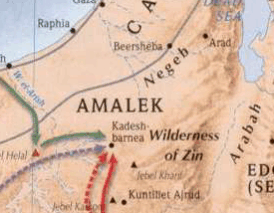
most Bible maps, they will cut over almost due west to Kadesh-barnea. From there, they will send out spies to
examine the land and plan for their first invasion. As the spies are looking over the land, the sons of Israel
advance to Hormah and beyond. However, the report of the spies will frighten the people, and they will refuse to
go into the land, to take it. Then, after they realize that they have screwed up and that God will discipline them
for it, they go up to invade the land, apart form Yehowah, and they are repulsed and pushed back to Hormah.
They stop and spend thirty-seven silent years in Kadesh-barnea [where perhaps they had left their women and
children prior to the invasion?]. After most of the Exodus generation has died out, they travel east and then south,
to where the Gulf of Aqaba began in those days (which I believe was much farther north than it is today). They
had hoped to go north on the King's Highway, but the Edomites would not give them passage. There are two
routes which they may have taken from here. I believe that they went west again, came up on the west side of
Edom, and cut across just south of the Salt Sea. However, it is possible that they moved due east or due south,
got out of the border of Edom that direction, and then proceeded north up along the east side of Edom's borders.
They traveled outside the east border of Moab, cut across between Moab and Ammon, and got into an altercation
with the Amorites who had recently taken a large chunk of alnd away from Moab (this is the land east and
northeast of the Salt Sea). Then Israel got into an altercation with Og, the king of Bashan, and they conquered
the land directly north of the Amorites and took a rather large chunk of land in that invasion. At the end of
Numbers, they will stand perched, across the Jordan River from Jericho, from where Moses will deliver his famous
Deuteronomic [pronounced DOO-ter-uh-NOME-ik] messages to the new generation of Israelites (the book of
Deuteronomy) who are soon to invade the land of Canaan to take it (the book of Joshua)
.
In this book of Numbers, we will spend more time traveling through the Sinai Peninsula and through the various
deserts than we do anywhere else in the Pentateuch. I think that it is important to note that the promised land
today is under discipline from God. It is filled with wars and racial and religious strife and intense violence. To
look at pictures of Palestine, one does not see a land flowing with milk and honey, but rather a lot of desert area
interspersed with some patches of green and disputations. A little water can transform any area, as can the lack
of water (Los Angeles is a prime example of what a little influx of water can do to a desert region). At least during
the time of the exodus and the early settling of the promised land, there was a lot more rain and a much great
agricultural prosperity than we see today. In fact, I believe that the rain was much more pleantiful for perhaps a
time period of close to two thousand years. Areas which have water in them only during the rainy season probably
had flowing water in them throughout the year. When Abraham and Moses looked out onto the promised land,
they saw a land which was lush, and green and inviting, with great agricultural prosperity, unlike it is today. The
gulf of Aqaba probably extended at least another 60 miles north, with water flowing between the Salt Sea and the
Gulf of Aqaba, at least during the rainy season, if not year round. When I first studied the Pentateuch, instead
of the standard translation, the wilderness of Sinai or the wilderness of Zin, I instead rendered it the desert of Sinai
and the desert of Zin. However, my studies have caused me to conclude that this was not the desert region then
that it is today. The translation wilderness would include some desert regions (obviously a problem at times when
the Jews faced the no-water test), but it also included some areas which were basically uninhabited and
sometimes difficult to transverse.
There are two basic views that I am aware of when it comes to the forty-year wanderings of the sons of Israel.
Most authors and commentaries take the stand that the Jews wandered in the desert for forty years. I personally
believe that they transversed the wilderness, moving toward Sinai and then toward the land of Canaan in a space
of about 2–3 years; then they camped in Kadesh-barnea, because there was no need for them to go anywhere.
They were not going into the land. God had begun to kill off large numbers of the exodus generation. They had
to deal with the deaths of two million people over a period of thirty-seven years. This would preclude a lot of travel
because (1) they had no reason to travel anywhere; (2) they had no place to travel to; and (3) they were constantly
busy with the rituals of coming into contact with dead people (cleansing from contact with dead people, although
it does not play a prominent part in the book of Numbers, it is still given more time than one would think under
normal circumstances). And, finally, (4) the Israelites did not just wander the desert. Now on the day that the
tabernacle was erected the cloud covered the tabernacle, the tent of the testimony, and in the evening it was like
the appearance of fire over the tabracnle, until morning. So it was continuously: the cloud would cover it, and the
appearance of fire by night. And whenever the cloud was lifted from over the tent, afterward, the sons of Israel
would then set out; and in the pace where the cloud settled down, there the sons of Israel would camp. At the
mouth of Yehowah the sons of Israel would set out, and at the mouth of Yehowah, they would camp; as long as
the cloud settled over the tabernacle, the remained camped. Even when the cloud lingered over the tabernacle
for many days, the sons of Israel would keep Yehowah's charge and not set out (Num. 9:15–19). Do you follow
this? The children of Israel did not wander aimlessly. There is no indication of that anywhere in Scripture. This
passage, along with Ex. 13:21–22 and 40:34–38, tell us that God guided them every step of the way. At Kadesh-barnea, after their terrible failure, they had no place to go. God had no reason to lead them anywhere.
"Therefore, I was disgusted with this generation. And said, "They continually went astray in their thinking [lit.,
heart]; and they did not know My ways. As I swore in My wrath, they will not enter My rest." (Heb. 3:10–11
Psalm 95:10–11). What do you think is going to happen? Moses is going to get wanderlust and get up some
morning and say, "Let's go for a forced march out into the desert." Do you think the sons of Israel will leave an
area of their basic necessities and go back into the wilderness? Do you think that God is going to lift the cloud
from above the tabernacle and commence to lead these sons of Israel on a wild goose chase, so to speak?
Yehowah suddenly says, "I'm bored with us just being here, let's go wander aimlessly until you die." Many of this
generation died en route to Kadesh-barnea and many of them will die when they go to enter the land once again
from the east side between the two seas. However, many of them will simply die uncermonious deaths out there
in the wilderness area of Kadesh-barnea. There is at least parital agreement with this viewpoint by David W. Kerr,
Th.M., who wrote the introduction to the book of Numbers. He wrote While these are sually described as eyars
of wandering, it is fairly clear that th epeople lived south of Canaan proper, partly in the area known as the Negev,
not far from Kadesh Barnea, for about thirty-seven years. During this time the tabernacle was the foacl point of
civil as well as religious life, since it was here that Moses carried out his administrative duties. It may be assumed
that the people followed the domestic pursuits of nomads, living in tents, pasturing flocks in the semi-arid steppes.
This circumstances required special divine provisions of food and water
.
One quite interesting note, however, is that I cannot recall anything being said about the disposal of the bodies
of their dead or rituals concerning burials and memorials. They came out of Egypt where the preservation of some
of their dead bordered on fanaticism, however this topic is not even covered in the books of Numbers and
Leviticus. My personal thought here is that they kept a large fire burning outside the camp and basically dumped
the bodies onto this fire. This may seem rather callous to you, but we have an average of approximately 150
people dying every single day. That is a lot of dead people to bury and that requires a lot of room for burial plots
(and, as I mentioned, burial is never discussed in these books).
The Census: One of the greatest contemporary objections to the book of Numbers is the census. The book of
Numbers is uncompromisingly consistent in this regard, but many object to this because how could two million
people wander in the desert for forty years and live? (6) The Israelites did not wander throughout the desert for
forty years; they traveled in the desert for a period of a year and a half, and then another half a year, (roughtly).
They cooled their heels in Kadesh-barnea for most of those forty years. (7) The climatic conditions of that area
were more favorable at that time toward a large, nomatic group. (8) Too many of us picture the water coming from
the rock, an incident which took place in Exodus and was repeated for the second generation in the book of
Numbers, to look like maybe a hose was in the middle of the rock. This idea is based upon pictures that we have
seen in children's Bible stories. Obviously, two million thirsty people and their cattle cannot get enough water from
a garden hose. Try standing at a water fountain behind two hundred people and see how fast your thirst is
assauged. Much worst to be standing behind two million people. The first we can comprehend; the large number
of the second makes this totally incomprehensible. However, this was not a garden hose-sized stream of water;
Psalm 78:20 105:41 both indicate that quite a river was almost an immediate result of this miracle. (9) It was
clearly miraculous for such a large group to be fed and clothed during this time in the wilderness. Our God is a
God of the miraculous. Many of the miracles pertaining to the preservation of these people are not even recorded
in Scripture, and others are alluded to very briefly (e.g., Moses said to the second generation: "And I have led you
forty years in the wilderness; your clothes have not worn out on you, and your sandal has not worn out on your
foot."—Deut. 29:5). For these two generations of Jews, miracles were almost commonplace. They had no excuse
for their unbelief.
For these reasons, you may read of many authors hedging on the numbers in Numbers; and some make some
very good arguments, reducing the population of Israel to a hundred thousand or two, as opposed to two million.
But ultimately, we have a problem that their numbers do not add up; they are not consistent. And such an
increase in population from a group of seventy in Egypt would have not only not been noteworthy (as recorded
in Ex. 1:7, 20), but, if anything, would indicate moderate growth at best.
Final Comments: Numbers, like much of the Old Testament, has been all but ignored in our day of apostasy;
however, this is a great book which demands our attention, earns our interest and gives us invaluable historical
data on the people of Israel.
Outline of Chapter 1:
vv. 1–3 The command by God for Moses to take a census
vv. 4–17 The heads of the tribes to assist with the census
vv. 18–46 The census is taken
vv. 47–54 The responsibilities of the Levites
Charts, Maps and Short Doctrines:
Introduction: In Num. 1 we have the first of two censuses taken in this book of Numbers, so aptly titled. The
original plan was for Israel to immediately go into the land and conquer it. However, they will fail a major test at
Kadesh Barnea and God will cause them to cool their heels in the desert for an additional forty years until the
generation that God loathed dies out.
The Command by God for Moses to Take a Census
And Yahweh spoke to Moses in the desert of Sinai, in the tent of meeting, on the first of the
second month, in the second year of their going out of the land of Egypt, saying, [Num. 1:1]
Moses has been careful to give us a place and date in order to fix this point in history. He was a methodical
person in this way. We were able to determine to the month when the book of Leviticus was written. According
to Num. 33:38, the scope of this book is 38–39 years. This is thirteen months after Israel began her exodus from
Egypt and Aaron will die on the first day of the fifth month in the fortieth year. That makes this book 38 years and
four months in its duration between Num. 1:1 and 33:38. Since the book of Deuteronomy begins on the first day
of the eleventh month of the fortieth year, Numbers spans 38 years and 9 months. During this time we will see
this evil generation struck down by God.
The NIV points out that dating the time of their wanderings using the anchor of the Exodus is very similar to the
Christian quoting dates as being a.d. or b.c. (before or after the year of our Lord). Our Lord's death is the great
act of deliverance of our souls, just as the deaths of the first born of the sons of Egypt marked the great act of
deliverance of Israel from Egypt.
Here, the Jews had packed up and began to wander through the desert. They had been at the foot of the Sinai
mountains, which they had walked along. This was their second time to break a semi-permanent camp. After
escaping the Egyptians, they had been traveling through the desert of Sinai and they parked themselves in front
of Mount Sinai while Moses received the beginning of the Law from Yahweh (Ex. 19:1–2). They broke camp after
the golden calf incident (Ex. 32) and moved along the mountains of Sinai (Ex. 33:1–6). However, they remained
near to these mountains (Lev. 27:34).
"Take a census [lit. head] [or, take a head count] of all the congregation of the sons of Israel by
their families, by the house of their fathers, in the number of names—every male by their head by
head. [Num. 1:2]
Take is the masculine singular, Qal imperative of nâsâ’ (א ָ ָנ ) [pronounced naw--SAW], a word with 46 renderings
in the Authorized version, among them: exact, ease, contain, cast, lade, marry, respect, suffer; it means, as we
have seen, to lift, to take, to bear, to carry. Moses bears the primary responsibility, so this verb is in the singular,
even though Aaron will assist him and the twelve to be mentioned will also assist them. What Moses is to take
is a rô’sh (ש אֹר ) [pronounced roshe] and it is from an unused root that means shake, and it generally means head
as the head is easily shaken. The closest we have to this idiom is take a head count. This idiom is reasonable
since the word head has a variety of meanings (e.g., top, chief, front, choicest, leading division). We find a
different word for head, used twice, at the end of this verse.
Moses is about to go into battle with the surrounding Gentiles and needs to know his strength.
"From a son of twenty years and upward, every one going out [to] war in Israel, you will number
them by their armies, you and Aaron; [Num. 1:3]
The census is to be taken of all the men able to go to war. The word translated war is tsâbâʾ (א ָב ָצ ) [pronounced
tsawb-VAW], and it can mean army, war, or warfare. It is usually translated hosts in the KJV, which often is sort
of a pansy translation, as you do not realize that we are speaking of war and warfare when you hear the word host.
Most people seem to think that we are speaking of a band of angels carrying harps and singing sweet hymns.
However, the picture is more of a huge army of angels ready to do battle. In this context, we are speaking of all
the sons of Israel who are draft age—who are old enough to go to war. God has clearly given the promised land
to Israel; however, they will have to take it, which includes going to war against the present inhabitants. This
census is not taken for the purposes of siple information or for taxation purposes, but to determine how many men
will be going to war. This is a military census. We will see this phrase another thirteen times throughout this
chapter.
The Heads of the Tribes to Assist with the Census
"And with you there is a man for each tribe, a man he [is] a head to the house of his fathers.
[Num. 1:4]
Moses and Aaron will not personally count each and every person. There will be a man with them from each tribe
of Israel, a head to the house of his fathers. That is, there will be a tribal leader from each of the twelve tribes of
Israel. There is not word for each in this verse, although some translations have the word each occur twice. What
is here twice is the word for man, ‛îysh (שי ̣א ) [pronounced eesh].
"And these [are] the names of the men who stand with you: [Num. 1:5a]
God does not even expect Moses and Aaron to choose the men who would stand for the tribes—God chooses
these men Himself. This way, there is no popularity contest, no one can resent Moses or Aaron because he was
not chosen, and, most importantly, the correct people can be chosen to head up a tribe.
"For Reuben—Elizur [pronounced el-ee-TSOOR], son of Shedeur [pronounced shed-ay-OOR];
[Num. 1:5b]
Ben (ן ∵ ) [pronounced ben] simply means son, a word that we find nearly 5000 times in the Old Testament. What
we have here is essentially our equivalent of a first and last name: Elizur ben Shedeur—the primary difference
being that the father's name is his father's first name. The tribe of Reuben would be on the south saide of the
camp (Num. 2:10). Although Reuben was the eldest of the sons of Jacob, he was called unstable as water—that
is, he would take the form of the container that he was poured into—which means that he did not have the
characterisitics of a leader. He was not the oldest son to whom his brothers could look up to. Therefore, when
offerings were presented by the leaders of the tribes, Elizur ben Shedeur was fourth, not a reflection upon his own
character, but upon that of his father, Reuben. Elizur's name means God of [the] rock; his father's name means
spreader of light. By their names, they both appear to have some doctrine and some divine viewpoint.
However, other than God choosing him for this important position of leadership, he did not distinguish himself in
any way apart from the rest of the heads of Israel and is therefore not mentioned apart from the other tribe
leaders. All five references to him in the book of Numbers are the same standard five references given to the
other eleven.
"For Simeon—Shelumiel [pronounced shel-oo-mee-ALE], son of Zurishaddai [pronounced tsoo-ree-shad-DAH-ee]; [Num. 1:6]
He and his tribe also camped on the south side with the tribe of Reuben (Num. 2:12). He was the fifth to offer
sacrifices to God (Num. 7:36) and also was not distinguished from the other tribal leaders. His name means peace
with God and his father's name means rock of [the] Almighty. In the Apocraphyl book of Judith, his name is listed
as Salamiel, son of Salasadai (Judith 8:1).
"From Judah—Nahshon [pronounced nahk-SHONE], son of Amminadab [pronounced am-mee-naw-DAWB]; [Num. 1:7]
Although the tribes are being given in order of the birth of their fathers, Nahshon ben Amminadab is one of the
pre-emminent of the tribal leaders. Amminadab means people of liberality and Nahshon means enchanter. He
was in the line of David (Ruth 4:20–22 1Chron. 2:10), in the legal line of our Lord (Matt. 1:4) and in the matriarchal
line of our Lord (Luke 3:32). Furthermore, you may note with the pronounciations that we do not have a correct
transliteration here (as well in several other cases). It appears as though the KJV set the standard for the names
and most Bible translations go with it. Nahshon's sister became the wife of Aaron (Ex. 6:23). Due to his position
in the line of Christ and the fact that his father, Judah, did eventually become a person with character, he gave
his offering first of all (Num. 7:12). He is also listed first when his tribe takes a position on the East side in
Num. 2:3. Furthermore, he took the lead when their troops set out (Num. 10:14). It just goes to show that you
can name your children whatever you want, but unless they are well-trained and use their own volition properly,
there is no telling how they will turn out.
"For Issachar—Nethaneel [pronounced neth-an-ALE], son of Zuar [pronounced tsoo-AWR];
[Num. 1:8]
Nethaneel means given of God, and Zuar means small. Although Nethaneel's name occurs several times
throughout the Old Testament, the one spoken of here finds his name only five times, where we would expect it
to be. Nethaneel gave his offering on the second day.
"From Zebulun—Eliab [pronounced el-ee-AWB], the son of Helon [pronounced chay-LONE];
[Num. 1:9]
Eliab means God of [his] father. HIs offering was on the third day.
"From the sons of Joseph: from Ephraim—Elishama, the son of Ammihud; from
Manasseh—Gamaliel, the son of Pedahzur; [Num. 1:10]
Elishama [pronounced el-ee-shaw-MAW] means God of Hearing, Ammihud [pronounced am-mee-0HOOD] means
people of splendor, Gamaliel [pronounced gam-lee-ALE] means reward of God, and Pedahzur [pronounced ped-aw-TSOOR] means a rock has ransomed. Elishama shows up in the standard five places of prominence plus one:
we find out in 1Chron. 7:26–7 that he is the father of Nun and the grandfather of Joshua. There are six other
people in the Bible with his name. Gamaliel sounds as though he should have been a man of great spiritual
growth; however, he is found in the typical five places (Num. 1:10 2:20 7:54, 59 10:23).
"From Benjamin—Abidan, son of Gideoni; [Num. 1:11]
Abidan [pronounced ab-ee-DAWN] means father of judgement (or, of judge) and Gideoni [pronounced ghid-o-NEE] means warlike. Although Benjamin was the youngest, Abidan made his offering on the nineth day.
"From Dan—Ahiezer, son of Ammishaddai; [Num. 1:12]
Ahiezer [pronounced akh,ee-EH-zer] means brother of help and Ammishaddai [pronounced am-mee-shad-DAH-ee] means people of [the] Almighty. This man, other than being chosen of God, does not indiviudally distinguish
himself.
"From Asher—Pagiel, son of Ocran; [Num. 1:13]
Pagiel [pronounced pag-ee-ALE] means accident of God (for those who thought that birth control and planned
parenting is relatively new) and Ocran [pronounced ak-RAWN] means muddler. With names like these, you want
these guys to come in first; however, Pagiel shows up in the appointed five portions of God's Word.
"From Gad—Eliasaph, son of Denel; [Num. 1:14]
Eliasaph [pronounced el-yaw-SAWF] means God [is] gatherer and Denel [pronounced deh-oo-ALE] means known
of God. He gave his offering on the sixth day (Num. 7:42); but it only goes to show that you can give children all
the advantages in the world (both he and his father have spectacular names), and it means nothing without the
proper training.
"From Naphtali—Ahira, son of Enan; [Num. 1:15]
Ahira [pronounced akh-ee-RAH] means brother of wrong (or, brother [is] evil) and Enan [pronounced ay-NAWN]
means having eyes. Ahira was the last one named and the last to give an offering (Num. 7:78). The sons younger
than he are Joseph and Benjamin, yet he is named last.
"These [are] those summoned [by popular demand] of the company, princes of the ancestral
tribes [or, tribes of their fathers]; they [are] heads of the thousands
of Israel." [Num. 1:16]
There is a word here found only three times in the Old Testament. Qârîy’ (אי ̣ר ָק ) [pronounced kaw-REE] is found
only here and in Num. 16:2 26:9. The corresponding verb is qârâ’ (א ָר ָק ) [pronounced kaw-RAW] which we find
many times throughout the Bible; it means to read, to proclaim, to summon, to call. In order to differentiate this
from the words called, and elected, we will translate the adjective summoned [by popular demand]. It is an organic
process where these are practically self-proclaimed leaders and men of reknown who stand before their tribe and
are popularly affirmed.
Even though I have spoken poorly of these men, it is only in comparison to the others who were also chosen. This
is the Exodus generation, a generation which God spoke of as loathing. Moses will live beyond the time of even
these men, the leaders of their generation; God will strike these men down in the desert along with their brothers
and sons.
And Moses (and Aaron) took these men, who were designated by name; [Num. 1:17]
I placed Aaron's name in parentheses because the verb took is in the masculine singular. Gâqabv (ב ַק ָג )
[pronounced gaw-KAHBV] means pierce, and you may be wondering about this, not seeing this word in this verse.
Gâqabv is in the Niphal (passive) perfect, meaning that they received the action of the verb. We have seen this
verb in Lev. 24:11, 16, when a young man blasphemed (or, pierced) the name of Yahweh (similar usage in
Num. 23:8, 25 Job 3:8 5:3). We will see this word to mean a literal piercing in 2Kings 12:9 18:2. However, here
it refers to someone who has been designated or distinguished or appointed to a position. What I would like to
find, but cannot, is this word used to bore a hole in the ear of a slave which earmarked the slave for lifetime
service. That is a different verb entirely (found only in Ex. 21:6).
The Census Is Taken
And all the congregation they assembled on the first of the second month, and they declared their
births by thir families, by the house of thir fathers, in the number of names from a son of twenty
years and upward, by their polls; [Num. 1:18]
The leaders were all chosen and the men were all assembled all on the same day. Even their leaders did not do
a head count, per se, but they assembled in groups and gave the number of males who were twenty years and
older from each family. The point is that this was done in an organized fashion.
As Yahweh had commanded Moses; and he numbered them in the desert of Sinai. [Num. 1:19]
God gave Moses the command on the first day of the second month and Moses has everything organized and
going on the very same day. Verse 19 summarizes the action and the next 33 verses provide the details. A
similar census was taken of the new generation in Num. 26.
So there were: the people of Reuben, Israel's first born—their births by their families, by the
house of their fathers, its numbered ones in the number of names by their polls, every male from
a son of twenty years and upward, and everyone of draft age [lit., going out to the army].
[Num. 1:20]
Only the males would be numbered here. The word for families is mishpâchâk (ה ָח ָ ׃ש ̣מ ) [pronounced mish-paw-KHAWH] and it means family, clan, class (of people), species (of animals), or sort (of things).
Their numbered ones, for the tribe of Reuben, are 46,500 [lit., six and forty thousand and five
hundred]. [Num. 1:21]
One of the theories which I have been exposed to is that there were fewer people of Israel at this time. The key
is the word ʾleph (ף ∵ל ∵א ) [pronounced EH-lef], which has several meanings. I first of all examined similar words
to make certain that a change in the vowel point would not change to meaning to a similar and also applicable
word. No such changes would have likely occurred without rendering this verse nonsense. This word appears
to be rendered a thousand most of the time, in some places only that rendering would make sense, such as
Ex. 18:21 and 25, which read, in part, leaders of thousands, leaders of hundreds, leaders of fifties, and leaders
of tens (see also Ex. 38:25, 29 1Sam. 29:2). The other meaning is families (however, this is not the same word
as we find used for families in the previous verse), which rendering is not found near as often (BDB gives the
passages Judges 6:15 1Sam. 10:19 Micah 5:2). This same word is translated kine or cattle in Deut. 7:13 28:4,
18, 51; the reference is to the large number of cattle rather than to the animals themselves. In these few
passages where this word could mean something other than a thousand, it could be translated a thousand without
obliterating the meaning. However, there are a significant number of passages where a rendering other than one
thousand would not make sense. Therefore, whereas I have no emotional attatchment to the actualy physical
number of Jews included in this census, meaning it doesn't make any difference to me whether there are 200 or
2,000,000 Israelites, I think that we, purely on linguistic grounds, need to stay with the traditional numbering of
46,500. Furthermore, the context of this verse seems to indicate a head count (recall Num. 2:2: Take a census
of all the congregation of the sons of Israel, by their families, by their fathers' households, according to the number
of names, every male, head by head). The Septuagint offers a slightly different number: 46,400 (for those who
are wondering, the words for four and for five are very different in the Hebrew). Therefore, the rendering one
thousand is supported by the Hebrew, by the context and by the Septuagint.
There are a lot of men who hold to ’eleph not meaning a thousand and most of that is based upon the fact that
this is an incredibly large army; the total population of Israel would have had to have been at least two million,
which is a lot of people to be meandering through the desert. We have already seen that God has provided them
with a bread-like substance, manna; and meat (quail)—which in itself is miraculous, and even more so considering
the large numbers that are being fed. We have examined the growth of the Israelites from 70 to two million and
have shown that it is possible; there would just had to have been large families and a population explosion, which
the Bible alludes to (Ex. 1:7–12). For your own study, the NIV Study Bible gives several possible explanations in
fairness in its introduction to Numbers, but you can tell that the author of Numbers, like myself, still lean toward
the large numbers presented here. Gleason L Archer in the Encyclopedia of Bible Dificulties
also lists some of
the alternate theories and in more detail. He goes into more detail. With those who hold to the alternate theories,
their beginning point is not God's Word, but human logic. They begin with the fact that it is unlikely for two million
people to live in the desert for forty years, a valid objection; and list a variety of reasons; along with the point of
view that for 70 people to become two million in 400 years, that would be a sizable population explosion. From
that standpoint, they rationalize what is found in the Scriptures to fit their viewpoint. I might as well give the
alternate theories. We have looked at the concept that ’eleph could means families, clans, but this linguistically
does not stand, nor is this the way you take a census to determine how many men you have. In determining your
own military strength, you do not settle for one division of 147 families as an accurate census. The other theory
is that ’eleph could be the word ‛allûp, which means chiefs, so that we are listing the number of chiefs and the
number of enlisted men. Our problem here is fivefold: (1) once or twice a mistake like this can be made with the
vowel points, but every single time is not likely; (2) this would put us in disagreement with all the codices; (3) we
would have several instances of too many chiefs and not enough Indians—for instance, Manasseh would have
32 chiefs and 300 Indians; (4) the Israelites are just now being counted in preparation to be mobilized for war—no
one has even begun to think about military training and officer selection; such a view is premature; and, (5) this
interpretation does not jive with all of the other numbers given in the Bible.
For those who wish to read an author
who does hold to one of these theories dogmatically, there is Robert W. Faid's A More Scientific Approach to More
Biblical Mysteries, pp. 71–78; however, it all boils down to all the Biblical evidence lands on the side of the large
numbers and all the human viewpoint lands on the side of smaller numbers.
Some additional points which Gleason brings out: even if you reduce the number of people, 30,000 draft age men
in the desert would die from thirst and hunger as easily as 600,000.
In regard to the sons of Simeon—their births by their families, by the house of their fathers, its
numbered ones in the number of names by their polls, every male from a son of twenty years and
upward, everyone going out to the army— [Num. 1:22]
The second-born was numbered next.
Their numbered ones, in regard to the tribe of Simeon: 59,300. [Num. 1:23]
The Septuagint's number is the same here.
In regard to the sons of Gad—their births by their families, by the house of their fathers, its
numbered ones in the number of names by their polls, every male from a son of twenty years and
upward, everyone going out to the army— [Num. 1:24]
Gad was numbered next.
Their numbered ones, in regard to the tribe of Gad: 45,650. [Num. 1:25]
The Septuagint places Gad much later in this list.
In regard to the sons of Judah—their births by their families, by the house of their fathers, its
numbered ones in the number of names by their polls, every male from a son of twenty years and
upward, everyone going out to the army— [Num. 1:26]
Judah was numbered next.
Their numbered ones, in regard to the tribe of Judah: 74,600. [Num. 1:27]
The Septuagint's number is 74,600.
In regard to the sons of Issachar—their births by their families, by the house of their fathers, its
numbered ones in the number of names by their polls, every male from a son of twenty years and
upward, everyone going out to the army— [Num. 1:28]
The NASB redners this as:Of the sons of Issachar, their genealogical registration by their families, by their father's
households, according to the number of names from twenty years old and upward, whoever was able to go out
to war.
Their numbered ones, in regard to the tribe of Issachar: 54,400. [Num. 1:29]
The Septuagint's number is the same.
In regard to the sons of Zebulun—their births by their families, by the house of their fathers, its
numbered ones in the number of names by their polls, every male from a son of twenty years and
upward, everyone going out to the army— [Num. 1:30]
Zebulun was numbered next.
Their numbered ones, in regard to the tribe of Zebulun: 57,400. [Num. 1:31]
The Septuagint's number is the same.
In regard to the sons of Joseph: in regard to the sons of Ephraim—their births by their families,
by the house of their fathers, its numbered ones in the number of names by their polls, every male
from a son of twenty years and upward, everyone going out to the army— [Num. 1:32]
Note that Joseph's tribe is counted as two. Joseph, due to his great spiritual character, received the double portion
normally affored to Reuben, the firstborn. Furthermore, the tribe of Levi is not included in this census, so the
double portion of Joseph gives us the magic number twelve for the number of tribes.
Their numbered ones, in regard to the tribe of Ephraim: 40,500. [Num. 1:33]
The Septuagint's number is the same.
In regard to the sons of Manasseh—their births by their families, by the house of their fathers, its
numbered ones in the number of names by their polls, every male from a son of twenty years and
upward, everyone going out to the army— [Num. 1:34]
Manasseh was numbered next.
Their numbered ones, in regard to the tribe of Manasseh: 32,200. [Num. 1:35]
The Septuagint's number is the same. Note that together, Joseph's children number 72,500, which is the second
largest family (after Judah) and almost twice the size of some families, such as Benjamin and Reuben.
In regard to the sons of Benjamin—their births by their families, by the house of their fathers, its
numbered ones in the number of names by their polls, every male from a son of twenty years and
upward, everyone going out to the army— [Num. 1:36]
Benjamin was numbered next.
Their numbered ones, in regard to the tribe of Benjamin: 35,400. [Num. 1:37]
The Septuagint's number is the same. It is after this verse that the Septuagint inserts the tribe of Gad.
In regard to the sons of Dan—their births by their families, by the house of their fathers, its
numbered ones in the number of names by their polls, every male from a son of twenty years and
upward, everyone going out to the army— [Num. 1:38]
Dan was numbered next. This also puts us back on track with the Septuagint.
Their numbered ones, in regard to the tribe of Dan: 62,700. [Num. 1:39]
The Septuagint's number is the same.
In regard to the sons of Asher—their births by their families, by the house of their fathers, its
numbered ones in the number of names by their polls, every male from a son of twenty years and
upward, everyone going out to the army— [Num. 1:40]
The tribe of Asher was numbered next.
Their numbered ones, in regard to the tribe of Asher: 41,500. [Num. 1:41]
The Septuagint's number is the same.
In regard to the sons of Naphtali—their births by their families, by the house of their fathers, its
numbered ones in the number of names by their polls, every male from a son of twenty years and
upward, everyone going out to the army— [Num. 1:42]
The tribe of Naphtali was numbered next.
Their numbered ones, in regard to the tribe of Naphtali: 53,400. [Num. 1:43]
The Septuagint's number is the same.
These [are] those numbered, whom Moses numbered—and Aaron, and the princes of Israel,
twelve men, each was for the house of his fathers [Num. 1:44]
This is a testimonial to authority and organization, as we got an accurate census taken of over 600,000 men.
And they are, all those numbers of [lit., all a numbering of] the sons of Israel, by the house of their
fathers, from a son of twenty years and upward, everyone going out to the army in Israel;
[Num. 1:45]
By the numbers given, this tells us that they had a reasonable arithmetic system, not exactly based upon ten digits,
but similar to that; furthermore, it should be obvious that they have rounded these numbers off to the nearest fifty
men.
All those numbered are 603,550. [Num. 1:46]
This is the same number given in the Septuagint. The numbers given in the Massoretic text do add up to 603,550,
whereas the numbers for the Septuagint do not. All of these men, except for Joshua and Caleb, will die in the
desert. The total number of men conscripted for the army is mentioned here, in Num. 2:3–32 and Ex. 12:37, which
reads Now the sons of Israel journeyed from Rameses to Succoth—about 600,000 men on foot aside from
children. A more exact figure is named in Ex. 38:26, a portion of which is evidently an addendum to that passage.
This indicates that every figure throughout these portions of Scripture became corrupted—including the
codices—or that they stand unabashedly as simply a very large number of Israelites. Recall that Yahweh had
made a promise to Abraham that his seed would be as the sand of the sea and the stars of the heavens—and
since Abraham had but one son, God had to take up the slack somewhere.
The Responsibilities of the Levites
But the Levites, for the tribe of their fathers, have not numbered themselves in their midst;
[Num. 1:47]
This is the first place where we will see that God will treat the Levite differently than the other tribes. This was not
the case in the book of Leviticus. The general responsibilities of the Levites will be stated in Num. 3:6: "Bring the
tribe of Levi near and set them before Aaron the priest, that they may serve him."
For Yahweh spoke to Moses, saying, [Num. 1:48]
Just as in the Book of Leviticus, Yahweh speaks directly to Moses. In the book of Numbers, also a neglected book
of the Bible, this particular phrase or one like it occurs over 150 times in 20 different ways. As the NIV Study Bible
says, from Num. 1:1 to the last verse, Num. 36:13, this book is filled with direct quotations from God spoken to
Moses.
"Only the tribe of Levie you will not number, and you will not take their census in Israel [lit., their
heads you will not take up in the midst of the sons of Israel]; [Num. 1:49]
The reason why God is numbering those in Israel, but not numbering the Levites is the Levites will not be involved
in the war other than on a spiritual level. The other sons of Israel were numbered because they will be going to
war against the cancerous heathen in the land.
"And you are to authorize [or, appoint] the Levites over the tabernacle of the testimony, and over
all its articles [or, vessels], and over all that it has; they will bear [or, carry] the tabernacle, and
all its articles [or, vessels], and they serve it; and round about the tabernacle, they encamp.
[Num. 1:50]
As you will recall, the tabernacle was a temporary tent and the articles of furniture were all desgined so that they
could be carried. The Levites were the ones authorized by God to do the moving of the furniture. Their camping
about the tabernacle was to guard it. Since the tables of the Law were kept inside the ark, which was inside the
tabernacle, this structure became known as the tabernacle of the testimony.
The Law was kept in the Ark of the
covenant, and it would be reasonable to assume that Levites were also used to make copies of the Law, as well
as to make copies of other documents and other literature. See the Doctrine of the Levites—not finished yet!
"And in the journeying of the tabernacle, the Levites take it down, and in the encamping of the
tabernacle, the Levites raise it up; and the stranger who is coming near is put to death."
[Num. 1:51]
Here the specific responsibilities of the Levites is given; also, a prohibition of the contact of Gentiles with the
tabernacle. In order to have fellowship with God, you must be born again. There is no relationship with God apart
from being regenerated. In those days, that meant becoming a Jew. However, in this context, the stranger is
anyone who is not a Levite. The Israelites, due to the holiness of God and their own natural depravity, could not
approach the tabernacle except as specified in their sacrifices and offerings.
And the sons of Israel have encamped each by his camp, and each by his standard, by their
armies. [Num. 1:52]
Chânah (ה ָנ ָח ) [pronounced khaw-NAW] properly means to incline; it is used primarily to pitch a tent, to encamp.
This word was used in the past three verses: the Levites were to encamp (Qal imperfect—the Qal is the normal
stem of a verb and the imperfect looks at the action of the verb as unfinished or in progress) about the tabernacle;
the tabernacle itself is pitched (or, setup) (Qal infinitive—the infinitive is similar to our infinitive where the verb is
preceded by to); and the sons of Israel have pitched their tents (Qal perfect—the action is looked upon as one
event or as an event or action having been completed) near their tribe, near the standard, or the flag of their tribe.
And the Levites encamp round about the tabernacle of the testmony and there is no wrath on the
company of the sons of Israel, and the Levites will keep charge [or, will take custody, or will take
the responsibility] of the tabernacle of the testimony. [Num. 1:53]
Encamp is in the Qal imperfect. The Levites camping about the tabernacle are a protection that Yahweh does not
bring His wrath down upon the Israelites. There is a play on words which we do not see in my English renderings;
it could read: and the Levites will guard what is to be guarded; this is the Qal perfect of shâmar (ר ַמ ָש ) [pronounced
shaw-MAHR], which means guard, keep, watch, preserve; and mish'mereth (ת ∵רמ ׃ש ̣מ ) [pronounced mish'MEH-reth] and it refers to something which someone has been given charge of or responsibility for. It is that which is
guarded or taken charge of. God would designate only certain people to be able to have contact with the
tabernacle; everyone else had to only observe.
And the sons of Israel did according to all the Yahweh had commanded Moses; so they have
done. [Num. 1:54]
The word for do is ʿâsâh (ה ָ ָע ) [pronounced ģw-SAWH] which means to do, to make, to construct. It is found twice
in this verse, first in the Qal imperfect, which describes the individual responsibilities involved in obeying God's
Word; and then it is in the Qal perfect which tells us that they had completed God's commands. Recall that they
are only a year plus one month out of the land of Egypt and they have seen many miracles and they have seen
the execution of several people. They Jews can handle obedience over a short term, but in the long haul, their
old sin natures will win out and God will have to strike them down in the desert.
Numbers 2:1–34
Outline of Chapter 2:
Vv. 1–2 Yahweh's command to Moses
Vv. 3–9 The eastern division
Vv. 10–16 The southern division
V. 17 The responsibilities of the Levites
Vv. 18–24 The western division
Vv. 25–31 The northern division
Vv. 32–34 A census summary and the obedience of the Israelites
Charts, Maps and Short Doctrines:
Introduction: Num. 2
Yahweh's Command to Moses
And Yahweh spoke to Moses and to Aaron, saying, [Num. 2:1]
What other book testifies to God speaking to man?
"The sons of Israel will encamp each man [lit. a man] by his standard, with ensigns of the house
of their fathers; they will encamp facing from a distance from round about [or, on every side of]
the tent of meeting. [Num. 2:2]
Facing from a distance from is the prefixed preposition mîn and the preposition/adverb neged (ד ∵ג ∵נ ) [pronounced
NEH-ghed]. Mîn is a preposition which invovles separation and neged means in front of, opposite to, in the sight
of. The Levites were to be close to the tabernacle, thus protecting the other Israelites from God's wrath
(Num. 1:53); so this short word tells us that the Israelites were to face the tabernacle and camped a distance away
from it. We find a similar usage in Gen. 1:16 Deut. 32:52. A more interesting usage of the same combination
can be found in Deut. 28:66 and 2Kings 2:15 (spiritual separation or aloofness is the key in these passages).
Each tribe had a ensign or a banner, different from the other tribes; and each trio of tribes had a standard which
they rallied around. The ensign was carried at the head of each tribe and possibly for each subdivision of a tribe;
the standard was a much larger field sign. We are not told in the Bible what these flags looked like (if they were
flags; however, they were probably more similar to Egyptian standards than our modern flags. Egpytian standards
were made of wood and/or metal and the top was shaped like some sacred entity. Freeman gives us some
various pictures in his books and at the end of a stick there might be a carved bird or an animal, the head of a
Pharaoh or some other symbol.
Jewish tradition, which is not always correct (and rarely has a basis in Bible doctrine) has it that each banner was
the color of whatever stone on the high priest's breastplate represented that particular tribe. I don't particularly
but that nor is it important, as it is not covered in the Bible. There is also a tradition the the standard fo Judah had
the figure of a lion on it; Reuben the figure of a man; Ephraim, the figure of an ox; and Dan, the figure of an eagle
(to correspond with Ezek. 1:10 and Rev. 4:7). This is more reasonable and satisfying than the first tradition, but,
again, has no basis in fact
.
The direction of God in our lives is pervausive. It encompasses every portion of our lives. For a new Christian,
this is frightening, and for those who are unsaved, it might even put you off. However, God's desire for us is the
absolute best and he works in every aspect of our lives. Here he organizes the way that the Israelites will camp.
Up until this time, they have just been traveling as a huge swath of men, women and livestock in a width of several
miles without any sort of real organization. For our God is not God of confusion...let all things be done properly
and in an orderly manner (I Cor. 14:33a, 40b).
The Eastern Division
"And those encamping eastward towards the sun-rising [are] the standard of the camp of Judah,
by their companies [lit., armies]; and the prince of the sons of Judah [is] Nashon, son of
Amminadab; [Num. 2:3]
This chapter will be very much like the portion of the previous chapter which was very repetitious. Yahweh will
position these men around the camp. You would expect the leading division to be Reuben, as he was the first-born, but it is Judah. "Judah, your brothers will praise you; you hand will be on the neck of your enemies; your
father's sons will bow down to you. Judah is a lion's whelp; from the prey, my son, you have gone up. He bows
down, he lies down as a lion; and as a lion, who [dares] wake him up? The scepter will not depart from Judah,
nor the ruler's staff from between his feet until Shiloh comes, and to him will be the obedience of the peoples."
(Jacob speaking to his sons in Gen. 49:8–10). Reuben was the eldest and he should have been in the lead of the
first division. However, when the brothers plotted against Joseph and were about to kill them, Reuben, as the first-born, should have put a stop to it. He meekly offered that they should not kill Joseph rather than take a stand as
a leader (Gen. 37:18–30). The next two oldest, Levi and Simeon, viciously killed every man in a city to avenge
the rape of their sister, whereas there was but two guilty parties, the rapist, and his overindulgent father, Shechem
(Gen. 34). This left Judah, who, although not perfect (Gen. 38:1–24), he could at least admit to being wrong and
he did not continue with his injustice against Tamar (Gen. 38:25–26). What these brothers did, did not determine
the future of their tribe; however, it set up a pattern or precedence for their progeny. I know you are wondering
about the Levites and how we see this pattern in them...fast forward to the time of our Lord and examine the
priests in the gospels—Jesus was persecuted and physically attacked by them on several occasions (Matt. 16:21
Mark 11:27 14:55–56 John 18:19–24). As we have seen, Judah will be the line of Christ.
"And his army, and their numbered ones: 74,600 [lit., four and seventy thousand and six hundred].
[Num. 2:4]
This is the same figure found in Num. 1:27, the population of the men in this tribe who were of draft age.
"And those encamped by him [are] the tribe of Issachar; and the prince of the sons of Issachar
[is] Nethaneel, son of Zuar; [Num. 2:5]
Notice that our order is different than we had in Num. 1.
"And his army, and its numbered ones: 54,400. [Num. 2:6]
God has certain men that He would like to function together as a unit.
"The tribe of Zebulun; and the prince of the sons of Zebulun: Eliab ben Helon; [Num. 2:7]
Notice that the sentence structure is not as repetitive. Judah, Issachar and Zebulun are all sons of Leah.
"And his army, and its numbered ones: 57,400. [Num. 2:8]
So far, all of this is in accord with the Septuagint.
"All those numbered of the camp of Judah: 186,400 [lit., a hundred thousand, and eighty
thousand, and six thousand, and four hundred] by their armies; they journey first. [Num. 2:9]
The wording here makes it even less likely that thousand really means chiefs or clans. Judah will take the lead
in most of the movement and most of the wars. Our Lord will come from the tribe of Judah.
The Southern Division
"The standard of the camp of Reuben: southward; by their companies [lit., armies]; and the prince
of the sons of Reuben: Elizur ben Shedeur; [Num. 2:10]
God has grouped the Israelites into three brigades to make a division.
"And his army, and their numbered ones: 46,500 [lit., six and forty thousand and five hundred].
[Num. 2:11]
This number agrees with chapter 1 and with the Septuagint.
"And those encamped by him: the tribe of Simeon; and the prince of the sons of Simeon:
Shelumiel ben Zurishaddai; [Num. 2:12]
Reuben was the lead brigade on the south side.
"And his army, and its numbered ones: 59,300. [Num. 2:13]
The numbers again check with Num. 1 and the Septuagint.
"The tribe of Gad; and the prince of the sons of Gad: Eliasaph ben Reuel;
[Num. 2:14]
Reuben, Simeon and Gad are grouped together. Reuben and Simeon were sons of Leah and Gad was a son of
her handmaid, Zilpah.
"And his army, and its numbered ones: 45,650. [Num. 2:15]
Again the numbers check.
"All those numbered of the camp of Reuben: 115,450 [lit., a hundred thousand, and one and fifty
thousand, and four hundred and fifty] by their armies; they journey second. [Num. 2:16]
Notice, as has been the pattern, all of those numbered in Reuben, Simeon and Gad are combined and the total
checks, as it should. When the Israelites move out, they will move as three divisions, with Judah's triad in front,
Reuben's triad second, Ephraim's third and Dan's will be in the rear.
The Responsibilities of the Levites
"And the tent of meeting, the camp of the Levites in the midst of the camps as they encamp; so
shall they set out each in position standard by standard. [Num. 2:17]
The book of Numbers begins to give the tribe of Levi, a son of Leah, a place in God's plan. They were to surround
the tabernacle and protect the surrounding troops from being in too close of contact with a holy and just God. We
have become so informal in our thinking about God that some men, seeing our Lord Jesus Christ would go right
up to Him and shake His hand and introduce themselves. Maybe they would say a nice thing about our Lord. We
have lost sight of the fact that we are corrupt in His sight; our sins caused the worst pain and suffering ever known
to man to our Lord; our old sin nature and our personal sins keep us afar from a holy and just God. God is not
some namby pamby, sit out on the lawn with all of us holding hands and smelling flowers. He is the perfect God
of the universe who demands no less than perfection and our sins sentence us to no better than everlasting
torment in separatin from Him. God cannot come into contact with sinful man. The Levites formed a barrier from
God's Presence and the Israelite.
The Western Division
"The standard of the camp of Ephraim by their companies [lit., armies]—westward [lit., on the sea-side]; and the prince of the sons of Ephraim: Elishama ben Ammihud; [Num. 2:18]
When compass directions are given, they are always given in terms of Israel. East is often described as the sun
rising and west is often described as the sea as the Mediteranean Sea is West of Israel. The word found here
is yâm (ם ָי ) [pronounced yawm] and it does not mean west strictly speaking, but sea. We find this word used in
Gen. 1:10, 22, 26, 9:2 as well is a half dozen references to compass direction (Gen. 12:8 13:14 28:14 Ex. 10:19
26:22, 27, etc.). Ex. 10:19 has yâm used twice and translated both sea and west. In fact, until 1Chron. 12:15,
there is no specific word for west in the Hebrew. However, here, the people have not been in the land and its lay
out is unknown to them. This tells us that a great Sea is on their west side for this to make sense to them. West
of them is the Gul of Suez, which they have crossed over. They do not realize that east of them is the Gulf of
Jordan. Now, God is speaking and God is consistent; therefore, He will refer to that which is on the west by using
the word sea. However, this would not have made any sense to the Israelites unless they also had a sea on their
western side at this time. One of the unfortunate things when a translation is made to help clarify what is being
said is that some things are lost. His helps us place the Jews on the map. Tradition has them on the Sinai
Peninsula and this verse is consistent with that.
Ephraim led the division on the West side. Jacob gave precedence to Ephraim over Manasseh (Gen. 48:13–20).
But Israel stretch out his right hand and laid it on the head of Ephraim, who was the younger, and his left hand
on Manasseh's head, crossing his hands, although Manasseh was the first-born...When Joseph saw that his father
laid his right hand on Ephraim's head, it displeased him; and he grasped his father's hand to remove it from
Ephraim's head to Manasseh's head. And Joesph said to his father, "Not so, my father, for this one is the first-born. Place your right hand on his head." But his father refused and said, "I know, my son, I know; he also shall
become a people and he also will be freat. However, his younger brother will be greater than he, and his
descendants will become a multititude of nations." Thus he put Ephraim before Manasseh (Gen. 48:14, 17–19,
20b).
"And his army, and their numbered ones: 40,500 [lit., forty thousand and five hundred].
[Num. 2:19]
If these numbers are incorrect, it is amazing that we do not have hundreds of contradictory manuscripts.
"And by him: the tribe of Manasseh; and the prince of the sons of Manasseh; Gamaliel ben
Pedahzur; [Num. 2:20]
Manasseh and Ephraim were the two sons of Joseph.
"And his army, and its numbered ones: 32,200. [Num. 2:21]
Our numbers check again.
"The tribe of Benjamin; and the prince of the sons of Benjamin: Abidan ben Gideoni; [Num. 2:22]
Jacob was in love with Rachel. He served seven years as a slave, thinking that he was serving this time for her.
So Jacob served seven years for Rachel and they seemed to him but a few days because of his love for her
(Gen. 29:20); one of the most romantic verses of the Bible. His father-in-law to be deceived him and gave him
Rachel's sister instead and they had sex before Jacob realized that she was not Rachel. Jacob served Laban,
his evil father-in-law, for another seven years and took Rachel as his second bride. Rachel produced two sons,
Joseph and Benjamin and Josephj later had two sons, Ephraim and Manasseh. It is Benjamin, Ephraim and
Manasseh who form the third division of the Israelite army.
"And his army, and its numbered ones: 35,400. [Num. 2:23]
God is very careful to inform us of the census figures. There is a reason for that.
"All those numbered of the camp of Ephraim: 108,100 by their armies; they journey third.
[Num. 2:24]
The division is then totaled, not as a check to Moses or Aaron, but as a check for us reading God's Word.
The Northern Division
"The standard of the camp of Dan: northward; by their companies [lit., armies]; and the prince of
the sons of Dan: Ahiezer ben Ammishaddai; [Num. 2:25]
The fourth and final division was led by Dan.
"And his army, and their numbered ones: 62,700. [Num. 2:26]
Dan had one of the larger populations; he was a son of Bilhah, Rachel's maid.
"And those encamped by him: the tribe of Asher; and the prince of the sons of Asher: Pagiel, ben
Ocran; [Num. 2:27]
Asher was one of the two sons of Zilpah, Leah's maid.
"And his army, and its numbered ones: 41,500. [Num. 2:28]
The size of Asher's regiment was about average.
"The tribe of Naphtali; and the prince of the sons of Naphtali; Ahira ben Enan; [Num. 2:29]
Naphtali was the only other son of Bilhah, Rachel's maid.
"And his army, and its numbered ones: 53,400. [Num. 2:30]
|
|
Asher
|
|
Dan
|
|
Naphtali
|
|
|
|
|
|
|
|
Manasseh
|
Levi
|
Issachar
|
|
Levi
|
|
|
|
Levi
|
|
Ephraim
|
|
The
Tabernacle
|
|
Judah
|
|
|
|
|
|
Benjamin
|
|
Levi
|
|
Zebulun
|
|
|
|
Gad
|
|
Reuben
|
|
Simeon
|
|
|
This shows the positioning of the troops around the tabernacleOur numbers check once again.
"All those numbered of the camp
of Dan: 157,600 by their armies;
they journey second. [Num. 2:31]
Again, God provides us with a checking
figure, rubbing our noses in the fact that
there were over 600,000 men in the army of
Israel, and over two million Jews that God
guided through the desert, an extraordinary
miracle.
A Census Summary and the Obedience
of the Israelites
"The are those numbered of the
sons of Israel by the house of
their fathers; all those numberdd
of the camps by their armies:
603,550. [Num. 2:32]
Again, this figure matches the one from Num. 1 and is a sum of the four divisions of Israel's army.
"And the Levites have not numbered themselves in the midst of the sons of Israel, as Yahweh had
commanded Moses. [Num. 2:33]
This tells us that we did not see the entirety of Yahweh's orders to Moses.
"And the sons of Israel did according to all that Yahweh commanded Moses; so they have
encamped by their standards, and so they have journeyed, each by his families by the house of
his fathers. [Num. 2:34]
The Israelites went from total disarray wandering through the desert to a very orderly camp, which is quite
impressive for a group of this size. For all intents and purposes, they have been a mob (witness the golden calf
incident or the murmuring prior to the water coming from the rock). Our armed forces have found out that the first
step in molding a fighting unit out of a bunch of undisciplined, egocentric young men, is to first instill discipline and
orderliness.
You may be wondering throughout this chapter why was this recorded. It is fine that God wanted the sons of Israel
to assemble in a certain way and group together in a certain way, but why the repetitive details? Why number the
four divisions? Why even name the number of men if this has already been done in the previous chapter?
Whereas this is certainly not anyone's favorite passage, it shows us that God has a specific plan for our lives to
which we must adhere for blessing. There are no alternatives and the Christian life is not a seat of the pants
experience. God has a direct will within which we will find our greatest earthly blessing. Often what is emphasized
in teh Christian life is what we cannot do and how much fun we are missing. What is missed is that in following
God's Word, we enter into the greatest earthly life that we can have. God gives us His very best here on earrth
and then gives us even greater blessings in eternity. However, I have strayed fromthe questions which I raised.
What is most important is that we have some checks and balances to the numbers found in Num. 1. God knew
that during our time period, many authors and many Christian men would take issue with the numbers presented
in the first chapter of Numbers. However, we are given even more checks and balances in this chapter. They are
groups by three's and those populations are summed; then the final summation comes at the end. Furthermore,
we will have a census of the next generation and it will be reasonable, considering the numbers that we have here.
God is telling us that he has done the impossible. He has fed and protected and guided over two million people
in the desert between Egypt and Israel, a miracle which is as great as those which accompanied the exodus from
Egypt. God knew there would be skepticism so he just rubbed it in verse after verse. Each verse has more men
than human viewpoint scholars would like to see, but these people were sustained in the desert beause God is
able. We have an analogous situation in the first chapter of Genesis. So there is no confusion as to the time
period alluded to, over and over in Genesis we have a literal 24-hour day presented repetitively in language that
can only be understood to mean six literal days. Those who hold to the day--age theory skim that chapter lightly,
as those who hold to the various theories concerning a small population here skim the verses lightly.
Numbers 3:1–51
Outline of Chapter 3:
Vv. 1–4 The Aaronic priesthood
Vv. 5–10 Yahweh sets aside the Levites to serve Aaron and his sons
Vv. 11–13 The Levites will replace the first-born as dedicated to Yahweh
Vv. 14–39 Census of the Levites and duties assigned to the Levites
Vv. 40–51 Redemption of the first-born
Charts, Maps and Short Doctrines:
Introduction: Num. 3 covers the Levite tribe, their genealogy and their background.
The Aaronic Priesthood
And this is the genealogy of [lit., these are the generations of] Aaron and Moses in the day of
Yahweh's speaking with Moses near mount Sinai: [Num. 3:1]
Tôwledâh (ה ָד ׃ל ) [pronounced to-L'DAWH] means generations and usually refers to the account of a man and
his descendants (as BDB puts it). The writer is not the person at the top of the list, but he is often either at the
end of the list or he is the second to the last. In the book of Genesis, the author generally began with a far
ancestor and worked his way down to himself. Genealogy is a good modern translation (Young uses the word
births). We are used to seeing the emphasis upon Moses and when Moses and Aaron are named in Scripture,
Moses comes first. However, in v. 2, we will examine the line of Aaron, so he takes precedence in this verse.
This is a title of sorts, one which we have seen repeated several times throughout the book of Genesis. What this
often connoted was there was a new author and he was about to cover his own genealogical information which
would end with himself or with his sons.
And these [are] the names of the sons of Aaron: the firs-born [was] Nadab, and Abihu, Eleazar and
Ithamar; [Num. 3:2]
You will notice that for the past book plus two chapters, we have been reading one long extended quote from God
to Moses or to the people of Israel. It was certainly given over various points in time for the past several weeks
and now Moses records some personal information. This begins in this verse and continues in v. 17.
These
[are] the names of the sons of Aaron, the anointed priests, whom he ordained as priests
[lit., whose hand he has filled to function as a priest]. [Num. 3:3]
When one receives a responsibility or is ordained into an office, this is spoken of as filling one's hand. The last
word is the verb cognate for the noun priest; we have no easy way to translate this word except to perform the
duties of a priest, to function as a priest, to perform priestly functions. Just bear in mind that is one word.
And Nadab died—Abihu also [lit., and Abihu]—before the face of Yahweh, in their approaching
with strange fire before Yahweh, in the desert of Sinai, and sons they had not; and
Eleazar—Ithamar also—acts as priest before the face of Aaron, their father. [Num. 3:4]
Moses has written an awful lot of material and realizing that one may just pick up this portion of God's Word in the
middle and begin reading, Moses gives a brief history of what happened to the first two sons of Aaron
(Lev. 10:1–2).
Yahweh Sets Aside the Levites to Serve Aaron and His Sons
And Yahweh spoke to Moses, saying, [Num. 3:5]
Unlike before, this will be a relatively short quotation.
"Cause the tribe of Levi to approach and cause it to stand before Aaron, the priest, and they will
serve him. [Num. 3:6]
Aaron only had two sons and there was far too much to do with the sacrifices to think about doing anything else.
They did not have the time to move the articles of furniture and the rest of the tabernacle. Therefore, God will
assign certain responsibilities to the Levites. There is a great many things about the Levite tribe in this book and
this book ought to have been named Leviticus.
"And they will guard his commission and [the] commission of the whole congregation before the
face of the tent of meeting to serve [or, work] the labor of the tabernacle. [Num. 3:7]
We have a pair of cognates here; they will guard his guarding, and to serve the service or to work the work of the
tabernacle is what is actually said in the Hebrew. All of Israel had a responsibility before Yahweh—they may not
have known the full extent of it quite yet, but they did have spiritual responsibilities as well as the sons of Aaron
had specific spiritual responsibilitities and the Levites were to assist in these. These will be specified:
"And they will take responsiblitiy for [lit., keep or guard] all the furniture [lit., vessels] of the tent
of meeting, and the responsibility [or, charge] of the sons of Israel to labor in the labor of the
tabernacle. [Num. 3:8]
Again we have a general and a more general responsibility: they are to take charge or take responsibility of the
furniture of the tabernacle. That is, it will need to be cleaned, moved, repaired, etc., and they are to see to those
responsibilities. In doing so, they will be doing the work of the tabernacle.
"And you will give the Levites to Aaron and to his sons; in their being given, they are given to
him.
[Num. 3:9]
We have a repetition of the verb for give, set, place both times in the masculine plural, Qal passive participle. The
Qal is the common stem; the passive voice means that God places them before Aaron or gives them to Aaron.
They repetition of the verb means that this is a solemn gift of great importance. "And observe that I, even I have
taken your brothers the Levites from among the sons of Israel; they are a gift to you, given to Yahweh, to perform
the service for the tent of meeting." (Num. 18:6). We will see more spiritual responsibilities dropped into the lap
of the Levites in Numbers 4 and Deut. 17 and 31. In Deut. 31, we will review the responsibilities of the Levites.
You may be wondering why did God choose the Levites; why not the tribe of Judah or Issachar? Ex. 32:25–29
reads: Now when Moses saw that the people were out of control—for Aaron had let them got out of control to be
a derision among their enemies; then Moses stood in the gate of the camp and said, "Whoever is for Yahweh, to
me!" And all the sons of Levi gathered together to him. and he said to them, "Thus says Yahweh, the God of
Israel, 'Every man put his sword upon his thigh and go back and forth from gate to gate in the camp and kill every
man his brother, and every man his friend and every man his neighbor.' " So the sons of Levi did as Moses
instructed and about 3000 men fell that day. Then Moses said, "Dedicate yourselves today to Yahweh—for every
man has been against his son and against his brother—in order that He may bestow a blessing upon you today."
"And you have appointed Aaron and his sons and they have taken the responsibility of their
priesthood; and to the stranger who approaches, he will be executed." [Num. 3:10]
There is a play on words which I do not entirely get. It is this very difficult verb pâqad (ד ַק ָ ) [pronounced paw-KAHD]. This is the verb used for taking a census and ggenerally translated numbered. However, this is also the
verb often translated appoint, visit, punish; and these are all meanings from the Qal stem. The Levites did not
have to be numbered as they served Aaron and his sons, who had been numbered [appointed] by Moses. As I
said, it is there in the Hebrew, but I don't quite grasp precisely what is being said.
As for the execution of the stranger; this is not just for the non-Jew. No one but the priest could come into the
temple. Being able to come to God is an act of mercy. However, there were strict rules and regulations set up
in order to present God's holiness and righteousness and ceremonies which clearly revealed the gospel of Jesus
Christ to anyone who was positive toward God at God-conciousness. Those who feel that God is their best friend
or that He overlooks their shortcomings out of love is confused as to Who and What God is. Just as the Jews
could not approach God directly, neither can we. Our approach to Godis done only in the power of the Holy Spirit
through our Lord Jesus Christ. There is no worship in whatever way you feel is correct and God will bless your
sincerity—it was God's way or no way at all, and His policy has not changed.
This remained God's policy even beyond the need for the tabernacle (which became a temple). Only the priests
could enter into the Holy Place and only the High Priest, once a year, was allowed into the Holy of Holies. None
of the disciples went into the sanctuary, nor did our Lord (although He would have been qualified). When our Lord
taught in the temple, this would be the temple enclosure. As The Amplified Bible points out, the Greek word used
is always the outer area (hieron) and never the sanctuary (naos). Our Lord, at His death, entered into the true
Holy of Holies, the throne room and Presence of God.
There is one time in God's Word where a king attempted to enter into the Holy Place; King Uzziah attempted to
go into the sanctuary in order to burn incense to God. Eighty priests forced him out and he became a leper for
this transgression (I1Chron. 26:16–21).
The Levites were to surround the tent of meeting. They were the only one authorized in the service to the
tabernacle. Only the priests could go into the tabernacle. There was to be absolutely no contact between the
sons of Israel and any part of the tabernacle or its furniture. They could at best come into the courtyard and
observe what was being done. What a marvelous picture of our salvation. All the work was done by Aaron, his
sons and the Levites—just as all of our salvation was provided for us by God the Son. Everything for our lives on
earth have been provided for us by God the Father, God the Son and God the Holy Spirit. They have given to us
a whole host of angels as guardian angels, our wall of fire, a protection that is about every single one of us. The
Israelites could bring a lamb or a goat without spot and without blemish, as we come to God in Christ. Then the
Jew could at best, just observe as this aimal is slaughtered before him. Again, the incredible shadow presented
here. It was the Jews, the corrupt, unregenerate Judas, along with the chief priests and the elders of the people
(Matt. 26:47b), who came and seized our Lord and brought him before the various courts to be tried and executed.
Aaron, who is in charge, is analogous to God the Father; he is the spiritual head of the tent of meeting. One of
his two sons kills the sacrifice, putting his hand on its head and identifying with it—analogous to our Lord Jesus
Christ. The second son is there doing work which we do not see—analogous to God the Holy Spirit. The Levites,
a great number of people, were responsible themselves for taking care of a great many things which we do not
see—analogous to the ministering angels given us by God. The Jews who day after day bring forward the
sacrifices represent both the sinner coming to God with nothing but the sacrifice of our Lord in his hand; and also
representative of the unregenerate Jews who seized our Lord and brought him to be crucified.
The Levites Will Replace the First-Born as Dedicated to Yahweh
And Yahweh spoke to Moses, saying, [Num. 3:11]
Again, God speaks to Moses.
"Observe, I, even I have taken the Levites from the midst of the sons of Israel instead of every
first-born opening a womb among the sons of Israel, and the Levites have been mine. [Num. 3:12]
Prior to this, the first-born had been set apart to God: "Set aside to Me every first-born, the first offspring of every
womb among the sons of Israel, both of man and beast; it belongs to Me." (Ex. 13:2). This is because God struck
down every first-born of Egypt. This was a substitution; God paid for every first-born of Israel with the death of
the first-born of Egypt. See also Ex. 11:4–5 12:21–29 13:11–16. The substitution of one for another is a major
theme in Old Testament Scripture.
Those who will serve as ministering saints to God are the Levites, taken from among the Jews. Recall that
previously, the Jews were a disorganized mob which God had recently organized and from out of this disorganized
mob, He pulled out the Levites to serve Him, as the believers are taken out of this world. We are in a mob which
we are taken out of by God. This is the mob of the unregenerates in the world and we are thoroughly mixed in
with them, insofar as the world sees. In fact, many believers lives do not even begin to reveal a separation.
However, we are pulled out to serve our Lord, rather than those who would be the pre-emminent, the first-born.
We are all a family, brothers, as the family of the Levites—called to serve God.
"For every first-born is mine. In the day of My striking every first-born in the land of Egypt, I have
sanctified to Myself every first-born in Israel, from man to beast; they are Mine; I [am] Yahweh."
[Num. 3:13]
Jesus Christ, when He slaughtered the first-born of the Egyptians, in this sacrifice, He set aside the first-born of
Israel for Himself. You are not your own, for you have been bought with a price; therefore, glorify God in your body
(I Cor. 6:19b–20). God has paid a fair price for each of the first born of the Israelites—a first-born for a first-born.
When our Lord died for our sins, His death was far more painful than we could ever imagine as He took upon
Himself the sins of all of us from Adam down to the last sinner in the millennium. See the Doctrine of the
Firstborn.
The complete Doctrine of the Firstborn can be found elsewhere, this is the abbreviated version.
|
The Abbreviated Doctrine of the Firstborn
|
1. Two of the related Hebrew words are:
a. In the Hebrew, the word firstborn is bekôwr (בְּכוֹר) [pronounced beKOHR]. Metaphorically, this word is
used for anything which is chief or first of its kind Strong’s #1060 BDB #114.
b. The feminine noun is bekôwrâh (בְּכוֹרָה) [pronounced bekoh-RAW], which means rights and
responsibilities of the firstborn, privileges of the firstborn, birthright [of the firstborn]; primogeniture.
By virtue of being born first, each firstborn has certain rights and privileges which are bestowed upon
him. We have several instances in the Bible where this is taken away. There was never, by God’s
Law, a set of definite rights and responsibilities which belonged to the firstborn. That was a matter of
tradition and culture, but not Law. See Gen. 29:26. Strong’s #1062 BDB #114.
2. The related Greek words:
a. The noun/adjective prôtotokos (πρωτοτόκος) [pronounced proh-tot-OK-oss], which means firstborn
[of man or animals]; the beginning [first] [of a new series]. Used as an adjective only in Luke 2:7;
elsewhere as a noun. Strong’s #4416.
b. The neuter noun: prôtotokia (πρωτοτόκια) [pronounced proh-toht-OHK-ee-ah], which means birthright,
right [or privilege] of primogeniture, the right or advantages of the firstborn son. This references the
religious leadership of a family (the firstborn belongs to God); and the double-portion of the father’s
wealth went to him. Strong’s #4415.
3. Webster gives us two sets of definitions for first-born, which is important in order to interpret the next point:
a. First brought forth; first in the order of nativity; eldest; as the first-born son.
b. Most excellent; most distinguished or exalted. Christ is called the first-born of every creature.1
4. It is very important in the Bible, the first time a word is used. This sort of sets the tone and/or the
parameters for this word.
a. When the first man born to a woman occurs in Scripture, he is named Abel but he is not called Adam
and Eve’s firstborn. We associate this term with the firstborn of Abel’s flock which he brings to God
to be sacrificed, a sacrifice which God respects (which sacrifice speaks of Jesus Christ). Gen. 4:4
b. The first time firstborn is used in the New Testament (Luke 2:7), it also refers to Jesus Christ (the only
use of that term in the gospels).
5. It is in Gen. 25 where we have our first indication that being the firstborn carries with it some privileges.
This is the chapter where Esau, the firstborn, and Jacob interact with Isaac, their very old and mostly blind
father. Jacob is after the blessing of the firstborn. As we go over the sub-points, bear in mind that the
Mosaic Law is not been spoken yet and what we are examining here is more tradition than anything else.
a. Esau and Isaac were twins, with Esau being delivered first. Isaac came out next, holding onto the heel
of Esau. God spoke to Rebekah concerning these two, saying that they would become two nations
who would struggle against one another and that the older would eventually serve the younger
(Gen. 25:22–26).
b. Unfortunately, both Isaac and Rebekah developed favorites—Isaac preferred his firstborn, Esau, the
hunter; and Rebekah preferred Jacob, who apparently learned to cook (Gen. 25:27–29).
c. When Esau came in from the field, he was starving—hungry to the point of great weakness. Jacob
had made a stew. When Esau asked for some, Jacob made Esau give up his birthright for a bowl of
stew. Esau’s rationalization is that he was so hungry, he was about to die and what good is a birthright
after death? Just exactly what this birthright entailed is not told to us. We also do not know who was
later told about the exchange of the birthright. It is never disclosed whether this was simply between
Esau and Jacob, or whether Jacob informed his parents of this information; however, it is implied that
this was known in their family in Gen. 27:36. Gen. 25:29–34
d. In Gen. 27, Jacob steals the blessing of his father to Esau. He pretends to be Esau (at the urging and
help of his mother), and receives the blessing from Isaac that was meant for Esau. This is not
necessarily related to one being firstborn or not. Isaac simply, prior to his death, was going to bless
Esau, but blessed Jacob instead. Jacob, when masquerading as his brother, identified himself several
times to his father as his firstborn.
6. Jacob also blesses his own sons, referring to Reuben as his firstborn. Then he tells Reuben that he is
spineless. Reuben lacked character and judgment. When he comes to Judah, Jacob says that his
brothers would praise him and bow down to him, meaning that the descendants of his brothers would bow
down and praise his Descendant. Actually, this has a double-fulfillment: it is fulfilled in the royal line which
extends David to the last king of Judah; and this is fulfilled in our Lord as well, Whose humanity is in the
line of Judah (Luke 3:23–33). What had happened was that Reuben, due to his lack of leadership,
particularly with regards to the brothers’ treatment of Joseph, lost his birthright. He lost the leadership
aspect of his birthright to Judah and the double portion to Joseph. We will touch on this in 1Chron. 5:1–2,
where the passage is properly exegeted (we will examine this probably after the book of Ruth).
7. Although, traditionally, the firstborn was seen as the primary continuation of the line of the father, and often
due more blessing and inheritance, God blessed men based upon their regeneration and cursed men if
they were negative toward Him. Gen. 41:51 49:3–4 1Chron. 5:1–2
8. The Levites were taken as God’s firstborn, instead of the firstborn from every family, as a tribe dedicated
to Him. Num. 3:12, 45, 50 The close association with the number of Levites as compared to the number
of firstborn was to indication (1) that redemption was involved in setting apart the firstborn; (2) setting apart
the Levites as firstborn was analogous to God setting apart Jesus as His firstborn; and (3) the redemption
had to be exactly the right amount. Jesus could not just go and suffer on the cross for awhile, and that
would do the trick; He had to pay for the sins of all mankind. Redemption, by the way, means payment.
This redemption was continued so that all of the firstborn had to be redeemed. Num. 18:15 Again, the idea
was to connect redemption with the firstborn with a specific amount (a specific redemption amount).
9. The Passover: The final judgment against Egypt was to kill their firstborn. This was a type of Christ.
Ex. 11–12 Num. 8:16–18 9 Deut. 16:1–6 Psalm 105:36 135:8 136:10 (which passage associates God’s
love with striking them down) 1Cor. 5:7 Heb. 11:28
a. God calls Israel His firstborn in Ex. 4:22. The implication is that there could be another born of God.
However, God used it in this way: Pharaoh was to let God’s firstborn go or He would kill Pharaoh’s
firstborn (Ex. 4:23).
b. God has Moses threaten the Pharaoh with this in Ex. 11:4–6.
c. Death of the firstborn is a type of Christ, as Christ is the Firstborn of God. 1Cor. 5:7 Heb. 1:6
d. Prior to the carrying out of this curse, God instructs Moses in the Passover. All of Israel is to, by
household, slaughter a lamb. What God says is chilling: “The whole assembly of the congregation of
Israel is to kill it at twilight.” (Ex. 12:6b). The blood of the lamb is then smeared on both sides and at
the top of the door frame (Ex. 12:7, 22). That believers were passed over because of the blood about
their door (matching the blood on our Lord’s hands, head and feet), is a picture of God not judging us
because He has judged His Firstborn in our stead. When God saw the blood of the Passover at the
entrance of the house, God would not go into the house and kill the firstborn (Ex. 12:13, 23). Then
they were to roast the lamb with fire without removing any part of it, and then to eat the lamb
(Ex. 12:7–11). Fire speaks of God’s judgment, which is put upon His Lamb rather than upon mankind,
who deserves death.
e. Easton tells us about the Egyptian Pharaoh who was probably the one whose firstborn died during this
time: Menephtah is probably the Pharaoh whose first-born was slain. His son did not succeed or
survive his father, but died early. The son's tomb has been found at Thebes unfinished, showing it was
needed earlier than was expected. Some of the records on the tomb are as follows: “The son whom
Menephtah loves; who draws towards him his father's heart, the singer, the prince of archers, who
governed Egypt on behalf of his father. Dead.” 2
10. Jesus Christ is called the firstborn in Psalm 89:27.
11. Jesus is called the firstborn in the New Testament:
a. The first occasion, already mentioned, is Luke 2:7.
b. Paul associates Christ as the firstborn of many brothers with election. For those whom He foreknew
He also predestined to be conformed to the image of His Son, in order that He might be the firstborn
among many brothers. And those whom He predestined He also called, and those whom He called
He also justified, and those whom He justified He also glorified (Rom. 8:29–30).
c. Jesus is called the firstborn of all creation in Col. 1:15–16: He is the image of the invisible God, the
firstborn of all creation. For by Him all things were created, in heaven and on earth, visible and
invisible, whether thrones or dominions or rulers or authorities--all things were created through Him
and for Him.
d. He is also called the firstborn from the dead in Col. 1:18–20: And He is the head of the body, the
church. He is the beginning, the firstborn from the dead, that in everything he might be preeminent.
For in Him all the fullness of God was pleased to dwell, and through Him to reconcile to himself all
things, whether on earth or in heaven, making peace by the blood of His cross. He has this same title
in Rev. 1:5
e. Heb. 1:5–6: For to which of the angels did God ever say, "You are my Son, today I have begotten
you"? Or again, "I will be to him a father, and He shall be to Me a son"? And again, when He brings
the firstborn into the world, He says, "Let all God's angels worship Him." (Psalm 2:7 2Sam. 7:14
Deut. 32:43 LXX?).
f. We should glean two things from these references: Jesus is not actually born or created, but He is
preeminent among all that which has been created. Secondly, His title Firstborn is also to tie Him to
the Passover event, where the death of the firstborn, redemption, the blood of the Lamb and the
passing over all those under His blood are all gathered together as a type, for which Jesus is the
antitype.
|
Again, this is the abbreviated version of this doctrine.
|
1 Noah Webster's 1828 Dictionary of American English from e-sword; topic: first-born.
2 M.G. Easton M.A., D.D., Illustrated Bible Dictionary; 1897; from e-Sword, topic: first-born.
|
Census of the Levites and Duties Assigned to the Levites
And Yahweh spoke to Moses in the desert of Sinai, saying, [Num. 3:14]
God is no longer speaking to Moses near Mount Sinai but in the desert region of Sinai, which means that the
mountains should be far out of view.
""Number the sons of Levi by the house of their fathers, by their families; every male from a son
of a month [in age] and upward you will number them." [Num. 3:15]
So this is after they have begun their forced march, as they are now in the desert of Sinai. Number is the same
word used for visit, punish, appoint. Here, a census is being taken of the Levites.
And Moses numbered them according to the word of Yahweh, as he had been commanded.
[Num. 3:16]
Moses had enough sense to obey when he heard God's Word.
And these are the sons of Levi by their names: Gershon, and Kohath, and Merari. [Num. 3:17]
We have this information in the records of Genesis (Gen. 46:11) and Exodus (Ex. 6:16–25). Moses has already
traced his lineage back in Exodus. This is done so that the various tribes of Levi could be separated.
And these [are] the names of the sons of Gershon by their families: Libne and Shemei.
[Num. 3:18]
We have covered these two men and their families back in Ex. 6:17.
And the sons of Kohath, by their families [are] Amram and Izhar, Hebron and Uzziel. [Num. 3:19]
Ex. 6:18.
And the sons of Merari by their families [are] Mahli and Mushi; there are the families of the Levites
by the house of their fathers . [Num. 3:20]
Ex. 6:19.
Of Gershon [is] the family of the Libnite, and the family of the Shimite; ther are the families of
Gershonite. [Num. 3:21]
The purpose of recalling the family line is so that the Levites can be counted and organized as each family will
have its own function and place to be.
Their numbered ones, in number, every male from a son of a month and upward, their numbered
ones [are] 7500. [Num. 3:22]
This is the Gershonite tribe.
The families of the Gershonite, behind the tabernacle, do encamp westward [lit., toward the sea].
[Num. 3:23]
When it comes to their position with regard to thee tabernaclee, theey will be on the westward, sea side. By this
we know they have traveled past the Gulf of Suez but they could not sea the Gulf of Aqaba (which would be to
the east or to the southeast).
And the prince of a father's house for the Gershonite [is] Eliasaph ben Lael. [Num. 3:24]
Eliasaph means God gathers and Lael means [belonging] to God. Eliasaph is obviously not the same Eliasaph
that we saw in Num. 1:14 and 2:14; That Eliasaph was also chosen as a great leader, but he was the son of Deuel
(or, Reuel) in the Gaddite tribe.
And the responsibility of the sons of Gershon in [lit., out of] the tent of meeting: the tabernacle,
and the tent, its covering
and the veil at the opening of the tent of meeting; [Num. 3:25]
Our second Eliasaph was in charge of the tabernacle coverings, the curtains fo the court and the main altar.
There was a curtain at the entrance to the courtyard (Num. 4:26); at the entrance of the tabernacle itself
(Num. 4:25); and between the Holy Place and the Holy of Holies (Num. 4:5). The tribe of Gershon was
responsible for these coverings.
And the hangings of the court and the veil at the opening of the court, which [is] by the tabernacle
and by the altar round about, and its cords, in regard to all its service. [Num. 3:26]
This family took the responsibility of the care of these items and the protection of them when moved.
(as the Jews will be on the move for the next 39 years).
And of Kohath, the family of the Amramite, and the family of the Izharite, and the family of the
Hebronite, and the family of the Uzzielite; these are the families of the Kohathite. [Num. 3:27]
Ex. 6:18.
In number, all the males from a son of a month and upward: 8600—keeping the responsibility of
the sanctuary. [Num. 3:28]
With the lack of verbs, this reads more like a list than prose. Moses in this verse records the census result and
their general function with respect to the tabernacle. The Septuagint reads 8300 here and 8300 is the proper
amount needed so that the total would be 22,000. This is one of the very few places where the minority of
manuscripts support a number which is incorrect. Likely this was a copiest error.
The families of the sons of Kohath encamp by the side of the tabernacle southward. [Num. 3:29]
Notice that even for these families, they are organized by God.
And the prince of a father's house for the families of the Kohathites: Elizaphan ben Uzziel.
[Num. 3:30]
Elizaphan means God of treasure (or, possibly, God has protected) and Uzziel means strength of God (recall that
El means God).
And their responsibility: the ark and the table and the candlestick and the altars and the furniture
[lit., vessels] of the sanctuary with which they serve, and the veil and all its service. [Num. 3:31]
The general statement was in v. 28 and the more specific duties, or responsibilities, are listed here. They are
responsible for the articules of furniture within the tabernacle.
And the prince of the princes of the Levites: Eleazar ben Aaron, the priest: the oversight of those
who perform the duties of the sanctuary [lit., the keepers of the charge—or, guardians of the
responsibility—of the sanctuary]. [Num. 3:32]
A prince of princes (or, a chief of chiefs), where a noun in the Hebrew is repeated in the genative plural, is an
expression of a very emphatic superlative. There is no superlative in the Hebrew, so it is often expressed using
a figure of speech like this, known technically as a polyptoton [pronounced po-LYP-to-ton].
The Levites will not have four chiefs over them, but one, to whom the four chiefs will report. We have a God of
order and authority. Aaron's son will assume that authority. At this point I do not know how old this son is,
however, Aaron is approximately 85, so this son is probably between 40-60 years of age.
Of Merari, the family of the Mahlite, and the family of the Mushite—these [are] the families of
Merari. [Num. 3:33]
Ex. 6:19. We have the interesting figure of speech here: an epanadiplosis [pronounced EP-an-a-di-PLO--sis],
which where we have the same word at the beginning and the end of a sentence. What is implied is a complete
circle, which in this case draws attention to the completeness of the statement.
And their numbered ones, in number, all the males from a son of a month and upward: 6200.
[Num. 3:34]
Note that the population of the Levites, even combined, is among the lowest of the the populations of the other
tribes. The other tribes numbered the males who were twenty years and older; these are males who are a month
old or older. The reason this numbering is done is that these men are not being numbered for war but for service
to yahweh, which can begin at any age beyond the age of accountability (and training prior to that is a must, as
we will see).
And the prince of a father's house for the families of Merari: Zuriel ben Abihail; by the side of the
tabernacle they encamp northward. [Num. 3:35]
Zuriel means rock of God and Abihail means father (or, possessor) of might. Zuriel is mentioned only here in
God's Word.
And the oversight—the responsibility of the sons of Merari: the boards of the tabernacle, and its
bars and its pillars and its sockets and all its vessels and all its service; [Num. 3:36]
So that we understand here, every tribe and every subdivision had a specific function, a specific part to play in
God's plan. Today, we all have specific functions and a specific plan for our lives, found only by being filled with
the Holy Spirit, remaining in fellowship and studying God's Word (and not on our own).
And the pillars of the court round about and their sockets and their pins and their cords.
[Num. 3:37]
Someday I will know—when I am in heaven—why those who set up the verses would stop midway in a sentence,
midway in a thought, and then finish it in the next verse.
|
|
Asher
|
|
Dan
|
|
Naphtali
|
|
|
|
|
|
|
|
Manasseh
|
Merari
|
Issachar
|
|
Gershon
|
|
|
|
Moses,
Aaron
and
Aaron's
sons
|
|
Ephraim
|
|
The
Tabernacle
|
|
Judah
|
|
|
|
|
|
Benjamin
|
|
Kohath
|
|
Zebulun
|
|
|
|
Gad
|
|
Reuben
|
|
Simeon
|
|
|
This shows the positioning of the Levite families around the
tabernacleAnd those encamping before the tabernacle eastward, before the tent of meeting at the east:
Moses and Aaron and his son, keeping the responsibility of the sanctuary for the responsibility
of the sons of Israel, and the stranger who approaches is executed. [Num. 3:38]
Again, the stranger is anyone outside of the Levite tribe. The eastward side, or the side of the sun rising, is the
most honored place, in general. This reasonably belongs to Moses and Aaron and also to the tribe of Judah,
which would produce King David, King Solomon and our Lord Jesus Christ.
All those numbered of the Levites whom Moses numbered—Aaron also
—by the command of
Yahweh, by their families, every male from a son of a month and upward: 22,000. [Num. 3:39]
This means that there were probably 10,000-15,000 males who were of age 20 and above.
Redemption of the First-born
And Yahweh said to Moses,
"Number every first-born male of
the sons of Israel from a son of a
month and upward, and make a
list of their names [lit., take up
the number of their names].
[Num. 3:40]
Now God requires Moses to take a census of
just the first-born.
"And you have taken the Levites
for Me—I Yahweh—instead of
every first-born among the sons
of Israel and the cattle of the
Levites, instead of every firstling
among the cattle of the sons of
Israel." [Num. 3:41]
The Levites were to be in place of the first-born, which belonged to God. The Levites would belong to God
instead. God has paid for the first-born of Israel, which in turn paid for the Levites.
And Moses numbered, as Yahweh had commanded him, all the first-born among the sons of
Israel. [Num. 3:42]
Moses again follows God's orders without question or delay.
And all the first-born—male—by the number of names, from a son of a month and upward, of their
numbered ones, are 22,273. [Num. 3:43]
This is the first exact figure which was taken and you will note that there are just enough Levites to stand in the
steads of the first-born. We should exmaine some numbers now: if, say, 200,000 of the men of the 600,000 are
married and have children, then the number for first-born would reasonably be between 20,000 and 60,000. If a
higher number of men are married, that would increase these figures. Well, this is going to cause us some
problems with the large population of the Israelites. Under any one of the theories proposed, this number of first-born would have been far too large. However, if you read this carefully, the number of first-born being 20,000
would appear to be too small. This would mean that each family would average ten children, which is excessive
at this point. The key here is that the sanctification of the first-born did not occur until Ex. 13:1–2; prior to that,
the first-born were not set aside to God. So from that point on, the first-born belonged to Yahweh. This gives us
a great many births between Ex. 13 and now (less than two years later). This may not be too large a number; this
means that for a period of less than two years, 1 out of 30 men age twenty or above, got married, or were recently
married, and they sired their first-born since the Exodus. The population of Israel had grown had a good rate
during their persecution; this probably leveled off with the tremendous pressures put upon them by the Egyptian
Pharaohs, and this sudden freedom probably blossomed into many marriages and first-born children. This is not
too unlike the baby boomer generation of the United States which generated a tremendous populatoin growth
immediately following World War II.
Alfred Eldersheim in his book Bible History Old Testament, points out that you cannot judge past population figures
by present growth. He gives the example of Austria that, in 1851, saw roughly one marriage for every ten people;
which country in 1854, had less than one marriage per 100 people.
He also gives the example of England
increasing in population by a million in the space of three years, whereas, during the same time period, the number
of marriages decreased by 11, 000.
And Yahweh spoke to Moses, saying, [Num. 3:44]
I am beginning to think that not only did the worst translators get assigned to Leviticus and Numbers, but the very
worst guys when it came to dividing up verses.
"Take the Levites instead of every first-born among the sons of Israel, and the cattle of the Levites
instead of their cattle; and the Levites have been Mine—I [am] Yahweh. [Num. 3:45]
The Levites are kept alive as an even trade for every first-born, just as our Lord was raised again and stands as
a perfect substitute for our deserving death uponm the cross.
"And those ransomed of the 273 (who are more than the Levites) of the first-born of the sons of
Israel; [Num. 3:46]
There are an excess of first-born sons who are not covered by the Levitical population. There were 22,000 Levites
(Num. 3:39) and 22,273 firstborn (Lev. 3:43). Therefore, God required Israel to pay a ransom for the excess of
273 men.
"You will take five shekels each by the poll—by the shekel of the sanctuary you will take; twenty
gerahs the shekel; [Num. 3:47]
A gerah is approximately 1/40th of an ounce, making a shekel about ½ an ounce (other sources read 4/10ths of
an ounce).
Yahweh will not ignore this disparity. Similarly, every sin that we have ever committed and will commit was paid
for on the cross. God did not allow a single sin to go without being paid for.
"And you will give the money to Aaron and to his sons, whereby those over and above are
ransomed." [Num. 3:48]
A major topic of the Old Testament is the ransoming of fallen man.
And Moses took the ransom money from those over and above those ransomed by the Levites;
[Num. 3:49]
God requires an exact accounting for every last person. This 273 first-born which were not redeemed man-for-man by the Levites, were redeemed with silver at five shekels each.
From the first-born of the sons of Israel he took the money, 1365 [shekels] by the shekel of the
sanctuary. [Num. 3:50]
The shekel of the sanctuary means that there is a divine standard.
The Levites were taken as God’s firstborn, instead of the firstborn from every family, as a tribe dedicated to Him.
Num. 3:12, 45, 50 The close association with the number of Levites as compared to the number of firstborn was
to indication (1) that redemption was involved in setting apart the firstborn; (2) setting apart the Levites as firstborn
was analogous to God setting apart Jesus as His firstborn; and (3) the redemption had to be exactly the right
amount. Jesus could not just go and suffer on the cross for awhile, and that would do the trick; He had to pay for
the sins of all mankind.
And Moses gave the money of those ransomed to Aaron and to his sons, according to the word
[lit., mouth] of Yahweh, as Yahweh had commanded Moses. [Num. 3:51]
That which is spoken is often called in the Hebrew according to the mouth of.
Outline of Chapter 4:
Vv. 1–20 The responsibilities of the Kohathites
Vv. 21–28 The responsibilities of the Gershonites
Vv. 29–33 The responsibilities of the sons of Merari
Vv. 34–49 Census figures and summary
Charts, Maps and Short Doctrines:
Introduction: Num. 4 deals even more specifically with the duties of the Levites; primarily it covers their
responsibilities in a move.
The Responsibilities of the Kohathites
And Yahweh spoke to Moses, and to Aaron, saying, [Num. 4:1]
Again, this is a direct quote from God. Whoever developed the idea of a red-lettered edition of the Bible did not
take it far enough.
"Take up a numbering [lit., a head count] of the sons of Kohath from among the sons of Levi by
their families and their fathers' houses; [Num. 4:2]
Rôʾsh (ש אֹר ) [pronounced roshe], as we have seen, means shake, and it generally means head count, as an
idiom, although it is used in several other ways. Initially, you should be confused; didn't we just take a census of
the sons of Kohath? However, the key here is that this is an unfinished sentence.
"From a son of thirty years and upward, even till a son of fifty years, everyone going in to the
service [lit., army], to do the work in the tent of meeting. [Num. 4:3]
The word here used for service is the same one used for the men entering the armed forces. The Levites are
entering into a spiritual battle, the likes of which we learn from God's Word, but will never completely appreciate
until we are face to face with the Lord.
This is to the Levites: from twenty-five years old and upward they will enter to perform service in the work of the
ten of meeting; but at fifty years they will retire from service in the work and not work any more (Num. 8:24–25).
Apparently between ages twenty-five and thirty, the Levites went through an apprentice program of sorts.
"This [is] the service of the sons of Kohath in the tent of meeting, the holy of holies: [Num. 4:4]
This will be a list of the services that they will perform, primarily with respect to the moving of the tabernacle. The
Kohathites have one of the most sacred positions of responsibility—they will be handling the furniture of the Holy
Place and from the Holy of Holies. However, they are not to touch it directly (v. 15) or even look at it (v. 20); or
they will be executed by God. The Kohathites were under the direct supervision of Aaron and his sons, who would
help to keep them from violating God's holiness.
There is a continual emphasis in the Old Testament on the absolute holiness of God and the fact that man can
have no direct contact with God. Those who claim to have a casual, friendly relationship with God the Father or
with Jesus Christ have not read the Scriptures and do not realize how painfully sinful we are in the light of His
perfection.
"And Aaron will go in and his sons when the camp is to set out; and they will take down the veil
of the hanging and have covered with it the ark of the testimony. [Num. 4:5]
The weil hanging between the Holy Place and the Holy of Holies is used to cover the ark.
"And they will put on it a covering of animal skin, and they will spread
a garment completely of
blue [possibly, violet] above, and have placed its poles. [Num. 4:6]
We do not know really what kind of a skin is being talked about here. Various translations use badger or dolphin;
so you can see there is no real agreement. The poles being placed are those poles which are used in order to
carry the ark. The idea here is simple: the Ark represents Jesus Christ, and what was seen of the Ark, the gold
plating, represented His deity. Man cannot look directly upon God’s deity, due to man’s inherent sinfulness.
Therefore, the Ark had to be covered when it was moved. We have one incident when the Ark was transported
on the orders of King David, that one of the men reached out to steady the Ark, and God struck him dead for that
irreverence (2Sam. 6:2–7).
"And on the table of the Presence, they will spread a garment of blue [or, possibly violet], and
they will place on it the dishes and the spoons and the bowls and the cups of the libation, and the
perpetual bread [lit., bread of continuity] is on it. [Num. 4:7]
Qasewâh (ה ָו ׃ ַק ) [pronounced ka-S'WAWH] does not mean covers as the KJV has, nor does it mean basins, as
implied by The Emphasized Bible; they are simply cups or jugs and this word is found only here and in Ex. 25:29
37:16 1Chron. 28:17.
The perpetual bread or the bread of continuity is simply bread which is always there; the bread speaks of
fellowship and even though God and Israel are now estranged, there is a place in God's plan for every single
Israelite, both now and in the future. Furthermore, this fellowship with the nation Israel will be restored in the future
when Israel returns to the Lord Who bought her.
We might go down to the local liquor store and pick up a few boxes in order to pack the breakables; however, they
did not have that luxury; therefore, the related items were placed over the garment which was on the table.
"And they will spread over them a garment of scarlet, and have covered it with a covering of
animal skin; and the will place its poles. [Num. 4:8]
The first garment, from a practical viewpoint, holds everything in place; and the animal (of whatever kind) skin,
holds everything in place as sort of a ballast. These things which are holy are surrounded by a cloth of blue, which
speaks of the third heaven; by a cloth of scarlet, speaking of our Lord's blood; and an animal skin, speaking of
our Lord's sacrifice. The latter two items may seem as though they overlap, but recall in the Lord's supper, we
partake both of the body and the blood of our Lord (symbolically).
"And they will take a garment of blue [possibly, violet] and they will cover the candlestick of the
lamp, and its lights, and its snuffers, and its snuff-dishes, and all its oil vessels with which they
minister to them. [Num. 4:9]
God is very explicit as to how these articles of furniture will be moved. There is no use your best judgement here.
It is the same for our lives; there is the correct way to conduct ourselves and the incorrect way. God has a perfect
pa=lan for our life and we can fulfill that plan. The only way that we can have complete fulfillment in our lives is
through fulfilling His plan for our lives. It is the difference between competing in a sporting event on the sdie of
the winning team and watching the game from the bench on the sidelines. Our team will win; there is no doubt
about that. We will all share in the glory. However, there will be greater prestige and rewards for those who
actually played. They will feel the greatest about our final victory of the Devil and his angels.
"And they will place it and all its utensils [lit., vessels] into a covering of animal skin and they will
place it on the carrying frame [or, pole]. [Num. 4:10]
We have a tough word here: môwţ (טמ ) [pronounced mote] and it means wavering, fall. This is found only six
times in the Old Testament (Num. 4:10, 12 13:23 Psalm 66:9 121:3 Nahum 1:13). This is apparently a pole
used to carry things on, although in the Psalms it refers to stability or possibly dependence and reliance.
"And on the golden altar they are to spread a garment of blue, and they will cover it with a
covering of animal skin, and they will place [or, position] its poles. [Num. 4:11]
Each article of furniture was to be covered, partially to keep it from being marred or bruised, and partly to shield
it from the Israelites as its holiness was just too great.
"And they will take all the utensils [lit., vessels] of service with which they serve in the sanctuary,
and they will place [them] into a garment of blue, and they will cover them with a covering of
animal skin, and the will place [them] on the bar. [Num. 4:12]
Like the other items of the sanctuary which are carried, these were also placed between the garments and the skin
to be carried in a protective way.
"And they will remove the fat-ashes of the altar and have spread over it a garment [of purple];
[Num. 4:13]
It is the altar that the garment is spread over. This tells us that the altar was a repository for ashes.
"And they will put on it [the garment] all its vessels with which they serve about it, the censers,
the hooks and the shovels and the bowls, all the utensils [lit., vessels] of the altar, and they will
spread on it a covering of animal skin, and will placed its poles. [Num. 4:14]
To remind you, vessels was an all purpose term; it did stand specifically for bowls and containers, but it was a
general designation for anything which was used for the altar (or for any of the other pieces of furniture of the
tabernacle).
"And Aaron will finish—and his sons also—covering the sanctuary, and all the vessels of the
sanctuary, in the journeying of the camp, and afterward the sons of Kohath will come in to carry
[it]; however [lit., and] they do not come into the Holy Place, or they will die; these [things are]
the burden of the sons of Kohath in regards to the tent of meeting. [Num. 4:15]
The tenses of the Hebrew language are very difficult to translate consistently as time is not a major concern of
the Hebrew tense system. An imperfect tense can be used to describe ongoing past action, present action, or
even future action, which is not looked at from an accomplished standpoint. However, the perfect tense, which
is usually a completed action, can also stand for an event which is past, present or future. In any case here, the
sons of Aaron and their descendants see to the disassembly of the tabernacle before the sons of Kohath move
anything.
One portion of this verse may seem awkward—the relative adjective these (referring to the duties enumerated in
this passage) and the predicate nominative (as we would know it in the English) of burden, which is in the singular.
However, I have added a couple of words to help smooth out the translation.
"And the oversight of Eleazar, son of Aaron, the priest: the oil of the lamp and the spice-perfume,
and the present of continuity, and the anointing oil, the oversight of the sanctuary, and in regards
to its vessels." [Num. 4:16]
The noun found here is a difficult one: pequddâh (ה ָ ֻק ׃ ) [pronounced p'kood-DAWH] are the noun cognate for
pâqad (ד ַק ָ ) [pronounced paw-KAHD], which we have translated appoint, set, make, committed, laid up, authorize,
delegate, designate, number or install. We find pequddâh used to mean visitation in Jer. 8:12 10:15 and it
appears to be a time when God has particular contact with someone, whether it be a positive or a negative
visitation (recall the verb is used to visit and to punish in Lev. 18:25 Isa. 13:11 26:14; but also it has been used
to visit and to bless or to take care of in Gen. 50:24–25). What appears to be implied here is direct contact with
God; so in this context, Eleazar will have direct contact with the items named; that is, they will be under his
oversight or under his visitation. Only the High Priest was allowed this kind of contact with the most holy of things
here on earth, representing God's perfection and righteousness. Even he, being human, could only enter into that
Holy of Holies once a year. He merely represent our Lord, Who is perfect and can draw near to God the Father.
It is important to note that all this is merely representative of God's perfection and our inadequacies. This will help
us to understand David's transport of the ark in a more casual manner in 2Sam. 6.
The oil speaks of the Holy spirit, the spice-perfume of propitiation and satisfaction with our Lord's work upon the
cross; the present of continuity (the bread) is fellowship; the anointing oil is the function of the Holy spirit in a
person's life—these things are all the responsibility of the priest, who represents the God-man. A priest is a go
between God and man and represents Jesus Christ in that way, Who was indwelt by the Holy Spirit, empowered
by the Spirit, Who was in fellowship continually with God the Father; whose death on the cross was a sweet-savor,
inasmuch as it brought us all to God.
And Yahweh spoke to Moses and Aaron, saying, [Num. 4:17]
Where else is it so clear that this is God speaking to man?
"You will not cut off the tribe of the families of the Kohathites from the midst of the Levites;
[Num. 4:18]
I am nonplussed here; why is Moses being told not to cut the Kohathites out of the loop?
"But do this to them and they will live and do not die in their approaching the Holy of Holies;
Aaron and his sons will enter, and they will place them, each man in accordance with his service,
and to his burden; [Num. 4:19]
This explains v. 18; if the Kohathites just barge into the Holy of Holies, then God will kill them, thus cutting them
off from the midst of the Levites. Therefore, there will be a specific procedure which will be followed whenever
the Jews break camp.
"And they will not go in to see when the holy thing is swallowed, so that they don't die."
[Num. 4:20]
Bâla׳ (ע ַל ָ ) [pronounced baw-LAHĢ] does not mean even for a moment, as some Bibles translate it (RSV and
NASB, for instance) but it means engulf, swallow up. We saw this same word used when the seven thin ears of
corn swallowed up the seven fat ears in Joseph's dream (Gen. 41:7, 24) and when the earth swallows up the
degenerate idolaters in Ex. 15:12. All this means is that the holy things will first be covered by the sons of Aaron
before these Levites have anything to do with them.
The Responsibilities of the Gershonites
And Yahweh spoke to Moses, saying, [Num. 4:21]
This is a continuation of the responsibilities and the regulations concerning the Levites.
"Take up the number of the sons of Gershon also they, by the house of their fathers, by their
families; [Num. 4:22]
The sub-tribe of the Gershonites are examined next. The they belongs in v. 22, even though it is not found in
many of the English translations.
"From a son of thirty years and upward, till a son of fity years, you will number them, everyone
who is going in to serve the host [lit., army], to do the service [lit., to serve the service] in the tent
of meeting. [Num. 4:23]
The NASB gives another meaning for number here: muster. Moses would be not necessarily counting these
Israelites but determining how many they were and delegating certain duties to each set which He interviewed.
The use of the verb and its cognate give great emphasis to these words; it is almost equivalent to the superlative
in the Hebrew (even though there is no superlative, strictly speaking, in the Hebrew).
The tribes of the Levites are examined one at a time. Again, spiritual service is equivalent to going to war. We
are in a constant warfare against Satan and his angels. For our struggle is not against flesh and blood, but against
the rulers, against the authorities, against the world forces of this darkness, against the spiritual [forces] or evil
in the heavenlies (Eph. 6:12).
"This is the service of the families of the Gershonite, to serve—and for burdens: [Num. 4:24]
Their duties and responsibilities will follow:
"And they will bear the curtains of the tabernacle and the tent of meeting, its covering and the
covering of the animal skin, which is on it above, and the veil at the opening of the tent of
meetings; [Num. 4:25]
Their responsiblities include primarily the curtains and the coverings for the tabernacle.
"And the hangings of the court, and the veil at the opening of the gate of the court which [is] by
the tabernacle, and by the altar round about, and their cords and all the vessels of their service,
and all that is made for them—so they will serve. [Num. 4:26]
Everything to do with the curtains and coverings are their responsibilities.
"By the word [lit., mouth] of Aaron and his sons will be all the service of the sons of the
Gershonite in regard to all their burden [or, responsibility] and in all their service; and you have
laid a responsibility [or, charge] on them concerning the responsibility [or, charge] of all their
burden. [Num. 4:27]
A chain of command is set up where the Gershonites report to Aaron and his sons.
"This is the service of the families of the sons of the Gershonite in the tent of meeting; and their
charge [is] by the hand of Ithamar, son of Aaron, the priest. [Num. 4:28]
Over the Gershonites is Aaron's son, Ithamar.
The Responsibilities of the Sons of Merari
"The sons of Merari, by their families, by the house of their fathers, you will number them;
[Num. 4:29]
This is the third sub-tribe of the Levites which will be counted and given spiritual responsibilities.
"From a son of thirty years and upward even to a son of fifty years will you number them,
everyone who is entering into the host [lit., army], to perform the service of the tent of meeting.
[Num. 4:30]
Like the other tribes, these are numbered as to their involvement in the service to God.
"And this [is] the responsibility of their burden: of all the service in the tent of meeting; the
boards of the tabernacle, and its bars and the pillars, and its sockets [or, bases]; [Num. 4:31]
The framework of the tabernacle was their responsibility.
"Also [lit., and] the pillars of the court round about, and their sockets [or, bases], and their pins,
and their cords; [Num. 4:32a]
The end of this verse is variously translated:
The Amplified Bible ...and all their accessories for service; and you will assign to them by name the articles
which they are to carry [on the march].
The Emphasized Bible ...to the extent of all their articles, to the extent of all they labour,—and by names
shall ye put under their care the articles of their charge of burdens.
KJV ...with all their instruments, and with all their service; and by name ye shall reckon
the instruments of the charge of their burden.
NASB ...with all their equipment and with all their service; and you shall assign each man by
name the items he is to carry.
NIV ...all their equipment and everything related to their use. Assign to each man the
specific things he is to carry.
NRSV ...with all their equipment and al their related service; and you shall assign by name the
objects that they are required to carry.
Young's Lit. Translation ....of all their vessels, and of all their service; and by name ye do number the vessels
of the charge of their burden.
It is a matter of how carefully you want to read this; if you are trying to get the general idea of what is occurring,
after reading through the various translation, you have it. All the stuff which is related to the framework of the tent
and the court is what they are responsible for; each person will have a specific assignment—specific items which
they are responsible for and which they will carry. That is all fairly clear. From the standpoint of a translator, this
is kind of a mess because the actual vocabulary is so different and inconsistent with the same words being used
elsewhere in the Old Testament.
At the beginning of the sentence, we have the pillars of the court followed by three conjunctions, three nouns and
three masculine plural suffixes, meaning the next three things belong to the function of the pillars: their sockets,
their pegs and their cords. Then the sentence structure changes and we have the lâmed prefixed preposition (to,
for, in regard to), the word for all the noun for vessels (and a masculine plural suffix), a conjunction and lâmed
again with the word for all and another noun. This change in sentence structure means that we are now talking
not about the pillars or anything to do with the pillars, but this refers backs to the sons of Merari—they are the
masculine plural suffix here. So it should read: in regards to all their [the sons of Merari's]....and in regards to their
[the sons's of Merari's]...
The first noun in use is specifically vessels; this became an all-purpose word. In the ancient world, a vessel was
used for a great many things and it could take all shapes, forms and sizes. Things were stored in vessels,
including food, utensils, clothing; vessels were used to carry liquid, to be used to drink from, to be used as food
containers for a meal. They had such a wide variety of uses, that anything connected with a particular function
in life was grouped under the general title of vessel. It doesn't matter that some of the items alluded to were not
themselves vessels; therefore, we have the renderings of accessories, articles, instruments, equipment. You see,
a vessel can mean different things depending upon what it is a vessel for. That is, it does not even have to mean
specifically something in which you could place water if it is attached to a function which has nothing to do with
that. I will translate this word component parts; these are the things they will carry. This word is found twice in
the plural at the end of this verse, which is why most translations have the same word repeated. Others
translators did not do this purely because it would sound funky to the English ear.
Then we have the same sentence structure (and with regard to all of their...) and the word burden, which, in the
Hebrew, is ׳ăbvôdâh (ה ָדֹב ֲע ) [pronounced ģub-vo-DAWH] and it means labour, service. In a more modern
vocabulary, we might use load, cargo, freight, payload. It is that which is lifted and carried; however, this refers
to the act of service as well as to that which is lifted. In other words, the specific things which the sons of Merari
are carrying are covered in Num. 4:31b–32a and this last portion of v. 32 is an all purpose phrase naming that
these are the freight and responsibilities of the sons of Merari. Strong’s #5656 & 5647 BDB #715.
At the end of the verse we have a verb which has many applications. It is the Qal imperfect of pâqad (ד ַק ָ )
[pronounced paw-KAHD]. We have looked at this word in the Hiphil, the causative stem, and translated it appoint,
set, make, committed, laid up, authorize, delegate, designate, or install. This is the word that we have used in
taking a census; we have translated it number. What is being done is that each component part is being assigned
or matched to a different person, just as each person was numbered in the census. They are being counted off
and assigned a particular piece of freight. This is preceded by the word for name, which is preceded by the
prefixed bêyth conjunction, which means in, into, at, by; proximity is
"In regards to all of their [referring to the sons of Merari] component parts [lit., vessels], and with
regard to all of their service [or, freight]; and by name you will assign [or number] the component
parts [lit., vessels]
of the responsibility of their burden [or, load]. [Num. 4:32b]
Even though what is occurring may seem trivial or unimportant to us, it is still nice to have a correct translation and
a reasonable understanding of what is occurring here.
"This is the service [or, responsibility] of the families of the sons of Merari, for all their service,
in the tent of meeting, by the hand of Ithamar and Aaron the priest." [Num. 4:33]
This is a summary statement, meaning that we will go onto a slightly different subject, we will go into an overall
summary of this chapter or a fulfillment of the directives of Yahweh.
Census Figures and Summary
And Moses numbered—and Aaron also, and the leaders of this assembly—the sons of the
Kohathites, by their families, and by the house of their fathers. [Num. 4:34]
The imperfect tense for numbering means that Moses took some time to do this census taking; the verb examines
this as a process and a continuing action and not as a completed action. This verse tells us it is the Kohathites
who are numbered here.
From a son of thirty years and upward, even to a son of fifty years, every one who is entering to
to the host [lit. army], for service in the tent of meeting. [Num. 4:35]
This verse tells us which group of the Kohathites were numbered.
And their numbered ones, by their families, are 2750. [Num. 4:36]
This is a reasonable portion of the males to fall between the ages of 30 and 50 given the previous numbers that
we have had.
These [are] those numbered of the families of the Kohathite, every one who is serving in the tent
of meeting, whom Moses and Aaron numbered according to the commandment [lit., mouth] of
Yahweh by the hand of Moses. [Num. 4:37]
This tells us what was done, who took the census; that the census was taken as God spoke (meaning not while
God spoke but in the manner prescribed by God); and that Moses was in charge.
And those numbered of the sons of Gershon, by their families, and by the house of their fathers;
[Num. 4:38]
This short passage is a summary of the census taken of the sub-tribe of Gershon. Notice how they are spoken
of slightly differently than the Kohathites. We speak of the families of the Kohathite and the sons of Gershon.
From a son of thirty years and upward, even to a son of fifty years, every one who is entering to
to the host [lit. army], for service in the tent of meeting. [Num. 4:39]
This verse tells us which sub-group of the Gershonites were numbered.
And their numbered ones, by their families, are 2630. [Num. 4:40]
This is a reasonable portion of the males to fall between the ages of 30 and 50 given the previous numbers that
we have had.
These [are] those numbered of the families of the sons of Gershon, every one who is serving in
the tent of meeting, whom Moses and Aaron numbered according to the commandment [lit.,
mouth] of Yahweh. [Num. 4:41]
This tells us what was done, who took the census; that the census was taken as God charged Moses.
And those numbered of the families of the sons of Merari, by their families, by the house of their
fathers; [Num. 4:42]
Finally we move to the exact numbers of the sons of Merari; notice that they are named in even a different way
than the Kohathites. I don't know how noteworthy that is.
From a son of thirty years and upward, even to a son of fifty years, every one who is entering to
to the host [lit. army], for service in the tent of meeting. [Num. 4:43]
This verse tells us which sub-group of the sons of Merari were numbered.
And their numbered ones, by their families, are 3200. [Num. 4:44]
This is a reasonable portion of the males to fall between the ages of 30 and 50 given the previous numbers that
we have had. This means that the large numbers overall which have been given are probably accurate. From
the standpint of human viewpoint, we may not like them, but God's plan does not depend upon human viewpoint.
These [are] those numbered of the families of the sons of Merari, whom Moses and Aaron
numbered according to the commandment [lit., mouth] of Yahweh by the hand of Moses.
[Num. 4:45]
This tells us what was done, who took the census; that the census was taken as God spoke to Moses.
All of those numbered, whom Moses numbered—and Aaron also—, and the leaders of Israel—of
the Levites, by their families, and by the house of their fathers; [Num. 4:46]
This is a final summary verse of the census taken overall of the Levites population which fell between the ages
of 30 and 50.
From a son of thirty years and upward even to a son of fifty years, every one who is going in to
do the work of the service, even the service of burden in the tent of meeting; [Num. 4:47]
Why these couple verse are broken up, I have no clue.
Even their numbered one are 8580; [Num. 4:48]
The three numbers given previously add up to this number.
By the command [lit., mouth] of Yahweh, he has numbered them, by the hand of Moses, each man
by his service and by his burden, with his numbered ones [or, thus they were numbered by him],
as Yahweh had commanded Moses. [Num. 4:49]
The last phrase of this verse was translated according to the western Samaritan, the Targum of Jonathan, the
Septuagint, the Syriac and the Vulgate codices; in the Masoretic text, this reads: ...thus they were numbered by
him were they whom Yahweh command Moses.
Yahweh commanded Moses to number the people and Moses obeyed, delegating the responsibility out as a good
leader should do. Furthermore, each man and each group was given their particular responsibilities during the
numbering. As we have seen, the word to number can refer to taking a census and it can refer to an assignment
of duties.
Outline of Chapter 5:
vv. 1–4 Uncleanness is removed from the camp of Israel
vv. 5–10 Confession and restitution
vv. 11–31 The determination of the unfaithfulness of a wife
Charts, Maps and Short Doctrines:
I
ntroduction: In the first portion of Num. 5, we will see certain defiled people removed from the camp of Israel.
Then we quickly examine restitution when the person to be compensated is no longer on the scene. Finally,
in part II, we will see a test applied to determine whether one has committed adultery or not. These are not
necessarily connected in anyway—these are three different topics presented that way. The fact that they are in
the same chapter is nothing more than a convenient man-made division, which has been quite helpful, but not
necessarily inspired.
Uncleanness Is Removed from the Camp of Israel
And Yahweh spoke to Moses, saying, [Num. 5:1]
A true red-lettered edition of the Bible would just about run out of red ink in Leviticus and Numbers. The parallel
passage for the next four verses is Lev. 15:1–33.
"Command the sons of Israel, and they will send out of the camp every leper and everyone with
an issue and everyone defiled in regard to the dead body [lit., in regard to the soul]. [Num. 5:2]
According to the NIV Study Bible, these discharges from the body were primarily continual discharges from the
sexual organs. This is not merely confined to sexually transmitted diseases, but could also refer to women who
are hemorrhaging, as in Luke 8:43–48.
We might look upon this as cruel, but the camp of Israel is illustrative of those who are set aside for Yahweh and
the only ones who can be set aside are those who are without spot and without blemish. Everyone else is
dismissed from the camp, as they are illustrative of what it means to be lost. The NIV Study Bible called them
object lessons. The concept of uncleanness was not left abstract nebulous; but God gave Israel concrete
illustrations of uncleanness. Any uncleanness whatsoever, and you are kept from fellowship with God and from
God's blessing. In this day and age when so many people claim to visit face to face with Jesus while they are
shaving, or visit with God the Son in between watching Lavern and Shirley,
we have totally lost track that God
is perfection; God is holy. Contact with God is not some whimsical notion. God does not have any contact with
that which is unclean.
The ultimate, if you will, in the realm of uncleanness, was that of a dead body. This is a person whose entire
earthly existence has stopped; his internal organs no longer function; his body has run out of energy and has
begun to decay. It illustrates the absolutely lost state that we find ourselves in with no way out of this life except
death. This is why contact with the dead is considered an act of uncleanness. We are not speaking of
punishment here or wrongdoing, but contact which makes one unclean. Just as the entire earth and the entire
realm of humanity became unclean due to the sins of Adam and the woman; so now we, as of the earth, are
unclean. Our Lord, whose work on the cross cleanses us from all unrighteousness, had contact with the dead,
as in the case of the daughter of the synagogue official in Mark 5:41—His contact gave her life instead of making
Him unclean, as He that is in us is greater than he that is in the world.
"From male even to female, you [plural] will send out—outside the camp; so that [lit., and] they
will not defile their camps in the midst of which I am temporarily dwelling. [Num. 5:3]
We are going to look at a couple of prepositions in the verse and the final verb:
׳Ad (ד ַע) [pronounced ahd] is used in four entirely different ways: it can be a noun which means perpetuity, a noun
which means booty, prey, a preposition that means as far as, even to, up to, until, while, and a conjunction that
means until, until that, to the point that, so that even. Here is a preposition which clearly states that every single
person is subject to this ban from the camp.
Describing where one is sent with regard to the camp is two prepositions. ʾEl (ל ∵א) [pronounced el] and it is a
preposition which denotes direction and is often rendered in, into, unto. It is followed by the prefixed preposition
mîn (ן ̣מ) [pronounced min], a preposition which denotes separation (away from, out from, out of from). The noun
which follows means outside. They are being sent in the direction of the outside of the camp away with everyone
else. This is all said by placing these two little prepositions prior to the word outside.
After the first person pronoun, the final verb is the Qal active participle of shâkan (ן ַכ ָש) [pronounced shaw-KAHN],
the verbal cognate for our word tabernacle (tent). This is why many translations render this where I tabernacle.
God dwelling in the camp of Israel, in the tent of meeting, speaks of fellowship on earth and of an eternal
relationship in heaven.
In the Bible, we have distinctions between the sexes—that is the laws are applied differently. We have areas
where either the man or the woman is named, but what is covered is applicable to both sexes. And, there are
passages like this where it is made clear that uncleanness cuts across sexual lines. So there is no confusion, all
males and females alike were cast outside the camp. A marvelous illustration, untouched here but implied: what
of the man whose wife is unclean and put outside the camp, yet he loves her? What are his options? He chooses
to join her in the area of the unclean outside the camp, just as our Lord Jesus Christ left the throne room of God
to pursue His beloved Israel, who is outside the camp through uncleanness.
God's Presence remained with Israel in the tent of meeting, foretelling what would occur in eternity. And I heard
a loud voice from the throne saying, "Behold, the tent of God is among men and He will dwell among them and
they will be His people and God Himself will be among them. And He will wipe away ever tear from their eyes;
and there will no longer be death; there will no longer be mourning, or crying or pain; the first things have passed
away." And nothing unclean and no one who practices abomination and lying will ever come into it [the new
Jerusalem], but only those whose names are written in the Lamb's book of life (Rev. 21:3–4, 27).
"And the sons of Israel did so, and they sent them outside the camp; as Yahweh had spoken to
Moses, so have the sons of Israel done. [Num. 5:4]
Our often used verb for to do, manufacture, make—׳âsâh (ה ָ ָע) [pronounced ģaw-SAWH]—is found here twice;
first in the Qal imperfect tense, referring to a process; and then in the Qal perfect, meaning the action was
completed. The rounded up those who were with physical defects, which took time—this is a process; and finally,
they were removed from the camp. That was the completed (perfective) action. This in no way means that these
persons were unbelievers or that they had no chance of being saved. They played a part in God's plan. We all
have a place in God's plan and their was outside the camp to portray God's absolute perfection and holiness.
Confession and Restitution
Lev. 6:1–7
And Yahweh spoke to Moses, saying, [Num. 5:5]
We covered the doctrine of inspiration back in Genesis; however, it does not get much more inspired than this.
There are people who try to draw a connection between v. 4 and v. 5 (and between vv. 10 and 11; however, there
is no need for such a relation to exist. This are presented as different periods of time when Yahweh spoke to
Moses. Therefore, just because they appear in the same chapter, does not mean they hae to be related or
connect, nor is there necessarily a natural segue between these three portions of scripture.
"Speak to the sons of Israel, man or woman, when they do any of the sins of mankind, in regard
to acting unfaithfully in unfaithfulness against Yahweh and that person is guilty. [Num. 5:6]
The direct vocabulary of God is sometimes more complex than what I am able to deal with without examining it.
There are two different words for man here, the first, with woman, is without the definite article and is therefore
rendered by some Bibles as a man or a woman; and the second word for man has the definite article and is more
of a generic term. Since it is in the singular, I have gone with mankind. This is a sin which was against another
person, which is why it is called a sin of mankind. This is followed by the verb and its cognate, acting unfaithfully
and unfaithful. This gives great emphasis upon the transgression.
The Bible so far has already given us a list of transgressions against God. Now we are going to deal with those
who have transgressed against Him.
"And they will confess their sin which they have done and he will make restitution [for] his guilt
with its principal [lit. full amount], and it fifth is added to it, and he will give it to him in reference
to whom he had been guilty. [Num. 5:7]
Confess is the Hithpael perfect of yâdâh (ה ָד ָי) [pronounced yaw-DAWH]. This word is used sparingly to cast or
throw when found in the Qal or the Piel;
in the Hiphil, the causative stem, it is used to give thanks (1Chron. 16:4
23:30 Psalm 106:47) and occasionally to confess (1Kings 8:33, 35 Job 40:14—this is usually the infinitive and
the imperative), and to praise (Psalm 54:6 76:10 99:3—this is usually in the imperfect tense). Finally, in the
Hithpael, which is the reflexive intensive (the reflexive of the Piel stem), it means confess (Lev. 5:5 2Chron. 30:22
Ezra 10:1). In all of these examples, we are throwing something down; we are placing our thanks before Yahweh,
we are throwing our confession before Him.
Shûwbv (בiש) [pronounced shoobv] is found over a thousand times in the Old Testament. In the simple Qal stem,
it just means to turn back, to return (Gen. 16:9 Josh. 2:23 Judges 15:19); however, in the Hiphil (the causative)
stem, it can mean to be caused to return (2Sam. 19:11 2Chron. 6:25), to bring (Gen. 14:16 28:15), or to return
something, to restore, to make restitution. (Neh. 5:11 Prov. 24:12 Lam. 3:64).
Obviously what has happened it that the guilty party has defrauded or caused harm to the plaintive, and he is
restoring to him what was due plus 20%.
V. 8 is somewhat confusing. It's difficult to tell whether the guilty party is making restitution to a kinsman or
whether the kinsman is making restitution on his behalf. The translations read:
The Amplified Bible But if the man [wronged] has no kinsman to whom the restitution may be made, let it
be given to the Lord for the priest, besides the ram of atonement with which atonement
shall be made for the offender.
The Emphasized Bible But if one have no kinsman unto whom he may make good that wherein he is guilty
then that wherein he is guilty, which is to be restored to Yahweh shall be the
priest's,—besides the ram of propitiation, wherewith a propitiatory covering is to be put
over him.
KJV But if the man have no kinsman to recompense the trespass unto, let the trespass be
recompensed unto the Lord, even to the priest; beside the ram of the atonement,
whereby an atonement shall be made for him.
NASB But if the man has no relative to whom restitution may be made for the wrong, the
restitution which is made for the wrong must go to the Lord for the priest, besides the
ram of atonement, by which atonement is made for him.
NIV But if that person has no close relative to whom restitution can be made for hte wrong,
the restitution belongs to the Lord and must be given to the priest, along with the ram
with which atonement is made for him.
NRSV If the injured party has no next of kin to whom restitution may be made for the wrong,
the restitution for wrong shall go to the Lord for the priest, in addition to the ram of
atonement with which atonement is made for the guilty party.
Young's Lit. Translation And if the man have no redeemer to restore the guilt to, the guilt which is restored is
Jehovah's, the preist's, apart from the ram of the atonements, whereby he maketh
atonement for him.
This obviously is not going to be an easy verse to exegete. This verse begins with a conjunction, an hypothetical
particle (if) and a negative. Then we have the word for man that we had in the previous verse—ʾîysh (שי ̣א)
[pronounced eesh]—this was the word found where we had man or woman. Therefore, this is likely the guilty
party, although grammatically it is not impossible for this to refer to the one who was transgressed against. So
far this would read: And if not a man... However, preceding a man is the prefixed lâmed preposition, which means
to, for, in regard to. Therefore it reads: And if not to a man... This is followed by the Qal active participle of gâʾal
(ל ַא ָ) [pronounced gaw-AHL], the verb for redeem. Because we have a preposition before man and because there
is no verb for has or is, we would translate this: And if not to a man [there is] one redeeming... This makes
reasonable sense when one leaves out the helping phrase there is.
What follows is the lâmed prefixed preposition and the Hiphil infinitive construct of shûwbv (בiש) [pronounced
shoobv], which means to restore, to make restitution. The lâmed plus the infinitive makes this act just like an verb
infinitive in the English. This is followed by the definite article and the word for guilt, offense or guilt-offense.
Unlike most of the translations, there are no relative pronouns and no prepositions here. This portion should read
to restore the offense. We have seen that this word can stand for the guilt one has, the offense that he has
committed, or the offering which is given on behalf of the offense, the guilt-offering.
Then we have a preposition which could be rendered regarding, to, unto; which gives us some leeway for
interpretation here. It is affixed to a singular masculine suffix. This is followed by the definite article and the word
for guilt-offense again, and the Hophal participle of restore. The Hophal stem is the passive causative stem. The
subject receives the action of the verb. In the participle, we do not have to have a subject per se, yet the verb is
still in the passive-causative stem. Then we have the lâmed preposition and Yahweh, and the lâmed preposition,
a definite article, and the masculine singular of priest. So far, we have And if not to a man one redeeming to
restore the offense regarding him, the offense being restored for Yahweh, for the priest...
Finally we have some agreement in [most of] the translations: apart from the ram of atonements [or, coverings],
with which it covers [or, atones] for him.
"And if not to a man a redeemer—to restore the offense [or, the guilt] to him—the offense
restoring [is] for Yahweh—for the priest, apart from the ram of the coverings [lit., atonements],
with which it covers [or, atones] for him. [Num. 5:8]
Here is a case where there is not someone to whom the guilty party can make restitution for what he has done
wrong; that which he should use to restore to another is given directly to Yahweh—actually, to the priests, who
represent Yahweh. Here the redeemer is the one who receives restitution. He is not doing the redeeming but
receiving the redemption. In addition to the redemption amount, there is the ram which is sacrificed for the sin.
"And every contribution to the holy things of the sons of Israel, which they approach [with] to the
priest will be his; [Num. 5:9]
When things are contributed to the tabernacle or for the sacrifices or for the furniture, these things become the
priests'. We have a large segment of the population of Israel who serve God directly and have to be remunerated
for not being able to go out in a free enterprise system and make a lot of money. In fact, they cannot make any
money—it is only what god provides them.
"And any man's hallowed [lit., set apart] things are his; whatever
any man gives to the priest is
his." [Num. 5:10]
God allowed for all things given to Him to go directly to the priests as His particular people. Just as Israel were
a peculiar people to God among the nations, the priests are a peculiar people to God among the sons of Israel.
The Determination of the Unfaithfulness of a Wife
And Yahweh spoke to Moses, saying, [Num. 5:11]
This means we are dealing with a new topic.
"Speak to the people of Israel and you will say to them, a man of a man—when his woman goes
astray and acts unfaithfully [or, commits an infraction] against him—an act of unfaithfulness [or,
infraction]. [Num. 5:12]
We have just recently had the verb mâ׳al (ל ַע ָמ) [pronounced maw-ĢAL] and its noun cognate used together. It
is usually translated to act unfaithfully, to act treacherously and I have often rendered this as to commit an
infraction. We had a similar construction in v. 6. Here is the verb in the Qal imperfect, the prepositional phrase
against him and the noun.
"And a man lies with her—the laying of seed—and it is concealed from the eyes of her man, and
she goes undetected, yet [lit., and] she has been defiled and [there is] no witness against her and
she has not been taken in the act [lit. she has not been seized]; [Num. 5:13]
Although it is fairly obvious what is occurring here, I will cover some of these words anyway. We have the Niphal
(passive) perfect of ׳âlam (ם ַל ָע) [pronounced ģaw-LAHM] means to veil from sight, to conceal. The next verb is
the Niphal perfect of çâthar (ר ַת ָס) [pronounced saw-THAHR] and it means to hide, to conceal. The difference
between these two words is that the first verb describes what is done behind closed doors, in a tent, under a
veil—that is, an act which is concealed; and the second word is an act of concealment.
The final verb is tâphas ( ַפ ָ) [pronounced taw-FAHS] and it means to manipulate, to seize. What is amazing here
is that the woman, who is a responder, has committed this act of adultery. However, every single verb in this verse
of the last four verbs is in the Niphal, the passive, stem—the receiving, responding stem. Only the first verb is in
the Qal, where the man is the subject of the verb.
"And a spirit of jealously has passed over him, and he is jealous of his woman, yet [lit., and] she
has not been [discovered as having been] defiled; [Num. 5:14]
We have the exact same construction as v. 13 where it reads she has been defiled except there is a negative here.
What is implied, but not outrightly stated is that she has not been discovered to receive defilement. There is a
terrific closeness between a man and wife and when adultery has occurred, very often the wronged party knows
it has occurred. They cannot put their finger on it, but something is terribly wrong. This does not mean that every
time a person is suspicious that adultery has occurred; some people are mentally ill and are in almost a constant
state of jealousy. The other way to look at these two verses is in v. 13, she has defiled herself and in v. 14 she
has not defiled herself and, in both cases, the husband is suspicious of her activity. Whichever the scenario, the
woman is not exposed unquestionably as an adulteress, yet the husband suspects infidelity on her part. For
jealousy enrages a man and he will not spare in the day of vengeance; he will not accept any ransom nor will he
be content though you give many gifts (Prov. 6:34–35).
The thrust of this passage is the determination of the innocence or the guilt of the woman. Adultery is terribly
destructive and hurtful to any marriage and the accusation of unfaithfulness is almost as devastating when the
accuser is wrong. It is important to discern at this point if the woman is guilty.
What has to be emphasized next is that early on in God's relationship with Israel, God was more spectacular in
the realm of signs and wonders. Yahweh performed more miracles and did more things which were extraordinary
than occurred later in the history of Israel and certainly more then than the church age after the first century.
Therefore, the next portion of this chapter should be examined in that context.
"Then [lit., and] the man will bring his woman to the priest and he will bring in her offering for her,
a tenth of the ephah of barley meal. He will not pour oil on it nor will he put on it frankincense,
for it [is] a tribute-offering of jealousy—it [is] a tribute-offering of remembrance—a remembrance
of guilt-iniquity. [Num. 5:15]
Let me take an unpopular stance. When either party of a marriage has been unfaithful, it is damaging often
beyond repair. However, I think that unfaithfulness on the part of the wife cuts deeper into the soul of the man
than his infidelities cut into her soul. A woman seems to be better able to forgive such a trespass, although it may
take years for her to do so; a man often cannot ever forgive such a thing. This is not a matter of right or wrong;
just a matter of a generalized difference between the sexes.
Marriage illustrates Yahweh's relationship to Israel.
The most famous analogy—which was based on historical
fact—is the relationship between Hosea and Gomer. Hosea took a wife who was unfaithful to him and he
continued to go after her until he finally found her at a slave auction and purchased her for the price of a gored
bull. HIs compassion and love, despite her unfaithfulness, illustrates our Lord's love for Israel. God has not cast
Israel aside because of her continued unfaithfulness. "And it will never again be the confidence of the house of
Israel, bringing to mind the iniquity of their having turned to Egypt. Then they will know that I am Yahweh Elohim."
(Ezek. 29:16). Although a husband whose wife has been unfaithful to might bear this in his soul forever, God will
not recall the unfaithfulness of Israel.
"And the priest will bring her near and will cause her to stand before Yahweh; [Num. 5:16]
We are coming to a portion of Scripture which was abused in later years. You have to always take into
consideration that although what is described is true and worked in those days; this does not mean that this
particular function will last for all time. The only reason I am able to go to the Old Testament and dig out what is
there is because I had an outstanding Bible teacher, R.B. Thieme, guide me through the New Testament doctrine
and place everything into perspective. So many cults and so-called Christian movements have been waylaid by
charismatic leaders who did not have a clue as to how to interpret the Old Testament. So let me make this clear:
1. God has just delivered the newly formed nation Israel from Egypt.
2. Yahweh delivered Israel using great signs, wonders and miracles.
3. The Jews were used to God working great deeds before their eyes. They were almost callous toward such
miracles.
4. At the beginning of almost any dispensation or at any change of a dispensation, there is often a preponderance
of supernatural activity which belongs to God.
5. Therefore, what follows has to be put into that historical context, just as we place the miracles and wonders
of our Lord into the context of His first coming; and just as we put the miracles and wonders performed by the
apostles during the first part of the first century into that historical perspective.
6. Jesus Christ, the same yesterday, today and forever refers to His essence as God; it obviously does not refer
to His incarnation, His actual time spent here on earth. It has nothing to do with signs and wonders being present
during every period of time during every dispensation.
"And the priest will take holy water in an earthen vessel, and of the dust which is on the floor of
the tabernacle, the priest will take it and place [it] into the water; [Num. 5:17]
For those who believe that talking face-to-face with God while alive on earth or speaking in tongues or healings;
you may want to take careful notes here and perform this determiner of guilt or innocence.
"And the priest will cause the woman to stand before Yahweh, and he will uncover the woman's
head and he will give into her palms the offering of remembrance—it [is] an offering of jealousy,
and in the hand of the priest are the bitter waters—the [waters of] cursing. [Num. 5:18]
Which cause the curse or that bring the curse, are two common renders of the end of this verse—albeit, not
altogether grammatically accurate. This is a masculine plural (referring back to waters), Piel (intensive stem)
participle (making this verb act like an adjectival noun) and a definite article (referring to a specific substantive)
means this verse should end as —the cursing. I have supplied additional words to attempt to give this more
readability in the English language without entirely destroying the grammatical correctness.
One of the things that we totally miss in this verse is the paronomasia [pronounced par-o-no-MA-si-a]—the term,
paronomasia, is the two Greek words, para (for beside) and onomazō (meaning, to name). Two things which
sound the same are placed next to one another, either for emphasis, contrast, additional information. Bullinger
writes: The figure is very frequently used and is never to be disregard. This figure is common to all languages,
but the instances cannot readily be translated from one language to another.
The last three words of this verse
read: mêy hammârîym hame’ârărîym (םי ̣ר ֲר ָא ׃מ ַה םי ̣ר ָ ַה י ֵמ) [pronounced may-ham-maw-reem-ham'aw-ra-eem].
As we saw, it was difficult to put together a flowing translation, but part of that problem was the grammar of this
verse takes second place to the paronomasia.
So the priest has the woman stand before Yahweh—it is not specified whether this is a public trial or not—and he
uncovers her head; and he places the barley meal into her hands. He has the water mixed with dust in his hand
(also called the dirty water). The uncovering of the woman's hair shows her submission to the court of law.
"And the priest will cause her to swear, and will say to the woman, 'If no man has lain with you,
and if you have not turned aside [to] uncleaness while you under your man—[then] be free of
these waters of bitterness bringing the curse; [Num. 5:19]
The woman will testify before God that she has not been unfaithful to her man while being under him.
" 'And you, if you have turned aside under your husband and if you have been defiled and a man
has place in you copulation other than your husband;' [Num. 5:20]
I am not certain how far I want to examine the word copulation here except to say that it is only found here and
in Lev. 5:33 18:20 and 20:15. Does it mean what you think it means? I am not certain; I haven't studied these
verse enough in the original languages.
"And the priest will make the woman take an oath—an oath of a solemn pledge [lit., swear a
swearing of a solemn pledge] and the priest will say to the woman, 'Yahweh give you a solemn
pledge and an oath in the midst of your people in Yahweh's giving your uterus [or, reproductive
system] to fall [or, to be brought down] and your womb to swell; [Num. 5:21]
We have looked at the word for swearing an oath before—Shâbva׳ (ע ַב ָש) [pronounced shawb-VAH] and it may be
recognizable to some because it looks so close to the word for Sabbath and seven. It is a verb which literally
means to seven oneself or to bind oneself with seven things. It is a verb for swearing to something, binding
yourself to something, giving your word on something, even taking an oath. Here it is found first in the Hiphil
perfect—the causative stem with completed action—so this one word is translated will make...take an oath. This
is followed by the noun cognate, Shebvû׳âh (ה ָע ֻב ׃ש) [pronounced sheb-voo-AH]; in the original Hebrew, it is formed
by merely adding an h; however, the pronunciation was also quite different. We simply render this swear a
swearing to illustrate the solemnity of the oath (in the English, it just sounds corny; in the Hebrew, it carries great
weight). At the other end of the Hebrew dictionary we have the word ʾâlâh (ה ָל ָא) [pronounced aw-LAW], commonly
translated oath, curse, or execration (whatever the heck an execration is). We might also think to translate this
as attestation, solemn oath, statement under oath, vow, guarantee, pledge, judicial oath, solemn declaration,
solemn promise. We first find this word used in Gen. 24:41, and although most translators use the word oath,
even a superficial examination of that context finds that this is not the best rendering of ʾâlâh. An oath is
something that you make to someone else. Therefore, in this context, it is more of an agreement, a pact, an
obligation, a commitment, a verbal contract. The difference between the two words is ʾâlâh is a solemn oath, a
verbal contract, a guarantee, or a pledge that you make to another person; whereas shebvû׳âh is an oath
extracted from someone else. Furthermore, ʾâlâh can mean a cursing (see Deut. 30:7 Psalm 10:7 59:12);
however, it appears to me that cursing is a short-cut for saying that a solemn promise has been made which
involves the cursing to whomever this promise is made. That is, Yahweh makes a solemn promise and this
solemn promise includes His wrath to fall upon someone.
The next verb found twice in this verse is the very common nâthan (ן ַת ָנ) [pronounced naw-THAHN], which means
to give, to set, to place, to put. A full four pages of BDB are given to this word, making it rank right up there with
most prepositions (which BDB gives the most space to in general). It is first found in the Qal perfect and then in
the Qal infinitive construct (the construct simply means that you can follow the word with our English word of).
Yahweh will cause the thigh to nâphal (ל ַפ ָנ) [pronounced naw-FAHL]. This word is given two pages in BDB and
means to fall, to lie, to die a violent death, to be brought down, to settle, to sleep deeply. This woman has possibly
lain with another man. Therefore, God will bring her uterus or reproductive system to fall, to be brought down.
The word translated thigh in the KJV is yâreke (׃ך ∵ר ָי) [pronounced yaw-REKe] and this word is also found in
Gen. 24:2, 9 Ex. 32:25, 31–32 46:26 47:29 Ex. 1:5 25:31 Judges 3:16. In most of these verses, it is translated
thigh, with the notable exceptions of Gen. 46:26 and Ex. 1:5, where Jacob's immediate prodgeny were said to have
come out of his yâreke, which is rendered loins in these two verses (also, see Judges 8:30). This use connects
it unquestionably with progeny; so we care causing the loins to fall here. The same word is rendered shaft in
Ex. 25:31 and 37:17, as in the shaft of the lampstand. This word is found translated side in Ex. 32:27 40:22, 24
Lev. 1:11 Num. 3:29, 35. So, to explain my translation: 1. It does not make much sense to cause someone's
thigh or side to fall, to be brought down, to die a violent death. 2. Yâreke is clearly associated with progeny in
some passages (Gen. 46:26 Judges 8:30). 3. Yâreke can be translated in the dual and there can be a right
yâreke (Ex. 28:42 Judges 3:21 SOS 7:1). 4. Yâreke can also be clearly singular where there is no left or right
yâreke possible (Ex. 25:31 Num. 8:4). 5. Context should always be taken into account when rendering a
translation. 6. The next word means womb. 7. Therefore, I have translated this uterus or reproductive system.
I am certain that there are many who think that I get far too technical when it comes to the language and the
examination of the language. Just how the heck do you think you got any English translation? These translators
did not sit around calling upon the Holy Ghost to guide their hands and their hearts and then just wrote what their
hearts told them to write. Those who were believers certainly called upon God the Holy spirit for guidance;
however, their ability to translate a verse came from years upon years of study of the original languages. Prior
to the were years of preparation. They worked to get the best manuscripts and examined with great scrutiny
alternate readings. A translation just does not happen without great formal training and your examination of God's
Word does just not happen. Not only am I fortunate enough to have spent roughly 60,000 hours under the
teaching of one of the best Bible exegetes of the 20th century, but I stand upon the shoulders of many great men
whose works in philology, history, textual criticism and language are fundamental—absolutely crucial—to my own
work. Without such dedicated men as R.B. Thieme, Robert Young, George Wigram, James Strong, Dr. Spiros
Zodhiates, John Owens, Brown, Driver, Briggs and Gesenius, James Freeman, E.W. Bullinger, and
hundreds—probably thousands more—many of whom I will not know even by name until I reach heaven, my work
would be trivial and absolutely mediocre at best. The finger has no meaning or use apart from the hand, which
is useless apart from the arm—my place in the Christian community, albeit as humble as it is, would be a thousand
times less without the dedication and hard, lifetime work of these men. You will never know how many hundreds
of thousands of believers from centuries past have touched and enriched your life with their personal dedication
and you have no idea how many lives that you will touch in your representation of Jesus Christ here on earth and
for how many generations your impact will be felt. In eternity future, I suspect that we will all be amazed as to the
intricacy and interdependency of God's plan and how incredibly blessed we are to be able to take any part in it.
Beţen (ן ∵ט ∵) [pronounced BEH-ten] primarily means womb, and, so far in the Bible, has been used in no other way
(Gen. 25:23–24 30:2 36:27 are all of the prior references)
.
The final word, translated to swell, sounds as though it speaks of pregnancy. However, this verb is found only in
Num. 5:22, 27 and this related adjective is found only in this verse.
We don't have anything else to guide us,
other than the fact that we are speaking of a womb. At this point in time, I will take the coward's way out and say
the God will promise that she will be impregnated by this other person. The problem is that there are other more
common words which could have been used, either for giving birth or for swelling, which were not. The NIV Study
Bible take on this verse, which is interesting, and has great application to this day, is that what is being said is that
these waters, through God's intervening action, will cause the woman to miscarry and to become barren. Since
the meanin of swell is not certain, and because the word translated thigh in most English Bibles is almost
nonsensical, this is not an unreasonable take on this verse's meaning. Looking at it from the perspective of the
ancient world, no man would bring his woman before a priest under these circumstances if the child in her womb
could be his. From the perspective of this age, this clearly allows for an abortion under certain circumstances—but
note who makes the choice—the husband when he suspects infidelity. This would allow for abortion, by
application, for cases of rape. Personally, if the woman's life was at stake, I would support an abortion, although
that inference cannot be gotten from this verse.
Recall that in Lev. 20:10, the punishment for being taken in adultery was death. Here, the man is uncertain, so
he depends upon God to (1) determine the woman's guilt or innocence; and (2) he further depends upon God for
the punishment of the woman. Marriage [is] in honor among all, and let the bed [be] undefiled; for God will judge
fornicators and adulterers (Heb. 13:4).
It is interesting that we have the same offense dealt with differently because of the way guilt was determined. Let
me give you an application—when a person is undeniably guilty of a particular crime, no amount of legal
maneuvering or loopholes should preclude the swift application of justice. A lawyer should not be faulted for the
cleaver and dedicated defense provided for his client; however, our system of law should be faulted when it allows
cleverness to supplant justice.
" 'And these waters which cause the curse [lit., the solemn promise] to go into your bowels, to
cause your womb to swell and to cause [the] uterus [or, reproductive system] to fall;' and the
woman will say, 'Amen amen [lit., truly truly].' [Num. 5:22]
To fall was in the Hiphil, or causative stem. God clearly will promise that her sin will be revealed and that there
will be physical manifestations of her sin. It appears as though there are more physical manifestations than simply
pregnancy. As many know, amen is merely a transliteration of the Hebrew, which means truly, verily. Often our
Lord would say, verily, verily, I say unto you. This is the same idea.
"And the priest will write these solemn promises in a book and he will blot out with the bitter
waters; [Num. 5:23]
Leaving the immediate context, note that we have one of the many references to writing here. People could write
in that day and time and it was not an abnormal thing for someone to be able to do. Yahweh does not call for a
priest who has the ability to write; this is assumed with this verse, indicating that this skill was wide spread, if not
relatively universal in Israel. We are not dealing with cave men here—these people were very likely our superiors
in intellect; this is revealed in their rich vocabulary and in the nuances of the Hebrew grammar and syntax. There
are times that we cannot fully grasp what is being said in a verse of Hebrew not always due to understanding the
individual meanings of the words, but that these thoughts are sometimes more complex than our minds are willing
to ponder. God's Word can be complex and we do not plumb its depths by closing our eyes and putting our finger
on a verse. Nor do we go to the Bible to find our life verse.
Our ignorance before God is so unbelievably
pathetic and our lack of interest in His truth is so appalling. We have so many superficial brethren who—let's put
it this way, in many families there is this one person that you do not really want anyone else to know you are
related to. These, in God's family, are the life-versers and the people who close their eyes and place their finger
on a verse for guidance. We might spend eternity with them and without their old sin natures, they may even be
likeable. However, when they're invited over for Thanksgiving dinner, I might end up going out to MacDonald’s.
Back to exegesis. The man's jealous feelings have brought the woman before the priest; the priest records in a
book her solemn oath that she has not lain with another man. God has made a promise of definite physical
manifestations of her sin before all of Israel. Many husbands, in these circumstances, are unable to copulate with
their wives, and, if a pregnancy results, it is clear to them they were not the father.
In this verse we have the Qal perfect of mâchâh (ה ָח ָמ) [pronounced maw-KHAWH]—it means to stroke, to rub, to
erase, and the implication is that something is being smoothed. This can be used in a positive or a negative way.
God promised to wipe out every living thing in Gen. 7:4 (prior to the flood); see also Deut. 25:19 29:20
2Kings 21:13 Psalm 9:5. However, it can be used to wipe away sin, or to blot out transgressions, as in
Psalm 51:1, 9 Isa. 43:25. Furthermore, it can be used to wipe away every tear (Isa. 25:8). What has happened
is that the priest writes her oath on papyrus and then washes or wipes it with the bitter water which he has
prepared.
"Then he will cause the woman to drink the bitter waters the cursing [waters]; and the water—the
cursing—will entere into her for bitterness. [Num. 5:24]
Now we have a word for curse: the Piel participle of ʾârar (ר ַר ָא) [pronounced aw-RAHR], which means to bitterly
curse. The previous words given did not appear to be curses—that is, they did not appear to be used in the
negative sense, although that could be implied. What seems to be the case is that they were given promises or
extracted promises. Here, it means curse, pure and simple (Gen. 12:3 Ex. 22:28 Judges 5:23 Mal. 2:2). This
is in the Piel stem, which is intensive, and it has the grammatical notation of a direct object, which is why I
translated as though it read that the woman was drinking the...cursing waters. This verb is repeated; it is used
again as a direct object. If the woman has slept with another man, her action is one that will cause great bitterness
in the soul of her man—as some have found it, this can be an irreparable bitterness.
"And the priest will take out of the hand of the woman the tribute-offering of the jealousy and he
will wave the tribute offering before Yahweh, and he will approach with it to the altar; [Num. 5:25]
The woman has brought an offering; she may or may not be guilty but her husband suspects her of being guilty.
The priest takes the offering and approaches Yahweh with the offering.
"And the priest will take a handful of the tribute-offering—its memorial—and he will cause it to
smoke on the altar; and afterwards, he will cause the woman to drink the water. [Num. 5:26]
Many of the tribute offerings were grain offerings (though not all), so this is how the priest is able to take a handful
of it. Then the priest puts this handful of the tribute offering on the altar, where there probably is something
already burning, and this causes smoke to come up to God. Recall that a grain offering is often one of fellowship
and if the woman has committed adultery, then she is out of fellowship. Finally, the priest causes the woman to
drink the water
.
"In fact [lit., and], he will cause her to drink the water and it will come to pass for her [lit. she will
become]—if she has been defiled and has acted unfaithfully [in] unfaithfulness against her
husband—the cursing waters have gone into her for bitter things, and her womb will swell and
her uterus [or, reproductive system] will fall, and the woman will become a curse in the midst of
her people. [Num. 5:27]
I don't quite follow why her thigh would fall or even what that means, other than perhaps an allusion to morning
sickness; however, what appears to be the likely scenario is that she makes a public declaration of her innocence
and several months later, her unfaithfulness will become known through her pregnancy. In reading through some
of the English translations, it sounded more mysterious and elaborate than that.
"And if the woman has not been defiled but is clean; then [lit., and] she will be acquitted and she
may sow seed. [Num. 5:28]
Nâqâh (ה ָק ָנ) [pronounced naw-KAWH], although said to mean to clean, to empty, it really means to be acquitted,
unpunished, declared free or declared guiltless (Niphal, or passive, stem—Gen. 24:8 Ex. 21:19 Jer. 2:35), and
cleansed, acquitted, declared innocent (Piel, or intensive, stem—Ex. 20:7 Psalm 19:12 Joel 3:21). This verb is
found in the Qal stem only in Jer. 49:12.
The last verb is the Niphal perfect of the verb which means to sow seed and this is followed by the masculine
singular of the word for seed; this means that, once acquitted, she can return to having children by her husband.
The NIV Study Bible points out that, while some of us may look upon these steps as severe and damaging, a
greater wrong would give the woman no recourse whatsoever when accused. A man tired of his wife or a man
who has an affair on the side could not frivalously accuse his wife of adultery, divorce her and establish a
relationship with another woman. In such a strongly male-dominated society, this sort of action would leave a
former wife without financial support and branded for the rest of her life. This law along with the laws dealing with
slavery provided rights and legal protection for slaves and women, something almost unheard of in other
societies
.
"This: the law of jealousies, when a woman turns aside under her husband an has been defiled;
[Num. 5:29]
This verse summarizes what we have just studied.
"Or when a spirit of jealousy passes over a man and he has become jealous of his wife; then he
will cause the woman to stand before Yahweh and the priest will do to her all of this law;
[Num. 5:30]
This is the other side of the coin. Here, the woman is placed before Yahweh and the priest and she will turn out
to be guilty.
"And the man will be acquitted from iniquity, and the woman will bear her iniquity." [Num. 5:31]
The man is jealous and that is a sin; however, if the woman has committed adultery, then he is acquitted from
being jealous. This is prior to the giving of the Holy Spirit; but still, this is an amazing verse. There are very few
sins which God overlooked, so to speak; yet, in the case of marriage and unfaithfulness, the man was acquitted
of the sin of jealousy if his wife committed adultery.
Outline of Chapter 6:
Vv. 1–8 Nazarite vows
Vv. 9–21 Offerings of a Nazarite who has become ceremonially unclean
Vv. 22–27 The priestly benediction
Charts, Maps and Short Doctrines:
Doctrines Covered
|
Doctrines Alluded To
|
|
|
Nazarites
|
|
Introduction: Num. 6 deals with an unusual breed of character—the Nazarite (and the Nazarite vows). Of the
stories with which everyone is familiar, that of Sampson if one of the most notorious. Samson was a Nazarite.
This is a vocation of personal choice, possibly for those who wished that they were Levites, but were not. Their
interest in spiritual service might be greater than that of the average Levite, therefore, the lifestyle of the Nazarite
might appeal to such a one. However, this is in no way to be confused with a Nazarene—that is, a person either
born or raised in Nazareth. Our Lord was a Nazarene; He was not a Nazarite. So Samson had long hair, as per
the Nazarite vows; Jesus Christ did not, because He was not a Nazarite (by vow).
Nazarite Vows
And Yahweh spoke to Moses, saying, [Num. 6:1]
"Speak to the sons of Israel, and you will say to them, when a man or a woman is caused to do
that which is extraordinary—to vow the vow of a Nazarite—to separate himself to Yahweh;
[Num. 6:2]
The first thing which should catch your eye, if you recall anything about Samson, is that a Nazarite can be a man
or a woman. Until now, I had never thought of a woman becoming a Nazarite. We have seen before the verb
pâlâ’ (א ָל ָ) [pronounced paw-LAW], which is usually used of God in reference to doing that which is miraculous
or extraordinary. Here, we find this word used the same way, except with reference to a person who has chosen
to do that which is extraordinary—set himself apart fully to Yahweh. This is in the Hiphil imperfect, meaning
causative continuous action. So this person is caused to make such a choice and, like all spiritual growth, it is
done on a day-by-day basis, involving thousands of decisions.
There are actually three different words for separation in this verse (check Zodhiates here and name them).
Nazarite is a transliteration. The Hebrew word is nâzîyr (רי ̣ז ָנ) [pronounced naw-ZEER] and we have seen this
word thrice previously in Scripture: Gen. 49:26 Lev. 25:5, 11. In Gen. 49:26, we are given the renderings
distinguished (NASB), the Separated One (The Emphasized Bible), him that was separate (KJV), who was set
apart from (NRSV), and separate (Young's); and it is almost ignored, but footnoted as the one separated from in
the NIV. Whereas most translations transliterate this word, the Septuagint translated it to separate (obviously,
that is the English translation of the Greek). In Lev. 25:5, 11, this word is translated untrimmed vines (NASB),
separated thing (Young's) undressed vine (KJV), untended vines (NIV), and unpruned vine (NRSV). The
connection here is that this is like a Nazarite with unshorn hair. The corresponding verb is nâzar (ר ַז ָנ) [pronounced
naw-ZAHR] and it is translated to take the vows of a Nazarite, to live as a Nazarite; and more simply to separate,
to consecrate (Lev. 15:31 22:2 Num. 6:2–3, 5–6, 12 Ezek. 14:7 Hos. 9:10 Zech. 7:3). A related masculine noun
is nêzer (ר ∵ז ֵנ) [pronounced nay-ZER], which means crown, consecration, Nazariteship. Strong’s #5145 BDB #634.
There is actually a connection between these various renderings. It is a crown which separates one man entirely
from every other man; the crown is on the head and the Nazarites crown is his hair, which is untrimmed, like the
vines during the Sabbath Year. These are words which began with a common meanings and Yahweh coined them
to mean Nazarite, to become a Nazarite.
It is possible that the vows made herein were similar to vows made by the Jews prior to Mount Sinai, but here they
are regulated and made a part of God's Law. Making a vow to separate oneself to God is not to be entered into
lightly, nor is this to be an exercise in creativity. God was very specific in what He expected of the Nazarite. This
separation to God did not mean that these men or women separated themselves from society, per se. That is,
they did not go off into the mountains and live off lettuce and bird seed, as Thieme was wont to say. They
remained in the camp of Israel. Famous people who have taken the vows of a Nazarite include Samson
(Judges 13:5–7 16:17), Samuel (1Sam. 1:11, 28) and possibly John the Baptist (Luke 1:15) and possibly even
Paul (Acts 21:23–26), although it would have been a mistake on the part of Paul to enter into a vow like that during
the church age.
The end of this verse is very paronomsiac: lînerrôr nâzîyr nerer lehazzîyr (רי ̣ ַה ׃ל רי ̣ז ָנ ר ∵ר ∵נ רֹּר ׃נ ̣ל) [pronounced
leen'r-roar naw-zeer New Englishman’s Hebrew Concordance of the Old Testament-zer l'hahz-zeer], emphasizing
the solemn character of this vow.
We have occasionally made reference to the Charismatics; I would guess that there must be a group of them
somewhere where of those who, instead of doing incredible miracles or speaking in tongues, they might be taking
Nazarite vows.
"From wine and strong drink, he will keep separate; vinegar of wine, and vinegar of strong drink,
he will not drink; and any juice of grapes he will not drink; and grapes moist or dry, he will not
eat; [Num. 6:3]
The grapes speak of blessing here on earth. Grapes are a personal favorite of mine and I often have them with
breakfast, lunch or dinner. To me, they have the most marvelous taste—not too sweet, but wondrously flavorful.
As is pointed out here, the Jews were adept at a great deal of food processing. They used grapes to make both
vinegar and wine; they ate grapes raw and as raisins. However, the Nazarite would not eat any of the products
associated with grapes, as grapes speak of that which is tied to the earth. They are marvelous blessings from
God, but they are a part of this fallen earth.
"All the days of his separation, of anything which is made of the wine-vine, from seeds even to
skin, he will not eat. [Num. 6:4]
There is a complete abstinence from all that which is associated with unsinful earthly pleasures. As mentioned,
the Nazarite is a type of Jesus Christ, Who is holy, harmless, undefiled, separate from sinners (Heb. 7:26b).
"All days of the vow of his separation, a razor will not pass over his head until the fulness of the
days which he had separated to Yahweh—he is separated—the upper part of the hair of his head
has grown up. [Num. 6:5]
Men grow hair on their heads and on their beards. This vow clearly related to the hair of one's head. And she
made a vow and said, "O, Yahweh of the armies, if You will indeed look upon the affliction of Your maidservant
and remember me and not forget Your maidservant, but You will give Your maidservant a son, then I will give him
to Yahweh all the days of his life, and a razor will never come on his head (1Sam. 1:11). We have all of thee goofy
pictures of the patriarchs with this long flowing hair. This was an unusual vow, not taken by any of the patriarchs
and not taken by Moses, Aaron, or any of the prophets that we know much about. The point here is that these
men did not all have long, flowing hair. They were not Nazarites. This is a vow of separation. How can you be
all that separate if you look exactly like everyone else? Paul made it very clear that if a man has long hair, it is
a shame unto him (I Cor. 11:14). Taking the vows of a Nazarite was an exception to this. Obviously, long hair
would not be a primary distinguishing mark between Nazarites and everyone else if every other male had long,
hippie hair. Also see Ezek. 44:20.
"All days of his keeping separate to Yahweh, concerning a dying soul he will not go; [Num. 6:6]
As we have seen, a person who has died represents the ultimate of what this earth has to offer—death. A
person's death, although it is a promotion to God, is viewed as tragic and sad—often the result of many
accumulated sins and often a result of the natural decay of the body. In any case, from the human standpoint,
death is everything which is wrong with this world. We have laws passed which attempt to keep people from
dying. The Nazarite is to be separated from all that is related to the earth. Even a priest was allowed contact with
close relatives who had died (Lev. 21:1–3). See also Num. 19:11–22.
It might seem logical to you to examine the Doctrine of the Nazarite at this point in time; however, that would be
better suited for our first case history, which is Samson in the book of the Judges (Judges 13:5).
"In regard to his father or in regard to his mother or in regard to his brother or in regard to his
sister—he is not to cause himself to become unclean for them at their death, for the separation
of his God [is] on his head. [Num. 6:7]
The end portion of this verse could have been rendered, ...for the [badge] of separation of his God[—his hair]—[is]
on his head. The vow of a Nazarite is not necessarily a lifetime, as is implied by all the days of his vow (vv. 4a,
5a, 6a); however, in order for his hair to grow long and to stand out because it has not been cut, indicates that this
vow must last at least several months, if not longer. Even if any of his close family members die during this time
period, he is not to defile himself by their deaths. The separation of the Nazarite to God was absolutely complete
and total. Even his family ties were not a hindrance to his vows. While He was still speaking to the multitudes,
behold, His mother and His brothers were standing outside, seeking to speak to Him. And someone said to Him,
"Behold, Your mother and Your brothers a standing outside seeking to speak to you." but He answered to the one
was telling Him and said, "Who is My mother and who are My brothers?" And, stretching out His hand toward His
disciples, He said, "Behold, My mother and My brothers! For whoever will do the will of My Father Who is in
heaven, he is My brother and sister and mother." (Matt. 12:46–50). Read also Luke 9:59–62.
"All the days of his separation, he is set apart to Yahweh. [Num. 6:8]
The sign of his separation is his unshorn hair and he is to have no contact with worldly pleasures (the grapes) and
no contact whatsoever with the dead. He is a man set solely apart to Yahweh—obviously a type of Jesus Christ,
Who came not to do His Own will, but the will of His Father. Our Lord had no interests of His Own which He
followed, but He did that which God the Father directed Him to do.
Offerings of a Nazarite Who Has Become Ceremonially Unclean
"And when the dead die beside him in an instant, suddenly, and he has defiled the head of his
separation, the he will shave his head in the day of his cleansing—on the seventh day, he will
shave it. [Num. 6:9]
The Nazarite, particularly one who took his vows during these next 30+ years of wandering, would see a lot of
people die; in fact, the Jews would be dying just like flies in the desert during this time period. The Nazarite must
then go through a period of cleansing, which involved shaving his head. The cutting of the hair due to
uncleanness was also a part of the ritual of one who had been cured from leprosy (Lev. 14:8–9).
"And on the eighth day, he will bring in two turtle doves or two young pigeons to the priest to the
opening of the tent of meeting; [Num. 6:10]
Recall that these are the two least expensive offerings. The land was plentiful at that time with these birds.
"And the priest will prepare one for a sin [-offering] and one for a burnt-offering, and he will make
atonement [or, a covering] for him because of that which he had missed the mark [or, sinned] in
respect to the soul and he had set apart his head on that day; [Num. 6:11]
Recall that the sin offering is the sins are transferred to the animal and the burnt-offering speaks of judgement.
"And he is separated to Yahweh the days of his separation and he will bring in a lamb, a son of
a year, for a guilt-offering; and the former days have fallen, for his separation has been defiled
[Num. 6:12]
The second to the last verb is the Qal imperfect of nâphal (ל ַפ ָנ) [pronounced naw-FAHL] and it simply means to
fall and is often used for the death of someone. Just as our Lord was made sin for us, his association with a dead
person makes him unclean and therefore dead to Yahweh. We are not speaking of being out of fellowship or
doing anything wrong; he is dead by virtue of association with the dead—just as we, as being born human, are
born out of fellowship and spiritually, as well as positionally, are born dead. Our association with the human race,
as being descended from Adam places us dead with regard to God. The former days refer to the time of his
Nazarite vows and these days have fallen, as he has had contact with the dead.
"And this is the law of the Nazarite; in the day of the completion [lit., fulness or fulfillment] of the
days of his separation, he brings it in unto the opening of the tent of meeting; [Num. 6:13]
The Nazarite brings the lamb to the opening of the tent of meeting; note that only the priests were allowed to go
inside. It is possible that Paul, in a move which compromised doctrine, was sponsoring those involved in the
Nazarite vows in Acts 21:17–26.
"And he has approached with his offering to Yahweh, one he-lamb, a son of a year; a perfect one,
for a burnt-offering, and one she-lamb, a daughter of a year, a perfect one, for a sin-offering; and
one ram, a perfect one, for peace-offerings. [Num. 6:14]
The peace offering is peace with God, not peace with mankind. As a result of the sin and the burnt-offerings, we
have peace with God—we are no longer at enmity with Him. Notice that these animals make for a rather
expensive offering.
"And a basket of unleavened breads of fine flour of cakes mixed with oil, and thin cakes of
unleavened breads anointed with oil, and their tribute-offering, and their libations. [Num. 6:15]
Unleavened bread speaks of several things: it is the body—uncorrupted by sin—of our Lord given for us, filled with
the Holy Spirit (oil). Bread also speaks of fellowship with God through God the Holy Spirit; the unleavened bread
being that which is uncorrupted by false doctrine. The drink offering was not consumed by the priests, but poured
out in its entirety in the sanctuary (Num. 28:7). A drink represents the life or the soul of a person which is poured
out into a body. Just as a drink completely fills whatever container it is poured into, similarly your soul fills your
entire body. The drink offering speaks of our Lord pouring out his life for us. In the same way, the cup, after they
had eaten, saying, "This cup which is poured out for you is the new covenant by means of My blood." (Luke 22:20).
It also speaks of the Holy Spirit which is poured out over our Lord's church. "But this is [similar to] that which was
spoken of through the prophet Joel: 'And it will be in the last days,' God says, 'That I will pour forth of My Spirit
upon all flesh; and your sons and your daughters will prophesy and your young men will see visions, and your old
men will dream dreams; even upon My slaves, both men and women, I will in those days pour fourth of My Spirit,
and they will prophesy.' " (Acts 2:16–18 Joel 2:28–29).
"And the priest will approach before the face of Yahweh and will make his sin [-offering] and his
burnt offering. [Num. 6:16]
Notice that the one who brings the offering to the priest, does not bring this offering to Yahweh nor does he
sacrifice this offering himself, but the priest actually brings the offering before God and kills it. The double
meaning of this is that our Lord brings before God the Father His body and offers it upon the cross—we stand
upon His finished work, but He brought it before God. Also, it was the result of the priests and the high priest that
our Lord was brought before Pilate and Herod and was eventually executed (Luke 22:49–54, 22:66–8:10).
"And the ram he made a sacrifice of peace-offerings to Yahweh, besides the basket of unleavened
bread; and the priest will make its present and libation. [Num. 6:17]
Notice again that the priest does all of the work; even though the Nazarite brings these things before the priest,
it is the priest who does the sacrificing of the animals and the burning of the unleavened bread and the pouring
out of the drink.
"And the Nazarite will shave (at the opening of the tent of meeting the head of his separation and
will take the hair of the head of his separation and he will place it on the fire which [is] under the
sacrifices of the peace-offerings. [Num. 6:18]
It is the hair of the Nazarite which distinguishes him physically from the other Israelites—or separates him from
his brothers and separates him to God.
"And the priest will take the boiled shoulder of the ram and one unleavened cake of the basket
and one thin unleavened cake, and he will put on the palms of the Nazarite after his shaving his
[badge of] separation; [Num. 6:19]
These things which are sacrificed to Yahweh are placed into the hands of the Nazarite; he takes a hold of them
as we take a hold of Jesus Christ for our salvation.
"And the priest will wave them—a wave offering before Yahweh. It [is] holy to the priest, upon
the breast of the wave-offering and upon the leg of the contribution; and afterward, the Nazarite
will drink wine. [Num. 6:20]
"For I say to you that I will not drink of the fruit of the vine from now on until the kingdom of God comes."
(Luke 22:18). At the end, drinking of wine no longer is a reference to legitimate human pleasures on earth, but
fellowship with God. Although I tend to spice up the conjunctions once and awhile, as and in the Hebrew does
not just mean and, the prepositions are a different thing. The one used here twice is ‛al (ל ַע) [pronounced al ], and
it sounds the same in the English, but it should not be mistaken for the preposition ’al (ל ַא) [pronounced al ]. The
first preposition basically means upon; it is upon this definition that all its other shades of meaning are discerned.
It is variously rendered as on the ground of, according to, on account of, on the basis of, on behalf of, concerning,
besides, in addition to, together with, beyond, above, over, by on to, towards, to, against. When rendering this,
we do not get to just go and blindly pick out a preposition from above, but what should be on our minds is the
relationship between the words in context and the idea of upon. The bread is generally placed upon the sacrifices
and burned, therefore I favor this meaning over besides (Young's Translation, The Emphasized Bible) with (KJV),
and together with (NASB, Owen's translation, NRSV, NIV).
"This [is] the law of the Nazarite, who vows his offering to Yahweh for his separation, apart from
that which his hand attains; according to his vow which he vows so he does on the basis of [lit.,
upon] the law of his separation." [Num. 6:21]
The portion which reads apart from that which his hand attains; is a reference to any other freewill offering that
the Nazarite might bring to Yahweh. This is the concluding statement, the period at the end of the giving of God's
laws on a particular topic.
We will examine the Doctrine of the Nazarite. in Judges 13:5.
The Priestly Benediction
And Yahweh spoke to Moses, saying, [Num. 6:22]
This will be a concluding general statement—a doxology, if you will—as we will spend some time in narrative.
"Speak to Aaron and to his sons, saying, 'Thus you will bless the sons of Israel, saying to them:
[Num. 6:23]
The Bible is legend for its quotes within quotes within quotes. The priests will apparently say this during or after
a sacrifice is offered.
" ' "Yahweh bless you and keep you; [Num. 6:24]
Aaron and his sons will call for the provision and blessing of the Israelites and Gods guarding them, as a shepherd
guards his sheep. Moses, in speaking to the next generation, said, "Now if will be, if you diligently listen to the
voice of Yahweh your God, being careful to do all His commandments which I command you today, Yahweh, your
God will set you high above all the nations of the earth. And all these blessings will come upon you and overtake
you, if you will obey Yahweh your god. Blessed you will be in the city and blessed you will be in the field. Blessed
will be the offspring of your body [lit., the fruit of your womb] and the fruit of your ground and the fruit of your
beasts, the increase of your herd and the young of your flock. Blessed will be your basket and your kneading
bowl. Blessed will be when you come in and blessed you are when you go out." (Deut. 28:1–6). Hannah, the
mother of Samuel, prayed, "He [Yahweh] keeps the feet of His godly ones, but the wicked ones are silenced in
darkness, for not by might will a man prevail." (1Sam. 2:9). A similar prayer is made by Jabez in 1Chron. 4:10.
" ' "Yahweh to cause His face to shine upon you and to favor you; [Num. 6:25]
A reference to Yahweh's face first signifies His presence, and, secondly, signifies His blessing and protection.
The face of anyone in the direction of someone else was a blessing or a show of favor; often associated with
deliverance and/or salvation. Make Your face to shine upon Your slave; deliver me in Your graciousness
(Psalm 31:16). O God, restore us, and cause Your face to shine on us and we will be delivered (Psalm 80:3).
"O, Yahweh, let your face shine on Your desolate sanctuary." (Dan. 9:17b). For God Who said, "Light will shine
out of darkness," is the One who has shone in our hearts to give the light of the knowledge of the glory of God in
the face of Christ (II Cor. 4:6 Gen. 1:3). It is our reflected light, ideally, which attracts the unbeliever, although
we know in practice, many of us are disdained by unbelievers—not for our faith, but for self-righteous, obnoxious
behavior. This is not God's plan, however. His plan is for His glory to be reflected from our souls, which does
occur on an occasional basis. "Let your light shine before men in such a way that they may see your good works
and glorify your Father Who is in heaven." (Matt. 5:16). Unfortunately, some of us will not reflect God's glory until
eternity: "Then the righteous will shine forth as the sun in the kingdom of their Father." (Matt. 13:43a Dan. 12:3).
See also Ex. 33:20, 23 Psalm 51:11 89:15 1Chron. 29:12 Jonah 1:3 I Cor. 13:12.
" ' "Yahweh lift up His face upon you and appoint for you peace." ' [Num. 6:26]
Those of Israel who are in fellowship and who are functioning correctly in God's plan are ambassadors for
peace—they help to bring the message of the faraway king of the peace that He offers them. In the Hebrew, v. 24
has 3 words, v. 25 has 5 and v. 26 has 7. "The steadfast mind You will keep in perfect peace, because he trusts
in You; Trust in Yahweh forever, for in God, Yahweh, the everlasting Rock." (Isa. 26:3–4). Yahweh, you will
establish peace for us, since You have also performed for us all our works (Isa. 26:12). This is obviously not world
peace, but peace with God; which, in turn, means all forms of earthly good and blessing.
"And they have placed My name upon the sons of Israel, and I—even I—bless them." [Num. 6:27]
God's reputation is tied to His name. There are no national gods, all pointing toward the same God; the national
deities are demons, and not the true God. There is but one God, Yahweh, Who chose to reveal Himself primarily
to the Israelites during the second period of man's history. God is tied to His name Yahweh—not that we need
to call Him by that name, as we know Him now by Jesus Christ, the King of Kings and Lord of Lords. However,
just as there is one mediator between God and man—the man Christ Jesus, there is one revealed member of the
Godhead in Old Testament times, and that is specifically Yahweh. And He has chosen to associate Himself and
His name with Israel and through this association, bless them. [A prayer of David to Yahweh]: "For what one
nation on the earth is like Your people, Israel, whom God went to redeem for Himself as a people and to make
a name for Himself, and to do a great thing for You and awesome things for Your land, before Your people whom
You have redeemed for Yourself from Egypt [and from other] nations and their gods." (2Sam. 7:23). [God
speaking to Moses that which is to be said to Israel]: "You will make an altar of earth for Me and you will sacrifice
on it your burnt offerings and your peace offerings, your sheep and your oxen; in every place where I cause My
name to be remembered, I will come to you and bless you." (Ex. 20:24).
Outline of Chapter 7:
Vv. 1–11 The tabernacle is reassembled; preparations are made for the sacrifices
Vv. 12–83 The offerings of the leaders of Israel
Vv. 84–89 A summary of the offerings brought before Yahweh
Charts, Maps and Short Doctrines:
Introduction: We will be reintroduced to the leaders of the twelve tribes of Israel in Num. 7. They will all bring
offerings before Yahweh. This is a chapter that, if you decided to read the entire Bible, and you got this far, you
either went on fast forward or you fell asleep to this chapter. We will have the same six verses repeated almost
verbatim twelve times. This is the longest and the most repetitive chapter of the entire Pentateuch. The challenge
to a teacher or the challenge to a writer is just what the heck do you say about the exact same verse the tenth or
eleventh time that you come across it? How can you even make a comment? If you will open your NASB—the
Study Edition, you will notice that between vv. 16 and 83 there is not a single Scriptural reference. I don't know
if this is true of any other portion of the Bible which is this extensive. This is God's Word and every part of it is
important. However, this was so difficult, I had to resort to using God's Word in order to expand upon what is
found here.
The Tabernacle Is Reassembled; Preparations Are Made for the Sacrifices
And it came to pass on the day Moses finished setting up the tabernacle, that he anointed it and
sanctified it, and all of its furnishings [lit., vessels] and the altar, and all of its furnishings [lit.,
vessels], and he anointed them and sanctified them; [Num. 7:1]
Anointing with oil means that Moses recognized the power of the Holy Spirit in evangelism and in spiritual growth,
with things the tabernacle and its furnishings facilitated, as they revealed Yahweh, the God of Israel, and the work
of Jesus Christ on the cross. Setting these things apart meant that they had the exclusive use for spiritual things.
Obviously, Moses did not himself, personally, set up the entire tabernacle, any more than Bob Builder, the builder
of Bob Builder Homes, builds the homes. The builder of any given house may not pick up the hammer even one
time to build a particular home. He oversees the work and sub-contracts out the work. Moses saw that everything
was organized and set up correctly.
And the princes of Israel—heads of the house of their fathers—they [are] the princes of the tribes,
they who are standing over those numbered—[were caused to] approach; [Num. 7:2]
Approach is in the Hiphil (causative) stem; Moses ordered them, by God's Word, to approach, after he had set
up the tabernacle.The word which I have consistently rendered approach, is in the 3rd masculine plural. That is,
the princes of Israel were caused to approach. They were not caused to offer anything in this sentence. They
will approach Yahweh with their offerings.
And they caused their offerings to be brought before Yahweh, six wagons covered, and twelve
oxen—a wagon for two of the princes and an ox for one—and they approached [or, were caused
to approach] with them before the tabernacle. [Num. 7:3]
What we have here are a great many sacrifices to God. It is not that God is overjoyed to see hundreds of innocent
animals offered to Him—however, this communicated the gospel to all of Israel and God the Holy spirit spoke to
the next generation of Jews through these sacrifices.
And Yahweh spoke to Moses, saying, [Num. 7:4]
We don't know if these leaders of the tribes of Israel had been instructed to bring these offerings to Yahweh or
if they just chose to do so.
"Receive from them, and they are to do the service [or, they are to serve] of the tent of meeting;
and you will give them to the Levites each according to his service." [Num. 7:5]
The plural they refers to the animals. Moses is to receive the animals and then they are to be given to the Levites
to be used in the service of the tent of meeting.
And Moses took the wagons and the oxen and gave them to the Levites. [Num. 7:6]
Moses receives the wagons and oxen as gifts from the leaders of Israel. These wagons and oxen were used to
bring the offerings of the twelve leaders of the tribes of Israel, but the wagons and oxen themselves were received
as gifts.
He gave two wagons and four oxen to the sons of Gershon, according to their service. [Num. 7:7]
There are three sub-tribes of the Levites and one would expect, from this verse, that each tribe would handle an
equal share. The Gershonites handled the hangings and the curtains—that was their service.
And he gave four wagons and eight oxen to the sons of Merari according to their service under
the direction of Ithamar, the son of Aaron the priest. [Num. 7:8]
However, the second tribe received twice as much to be responsible for. The Merarites handled the heavy
framework and the pillars, so they required most of the wagons.
But to the sons of Kohath, he gave none because the care of the holy thing [was] upon them; on
the shoulder they bore [it]. [Num. 7:9]
The word found here is the masculine singular of qôdesh (ש ∵דֹק) [pronounced koe-DESH], which is a noun
meaning sacredness, apartness, that which is holy, holy things. We are not referring to the furniture of the
tabernacle here or the utensils of the various pieces of furniture because this is in the masculine singular. Some
Bible render this holy things, holy objects and some sanctuary; however, they were not in charge of the sanctuary,
per se, but they were in charge of the most holy item of all, the ark, and that is what this passage references.
Recall that through the rings of the ark were placed the poles and the sons of Kohath were to carry this ark with
the poles on their shoulders. This is what this verse refers to and I am not aware of any translation which got this
right.
Now, the Kohathites were in charge of most of the sacred furniture (the ark, the lampstand, the altar, the table of
showbread—Num. 4:5–15) and all of these holy pieces of furniture were designed with rings and poles that they
might be carried without having direct contact with the furniture itself (Ex. 37:13–15, for instance). These pieces
of furniture all representing Christ's work upon the cross and they were to be borne on shoulders as our Lord bore
our sins. There was not an easy way out and what our Lord did was not without work—in fact, what He did in
terms of sacrifice is totally beyond our comprehension. We would have to suffer through the Lake of Fire for a
time just to imagine the weight which He bore.
Then the leaders approached the dedication [or, consecration] of the altar in the day of its being
anointed; in fact, the princes will approach with their offering before the altar. [Num. 7:10]
When everything was set up again and dedicated to Yahweh, then these leaders were to approach with their
offering (the singular means what they brought was seen as a whole).
And Yahweh said to Moses, "One prince to a day—one prince to a day—they will approach with
their offering for the dedication of the altar." [Num. 7:11]
Here we know that if these men took the initiative to come before Yahweh with their offerings, that this would be
organized by God. Each leader, or prince, would approach Yahweh with his offering on each day. We have a
similar dedication of Solomon's temple in 2Chron. 7:8–10: So Solomon observed the feast at that time for seven
days, and all Israel with him, a very great assembly from the entrance of Hamath to the brook of Egypt. And on
the eighth day, they held a solemn assembly, for the dedication of the altar they observed seven days, and the
feast seven days. Then on the twenty-third day of the seventh month, he sent the people to their tents, rejoicing
and happy of heart, because of the goodness that Yahweh had shown to david and to Solomon and to His people,
Israel.
The Offerings of the Leaders of Israel
Then the one approaching on the first day [with] his offering is Nahshon ben Amminadab of the
tribe of Judah. [Num. 7:12]
I have changed the word order somewhat to accurately render the Hebrew. The status quo verb to be is the first
word of this sentence—it is in the Qal imperfect, indicating a long list of leaders to come before Yahweh.
Approach, a word that we have looked at several times, poorly translated throughout most Bible translations, is
in the Hiphil participle—they are caused to approach and the participle makes this verb act as a noun—the subject
of this sentence, in fact. Many of the translations use the words he who at this juncture, which is accurate since
both verbs are in the masculine singular; however, there is no relative pronoun.
And his offering: one silver plate, its weight a hundred and thirty [shekels]; one silver bowl,
seventy shekels (according to the shekel of the sanctuary)—both of them full of fine flour mixed
with oil for a tribute-offering; [Num. 7:13]
When you read a repetitive shopping list such as this, you might wonder as to its purpose. It is good in terms of
practicing one's Hebrew and it helps us with the meanings of certain words.
One golden spoon of ten [shekels], full of incense; [Num. 7:14]
The word translated spoon is actually kaph (ף ַ) [pronounced kaf] and it is generally translated palm, hollow or flat
of the hand, sole of the foot and even bowl. The reason that this is translated spoon is because of its weight—it
only weighs four ounces (110 grains). Because of that, we can conclude this should be translated spoon in such
passages as Ex. 37:16 Num. 4:7 1Kings 7:50. These various renderings are tied together by the concept of the
hollow. Strong’s #3709 BDB #496.
One young bull, a son of the herd, one ram, one lamb, a son of a year; for a burnt-offering;
[Num. 7:15]
The young bull, of course, speaks of Jesus Christ. He was taken out of the herd, just as our Lord was a Jew taken
out of the Jewish race. We have several examples in the New Testament where our Lord, when persecuted, was
able to elude his persecutors merely by melting into the crowd. Even at the very end, Judas had to identify our
Lord Jesus Christ, the God of the Universe, to the priests who came for him the night before the cross—because
they knew not Who He was.
One kid of the goats [lit., A male-goat of the female goats—one] for a sin [-offering]; [Num. 7:16]
This first portion of this verse literally reads: A male-goat of the female goats—one. Why are we that concerned?
We are just speaking of one male goat when we just come down to it, right? Wrong—the male goat is born out
from the female goats, just as it is the seed of the woman from which would come the Savior. It is the uncorrupted
46 chromosomes of the woman from which came our Lord Jesus Christ, holy and undefiled, not polluted by the
sin nature of Adam. Every word in God's Word is important—we need to have more than just the gist of what is
being said.
And for the sacrifice of peace offerings, two oxen, five rams, five male goats, five lambs, sons of
a year—this was the offering of Nashon ben Amminadab. [Num. 7:17]
Once a burnt-offering and a sin-offering had been placed before Yahweh, there was an even greater offering for
peace. What follows is an additional 66 verses which state substantially the same thing for each of the other
eleven leaders of the remaining nine tribes plus two half-tribes. Matthew Henry expressed the view that each tribal
leader had a separate day for his git and the reports were all given equal space, regardless of the individual tribe's
strengths, weaknesses, size, etc. Each tribe was fully recognized and each leader was fully recognized for their
particular offering and approach to Yahweh. This tells us that each tribe had an equal share in the land and an
equal standing before Yahweh that would only change as their dedication changed. However. God took note of
everything that each tribe brought before Him and recorded it perfectly in His Word, telling us that our spiritual
service is not unnoticed or disregarded even though our lives at times seem rather unspectacular. We will find
that there are many unknown heroes from the church age whose prayer, whose personal integrity in their day to
day life, whose unfailing witness sometimes before only one person will not pass unnoticed. We all have a specific
plan for our lives on this earth and our fulfillment of those plans are what God wants to see. There is no way that
we can assign relative merit to individual lives. The quality of our service is not dependent upon our means or its
visual impact upon other believers and unbelievers. The widow with two mites gave a great deal more than rich
people with great sums of money (Mark 12:41–44). Our all is worth much more than any billionaire's 10%
.
In the second day, Nathanel ben Zuar, leader of the tribe of Issachar, was caused to approach
[Yahweh]. [Num. 7:18]
The sentence structure here is somewhat different; approach is in the Hiphil perfect, rather than the Hiphil
participle, and there is no is.
And his offering: one silver plate, its weight a hundred and thirty [shekels]; one silver bowl,
seventy shekels (according to the shekel of the sanctuary)—both of them full of fine flour mixed
with oil for a tribute-offering; [Num. 7:19]
130 shekels is approximately 3¼ pounds, or 1.5 kg.
One golden spoon of ten [shekels], full of incense; [Num. 7:20]
In the Hebrew, the first portion of this verse reads, literally, one spoon ten gold.
One young bull, a son of the herd, one ram, one lamb, a son of a year; for a burnt-offering;
[Num. 7:21]
The ram also represents Jesus Christ. See the Doctrine of the Ram—not finished yet!!
A male-goat of the female goats—one for a sin [-offering]; [Num. 7:22]
And for the sacrifice of peace offerings, two oxen, five rams, five male goats, five lambs, sons of
a year—this was the offering of Nathanel ben Zuar. [Num. 7:23]
Those who love Your law have great peace and nothing causes them to stumble (Psalm 119:165).
In the first day the leader of the sons of Zebulun, Eliab ben Helon. [Num. 7:24]
We have no verb whatsoever here. We know they are all approaching the altar.
And his offering: one silver plate, its weight a hundred and thirty [shekels]; one silver bowl,
seventy shekels (according to the shekel of the sanctuary)—both of them full of fine flour mixed
with oil for a tribute-offering; [Num. 7:25]
A silver bowl of seventy shekels weighs about 1¾ pounds, or 0.8 kg.
One golden spoon of ten [shekels], full of incense; [Num. 7:26]
When weight is referred to, it was understood that the weight was in shekels if not otherwise noted.
One young bull, a son of the herd, one ram, one lamb, a son of a year; for a burnt-offering;
[Num. 7:27]
The lamb is probably the most widely used and recognized of the animals which represent our Lord. John the
Baptizer said, Behold, the lamb of God comes. Being a year old is pretty much after the lamb has entered into
adulthood. Our Lord began His public ministry at age 30, equivalent to the lamb's age.
A male-goat of the female goats—one for a sin [-offering]; [Num. 7:28]
Recall that there is no particular word for sin-offering in the Hebrew. It is not a combination of sin and offering but
it is simply the word sin. It is the context which tells us that we are speaking of a sin-offering rather than just sin.
This is because the sin-bearing became completely identified with the sin which He bore.
And for the sacrifice of peace offerings, two oxen, five rams, five male goats, five lambs, sons of
a year—this was the offering of Eliab ben Helon. [Num. 7:29]
For a child will be born to us, a son will be given to us and the government will rest upon His shoulders; and His
name will be called Wonderful Counselor, Mighty God, Eternal Father, Prince of Peace (Isa. 9:6).
On the fourth day, the leader of the sons of Rueben, Elizur ben Shedeur. [Num. 7:30]
Now the sentence structure is exactly the same as v. 24.
And his offering: one silver plate, its weight a hundred and thirty [shekels]; one silver bowl,
seventy shekels (according to the shekel of the sanctuary)—both of them full of fine flour mixed
with oil for a tribute-offering; [Num. 7:31]
Silver is one of the precious metals, white in color, and malleable enough to be beaten into leaves 0.00025 mm
thin. Its melting temperature is 961°C, and it can be alloyed with gold, copper, nickel and zinc. In fact, there is
generally about 10–15% silver found in mined gold. According to ZPEB, the celle dimensions of the basic cubic
units of four atoms of silver and of gold are almost identical and because of this silver substitutes for gold, and vice
versa, right up to 100%
.
One golden spoon of ten [shekels], full of incense; [Num. 7:32]
This spoon—which could also be a very small incense bowl (?)—contained qeţôreth (ת ∵רֹט ׃ק ) [pronounced k'toe-RETH] and should not be rendered perfume, but incense.
One young bull, a son of the herd, one ram, one lamb, a son of a year; for a burnt-offering;
[Num. 7:33]
See the Doctrine of the Bull—not finished yet!
A male-goat of the female goats—one for a sin [-offering]; [Num. 7:34]
So a male goat is taken from the female goats, just as Jesus Christ was the seed of the woman.
And for the sacrifice of peace offerings, two oxen, five rams, five male goats, five lambs, sons of
a year—this was the offering of Elizur ben Shedeur. [Num. 7:35]
[Our Lord speaking to His disciples]: "Do not think that I came to bring peace on the earth; I did not come to bring
peace, but a sword. For I came to set a man against his father and a daughter against her mother; and a
daughter-in-law against her mother-in-law." (Matt. 10:34–35 Micah 7:6).
On the fifth day, the leader of the sons of Simeon, Shelumeil ben Zurishaddai. [Num. 7:36]
Like the rest of the chapter, this is now fallen into a pattern.
And his offering: one silver plate, its weight a hundred and thirty [shekels]; one silver bowl,
seventy shekels (according to the shekel of the sanctuary)—both of them full of fine flour mixed
with oil for a tribute-offering; [Num. 7:37]
Continuing with the information found in ZPEB, Vol. 5, p. 438: from the earliest times, silver was manufactored
into articles of value, such as ornaments, jewelry; and, it was of course used as a precursor of money (Lev. 5:15
1Chron. 18:10 Matt. 26:15 Acts 19:24). Silver was certainly known in Egypt as far back as 4000 bc, and it was
given the specific value as one-fourth that of gold in 3100 bc by the founder of the 1st dynasty of ancient Egypt.
A portion of Abraham's wealth was silver (Gen. 13:2) and it is likely that silver and gold became fairly standard
mediums of exchange (i.e., they were money) around 800 bc for all of the countries which were between the Nile
and the Indus.
One golden spoon of ten [shekels], full of incense; [Num. 7:38]
Gold is considered to be probably the precious metal, although it is by no means the rarest or the most expensive.
Because of its beauty, it represents the deity of Jesus Christ.
One young bull, a son of the herd, one ram, one lamb, a son of a year; for a burnt-offering;
[Num. 7:39]
See the Doctrine of the lamb—not finished yet!!
A male-goat of the female goats—one for a sin [-offering]; [Num. 7:40]
See the doctrine of goats—not finished yet!!
And for the sacrifice of peace offerings, two oxen, five rams, five male goats, five lambs, sons of
a year—this was the offering of Shelumeil ben Zurishaddai. [Num. 7:41]
The father of John the Baptist was filled with the Holy Spirit and he said (or, possibly wrote) the following: Because
of the tender mercy of our God, with which the Sunrise from on high will visit us, to shine upon those who sit in
darkness and the shadow of death, to guide our feet into the way of peace." (Luke 1:78–79).
On the sixth day, the leader of the sons of Gad, Eliazaph ben Deuel. [Num. 7:42]
It is unfortunate that these were the men of God's choosing, meaning that they had the greatest potential of all
in their tribe, and, while they are mentioned several times, it is always as part of a large group whose
accomplishments were minimal.
And his offering: one silver plate, its weight a hundred and thirty [shekels]; one silver bowl,
seventy shekels (according to the shekel of the sanctuary)—both of them full of fine flour mixed
with oil for a tribute-offering; [Num. 7:43]
Continuing with the information found in ZPEB, Vol. 5, p. 438: native silver is much more of a rare occurrence than
native gold, but it is widely distributed in small amounts and would have been the earliest source of the metal.
Silver can be extracted from it many ores by a number of relatively simple processes, one of which was used by
the Babylonians, cupellation with lead, is still used today. ZPEB describes the process. However, the melting of
the resultant lead-silver alloy, produces lead oxide, which is skimmed away—I mention this, because this lead
oxide is called dross in Ezek. 22:18. The tarnish which forms on silver is not an oxidation of silver, but a
combination of sulphur or sulphur compounds in the air reacting with the silver to form a thin layer of silver
sulphide on the surface of the silver. We see this commonly today in any area adjacent to an industrialized city;
however, in the ancient world, such tarnishing was rare, and silver remained the most lustrous of the metals almost
indefinitely in the ancient world.
One golden spoon of ten [shekels], full of incense; [Num. 7:44]
Taken from ZPEB, vol. 2, p. 771: Gold's melting point is above that of silver (1063°C), which surprised me.
Although it is used to plate a great many things, and can be beaten into leaves with a thickness less than 0.0001
mm, that is not as thin as silver.
One young bull, a son of the herd, one ram, one lamb, a son of a year; for a burnt-offering;
[Num. 7:45]
When these animals were burnt, this spoke of the sacrifice and judgement of our Lord Jesus Christ upon the
cross.
A male-goat of the female goats—one for a sin [-offering]; [Num. 7:46]
Indeed, there is not a righteous man on earth who does good and who never sins (Eccles. 7:20).
And for the sacrifice of peace offerings, two oxen, five rams, five male goats, five lambs, sons of
a year—this was the offering of Eliazaph ben Deuel. [Num. 7:47]
"Peace I leave with you; My peace I give to you; not as the world give, do I give to you. Let not your heart be
troubled, nor let it be fearful." (John 14:27).
In the seventh day, the leader of the sons of Ephraim, Elishama ben Ammihud. [Num. 7:48]
Ephraim is the half-tribe of Joseph.
And his offering: one silver plate, its weight a hundred and thirty [shekels]; one silver bowl,
seventy shekels (according to the shekel of the sanctuary)—both of them full of fine flour mixed
with oil for a tribute-offering; [Num. 7:49]
The failure of the refining process of lead and silver in the ancient world became a parable to illustrate the refusal
of the sons of Israel to become obedient to Yahweh, the God Who bought them (Jer. 6:29–30).
One golden spoon of ten [shekels], full of incense; [Num. 7:50]
Taken from ZPEB, vol. 2, p. 771: another item of interest, of which most of you are aware, is that gold is the most
malleable and ductile of the metals, meaning that its shape and size can be changed tremendously without
breaking. What a marvelous picture of the deity of our Lord! His perfection and essence are faced with billions
upon billions of situations and it can be applied perfectly without tearing it or compromising it. There is a right way
to do a thing; there is a correct way to approach every situation. God's character can be applied to every situation
in life without compromise.
One young bull, a son of the herd, one ram, one lamb, a son of a year; for a burnt-offering;
[Num. 7:51]
In this, the first sacrifices of the tabernacle after it was reassembled, went on for twelve days. Each day there
would be parade of animal sacrifices. God was communicating His gospel to the next generation as they became
of age.
A male-goat of the female goats—one for a sin [-offering]; [Num. 7:52]
David wrote the following after having taken Bathsheba, another man's wife, and then had her husband killed: Be
gracious to me, O God, according to Your gace, according to the greatness of Your compassion, blot out my
transgressions. Wash me thoroughly from my iniquity and cleanse me from my sin. For I recognize [lit., know]
my stransgressions and my sin is always before me. Against You and You only I have sinned (Psalm 51:1–4a).
And for the sacrifice of peace offerings, two oxen, five rams, five male goats, five lambs, sons of
a year—this was the offering of Elishama ben Ammihud. [Num. 7:53]
Paul, writing to Gentiles: But now in Christ Jesus, you who formerly were far off have been brought near by the
blood of Christ. For He Himself is our peace, who made both one, and broke down the barrier of the divinding wall
by abolishing in His flesh the enmity, the Law of commandments in ordinances that in Himself He might make the
two into one new man, establishing peace, and might reconcile them both in one body to God through the cross,
by having put to death the enmity. And He came and preached peace to you who were far away and peace to
those who were near (Eph. 2:13–17). Here, the peace spoken of is that between the Jew and the Gentile, a
natural enmity existed, as there would be between believers and unbelievers. God joined the Jews and the
Gentiles in the church.
In the eighth day, the leader of the sons of Manasseh, Gamaliel ben Pedahzur. [Num. 7:54]
Manasseh is the other half tribe of Joseph.
And his offering: one silver plate, its weight a hundred and thirty [shekels]; one silver bowl,
seventy shekels (according to the shekel of the sanctuary)—both of them full of fine flour mixed
with oil for a tribute-offering; [Num. 7:55]
Silver was a mark of wealth and prosperity. When lands were conquered and booty taken, often silver and things
made with silver were taken. Silver was used in the construction of the various items of the tabernacle—chiefly
the rings. As was mentioned, silver would last for a very long time without tarnishing; however, we do not find
many archeological objects of silver from Palestine and Syria because the limestone soil causes silver to corrode
badly
.
One golden spoon of ten [shekels], full of incense; [Num. 7:56]
Taken from ZPEB, vol. 2, p. 771: native gold which is mined is usually alloyed with silver; but occasionally it can
be found alloyed with copper, iron, platinum, palladium and rhodium. The more silver present, the whiter the gold;
copper makes the gold an orange-red.
One young bull, a son of the herd, one ram, one lamb, a son of a year; for a burnt-offering;
[Num. 7:57]
At the first advent, our Lord did not come out of heaven riding a white steed, but he was a son of the herd, a man,
just like us.
A male-goat of the female goats—one for a sin [-offering]; [Num. 7:58]
The wisdom of the prudent is to understand His way, but the folly of fools is deceit. Fools mock at sin, but among
the upright there is grace [from God]. The heart knows its own bitterness and a stranger does not share its joy.
The house of the wicked will be destroyed; but the tent of the upright will flourish. There is a way [which seems]
right to a man, but its end is the way of death (Prov. 14:8–12).
And for the sacrifice of peace offerings, two oxen, five rams, five male goats, five lambs, sons of
a year—this was the offering of Gamaliel ben Pedahzur. [Num. 7:59]
And the peace of God, which surpasses all comprehension, will guard your hearts and your minds in Christ Jesus
(Phil. 4:7).
In the ninth day, the leader of the sons of Benjamin, Abidan ben Gideoni. [Num. 7:60]
Recall that Benjamin was the youngest of all of the brothers, Joseph was the second to the youngest. They were
particularly important to their father Jacob, as they were children of the woman he loved, Rachel.
And his offering: one silver plate, its weight a hundred and thirty [shekels]; one silver bowl,
seventy shekels (according to the shekel of the sanctuary)—both of them full of fine flour mixed
with oil for a tribute-offering; [Num. 7:61]
What is most important is what does silver symbolize in Scripture. I appropriated this list from Then International
Standard Bible Encyclopedia, vol. 4, p. 2793: 1. The possession of silver indicates great blessing and abundance
(Gen. 13:2 Job 3:15 22:25 27:16 Isa. 60:17 Zech. 9:3). 2. God's Word is compared to silver refined seven
times with regard to Its purity (Psalm 12:6). 3. Pursuing and attaining knowledge is superior to the gaining of silver
(Prov. 3:14 8:19 10:20 16:16 22:1 25:11)—or so says one of the riches men in the history of the world
(Solomon, the writer of the bulk of Proverbs). 4. The dross from the silver refinement process was used to
illustrate the degeneracy of Israel (Isa. 1:22 Jer. 6:30). 5. Daniel interpreted the breast and coat of arms of silver
to present an inferior kingdom to that of Nebuchadnezzar's (Dan. 2:32, 39). 6. Men often compromise what is right
in order to make a living; the illustration is the silversmith Demetrius, who made gods of silver (Acts 19:24–41).
7. Although there is nothing wrong with making money, a dependence upon silver in the long term is futile
(James 5:3). 8. Finally, one of the signs of the fall of Babylon is the sudden drop off in trade of silver and other
items of wealth (Rev. 18:9–19).
One golden spoon of ten [shekels], full of incense; [Num. 7:62]
Taken from ZPEB, vol. 2, p. 771: gold is distributed widely throughout the earth's crust, but in small amounts. The
gold in the earth's crust is approximately one part per thousand million. The proportion of people who are in God's
plan and acting appropriately is probably similar. In the population of the Jews, of those two million, there are only
three men of note: Moses, Caleb and Joshua. And the Jews made up a small portion of the earth's population.
One part per thousand million is not out of line when comparing the number of people fulfilling God's plan for their
lives as compared to the number of people that there are.
One young bull, a son of the herd, one ram, one lamb, a son of a year; for a burnt-offering;
[Num. 7:63]
Each and every day, a leader-representative from each of the twelve tribes (excluding the tribe of Levite and the
tribe of Joseph being counted twice) brought before Yahweh and before the congregation twenty-one animals to
be slaughtered.
A male-goat of the female goats—one for a sin [-offering]; [Num. 7:64]
"Come now, let us reason together," say Yahweh. "Though your sins are as scarlet, they will be as white as snow;
through they are red like crimson, they will be like wool." (Isa. 1:18).
And for the sacrifice of peace offerings, two oxen, five rams, five male goats, five lambs, sons of
a year—this was the offering of Abidan ben Gideoni. [Num. 7:65]
Now may the Lord of peace Himself continually grant you peace in every circumstance. The Lord be with you all!
(II Thess. 3:16).
In the tenth day, the leader of the sons of Dan, Ahiezer ben Ammishaddai. [Num. 7:66]
Dan was a son through Rachel's amid.
And his offering: one silver plate, its weight a hundred and thirty [shekels]; one silver bowl,
seventy shekels (according to the shekel of the sanctuary)—both of them full of fine flour mixed
with oil for a tribute-offering; [Num. 7:67]
In the outside world, the value and weight changes. However, Jesus Christ is the same today, yesterday and
forever. Therefore, the weight of the silver was measured according to the unchanging standard of the tabernacle.
The word for sanctuary is one that we have studied earlier: qôdesh (ש ∵דֹק ) [pronounced koe-DESH], which is a
noun meaning sacredness, apartness, that which is holy, holy things, sanctuary. We could also have rendered
this: according to the holy shekel or the shekel of holiness.
One golden spoon of ten [shekels], full of incense; [Num. 7:68]
Taken from ZPEB, vol. 2, p. 771: since gold has such a high density, when it is found in sand, water was used to
carry off the less-dense particles, leaving the flakes of gold. Having been raised in California, I had the mining
techniques used in the gold rush drilled into me.
One young bull, a son of the herd, one ram, one lamb, a son of a year; for a burnt-offering;
[Num. 7:69]
For many, worship of God become perfunctory—the burnt sacrifices often become but a ritual, just as many
churches today are filled with a variety of rituals which the congregation blindly goes through without thought, half
asleep on a Sunday morning. "For I delight in grace [or, mercy], rather than sacrifice; and in the knowledge of God
rather than burnt offerings." (Hosea 6:6).
A male-goat of the female goats—one for a sin [-offering]; [Num. 7:70]
"And she will bear a Son, and you will call His name Jesus, for it is He who will deliver His people from their sins."
(Matt. 1:21).
And for the sacrifice of peace offerings, two oxen, five rams, five male goats, five lambs, sons of
a year—this was the offering of Ahiezer ben Ammishaddai. [Num. 7:71]
For God is not of confusion, but of peace, as in all the churches of the saints (I Cor. 14:33). Some codices list this
person's name as Ahiezer ben Ammi-Shaddai
In the eleventh day [lit., in the day of one, ten day], the leader of the sons of Asher, Pagiel ben
Ochran. [Num. 7:72]
Asher is the last son of Leah's maid.
And his offering: one silver plate, its weight a hundred and thirty [shekels]; one silver bowl,
seventy shekels (according to the shekel of the sanctuary)—both of them full of fine flour mixed
with oil for a tribute-offering; [Num. 7:73]
The flour mixed with oil speaks of the humanity of Jesus Christ filled with the Holy Spirit.
One golden spoon of ten [shekels], full of incense; [Num. 7:74]
From ZPEB, vol. 2, p. 771: Gold ornaments and utensils go back to at least the Bronze Age, circa 3000 bc. On
Egyptian monuments which date back to 2900 bc, to the 1st dynasty of Egypt, we have the washing of gold ores
depicted (gold was found between the Nile and the Red Sea).
One young bull, a son of the herd, one ram, one lamb, a son of a year; for a burnt-offering;
[Num. 7:75]
Thus says Yahweh: "Hear, O earth: behold, I am bringing disaster on this people [and on] the fruit of their plans,
because they have not listened to My words. And as for My law, they have rejected it also. For what purpose
does frankincense come to Me from Sheba, and the sweet can from a distant land? Your burnt offerings are not
acceptable and your sacrifices are not pleasing to Me." (Jer. 6:16a, 19–20).
A male-goat of the female goats—one for a sin [-offering]; [Num. 7:76]
Therefore, just as through one man, sin entered into the world, and death through sin, and so death spread to all
men, because all sinned. For the wages of sin is death, but the free gift of God is eternal life in Christ Jesus our
Lord (Rom. 5:12 6:23).
And for the sacrifice of peace offerings, two oxen, five rams, five male goats, five lambs, sons of
a year—this was the offering of Pagiel ben Ochran. [Num. 7:77]
Jesus answered them: "These things I have spoken to you, that in Me you may have peace. In the world, you
have tribulation, but take courage; I have overcome the world." (John 16:31a, 33).
In the twelfth day, the leader of the sons of Naphtali, Ahira ben Enan. [Num. 7:78]
Naphtali is the youngest son of Rachel's maid. These tribal leaders appear before Yahweh in the order that they
are stationed around the tabernacle, which tells me that my chart on this is incorrect and the one in the NIV is
more accurate.
And his offering: one silver plate, its weight a hundred and thirty [shekels]; one silver bowl,
seventy shekels (according to the shekel of the sanctuary)—both of them full of fine flour mixed
with oil for a tribute-offering; [Num. 7:79]
Tribute offering is the correct rendition of this word, rather than grain-offering; as I have pointed out in the past,
there are several passages where this word is used and animals are sacrificed.
One golden spoon of ten [shekels], full of incense; [Num. 7:80]
Since gold is pictured in relationship to wealth and abundance (Gen. 13:2 Judges 8:26 1Kings 10:14), it
represents that which is the most valuable to man on earth (Psalm 19:10 I Peter 1:7 Rev. 21:18). It is no large
leap to see the obvious parallel between gold and our Lord Jesus Christ. The incense, of course, speaks of the
sweet savor of our Lord's sacrifice before God the Father; it is that sweet savor which gives us standing before
God. Otherwise, we would be totally lost, without any means of reaching out to God.
One young bull, a son of the herd, one ram, one lamb, a son of a year; for a burnt-offering;
[Num. 7:81]
Sacrifice and a tribute offering, You have not desired; my ears You have pierced [a mark of lifetime slavery]; burnt
offering and sin-offering You do not require (Psalm 40:6).
A male-goat of the female goats—one for a sin [-offering]; [Num. 7:82]
Now I make known to you, brothers, the gospel which I proclaimed to you, which you also received, in which you
stand, by which also you are saved, if you hold fast the word which I have preached to you, unless you believed
in emptiness. For I delivered to you as of first importance, what I also received, that Christ died for our sins
according to the Scriptures (I Cor. 15:1–3). He made Him who knew no sin, sin on our behalf, that we might
become the righteousness of God in Him (II Cor. 5:21).
And for the sacrifice of peace offerings, two oxen, five rams, five male goats, five lambs, sons of
a year—this was the offering of Ahira ben Enan. [Num. 7:83]
The Word of Yahweh came to Haggai the prophet, saying, "The latter glory of this house [Israel] will be greater
than the former," says Yahweh of the armies, "And in this place I will give you peace," declares Yahweh of the
armies (Hag. 2:1b, 9).
A Summary of the Offerings Brought Before Yahweh
This [is] the dedication of the altar, in the day of its being anointed, by the princes of Israel;
twelve silver dishes, twelve silvers bowls, twelve golden spoons; [Num. 7:84]
The silver speaks of God's reflected glory and the gold speaks of His deity.
A hundred and thrity [shekels] each silver dish, and each bowel seventy [shekels]; all the silver
of the vessels: 2400 [shekels], by the shekel of the sanctuary. [Num. 7:85]
The word shekels is implied; such would be the case even without the phrase at the end. When I gave word
problem tests and tests over units to my students, the units involved, in their mind, were often implied (as was the
irony of some of their answers).
Twelve golden spoons, full of incense, ten [shekels] each spoon by the shekel of the sanctuary;
[Num. 7:86]
God's sanctuary is the measure of all things. When Solomon built a temple, a permanent home for the Shekinah
Glory, we had all the cups, snuffers, bowls, spoons, fire pans, etc. We find this in 1Kings 7:48–51 and
2Chron. 3:3–4:22. However, Israel's disobedience to God and lack of interest in His truth resulted in the
Chaldeans overthrowing Jerusalem and carrying these things away (2Kings 25:10–17).
All the oxen for burnt-offering: twelve bullocks; rams twelve; lambs, sons of a year, twelve; and
their present; and kids of the goats twelve, for a sin offering; [Num. 7:87]
I preserved the word order, followings Young's example and translation here.
And all the oxen for the sacrifice of the peace-offerings are twenty-four bullocks; rams sixty; male
goats sixty, lambs, sons of a year, sixty; this is the dedication of the altar, in the day of its being
anointed. [Num. 7:88]
I am confused; I am counting only twelve bulls; the other explanation here is that the two oxen (vv. 65, 77) are the
twelve bulls here.
And in the going in of Moses to the tent of meeting to speak with Him, he did hear the voice
speaking to him from off the mercy-seat which [is] upon the ark of the testimony, from between
the two cherubs, and He spoke to him. [Num. 7:89]
This tells us that Yahweh was present in the reassembling of the tabernacle. O Shepherd of Israel, listen, You
Who leads like the block [of] Joseph; You Who are enthroned—[between] the cherubim—shine forth!
(Psalm 88:1).
Outline of Chapter 8:
Vv. 1–4 Yahweh's orders to reassemble the lampstand
Vv. 5–22 The cleansing of the Levites for service
Vv. 23–26 Ages of service of Levites
Charts, Maps and Short Doctrines:
Introduction: Num. 8 deals with three different topics: (1) The reassembling of the lampstand is important
because the function of the Jews on earth is to be the light of the world to the Gentiles. (2) The Levites are also
set aside for service to Yahweh and herein cleansed. A ceremony which sets them apart to Yahweh, bought by
the death of the first-born in Egypt, occurs in this chapter. (3) Finally, God sets up specific ages at which time the
service of the Levites will begin and at what time they will retire from physical labor (although they might remain
on the scene in an advisory position).
Yahweh's Orders to Reassemble the Lampstand
Ex. 21:31–40
And Yahweh spoke to Moses, saying, [Num. 8:1]
This verse will occur three times in this chapter. Very likely, that represents three different sessions which Yahweh
had with Moses.
"Speak to Aaron, and you will say to him, 'In your causing the lamps to go up [or, in your raising
up of the lamps], upon the front of the face of the lampstand, the seven lamps will [be caused to]
give light.' " [Num. 8:2]
This is a very literal translation; however, many of the Hebrew verbs have been translated by several words to
convey their actual meanings. The lamps (or lights, or candlesticks) will be caused to be put up by aaron, although
he may not actually do it himself. Therefore, the word ‛âlâh (ה ָל ָע) [pronounced aw-LAWH], meaning to go up, to
ascend, to raise up, is in the Hiphil infinitive. In the infinitive, we do not have a subject, per se, but we can affix
a suffix. Here, that suffix was the second masculine singular. When we express our verbs in general form, we
use the infinitive of the verb, as in to go up, to ascend, to raise up; and I often do that when giving the meaning
of a verb. However, in the Hebrew, verbs expressed in the vocabulary form are given in the Qal stem, just as
verbs in the Greek in vocabulary form are given in the present active indicative. This accounts for the added word
to. The Hiphil stem is causative, meaning that the rendering to raise up is most apropos.
I have not yet seen a picture of a lampstand which would actually jive with this description. The prepositions
involved indicate clearly that there is a front (and, by implication, a back) to the lampstand. The first preposition
is ‛al (ל ַע) [pronounced al], which means upon, against, above, over; and this is followed by the preposition mûwl
(למ) [pronounced mool] and it means in front of. This is followed by the word for face. These two words together
mean that there is a front to the lampstand.
The lamp was in the holy place and the ark was in the Holy of Holies. Because of the Shekinah glory, there was
no light needed in the Holy of Holies; in the holy place, the lamp itself provided the light. The lampstand
represented the Jews, who were to be the light of the world, just as we as believers have become.
And Aaron did so; upon the front of the face of the lampstand, he caused its lamps to go up [or,
he raised up its lamps], as Yahweh commanded Moses. [Num. 8:3]
God always has a chain of command. God spoke to Moses, Moses spoke to Aaron, and Aaron caused, that is
delegated this responsibility, to an unnamed Levite (we know this by the continued use of the Hiphil, or causative,
stem in this verse and in the previous verse). It is likely that Aaron went to the head of the partial Levitical tribe
and spoke to him and he had one of those under him actually do the placement of the lamps. Notice that God
does not go directly to the Levite and tell him what to do. Nor does Moses go directly to that Levite and tell him
what to do. There is a clear, specific chain of command which is taught to us in the Hebrew.
And this [was] the craftsmanship [lit., work] of the lampstand: hammered work, gold from its base
[lit., thigh] to its flowers,
it [was] a hammered work according to the blueprint [lit., appearance]
which Yahweh had shown Moses, so he constructed [or, made] the lampstand. [Num. 8:4]
Ma׳ăseh (ה ∵ ֲע ַמ) [pronounced mah-ğă-SEH] means deed, work; it is a reference to that which has been
constructed or made (it comes from the oft used Hebrew verb ׳âsâh). I have translated it craftsmanship.
Strong’s #4639 BDB #795. Its verbal cognate does occur in this verse in the Qal perfect with an unnamed subject
here. The he does not refer to Moses, Aaron or Yahweh but to the person who actually constructed this
lampstand, Bezalel (Ex. 37:1, 17–23).
Mar‛eh (ה ∵ע ׃ר ַמ) [pronounced mahr-EH] means vision, appearance, sight, that which is seen. I stretched things
somewhat here to use the word blueprint. Yahweh obviously revealed this to Moses visually and Moses oversaw
the work to be certain this is what was constructed.
The Cleansing of the Levites for Service
And Yahweh spoke to Moses, saying, [Num. 8:5]
This is likely a completely different session.
"Take the Levites out from the midst of the sons of Israel, and you will cleanse them. [Num. 8:6]
In his attempt to be literal, Young translates perfect tense of a verb and translates it as though it is a completed
action. So, if you are following along in his translation, it reads and thou hast cleansed them. However, the
Hebrew does not have a past, present or future tense; the context determines the timing of the verb. The perfect
tense examines this as a completed action, not as a series of actions; however, if God is speaking to Moses, He
is not telling Moses what he has done but rather what he will do; therefore, I have used the English future tense.
I say this on behalf of anyone who knows that I use Young's Translation as a guide (as well as Owen's terrific
Analytical Key to the Old Testament). The Levites have been set apart for service directly to God, to assist Aaron
and his sons, and therefore anyone in service to God must be cleansed. No matter how good, kind and nice a
person is, they are not in service to God if (1) they are not saved and (2) they are not in fellowship. If I give all my
possessions and if I deliver my gody to be burned, but I do not have love [a reference to the filling of the Spirit in
this context], [then] it profits me nothing (I Cor. 13:3). The ceremonial cleansing speaks of the perfection of Jesus
Christ in His, the ultimate work; and on a less important level, of our service as Christians
.
It is time to look at the translations. If you have a parallel Old Testament, you would read right through this verse
and not give it a second thought. If it wasn't for one of my sources, Edersheim, I might have missed this entirely.
The Amplified Bible And thus you shalldo to them to cleanse them: sprinkle the water of purification [water
to be used in case of sin] upon them...
The Emphasized Bible And thus you will do unto them to purify them, sprinkle upon them sin-cleansing
water...
KJV And thus shalt thou do unto them, to cleanse them: Sprinkle water of purifying upon
them,...
NASB And thus you shall do to them, for their cleansing: sprinkle purifying water on them...
NIV To purify them, do this: Sprinkle the water of cleansing on them;
NRSV Thus you shall do to them, to cleanse them: sprinkle the water of purification on
them,...
Owen's Translation And thus you shall do to them to cleanse them; sprinkle upon them the water of
expiation...
Young's Lit. Translation And thus thou doest to them to cleanse them: sprinkle upon them waters of
atonement,...
Except for the The Emphasized Bible's translation, a footnote in the NASB and the The Amplified Bible's rendering,
you would miss this entirely. What we find here is water of chaţţâ’th (תא ָ ַח) [pronounced khat-TAWTH] and this
is the word for sin or sin-offering.
"And you will do this to them to cleanse them: sprinkle upon them waters of sin, and they will
cause a razor to pass over all their flesh, and they will wash their garments, and clean
themselves; [Num. 8:7]
Maybe if you understood how soap works, then this verse would make more sense. The reason soap works is
that it attatches itself to the dirt—the dirt that was attatched to you or to your dishes or to your carpet; it acts like
a magnet; and when you wash the soap away, the dirt it is attatched to also is washed away. The waters of sin
is the same. The water attatched itself to the sin and as the water flows off the skin, it takes the sin with it.
Translating this as waters of purification is fine, if you recognize that it is the water which washes away the sin;
it is identified with sin or it attatches itself to sin.
Ther is little significance to the plural of water; throughout the bulk of the Old Testament, water is in the plural.
It is the way the Hebrews spoke, just as we say pants or trousers.
You may recognize the shaving of the entire body. This had also occurred back in Lev. 14:8–9 when a leper was
cleansed. This simply symbolizes the cleansing of the entire body.
All of this, of course, is ceremonial; this was a way to illustratespiritual cleanness; cleanliness before God. For
the believer, there are two kinds of cleanness here on earth. We are positionally clean when we believe in Jesus
Christ; and we are temporally clean whenever we have named our sins to Him. Wash me thoroughly from my
iniquity and cleanse me from my sin. For I know my transgressions, and my sin s ever before me. Purify me with
hyssop and I will be clean; wash me and I will be whiter than snow (Psalm 51:2–3, 7). However, this is all
ceremonial. But when Christ appeared as a high priest of the good things to come through the greater and more
perfect tabernacle, not made with hands, that is to say, not of this creation; and not through the blood of goats and
calves, but through His own blood, He entered the holy place once for all, having obtained eternal redemption.
For if the blood of goats and bulls and the ashes of a heifer sprinkling those who have been defiled, sanctify for
the cleansing of the flesh, how much more will the blood of Christ, Who, through the eternal Spirit, offered Himself
without blemish to God, cleanse your conscience from dead works to serve to living God (Heb. 9:11–15). The true
cleansing is the blood of Jesus Christ—His spiritual death on the cross, His payment for our sins upon the cross.
After that, we are temporally cleansed through rebound, the naming of our sins to God—which is simple and
nonmeritorious as the payment for these sins was made on the cross—we merely acknowledge that fact.
"And they will take a young bull, a son of the herd, and its tribute-offering, flour mixed with
oil,—and a second bull, a son of the herd you will take for a sin [-offering]; [Num. 8:8]
We continually see the animal taken out from the herd, just as our Lord Jesus Christ was taken out of the
population of the Jews and was made sin for us. The flour mixed with oil speaks of the humanity of our Lord filled
with the Holy Spirit.
"And you will cause the Levites to approach before [lit., to the face of] the tent of meeting and you
will assemble the entire congregation of the people of Israel. [Num. 8:9]
Moses is the you in this verse. He is the one who will approach the tent of meeting with the Levites and he will
be the one to assemble the entire congregation of Israel. The Hiphil stem is causative, so Moses caused the
Levites to approach.
"And you will cause the Levites to approach before the face of Yahweh and the people of Israel
will lay their hands upon the Levites. [Num. 8:10]
The laying on of hands has three separate connotations: (1) It is a way of identifying. The Levites are set apart
to God and the Israelites are identified with the Levites. (2) The laying on of hands often is a means of conferring,
and the spiritual vocation of the Levites is recognized by the sons of Israel conferred upon them. (3) Finally, the
laying on of hands indicates a substitution has taken place. The sinner often was instructed to lay his hands on
the animal sacrifice before it was slaughtered; here, the Levites are substituted for the first-born of Israel.
It's time to see how several translations rendered the next phrase:
The Amplified Bible And Aaron shall present the Levites before the Lord...
The Emphasized Bible and Aaron shall offer the Levites as a wave-offering before Yahweh...
KJV And Aaron shall offer the Levites before the Lord...
NIV Aaron is to present the Levites before the Lord as a wave offering...
NRSV And Aaron shall present the Levites before the Lord as an elevation offering...
Young's Lit. Translation and Aaron hath waved the Levites—a wave-offering before Jehovah,...
This verse does begin with a conjunction and the subject is Aaron. The verb is the Hiphil perfect of nûwph (ףנ)
[pronounced noof]. According to BDB, the technical use of this word is that priest would take an offering and lift
it up toward the altar and then move it away, back to himself, as it were, to represent that this is being offered to
Yahweh and Yahweh has given it back to them. So, in this verse, Aaron presents the Levites to Yahweh, but then
receives them back as a present to himself and his sons.
"And Aaron will present [lit., wave] the Levites—a wave-offering before the face of Yahweh, from
among the sons of Israel; they are to serve the service [or, to work the work] of Yahweh.
[Num. 8:11]
T'nûwphâh (ה ָפנ ׃) [pronounced t'noo-PHAWH] is obviously closely related to nûwph. Often, in the Hebrew, a
noun is formed from the verb by adding an âh ending. Here, it is preceded by a t as well. This is a wave-offering
for want of a better term. This is the offering which the priest brings toward the altar and then takes it away,
signifying that the offering is given to God and then received back to them. The Levites are offered to Yahweh,
given wholly over to Him; and God the presents them to Aaron and his sons for their service to Him.
The second portion of this verse appears to be generally as poorly dealt with as the first. Owen's reads: from the
people of Israel that it may be theirs to do the service of Yahweh; the NASB: from the sons of Israel, that they may
qualify [footnoted as lit., be able] to perform the service of the Lord; and Young's Translation is equally abstruse:
from the sons of Israel, and they have been—for doing the service of Jehovah. This is not difficult. There are two
prepositions, mîn (separation is implied) and ʾêth (ת ֵא) [pronounced ayth] and it simply means with, among. This
is a little tricky as this same word is often untranslated and used to designate a direct object. The context here
tells us how this is to be used.
The we have the simple verb to be in the Qal perfect with a masculine plural subject, mysteriously rendered by
Owen (and the RSV) as that it may be theirs. Hello! This is simply they are. This is followed by the preposition
to (the prefixed lâmed) and the Qal infinitive construct of to serve, to work; that is, the verb ʿâbvad (ד ַב ָע)
[pronounced ģawb-VAHD]; from this verb is built the words for servant, service (work), and labor. Strong's #5647
BDB #712. The noun cognate is found immediately afterward. The meaning is simple; they Levites are dedicated
to God, set apart to Yahweh, offered to their Lord; and then Yahweh returned them to Aaron for service to Aaron
and his sons to do the work of Yahweh. Why this was not simply literally rendered by these translations, I do not
know.
We have a similar situation back in Lev. 7:30–34: the breast of the wave offering was brought before God. It was
likely brought toward the altar, but not burned, and then taken away. When it is brought before Yahweh, brought
is in the imperfect and not perfect tense, as though we have a process and not a completed action. Therefore,
it is possible that this was brought to the altar and taken away and then this may have been repeated several
times. In any case, this portion of the peace-offering—the breast and the thigh—was given to Aaron and his sons
(Lev. 8:31–32).
"And the Levites will lay their hands on the head of the bulls and you will make [lit., do] the one
a sin-offering and the one a burnt-offering to Yahweh, to cover [or, atone] for the Levites;
[Num. 8:12]
In this verse we have a clear case of epanadiplosis [pronounced EP-an-a-di-PLO-sis] where a sentence begins
and ends with the same word. A complete circle or completeness is implied in a verse like this; there has been
a statement of complete truth and its beginning and end are both marked. The identification with the bulls and
their sacrifice as a sin-offering and as a burnt-offering is a complete offering, just as what our Lord did on the cross
was completely efficacious on our behalf; that is, His work, His death, completely blotted out the list of sins and
ordinances against us.
The laying on of hands is identification and the Levites identified themselves with the bulls. The bulls stood for
Jesus Christ being judged (burnt) for our sins (the sin-offering). How this was done, whether a few did this as
representing the Levite tribe, it is not revealed to us here. There could have been a procession, but that is not
implied here either.
"And you will cause the Levites to stand before Aaron, and before his sons, and you have
presented [lit., waved] them [as] a wave-offering to
Yahweh; [Num. 8:13]
Furthermore, it is not revealed whether the Levites moved forward toward the altar and back again; with the use
of these verbs and the fact that the Jews were very demonstrative, it would seem as though these movements
were done.
"And you will separate the Levites from the midst of the sons of Israel, and the Levites are [or,
will be] Mine; [Num. 8:14]
It is in the book of Numbers that we hae the specific duties of the Levites and their calling out, as opposed to the
book having their name, Leviticus.
"And afterwards the Levites will go in to serve
the tent of meeting and you will have cleansed
them, and you have presented [lit., waved] them—a wave-offering. [Num. 8:15]
As before, the tenses given these verbs are reasonable, given the context. Not recalling my English, it sounds
as though I have used a perfective future here (or something like that) to refer to a completed action in future time.
When they go in to serve the tent of meeting (an event future from Yahweh speaking to Moses), this will follow
Moses having presented them to God, an action future from the time of speaking, but past with regards to their
dedicated service.
"For they are completely given [lit., they are the given, they are the given] to Me from the midst
of the sons of Israel, instead of him who opens any womb—the first-born of all—from among
the sons of Israel, I have taken them to Myself; [Num. 8:16]
God had purchased the first-born of Israel with the first-born of Egypt; "Set apart to Me every first-born, the first
offspring of every womb from among the sons of Israel, both of man and beast; it belongs to Me." (Ex. 13:2).
Here, He has exchanged or substituted the Levites for the first-born. This fits in with the great themes of the Old
Testament: atonement (or, covering) of sin, sacrifice, redemption, slavery, cleansing, substitution, the first-born.
Every major theme in the Old Testament is a shadow of the good things to come.
"For every first-born from among the sons of Israel, among man and among beast[is] Mine; in the
day of My striking every first-born in the land of Egypt, I sanctified them for Myself; [Num. 8:17]
Sanctified, recall, is the verb qâdash (ש ַד ָק) [pronounced kaw-DAHSH] and it means consecrate, sanctify, dedicate,
hallow. There are a whole set of words which we have examined wich mean holy, sacred, apart from, set apart
to, etc. The entire concept is that God purchased these in Israel through the death of the first-born, through the
sacrifice of the first-born when God judged and struck down the first-born. Similarly, he would purchae all of us
through the judgment and striking down of His first-born and we would be thereby set apart to Him. You were
bought with a price; do not become the slaves of men (I Cor. 7:23).
"And I take the Levites instead of every first-born among the sons of Israel; [Num. 8:18]
Again, we have the great theme of substitution. Just as God's Son will be our substitute for judgement, so the
Levites were substituted for the first-born.
"And I give the Levites gifts [lit., given ones] to Aaron and to his sons, from the midst of the sons
of Israel, to serve the service [or, work the work] of the sons of Israel in the tent of meeting, and
to make atonement for the sons of Israel, and there is not a plague among the sons of Israel in
the sons of Israel's approaching the sanctuary." [Num. 8:19]
This gives us a better idea of what a wave offering is. The Levites are presented before God for His service and
God gives them to Aaron for service to Aaron and his sons. Giving is a process of receiving blessings from God
and returned some of those blessings to Himand having Him return these blessings to you. Our service to God
is similar—God has given His Son for our salvation and we give ourselves to Him in service and He gives to us
great spiritual and material blessings. The idea of a wave offering is not so much like waving your hand but more
like the waves of the ocean, which move backward and forward.
God has a plan for every believer in every dispensation. No one is unimportant. In the church age, this is even
more true, as everyone has been baptized with the Spirit and everyone has received at least one spiritual gift.
Now concerning spiritual [gifts], brothers, I do not want you to be ignorant...there are varieties of gifts, but the
same Spirit. And there are varieties of effects, but the same God who works all things in all. But to each one is
given the manifestation of the Spirit for the common good. For one is given the word of wisdom throught the Spirit,
and to another the word of knowledge according to the same Spirit; to another, faith by the same Spirit, and to
another, gifts of healing by the one Spirit, and to another the effecting of works of power [i.e., miracles]
and to
naother prophecy, and to another the distinguishing of spirits and to another [the ability to speak] various foreign
languages, and to another the interpretation of [these] languages. But one and the same Spirit work all these
things, distributing to each one individually, just as He wills. For even as the body is one and has many members,
and all the members of the body, thought they are many, are one body, so also is Christ. For by one Spirit we
were all baptized into one body, whether Jews or Greeks, whether slaves or free, and we were all made to drink
of one Spirit. For the body is not one member, but many. If the foot should say, "Because I am not a hand, I am
not of the body," it is not for this reason any the less of the body. And if the ear should say, "Becaue I am not an
eye, I am not of the body," it is not for this reason any the less of the body. If the whole body were an eye, where
would the hearing be? If the whole were hearing, where would the sense of smell be? But now God has placed
the members, each one of them, in the body just as He desired. And if they were all one member, where would
the body be? But now, there are many members, but one body. And the eye cannnot say to the hand, "I have
no need of you"; or again, the head to the feet, "I have no need of you." On the contrary, it is much truer that
members of the body which seem to be weaker are necessary (I Cor. 12:1, 3–21). In fact, if anything, there is a
much greater importance placed upon the believer who is inconspicuous. The older widow who prays two hours
a day, the wealthy benefactor who quietly gives to a church without strings, the person who might spend three or
four hours a day studying. As I have mentioned, there are believers whose shoulders I stand upon that you have
never heard of who faithfully did work in the original languages, an absolutely necessary but thankless job that
some Christians actually denegrate because it is complicated and does not always support their own viewpoints.
The Levites also act as a protective barrier, a hedge against attack from God. They are to be the salt of the
land—those in service to God, those whose presence in Israel will keep Israel safe from God's wrath and His
plagues. Believers today in a nation also protect that nation from God's wrath. The United States is a decadent
nation, but it has been prospered and blessed due to a small pivot of mature believers. Because I know how some
of you think, you mind is thinking, I'll just make the best use of the great blessing given by God and I will allow
someone else to be the mature pivot. We are all sons of God, and as such are subject to discipline. So even
though we live in a nation of great material wealth and blessing, we who try God's patience will be severely
disciplined. Have you forgotten the exhortation which is addressed to you as sons? "My son, do not regard lightly
the discipline of the Lord nor faint when you are reproved by Him. for those whom the Lord loves, He disciplines
and He scourges every son whom He reeived." It is for discipline that you endure; God deals with you as with
sons; for what son is there whom his father does not discipline? But if you are without discipline, of which all have
become partakers, then you are illegitimate children and not sons. Furthermore, we had earthly fathers to
ddscipline us, and we respected them; shall we not much rather be subject to the Father of spirits and live? for
they disciplined us for a short time as seemed best to them, but He dsiciplines us for good, that we may share His
holness. All discipline for the moment seems not to be joyful, but sorrowful; yet, to those who have been trained
by it, afterwards it yields the peaceful fruit of righteousness (Heb. 12:5–11 Prov. 3:11–12).
And Moses did [this]—and Aaron— and all the congregation of the sons of Israel in regard to the
Levites according to all that Yahweh had commanded Moses concerning the Levites; so have the
sons of Israel done to them. [Num. 8:20]
For a long time, a lot of things ran smoothly for the Israelites—God gave a set of directives and Moses saw to it
that these directives were followed to the letter. For those who know what is coming, you keep waiting for the ax
to fall. It will fall in Num. 11. Thus far, since many of the degenerate idolators were eliminated back in the incident
of the golden calf, Moses and the people have been very obedient to all of Yahweh's commands. However,
coming up in Num. 11, they will murmur against His great provisions for them here on earth and that will be the
beginning of the end. Our relationship to God requires more than legalistic obedience.
The beginning of v. 21 is interesting:
The Amplified Bible And the Levites cleansed and purified themselves...
The Emphasized Bible And the Levites accepted the cleansing from sin,...
KJV And the Levites were purified...
NASB The Levites, too, purified themselves from sin...
NIV The Levites purified themselves...
NRSV The Levites purified themselves from sin...
Owen's Translation And purified themselves from sin the Levites...
Young's Lit. Translation And the Levites cleanse themselves...
The beginning verb is not what you would expect to find here. We would expect the third person masculine plural,
Hithpael imperfect of ţâhêr (ר ֵה ָט) [pronounced taw-HAIR] which simply means to be cleansed. The Hithpael is the
intensive reflexive; they act upon themselves and the verb is intensified.
Our morphology would be correct but
the verb would be wrong. The verb here, surprisingly enough, is châtâ’ (א ָט ָח) [pronounced khaw-TAW], the verb
for sin, deviate, subvert [the Law]. However, when this verb is found in the Piel, it appears to mean unsin, purify
(Piel perfect: Ex. 29:36 Lev. 14:52 Num. 19:19 Ezek. 43:20, 22 45:18; Piel Infinitive: Lev. 14:49 Ezek. 43:23;
Piel imperfect: Gen. 31:39 Lev. 8:15 9:15 2Chron. 29:24 Psalm 51:9; Piel participle: Lev. 6:26; and the Hithpael
future: Num. 8:21 19:12, 13, 20 31:19, 20, 23 Job 41:25).
I wonder if there might be just a complete
identification with sin here? This will take some more study; however, for right now, I will take the easy way out
and go with the scholarship to date. The Brown Drive Briggs goes into detail with this verb in the Qal stems and
their variations, but only devotes a pararaph to the Piel and related stems. Alfred Edersheim suggests the
translation unsinned
.
And the Levites were purifying themselves [from sin]
, and they were washing their garments,
and Aaron was presenting [lit., waving] them—a wave-offering before the face of Yahweh, and
Aaron was making a covering [or, atonement] for them to cleanse them; [Num. 8:21]
The actual activities involved in this cleansing process are ween here as a process and not as a completed action.
From God's standpoint, from the standpoint of His directives, these things were mandated and the action was seen
as completed; however, from the viewpoint of the Israelites, this was a process which took time in order to fulfill
the demands of Yahweh.
And afterward, the Levites have gone in to do [lit., serve] their service at the tent of meeting,
before the face of Aaron and before the face of his sons; as Yahweh had commanded Moses
concerning the Levices, so they have done to them. [Num. 8:22]
Once the Levites had been ceremonially cleansed, they were fit to serve Yahweh at His holy tent of meeeting.
I do not believe that they actually went inside as a general rule; that seems to be reserved for the sons of Aaron,
just as only the high priest could go into the Holy of Holies.
This is analogous to Paul, who offered to God the Gentiles. But I have written very boldly to you on some points,
so as to remind you again, because of the grace that was given me from God; to be a minister of Christ Jesus to
the Gentiles, ministering as a priest the gospel of God, that [my] offering of the Gentiles might become acceptable,
sanctified by the Holy Spirit (Rom. 16:15–16). If you have never studied the Old Testament, you have no
appreciation for the analogy which Paul was drawing. He brings the Gentiles to God as a wave offering, bringing
them to God and then God gives them back to the population for serviced to Him. Paul is just like Aaron or his
sons, the priests, offering the Levits to God after having cleansed them.
There are some similarities and several significant differences between the ordination of the priests and the
cleansing of the Levites:
The Priests
|
The Levites
|
The priests were made holy.
|
Lev. 8:30
|
The Levites were made clean.
|
Num. 8:6–7, 15
|
The priests were anointed and
washed.
|
Lev. 8:6, 10,
12
|
The Levites were sprinkled.
|
Num. 8:7
|
The priests received new garments.
|
Lev. 8:7–9
|
The Levites washed their clothing.
|
Num. 8:7, 21
|
A bull and two rams were sacrificed;
blood was applied to the priests.
|
Lev. 8:15, 24
|
Two bulls were sacrificed, but
nothing was said of their blood.
|
Num. 8:8
|
The priests were essentially given to
the Israelites; God had them
perform all of the sacrifices.
|
Lev. 6:9, 20
|
The Levites were a gift to the
priests; they were a wave offering
|
Num. 8:11, 19,
21
|
Ages of Service of Levites
And Yahweh spoke to Moses, saying, [Num. 8:23]
Now that the Levites are cleansed and set aside for God's purpose, we turn to another topic:
"This [is] that which [is] the Levites: from a son of twenty-five years and upward, he will go in
to serve the host [lit., army] in the service of the tent of meeting; [Num. 8:24]
This appears to contradict the information given us in Num. 4:3 where it appears as though the time of service
would fall between the ages of thirty and fifty. However, that was a census taken for a particular responsibility.
It is likely that between the ages of twenty-five and thirty, a Levite would go through a period of training and
observation, an apprenticeship. We have a similar census taken by David in 1Chron. 23:3. In 1Chron. 23:24,
where David apparently lowered the age of service of the Levites to twenty.
"And from a son of fifty years he will retire from service [lit., return from the army of the service]
and he will not serve any more; [Num. 8:25]
God does set up a specific retirement age, that being age fifty for those serving as Levites. This does not mean
that all servants of God should retire from Christian service at age fifty. There are some who should retire,
perhaps, or pursue other areas of service and fifty strikes me as being quite young. However, the responsibilities
of the Levites primarily was that of moving the things of the tabernacle and the walls and around age forty is when
I lost the romanticism of moving. It is important to be matched with a proper position and this definitely implies
that age fifty is a good cut off for strenuous physical labor.
"And he will minister with his brothers in the tent of meeting, to keep the charge [or,
responsibility] yet [lit., and] not to do the service; thus you do to the Levites concerning their
charge [or, responsibility]." [Num. 8:26]
Recall that mish'mereth (ת ∵רמ ׃ש ̣מ) [pronounced mish'MEH-reth] refers to a charge, a responsibility or commission.
The Levites did a lot of grunt work; that is, a lot of physical labor. When they moved from camp to camp, the
Levites took down the tabernacle and its perimeter and carried it from place to place. However, by age fifty, they
were relieved of this work, although they were allowed to assist or advise the younger Levites in their service.
Outline of Chapter 9:
Vv. 1–14 God's directives for the second Passover
Vv. 15–23 A summary of God's geographical will for the children of Israel
Charts, Maps and Short Doctrines:
Introduction: Num. 9 is a summary passage, written long after it occurred, just as Ex. 40 was written long after
it occurred. The first half of this chapter focuses in on the first Passover and God's commandments pertaining
thereto. The second portion deals with God's directive will in the lives of the Israelites, leading them through the
desert. A pattern had been established by this time, indicating that Moses wrote this long after it actually occurred.
Furthermore, the time given in Num. 9:1 is prior to the time of Num. 1:1, indicating that Moses wrote this from
memory or from notes and arranged this information topically. This indicates to me that from somewhere near
the end of Exodus to at least this far in Numbers, Moses wrote that portion long after it all occurred.
What is quite helpful to us in Num. 9 (and 10) is a time frame is given to us by implication. We, as Westerners,
tend to think linearlly and chronologically, and the end of Exodus (from Ex. 33 on), all of Leviticus and the first nine
chapters of Numbers are not exactly in chronological order, but in a topical order as this information was brought
to the hand of Moses when he recorded it. Most of the incidents recorded were in a chronological order and they
would be interspersed with information received from God. Moses spent eighty days on top of the Mount of Sinai,
God pseaking to him. Do you think that he got the Ten Commandments and then God said, "Cool your heels, boy
and let's wait till the Jews get themselves in trouble." God taught Moses the Law and everything that was
expected by the Law. During the passages which read, and God spoke to Moses on Mount Sinai (Lev. 25:1), this
came from one of these two times upon Mount Sinai. When God spoke to Moses from the tent of meeting, this
would have occurred after the completion of the tabernacle at the foot of Mount Sinai (Lev. 1:1) or in the tent
pitched outside the camp (Ex. 33:7–11). When God spoke to Moses in the desert of Mount Sinai, this would have
been either after they set out on a journey or outside the camp prior to the building of the tabernacle (I haven't
decided which yet). Now, how do we know that Ex. 33–Num. 9 was not recorded as given by God in a day-by-day
fashion? Two reasons: (1) Ex. 40:34–38 and Num. 9:15–23 both are summary verses of the travels of Israel
through the desert. That is, both look at the encampments of Israel and the travels of Israel from a perspective
of several years of movement—a pattern was observed and recorded. This indicates to us that the information
contained in these two passages, and, therefore, everything in between, was written after such a pattern was
established. Furthermore, Ex. 33 contains the orders to set out and Num. 10 is the fulfillment of these orders.
In between, we have the construction of the tabernalce, tabernacle worship, etc.
God's Directives for the Second Passover
Ex. 12:1–20, 47–49
And Yahweh spoke to Moses, in the desert of Sinai, in the second year of their going out of the
land of Egypt, in the first month, saying, [Num. 9:1]
This verse tells us a couple of things. First of all, Num. 1–9 was all written after the move from the foot of the
mountains of Sinai. Thus far, the Jews camped at Mount Sinai when Moses went up to receive the Law; they
camped along the foot of the mountains of Sinai, and now they have left the mountains for the desert. During the
move and immediately after the move, Moses received divine revelation from God and he either kept it in his mind
or he took notes. However, this is the final version or his final revision and it is obvious that if Num. 9:1 occurred
prior to Num. 1:1 that Moses is not recording this as it occurs, in chronological order, but in a topical order. This
takes some getting used to as my personal preference is chronological order and I will likely teach most of the Old
and New Testaments in chronological order. It is likely that this chapter is logically inserted here, somewhat out
of order.
"Also, the sons of Israel are to prepare [lit., will do] the Passover in its appointed season;
[Num. 9:2]
There is a specific reason that this chapter is presented out of chronological order. When God spoke to Moses,
it was to let Moses know that first and foremost what must be done in the very near future is the Passover. This
is not a ceremony which can be skipped for any reason. Therefore, the Jews were first to erect the tabernacle
as per Ex. 40:2 and 17, on the first day of the first month. Then they were to observe the Passover. Then they
would be on the move, first cleansing the Levites and then dismantling the tabernacle. The orders to perform the
Passover took place prior to the orders concerning the Levites and the dismantling and the moving of the
tabernacle. And the fulfillment of God's directives would take place in the following order: first the observance of
the second Passover, then the Levites would be cleansed for service (as it would make sense for them to be
cleansed prior to rendering their services in the moving of the tabernacle); then they would move the tabernacle
and a march would begin, with encampment taking place as per the picture given in Num. 2; finally, the tabernacle
would be set up once again.
"In the fourteenth day day of this month between the evenings, you all will prepare it in its
appointed season according to all its statutes and acording all its ordinances you will prepare it."
[Num. 9:3]
Between the evenings has traditionally been at the end of one day, and the beginning of another which is sunset,
when calculated by Jewish time.
In Num. 9:1, it is the first month of the second year, probably at the first of the month. This directive is for the
fourteenth of this same month (Num. 9:3). After the Passover, Yahweh speaks to Moses again on the first day
of the second month in the second year (Num. 1:1). It is likely that the bulk of the material written between
Ex. 40:17 and Num. 9:3 was written quite a bit after the fact, as Moses brought this information to mind.
And Moses spoke to the sons of Israel to prepare [lit., do] the Passover; [Num. 9:4]
The tabernacle has just been erected for the first time not but a day or a week previous and Moses speaks to the
people. The cleansing of the Levites and the moving of the tabertnacle take place subsequent to this verse.
And they prepared the Passover in the first [month] on the fourteenth day of the month, between
the eveing, in the desert of Sinai, according to all that Yahweh had commanded Moses, so the
sons of Israel did. [Num. 9:5]
What we have between Ex. 40:2 and this point in time is the honeymoon. God commands the Israelites and they
obey. They are happy and they aren't complaining. When it is time to celebrate the Passover, they do. In the
past several verses, we have had the same verb, ‛âsâh, meaning to do, to construct, in severfal different forms.
In v. 3, it occurs twice in the 2nd person masculine plural, Qal imperfect—all the sons of Israel performed the
action of the verb and it was looked upon as a process. In v. 4, the same verb is in the Qal infinitve construct,
correctly translated to do. Finally in v. 5, ‛âsâh occurs twice again, first in the 3rd person masculine plural, Qal
imperfect—the sons of Israel begin to go through the process fulfilling God's commands; and finally, at the end
of v. 5, ‛âsâh is found in the 3rd person plural, Qal perfect, meaning the action of the verb is seen as completed.
Then there men were were unclean by a human soul, and they have not been able to prepare [lit.,
to do] the Passover on that day, and they approached before the faces of Moses and before Aaron
on that day; [Num. 9:6]
Now we get a better idea as to the reason for the order of these chapters. Moses recorded things as they went
well. Here is the first hint of trouble. Yahwe's directives were clear. Anyone who was ceremonially unclean for
any reason could not take part in spiritual activity. It did not matter if they meant it to happen or not. Sincerity is
not the issue. You can be as sincere as possible and if you are unclean—that is, if you are out of fellowship—then
your service to God is meaningless. The money you give, the amount of time you spend praying, all the
witnessing that you do is all worthless. And their spiritual worship would be meaningless because they are
unclean.
And those men said to him, "We are defiled by a soul of a man; why are we prevented so as not
to approach with the offering of Yahweh in its appointed season in the midst of the sons of
Israel?" [Num. 9:7]
Mses' Father-in-law suggested: "Furthermore, you will select out of all the people able men who fear God, men
of truth, those who hate dishonest gain; and you will place [these men] over them—leaders of thousands, of
hundreds of fifties and of tens. And let them judge the people at all times; and let it be that every major dispute
they will bring to you, but every minor dispute, they themselves will judge." (Ex. 18:21–22a). The logical extension
of this is that if Moses could not decide, then he took the matter before Yahweh.
If you are stupid, you are thinking, bully for them; they are demanding to worship God! Sorry, but you are 100%
wrong. Those who worship Him must worship Him in Spirit and in doctrine. You cannot come to God unclean and
expect anything to come of it other than discipline. You cannot do a right thing in a wrong way and expect God
to bless you or to take notice of you. These men are sincere and they are wrong. This reveals an undercurrent
of disobedience to God that we have not seen heretofor. Moses included this here as a foreshadowing of what
was to come. This logically had to occur at the time Yahweh had mandated the second observance of the
Passover. So from Ex. 40 until now, we have just heard what occurred that was good and how Moses and the
sons of Israel obeyed the mandates of God. Now we will observe a change.
And Moses said to them, "Wait a minute, boys [lit., all of you, stand], that I may hear what Yahweh
will command concerning you." [Num. 9:8]
We already know—or think we know—God's response here. Hell no! However, prepare to be surprised.
And Yahweh spoke to Moses, saying, [Num. 9:9]
This will give us the divine viewpoint regarding this:
"Speak to the sons of Israel, saying, 'Even though a man is unclean by a soul or in a distant
journey (or you [specifically] or of your generations), yet he has prepared a Passover to Yahweh;
[Num. 9:10]
Here is the if portion of this: a person is unclean due to contact with a dead person or they happen to be away from
the camp during a Passover; this means that this ordinance shall stand forever. Now one thing which I would hate
for you to miss in this document is the uncleanness associated with death. This is mentioned in vv. 6, 7 and 10—a
contemporary to these events would certain write about this because so many of those in the Exodus generation
are dying; however, it would make no sense to include this kind of material if this book were written, say, a
hundred years after these events occurred, and even less sense for this material to be included in a book written
hundreds of years after these events (as some have asserted).
"In the second month on the fourteenth day between the evenings, they will do it; they will eat it
with unleavened bread and bitter herbs. [Num. 9:11]
Time must still pass and they might have to go through a ceremonial cleansing similar to that found in Lev. 21:1–2,
11, which applies to priests. The NIV Study Bible provided a good observation here: The Lord thus demonstrates
the reality of the distance that uncleanness brings between a believer and his (or her) participation in the worship
of the community, but he also provides a merciful alternative.
Out of fellowship, we have no relationship to God's
plan. We are afar off. We must become clean, enter into fellowship again, and then we may participate in His
plan.
"They will leave none of it until the morning and they will not break a bone of it—according to all
the statute for the Passover, they will keep it. [Num. 9:12]
The Passover lamb is Jesus Christ and on the cross, not a bone of his body was to be broken. "It is to be eaten
in a single house; you will not bring forth any of the flesh outside of the house, nor are you to break any bone of
it" (Ex. 12:46). Yahweh is near to the brokenhearted and delivers those who are grace-oriented. Many are the
afflictions of the righteous, but Yahweh delivers him out of them all. He keeps all his bones; not one of them is
broken. Evil will slay he wicked; and those who hate the righteous will be concemned. Yahweh redeems to soul
of His servants and none of those who take refuge in Him will be condemned (Psalm 34:19–22). I feel sorry for
the exegete in Old Testament times who had to explain this bit about the no broken bones. In the midst of saving
the grace-oriented and the redeeming of the souls of his servants, suddenly the Psalmist points out that that He
keeps all his bones; not one of them is broken. That would be tough to explain except in the light of what has
transpired. Only John was there at the crucifixion, so he observed more details than is found in the other of the
gospels. His Greek is deceptively simple, meaning that either Greek was not his original language or he was not
excepitonally bright. Nevertheless, his gospel is packed with information not found i the others: The Jews,
therefore, because it was the day of preparation, so that the bodies should not remain on the cross on the Sabbath
(for that Sabbath was a high day), aksed Pilate that their legs might be broken and they might be taken away.
The soldiers therefore came, and broke the legs of the first man, and of the other man who was crucified with Him;
abut coming to Jesus, when they saw that He was already dead, they did not break His legs; but one of the
soldiers pierce His chest with a spear, and immediately there came out blood clots and serum {lit., blood and
water]. And he who has seen has borne witness, and his witness if true; and he knows that he is telling the truth,
so that you also may believe. For these things came to pass, that the Scripture might be fulfilled, "Not of bone
of Him shall be broken." (John 19:–36).
"And the man who is clean, and has not been on a journey and has ceased to prepare [lit., to do]
the Passover, even that person has been cut off from his people; because he has not approached
with the offering of Yahweh in its appointed season, that man will bear his sin. [Num. 9:13]
The Passover is the sacrifice which most closely parallels the death of Jesus Christ for our sins. The innocent
lamb, without spot and without blemish; the entire congregation shall slay it; the death of the first-born; the blood
on the door posts; the delivery out of the land of slavery into the promised land—all of this obviously points toward
our Lord's death for our sins.
We have a similar warning concerning the communion table: But let a man examine himself and so let him eat
of the bread and drink of the cup; for he who eats and drinks, eats and drinks judgment to himself, if he does not
judge to body correctly. For this reason, many among you are weak and sick and many sleep. But if we have
judged ourselves, we will not be judged. But when we are judged, we are disciplined by the Lord in order that we
may not be condemned along with the world (I Cor. 11:28–32).
"And when a visitor visits with you, then he will prepare [lit., do] a Passover to Yahweh, according
to the statute of the Passover, and according to its ordinance, so he will do. One statute is to [all
of] you, both to a visitor and to a native of the land." [Num. 9:14]
People will come from all over the world to the Jews and to their God, a God of a small but exceedingly prosperous
and powerful nation; a nation of slaves which walked away from the Egyptian empire and their God brought that
empire to its knees. God will see to it that other people come through Israel for other reasons and they will all be
evangelized through the Passover and the other sacrifices. Recall that God the Holy Spirit can take spiritual truth
and make it real to the soul of the unbeliever, allowing the unbeliever the chance to believe. This parallels
Ex. 12:47–49, which reads: "All the congregation of Israel are to celebrate this. But if a visitor stays with you and
does the Passover to Yahweh, let all his males be circumcised, and then let him approach to do it; and he will like
like a native of the land. But no uncircumcised person may eat of it. One law will be to the native as to the visitor
who stays among you." Notice, this is just like being born into a new family, which is the whole point of
regeneration.
The Passover ceremony, as we have covered before, speaks clearly of Jesus Christ dying for our sins on the
cross. It is one of the clearest pictures of His sacrifice on our behalf. For Christ, our Passover, also has been
sacrificed (I Cor. 5:7b). This most solemn of ceremonies was the only one carried into the New Testament. Our
Lord and the disciples celebrated Passover together the night before the cross, and, while they were eating, He
took bread and after a blessing, He broke [it] and gave [it] to them and said, "Take—this is My body, which is given
for you; do this in remembrance of me." And He took a cup, and when He had given thanks, He gave [it] to them
and they all drank from it. And He said to them, "This cup—which is poured out for you—this is the My blood of
the covenant, which is shed on behalf of many for forgiveness of sins. This cup is the new covenant by means
of My blood. Do this as often as you drink [it] in remembrance of Me." (Mark 14:22–24 Luke 22:20b Matt. 26:28b
I Cor. 11:25b).
According the the NIV Study Bible, this is the last time the Israelites will observe the Passover until Joshua 5:10.
This is not necessarily true. The only recorded instance of the observance of the Passover in all of the
Penteteuch is in Ex. 12; here, it has mandated and the mandate being carried out was implied by the questions
of the unclean men. The mandate to keep the Passover will be found again in Num. 28:16 33:3 and in
Deut. 16:1–6. Just because we do not find specific references to keeping the Passover does not mean that they
did not keep the Passover. The Israelites did not observe their Sabbatical years and that is well attested to.
However, there is nothing said in the Bible about them not observing the Passover.
A Summary of God's Geographical Will for the Children of Israel
Ex. 13:21–22 40:1, 34–38
And in the day of the raising up of the tabernacle the cloud covered the tabernacle, even the tent
of the testimony; and it the evening it was over the tabernacle, as an appearance of fire till
morning; [Num. 9:15]
Recall the time frame that we are in right now. The tabernacle has just been completed (although this is also true
for the first time that it was moved) and the glory of Yahweh is upon the tabernacle. This, just as the end of
Exodus, describes what happened the first time the tabernacle was erected, just as what happened everytime it
was reassembled. And he erected the court all around the tabernacle and the altar and put the screenfor the
entryway of the court. Thus Moses finished the work. Then the cloud covered the tent of meeting, and the glory
of Yahweh filled the tabernacle, and throughout all their journeys whenever the cloud was taken up from over the
tabernacle, the sons of Israel would mobilize; but if the cloud was not taken up, then they did not mobilize until the
day when it was taken up. For throughout all their journeys, the cloud of Yahweh was on the tabernacle by day,
and there was a fire in it by night, in the sight of all of house of Israel (Ex. 40:33–38). Notice that the end of the
book of Exodus does not sound like some written immediately after the first raising of the tabernacle, but it sounds
like something written afterwards, after the tabernacle had been dismantled and moved several times, as per the
direction of Yahweh.
Even at the very beginning of the journey of Israel away from Egypt, God provided for them this kind of direction.
And Yahweh was going before them in a pillar of cloud by day to lead them on the way, iand in a pillar of fire by
night to give them light, that they might journey by day and by night. And He did not take away the pillar of cloud
by day nor the pillar of fire by night from before the people (Ex. 13:21–22).
So it has been continually; the cloud covered it and the appearance of fire by night. [Num. 9:16]
Fire is the Hebrew word ’esh (ש ֵא ) [pronounced aysh] and one of its many uses is the supernatural fire, the
presence of Yahweh or the attendance of a theophany. This passage parallels Ex. 40:33–38. It was written later,
but refers to simultaneous events. Recall that this is in the desert of southern Egypt and it is highly unlikely that
there are any clouds in the sky at all except for this, the visual image of the acompaniment of Jesus Christ.
And according to the going up of the cloud from off the tent and afterwards the sons of Israel
journey; and in the place where the cloud settles [lit., tabernacles], there the sons of Israel would
settle [lit., would tabernacle]; [Num. 9:17]
The verb used twice in this verse is the Qal imperfect of shâkan (ן ַכ ָש ) [pronounced shaw-KHAHN] and it means
to settle, to settle down, to dwell, to encamp, to tabernacle. Its noun cognate is mîshekkân (ן ָ ׃ש ̣מ ) [pronounced
mish'k-KAWN], which means dwelling place, tent, tabernacle.
By the command [lit., mouth] of Yahweh, the sons of Israel journey, and by the command [lit.,
mouth] of Yahweh, they encamp; all the days that the cloud encamped over the sacred tent, they
encamped [or, more lit, the cloud tabernacled over the tabernacle they tabernacled]. [Num. 9:18]
This is a summary verse describing what would happen in general following the first and the subsequent raisings
of the taberncle. The command of Yahweh was the encampment or the tabernacling of the cloud by day, fire by
night. The command or the mouth of Yahweh was the movement of the cloud, which guided them. This cloud
is supernatural. It is almost supernatural to see a cloud there in the first place and to have one which hovers, rises
and falls and moves slowly enough to be followed, is supernatural. The Jews in the Exodus generaton were privy
to a great many miracles, although it did not really affect them spiritually. They were a degenerate, rebellious
generation and God loathed that generation. Since the cloud represented God's presence and His guidance, it
was only natural to follow it, even without being given the directive to do so.
And in the cloud prolonging itself over the tabernacle many days, then have the sons of israel
kept the responsibility [or, charge] of Yahweh, and they would not set out; [Num. 9:19]
Whenever the cloud stopped moving, then the sons of Israel remained in the one place. There is a geographical
will of God and we are to remain in that geographical will. Ours is not quite as clearly prescribed as it was to the
Exodus generation; however, it is not a situtation where we must determine do we go right on the 610 Loop to get
to the Galleria, or do we stay on 45 until we get to interstate 10 and cut over on 10? If we stay with doctrine, God
will take care of our geographical location. No matter what, it will not be determined by how we feel at any given
time.
And so when the cloud is a number of days over the tabernacle; by the command of Yahweh, they
encamp (lit., tabernacle); all the days that the cloud tabernalces over the tabernacle, they encamp
(or, tabernacle). [Num. 9:20]
The cloud remaining in one place is God's visual directive to them to remain in that one place.
And so when the cloud is from evening till morning, when the cloud has gone up in the morning,
then they will journey; whether by day or by night, when the cloud goes up, then they journey.
[Num. 9:21]
Apparently, the cloud would settle further down, much closer to the tabernacle. This was an easy task to
determine for the sons of Israel. In this desert, they would be staring into an almost cloudless sky, save one.
When the cloud would ascend, then would pack up and head out; when it would begin to hover, they would stop,
camp and set up the tabernacle. Then the cloud would descend upon the tabernacle.
Whether two days or a month or a year [lit., days], in the cloud prolonging itself over the
tabernacle, to tabernacle over it, the sons of Israel tabernacled and did not journey; and in its
being lifted up, they journeyed; [Num. 9:22]
There was no set amount of time that the Israelites journeyed. It might be for two days, a month, or for many days
(this usually indicates a year, as per Lev. 25:29). It was an indeterminable amount of time, just as our knowledge
of our lives here on earth is an indeterminable amount of time. Thisis written from a perspective of previous
observation. There have been enough travelings and encampments that Moses has seen the pattern and that
the pattern is unrelated to a time factor but to the leading of Jesus Christ in the desert.
By the command [lit., mouth] of Yahweh, they encamp; and by the command [lit., mouth] of
Yahweh, they set out; the responsibility of Yahweh, they have kept, by the command [lit., mouth]
of Yahweh with the hand of Moses. [Num. 9:23]
This previous passage describes divine guidance to the children of Israel.
Numbers 10
|
|
Numbers 10:1–36
|
|
Outline of Chapter 10:
Vv. 1–10 The Use of trumpets
Vv. 11–28 The first march away from Mount Sinai
Vv. 29–32 Moses and his brother-in-law
Vv. 33–36 The ark of the covenant leads the advance
Charts, Maps and Short Doctrines:
Introduction: Up until this time, the Israelites have prepared to travel. Everyone had their assigned duties and
the Levites had been cleansed for service. In Num. 10, as God ordered in Ex. 33, the Jews will finally set out from
Mount Sinai. In retrospect, from the end of Exodus until about this time, this information was recorded not in
chronological order, but in a topical order, as Moses brought these things back to mind. Some were received on
Mount Sinai during his two times up there and some were received in the desert of Sinai (when he was outside
the camp) and some things were spoken to him in the tabernacle. At this point, we are actually breaking camp
and moving away from Mount Sinai and toward the promised land. Num. 10 is the end of the honeymoon. It has
appeared that since the golden calf incident that the cutting out of the cancerous element of Israel possibly did
the trick. However, the implication of the Num. 9 incident and one of the first things which will occur when the
Jews come into the desert away from the mountain, will indicate that these are a hard-hearted, rebellious
generation that God will have to strike dead in the desert.
The Use of Trumpets
And Yahweh spoke to Moses, saying, [Num. 10:1]
Prior to moving out, there will have to be some way for Moses to keep order. We will have two million people
wandering across the desert and there will be times when Moses will have to gt their attention.
"Make for yourself two trumpets of silver; beaten work you will make them, and they have been
to you for the convocation of the company, and for the journeying of the camps; [Num. 10:2]
Trumpets, insofar as we know, were long metal tubes which were straight and thin and the ends, like all brass
instruments, were falred. God states the purpose of the two trumpets—they are to convene the companies of
Israel and to assist them on their journey.
"And they sound the trumpets [lit., blow with them], then [lit., and] the entire congregation will
assemble themselves with you, in the direction of the opening of the tent of meeting. [Num. 10:3]
Some of the translation here are difficult to follow. Simply, the horns will be blown and that will be the sign for the
sons of Israel to gather themselves to the tent of meeting. We are talking such a large group that there would only
be a small percentage of men who would actually be right at the tent of meeting and everyone would have fallen
in behind them.
"And if one sounds the trumpet [lit., and if with one they blow], then the princes, the heads of the
divisions [lit., thousands] of Israel, will meet together with you; [Num. 10:4]
Two trumpets blowing at the same time means the entire congregation will assemble themselves and one trumpet
means that only the princes of Israel need assemble themselves.
"And [if] you blow [the trumpet]—a shout, then those on the east side of the tabernacle will
advance [lit., and the camps which are encamping eastward will journey]; [Num. 10:5]
This is not a trumpet sound and then a shout, but rather a description of a type of trumpet sound. The troups
camped on the east side of the tabernacle, at this sound, would march. Rotherham renders this but when ye blow
an alarm and footnotes it, explaining that it likely means a protracted or repeated blowing.
We find such an alarm
alluded to in Joel 2:1: Blow a trumpet in Zion an dsound and alarm on My holy mountain! Let all the inhabitants
of hte land tremble for the day of Yahweh is coming; surely it is near.
"And you [all] have blown—a second shout, then [lit., and] the camps which are camping on the
south will advance [or, journey]; a shout they blow for their journeys. [Num. 10:6]
Here, two shouts of the trumpet causes the southern troops to advance; I don't quite follow the last sentence here.
"And in the assembling of the assembly you blow and you do not shout; [Num. 10:7]
There is apparently a different kind of trumpet sound to assemble all of Israel.
"And sons of Aaron, the priests, blow [with] the trumpets; and they will be to you a perpetual
statute throughout your generations [or, more literally, and they have been to you for a statute
age-during to your generations]. [Num. 10:8]
Our language is somewhat different than the Hebrew language. We would blow the trumpets and they would blow
with the trumpets. We are saying essentially the same thing. The they here may not necessarily refer to the
priests but rather to the instructions with regards to blowing the trumpets. We find the priests blowing these
trumpets hundreds of years later in 1Chron. 15:15:24 and 2Chron. 13:12.
"And when you [all] go into battle in your land against an adversary who is distressing you, then
you will shout with the trumpets and you will be remembered before the face of Yahweh your
God, and you [all] will be delivered from your enemies. [Num. 10:9]
The key here is that during the battle, they concentrate upon their God and Savior, Jesus Christ and callupon Him
when things begin going bad, and Jesus Christ would deliver them in battle. We will see a miraculous illustration
of this in Joshua 6.
"And in the day of your gladness and in your appointed seasons, and in the beginnings of your
months, you will blow also with the trumpets over your burnt-offerings and over the sacrifices
of your peace-offerings, and they will be to you a memorial before the face of your God; I,
Yahweh, [am] your God." [Num. 10:10]
The trumpets can be blown to express joy and gladness and when offerings are made to God. God is obviously
saying that He will hear them. The Psalmist wrote: Blow the trumpet at the new moon, at the full moon on our
feast day. For it is a statute for Israel, an ordinance of the God of Jacob (Psalm 81:3–4). So far, we see that
trumpets are to be used for (1) the assembling of the congregation (v. 3); (2) the assembling of the leaders (v. 4);
(3) advancing (vv. 5–6); (4) going into battle (v. 9); and, (5) feastdays (v. 10). See the Doctrine of
Trumpets—not finished yet!!
David, possibly during his retirement, set up a full orchestra of 288 musicians (1Chron. 25). I believe that there
is one sect (and probably more) which does not believe in musical instruments i the church. And when the priest
came forth from the holy place (for all the priests who were present had sanctified themselves, without regard to
divisions), and all the Levitical singers, Asaph, Heman, Jeduthun, and theirs sons and relatives, clothed in fine
linen, with cymbals, harps and lyres, standing east of the altar, and with them 120 priest blowing trumpets in
unison when the trumpetes and the singers were to make themselves heard with one voice ot praise and to glorify
Yahweh, and when they lifted up their voice accompanied by trumpets and cymbals and instruments of music, and
when they praised Yahweh: "He indeed good for His graciousness is everlasting" then the house, the house of
Yahweh, was filled with a cloud, so that the priests could not stand to minister because of the cloud, for the glory
of Yahweh filled the house of God (1Chron. 5:11–14). If Yahweh was totally against musical instruments, He
would have not have blessed this group by filling the temple with His Presence.
The First March Away from Mount Sinai
And it came to pass, in the second year in the second month, in the twentieth of the month, that
the cloud went up from off the tabernacle of the testimony; [Num. 10:11]
This is actually the first time that the Jews would set out. Prior to this, they had spent eleven months at the foot
of Mount Sinai. During these eleven months, Moses had received doctrine directly from God on Mount Sinai, at
the foot of Mount Sinai in the tabernacle; and out in the desert of Sinai at the tent of meeting pitched outside the
camp. Ideally, this should have been the march of the Jews into the land of Canaan, into the promised land.
These former slaves were to march against and defeat the various degenerate Canaanite tribes. This should have
taken another couple years to establish themselves in the land given them by God.
And the sons of Israel journey in their journeyings from the wilderness of Sinai, and the clouth
dwelt [lit., tabernacled] in the desert of Paran. [Num. 10:12]
The Jews broke camp and began to follow the cloud which moved into the desert of Paran. Recall that when
Hagar left with Abraham's son, Ishamael, they went to the desert of Paran (Gen. 21:21). They are heading north
toward the land of Canaan and their first major stop will be Kadesh, which is approximately 150 miles away.
And they advanced [or, journeyed] at first by the command [lit., mouth] of Yahweh, at the direction
of [lit., in the hand of] Moses. [Num. 10:13]
The Israelites moved forward following the cloud in obedience to the command of Yahweh. Now even though this
is a miraculous occurence, it will seem to them much less spectacular than the things which they have seen and
heard about. A cloud is a cloud is a cloud. Even though clouds were rare in an Egyptian or desert sky, particularly
one which moved with intelligence, it nevertheless is a less than spectacular miracle and the Jews, once they had
traveled somewhat, will begin to complain of God's provision.
And the standard of the camp of the sons of Judah advance in the first, by their hosts, and over
its host is Nahshon, son of Amminadab. [Num. 10:14]
Judah's tribe is pre-emminent throughout, even though Moses and Aaron came from the tribe of Levi and the last
great person in the Jewish line was Jospeh, fathering the two half-tribes of Manasseh and Ephraim. Each
company of three tribes will have a standard or a banner which would lead them and which they would rally
around.
And over the armyh of he tribe of the sons of Issachar: Nathaniel ben Zuar. [Num. 10:15]
Obviously, this will be another list of the leaders.
And over the army of the tribe of the sons of Zebulun: Eliab ben Helon; [Num. 10:16]
These tribes are probably assembling and falling in line behind one another according to where they had camped
about the tabernacle.
And the tabernacle has been taken down and the sons of Gershon and the sons of Merari have
advanced, bearing the tabernacle. [Num. 10:17]
As was pointed out, this was their duty. Only the Levites could take the tabernacle down, as per Num. 1:51—any
unauthorized person would die the sin unto death. Notice that their place in the procesion is interesting. You
would think that they would be in the middle or in the middle-back, for maximum protection. Nope—they are fourth
in line. The sons of Merari are performing their duties as per Num. 4:21–32 and 7:7–9.
And the standard of the camp of Reuben will advance, by their armies; and over its army: Elizur
ben Shedeur. [Num. 10:18]
The tribe Reuben should lead by virtue of Reuben being the first-born of Jacob, however he will lead the second
brigade (or third, if you include the two companies of Levites) (Num. 2:10–16).
And over the army of the tribe of the sons of Simeon: Shelumiel ben Zurishaddai. [Num. 10:19]
Simeon was the second born and should be second in line; however, as a group, they were not faithful to God's
Word.
And over the army of the tribe of the sons of Gad: Eliasaph ben Deuel; [Num. 10:20]
Here we have the repetition of a sentence finally.
And the Kohathites will advance, bearing the tabernacle and the others have raised up the
tabrnacle until their coming in. [Num. 10:21]
It's interesting that the Levites were split up with the tribes of Gad, Simeon and Reuben falling between them. We
covered the duties of the Kohathites in Num. 4:4–20.
And the standard of the camp of the sons of Ephraim has advanced, by their armies, and over its
army: Elishama ben Ammihud. [Num. 10:22]
The two half-tribes of Joseph come next. See Num. 2:18–24.
And over the army of the tribe of the sons of Manasseh: Gamalial ben Pedshzur. [Num. 10:23]
These chosen twelve men are somewhat of a mystery. They are named several times in the Bible, always
together in a group where they are essentially indistinguishable, and not one is ever alluded to apart from the
others nor is something said to distinguish them from the others. It is as though these are the best the Israel has
to offer (with the exception of Moses, Aaron, Joshua, Caleb, Aaron and Aaron's sons) and they will all die with their
troops and with their generation.
And over the army of the tribe of the sons of Benjamin: Abidan ben Gideoni. [Num. 10:24]
The two youngest sons of Jacob are generally placed together. Notice that right man/right woman does not
necessarily insure that your children or their children will be great. Joseph was without a doubt one of the greatest
spiritual heroes of the Old Testament, but there have been very few if any others who were distinguished from
these tribes.
And the standard of the camp of the sons of Dan has advanced (rearward to all the camps) by
their armies, and over its army: Ahiezer ben Ammishaddai. [Num. 10:25]
This is the last three companies led by the tribe of Dan (Num. 2:25–31). The rear army is of great importance and
they are mentioned twice more in Joshua 6:6, 9.
And over the army of the tribe of the sons of Asher: Pagiel ben Ocran. [Num. 10:26]
These troops come in from the north.
And over the army of the tribe of Naphtali: Ahira ben Enan. [Num. 10:27]
Naphtali is the final tribe to move out. This was the fourth and final time that these leaders of Israel were to be
named (see also Num. 1:5–15 2:3–31 and 7:12–83). We will never hear from them again because God intends
to send them into battle and they, like the rest of the congregation, will whine and complain and refuse to go into
battle with the Canaanites and God will kill them in the desert.
There advances of the sons of Israel by their armies—and they advanced. [Num. 10:28]
This is our summary statement—the entire two million of Israel advanced into the desert.
Moses and His Brother-in-law
And Moses said to Hobab ben Reguel (the Midianite, father-in-law of Moses), "We are advancing
to the place of which Yahweh has said, 'I give it to you'; go with us and we will do good to you;
for Yahweh has spoken good concerning Israel." [Num. 10:29]
Obviously one of the things which attracted Moses to his first wife was her father, whom he loved and admired.
His father-in-law, a Midianite, is mentioned more often and given more personality and is a greater person than
any of the twelve leades of the tribes of Israel. Hobab would be the broterh-in-law of Moses and it is obvious that
Moses developed a much better relationship with his in-laws than he did with his wife. Moses and Hobab will be
actually going near where they originally met, to where his in-laws had their roots. We will hear about the sons
of Hobab in Judges 4:11. We ought to examine The Doctrine of Moses' In-Law's—not finished yet!!
God would promise to bless Israel if Israel obeyed His Word. "So you will keep His statutes and His
commandments which I am giving you today, that it may go well with you and with your children after you, and that
you may live long on the land wich the Lord your God is giving you for all time." (Deut. 4:40). As we will see, the
generation following the Exodus generation was a much greater population; Moses told this second generation:
"And Yahweh your God will bring you into the land which your fathers possesed, and you will possess it; and He
will prosper you and multiply you more than your fathers." (Deut. 30:5).
And he said to him, "I will not go, but to my land and to my relatives I will go." [Num. 10:30]
Hobab certainly would prefer to return to his family, most of which has remained in the Midianite desert area, how
Moses would prefer for his brother-in-law to remain for several reasons. (1) Moses genuinely likes his in-laws;
(2) Moses has spent more time with his in-laws (forty years) and has a greater relationship with them than he does
with most individual Jews, whom he has only spent less than two years with; and, finally, (3) his brother-in-law,
Hobab, would be invaluable as a guide thorughout this desert area. Both he and Moses would have a vast
knowledge of the desert area, although Hobab's knowledge would have had approximately an additional forty
years of familiarity with the desert area.
And he said, "I [respectfully] implore you, do not forsake us, because you have known our
encamping in the desert and you have been to us for eyes; [Num. 10:31]
Don't misunderstand, Moses was not calling his brother-in-law four eyes, but his father-in-law knew the desert area
and he would have been quite helpful. However, God wants Moses to depend upon Him and not upon his father-in-law in these travels.
We have this word in the Hebrew nâ’ (א ָנ ) [pronounced naw] and it is part of an exhortation or part of an entreaty.
It is equivalent to our word please, although it often does not sound right when translated that way. I cannot come
up with a good one word translation, so I will do what the KJV does, but update it from I pray thee to I respectfully
implore [or ask or request] you. Moses also genuinely likes his father-in-law, much more than his first wife, who
will never be heard from again.
For the next verse, let me give you the smooth and the unsmooth versions:
The Amplified Bible "And if you will go with us, it shall be that whatever good the Lord does to us, the ame
we will do to you."
The Emphasized Bible "And it shall be if thou wilt go with us,—yea it shall be that with the very good wherewith
Yahweh shall do us good will we do good unto thee."
KJV "And it shall be, if thou go with us, yea, it shall be, that what goodness the Lord shall
do unto us, the same will we do unto thee."
NASB "So it will be, if you go with us, it will come about that whatever good the Lord does for
us, we will do for you"
NIV If you come with us, we will share with you whatever good things the Lord gives us."
NRSV "Moreover, if you go with us, whatever good the Lord does for us, the same we will do
for you."
Young's Lit. Translation And it hath come to pass when thou goest with us, yeah, it hath come to pass—that
good which Jehovah doth kindly with us—it we have done kindly to thee."
From these verses, the general meaning of this verse can be ascertained. However, let's look at the Hebrew a
bit to see what is here, as our two most literal translations are somewhat abstruse and the freer translations sound
great and are easy to understand, but they seem to more of a translation of the general impact of the verse as
opposed to a word--by-word translation. This verse begins with the verb hâyâh (ה ָי ָה ) [pronounced haw-YAW]
which simply means to be. Without a specific subject and object, it often means and it will come to pass. This
is followed by the conjunction kîy (י ̣ ) [pronounced kee] which means when, that, for. Then hâyâh is repeated
with the same morphology. Placing the same word twice in the same verse gives it great emphasis, which I have
achieved in my translation below by inserting the words in fact which are not a part of the translation, but an
interpretation of the syntactical meaning. Since the Hebrew has no past, present or future tense, I have personally
given this a past tense to contrast the future tense which I began the verse with. In the Hebrew, both time this
verb is in the Qal perfect, which is the simple stem and completed action.
Here is where things begin to become tricky (the previous stuff was fairly easy by comparison). We have a definite
article and the masculine singular of the 3rd person personal pronoun hîy’ (אי ̣ה ) [pronounced hee] and this can
be translated he or it. It is preceeded by a definite article and often this personal pronoun is translated it [is].
However, it could also be the subject of the verb hâyâh. However, it can also be translated as a demonstrative
pronoun, as this or that. The reason for connecting this pronoun or demonstrative adjective with the next noun
is that the next noun, meaning good, benefit, welfare is also in the masculine singular. This is followed by a verb,
again used twice, which means to do good to, to deal well with. The first time the subject is Yahweh and the
second time the subject is we.
"And it will come to pass when you go with us, in fact, is has come to pass—that the [lit., the that]
good [or, benefit] which Yahweh does graciously with [possibly, in spite of] us, and we will deal
graciously with respect to you." [Num. 10:32]
God graces out all of Israel and Moses will grace out his father-in-law; as it has been in the past, so it will continue
to be in the future. This is not the first instance of blessing by association being observed by one of Moses' in-laws. And Jethro rejoyced over all the goodness which Yahweh had done to Israel, in delivering him from the hand
of the Egyptians (Ex. 18:9). He certainly taught this great truth to hs sons. Furthermore, the Jews had been
carefully instructed not to defraud those who ae not Jews by birth. "When a stranger resides with you in your land,
you will no defraud him. The stanger who resides with you will be to you as a native among you and you will love
him as yourself; for you were aliens in the land of Egypt; I am Yahweh, your God. You will do no wrong in
judgemtn, in measurement of weight or capacity. You will have just balances, just weights, a just ephah and a
just hin; I am Yahweh your God who brought you out from the land of Egypt" (Lev. 19:33–36). They were not to
show favortism in the courts nor were they to lower their standards of business when dealing with a foreignor.
In Judges 1:16 we have the descendants of Moses' father-in-law traveling with the sons of Judah, indicating that
Hobab chose to stay with Moses and the Israelites (see also Judges 4:11 and 1Sam. 15:6).
The Ark of the Covenant Leads the Advance
And they advanced from the mount of Yahweh, a journey of three days; and the ark of the
covenant of Yahweh advanced before their faces. The journey of three days [was] to seek for
them a resting-place. [Num. 10:33]
If the ark were a mere religious artifact, then it certainly would not lead the march. We are talking about something
which required a great deal of gold to make. An enemy would certainly desire to destroy and plunder the front line
with the ark in the lead. However, the ark is the very Presence of Jesus Christ, Yahweh Who would lead the
Israelites into battle for the next thousand years. This generation needed only to focus their attention upon Jesus
Christ, as Moses essentially symbolized by placing the ark before them.
One of the things we search for is eternal rest. Life is difficult and filled with hard labor. Then it will come to pass
in that day that the nations will resort to the root of Jesse, who will stand as a rallying point for the peoples; and
His resting place will be glorious (Isa. 11:10). "Come to Me, all of you who are weary and heavy-laden, and I will
give you rest." (Matt. 11:28). Rest in Yahweh and wait patiently for Him; do not fret because of whom prospers
in his way because of the man who carries out evil schemes (Psalm 37:7). Therefore, let us be diligent to enter
into that rest, so that no one will fall through the same example of disobedience (Heb. 4:9).
The mount of Yahweh is Mount Sinai. This is the honeymoon period of this march. Recall that we have two million
Jews on the march with children, women and animals, no easy feat. We are looking for a new place to put down
camp. The three days of marching has no significance yet. It will be in Num. 11 that we will hear these people
begin to whine and complain, which will be after the three day march. It should be obvious that with two million
people on their first organized march that they did not really get too far.
And the cloud of Yahweh on them by day, in their advance from the camp. [Num. 10:34]
They advanced as the cloud advanced.
And it came to pass in the advancing of the ark, that Moses said, "Rise, O Yahweh, and Your
enemies are scattered, and those hating You flee from Your presence." [Num. 10:35]
This was essentially a prayer of protection; Moses called upon God to protect them and scatter their enemies as
they marched for the first time in about a year. He called for Yahweh to scatter their enemies from all around.
King David wrote a Psalm celebrating this: Let God arise, let His enemies be scattered and let those who hate Him
flee befor Him. As smoke is driven away, so drive [them] away; as wax melts before the fire, so let the wicked
perish before God (Psalm 68:1–2). We will later hear Moses speak to the congregation: "But He rapys those who
hate Him to his face, to destroy him; He will not delay with respect to him who hates Him; He will repay him to his
face." (Deut. 7:10).
And in its resting, he said, "Return, O Yahweh, the myriads, the thousands of Israel." [Num. 10:36]
And in the evening, when they stopped, Moses called for Yahweh to return to their camp and to rest upon them,
as it were, as their protection.
It is possible that these verses are slightly out of order from the original; it is possible that the correct verse order
should be vv. 33, 35, 36, 34; or, And they advanced from the mount of Yahweh, a journey of three days; and the
ark of the covenant of Yahweh advanced before their faces. The journey of three days [was] to seek for them a
resting-place. And it came to pass in the advancing of the ark, that Moses said, "Rise, O Yahweh, and Your
enemies are scattered, and those hating You flee from Your presence." And in its resting, he said, "Return, O
Yahweh, the myriads, the thousands of Israel." And the cloud of Yahweh on them by day, in their advance from
the camp. The verses seem to flow more logically when rearranged like this. HOwever, that is not the reason that
scholars suspect that they were misordered. The earliest Massoretic authorities bracketed vv. 35–36, which likely
indicated that they had probably been dislocated. The rearrangement is the thought of Hebrew scholar Ginsburg.
Numbers 11
|
|
Numbers 11:1–35
|
Israel Complains and God Gives Them Quail to Eat
|
Outline of Chapter 11:
vv. 1–5 The sons of Israel desire meat in their diet
vv. 6–9 The people are tired of eating manna
vv. 10–15 Moses himself complains about his great responsibilities
vv. 16–20 God promises Moses that He will send the Israelites an overabundance of meat
vv. 21–23 Moses becomes sarcastic; Yahweh gently upbraids him
vv. 24–30 Moses chooses his seventy helpers and God sends them the Holy Spirit
vv. 31–35 God sends the Israelites an over abundance of quail
Charts, Maps and Short Doctrines:
v. 15 The Early Life of Moses
V. 15 The Parallelism Found in vv. 10, 11 and 15
v. 25 The Abbreviated Doctrine of the Ministry of the Holy Spirit in the Old Testament
Introduction: In Num. 11, we return to narrative once again. Prior to this, throughout Leviticus and Numbers, we
have had ordinances and laws given by Yahweh to Moses, interspersed with a portion of their daily life. Now the
Israelites are moving away from Mount Sinai, north toward the land of Canaan, and after three days travel, we will
begin to see them for what they really are and we will begin to understand why God loathed this generation.
The Sons of Israel Desire Meat in Their Diet
Already in the first verse, we have quite a difference in translations:
The Amplified Bible And the people grumbled and deplored their hardships, which was evil in the ears of
the Lord; and when the Lord heard it, His anger was kindled;
The Emphasized Bible And it came to pass that when the people were giving themselves up to murmuring it
was grievous in the ears of Yahweh, so Yahweh hearkened and kindled was his
anger,...
KJV And when the people complained, it displeased the Lord; and the Lord heard it; and his
anger was kindled;
NASB Now the people became like those who complain of adversity in the hearing of the
Lord; and when the Lord heart it, His anger was kindled,...
NIV Now the people complained about their hardships in the hearing of the Lord, and when
he heard them his anger was aroused.
NRSV Now when the people complained in the hearing of the Lord about their misfortunes,
the Lord heard it and his anger was kindled.
Owen's Translation And the people complained about distress in the hearing of Yahweh and when Yahweh
heard his anger was kindled...
Young's Lit. Translation And the people is evil, as those sighing habitually in the ears of Jehovah, and Jehovah
heareth, and His anger burneth,...
The idea of the first half of the verse is basically the same; the people grumble and complain, Yahweh hears and
He becomes greatly angered (obviously an anthropopathism). However, it would be nice to know just exactly what
God's Word really says. This verse begins with the wâw consecutive and the 3rd person masculine singular, Qal
imperfect of hâyâh. This is followed by the definite article and the masculine singular for the word people. Without
the appropriate noun, this verse would begin, then it came to pass, the people...; however, the people are likely
the subject of this verb. Young, being as literal as can be, translated the verb in the singular, which makes it
sound goofy in the English; it is an accurate translation, albeit a bit goofy. This is followed by the prefixed
preposition ke, meaning like, as; and the masculine plural, Hithpael participle of ʾânan (ן ַנ ָא) [pronounced aw-NAHN],
a word occurring but twice in the OT (here and Lam. 3:39) and it means complain (insofar as we know). The
Hithpael is the intensive, reflexive stem, so this complaining was like a person you have upset, and he wanders
off muttering caustic things, almost out of your hearing. A participle is a verb which can act as a noun,
emphasizing the action of the verb. An English example: the hearing impaired. So this should be translated, then
the people became like those complaining [to themselves]... Unfortunately, every major translation ignored the
reflexive in this participle. These people are like those who are muttering to themselves. God is right there; they
can communicate directly to Moses, through the chain of command, and they can pray to Yahweh, Whose very
presence they are in constantly. Instead, they mutter to themselves, just loud enough so that those around them
hear their dissatisfaction, causing them to mutter to themselves.
This is followed by the noun for evil, distress, misery; ra׳ (ע ַר) [pronounced rah]. Prior to this, we have a complete
thought—this cannot be appended to what we have just had. Prior to this noun, we do not have a construct, nor
do w e have a preposition, nor can this be attached to the previous verbs as a subject, as they are already
attached to subjects. This begins a new thought. It is immediately followed by the preposition meaning in and
the rest of the phrase, ear of Yahweh.
Then the people became like those complaining [to themselves]—evil in the ear
of Yahweh.
[Num. 11:1a]
It is all well and good to translate the rough meaning, but it is even more reasonable to translate this literally, as
the meaning is clear, even though a literal simile is used (when it reads the people became as those complaining,
they actually were people who were complaining. The first portion of this verse tells us what the people did and
what this was to God. God had freed them from slavery and had provided for them miraculously in the desert.
Their complaints and mumblings to themselves showed a distinct lack of faith in a God Who had shown them
greater miracles and signs than He has ever shown to any previous generation. Psalm 106:10–13 describes their
problem: So He delivered them from the hand of the one who hated [them], and He redeemed them from the hand
of the enemy; and the waters covered their adversaries; not one of them was left. Then they believed His words;
they sang His praise. They quickly forgot His works; they did not wait for His counsel.
Recall that these very same people cried out to Yahweh to deliver them from the Egyptians. Ex. 2:23: Now it came
about in the course of those many days that the king of Egypt died. And the sons of Israel sighed because of the
slavery, and they called out [to God]; and their cry for help because of slavery rose up to God. So God heard their
groaning and God remembered His covenant with Abraham, Isaac and Jacob. And God saw the sons of Israel
and God knew them.
From the first ten chapters of Numbers, we have made a dramatic change. For ten chapters, over and over we
saw the obedience of Moses and the obedience of the people. All of a sudden, in this chapter and the subsequent
ones (see Num. 14:2 16:41), once Israel was uprooted and put on a force march to the promised land, their evil
nature is brought out. Some people's evil nature cannot be observe until you put them under a little pressure and
then you see them for exactly what they are. Certainly you have seen a husband or a wife who seems perfect;
however, when you ask their spouse, who has observed them up close under pressure, the report is not
necessarily so favorable. What we really are is clearly revealed when pressure and trials are added to our lives.
Almost anyone can behave decently when things are going their way.
So Yahweh kept hearing then his anger was kindled then it burned against them—the fire of
Yahweh [or, the fire of Yahweh burned against them]—and it consumed the extremity of the camp.
[Num. 11:1b]
The second portion of this verse gives Yahweh's reaction to their degenerate, faithless thinking. We have three
words for fire or burning in this verse, and one word for the consumption by fire. The first phrase, his anger was
kindled, cannot be improved upon in the English. The verb is chârâh (ח ָר ָה) [pronounced khaw-RAWH] and it
means to kindle, to become angry. This is obviously an anthropopathism—God does not get angry; but the picture
here is God sees this, and he gets a little mad; He thinks about it, and He gets a little more angry; He thinks about
it some more, and He begins to seethe and burn with anger. Just as I learned in the cub scouts, you begin a fire
with some paper, which ignites some small twigs, which ignites some larger branches, which ignites the logs. This
verb obviously must be in the imperfect, as this is a continued action of one's anger building up. But again, let me
emphasize, this is an anthropopathism; God's character does not allow for Him to seethe with anger; this is
language of accommodation so that we can have a human understanding of God's actions. We have all been
upset over a situation that, when given time to reflect upon it, have become more and more angry. Every time we
think about it some more, we get angrier. That is the meaning of this verb—it is just like kindling a fire.
The next verb for burn is in the 3rd person feminine singular, Qal imperfect. This tells us what the subject of the
verb is; it is fire (also in the feminine singular) and not Yahweh, a proper noun which takes a masculine singular
verb. I placed the fire of Yahweh where it occurs in the Hebrew, but it is the subject of that verb. It is normal for
the Hebrew subject to follow the Hebrew verb, rather than vice versa, as in English. Let's take a look at this word
for fire. The word is ʾesh (ש ֵא) [pronounced aysh] and it means fire (Lev. 1:7); lightning (Gen. 19:24 Ex. 9:23–24);
and it is often used to mean a supernatural fire, the presence of Yahweh or the attendance of a theophany.
(Ex. 3:2 13:21). Here, all three meanings are combined; it is lightning from above, revealed the presence of God,
resulting in fire on the earth. This is in the imperfect tense and it mirrors the meaning of kindle. Just as kindling
is a series of actions, so was this lightning—it is the Divine Presence, which resulted in lightning from the sky,
which resulted in fire on the ground. We will see lightning from above strike an altar on behalf of Elijah in
1Kings 18:38. A logical progression God's presence and of His actions, none of which can be isolated from the
others.
Throughout this verse there are five waw consecutives. This is generally a w with a patah (ַו) [pronounced wah].
The waw consecutive was once called a waw conversative; it received the latter name because, it was thought,
it would change an imperfect verb into the perfect tense and vice versa; it converted them.
My chief comment
at this point is why bother? Why not make the verb the way you wanted it in the first place; why bother with a
conversative? Luckily, those well-versed in the Hebrew have come to the same conclusion and the name and the
meaning of the waw conversative changed. It is now called a waw consecutive, meaning consecutive action is
being given.
Here, the continued use of the waw consecutive also draws great attention to these two sentences.
Recall that everything has been going so well, and suddenly Moses, through God the Holy Spirit, grabs us by the
shirt collar and yells at us. There weren't even five waw consecutives in the preceding five verses and here we
have five all at once. They should be translated and so, and then, then, so. Now read v. 1with the following
emphasis: Then the people became like those complaining [to themselves]—evil in the ear of Yahweh. Then
Yahweh kept hearing; then his anger was kindled; then it burned against them—the fire of Yahweh—then it
consumed the extremity of the camp. Not only do we have consecutive action, but it is consecutive action with
great emphasis. The similar words for fire and burning also give great emphasis to what is being said here. This
is a complete change of pace from the Pentateuch all the way from the golden calf incident back in Exodus until
now. I am certain that some of you do not like to delve into the Hebrew, but it is the Hebrew of this verse which
tells us exactly what is being said. There are a series of events, one which follows another, a logical progression
of events—from our standpoint, not from God's—a series of events which tells us that certain actions have logical
consequences.
We might be a trifle concerned at this point, thinking that the Jews have had a pretty good track record up until
this time and all that is occurring here is a little mumbling and complaining, and most of them are keeping it to
themselves. And Peter said, "Lord, are You addressing this parable to us or to everyone as well?" And the Lord
said, 'Who then is the faithful and sensible servant, whom his master will place in charge of his slaves, to give
them their rations at the proper time. Blessed is that slave whom his master finds so doing when he comes. In
fact, I say to you that he will put him in charge of all his possessions. But, if that slave says in his heart, 'My
master will be a long time in coming,' and begins to beat the slaves, both men and women, and to eat and drink
and get drunk; the master of that slave will come on a day when he does not expect, and at an hour he does not
know, and will cut him in pieces, and assign him a place with the unbelievers. And that slave who knew his
master's will and did not get ready or act in accord with his will, will receive many lashes. However, the one who
did not know, and committed deeds worth of a flogging, will receive but few. And from everyone who has been
given much shall much be required; and to whom they entrusted much, of him they will ask all the more. I have
come to cast fire upon the earth; and how I desire that it already be kindled." (Luke 12:41–49). These Jews, at
that time, had been given much more and they had seen much more, than any other people on the earth.
However, as recipients of God's grace, God expects much more from them. Their advantage is a double-edged
sword—one the one hand, they saw daily the animals being sacrificed to Yahweh and they saw the might hand
of God through many great miracles and incredible feats and this gave them a jump start on salvation and a
relationship with Jesus Christ (as a majority of the great believers in the Old Testament are Jewish). As Paul
wrote: Then what advantage has the Jew? Or what is the benefit of circumcision? [It is] great in every respect.
First of all, they were entrusted with the oracles of God (Rom. 3:1–2). For those who are ignorant of God's Word,
there is limited discipline and limited blessing. For the unbeliever, God pretty much allows them to do what they
want (God does not chastise those who are not His children) and only applies pressure when they have positive
volition and just need encouragement (if we could have wondrously perfect lives and still be positive toward a
relationship with God and to God's Word, it would be highly unlikely that God would ever apply pressure which
hurt). However, on the other hand, for a person to be exposed to the gospel and to God's Word and to disobey,
there is hell to pay.
Then the people cried to Moses so Moses prayed to Yahweh and so the fire was quenched [lit.,
sunk down or drowned]. [Num. 11:2]
Again we have several waw consecutives, three of them to be exact, which I have translated differently, then, so,
and so. A more literal translation might stick with one rendering only. These eight waw consecutives in one verse
grab us and tell us that we are in an historical narrative now which is chronological. The thrust of such a
connective is essentially chronological or logical progression.
The final verb is the Qal imperfect of shâqa׳ (ע ַק ָש) [pronounced shaw-KAH] and it means to sink down, to drown
although it is a relatively rare word in the Old Testament (Job 41:1 Jer. 51:64 Ezek. 32:15 Amos 8:8 9:5).
Strong's #8257 BDB #1054.
Notice here that we have our levels of authority and now the people are going through the correct channels. They
go to Moses, who represents God to them, and he goes to God. The stop mumbling to themselves and they talk
to Moses (possibly after going through their own immediate leaders). They are not as concerned about the things
that they were mumbling about, but about the fires of Yahweh which have been started near the outside of the
camp. God listens to this and withdraws the lightning and the fires.
Then he called the name of that place Taberah, for [lit., and] the fire of Jehovah burned among
them. [Num. 11:3]
Taberah is obviously a transliteration (we will only see it once more in Deut. 9:22) and it is the word for buring to
the letter, with the exception that it is preceded by a ta. The fires which burned among them came directly from
Yahweh. Naming this place serves two purposes: (1) as a reminder to them of what had transpired; and, (2) as
a teaching aide to their children; the children would ask why this area had the name Taberah, and the adults would
explain why.
And the rabble who [are] in its midst had great cravings [lit., lusted a lust], then the sons of Israel
reminisced [lit., turned back] then wept, then said, "Who will give us meat? [Num. 11:4]
One of the things which we do not see in the English is the use of the verb and its noun cognate to draw attention
to the intensity of this verse. The verb is the 3rd person masculine plural, Hithpael perfect of ʾâwâh (ה ָו ָא)
[pronounced aw-WAWH] and it means to desire, to crave, to lust. It is followed by the feminine singular noun
taʾăvâh (ה ָו ֲא ַ) [pronounced tah-av-WAW], which is a desire, a craving, a lust, a wish, that which is desired. The
literal translation is to lust a lust. This expression, known technically as a polyptoton [pronounced po-LYP-to-ton]
obviously intensifies the meaning of the words; this was an overpowering lust or desire. Several translation insert
the word again near the word wept; it is actually the Qal imperfect of shûwbv (בש) [pronounced shoobv]; which
means return; we saw it several times in Leviticus (Lev. 25 is where we studied this word), where that which was
stolen or destroyed or broken was returned or restored to the original owner. Here, the Israelites are returning
in their minds to Egypt; that is, they are reminiscing. There are times that we have rosy notions of the way things
use to be; there are people, like myself, who rarely remember things in a negative way, but recall the past quite
favorably. Some people who do this find themselves longing for the good old days. Here, it was complete and
total removal from reality. They were so abused as slaves that they called out to their God for help, as we have
recently quoted. They were under great stress and pain. And suddenly, one year later, they are reminiscing about
the good old days and their idyllic life as slaves and they are homesick! They weep—the imperfect tense for both
verbs indicates that they think back a little, they weep a little, they think back some more and weep some more.
Insert into this action that they call out for some actual meat, which they have not had for awhile. Some people
have a very tough time with personal inconvenience; where some things are just never the same. I personally
recall having apricot trees and eating fresh apricots right off the tree and having apricot pie—the yellowish orange
fruit sold in the stores is practically a different fruit; and that which is sold in cans does not even resemble the taste
or texture of apricots even remotely. This does not mean that was the greatest time of my life and I spend my life
wishing to return to those days. When your life moves ahead, there are things in this world which you will leave
behind and some things which you will miss. That is a part of this life. However, these Jews were being
melodramatic and their horrible past was blurred by some of the delicacies that they were able to enjoy then. It
was not wrong to desire some of the tremendous food which they left behind in Egypt. However, these people
are taking this too far; they fail to recognize that (1) their lives were horrible under Egyptian slavery; (2) that they
had called to Yahweh for help and deliverance from slavery to the Egyptians; (3) that God was taking them to a
land of milk and honey; (4) that the God of the Universe, the One capable of anything, was leading them through
the desert and He could provide for them whatever they needed and often gave them things which they desired.
There was a way to approach this and a way not to approach this. They could speak to Moses and ask him to
ask God for some variation in their diet.
This is actually kind of fascinating because, originally, God provided the sons of Israel with both manna and quail
meat, back in Ex. 16 (see Ex. 16:8–13). We do not know what happened between then and now. Did God
suddenly stop providing quail? Did God gradually wean the Jews from quail? We are never told that. However,
the Jews are being tested here—they are being tested to trust God’s provisions. They are about to face the real
test, and this is an intermediate test to get them ready. This is the practice test. God has provided them with meat
and manna in the past; God continues to provide the Jews with manna at this time; so, the test question is, can
God provide them meat if they ask for it? These Jews did not need to complain. They did not need to bellyache.
This did not need to approach Moses like Moses has ruined their lives, taking them out of their Shangri-la Egypt
and making them to wander in this desert. Back in Egypt, they got roasts and fish and leeks and garlic; and their
life was so good. This is a bad move on their part. This band of elders who have come to Moses simply have to
say, “We are all tired of just manna; could God provide us with quail again or even with fish?” God is God. God
can do anything. With the proper mental attitude, not only could these Jews have eaten well, and probably have
gotten anything that they asked for, but they chose to approach God (actually, Moses, their mediator) in a hostile
manner. The fact that these people will fail big time in the next couple chapters is what we ought to expect.
What they wanted in their diet is bâsâr (ר ָ ָ) [pronounced baw-SAWR] which is properly translated flesh; however,
it can be used as a euphemism for the male organ (Gen. 17:11, 414, 23), flesh in terms of being related
(Gen. 29:14 Judges 9:2), for man as different from God (Gen. 6:3 Psalm 56:5); for animals (Gen. 7:15–16
Isa. 31:3); for living things (Gen. 6:17, 19 Lev. 17:14). However, we will translate this meat because that is the
proper meaning of this word in this context relative to our culture.
Perhaps if we looked at this a different way, so that you can understand what was so lousy about their attitude.
Haven't you ever known or worked with or been related to someone who does nothing but complain about life, their
boss, their co-workers, their family, their husband, their wives, their children? It is if every other sentence from
their mouths is a complaint about someone or something. If you are a fellow comiserator, you might enjoy what
they have to say because when they stop and take a breath, you will have your chance to complain about
someone—or to agree with them. However, for most people, listing to someone moan, bitch, whine and complain
is the most distressing. Have you as a husband come home from working ten hours a day and your wife starts
bitching at you the moment you come in the door that you don't make enough money? Haven't you as a wife,
come home from a hard day at work and the first thing you hear from the husband is why haven't you straightened
this up, or why isn't dinner ready yet? Haven't you spent two hours preparing an incredible meal—perhaps several
hours preparing a Thanksgiving dinner, and your kid whines about how he would rather have a hamburger; don't
you want to just pop him in the head? You foolishly bought your sixteen year old daughter a new red corvette to
reward her because she is (1) not pregnant and (2) still in school; and she whines because she likes teal? It is
absolutely irritating and frustrating to be around people who are so self-centered, so insensitive and so negative.
This is what God faced. Instead of appreciation for what He had done and anticipation for what lay ahead—He
had promised them a land flowing with milk and honey—these Jews are whining, bitching, complaining about the
good old days which weren't all that good. Now these things happened as examples for us, that we should not
crave wrong things, as they [those of the Exodus generation] also craved (I Cor. 10:6).
Application: God gives us a variety of tests; some are practice tests and some are mid-terms. This is the practice
test for Gen X. Coming up, in Num. 13–14, will be their final exam. They fail the practice test and they will fail
the final exam. When God tests you, then it is a good idea to make some kind of attempt, through the power of
the Holy Spirit, to pass that test. It is the prudent thing to do. Had this generation of Jews passed this test, it is
possible that they would have walked right into the Land of Promise and taken it away from the heathen in the
land. However, what will happen instead is, God will let their carcasses die in the desert (preview of coming
events). Simple question for you when you face a test: do you want to pass the test and enjoy all that God can
provide for you or do you want your dried up carcass to drop dead in a miserable desert?
Application: So there is no misunderstanding, the Christian life is not all about you want to do one thing and God
wants you to do something different, and now you have to do this something different that you absolutely hate
doing. God is not going to send you off to the African junles to be a missionary if you (1) hate Africa, (2) hate
languages, (3) hate bugs and wildlife, and (4) hate difficult surroundings. God has a plan for your life which you
will enjoy. I can attest to that. God’s plan for everyone is different. Now, God is going to disrupt your life now and
again, and God is going to pick you up and move you from point A to point B; but don’t think that a life of Christian
service means, God is going to pick out the thing you hate the most and make you do that. The basic key is this:
you regularly name your sins to God, you get under a pastor-teacher who carefully teachers the Word of God
regularly (I would say that 4x a week is a bare minimum; and that minimum should be supplemented), and then
let come what may. You start there, and then God is going to both bless you and test you. Of course, if you want
to just whine and complain to God about how lousy your life is and how mean He is, try that, and see how far that
gets you.
If you are carrying Zodhiates The Complete Word Study Old Testament, or the NIV Study Bible, and you read the
commentary note which associates this rabble with the Egyptians who came out with the Jews, put a large "X"
through that footnote and next to it write wrong wrong wrong. Too many Bible commentaries try to associate the
rabble with the non-Jews who came out of Egypt with the Jews. Don't be misled by your translation if it reads
mixed-multitude. Those who came with the Jews who were not born Jews were not the problem here or anywhere
else. This is a condition of the heart. This is not a racial issue. Certainly, some former Egyptians were whining
and complaining; but so were some Jews. The Bible never lists the mixed-multitude as the culprits. Psalm 78,
a marvelous psalm written about this generation, reads: Then He led them with a cloud by day and all the night
with a light of fire. He split the rocks in the wilderness, and gave abundant drink, like the depths of the oceans.
Yet they still continued to sin against Him, to rebel against the Most High in the desert; and in their heart, they put
God to the test, by asking fo food according to their lust. Then they spoke against God; they said, "Can God set
[or, prepare] a table in the desert? Sure [lit., behold], He struck the rock, so that waters gushed out and streams
were overflowing; [but] can He give bread also? Will He provide meat for His people?" Therefore, Yahweh heard
and was full of wrath, and a fire was kindled against Jacob and anger also mounted against Israel, because they
did not believe in God and they did not trust in His deliverance (Psalm 78:14–24). This is God's Word and it tells
us that the culprits were Jacob and Israel (God's designation for the Israelites). For he is not a Jew who is one
outwardly; neither is circumcision that which is outward in the flesh, but he is a Jew who is one inwardly; and
circumcision is that which is of the heart, by the Spirit, not by the letter; and his praise is not from men, but from
God (Rom. 2:28–29). It was that entire generation which God loathed, not just a few scattered Egyptians who left
with the Jews. Do not harden your hearts as when they provoked Me as in the day of trial in the desert—where
your fathers tried Me by testing. And they saw My works for forty years. Therefore, I was disgusted with this
generation, and said, "They always go astray in their heart; and they did not know My ways." As I swore in My
wrath, "They will not enter into My rest." (Heb. 3:8–11 Psalm 95:8–11).
Don't you recall all these consecutives that we just examined. Then the people cried out to Moses; then Moses
prayed to Yahweh, then the fire was quenched (v. 2). These Jews are related to the God of the Universe. If they
want something, they can ask for it. This principle is illustrated in the gospel of Luke: "And I say to you, ask, and
it will be given to you; seek, and you will find; knock, and it will be opened to you. For everyone who asks,
receives; and he who seeks, finds; and to him who knocks, it will be opened. Now suppose one of you fathers
is asked by his son for a fish; he will not give him a snake instead of a fish, will he? Or he is asked for an egg,
he will not give him a scorpion, will he? If you then, being evil, know how to give good gifts to your children, how
much more will your heavenly Father give the Holy Spirit to those who ask Him?" (Luke 11:11–13).
"We remember the fish which we ate in Egypt for nothing; the cucumbers and the melons and the
leeks and the onions and the garlic; [Num. 11:5]
This is all well and good. Egypt would have had some food stuffs unobtainable while crossing the desert. They
have been eating manna all this time and certainly their meals had become monotonous. So what? There was
some self-sacrifice involved for a few years. The Israelites had a difficult time separating themselves from Egypt.
There weere several times that they viewed their slavery in Egypt through rose-colored glasses, as though it were
a stroll through the country. And the sons of Isrrael said to them [Moses and Aaron], "We wish tht we would have
died by Yahweh's hand in the land of Egypt, when we sat by the pots of meat , when we ate bread to the full; for
you have brought us out into this desert to kill this entire assembly with hunger." (Ex. 16:3).
The People Are Tired of Eating Manna
"And now our appetite is bored [lit., our soul is dry]; there is not anything, except the manna [lit.,
what is it?] before our eyes." [Num. 11:6]
Now her is a thought. Leading them through the desert is the God of the Universe Who created the Universe.
All they needed to do was to go to Moses and ask Moses to ask God for some variation in their diet. They don't
need to whine, bitch, moan and complain. The problem here is attitude and faith. God should have just popped
them in the heads.
And the manna is a coriander seed, and its appearance is like the appearance of bdellium [lit., the
eye of it as the eye of bdellium]. [Num. 11:7]
In this verse, the word eye stands in for the word color. This is because it is with the eye that we distinguish color,
a meaningless concept to smell, taste and touch. What we have here is an aside by Moses, as guided by the Holy
Spirit. Let's just examine this manna thing for a moment:
The people have turned aside and gathered [it], and they have ground [it] will mill-stones, or beat
[it] in a mortar, and boiled [it] in a pot, and made it cakes, and the taste is similar to the taste of
the moisture of oil. [Num. 11:8]
So what is the point of all this? The point is that when they were hungry, God fed them and brought to them a food
unlike any other which wa exceptionally versatile and could be prepared in a very large number of ways. I think
of wheat, which can be made into cereal, hot or cold, a vast multitude of breads, croutons, stuffing, pastry and
other deserts. This is merely one food, just as manna was merely one food. Don't these Jews realize that they
can ask God for what they need? Don't you know that you should not spend your life bitching, whining and
moaning? If you need something, you can ask God. Obviously, there is a right way and a wrong way to go about
this. There is protocol. I recall one friend who, whenever she wanted some material thing, she would ask me to
pray to God to get it for her. Now she had no interest in God, or Who he really is, or what her relationship to Him
should be—she simply wanted that material thing and I was a rabbit's foot to help her get it. I am certain that she
also appealed to her Catholic or Buddhist friends in the same way, to cover all bases.
And in the descending of the dew on the camp by night, the manna descended with [lit., on] it.
[Num. 11:9]
Moses reminds us that the Jews are still receiving manna here from God. The emphasis here is that manna was
miraculous; God gave that to them. Can you imagine what other things God would have given them had they
asked correctly? This is simple. Your eighteen-year-old comes to you and says "Gimme the car keys." What's
your reaction? Or, he says, "May I borrow the car; I'll be going over to Marcia's to study Algebra for an hour then
I would back back here before 10:00 pm." Which kid has the better chance of getting the car? You lust and you
do not have...you do not have because you do not ask. [or] You ask and you do not receive, because you ask
with wrong motivation, so that you may squander [it] on your lusts (James 4:2a, 2c, 3). Don't misundestand what
is being taught here. Neither James nor I are teaching you how to play God. You cannot out-psyche God and
there is no particular set of prayers which work better than any others. The key is what is in your soul. You cannot
manipulate God; however, there is still a right way and a wrong way of approaching Him. You will note that a great
many of the principles taught in the New Testament are merely carried over from the Old Testament. We are
certainly in a new dispensation and there have been great changes in what has been given us; however, a vast
majority of that which is right and wrong is found in both testaments. You may want to review your notes on
manna at this time.
Moses Himself Complains about His Great Responsibilities
Then Moses heard the people weeping by its families, each at the opening of his tent, and the
anger of Yahweh burned exceedingly, and in the eyes of Moses they were evil. [Num. 11:10]
A minor grammatical point here: the subject of were evil is people; both are in the masculine singular. However,
our use of the word demands the plural, which is the way I translated it. We use the word crowd in the singular;
however, this is not a synonymous term for the Hebrew word translated people.
There is a verb found here and in v. 11 (and its noun cognate is found in v. 15). Here we find the Qal perfect of
râʿaʿ (ע ַע ָר) [pronounced raw-ĢAHĢ] and it means to be evil, bad, displeasing. To Moses, the behavior of this
people was evil.
The people have been out for three days; they are a little tired of manna and they are being melodramatic about
the lack of variety in their diet. Their poor attitude, their sloppy approach to God, and their intent to incite others
to their own level of dissatisfaction is deplorable; they are nothing more than a bunch of damn crybabies. Here
they are, related uniquely to the God of the Universe, and they are whining and complaining. Don’t miss the
application to your life. You personally are related to the God of the Universe. You are indwelt by God the Father,
God the Son and God the Holy Spirit; you have the greatest power on earth operational inside of you. Do you
whine and complain, cry about your lot in life? Are you sniveling about your lack of opportunity, the lack of material
wealth that you have, a broken heart? Let me let you in on a little secret: God deplores you! You are wretched
in His sight.
And if Moses were on earth, you would be evil in his sight also. You can solve every problem that
life has given you. Jesus Christ, on earth, operated His human life entirely by means of the Holy Spirit. I know
you don't even have a clue as to what I just said. Whenever it came to His personal needs, to His emotions and
mental state, to His hunger and thirst; He could have, in His own power, satisfied His every need. When He was
tempted by Satan and had not eaten for forty days, He had the innate power not to just turn the rocks at His feet
into bread, but into fillet mignon with baked potatoes, sour cream, cheese and chives. When the soldiers slapped
him prior to the cross, He could have instantly vaporized them. Every miracle He performed was not in His own
power or from His own diety, but from the power of the Holy Spirit—the exact same Holy Spirit which indwells us.
Does that mean that we can turn the stones in our backyard into a barbecue right before the crowd shows up?
Certainly not! We are not to function outside of God's plan and we cannot use the power of the Holy Spirit outside
of God's plan. However, there is no difficulty, no heart ache, no circumstance, no problem which God did not
forsee—He has made full provision for every trouble in our life and has given us the Holy Spirit and His written
Word to guide us.
Now brace yourselves: there is another way to see this verse. In this case both interpretations are valid. The
unnamed subject for is evil can also be God. In the eyes of Moses, after hearing all this tremendous whining and
complaining, God is evil in his eyes because Yahweh has saddled him with this tremendous responsibility and
Moses does not know how to make it stop hurting. A mother whose child is in terrible pain, looking to her for
comfort, clearly understands the feelings of Moses. She desires above all else to quell the pain and suffering of
her child and could find herself angry with God for giving her a child in great pain that she can seemingly do
nothing about.
And Moses said to Yahweh, "Why have You caused evil to be done to Your servant? And why
have I not found grace in Your eyes—to place of all this people upon me? [Num. 11:11]
Recall how you did not like one of the interpretations that Yahweh had been evil in the sight of Moses. Notice that
we have the same verb, râ׳a׳ (ע ַע ָר) [pronounced raw-AH] and this unquestionably is Moses referring to God, as
it is in the second person singular. However, Moses has couched this is what would be considered more polite
language. The verb this time is in the Hiphil perfect, meaning that God as not done evil to Moses but that God
has caused evil to be done to Moses. Because of the Hiphil stem, I have translated this single verb by the phrase
caused evil to be done to. God was not the doer of the action of the verb, but God set up a serries of events which
resulted in a situation which was evil to Moses.
And notice who is complaining now; Moses is complaining to God. His people the Jews, are hurting and he does
not know how to make it stop. Their discontnent and unhappiness is catching. It is difficult for anyone, regardless
of their spiritual strength, to be around people who are whining, complaining, blaming and to maintain an even
attitude. Moses is a great man beyond what any of us have ever seen, and the whining and complaining of his
generation has even impacted him.
"Have I—even I—conceived all this people? Have I—even I—begotten them,
that You say to me
'Carry them
in your bosom as the nursing father bears the suckling? [Carry them] to the land,
which You have sworn to their fathers?' [Num. 11:12]
So Moses asks God if he, Moses, is the person who fathered this people, because the person who fathered these
people should be the one to carry them into the land. Moses is approaching God gingerly, mostly with inference.
He does not come right out and say, "These are Your people, God, You take care of them." Instead, Moses
implies that. Afterall, God is the Father of Israel. "Then you will say to Pharaoh, 'Thus says Yahweh, "Israel is
My son, My first-born." ' " (Ex. 4:22; also see Isa. 63:16). The picture drawn is that of Moses carrying a suckling
baby next to his bosom—a baby actually conceived by Yahweh. And Moses will do this for forty years And for
a period of about forty years, He [God] put up with them in the desert (Acts 13:18). God has made promises to
the sons of Israel, so why is Moses doing all the work and acting as though he made all these promises? As is
footnoted, them should be translated it but it could also be translated him. There is no distinction in the Hebrew
between the masculine and the neuter as there is in the Greek.
Moses is the great mediator between God and God's people Israel; and for him the pressure was becoming too
great. Moses represents our Mediator, Who faced an even greater pressure. And He took with Him Peter and
James and Joh, and began to be very distressed and troubled. And He said to them, "My soul is deeply grieved
to the point of death; remain here and keep watch." And He went a little beyond and fell to the ground and began
praying that if it were posible, the hour might pass Him by. And He was saying, "Abba! Father! All thing are
possible for You; remove this cup from Me, yet not what I will but what You will." (Mark 14:33–36). We have our
salvation because our great Mediator did not buckle under the pressure of bearing our sins, even though we were
born of the devil and not of Him, having an indwelling old sin nature and a deep desire to oppose Him.
"From where do I have meat to give to all this people? For they weep to me, saying, 'Give to us
meat, and we will eat.' [Num. 11:13]
Moses lists their number one complaint: they are tired of manna and want some actual meat in their diet. He
doesn't have any meat and he has no idea where to get the meat necessary for this many people out in the middle
of the desert. However, God is able. This is the same God, Who, several centuries in the future, will feed 5000
with five barley loaves and two fish (Matt. 14:13–21 Mark 6:32–44 Luke 9:10–17 John 6:7–13). He is more than
able.
"I am not able—I alone—to bear all this people. For, [this burden is] too heavy for me.
[Num. 11:14]
This is a fascinating figure of speech—an implied polyptoton (implied through ellipsis). Normally, this would read:
I am not able—I alone—to bear the burden of all this people; for this burden is too heavy for me. The polyptoton
is the combining of the verb for to bear with its noun cognate, which would be understood. Hence an implied
polyptoton. You expect to see the polyptoton, but you do not; this, along with the abbreviation (ellipsis) of it all
shows great emotion in Moses' speech. This is an intense plea for help.
God is incredibly gracious. Moses has begun to sound like the whiny Jews he is leading around. He is acting as
if he is all alone, as if God is not there to help him. Rather than strike Moses down for his ignorance, God allows
him to speak. Moses, even though this makes him look bad, recorded this conversation of over 3000 years ago
for our benefit. Perhaps we may recognize ourselves as going to God, whining about this or that little insignificant
problem, as though the world were falling in upon us.
"And if You are doing me [this way], [then] kill me, I implore You [lit., please]; kill [me]—if I have
found grace in your eyes, and let me not look on [or, at] Your evil."
[Num. 11:15]
You may perhaps think that I am being far too free with this translation. Moses begins with a conjunction and the
hypothetical particle if. This is followed by the second person pronoun
followed by the Qal active participle of
׳âsâh (ה ָ ָע) [pronounced aw-SAWH] which means to do, to make, to construct. This is followed by the the lâmed
preposition (to) with a first person suffix. Literally, so far, we have and if you are doing to me. The verb to kill is
found twice in this verse, once in the Qal imperative and once in the Qal infinitive absolute. The second occurence
of this verb tends to intensify the first usage. In between is a particle of entreaty which should be translated please
but that sounds too lame. Occasionally, we have believers in Jesus Christ who get under so much pressure that
they cry out to be killed by God. Elijah, when on the run, and feeling quite alone in the world with his stand, wrote:
But he himself went a day's journey into the desert, and came and sat down under a juniper tree; and he
requested for himself that he might die, and said, "It is enough, now. O Lord, take my life., for I am not better than
my fathers." (1Kings 18:4). There can be times when you have a serious interest in God's Word an dyou will be
all alone, insofar as you know, when it comes to this interest. The Christians that you know might be interested
in a thousand other things other than the Word. Don't be surprised. In fact, don't be surprised if once and awhile,
if not all the time, you feel as though you are the only believer left on this planet who is interested in God's Word.
You are no doubt wondering about the end of the verse. My evil (or, misery) is the reading of the Massoretic text.
However, vv. 10–11 lend themselves more readily to this reading Your evil. Furthermore, context does not lend
itself to Moses being so insightful here to recognizing that his personal viewpoint and stand here is evil. His
accusation is against God, not himself. It has been asserted that the Sopherim (the editorial scribes), made this
alteration, not wanting to associate evil with God, and left a margin note to indicate this. Such a marginal note
is called an emendation and this will be covered in greater detail in 1Sam. 3:13 From the Jerusalem Targum, it
has been shown that this was read the evil of the people or their evil
.
This verse is a small, personal pity party being thrown by Moses. Life is too tough, people are complaining—just
kill me, God, and get me out of this. Some of us are foolish enough to desire positions of great authority, not
because we can handle it or because we have any leadership capabilities at all, but because we like to boss
people around. We like to tell people what to do, but we don't want to be told what to do. This gives us a much
better idea as to what leadership is all about. Moses has a tremendous responsibility and all complaints
inevitiably—even when they are just spoken to oneself on a hot desert afternoon to no one in particular—wind up
on his desk and he, being in authority, is to both take the blame for what has happened and then fix the problem.
This is too much for Moses who has never had delusions of grandeur and never had any great desire to lead
anything (although, as we have seen, was raised to become the leader of on of the greatest nations on earth at
the time). In fact, it might be a good time to re--examine Moses' early life:
The Early Life of Moses
|
1. Moses was born a Jew; a Levite (Ex. 2:1–2).
2. At the time of his birth, the Jews were slaves in Egypt and experiencing a tremendous population explosion
(Ex. 1:8–12).
3. The Pharaoh first instructed the two supervisors of the midwives to kill all male Hebrew babies as they were
born, and, when that failed, commanded all of the people to cast male Hebrew babies into the Nile
(Ex. 1:15–22).
4. Like all male Hebrew babies, Moses had been circumcised on the seventh day (Gen. 17:11–12), and
therefore when the Pharaoh's daughter found him in the Nile, she knew that he was an Hebrew (Ex. 2:5–6).
5. Moses was brought up in the castle of Pharaoh (Ex. 2:10 Acts 7:21–22).
6. Whereas Moses could have been brought up as a prince to one day become king (he would have been in
line as a crown prince), he chose instead to lead his people (Acts 7:21–22 Heb. 11:24–27).
7. The decision to stay with his people and lead them was no one-shot decision; the totality of this decision
took over forty years (Acts 7:23–30). Even here we see his reticence.
8. Moses was so concern about his natural speakig ability that he requested God to give him some alternative
to speaking directly to Pharaoh, which was Aaron—for awhile, Aaron spoke for God to Pharaoh
(Ex. 4:10–16 6:29–7:2).
9. However, Moses did eventually assume his position of authority and speak directly to Pharaoh (Ex. 8:8–10
25–30)
|
.
You will certainly recall back in Ex. 32 the golden calf incident when Moses went up on Mount Sinai to speak with
Yahweh and the people fell into idolatry. At that time, when he confessed the sin of the people to God, he asked
God to remove their sin or blot him from the book of life (Ex. 32:32). In this case, we have Moses, unhappy in his
position of authority, unable to make it stop hurting ofr his people the Jews; upset because they certainly blamed
him for all of their hardships and he knows that he was the mouth which led them out of Egypt into the desert (it
was God's command, but it was Moses spoke to the people). Moses asks God to kill him so that he, Moses, will
not have to look upon his own affliction—that is, he will not have to deal with his problems and the inevitable crises
which come to a person in a leadership position. Your personal application? If you greatly desire a leadership
position, rethink this craving. If all it is is a lust for power—a desire to boss others around—don't bother to even
pursue such a notion. Be honest with yourself, if this is your motivation, then you will make a horrible leader. The
one who leads is a servant of all, not vice versa (Matt. 20:25–28 23:11–12 John 13:3–8 I Cor. 9:19). If you think
any differently, you are all mixed up. One of the many problems with out government to day is that it has assumed
a position of authority but not a position of servitude and responsibility. Again, the book of Numbers is filled with
applications to your life today. When it comes to pointing out these applications, I am only scratching the surface.
We also have a parallelism running between verses 10, 11 and 15, which is even noticeable in the English:
The Parallelism Found in vv. 10, 11 and 15
|
v. 10
|
And it [or He] was evil in the sight of Moses.
|
v. 11
|
Why have you caused evil to your servant and why have I not found grace in Your sight?
|
v. 15
|
[Kill me] if I find grace in Your sight and I may not look at my misery (or, evil, or affliction).
|
Notice that we have a repeating of the theme in the sight of; and the verb evil occurs in vv. 10–11 and its feminine
noun cognate occurs in v. 15. Furthermore, the verb for see is quite simlar to the verb for doing evil. See is râʾâh
(ה ָא ָר) [pronounced raw-AWH] and doing evil is râ׳a׳ (ע ָע ָר) [pronounced raw-AW].
We all tend to focus in on God's wrath directed towards Israel and Moses' weakness here; but what we often do
not see is God's graciousness toward Moses. Moses has been sarcastic, insolent, self-pitying, and weak. God
does not upbraid Moses even once. Moses is so great that God overlooks some of his faults which are
occasionally expressed, and God focuses in on what will be done. He does not have to chew Moses out; God
needs only to refocus Moses and the greatness that is Moses, being filled by the Holy Spirit, will take over. We
will see the same thing when David sins with Bathsheba. God will discipline David and the pain will be almost
unbearable, but David will regain his position and power and the line of Christ will actually proceed through David
and Bathsheba (who was David's right woman, whom David should have waited for).
God Promises Moses That He Will Send the Israelites an Overabundance of Meat
And Yahweh said, to Moses, "Gather to Me seventy men from the elders of Israel, whom you have
known that they are elders of the people, and its authorities; and you will take them to the tent
of meeting, and they will station themselves there with you. [Num. 11:16]
Unlike most people, Moses does not desire to have absolute authority. He would like some help. There are two
million people to rule over and God also recognizes that it is an impossible task for one man to handle. Moses
has set up some judges, as per his father-in-law's advice (Ex. 18:17–26); so you may be wondering, where are
these men? they were from the older generation, many of whom have died the sin unto death. In addition, the
size and complexity of his mobile country requires more administration than just some additional judges. The
rulership over two million people by principally one man is an administrative nightmare. Some people foolishly lust
after such power. Finally although the suggestion of the father-in-law of Moses was an excellent idea, those who
were appointed over groups of fifty and a hundred and a thousand were not filled with the Spirit, so they were likely
ineffectual as leaders. Moses, in his working with these people, has gotten to know a great many people well and
recognizes the leadership potential in others. God places upon him the task of putting together a government of
about seventy men to rule over these two million wandering Jews. As we will find out by the end of the
Penteteuch, there are only two men in all of Israel, other than Moses, Aaron and Aaron's two sons, who have any
real true leadership potential.
I should point out that from this passage comes the Sanhedrin, the most authoritative Jewish assembly during the
time of our Lord. Unfortuantely, they conformed in form, but not in reality. The Sanhedrin during our Lord's time
contained very few men, if any, who were guided by the Spirit of God.
"And I will come down and speak with you there, and I had kept back my Spirit, which is upon
you, however [lit., and] I will place [it] upon them, and they will bear with you some of the burden
of the people, and you will not bear [it] yourself alone. [Num. 11:17]
Now note how easy that was. Moses had a problem, he went to God, and God solved it. Moses prayer was for
God to kill him or in some way remove the great responsibility with which he had been saddled. God did not
answer this prayer in the way that Moses expected, but God did answer the prayer, immediately, and God solved
the problem. The Israelites could have learned something here. Rather than their bitching, whining and
complaining, they just needed to go to God (through Moses—they had to approach God through an
intermediary)—and requested an expansion of their menu. God is easy. They have believed in Him and up until
now had trusted and obey Him. They just needed to approach their God. Be anxious for nothing, but in everything
by prayer and supplication with thanksgiving let your requests be made known to god. And the peace of God,
which surpasses all [human] comprehension shall garrison your hearts and minds in Christ Jesus (Phil. 4:6–7).
"They will not labor in vain or bear [children] in calamity; for they are the seed of those blessed by Yahweh, and
their descendants with them. It will also come to pass that before they call, I will answer; and while they are sitll
speaking, I will hear." (Isa. 65:23–24).
Don't become nonplussed over the keeping back of the Holy Spirit here. God has poured the Holy Spirit upon
Moses; God will keep back some of that power which He has been giving to Moses and pour it upon the seventy.
This does not mean that Moses will now be operating with 32 megs of RAM as opposed to 64; Moses will not
operate now on four cylinders instead of eight; God is simply reserving some of the Spirit's power for the assistants
to Moses. Filled with the Spirit, these men will be a help to Moses; apart from the Holy Spirit, these seventy elders
were just be another seventy people who are a pain in the neck to Moses with more power and authority than they
had before. If those immediately under you are working against you, then their influence is much more destructive
than that of the hoi polloi.
Note here, as I have pointed out time and time again, their service is worthless outside of the power of the Holy
Spirit, just as our service is worthless without God's indwelling power. Our giving, our self-sacrifice, our prayers,
our church attendance, our witnessing—you name it—whatever you view as Christian service or Christian activity
is absolutely vain and useless apart from the filling of the Holy Spirit. In the Old Testament, they had not the
choice that we have. God sovereignly chose who received the Holy Spirit and who did not. Today, we need only
name our sins to God and we are filled again with the Holy Spirit
.
"And to these [lit., the] people you will say, 'Sanctify [or, set yourselves apart to God] yourselves
for tomorrow, and you [all] will eat meat, for you [all] have wept in the ears of Yahweh, saying,
"Who will give us meat? For it was good [or, pleasant] to us in Egypt." Yahweh will give you
meat and you will eat [meat]. [Num. 11:18]
The problem was not i God's desire or ability to provide the Israelites with meat. That was a given. He could do
that without any difficulty. The problem was their attitude and their approach. We can approach God in a lot of
different ways. However, when we come to him with mental attitude sins, in bitterness, blaming Moses,
scapegoating others, in anger, in frustration—we have a problem. God is not going to answer our prayers, or,
when He does, He will be quite unpleasant about it. He knows the pressures that we are under and He is a
forbearing, understanding God. However, the attitude of the Exodus generation was sorry, and God loathed that
generation.
" 'You [all] will not eat for one day, nor two days, nor five days, nor ten days, nor twenty days;
[Num. 11:19]
God will not just answer their prayers, He will give them an overabundance of meat. We have an expression in
the next verse about having so much meat that it comes out their nostrils. The Amplified Bible interprets this as
them becoming so full that they violently vomit this food back up and it comes out of their nostrils. This is not what
God will say below. You recall that, as a child, when describing a marvelous Thanksgiving meal, that you
exclaimed that you were full up to here, and you used your hand to illustrate how full you were (usually, you held
it over your head). This is the same kind of expression. While not exactly a genteel metaphor, it clearly indicates
an overabundance of and overindulgence in meat. Freeman concurs with this explanation of being filled to the
nostrils in his book Manner's and Customs of the Bible (p. 99), where he points out the a similar phrase is still used
in India.
" 'As far as a month of days, till that it comes out from your nostrils, and it becomes to you an
abomination; because you [all] have loathed Yahweh, Who is in your midst, and you weep before
Him, saying "Why this? We have come out of Egypt!" ' " [Num. 11:20]
The very words of these Jews shows how disoriented they are to God's plan. For the ways of a man are before
the eyes of Yahweh and He watches all his paths; his own iniquities will capture the wicked and he will be held
with the cord of his sin. He will die for lack of instruction and in the greatness of his folly, he will go astray
(Prov. 5:21–23). "And I say to you that every careless word that men speak, they will render an account for it is
the day of judgment. For by your words you will be justified, and by your words you will be condemned."
(Matt. 5:36–37).
The problem is not that the sons of Israel desire a change of diet or some more variety in their diet. It is their sorry
attitude. Their attitude and their approach to God shows a loathing for God's character, a misapprehension of
God's character. With the right attitude, they could have gone to Moses, their great mediator, and asked Moses
to ask God for meat. God would have immediately granted this request. However, instead, they stood around
and bitched and moaned to themselves, then to each other, so God gave them too much for the period of a month.
We find this kind of attitude and perception of God is found today. How many people are trapped in what it is they
believe because they have made God into their image and they have an idea as to how God should act and be
toward them, and where God should show some slack, and how God's morality should change and become
updated. To these people, God is loathed because they do not like Him for Who He is.
Moses Becomes Sarcastic; Yahweh Gently Upbraids Him
And Moses said, "Six hundred thousand footmen—your people—in whose midst I [am]; and
You—You have said, 'I will give meat to them and they will eat [it for] a month of days!'
[Num. 11:21]
Moses reminds God of how many people there are. He has just recently taken the census, so the numbers are
in his head. They are in the middle of the desert and there are 600,000 men fit for service in their army—and God
is telling Moses that they will eat meat until it comes out their nostrils—for a month of days? Moses is just making
sure that he has got his facts right. As far as Moses is concerned, this is quite a miracle—he is just making sure
that he got it right and there may have been a bit of a tone of disbelief and/or mocking in his voice.
"And is [the entire] flock and herd slaughtered for them, that [lit., and] one has found for them?
If all the fishes of the sea gathered for them, that [lit., and] one has found for them?" [Num. 11:22]
Even in a translation made over three thousand years after the act, you can hear the incredulousness in Moses'
voice. You can hear him half-mocking this notion that God will feed this many people meat. Why has Moses
taken this tact, and, if he is in disbelief, what about the rest of Israel? When one's faith is held by miracles, then
one needs more miracles and greater miracles to sustain this faith. It has been over a month since the Jews have
seen anything which was extraordinary. What about the cloud and the fire? this was old hat. They had seen that
for over a year; they had begun to take that for granted. Let me give you an illustration. Let's say that God has
decided to give you your own personal, private miracle...that everytime you were alone and thirsty and had an
empty glass in your hand, that God would miraculously fill it with water or the beverage of your choice. Well, the
first time that this happened, you would be amazed. You would drink it down and hold it up for a refill. By the end
of the day, you'd be retaining an ocean of fluid. And for a month or so afterwards, this would be the most
incredible thing that you could imagine. However, once several months go by, even though you recognize that
this is quite unusual, it would not be that big of a deal. And, once a year has passed, it would be nothing, and
certainly such a miracle would not sustain your faith. The key is that real faith comes from the inside. Faith comes
by hearing and hearing by the Word of God. This is where our faith is developed—not by seeing miracles. Those
miracles were Moses' credit card. He was to lead Israel, he was to withstand the Pharaoh of Egypt and the
miracles confirmed this. To base your faith upon these great miracles is a mistake. Your sustaining faith will come
from your volition. You will choose to take God at His Word. "And if it is disagreeable in your estimation [lit., sight]
to serve Yahweh, choose for yourselves today whom you will serve; whether the gods which your fathers served
which were beyond the River, or the gods of the Amorites in whose land you are living; but as for me and my
house, we will serve Yahweh." (Joshua 24:15). Let's change this passage slightly: And if it is disagreeable in your
estimation to believe Yahweh, then choose for yourselves today whom you will believe; whether the whether the
gods which your fathers believed in which were beyond the River, or the gods of the Amorites in whose land you
are living; but as for me and my house, we will believe Yahweh. Service to God begins by faith in God, just as the
Christian life begins with nothing but faith, faith the size of a mustard seed.
And Yahweh said to Moses, "Is the hand of Yahweh shortened? Now you will see whether My
Word will meet your expectations or not [lit., will meet you or not]." [Num. 11:23]
Here is the key: My Word. God spoke to Moses and told Moses what was going to happen. That is all God had
to do. Moses only needed to believe at that point. When God said, "Is the hand of Yahweh shortened?", what
He was saying is did He not have the power to effect this miracle? This is an idiomatic phrase, rendered in the
NASB and the NRSV: "Is the Lord's power limited?" The Amplified Bible: Has the Lord's hand [His ability and
power] become short [thwarted and inadequate]? It makes me grimace to quote the Living Bible, but: Then the
Lord said to Moses, "When did I become weak?" As He said in Isa. 59:1: Behold, Yahweh's hand is not so short
that it cannot save; neither is His ear so dull that it cannot hear. Finding meat for a population of 2,000,000+ is
obviously a human impossibility in this desert. However, for God, is His arm too short? God created the entire
universe in an instant. Providing a little meat is not such a difficult thing. In fact, as we will see, God had obviously
been tending a huge flock of quail and will bring them to the Jews without even performing some incredible
miracle. He will provide for them from His great power; however, instead of create the quail immediately, God had
already had the quial in waiting and he will simply gather them up and bring them to the sons of Israel.
The final verb in this verse is the 3rd person masculine singular, Qal imperfect, 2nd person masculine singular suffix
of qârâh (ה ָר ָק) [pronounced kaw-RAWH] and it means encounter, meet, befall. However, in this word is just the
slight hint of chance; something just might happen. There is that tinge of probability which is implied, as we see
in its noun cognate, mîqereh (ה ∵ר ׃ק ̣מ) [pronounced mike- REH], its meaning, by BDB, is accident, chance, fortune.
The response of God is missed entirely in all the English translations. Moses is half-mocking, half unbelieving
telling God—now let me get this straight—there are 600,000 foot soldiers and you are going to feed them meat
until it comes out their nostrils? We're going to slaughter all of the herds and flocks, right? You're going to
suddenly provide us with all of the fish in the sea—do I have my facts right, here?" And God replies, "Am I too
weak? Let's just see—maybe it will come to pass; it could happen." The attitude of Moses is given rigth back to
him by God. I don't mean to imply informality between Yahweh and Moses as much as I want to convey to you
God replies to Moses almost tongue in cheek; sarcastically, if you will.
Moses Chooses His Seventy Helpers and God Sends Them the Holy Spirit
And then Moses went out and spoke to the people the words of Yahweh, and so he gathered
seventy men of the elders of the people
then
caused them to stand round about the tent.
[Num. 11:24]
Moses is a bit uncertain that these things will really occur, so he has quizzed God to make certain these things
would occur, thought to himself, what the hell, and presented God's Word to the people. When a pastor runs into
a passage of the Bible where the meaning of the passage causes him to be uncomfortable or he thinks that it
might not go over well; then just take Moses' attitude. What the hell, I'll just present God's Word and we'll see
what happens.
The next verse is rather difficult in translation and some words are generally mistranslated; others have acquired
a meaning or an emphasis apart from its true usage in the original languages.
Then Yahweh came down in the cloud and then He spoke to him, and then He set aside out from
the [power of the] Spirit which [is] on Him and then He placed [it] on the seventy men of the
elders; [Num. 11:25a]
The first phrase of this verse is easy; but there is some difficulty with the latter portion:
The Amplified Bible ...and took of the Spirit that was upon him, and put it upon the seventy elders;
The Emphasized Bible ...and took of the spirit that was upon him, and gave unto the seventy men—the elders.
NASB ...And He took of the Spirit who was upon him and placed Him upon the seventy
elders.
NRSV ...and took some of the spirit that was on him and put it on the seventy elders;
Young's Lit. Translation ...and keepeth back of the Spirit which is on him, and putteth on the seventy men of
the elders;
As usual, Young's translation does not quite agree with the others. The key word is 3rd person, masculine
singular, Hiphil imperfect of ʾâtsal (ל ַצ ָ ַא) [pronounced aw-TSAHL], a word found only in Gen. 27:36 Num. 11:!7, 25
Ecc. 2:10 and Ezek. 42:6 (the most interesting use of this word). It's meaning in BDB is given as lay aside,
reserve, withdraw, withhold. It would be reasonable, because of its use in Gen. 27:36b
to translate this word
set aside, reserve.
Recall that Moses went to God with two problems: the people were complaining about not having any meat in their
diet and the responsibility was too great for him. First we deal with Moses being over-extended. He needs some
assistance. So seventy men are chosen, as per God's instructions. These may or may not have been the same
seventy elders mentioned in Ex. 24:9. There was very likely some overlapping. Then God places His Spirit upon
these men. This is an unusual event, and, as such, is given some unusual accompaniment. This does not sound
too unlike, "And it will come about after this that I will pour out My Spirit on all mankind; and your sons and
daughters will prophesy; your old men will dream dreams and your young men will see visions." (Joel 2:28). When
God gives His Holy Spirit, in some cases, this occurs with unusual signs and activity—like at the beginning of the
church age and at this point in time before the Spirit is given in general to all believers.
Now that was easy enough; however, notice the last portion of this verse:
The Amplified Bible ...and when the Spirit rested upon them, they prophesied [sounding forth the praises
of God and declaring His will]. Then they did so no more.
The Emphasized Bible And it came to pass that when the spirit rested upon them they prophesied, and then
did so no more.
KJV ...and it came to pass, that, when the spirit rest upon them, the prophesied, and did
not cease.
Owen's translation ...and it was when the spirit rested upon them, they prophesied but they did so no
more.
Young's Lit. Translation ......and it cometh to pass at the resting of the Spirit on them, that they prophesy, and
do not cease.
Prophesy is in the Hithpael imperfect of nâbvâʾ (א ָב ָנ) [pronounced nawb-VAW] and this is one of the rare instances
where the Hithpael (the reflexive of the Piel) acts more as a passive voice;
that is, their speaking prophecy is a
result of receiving this directly from God. Furthermore, this is the first occurrence of this verb in the Old Testament
(it is found in Num. 11:26–27, scattered parsimoniously in some of the historical books, such as in 1Sam. 10:11,
13 1Kings 22:10 2Chron. 18:7, 9; however, this word occurs most frequently in Jeremiah and Ezekiel—almost
75 times). The upshot of this is we do not have a precedence in terms of the use of this verb. However, its noun
cognate, nâbvîyʾ (אי ̣ב ָנ) [pronounced nawb-VEE] has already when found in Gen. 20:7 and Ex. 7:1. In Genesis, God
tells Abimelech that Abram is a prophet, although Abram had not, up until that time, cited any future events which
were to come to pass; and in Ex. 7:1, there was an analogy set up. God's plan was for Him to speak to Moses
and for Moses to communicate God's will to Pharaoh, as God's prophet. However, since Moses was suffering
from a terrific case of shyness, God said, "I will make you God to Pharaoh and your brother Aaron will be your
prophet." In these two instances, even though there would be some prophecy involved in what Aaron would tell
Pharaoh, the thrust of what is being said is divine viewpoint. A prophet is a person who is speaking to man from
God; a prophet is a man who speaks from God and communicates divine viewpoint to man; a prophet represents
God to man (just as a priest primarily represents man before God). People get carried away and overemphasize
the prophetic nature of what is being said. Prophecy is involved because God is omniscient—He knows the end
from the beginning—so obviously anything spoken directly from God will contain elements of what we consider
prophesy, simply because the future to God is no different than the past. Time applies to us, because we are in
time; God is not confined by time. Furthermore, BDB translates nâbvîyʾ as spokesman, speaker, prophet. In other
words, what we view as prophesy is incidental to the meaning of both the verb and the noun.
Another mistake which is made when interpreting this verse is claiming that the seventy elders fell into ecstatic
utterances. There is no evidence and nothing by way of inference, either in context or in the previous usage of
the noun cognate that which indicates that these men are speaking in tongues or in some sort of ecstatic state
with verbal accompaniment. The ghastly tongues movement has sadly distorted some Scriptures, including this
one. From one end of the Bible to the other there is not one mention of men who are filled with the Holy Spirit,
who babble like a bunch of possessed idiots—not one! There is a likelihood that such behavior took place in
1Kings 18:28–29, but these were prophets of Baal influenced by demons. Without going into a long dissertation
on tongues, in Acts 2, what is occurred is the Apostles spoke in foreign languages which were clearly understood
by those who spoke the same languages. The tongues movement rests upon a sadly out-of- context interpretation
of I Cor. 13:1
combined with the psychotic babbling which occurs inside their churches.
At the end of this verse we have a conjunction, a negative and the 3rd person plural, Qal perfect of yâçaph (ף ַס ָי)
[pronounced yaw-SAHPH] and it is a primitive verb which means to add, to augment; and as an adverb it means
to continue to do a thing. There is no problem finding additional references to this particular word—it is found over
300 times in the Old Testament. The problem is coming up with a consistent meaning. However, if we stick with
the Qal stem (which is appropriate with so many references), we might be able to ascertain the correct meaning.
In Gen. 8:12, we have the exact same morphology (except that it is in the feminine singular), along with the
negative and the conjunction: Then he waited another seven days and sent forth the dove and she did not continue
to return to him any more. We have the same morphology in Gen. 38:26: Then Judah recognized and said, "She
is more righteous than I, inasmuch as I did not give her to Shelah, my son;" and he did not continue again to know
her. From these two verses, the meaning would seem clear; however, we see that this verb can be clearly used
to mean to add, to append. Lev. 22:14: But if a man eats that which is holy unintentionally, the he will add to is
a fifth of it and he will give the holy to the priest (also examine Lev. 26:18, 21 27:13, 15, 27). What has occurred
in Num. 11:25 is that, although for the past couple days everyone has been mumbling negative human viewpoint,
expressing their general dissatisfaction with their lot in life and with God's guidance, those upon whom God placed
His Spirit not only expressed God's viewpoint, but they did not add to it their own personal views and
misconceptions.
And so it came to pass at the resting of the Spirit on them so then they prophesied and they did
not add [their human viewpoint]. [Num. 11:25b]
The problem with the other versions (i.e., they stop or they don't stop prophesying) of this verse is neither
interpretation jives with the context. For the translations which sound as though they stopped, the wâw
consecutive begins the next verse, which means and then, and the rest of the chapter deals with prophesying.
Other versions which indicate that they did not stop are contextually accurate, to an extent, but do not match at
all the meanings of the Hebrew words. With the negative, it would be did not continue. However, the entire thrust
of this chapter is the disgruntled mumbling of human viewpoint. Everyone, including Moses, is operating on
human viewpoint, and bitching and mumbling and complaining, first to themselves, and this general air of
dissatisfaction has spread throughout the camp. The emphasis here is not only do these seventy men express
divine viewpoint, but they do not add anything to it. God's Word is not appended with the typical dissatisfaction
found throughout the camp.
Now that we know what this verse actually says, it would be a good idea to examine the Doctrine of the
Ministry of the Holy Spirit in the Old Testament.
|
The Abbreviated Doctrine of the Ministry of the Holy Spirit in the Old Testament
|
1. The Holy Spirit is presented as an independent, sovereign entity in the Old Testament. Isa 40:13–14 Who
has measured the Spirit of the LORD, or what man shows Him his counsel? Whom did he consult, and
who made Him understand? Who taught Him the path of justice. Isa. 48:16 [The revealed God of the Old
Testament is speaking]: “Draw near to Me, hear this: from the beginning I have not spoken in secret, from
the time it came to be I have been there." And now the Lord GOD has sent Me, and His Spirit.”
2. The Holy Spirit was involved in the restoration of the earth so that life could survive on it. It appears as if
the Holy Spirit provided the energy to warm planet earth, which was encased in ice. Gen. 1:2
Psalm 104:30
3. God the Holy Spirit gives all men life and sustains that life. Gen. Gen. 2:7 Job 27:3 33:4 Eccles. 12:7
...and the dust returns to the earth as it was, and the spirit returns to God who gave it. Isa. 42:5
4. The Holy Spirit interacted with mankind—even with corrupted mankind—presumably to give them the
gospel. Gen. 6:3
5. The Holy Spirit and the truth in the Old Testament:
1) The Holy Spirit makes spiritual information understandable to Old Testament saints. Job 32:8
2) The Holy Spirit empowered those who wrote the Old Testament. Psalm 23:1–3 Matt. 22:43
Mark 12:36 2Peter 1:21
3) God the Holy Spirit empowered those prophets in the Old Testament to speak the truth. Neh. 9:30
Ezek. 2:1–3 And He said to me, "Son of man, stand on your feet, and I will speak with you." And as
He spoke to me, the Spirit entered into me and set me on my feet, and I heard him speaking to me.
And He said to me, "Son of man, I send you to the people of Israel, to nations of rebels, who have
rebelled against me. They and their fathers have transgressed against Me to this very day.” This is
both prophetical, speaking of Jesus Christ; and for the time it was given, speaking of Ezekiel. See also
Ezek. 3:12 Luke 1:67 2:25
6. The Holy Spirit and prophecy in the Old Testament:
1) The people of Israel were to look to fulfilled prophecy in order to realize that this is the Spirit of God
telling them of these things. Isa. 34:16
2) Isaiah prophesied the ministry of God the Holy Spirit to the Messiah. Isa. 11:2 And the Spirit of the
LORD shall rest upon him, the Spirit of wisdom and understanding, the Spirit of counsel and might, the
Spirit of knowledge and the fear of the LORD. See also Isa. 42:1 Isa. 61:1–2
3) Isaiah, Ezekiel and Joel prophesied that the Spirit would be poured out upon mankind during the
Millennium. Isa. 32:15 Ezek. 36:26–28 37:14 39:29 Joel 2:28–29
7. The Holy Spirit and empowerment in the Old Testament:
1) The key to empowerment, even in the Old Testament, was the Holy Spirit. Zech. 4:6
2) Some of the artisans involved in the building of the Tabernacle of God were empowered by God the
Holy Spirit. Ex. 31:3 35:31
3) God allowed Moses to delegate his authority, and God would give these men the Holy Spirit.
Num. 11:16–17, 24–25
4) God gave the Holy Spirit to some early prophets when Moses and the people of God were in the
desert. Num. 11:26–29
5) Specific people in the Old Testament had been given the Holy Spirit in order to empower them.
Num. 27:18 Judges 3:10 6:34 11:29 14:6, 19 15:14 1Sam. 10:6, 10 11:6 16:13 2Chron. 20:14
24:20 Daniel 4:18 Micah 3:8
6) One could ask for empowerment by the Holy Spirit. 2Kings 2:9 Luke 11:13
7) Jesus Christ, in His humanity, in the Age of the Hypostatic Union (which was, in many respects, a
continuation of the Age of Israel) was empowered by the Holy Spirit. Isa. 61:1 Luke 4:1 4:14, 18
8. The Holy Spirit and Israel:
1) God’s Spirit remained with Israel from the exodus. Haggai 2:5
2) God promises an eternal relationship with the Jews; a relationship which is based upon truth. Isa.
59:20–21 "And a Redeemer will come to Zion, to those in Jacob who turn from transgression,"
declares the LORD. "And as for Me, this is My covenant with them," says the LORD: "My Spirit that
is upon you, and My words that I have put in your mouth, shall not depart out of your mouth, or out of
the mouth of your offspring, or out of the mouth of your children's offspring," says the LORD, "from this
time forth and forevermore."
3) The Holy Spirit was given to Israel as a nation. Isa. 63:11–13a Then he remembered the days of old,
of Moses and His people. Where is He Who brought them up out of the sea with the shepherds of his
flock? Where is He Who put in the midst of them his Holy Spirit, who caused His glorious arm to go
at the right hand of Moses, Who divided the waters before them to make for Himself an everlasting
name, Who led them through the depths?
4) Israel continued to be in opposition to the Holy Spirit. For this reason, God subjected them to the 5th
stage of national discipline (the fifth cycle of discipline). Zech. 7:12–14
9. The Holy Spirit could be taken from a person previously endowed with the Holy Spirit. 1Sam. 16:14
Psalm 51:11
|
The entire Doctrine of the Ministry of God the Holy Spirit in the Old Testament (HTML) (PDF)
|
And then two of the men remained in the camp, the name of te one: Eldad, and the name of the
second Medad, and the Spirit rested upon them—and they are among those written and have not
gone out to the tent—and they prophesied in the camp. [Num. 11:26]
Moses picked out seventy men to assist him in governing these people. He obviously made a list of their names,
considering their strengths and weaknesses, eliminating some, and adding others. Moses did not just rattle off
the first seventy names which came to his mind. That is why Eldad and Medad's names were among those
written. They were all called out to the tent of meeting, but, apparently, some could not attend. This does not
imply any shortcomings on their part; there could have been a myriad of valid or invalid reasons for their
nonattendance. However, these were men chosen by Moses and all those chosen by Moses were lit upon by the
Holy Spirit. This is a picture of what would happen in the book of Acts when God called into the body of believers,
without differentiation, Jew and Gentile alike. Even those who were believers from far away were given the Spirit.
This is another shadow of the good things to come.
Then a particular [lit., the] young man ran, then declared to Moses, and said, "Eldad and Medad
are prophesying in the camp." [Num. 11:27]
Moses had a particular young man who was his aide or servant, Joshua. Moses calls him the young man in this
verse and identifies him in the next. When Joshua names Eldad and Medad, Moses knows these men by name
and recognized them as a part of the seventy that he had placed on his list. He knew that God had placed His
Spirit upon the other sixty-eight, because Moses was there to observe it. Therefore, it would be obvious that God
placed His Holy Spirit, as He promised, also on those who were unable to attend the first meeting of the board of
executives.
And then, Joshua, son of Nun, minister of Moses, out from his young men, answered and said,
"My lord, Moses, restrain them." [Num. 11:28]
Restrain is the second person masculine singular, Qal imperative, 3rd person masculine plural suffix of kâlâʾ (א ָל ָ)
[pronounced kaw-LAW] and it simply means to shut up, restrain, withhold. It is an imperative delivered from
Joshua to Moses and the action of the verb is to be applied to the 3rd person plural, rendered them. Joshua is one
of the great men of his generation, but this does not mean that everything that he says and does will be correct.
Moses is in charge because Moses has the big picture and Joshua does not (we have only seen Joshua briefly
prior to this in Ex. 33:11. You may recall a similar incident from the New Testament: John said to Him, "Teacher,
we saw someone casting out demons in Your name, and we tried to hinder him because he was not following us."
But Jesus said, "Do not hinder him, for there is no one who shall perform a miracle in My name and be able soon
afterward to speak evil of Me. For he who is not against us is for us." (Mark 9:38–40). Perhaps you want some
application to today? Certainly; there are a lot of cults which claim to have the only truth and that only those who
belong to these cults really have any line to God's truth and that only members of these cults can really have a
relationship with God. This is untrue. There are Christians in every major Christian religion, including even a few
in Catholicism, who have effective, dynamic Christian lives. There is no one church or denomination which has
a monopoly on the truth. God's Word is the Truth and any pastor of any denomination who attempts to teach
God's Word as it stands will bear fruit. Any believer who allows God's Spirit and God's Word to work in his life will
lead a meaningful life.
Furthermore, there are numerous examples, in contemporary history and in Scripture where the spiritually accurate
fell far outside mainstream Christianity. The most obvious examples are John the Baptizer, Jesus Christ and the
Apostles (particularly Paul). John the Baptizer was a herald for the King, announcing the arrival of Jesus Christ.
He did not do this in the synagogues, where Scripture was read daily which spoke of Him. He spoke out in the
desert. He didn't send out flyers or advertisements of his ministry either; God brought the hearers to him. Our
Lord Jesus Christ, even though He taught in the synagogues, as well as in the streets and in the fields, was
accursed by organized religion. In fact it was organized religion which brought Him to the cross. And, of course,
much of Paul's letters deal with the correction of confused thought as espoused by the organized religion of his
day.
In this century, one of the most enlightening churches was the one I was spiritually raised in, Berachah Church,
which was not associated with any particular denomination. Often criticized and maligned, its pastor, R.B. Thieme,
Jr., faithfully studied and taught God's Word as often as nine times per week on his regular schedule, and
occasionally 12-13 times per week during certain conferences.
Going further back, the history books are filled with men, whose primary intention was to get God's Word out to
the general population; men who were persecuted by the Catholic church. One of my personal heroes was a man
named Tregelles, someone that most of you have never even heard about. Codex Vaticanus, which dated back
to circa 340 ad, was a manuscript containing the majority of the Old and New Testaments. This manuscript had
been brought back East around 1448 by Pope Nicolas, and its existence had been kept secret from the public until
1800's. When it became known that such a manuscript was at the Vatican library, Tregelles applied to the Pope
to examine the manuscript. He was summarily refused. He explained that he was a professor of New Testament
literature at Leipzig University, so the Pope allowed him, in 1843, to examine it for six hours. In 1845, Tregelles
was again given the opportunity to study the manuscript for six hours a day for several days. However, there were
certain requirements. He was searched upon entering and exiting the library. He was not allowed to bring his own
writing materials nor were any provided, so he could not take notes. The manuscript was laid out on a large table
and guards stood over him watching him as he studied it. So, every day, Tregelles went into the library, was
searched, sat down before the manuscript under the scrutiny of the guards, and memorized a portion of the
original text. Once he got home, he sat down and wrote out that portion of Scripture which he memorized. In
three months, during his summer vacation, he had memorized the entire Codex Vaticanus (which was in Hebrew,
Aramaic and in Greek), an incredible feat of memory and a testament to the power of the Holy Spirit. He then
published his results. The Vatican, realizing that the cat was out of the bag, had the manuscript photographed,
thus making it public property for the world at large. The point is that those who are in God's service are not
necessarily recognized by the general Christian populace nor are they necessarily connected in any way to any
denomination.
And Moses said to him, "Are you jealous for my sake? O that all Yahweh's people were prophets
[and] that Yahweh would place His Spirit upon them!" [Num. 11:29]
Moses is the prophet to his generation. However, he is not power-hungry nor is he concerned about his position.
He did not want to lead all of these people in the first place; his last concern is to censor someone whom God is
also guiding. Moses was the meekest man on the earth. He was not threatened in his position of leadership, as
God gave it to him, he did not aspire and work towards it (although God did see to it that he was prepared for such
a position of power).
Then Moses gathered [and removed] himself and the elders of Israel to the camp. [Num. 11:30]
Some translations read that Moses returned to the camp, but the word here is ʾâçaph (ף ַס ָא) [pronounced aw-SAHPH], and this word means to gather, remove. He gathered up and removed himself and the elders of Israel
from the tent of meeting and went back to the camp. Got is a good one-word description.
God Sends the Israelites an over Abundance of Quail
This is a difficult section of Numbers, which is why we have spent so long in just this one chapter. We need to
look at the translations of this next verse:
The Amplified Bible And there went forth a wind from the Lord and brought quails from the sea, and let
them fall [so they flew low] beside the camp, about a day's journey on this side and on
the other side, around the camp, about two cubits above the ground.
The Emphasized Bible Now a wind had sprung up from Yahweh and cut off quails from the sea, and let them
lie over the camp—as it were a day's journey here and a day's journey there, round
about the camp—and as it were two cubits on the face of the land.
NIV Now a wind went out from the Lord and drove quail in from the sea. It brought them
down all around the camp to about three feet above the ground, as far as a day's walk
in any direction.
Young's Lit. Translation And a spirit hath journeyed from Jehovah, and cutteth off quails from the sea, and
leaveth by the camp, as a day's journey here, and as a day's journey there, round
about the camp, and about two cubits, on the face of the land.
And He set out a wind [or, spirit] from Yahweh and He [Yahweh] cut off quails from the sea, and
left [them] by the camp, a day's journey in all directions [lit., as a day's journey here, and as a
day's journey there], round about the camp, and about two cubits above the face of the land.
[Num. 11:31]
Yahweh is the subject of all three verbs, as they are both in the 3rd person masculine singular and the wind (or,
spirit) is in the feminine singular. The wind is acting under God's specific direction. Gathering the meat for the
Israelites to eat is not a big deal to God.
Most of us, having driven on the freeway, know what it is like to be cut off. We are driving in a particular direction
at a particular speed, and suddenly we are cut off and this changes our speed and sometimes our direction. Here
we have a bunch of quail flying about with their own inbred ideas about where they were going to go and how high
they would fly, and God suddenly cuts them off and re-routes them.
Without going into all the explicit details, God brought a huge number of quail into their area. The quails stretched
out in a radius around the camp of a day's journey in all directions. God brought these quail low to the ground;
they were flying, and not lying, three feet off the ground. God had promised that they would have their fill of meat,
and they would.
And the people rose up all that day and all the night and all the day after, and they gathered the
quails—he who had the least gathered ten homers—and they spread them out for themselves
round about the camp. [Num. 11:32]
Thes people were ravenous and greedy. Surrounding them were miillions upon millions of quail flying low enough
the the ground to just alk over and grab. They went out and grabbed these quail to eat as if there were no
tomorrow. Food lust controlled them. God had provided them day after day the miraculous manna from the sky
that they had only to get up and go out and gather. Now God has given them meat to eat and they have gathered
far more than they really need. The great Psalm 78 makes mention of this incident: He caused the east wind to
blow in the heavens and by His power He directed the south wind. When He rained meat upon them like the dust,
even winged fowl like the sand of the seas. The He let them fall in the midst of their camp, round about their
dwellings. so they ate and were well filled and their desire He gave to them (Psalm 78:26–29).
Now you may have caught what is going on. They Jews never went to Moses to request meat. They are in the
desert and this is just something which could not be done. So, instead, they wail and cry to themselves. God asks
Moses, when dealing with this problem, if His arm is too short. You mean God cannot provide meat for these
people. God had the quail in waiting. He knew of their needs in eternity past. God did not just suddenly decided,
"Omigosh, they need some meat in their diet"; and then created several million quail. God had a huge flock of
quail in waiting. They had fed off of the locusts or the frogs or something in Egypt and had become probably the
larges flock of quail in human history. Or, this was an incredibly large number of quails migrating north from the
interior of Africa, derailed by God's power. This particular flight of a group of quails and the fact that they were
low to the ground is not an unheard of thing in this area. However, this was beyond anything which had ever been
seen before or since. But notice the naturalistic explanation. God simply caused a wind to pull this flock over to
the Israelites. Certainly, God could have created all of those quail in an instant. He did not. He chose to raise
these quail far in advance of their need, to reveal that he knew what Israel needed in the desert and made
provision for it—long before they asked for it. Our needs do not catch God unawares. However, when God
provides, we are going to be a lot happier if our heart was right in the first place.
[While] the meat is yet between their teeth—it is not yet cut off—and the anger of Yahweh burned
among the people, and Yahweh struck down among the people—a great striking down [or,
mauling or slaughter]. [Num. 11:33]
The KJV translates the verb makkâh (ה ָ ַמ) [pronounced mahk-KAWH] as plague, slaughter, stroke, or wounds.
However, this is not the word found in the book of Exodus; in fact, its first use is in Lev. 26:21. The only English
words which I can find which seem to be apt are mauling, beating, striking, striking down. However, I cannot seem
to lay hold of a word which would consistently work for Lev. 26:21 Num. 11:33 Deut. 25:3 Joshua 10:10 and
Esther 9:5. The word slaughter works great in this passage and many others—it just does not work consistently.
The verbal cognate of makkâh is fairly consistently translated smite in the Authorized version, although I have
usually translated it strike, updating the word ever so slightly.
God is so irritated with the people's attitude and their greed, as if He would forget to provide them with food
tomorrow, that he strikes down a larger number of the Israelites. Although not ever incident in the desert will be
covered in this book, God will strike down this entire generation, with a handful of exceptions. Before they had
satisfied their desire while their food was in their mouths, the anger of God rose against them and killed some of
their soutest ones an dsubdued the choice men of Israel (Psalm 78:30–31).
And one called the name of that place Kibroth-Hattaavah, for there they have buried the people
who lust. [Num. 11:34]
Kibroth-Hattaavah [pronounced kib-RŌTH haht-tah-ăv-WAWH] meaning Graves of Desire. These people are just
about out of control when given meat from God. When your Quiet, loving cat is hungry, throw him a raw piece
of round steak and see how he reacts if you try to take it away. His disposition changes slightly, does it not? This
is how the Israelites were behaving. God will remind the next generation of this inident in Deut. 9:22. Obviously,
God despises gluttony as He does any other sin. Gluttony is simply the unbridled satiating of food lust. It is okay
to like food, to desire it and to eat it. It is not okay to berate God if you cannot get the kinds of food that you
desire, nor is it okay to behave greedily, like a dog or cat who is given a piece of steak. We are not animals, we
are created in God's image and we degrade ourselves when we behave as an animal does with meat.
From Kibroth-Hattaavah have the people journeyed to Hazeroth, and they are in Hazeroth.
[Num. 11:35]
The Israelites first camped at the foot of Mount Sinai, then at Kibroth-Hattaavah, and now at Hazeroth [pronounced
khats-ay-ROTH] (Num. 33:16–17).
Numbers 12
|
|
Numbers 12:1–16
|
|
Outline of Chapter 12:
vv. 1–3 Miriam criticizes Moses
vv. 4–8 Yahweh straightens Miriam and Aaron out
vv. 9–10 God judges Miriam
vv. 11–16 The judgement is removed and the trip is resumed
Charts, Maps and Short Doctrines:
v. 8 Numbers 12:6b–8 in Verse
I
ntroduction: Num. 12 contains an incident that we might think is just there for historical filler. Aaron and Miriam
both criticize Moses, God disciplines them, striking Miriam with leprosy, then she and Aaron ask God's
forgiveness. The reason this is so aptly placed is that the Jews in Num. 11 had the same options. They could
have come to God and begged His forgiveness for their sins. Moses would have interceded and the march would
have gone on to the land of milk and honey. However, in all of Num. 11, in the several hours we spent there, not
once do the gluttonous, complaining Jews go to God asking His forgiveness. There is a parallel here; Miriam
herself will not ask forgiveness. The Exodus generation is corrupt from the foot soldier to those in the leadership
positions, with but a handful of exceptions.
Miriam Criticizes Moses
Later [lit., and then] Miriam spoke, and Aaron, against Moses concerning the circumstance of the
Cushite woman whom he had taken; for he had taken a Cushite woman. [Num. 12:1]
First of all, this is not the same woman as Moses' Midianite wife of his youth, Zipporah. Miriam and Aaron are not
going to suddenly object to this marriage forty years after the fact. If it was bad, they don't have to say a thing,
because that would be obvious. This is a second marriage for Moses which had just taken place. There are two
million people in this camp and a large number of them are single, Jewish women.
Cush is the Hebrew word for Ethiopia, south of Egypt. This is a woman who is a part of the much maligned mixed-multitude whom Moses married. We do not know where his first wife is. When he was under God's direction to
lead the Jews out of Egypt, she deserted him because circumcising her sons was too yucky for her or Moses told
her to return to her father, as she was going to stand in his way (Ex. 4:24–26 18:2). Her father brought her back,
hearing of the great deliverance of Israel by Moses, but nothing is said of her; the true fellowship is between
Moses and her father (Ex. 18). At this point in time, we have no idea as to where Zipporah is. She returned to
her family before and it is possible that she went back with her father. Her father recognized the greatness of
Moses and certainly, when joining Moses in Ex. 18, had thoughts of reuniting his daughter to this great man (as
well as the enjoyment of his personal friendship with Moses). We do know that Moses' sons are probably with him,
as they have been mentioned prior to this (Ex. 18:2) and will be mentioned later on (1Chron. 23:15–16).
One of the issues which is occasionally brought into focus here is the race of this Cushite woman. It is very
possible that she was black. Moses was raised with the Egyptians until age forty. Egyptians back to 2700 bc were
brown-skinned with stiff, dark hair, according to a wall painting from the fourth dynasty. However, as we have
noted, there is some confusion as to who exactly ruled Egypt during the time of Moses, so we do not know
precisely what the Egyptians were racially during that time. I mention this, because this is what Moses would have
become accustomed to. His adopted mother was also probably dark-skinned and what a mother looks like can
have a great affect upon what a man will later find attractive. Furthermore, the Jewish people themselves, having
been under forced labor for several hundred years, and because they are Semitic, would also have been darker
skinned. We all certainly envision Moses as looking like Charlton Heston, but this is cultural conditioning. If you
were to examine a photograph of some moderately dark, middle eastern men, say from Pakistan or Afghanistan,
that would be much closer to the actual appearance of Moses than what we see. So there is no misunderstanding,
even cleaned up and in a suit, Moses would have been denied entrance into the average white church in the
1950's or earlier. He was not Caucasian. Now, Thieme’s remark that this woman that Moses marries here is a
white Egyptian just does not have any foundation in fact. No matter who is in power in Egypt, it is likely that the
people of Egypt are going to be darker-skinned, and in Ethiopia, even more so. In other words, there is no reason
why we would think that this woman is not African; or, in the very least, dark-skinned. Furthermore, it is also
possible that the New Testament Greek word for Ethiopian means dark-faced. All of this suggests that Moses'
second wife was black. However, this is not the objections of Miriam and Aaron. Their problem is with her not
being a Jew. They might have a problem with his being married to Zipporah. Now, Moses is not going to marry
an unbeliever. There is no reason to doubt the sincerity of the mixed multitude. They may have been no better
than gen X of the Jews, but they were certainly no worse.
Also, there is another reason for believing that this woman is black. The term Cush or Cushite seems to
differentiate this group from all others. We see such a usage of the word in Amos 9:7a, where God says to Israel:
"Are you not as the sons of Cush [or, Ethiopia] to Me?" In a similar vein, it is possible that Cush in the inscription
of Psalm 7:1 is a veiled reference to King Saul. The name Cush sets him apart from everyone else.
In all of
these references, Cush sets the person apart from everyone else. This would be an indication that this woman
was black, set apart from all other women as Moses' wife. No matter what the reason is that Miriam (and Aaron)
criticize Moses, it is none of their damn business who Moses wants to marry; nor does it matter how far outside
his culture or race he is marrying. You will note that throughout this chapter, it will be Miriam who is disciplined
for her foolish interference and not Moses. Moses can marry any woman that he wants, and it does not matter
whether his family has approved of her or not. Moses was an adult a long time ago. His former wife is probably
dead and he appears to have been separated from her for most of their marriage (we really don’t know whether
she remained with Moses after her father returned her to Moses in Ex. 18—her track record would suggest that
she did not).
Now, I realize that there is automatically the 1% who read this and read things which aren’t there. I am not saying
that you should marry into another race nor am I saying that it is good when you can piss off members of your
family with the person that you choose to marry. Those things are generally non-issues. However, if you are a
believer, and you are considering marriage to an unbeliever, and your believing family protests, then you ought
to listen to your family.
And they said, "Yahweh has spoken only by Moses? Has He not spoken also by us?" And
Yahweh heard. [Num. 12:2]
It has been clear, but not a law, up until this time, that the Jews were to intermarry. This did not forbid marriages
with other nationalities. Joseph, after all, married an Egyptian woman (Gen. 41:45). The primary prohibition was
aginst marrying Canaanites, who were too degenerate. Moses had made the mistake of marrying a woman who
was not very supportive of his spiritual destiny (although her father was; and this would have indicated to Moses
that she would have been). Moses accurately sized up her father and determined that she had come from good
stock. However, he misjudged Zipporah—possibly confused by her beauty. Now he had made another decision
to marry, which may or may not have been a good decision (this is over forty years later and Moses had become
more people-smart since then). However, this was probably not what set Miriam off. She saw their family as being
a triumvirate [pronounced try-UM-ver-it] over Israel, and her position of authority was challenged by the seventy
elders chosen by Moses and ratified by God with the giving of the Holy Spirit. All of a sudden, she did not have
official standing, and Moses was getting married to someone who could assume the power that she thought that
she had. The Bible was never clear as to her position of authority (although Micah 6:4 indicates that she did have
some and Ex. 15:20 indicates that she was a prophetess). Since that is an historical fact and not a precedent,
we don't need to know what it was exactly. However, if God demoted Moses, he would have accepted it
immediately. Here it appears that Miriam might be being demoted and she throws a hissy fit. As for Aaron, he
is easily influenced and would go along with whoever convinces him.
Recall last chapter when other men were speaking as inspired by the Holy Spirit where Moses had not prepared
them first, that this did not concern Moses. He saw no reason to censor them. Moses had no problems with his
position of authority. He did not have to assert, defend or maintain it. God handled all of that. All he had to do
was go along for the ride. However Miriam, and also Aaron, obviously influenced by Miriam (said in v. 1 is in the
feminine singular), are concerned about their place in God's plan. They have to defend their status and Miriam
wants to be on equal footing with Moses. Moses often had his authority challenged, as great men always face.
We will see another challenge to his authority in Num. 16:3 by Korah and the popular leaders chosen by the
congregation of Israel.
There is quite a contrast between Moses and Miriam. Miriam cannot go to Yehowah directly. She has no direct
contact to God. So she goes to Moses to complain that she does not have the spiritual authority that he does.
She is not asking God to give her more authority in this regard, she is asking Moses to. She deserves it because
God speaks through her just as He speaks through Moses. This is absurd and her argument is absurd. God will
not even grant Miriam a private audience, so obviously, her spiritual authority is inferior to that of Moses. This
would be found in the book of the Bible entitled Duh! Moses, onthe other hand, would prefer to have less
authority. Recall that just one chapter ago, in Num. 11:10–15, that Moses desires less authority. He would prefer
to delegate all of his responsibilities. He would prefer that Miriam and Aaron had authority equal to his in order
to relieve some of the burden that God had placed upon him.
What we have here is a great contrast in motivation. Miriam is motivated by power lust, by jealousy and by
arrogance—this is why she believes that she should be on an equal footing with Moses. Moses is, on the other
hand, the most grace-oriented person in the world. He did not want the authority over the children of Israel in the
first place and took this upon himself only because God so required this of him. His reason for wanting less
authority is because he cannot give these people what they desire. Moses feels responsible for them (as any
person in authority should feel) and asks for his position of authority to be removed because he cannot provide
these people with what they want.
And the man Moses [is] very grace-oriented [or, humble]—more than any of the men on the face
of the earth. [Num. 12:3]
The word for humble is ’ânâv (ב ָנ ָע ) [pronounced ģaw-NAWV] and it means humble, meek, grace-oriented and
possibly poor or afflicted. We have studied the corresponding verb back in Lev. 23:29. Strong's #6035
BDB #776.
This is an incredible statement. This is Moses, who could stand up to two million rebellious Jews and put them
in their place. This is the man who, when many Jews fell into idol worship with the golden calf, grabbed them by
the scruff of the neck and made them drink the ground-up gold in water. This is the man who writes repeated,
thus said Yahweh. This is the man who, when the second generation will cry for water, he will yell, "Listen, now,
you rebels, shall we bring forth water for you out of this rock?" (Num. 20:10b). We think of humble as someone
who is always looking down at his own feet, mumbling self-depreciatory things in a holy voice, shuffling, holding
his head at half-mast, as Thieme used to say. When complimented, we think the humble person should shuffle
his feet and look down and say "It wasn't nothing." That is phoney and meaningless. So is humility, improperly
understood. Humility is grace-orientation. This means that you know just exactly who and what you are and Who
and What God is. You are oriented to God's plan for your life. This might involve a leadership position and you
might spend your life cleaning toilets. It doesn't matter. God has a plan and we are going to be happiest when
in this plan. Grace-orientation is realizing that where God want you to be is what is perfect for you. Moses had
no desire to lead, to have power, to exert his authority. He left Egypt, although he could have become the King
of Egypt. When God wanted him to assume a position equal to that of Pharaoh, he asked for assistance from
Aaron—not because he wanted to share the glory, but such a position was more than he was ready to take right
off the bat. He had to warm up to it. If any one of you were offered the position of presidency tomorrow, you
would snap it up in a second. Or if you were chosen to head a multi-million dollar industry, you would take it in
a heartbeat, thinking that if they can do it, you can do it. We are arrogant fools. However, Moses was the most
grace-oriented man on the face of planet earth in his day. In his grace-orientation lies his quiet greatness and
nobility.
Our Lord said of Himself: "Take My yoke upon you and learn from Me, for I am gentle and humble in heart; and
you will find rest for your souls. For My yoke is easy and My load is light." (Matt. 11:29–30 Jer. 6:16). This
passage speak of the humility of the humanity of Jesus Christ. In His humanity, our Lord was also grace-oriented,
allowing His strength to be in the Holy Spirit rather than depending upon His Own inherent diety. Our Lord also
said, "Blessed [or, happy] are the gentle [the grace-oriented ones], for they will inherit the earth." (Matt. 5:5).
Those of you who are grace-oriented like Moses, regardless of your IQ, your attractiveness, your social
position—regardless of any other human factor—you will inherit the earth; you will assume a leadership position
in this universe. And those of you here who are rich and attractive and successful—yet you lack grace-orientation—you will be working in their cotton fields (and you will like it). And no matter what human status you
have now, you will spend your eternity in constant pain and suffering in the Lake of Fire, prepared for the devil and
his angels.
I should point out that some scholars believe that this statement was inserted by Joshua several decades later.
In fact, Gleason Archer writes: Apart from Deuteronomy 34 (which must have been an obituary written after Moses'
death), no passage in the Pentateuch has been more frequently cited as an evidence of non-Mosaic authorship
than this verse.
Although that it is possible that someone else wrote this, is it not necessary. The reasoning is
that Moses would not be meek if he wrote a statement claiming meekness. Poppycock. Now that we undestand
what meekness is, we should have no reason to take this stance. J.W. Haley wrote: The objectionable words were
inserted to explain why it was that Moses took no steps to vindicate himself, and why, consequently, the Lord had
so promptly intervened.
Moses was guided by the power of the Holy Spirit, which allowed him to record his
greatness as well as his weaknesses—which he did with perfect accuracy and objectivity. This is no different than
the Apostle Paul, in defense of his own Apostolic authority, writing: For I consider myself not in the least inferior
to the most eminent Apostles (II Cor. 11:5; see also 12:11–12). It is a simple matter of God the Holy Spirit causing
both men to record the objective truth.
Yahweh Straightens Miriam and Aaron out
Then Yahweh said suddenly to Moses and to Aaron and unto Miriam, "Come out you three to the
tent of meeting;" and the three went out. [Num. 12:4]
Miriam and Aaron have no business trying to run Moses' life. Nor does God speak to them as He does to Moses.
They need to be straightened out immediately. The structure of authority and who is in charge is at stake here,
and God immediately deal with the problem of Aaron and Miriam. Now, Aaron will go along with whatever, but
Miriam needs to have her head screwed on right. If Moses tells Aaron that he must verball present God's
message to Pharaoh, he'll do it. If the Jews tell Aaron that Moses has been up on the mountain for too long and
Aaron needs to build a gold calf idol, he'll do it. If Miriam tells Aaron that Moses just should not be marrying this
Ethiopian woman, he'll go along with her. Aaron likes everyone and wants to get along with everyone and wants
everyone to be happy. He is not so much concerned with compromising his position on doctrine as he is with
getting along with everyone. Aaron is spineless and easily influenced, which is why God did not choose Aaron
to run the show. Aaron got dominated early in life by Miriam, and he was unable to function appart from someone
telling him what to do. God removed Moses from the household so that his older sister would not have an undue
amount of influence over his life.
And Yahweh came down in the pillar of the cloud, and stood at the opening of the tent and called
Aaron and Miriam and they came out, both of them. [Num. 12:5]
Moses does not need to be upbraided here—Miraim and Aaron need it. Moses is strictly there to observe. God
may come down to judge (Gen. 11:5) or he may come down to bless (Num. 11:25). The NIV Study Bible has a
marvelous quote here: In a sense, every theophany (appearance of God) is a picture and promise of the grand
theophany, the incarnation of Jesus, both in grace and in judgement.
And He said, "Listen, if you would, My Words: [Num. 12:6a]
This statement is dripping with sarcasm. What did Miriam say in v. 2? "Yahweh has spoken only by Moses? Has
He not spoken also by us?" Miriam is saying that God spoke to her and Aaron and they also relayed God's Word
to the people. So God speaks to Miriam directly and asks her to listen. She can stop speaking God's Word for
a few moments and listen to His Word. Furthermore, he asks her to listen using the particle of entreaty, please,
if you will, I respectfully ask you.
There are times like this when God is sarcastic, and other times when He is forceful, such as on the Mount of
Transfiguration when Peter started shooting off his mouth. Now Peter and his companions had been overcome
with sleep; but when they were fully awake, they saw His glory and the two men [Moses and Elijah] standing with
Him [Jesus Christ]. And it came to pass, as they were parting from Him, Peter said, to Jesus, "Master, it [is] good
for us to be here; so let us make three tents: one for You and one for Moses and one for Elijah" (not realizing what
he was saying); and when he was saying this, a cloud formed and overshadowed them; and they wee afraid as
they entered the cloud. And a voice came out of the cloud, saying, "This is My Son—Chosen One—listen to Him!"
(Luke 9:32–36). In both of these instances, we are speaking of the same person Who is to be listened to: Jesus
Christ.
"If your prophet is [of] Yahweh—in a vision to him will I make Myself known; in a dream I will
speak with him. [Num. 12:6b]
The beginning of this verse is a little difficult. It begins with an hypothetical particle (if) and the Qal imperfect of
hâyâh (ה ָי ָה ) [pronounced haw-YAWH], which is the absolute status quo verb to be. In the masculine singular
suffix. So far, we could translate this if it comes to pass or if there is. Then we have the word for prophet with a
masculine plural suffix. Often, the Hebrew language places the subject of the verb after the verb; and since this
agrees with the verb (they are both in the third person, masculine singular), we would place prophet first, as we
do in the English. This is followed by the proper noun Yahweh. So, although a case could be made for translating
this if there is your prophet [of] Yahweh; it is better translated: if your prophet is [of] Yahweh. We have an example
of this in God speaking to Jacob in a vision, back in Gen. 46:2; and communicating to him in a dream in
Gen. 31:11. Jacob, as you will recall, was not exactly a spiritual giant, but he was in the chosen line and he did
mature to some degree. However, God did not speak to him mouth to mouth (also see 1Sam. 3:15 1Kings 3:5,
15).
Miriam has just told Moses that what they said came from God. Therefore, God speaks to her for the first time
and explains how His communication works. God might make an appear in a vision to the prophet. This means
that the person would go into a trance-like state and God would speak to him, holding him in rapt attention.
Method #2 is that God comes to the prophet in a dream. As has been discussed, these revelations no longer take
place, except with psychotics. People may be influenced by demons that way, but God no longer needs to speak
with anyone because He has finished speaking to man with the canon of Scripture. We do not require anything
more. God does not suddenly say, "Oh hell, I forgot to tell Charlie Brown when to buy and when to sell; I'll just
have to speak to him in a dream." Those people who think God is speaking to them in dreams or in an audible
voice or in visions are boardering on psychosis or they are having a true communion with demons. Those who
think they need to do not even have a clue as to the power of God's Word. The Bible is more than some happy
sayings scratched down by some old people a long time ago—it is alive and powerful, sharper than any two-edged
sword, piecing even to the dividing asunder of the soul and the spirit, the joints and the marrow, and it is able to
judge of the thoughts and intentions of the heart (Heb. 4:12). Some of you think that if you could have only been
alive when Jesus walked the earth, that you would have listened intently to His every word and obey everything
that He said. You fool! Don't you know what the Bible is? It is the mind of Jesus Christ (I Cor. 2:16); it is the very
words of our Lord. Jesus Christ did not stay on earth for a speaking engagement of twenty years. His public
ministry was but three years, and most of the disciples, although they were believers, after spending much of these
three years with Him, barely understood a portion of the gospel. You are carrying around with you the written
Word of God, as our Lord was the living Word of God. You have God's Word and you have someone who is
willing to teach it to you.
"[It is] not so [with] My servant Moses; in all of My house, he [remains] steadfast [reliable,
faithful]. [Num. 12:7]
This verse actually begins with Not so My servant Moses. It is very elliptical, meaning that this is being stressed
to Miriam. She actually thinks that she is on some sort of equal footing with Moses, speaking the Word of God.
Suddenly, God is speaking to her for the first time, and He yells at her. Not so My servant Moses! God begins
with great sarcasm, to catch her attention, and then yells at her. We do not know if He raised His voice, but
grammatically he yelled at Miriam. This is followed by the preposition phrase in all of My house and the Niphal
participle of ʾâman (ן ַמ ָא ) [pronounced aw-MAHN] and this is a word that some of you actually recognize. You're
thinking, is that...? and it is. We transliterate this word amen. Most Christians think that this is the word that you
just affix to the end of a prayer; but it is equivalent to ending a prayer with the phrase I believe it or I believe You
or I am entrusting this to You. Actually, it is not quite the same as ending a prayer with any of those three phrases,
because when you end a prayer with any of those three phrases, that indicates that you have some cognizance
of what you just did, as opposed to the person who just says amen at the end of a prayer because that's just the
way he's always ended a prayer. The Niphal is generally the passive of the Qal, but it also indicates a state of
being, progress or development. To indicate a continuous action, I have insert the verb remains rather than the
verb is. The word itself can mean several things: confirmed, faithful, steadfast, dependable, trustworthy, entrusted,
reliable; note that I am giving the English equivalents as adjectives, and not as verbs—the participle behaves like
an adjective here, or a predicate nominative. I did not use the passive translation here (such as entrusted)
because the use of the Niphal more describes a state of being rather than the passive voice. God sets up a
contrast between the way that He speaks to a prophet and the way that He speaks to Moses—and this contrast
is because Moses remains steadfast, faithful and reliable.
Jews point to Moses as one of the very greatest in their line, and they are correct in this. However, the writer of
Hebrews takes this one step further. Therefore, brothers set apart, partakers of a heavenly vocation, consider
Jesus, the Apostle and High Priest of our confession. He was faithful to Him who Appointed Him, as Moses was
also in all His house. For He has been counted worthy of more glory than Moses, by just so much as the builder
of the house has more honor than the house. For every house is built by someone, but the builder of all things
is God. Now Moses was faithful in all His house as a servant, for a testimony of those things which were to be
spoken later, but Christ was as a Son over His house whose house we are, if we hold fast our confidence and the
boast of our hope stablized until the end (Heb. 3:1–5). At this point, we should examine the Doctrine of Moses
as a Type of Christ—not finished yet!!
"Mouth to mouth, I speak with him. And an appearance and not in enigmatic sayings [or, riddles
or dark speech]; and the form [or, likeness] of Yahweh he beholds attentively; [Num. 12:8a]
We need to carefully plow our way through the first part of v. 8. It sounds, particularly when mistranslated, as if
there is no contrast. God speaks to the prophet in a vision (v. 6) and He speaks to Moses in a vision (v. 8). There
are two words found in v. 6 and v. 8 which are simply the masculine and the feminine of the same word. This is
an incredible play on words and on gender. Miriam is saying how she is just as privy to the Lord's counseling as
was Moses so God contrasts the inferior word, found in the feminine gender (visions) with the masculine word
(appearance or form). Whereas God will come to prophets in visions and by dreams, He speaks directly to Moses
just as one would hold a normal conversation. It is mouth to mouth, speaking to Moses just as Miriam was
speaking to Moses and to Aaron. In v. 1, Miriam (and Aaron) spoke against Moses. It is the same bêyth prefixed
preposition, and it can mean in, into, against, with. The implication is opposition in v. 1, where here it is
communion. Let's put this into English: you're the mom and your son has done something wrong. You say to your
husband, "You need to speak to him!" And your husband goes into your son's room and says, "I need to speak
to you." Even though we are dealing with the same word to, the emphasis is slightly different. In he first phrase,
we are dealing with something which is more confrontational and in the second, it is more communal (even though
the kid is about to get his butt chewed).
The word vision in v. 6 was preceded by the bêyth preposition, which, as we have said, can mean with, in. Here,
it is a very slightly different word and it stands without the preposition with the simple conjunction and. In v. 6, we
used the word mareʾâh (ה ָא ׃ר ַמ ) [pronounced mahre-AWH] and it strictly
means vision. See Gen. 46:2 Ezek. 1:1
8:3 40:2 Dan. 10:7–8. That word is in the feminine and is used less often than its masculine counterpart mare’eh
(ה ∵א ׃ר ַמ ) [pronounced mahre--EH] and this can mean the act of seeing, a vision, an appearance, or a sight. This
is more of a true image of God as opposed to looking into a shiny brass sheet which may distort our images
somewhat. The word translated enigmatic sayings can also mean dark speech, contrasting it with the word for
appearance, but corresponding to the word vision. The word for behold attentively is different from the often used
word to see. We will examine it in the future. We might translate this and he looks [carefully] at the form [or,
likeness] of Yahweh.
God's revelation to mankind is not equal by any means. This is obvious with Christians that you know. Some
things that they do, in the name of Christianity is downright scary. When they start praying for the Holy Ghost or
they describe to you how they kow to turn left instead of right because they can feel it in their shoulders, you know
right then that revelation is not equal to all (although it is now equally available to all—posotive volition is the
determinnig factor today). However, in regard to the prophets and the Apostles, their understanding varied greatly.
With Peter and Matthew, their understanding of what was taking place during our Lord's ministry here on earth
was very limited, as seen in the gospels of Matthew and Mark. Matthew recognized that Jesus was the Messiah,
come from God and they were both able to record a great many historical events; however, both seemed to be
nonplussed by the cross, its meaning not clear to them until years later. However, the Apostle John, whose
vocabulary in the New Testament is the most simplistic, seemed to have the most firm grasp of what it all meant
and he was able to isolate what was important from the events of our Lord's ministry. This helps us to understand
why our Lord spoke in parables; it brought truth down to the level that the disciples could grasp, yet gave us
information which could be disected for even greater meaning than they were able to take in at the time.
This means that Moses is different from those who received the Holy Spirit; he is different from other prophets
from the past. He speaks with God as a man speaks to another man face to face; whereas some receive
enigmatic sayings or see God in a vision, God speaks clearly Moses and God's appearance, as it were, is more
real or closer to the truth. Bear in mind Ex. 33:20: But He (Yahweh) said, "You cannot see My face and live; for
no man can see Me and live." and John 1:18a: No man has seen God at any time (see also I John 4:12). There
is none who could behold the full deity of our Lord and live, as His perfection is just to great for us to bear. My
educated guess is that, on occasion, Moses spoke with Jesus Christ in his glorified human form—in His glorified
incarnation, a privilege not given to anyone else until the Mount of Transfiguration. I wouldn't stake my life on it,
but this seems to imply that. In any case, I am certain that Paul had this passage in mind when he wrote to the
Corinthians: For now we see in a mirror dimly; but then face to face; now I know in part, but then I will know
completely just as I have been fully known (I Cor. 13:12).
Now follow this logic: the conversation between Moses and God was unlike that between anyone else in their
generation. No one had that close of a relationship with God. However, Miriam took it upon herself to upbraid
Moses. Now God will lead her to a logcial conclusion. Thus, Yahweh used to speak to Moses, face to face, just
as a man speaks to his friend (Ex. 33:11a). Since then, no prophet has risen in Israel like Moses, whom Yahweh
knew face to face (Deut. 34:10). Anyone with any sense would fall to the ground in fear before God. Miriam,
however, has decided to take it upon herself to criticize Moses, God's representative here on earth.
"And why are you [both] not afraid to speak against my servant—against Moses?" [Num. 12:8b]
It is not Miriam's business to run the life of Moses. She is his older sister, but into their eighties and above, her
rank as being a few years older no longer is meaningful. With such a direct representative from God in their midst,
a prophet as has never been before, isn't she just a little afraid to criticize his life? Afterall, to his own master he
stands or falls; God can take care of Moses, if there is a problem; God does not require Miriam's assistance or
even her advice. We are not called upon by God to be busybodies, to interfere with the lives of others. God can
handle his own servants here on earth. We do not need to meddle with the affairs of others; we do not need to
gossip or upbraid others; nor do we need to run anyone else's life. Furthermore, God has set up the authority
structure in the traveling nation; not Moses—and definintely not Miriam or Aaron. Questioning the authority of
Moses is questioning God's authortiy.
There is more to this than just keep your nose out of Moses' business; God asks Miriam if she isn't afraid. If you
were about to jump out of a four story building, wouldn't you have enough sense to be afraid. Miriam has just
attacked the most personal servant of Yahweh. "Do not touch My anointed ones, and do My prophets no harm."
(Psalm 105:15). God asks her, "Don't you have enough sense to be afraid?" Aaron is included in this, although
he'll go along with whatever.
What we miss in this exegesis is the poetic nature of the answer (which is lost, to a certain degree since it is
translated into a different language. However, it may be helpful to see these last few verses presented in poetic
form:
|
Numbers 12:6b–8 in Verse:
|
If your prophet is [of] Yahweh—in a vision to him will I make Myself known;
In a dream I will speak with him.
Not so My servant Moses; in all of My house,
he [is] faithful.
Mouth to mouth, I speak with him.
And an appearance and not in enigmatic sayings
and the form of Yahweh he beholds attentively;
And why are you not afraid to speak against my servant—against Moses?
|
God Judges Miriam
Then the anger of Yahweh was kindled against them and then He departed. [Num. 12:9]
There is a simple lesson to be learned here—you do not attack the Lord's anointed. Moses belongs to God, he
was chosen to accomplish a particular series of tasks, and Miriam and Aaron were there to assist, if even that.
The next time you decide to run down a pastor or a missionary or any Christian that you barely know, bear in mind
that you will carry their punishment if they've done anything wrong and, if they haven't, you will bear the
punishment they would have deserved had they done anything wrong. You will receive that along with punishment
for your mental attitude sins and for your gossip and slander and maligning. "Do not touch My anointed ones and
do no harm to My prophets." (1Chron. 16:22 Psalm 105:15). "Do not judge or you will be judged. For in the way
you judge, you will be judged; and by your standard of measure, it will be measured out to you." (Matt. 7:1–2).
If someone has done wrong, and you know it, just stand at a distance and allow God to take care of it. I have
personally seen God judge others and for all intents and purposes, bring them to their knees. Just stand far
enough away so that the lightning does not strike you too.
But when [lit., And] the cloud had departed [lit., turned aside] from over the tent, they took notice
that [lit., and, lo], Miriam [was] leprous as snow; and Aaron turned to Miriam and, check it out [lit.,
lo], leprous! [Num. 12:10]
With my translation, what is lost is the elliptical nature of the verse, indicating the immediate and shocking effect.
The Emphasized Bible reads: And when the cloud removed from off the tent—lo! Miriam leprous, like snow! And
Aaron turned unto Miriam, and lo! Leprous! Moses was taken aback and Aaron was totally shocked. Aaron was
likely quite afraid, not knowing if he personally had been struck with leprosy. It doesn't say, but you can be sure
that Aaron quickly lifted his hands to examine them for any change.
As a woman, even one with pseudo power, Miriam is going to be concern about her appearance and suddenly
she finds herself to be struck with leprosy. One of the things which is most pronounced in the Old Testament is
that God was more demonstrative, as the Jews tehmselves were more demonstrative. So you might criticize a
pastor today and not be struck with leprosy; however, you will be disciplined and God knows what hurts you the
most. And if you don't believe me, test God. We all know how much God likes for us to test Him,
so try Him and
His patience and see what happens. Having faced divine discipline on many occasions I would just as soon take
Him on His Word, myself.
As we have noted before in the book of Leviticus, this is not necessarily leprosy, but some sort of skin disease
which may or may not still be extent. This will be the last time we will hear about Miriam, other than a reference
to her death (Num. 20:1), several family line references, and God will use her mistake here to teach others
(Deut. 24:9). See the Doctrine of Miriam—not finished yet!!
You may wonder why the Bible stops to deal with the failings of Miriam and the far-too-easily-swayed Aaron, but
there is a reason for this—God is going to wipe out an entire generation of Israelites, and we might wonder, why
does God kill Aaron and Miriam as well? God is going to let three men of Gen X live: Moses (who is older than
most in Gen x), Joshua and Caleb. We find out in this chapter why God did not preserve Aaron and Miriam; and
we will find out in Num. 14–15 why God preserved Joshua and Caleb.
The Judgement Is Removed and the Trip Is Resumed
And Aaron said to Moses, "O my lord, I respectfully ask you, do not lay upon us [this] sin [in]
which we have been foolish, and in which we have sinned; [Num. 12:11]
Aaron is easily led astray, but when God clobbers someone nearby, he suddenly straightens up. There is nothing
wrong with Aaron's action here. He is not to go directly to God, he is to go directly to Moses, which he did. He
does not go directly to God because he cannot go directly to God. In the Old Testament in almost any generation,
there was one person to go to who stood between man and God. At this time it was Moses. Aaron immediately
recognizes the authority of Moses and pleads with him. God knew that he didn't have to do too much to get
Aaron's attention. King David made a similar confession to God: Now David's heart troubled him after he had
numbered the people. So David said to Yahweh, "I have sinned greatly in what I have done. But now, O Yahweh,
please cause the removal the iniquity of Your servant, for I have acted very foolishly." (2Sam. 24:10). Aaron knew
what was right and he could have straightened out Miriam, or at least, refused to stand with her in her silliness,
and since he did not, his sister has been struck with leprosy. She may have done nothing, had he not stood with
her. Aaron made a lot of mistakes and was too spineless to be a solo spiritual leader. However, it didn't take too
much from God to straighten him up. His realization of his mistake is complete and his true concern for his sister
is touching.
In our dispensation, we do not approach God directly for salvation. It does not matter how many times we say
please or how nice we are or how many sins that we eliminate from our lives. This does not mean a thing to God.
We all go to God the same way: through his intermediary, Jesus Christ, the God-man. We believe in Jesus Christ
and that gains us salvation.
"Please do not let her be as dead [or, still-born], whose flesh is half eaten away when he comes
from our mother's womb [lit., when in his coming out from the womb of our mother—the half of
our flesh is consumed]." [Num. 12:12]
First we must deal with the use of the word our in my translation as opposed to his in your translation. It was
considered derogatory for mother of the great lawgiver to be depicted in this way, so the simile was softened so
as to be more general. It was changed from the personal to the very impersonal
.
Miriam's body had been eaten away with leprosy and Aaron felt terrible about the part that he played. He should
have had enough backbone to stand up against her before she let things go this far, but the one thing that Aaron
lacks, as we have seen again and again, is backbone and conviction. He only realizes what is right after doing
what is wrong. Everyone is different. Some people do that which is wrong because they are bull-headed and
some people do wrong because they are led to do wrong by others. Aaron was obviously of the latter group.
And Moses creid to Yahweh, saying, "O God, I respectfully ask you, give, I respectfully request,
healing to her." [Num. 12:13]
Moses is the person who is wronged here, but he loves his family and cannot bear to see them hurt. He acts as
an intermediary, as Jesus Christ does. We are lucky, because in believing in Jesus Christ, we have an advocate
before the Father. We are related to one who loves us, because of your position in Christ.
This passage tells us that sometimes illnesses of various sorts are a result of divine discipline. We do not go to
divine healers for their removal, but to God (Psalm 30:2 41:4 Isa. 30:26 Jer. 17:14). Bless Yahweh, O my soul,
and do not disregard His benefits; Who pardons all your iniquities; Who heals all your diseases (Psalm 103:3).
And Yahweh said to Moses, "And her father had but spat [lit., in spitting, had spit] in her face—is
she not ashamed seven days? She is shut out seven days at the outside of the camp, and
afterwards she is gathered [to the camp]." [Num. 12:14]
I do not know the significance of spittle. Our Lord once cured a blind person when He rubbed spittle in his eyes.
There is nothing curative in the spittle that I am aware of; nor do I follow the symbology in the latter case. Here,
it is certainly a symbol of derision and shame to Miriam (see Job 7:6 30:10 Isa. 50:6), which is what God would
expect. She had no right putting her nose into Moses' business. In the seven days, she is isolated from the camp
and she is given time to think about her position and how wrong she is. The simple application to today is that
you do not butt into other people's business. God can take care of them. The exceptions, of course, are your
children and those involved in felony criminal activity. What your children do and with whom they associate is your
business. The seven days of quarantine is a standard period of public shame and cleansing.
And Miriam was shut out at the outside of the camp seven days, and the people did not journey
until Miriam had been gathered [to them]; [Num. 12:15]
This is, of course, in accordance with previously given revelation (Num. 5:1–4). The people of Israel were also
given time to think about this; whatever they might know. They do know that their journey has been halted and
that it is because of Miriam, one that they had associated with leadership.
And afterwards the people journeyed from Hazeroth and the encamped in the desert of Paran.
[Num. 12:16]
I don't believe that we have any dates in this section of Numbers between Num. 9:1 and 33:38 (a span of 38
years). This was a major move, not covering years, but probably months. They Jews made their mistake
concerning the mumbling to themselves about not getting meat; God killed several of them; Miriam was punished;
and then they traveled for quite a distance. Since we are moving two million people, my guess is that this journey
took between a month and a year. We are now in the southern most portion of the promised land. The entry into
the promised land to take it is placed before this generation of Jews. They have seen God's tremendous power
against their opposition. Now they need only call upon their own faith.
Numbers 13
|
|
Numbers 13:1–33
|
|
Outline of Chapter 13:
vv. 1–16 Twelve men are chosen for a reconnaissance mission
vv. 17–20 Moses' orders to his spies
vv. 21–25 The actual mission
vv. 26–29 The general report
vv. 30–33 The minority and the majority report
Charts, Maps and Short Doctrines:
v. 20 What Information Needed to be Gathered on the Reconnaissance Mission
Introduction: In this Exodus generation that Yahweh loathed, there were only a couple of men who had any
character. One of these men was Caleb, whom we will meet in Num. 13. The Israelites will go right up to the
southern portion of the promised land. All they need to do is to go in and take it. They have seen signs and
wonders as we can only imagine from the examination of Scripture—they have seen a great force of Egyptians
destroyed by Yahweh on their behalf. Now they have a chance to stand on their faith in Yahweh—and it is here,
they will fail miserably as a nation. This is their last chance to redeem themselves. The reaction of the Jews in
this chapter will doom them to spending the next thirty-eight years wandering in the desert as God wipes out this
loathed generation.
Twelve Men Are Chosen for a Reconnaissance Mission
Num. 13 needs to be prefaced so that we can understand Deut. 1. The Jews traveled to the promised land
relatively quickly. They stopped in order to build the tabernacle and to celebrate certain days of worship, but they
have moved right into the land. They are about to take the land, and Moses apparently has a conference with the
seventy, and they (or they and their constituents) have suggested that a reconnaissance team be sent out first.
This makes good sense to Moses. He goes to Yehowah concerning this plan and God tells Moses to send one
man for each tribe.
And Yahweh spoke to Moses, saying, [Num. 13:1]
Although I haven't checked every passage, it is likely that Num. 12 was the last time that God would speak to
Aaron and Miriam personally. From here on out, God will speak only to Moses.
"Send for yourself men, and they will spy the land of Canaan, which I give to the sons of Israel;
one man, one man for the tribe of his fathers will you send; every one [of them] a prince [or,
leader] among them." [Num. 13:2]
The Jews have seen the greatest signs that any generation of mankind has every witnessed before. Up until that
point in time, and not until the generation of the incarnation of our Lord, will such signs be given. They have seen
God's power and provision; they need only believe that God has to power to do what He has hsown them that He
can do.
Once we have got to here, you may be wondering where in the heck did I get this conference between Moses and
the seventy? Deut. 1:19b–24 reads: ...and as we came to Kadesh-barnea, and I said to you, "You have come to
the hill country of the Amorites which Yehowah our God is about to give us. See, Yehowah your God has placed
the land before you; go up, take possession, as Yehowah, the God of your fathers, has spoken to you. Do not fear
or be dismayed. Then all of you approached me and said, 'Let us send men before us, that they may search out
the land for us, and bring back to us word of the way by which we should go up, and the cities which we will enter.'
And the thing pleased me and I took twelve of your men, one man for each tribe, an dthey turned and went up into
the hill country, and came to the valley of Eshcol and spied it out." You see, once we get to Deuteronomy, we
have the next generation, and much of Deuteronomy is a recap of what had already occurred. However, there
are often two or more ways to view an event. In Numbers, we are seeing the Godward side, and, in the first few
verses, the manward side is not recorded. However, in Deut. 1:19–26, we see what occurred almost from strictly
the human viewpoint.
And Moses sent them from the desert of Paran by the command [lit., mouth] of Yahweh—all of
them men, heads of the sons of Israel, they [are]. [Num. 13:3]
Moses had chosen seventy of the greatest men of Israel of that generation to assist him in leading the nation.
Now he will choose twelve men from them to go into the land of Canaan and spy out the land. The word men here
is the simple word for man: ’ish, and is not merely a designation of gender, but more a designation of prominence
and strength (a simlar useage can be found in Isa. 5:15). And you would think that out of two million people, there
would have been twelve men who were both brave and who trusted in Yahweh. Now, from a human standpoint,
all twelve of these men were brave—there is no doubt about that. However, they did not believe Yahweh.
And these are their names: for the tribe Reuben, Shammua ben Zaccur. [Num. 13:4]
Shammua [pronounced sham-MOO-ah] means renown and his father's name [pronounced zak-KOOR] means
mindful.
For the tribe of Simeon, Shaphat ben Chori. [Num. 13:5]
Shaphat [pronounced shaw-FAWT] means judge (which was rather presummptuous of his parents, don't you
think?) an dhis father's name [pronounced kho-REE] means either cave-dweller or white. Obviously a very pale
boy when born and his father named him.
For the tribe of Judah, Caleb ben Jephunneh. [Num. 13:6]
Caleb means dog and Jephunneh [pronounced yef-oon-NEH] means he will be prepared. Youwondering to
yourself, what were those parents thinking? Now you will notice by now that these are not the same men who
were named earlier as tribal leaders in Num. 1. This would possibly require them to be younger and stronger,
possibly versed in other languages. The other heads of the tribes had a different function—to assist Moses in
working with these tribes and alleviating the load that he was bearing.
For the tribe of Issachar, Igal ben Joseph. [Num. 13:7]
Igal [pronounced yig-AWL] means avenger and Joseph [actually pronounced yo-SAFE] means an addition, the
act of adding as though a family had a large number of children and this was another child.
For the tribe of Ephraim, Hosea ben Nun. [Num. 13:8]
Hosea [pronounced ho-SHAY-ah] means deliverer—it is the Hebrew equivalent of Jesus. Nun [pronounced noon]
means to propagate by shoots, to resprout, to be perpetual. This is not unlike the chip of the old block expression.
For the tribe of Benjamin, Palti ben Raphu. [Num. 13:9]
Palti [pronounced pahl-TEE] means delivered and Raphu [pronounced raw-FOO] means cured.
For the tribe of Zebulun, Gaddiel ben Sodi. [Num. 13:10]
Gaddiel [pronounced gad-dee-ALE] means fortune of God and Sodi [pronounced so-DEE] means a confidant.
For the tribe of Joseph—for the tribe of Manasseh—Gaddi ben Susi. [Num. 13:11]
Gaddi [pronounced gahd-DEE] means very fortunate and Susi [pronounced soo-SEE] means horse-like. As you
will recall, it was the tribe of Joseph which received the double portion; so it became two half-tribes.
For the tribe of Dan, Ammiel ben Gemalli. [Num. 13:12]
Ammiel [pronounced am-mee-ALE] means people of God and Gemalli [pronounced ghem-ahl-LEE] means camel-driver. Notice how many of their names were related to animals. It must have been a phase people were going
through (as, in some contemporary generations, where some name every child with a name that begins with j).
For the tribe of Asher, Sethur ben Michael. [Num. 13:13]
Sethur [pronounced seth-OOR] means hidden and Michael [pronounced mee-kaw-ALE] means who is like God.
For the tribe of Naphtali, Nahbi ben Vophsi. [Num. 13:14]
Nahbi [pronounced nahk-BEE] means occult and Vophsi [pronounced wauf-SEE] means additional.
For the tribe of Gad, Geuel ben Machi. [Num. 13:15]
Geuel [pronounced gheh-oo-ALE] means majesty of God and Machi [pronounced maw-KEE] means pining.
There [are] the names of the men whom Moses sent to spy the land; and then Moses was calling
[or designating] Hosea ben Nun, [as] Joshua. [Num. 13:16]
Hosea is pronounced ho-SHAY-ah and means deliverer; Jehoshua [pronounced yeh-ho-SHU-ah] means Yahweh
delivered. So, although you do not realize it, in your English Bibles, up until this time, Joshua wasn't Joshua but
Hosea (or Hoshea) [these are our common English transliterations, which are obviously pretty far off]; and now
he is called Joshua which still isn't really Joshua, but yeh-ho-SHU-ah. Now the actual difference is in meaning,
of course. Hosea means salvation or deliverance; and Joshua means Yahweh saves [or, delivers]. Joshua has
been named earlier in Scripture as Joshua rather than as Hosea (I have chosen to stay with the Anglicized
versions of these names) in Ex. 17:9 and 24:13. We have the exact same sentence structure as Gen. 1:5, 8, 10.
This means either (1) Moses did not write much of this information down in its final form until after Num. 13, when
the Jews spent 38 years wandering in the desert; by then it would have been much more natural to refer to Hosea
as Joshua; (2) that he or someone else went back and changed Ex. 17:9 and 24:13 (which I doubt); or (3) this is
when Moses began to publically call for Hosea with the name Joshua. I tend to go with the first explanation,
allowing Moses notes to write down the laws of God and then, during the 38 years of wandering, to record all this
information in its final form, however not necessarily always in chronological order.
This dinking around with the names made me think; there are a lot of disagreements as to the correct
pronunciation of God's name in the Old Testament. This verse will actually help us here. See the Doctrine of
the Pronunciation of God's Name.
Moses' Orders to His Spies
And Moses sent them to spy the land of Canaan, and said to them, "Go up this [or, here] into the
south [the Negev], and you [all] will have gone into the mountains. [Num. 13:17]
It sounds as though Moses has drawn a map and is pointing out on the map their direction and speaking at the
same time. It is the word zeh (ה ∵ז) [pronounced zeh] which means this or here which suggests that to us. Either
that or they are standing before the mountains and the valley and Moses is pointing toward the Negebv.
South or Negev is the word negebv (ב ∵ג ∵נ) [pronounced ne-GHEBV] is a very well defined portion of Israel and, in
this case, is best translated south-country. The word originally meant south (Gen. 13:14) and became the general
designation for this portion of the promised land (Gen. 12:9 13:1, 3 20:1). This land extended northward from
Kadesh almost to Hebron, with the Dead Sea and the Mediterranean bordering it on the east and west.
Strong’s #5045 BDB #616.
The word translated mountains is a word which came to refer to a range of hills and mountains in the southern
and central portion of Canaan, which area falls within the inheritance of Judah and Ephraim, primarily. These
mountains begin south of Hebron and extend northward toward the plain of Jezreel, and looping northwest to the
sea at Mount Carmel. Often common terms are used by inhabitants to refer to a specific area. The Jews referred
to the land of Canaan as simply the land. Some nationalities (I have forgotten which) referred to themselves as
simply the people. Most of my friends called my Uncle Bill Uncle Bill.
The Jews are probably at the foot of the hill country of Judea, at the southernmost portion of Judah, perhaps in
Kadesh Barnea. The spies are entering into the southern portion of Judah, through the desert, and then return
by way of the mountains, which would provide them cover. There were just twelve of them, so it would be easy
to remain surreptitious.
"And you will see the land —what it and the people which dwell in it, whether they [are] [lit., it is]
strong or feeble; whether they [are] [lit., he is] few or many; [Num. 13:18]
The intention here is to take the land. Moses has been prepared by God to realize that they are not just going to
walk into the land, ask for the keys, and ask the people to leave. The Jews will have to go into the land and take
it from the degenerate Canaanites. This means actual war, which the Jews have never faced before. Most of
them had never been in a skirmish before, let alone a fight. So this weighed heavily on their minds as they entered
into the land. Keep in mind, these twelve are the best possible military men that Moses could muster out of
600,000 soldiers.
"And what the land [is like] in which they [lit., he] dwell [s], whether it [is] good or bad; and what
the cities [are like] in which they dwell [lit., it dwells], whether in camps or in fortresses;
[Num. 13:19]
So far this reconnaissance team has got two areas of examination, the people and the land.
"And what the land [is like], whether it [is] fat or lean; whether there is wood on it or not; and you
will strengthen yourselves, and you will take up the fruit of the land; and the days [are] the days
of the first-fruits of grapes." [Num. 13:20]
To examine the different takes of a portion of this verse:
The Amplified Bible And be of good courage and bring some of the fruit of the land.
The Emphasized Bible Then shall ye pluck up courage and take of the fruit of the land.
KJV And be ye of good courage and bring of the fruit of the land.
NASB Make an effort then to get some of the fruit of the land.
NIV Do your best to bring back some of the fruit of the land.
NRSV Be bold, and bring some of the fruit of the land.
Young's Lit. Translation ...and ye have strengthened yourselves, and have taken of the fruit of the land;
The verb is the second person masculine plural, Hithpael imperative of châzaq (ק ַז ָח) [pronounced khaw-ZAHK]
and the root means to fasten upon, to seize. This word came to mean to be strong, firm, to strengthen. The
HIthpael is the reflexive of the Piel (the intensive stem), so they are to do this to themselves. Let us examine the
immediate context. How this phrase occured prior to entering the land or prior to the invasion of the land, it would
have the connotation of becoming confident and courageous; however, notice that they have just looked at the
landscape, whether it is heavily forested or not, and they are about to take up some grapes. They are going to
strengthen themselves, nourish themselves by eating from the fruit of the land. Furthermore, despite the
reference noted in the Scofield Bible to Deut. 31:6 and 23, this is not the same word found in theose verse,
although it is translated as though it is. The next verb is take not bring, and it is in the Qal perfect, which is not
an imperative—it could be better translated ...and you have taken up the fruit of the land. Now, they will eat of the
fruit of the land and they will also bring some back to the encampment. Bringing it back was not necessarily a part
of their field orders, but men are allowed to take some initiative. Then they took of the fruit of the land in their
hands and brought it down to us (Deut. 1:25a).
What Information Needed to be Gathered on the Reconnaissance Mission
|
The People:
1. Their relative strength and might (not a
reference here to numbers, but to their
conditioning, observed physical strength,
their military resources, etc.)
2. The number of people—is the land densely
populated, are there a few individualized
tribes of people here and there. Recall that
during this time that the Jews grew to a
population of two million, the Canaanites had
also experienced some population growth.
|
The Land:
1. Is the land good or bad, as a qualitative
estimation of the value of the land for living
and farming.
2. What are the living conditions of the natives;
do they live in cities which are fortified
against attack or are they in spread out
camps.
3. What is the land like—is there a lot of
agriculture and growth, or is it like Egypt with
a lot of worthless desert.
4. What about the foliage? Are there forests?
|
All of the above were important when planning an attack and a mode of attack. Moses understands that there will
be actual battles which will be fought and that strategy and tactics will be important. Moses must know his enemy.
At the time of this reconnaissance, it is the springtime and the land should have harvest of fresh grapes. One of
the advantages of being on this mission was the men got to enjoy some of the fruits of the land. The actual
mission was to cover the entire length of the land, from the southernmost region to the northernmost region, a
distance of approximately 250 miles. Twelve men, on a forced march, if necessary, can travel twenty to fifty miles
a day. Since they will be on the trail for forty days, this means that they must average 12.5 miles per day, which
is a reasonable average for twelve strong men.
The Actual Mission
And they went up to spy the land, from the desert of Zin to Rehob at the entrance of [or, going in
to] Hamath; [Num. 13:21]
They were to possibly begin in the south, move in a northwest direction, through the desert, perhaps on a
particular road which extends to Hamath, take the road north and then come back around through the mountains.
Hamath is the most northern portion of Israel. God had told them to take the land, so they will examine it from the
bottom to the top, traveling first on the western portion and returning on this eastern mountains. This mission
would take forty days, probably from spring through the beginning of summer. This would be a good time to
examine the Doctrine of the Desert of Zin and the Doctrine of Hamath—not finished yet!!
And they went up by the south then one went as far as Hebron, and there [were] Ahiman, Sheshai,
and Talmai, children of the Anak (and [they learned] Hebron had been built seven years before
Zoan in Egypt); [Num. 13:22]
Most of your translations read, And they went up by the Negebv [or, the southern portion] and went into Hebron.
However, this is not how it reads in the original languages. The second verb is in the third person masculine
singular, nor plural. In the many mistranslations we lose a little of what occurred.
They all went into the land
through the Negebv but they sent one man into Hebron, to spy out the city itself, to obtain more explicit information.
All twelve of them traveling through Hebron would have seemed to be more of a threat, more noticable, more
suspicious. One lone man traveling through would not be noticed and he would not be a threat. There is another
concern here: language. In Egypt, there was a lot of trading which took place. They sent their traders out
throughout the world and traders came to them. In order to engage in trade, there had to be a common language.
Therefore, some Egyptians knew the languages of other countries and traders from other countries often knew
enough Egyptian to get by. The Jew who went into Hebron (I would think it would be Joshua or Caleb) likely knew
a smattering of a couple of other languages.
It is likely that this very generation built most of Zoan in Egypt and the newness of the construction of the city of
Hebron indicated a similar start date. This is likely pointed out because they were impressed with the construction,
probably having had a hand in the construction of Zoan. Having not traveled until now, they would be surprised
to see a fortification as sophisticated as that in Egypt done with their slave labor. Furthermore, they knew of
Hebron from the information in Genesis, and stories which had been handed down from generation to generation.
They were not expecting to see it built up and fortified from what they had been told about it. We will examine at
the Doctrine of Hebron in Joshua 14:15.
Hebron was the area where the Hebrew patriarchs had been buried (Gen. 23:19 49:31). There is no contradiction
in this. Obviously, this Hebron was a recently built city. This is the first time that we have heard of the children
of Anak; however, their names will crop up again throughout the rest of the Pentateuch and for a portion of
Joshua. Anak means long-necked or giant. And, yes, it is preceded by a definite article as indicated. later, Caleb
will lead the force which will drive them out of the land (Joshua 15:14).
So that you do not worship at the shrine of archeology, it was long asserted that Zoan was associated with the
cities Tanis and Avaris, which came later in Egyptian history—that would obviously make this account bogus.
However, relatively recent archeology has discovered an ancient city near modern Qantir which has now been
identified as Zoan. Zodhiates asserts that this is the same city as Rameses, which was mentioned in Ex. 1:11(or
built in the same area). Zodhiates writes: This would seem to confirm that the Hyksos rulers began the oppression
of Israel in Egypt.
See the Doctrine of Zoan—not finished yet!!
And they came in unto the brook of Eshcol, and cut down a branch and one cluster of grapes, and
they bore it on a staff by two; also, of the pomegranates and of the figs. [Num. 13:23]
One of the complaints of the Israelites was the monotony in their diet. At that time, the land of Israel was quite
fertile and it had a great many naturally growing fruits. Furthermore, these were so huge, that it took two men to
carry these grapes. This will reveal that this land is flowing with milk and honey. Also, in case the name Eshcol
sounds familiar, he was a convert of Abraham's in Gen. 14:13.
That place was called [lit., he called that place] the Valley of Eshcol because of the cluster which
the men of Israel cut down from there. [Num. 13:24]
The word for cluster of grapes and Eshcol are the same. There is a Canaanite tribe also by that name. My guess
would be that the name naturally applies to the cluster of grapes first and was given to the Canaanite people and
to the brook at a later time.
And they returned from spying the land at the end of forty days. [Num. 13:25]
This gives us the tour of duty of this reconnaissance mission. This would help give us an idea as to the amount
of ground that they covered. Twelve men could cover up to forty miles in a day, if necessary. Certainly, they
broke off into smaller groups and went into the towns, as they knew the names of some of the people who lived
there.
The General Report
And they went and then came into Moses and to Aaron to all the company of the sons of Israel,
as far as the desert of Paran, to Kadesh; and they brought them and all the company back word,
and showed them the fruit of the land. [Num. 13:26]
We have heard about Kadesh (also known as Kadesh-Barnea) many times. It was an oasis in the desert, right
below the land of Canaan. See the Doctrine of Kedesh-Barnea—not finished yet. No one in the land realizes
that there are two million people camped right outside the land (or in the southern most region) ready to take
possession of their land. When they returned, it sounds as though there was somewhat of a parade. They at least
wandered through the camp, showing the fruit of the land and were received by Moses, Aaron and the remainder
of the seventy elders.
As we will see, Israel will remain in Kadesh-barnea for the next 38½ years (or, at least, very close by). This is in
the far southern region of Judah and when we next read of where Israel is, it will still be Kadesh, even though it
will be 38½ years later (Num. 20:1).
And they recounted to him and said, "We came in unto the land whither you had sent us and also,
it is flowing with milk and honey—and this is the fruit. [Num. 13:27]
So they first give everyone the good news. {Moses said:] "Then they took of the fruit of the lnad in their hands and
brought it down to us; and they brought us back a report and said, 'It is a good land which Yehowah is about to
give us.' " (Deut. 1:25). The land was exactly as God had promised them. Great amounts of produce, beautiful
and lush; it is obvious by the Biblical descriptions, that Palestine has changed a great deal over the past several
milleniums.
"Only, surely the people which dwell in the land [are] strong; and the cities are fortified, very
great; and also, the children of Anak we have seen there. [Num. 13:28]
So far, the spies agree upon everything. The land is marvelous and the people are strong who live in the land and
their cities are well-fortified. This fact has been attested to by modern archeology. It has been confirmed that
there were several walled fortresses throughout the land of Canaan even during the time of 1440 bc. For a long
time, it made these cities almost impregnable until the science and techniques of siege warfare became as
advanced as that of the fortifications. By what has been said here, the tribe of Anak has quite a reputation even
to men who were once slaves. Let’s examine the Doctrine of the Anakim here.
"Amalek is dwelling in the land of the south, and the Hittite, and the Jebusite, and the Amorite is
dwelling in the hill country, and they Canaanite is dwelling by the sea, and by the side of the
Jordan." [Num. 13:29]
These are all very famous ancient peoples. At some time in the future, we will examine each of these groups, both
their place in secular history and their relationship to Israel. We will run into them again and again. Some of them
we may have already covered in Genesis—I just hadn't begun the index yet!
What we have had so far is the information which Moses had asked for, and these were objective facts to which
all twelve would agree. Now we will get the minority report:
The Minority and the Majority Report
Then Caleb quieted the people [or, caused the people to become quiet] and he said to Moses "Let
us certainly go up [lit., in going up, we will go up] and we will possess it for we are more than able
to do it [lit., in our ability, we are able]." [Num. 13:30]
The actual word order is something like this: Then quieted Caleb the people to Moses and said... However, in the
Hebrew, the direct object often precedes the verb, as the subject of the sentence often comes after the verb. So
the phrase to Moses is the object of Caleb's speaking, not the object of Caleb quieting down the people.
Otherwise, the preposition to doesn't make much sense.
Now Caleb is one of the few men of his generation who recognize the strength and power of God. Most of us do
not, so we lie, cut corners, pilfer, gossip and do numerous other things because we do not believe in God's
strength. We ignore His Word because we do not believe in its strength. Caleb was different and he will be one
of the men who will survive and go into the land. He and Joshua stood in favor of invading the land and taking
it (we know that Joshua also stood with Caleb because of Num. 14:6–7). It is because of their stand that they will
live to invade the land and their contemporaries would have their bodies strewn throughout the desert sands. Now
for the majority report:
And the men who went up with him said, "We are not able to go up against the people, for they
[are] [lit., it is] stronger than we." [Num. 13:31]
This was not the entirety of the majority report. What likely happened is that these twelve came into camp, they
either went to their families and friends and told them what they had seen, or, after reporting to Moses, the rumor
of what they had seen spread throughout the camp and the sons of Israel creid and moaned that night. [Moses
is speaking] "Yet you were not willing to go up, but rebelled against the command of Yehowah your God and you
grumbled in your tents and said, 'Because Yehowah hates us, He has brought us out of the land of Egypt to deliver
us into the hand of the Amorites to destroy us. Where can we go up? Our brothers have made our hearts melt,
saying "The people are bigger and taller than we; the cities are large and fortified to heaven. And besides, we saw
the sons of Anakim there." ' " (Deut. 1:26–28). The spies recognized that they would be the military leaders and
they were frightened. They did not want to die. So, after delivering their report, they went back into the camp
amidst their families and friends and incited the people against Moses and Aaron (we will see this in Num. 14).
The majority report does not believe God. This is constantly seen in real life. God sets up perfect standards in
relationships, in marriage, in friendship, in business practices—standards which are the best for us, and we, being
filled with evil, reject them. We know that Caleb and Joshua believed God and were ready and willing to go in and
take the land. It was their manifest destiny. God had promised to give them the land. They fully recognize God's
great power. However, the other ten men thought otherwise. They look at life totally from human viewpoint. From
human viewpoint, they are entirely correct. The people in the land have been warriors for many generations. This
land is a marvelous land flowing with milk and honey and in order to keep it for themselves, they have certainly
had to defend their occupation many times. They are stronger than the Israelites, there is no doubt, with far
greater experience i the art of war. Without the leadership of Jesus Christ and the assurance of God the Father,
there is no way that the Jews could take the land. However, they have the guidance and strength of
Ye'howâh——with men, this is impossible; with God, all things are possible (Matt. 19:26b).
And they brought out an evil account [or, a whispering defamation] of the land which they had
spied to the sons of Israel, saying, "The land into which we passed over to spy it, is a land
devouring its inhabitants [or, those inhabiting it, or those dwelling in it] and all the people whom
we saw in its midst: men of stature; [Num. 13:32]
Ten of the men are afraid. They are to lead the sons of Israel in battle if they were the ones chosen to spy out
the land. They see themselves as the first to die. Therefore, they pass on an evil report, a whispering, a
defamation, a rumor that the situation is even more bleak than they presented to Moses the first place. They did
not want to go into battle, so they quickly spread the rumor that they would all die if they went ot battle against the
people of the land. The interpretation of the phrase devouring its inhabitants I take to mean that if the Jews went
in to posses the land, to occupy it, they would be devoured. The land is personalized here, a metonomy for the
peoples of the land, and the land would devour them as those who would like to dwell in it (we find a similar use
in Ezek. 36:13–14). Israel had a great deal more precipitation during that period of time and was lush, green and
fertile. Because of its high desirability as a land, many peoples settled in the land and many died trying to settle
in the land (that is the meaning of this rumor which was being spread). Then they begin with their description of
the people of the land. The men who dwell in the land are huge almost beyond imagination, will be the further
assertion of this rumor.
"And there we saw the Nephilim, sons of Anak, of the Nephilim; and we are in our own eyes as
grasshoppers, and so we were in their eyes." [Num. 13:33]
The word Nephilim is nephîlîym (םי ̣ל ̣פ ׃נ) [pronounced nef-eel-EEM] is obviously a transliteration and it means
giants. We have seen this word only applied to a pre-deluvian half-human, half-angelic race in Gen. 6. There is
no relation between the two peoples, other than those in the land of Canaan were obviously larger and taller than
the sons of Israel. This indicates that there had been some Bible teaching to these men, that they had studied
Gen. 6, probably under Moses, but, as all people in reversionism, they misapplied it. And notice how these men
went from being tall in stature (the implication of v. 28) to being giants of mythical proportions (v. 33). To further
exaggerate the differences, these Jews used a type of figure of speech called meiosis [pronounced mī-Ō-sis],
which means the belittling of one thing to exaggerate the size of another. Now only were these people giants as
was known in the pre-Deluvian period of time, but the spies, the strongest of the Jews, were but grasshoppers in
their sight. These ten leaders did not want to go to war against these inhabitants of Canaan and they roused the
people against God's plan through exaggeration and scare tactics. Rather than recognize their phenomenal place
in history being guided by the only true God, our Savior—they viewed these Canaanites and their fortified cities
as impassible barriers. From the sound of their report, a few of the Israelites actually went into some of the cities,
as they knew who occupied the land. From afar and from close up, these men were giants. Now we do not know
the actual stature, but size is relative. We can assume that those who occupied the land were perhaps a head
taller than the Jews. However, do not lose sight of the exaggeration factor. It is possible that these men were
slightly taller and larger than the average Jew; however, by the time the party of spies returned to the camp, ten
of them saw these men as giants. They did not want to fight against the people of the land, so they exaggerated
their size in their own minds (see also Deut. 1:28) God would destroy these giants—with or without this particular
generation (Deut. 9:2 Josh. 11:21).
The use of the word Nephilim tells us that without a doubt, the contents of Genesis was known to the Jews in
general—otherwise, this would be a very obscure reference understood by very few people. The idea here was
to use scare tactics to keep the Jews from going to war against the people of Canaan. Scare tactics won't work
if no one understands what it is you're talking about. For this word to mean anything to the Jews, they all had to
know the contents of Genesis. This means that it was taught to them. However, as we will see more and more,
their degenerate spiritual state indicates that there is a better chance that the history recorded in Genesis is not
the result of an oral tradition, requiring accurate verbal transmission through many generations, but likely the
result of the responsibility of a very few (in percentage) who wrote this information down (as I have described to
you in our study of Genesis) and the very few who taught from the Scriptures (and these Israelites were obviously
taught). This is furthermore tied to the ministry of God the Holy Spirit, Who, as we have seen, did not minister to
all Old Testament saints, but to also a very small percentage. Then, as today, only those moved by God the Holy
Spirit would be entrusted to the preservation, the transmission and the teaching of God's Word. So there is no
confusion, God did not trust his Word to the verbal transmission of a race of people not empowered by the Spirit,
just as today He only entrusts the teaching of His word to those filled with the Spirit.
The ten spies who came out of the land not only spoke of the inhabitants and their great stature, but how well
fortified their cities were. "Where can we go up? Our brothers have made our hearts melt, saying, 'The people
are bigger and tall than we; the cities are large and fortified to heaven. And besides, we saw the sons of the
Anakim there.' " (Deut. 1:28). From the standpoint of human viewpoint, the cities were quite foreboding. In Egypt,
in the land of Goshen, the Jews had seen but one fortified city: Raamses. In the land, due to the warlike nature
of its inhabitants, it was filled with fortified cities, described by Keller as turreted fortresses built of "Cyclops-walls"...the country was plastered with them. Numerous strongpoints stared down from hilltops and mountain
peaks, which made them look even more powerful and terrifying.
Keller further points out that the Jews were
not skilled in the art of making weapons (this is not a skill which the Egyptians thought good to teach them), so
they did not have even the skills to prepare for such a war. This is mentioned in Deuteronomy but not here
because the purpose of Num. 14 is to show how the oral tradition really works and how a small exaggerated piece
of information, especially cultivated in an environment of fear, can built quickly to information which is incredibly
exaggerated.
Now if you would like to see the result of the real oral tradition, then Num. 14 will be an illustration of it. This,
unfortunately, is one of the worst places to have a chapter break. The majority report needs to lead directly into
the response of the people. To fully understand why God loathed this generation, we need to move directly from
this chapter into the next.
Numbers 14
|
|
Numbers 14:1–45
|
|
Outline of Chapter 14:
Vv. 1–10 The sons of Israel rebel against Yehowah and Moses for the tenth time
Vv. 11–19 Moses intercedes on behalf of the people
Vv. 20–35 God promises to destroy only that generation, excepting Joshua and Caleb
Vv. 36–38 An inserted postscript
Vv. 39–43 Moses relays God's Word to the people
Vv. 44–45 The people storm the hill against God's commandment
Charts, Maps and Short Doctrines:
v.
Introduction: Num. 14 has picked up where the exciting 13th chapter left off. Out of complete unbelief and lack
of faith, ten of the spies began spreading the evil rumor that they could not win against those who occupied the
land of Canaan. They over exaggerated the disparity between the Jews and the people of the land, in order to
sway the people over to their way of thinking. The men of Israel, who were a generation of trashy, worthless and
faithless crybabies, were easily convinced. After seeing incredible signs of what Yehowah was capable, all it took
was an evil rumor passionately spread to dissuade them of God's power.
Due to their unbelief, God will speak personally to Moses and threaten to destroy the entire race of Jews and begin
anew. Moses intercedes, portraying a wonderful picture of God the Son, standing in the gap between God and
man, redeeming worthless man before a perfect God. It is only the intervention of God the Son which delivers us
from eternal separation from God, which was the proposal of God concerning the children of Israel. The pictures
painted in the Old Testament are marvelous and incredible, all foreshadowing a God Who forgive us our
sins—Who forgives those who do not deserve it—on the intervention of a mediator.
The Sons of Israel Rebel Against Yehowah and Moses for the Tenth Time
Deut. 1:26–33
And then all the congregation lifted up and gave [forth] their voice, and then the people were
weeping during [or, in] that night; [Num. 14:1]
You know exactly what is going on here if you have had a child. A young child has learned that when he wants
something, crying seems to do the trick. He may stub his toe, fall down, or whatever, but if he has decided that
he needs a little sympathy, he will cry. He will lift up his voice and cry. If there is not an immediate response to
this personal crisis, his personal crisis management skills demands that he cry louder until there is a response.
So the Jews heard the rumors, talk about this in an animated fashion, trading viewpoints, lifting up their voices to
God, hoping for a pardon, and after a lot of talking, began to cry and weep in unison.
And all the sons of Israel were caused to murmur against Moses, and against Aaron, and all the
assembly said to them, "O, that we had died in the land of Egypt or in this desert; O that we had
died! [Num. 14:2]
Back in Num. 11:1, the Jews became like those who complain of adversity. Here, they are no longer like those
who complain, but they have broken into a full blown verbal revolution. Their complaint before was lack of variety
in their diets—in fact, they longed to return to Egypt to enjoy once again the foods they remembered (Num. 11:5).
These complaints will continue and escalate throughout Num. 16, 20 and 21.
The verb murmur is in the Niphal, which is the causative stem. The rumors started by the ten dissidents caused
them to murmur against Moses. So, what are they afraid of? They are afraid of dying. So what is their solution?
That they died earlier.
"And why is Yehowah bringing us into this land to fall by the sword? Our wives and our infants
are become a prey; is it not good for us to turn back to Egypt?" [Num. 14:3]
Obviously they are talking to one another. There are certain phrases being said over and over again, or similar
things are being said. These three sentences in v. 3 may or may not have been spoken by the same person; it
is as though the assembly of Israelites spoke as one. Once mobs get started, their intelligence quotient seems
to drop to the lowest level. There is no true reasoning here; they are only rationalizing what they want due to their
fear, which was inspired by the ten reversionists
.
Back in Ex. 5:21, this same generation complained to Moses: "May Yehowah look upon you and judge you, for you
have made us odious in Pharaoh's sight and in the sight of his servants, to put a sword in their hand to kill us."
Now it is two years later, they have seen Yehowah's great power, but they are faithless, so, not only do they want
to return to Egypt but they have decided that it would be preferable to have died in Egypt as opposed to dying
here. You may be thinking to yourself so what difference does that make? When people have strayed from God,
and they behave according to their emotions, they become quite irrational and illogical. From where we stand,
these people don't make sense—however, that is to be expected from reversionists.
They have used their children, heirs to the land, as an excuse. The only way to turn around a curse which falls
upon succeeding generations is for the younger generation to reject their parents and to embrace the values as
taught by God's Word. Our Lord said, "Do you suppose that I came to give peace on earth? I tell you
[unequivocally] no; instead [I give] division. They will be divided, father against son and son against father, mother
against daughter and daughter against mother." (Luke 12:51, 53a). This is not a brief for rebellious teenagers to
act like bigger jerks than they already are. This is when clear spiritual lines are drawn between following God's
Word or not—this younger generation, observing God's power and the hopeless degeneracy of their parents, will
separate them from their parents and they will enter the land. Moses said, "Moreoever, your little ones, who you
said would become a prey and your sons, who this day hae no knoledge of good or evil, will enter there [into the
land of milk and honey], and I will give it to them and they will possess it." (Deut. 1:39).
And they said to one another, "Let us appoint a head and turn back to Egypt." [Num. 14:4]
This plan of action is about as foolish as they could be. Yehowah just decimated Egypt. The living Egyptians
despise them, but no one would pursue them further because of the power of God. However, if they returned,
without the direction and power of Yehowah, then the Egyptians who remained would slaughter most of them and
enslave the rest. Had even a thought gone through their heads, they would have realized this. They did not
defeat the Egyptians because they were mighty warrriors. They did not lift up a hand against the Egyptians. They
did not leave Egypt on good terms either. Every person who remained in Egypt had had sons and male family
members killed because of the Jews. The Egyptians are not going to hold open welcome arms to celebrate the
return of the Jew. But note the suggested method of government—a democracy. They will all choose a leader
and then return under that person's leadership to Egypt. Fear is an irrational emotion.
And Moses fell—and Aaron also—on their faces before all the assembly of the company of the
sons of Israel. [Num. 14:5]
There are two words here that we ought to take a quick look at. Qâhâl (ל ָה ָק) [pronounced kaw-HAWL] means an
organized assembly, a called convocation; this is not just a crowd of people milling about, but people who were
assembled for a reason. ‛Êdâh (ה ָד ֵע) [pronounced ay-DAW] and this also means a company of people assembled
together by appointment or a group of people acting together concertedly. At this point in time, I do not know the
difference between the two words.
What we have is an organized mob standing against Moses and Aaron. They are but two people and they are
facing two million who have worked themselves into an irrational froth. You need to udnerstand that mobs cannot
think and they cannot reason. They do not behave rationally. All mob violence and mob action is unequiviocally
wrong. No matter what the circumstance, you should never, as a Christian, be involved in a union, a gang, a
paramilitary group, a peace demonstration, a racial gathering or any other group when there is the slightest hint
that things could errupt into violence. Union lines where obsenities are shouted and fists are being waved should
be avoided. These people are not ready to listen to reason. They are ready to elect a new leader and do violence
against Moses and Aaron. Moses an dAaron fall down before them.
And Joshua ben Nun, and Caleb ben Jephunneh, of those spying the land, rent their garments.
[Num. 14:6]
Caleb and Joshua recognized the authority of Moses and Aaron and recognize the strength and omniscience of
God. Notice that none of these four great men begin by engaging in a verbal contest of yelling. Moses and Aaron
prostrate themselves before the crowd and Joshua and Caleb tear their clothes to indicate their protest against
the mob action and the mob mentality. Their actions quiet the crowd long enough for them to speak:
And they spoke to all the congregation of the sons of Israel, saying, "The land into which we have
passed over to spy it—the land is exceedingly [lit., very very] good. [Num. 14:7]
When it says they spoke to the congregation of Israel, this is obviously Caleb and Joshua, but it also includes
Moses. We are dealing with 600,000 sniveling warriors and they are spoken to in groups, in shifts. We know that
Moses did some speaking here because of Deut. 1:29–30, where Moses says, "Then I said to you, 'Do not be
shocked nor fear them. Yehowah your God who goes before you will Himself fight on your behalf just as He did
for you in Egypt befroe your eyes.' "
The Jews have been outside of the land that God gave to their fathers for four hundred years. God had promised
them a land flowing with milk and honey and, as eye witnesses, they are pointing out that this was exactly as God
had promised them. Another way to translate this would be: the land was good—excepitonally good. This is
affirmed in Num. 13:27 and Deut. 1:25.
"If Yehowah delights in us, then He will bring us into the land and He will give us a land flowing
with milk and honey. [Num. 14:8]
God has kept his promise with respect to the land which He had promised them. It was prosperous and beautiful.
If they attained God's favor, then God would bring them into the land and He would given them the land.
In the next verse, there is a phrase which is generally mistranslated:
The Amplified Bible ...their defenseand shadow is removed from over them, but the Lord is with us;
The Emphasized Bible Their shade hath departed fro mover them, And Yahweh is with us.
KJV ...their defense is departedf rom them, and the Lord is with us.
NASB Their protection [lit., shadow] has been removed from them, and the Lord is with us;
NIV Their protection is gone, but the Lord is with us.
Young's Lit. Translation ...their defence hath turned aside form off them, and Jehovah is with us;
The word in question is tsêl (ל ֵצ) [pronounced tzale] and it means shadow (and all the words similar to it are
somehow related to the concept of a shadow. We find a similar word in Gen. 1:26–27, when God creates us in
His shadow-image. However, this particular word is only previously found in Gen. 19:8. In that passage, shadow
was related to protection, preservation and responsibility. As has been so many times pointed out, we can often
employ the first usage of a word in Scripture to ascertain its general meaning and implications. The degenerate
peoples of Sodom had come to Lot to rape and ravish the male strangers which had come to Lot and were now
under the shadow of his roof. What is being said here is whatever protection and preservation which was afforded
these peoples of the promised land had now been removed. The verb for remove, çûwr (רס) [pronounced soor]
generally means to turn aside, however, in the Hiphil, it means to cause to depart, to remove, to take away.
"Only, do not rebel against Yehowah and do not fear the people of the land for they [are] our
bread; their protection [and preservation] [lit., shadow] has been removed from off them and
Yehowah [is] with us—do not fear them." [Num. 14:9]
Most of the time when the Bible uses an idiom or a figure of speech, it is not difficult to distinguish this from
accurately recorded historical fact. Joshua is not saying that the people in the land of Canaan are literal bread.
This is a saying similar to our contemporary they ate them up, when referring to two teams in a mismatched
sporting event. Today, if speaking to a crowd, Joshua would say, we will eat them alive.
You can see how insidious religion is—we had to make educated guesses as to the pronounciation of God's name,
yet His name was used in common everyday speaking. Joshua has just used His name three times. If for some
reason, man was not to use God's name at all, then we would not find verses like this.
Joshua tells them the key is not to rebel against God; nor are they to fear the people who live in the land. The land
does not eat up its inhabitants—the Jews will eat up the inhabitants of the land. Their defenses are worthless
because God is with Israel. And Joshua (or Caleb) repeats, "Do not fear them." (see Deut. 1:21, 29). Joshua,
Caleb and Moses all spoke, to different groups within the crowd and these few sentences are just a summary of
what was said. Deut. 1:31–33 tells us more of the things which Moses said to them: "And in the desert where you
saw how Yehowah your God carried you, just as a man carried his son, in all the way which you have walked, until
you came to this place—but for all this, you did not trust Yehowah your God, who goes before you on [the] way,
to seek out a place for you to encamp, in fire by night and cloud by day, to show you the way in which you should
go."
V. 9 finishes with Yehowah is with us; fear them not. Although ocassionally trivialized by people who talk to their
best friend, Jesus, this concept is applicable to us at all times. Thus Sarah obey Abraham, calling him lord, and
you have become her children if you do what is right without being frightened by any fear (I Peter 3:6). Our Lord
said, "Peace I leave with you; My peace I give to you; not as the world gives, do I give to you. Let not your heart
be troubled nor let it be fearful." (John 14:27); and He said, "Lo, I am with you always, even to the end of the age."
(Matt. 28:20b). One of the last things that Moses will say to the next generation is: "Be strong and courageous,
do not be afraid or tremble at them, for the Lord your God is the one who goes with you. He will not fail you or
forsake you." (Deut. 31:6).
And all the congegation said to stone them with stones, and the glory of Yehowah appeared in the
tent of meeting to all the sons of Israel. [Num. 14:10]
Moses was aware for a long time as to the volatility of this generation of Jews. As far back as the beginning of
their journey through the desert, Moses, when the people were copmlaining about lack of water, said to God:
"What will I do to this people? A little more and they will stone me." (Ex. 17:4). The threat here was against
Moses, Aaron, Joshua and Caleb.
Early on in this history of the formative nation of Israel, God displayed His glory. The people complained of no
food, so prior to providing them with mannah, it is written: And it came about as Aaron spoke to the whole
congregation of the sons of Israel, that they looked toward the desert and saw the glory of Yehowah appear in the
cloud (Ex. 16:10). We do not know exactly what physical apparition was invovled here. However, what is
important is that the people understood that they were undeniably in the presence of the glory of God. Exactly
what that was in terms of a sensory experience has been left unspecified so that people do not search for that
particular sensory experience, thinking that in it is God's glory. All we know is that everyone in the congregation
knew unquestionably that it was god's presence. There were no more grumblings or complainst for awhile.
God's glory primarily hovered over the tent of meeting when Moses was there alone writing or praying (and, as
we have seen, Joshua would be outside the door). However, things have gotten out of hand. The sons of Israel
are about to kill the only great people of their generations. God steps in, just as He would had they gone to battle
against the Canaanites. This stops the mob action dead in its tracks.
Moses Intercedes on Behalf of the People
Deut. 1:34
And Yehowah said to Moses, "Until when will this people despise Me? And until when do they
not believe in Me, for all the signs which I have done in its midst? [Num. 14:11]
God knows the answers to all of these questions. He knew exactly what would occur here in the southern most
portion of the land of Canaan back in eternity past. He knew of the rebellious crowd and how Moses and his
company would try to reason with them and He knew that would fail. He knows that this people will stand in
complete rebellion against him as long as they draw breath. They despised the pleasant land; they did not believe
in His Word, but grumbled in their tents. They did not listen to the voice of Yehowah (Psalm 106:24–25). However,
what is being taught must be spoken on man's level so that we can appreciate what has occurred for the next
several milleniums. God has performed more signs and miracles before these people than every before. Only
when our Lord returned in human form did large groups of people ever see such incredible miracles (remember
that they were negative also). And even after all of these signs and wonders done in their midst, the Jews still
complained and were faithless. And these are regenerate Jews. These are believers. This shows us that,
theologically speaking, even after regeneration, man is worthless. Four men out of two million have even a clue
as to what is going on (and who knows, there might be another handful of mature believers somewhere in this
group). Man would require the Holy Spirit to have any spiritual function whatsoever.
After Satan fell, at his appeals trial, perhaps one of his objections was: "Had I seen a daily demonstration of Your
power and might, then I would not have rebelled." It takes more than seeing God's signs and wonders to make
an impact on man. God's power is in His Word—in His written Word and in His living Word.
The greatest mistake in life that we can make is not to believe Him. "O unbelieving and perverted generation, how
long will I be with you? How long will I put up with you?" (Matt. 17:17b). And He aid to them, "O foolish men and
slow of heart to believe in all that the prophets have said! Was it not necessary for the Messiah to suffer these
things and to enter into His glory?" (Luke 24:25–26). Take care, brothers, so that there is not in you an evil,
unbelieving heart by revolting against the living God (Heb. 3:12). [And the final testimony of John the Baptizer]:
"He who believes in the Son has eternal life; but he who does not obey the Son will not see life, but the wrath of
God abides upon him." (John 3:36).
"I will strike it with pestilence and dispossess it and make you to become a nation greater and
mightier than it." [Num. 14:12]
What we find here is tremendous. I hope you recognize where else this occurred. God has just offered Moses
a chance to say the word and God would destroy that generation which stood in opposition to him. Moses' life is
in danger and God tells Moses, "Just say the word and these people are history." And then Moses would be the
first in a generation set apart to God. It would be strictly from his progeny. This was a bona fide offer to Moses
one which he had rejected before in Ex. 32:10–14. Therefore, He said that He would destroy them, had not
Moses, His chosen one, stood in the breach before Him, to turn away His wrath from destroying [them]
(Psalm 106:23). Can you imagine being offered the chance to be known as the father of the greatest nation in
the world—that everyone in that great nation would come from you. Our Lord was tempted in a similar fashion.
And he [the devil] led Him [Jesus Christ] up and showed Him all the kingdoms of the world in a moment of time.
And the devil said to Him, "I will give You all this domain and its glory; for it has been handed over to me and I give
it to whomever I wish. Therefore, if You worship before me, it will all be Yours." And Jesus answered and said
to him, "It is written, You will worship the Lord your God and serve Him only." (Luke 4:5–8). Now this is obviously
not a perfect parallel, but Moses is faced with a great temptation. He can eliminate all this pressure in an instant.
Before him are thousands of men ready to take his life because they are degenerate scum. God would destroy
them in a second, and Moses would begin anew, with a lot fewer pressures—and he would be the father of a great
nation. Satan offered our Lord a chance to rule the entire world and to remove the pressure of the cross (although
I do not believe that Satan realized that there would be a cross). However, in both instances, what was offered
was less pressure, less work and an alternative which fell outside the plan of God (even though God has made
the first offer, it is still outside His plan).
There is something else afoot here as well. God is speaking to Moses about wiping out everyone except for him
(well, God may allow a couple of others to live). Do you realize that God could have looked at the entire human
race at any time and say, “To hell with these ungrateful, hard-headed people; they are dead.” And in an instant,
God could have wiped out the entire human race. We do not deserve more. We as believers in Jesus Christ fail
again and again and again and again. As you read this, and understand what a failure you are, you also must
recognize the grace of God. This passage tell us that we can get up off the ground, dust ourselves off, and move
forward. This passage tells us that God is not going to grind us into the dirt for our failures, despite the fact that
we deserve it.
Our great Mediator is Jesus Christ, and Moses is a type of Christ; Moses is acting as mediator for this group of
losers. You might be reading through this commentary, thinking, “Yeah, kill ‘em, God; they’re worthless; they’re
chumps; stomp them into the ground!” This what Satan does. He is the accuser. He is like a rogue prosecuting
attorney. He goes up to heaven day in and day out, asks to speak to God, and brings with him several million files
on believers, and tells God what losers they are and how God needs to hand them over to him, so that he can
destroy them. In almost every single case, Jesus Christ stands in between our accuser and God the Father and
says, “He is under the blood; he has rebounded; he’s got a future.” Now, once and awhile, Satan comes across
someone, and God hands that person over to Satan for the destruction of the body, so that his soul might be
saved. That is the sin unto death.
At this point in our narrative, that is what is going to happen. God will put Gen X under the sin unto death. They
will die in the desert. This is the closest that they will ever come to the Land of Promise. God will put this whole
movement forward on hold, and man after man after man from Gen X will drop dead in the desert. Once God has
killed them all, the next generation, the Generation of Promise, will pick themselves up, walk into the land, and,
under Joshua, they will conquer it.
And Moses said to Yehowah, "Then all the Egyptians would hear! For You have brought up with
Your power this people out of their midst. [Num. 14:13]
The phrase out of their midst does not necessarily refer to a point equidistant from the extremes, but it simply
means out from among the people of Egypt
.
One of the very best professors that I had in college, my Political Science professor, Dr. Gottlieb Baer, would often
bate us with questions and viewpoints—some of which he held and some of which he didn't—just to argue, just
to give us an alternative viewpoint and primarily to make us think. He did not have to hold a position to assert it.
God is making a valid offer here to Moses, but it is God's second choice. God's first choice is what Moses will
choose to do. Moses does give this option some thought. Killing all of the Jews, although they obviously deserve
it, would not be what God should do for several reasons, the first being the reaction of the Egyptians. God has
just gone through a great deal of trouble to take His people out of Egypt. The Egyptians faced great signs and
wonders and the power of Yehowah. This would look silly to them for God to have done all this and then to
slaughter his people two years later at the foot of the promised land. What happens to the Jews is a reflection
upon God's omniscience and omnipotence—God has gone to a tremendous amount of trouble to remove the Jews
from Egypt and for what reason? Could God not see in His grand intelligence that the people He delivered were
worthless? (this, incidentally, should let you know why you are sitll alive after some of the crap you have pulled
since you have become a Christian).
"And they have said it to the inhabitant of this land, they have heard that You, Yehowah, [are] in
the midst of this people, that eye to eye You are seen, O Yehowah, and that You are going before
them by day in a pillar of cloud and by night in a pillar of fire. [Num. 14:14]
God has been tied to this people. He leads them as a pillar of cloud and a pillar of fire through the desert. Not
only do the Egyptians know this, but the inhabitants of the promised land are aware of it. Recall that the Jews
have spent almost two full years in the desert while Moses received the Law and while they built the tabernacle
and celebrated the various feast days. They did not cut a straight path to the land of Canaan. This gave time for
the news to spread concerning the final outcome of the struggle between the God of the Jews and the gods of
Egypt. The entire world was aware of this struggle. It was the gospel of the ancient world during this and several
more generations. So Moses points out that God is inextricably connected to this people, for better or for worse.
"And You will put to death this people as one man, and the nations who have heard Your fame
will speak, saying, [Num. 14:15]
God will have to cut out some of the Jews as a cancer. However, what is being discussed his is the total
eradication of the Jewish race, with a half dozen exceptions. If such a thing occurred, this would be noised abroad
just as His deliverance of the Jews was. And they heathen would talk about it and express their own opinions:
" 'From Yehowah's want of ability to bring this people into the land which He had sworn to
them—He slaughters them in the desert.' [Num. 14:16]
To the heathen, this will not be a reflection upon the Jewish people and their degeneracy but such an act will
reflect upon the Living God, Yehowah, and His inability to bring the people into the promised land. It is known that
God has given this land to the Jews—if God slaughters them in the desert, it will indicate that there was some sort
of inadequacy in Him and not in the Jews themselves. Such action would make God seem unfocused,
inadequate, with limited power and limited knowledge. God would appear frivilous and changeable, rather than
perfect and omniscient.
"And now, I respectfully ask You, let the power of my Yehowah
be great, as You have spoken,
saying: [Num. 14:17]
Moses is now applying all this doctrine which he knows. He may or may not recognize that God is baiting him,
but he does know what would be the better witness. The greatness of Yehowah's power is foremost; what God
has suggested would appear weak in the eyes of the other nations.
" 'Yehowah [is] slow to anger, and of great kindness; bearing away iniquity and transgression, and
now entirely acquitting, charging iniquity of fathers on sons, on a third and on a fourth
[generation];' [Num. 14:18]
Some codices are slightly different, and we read, instead:
Yehowah—slow to anger and great in grace and faithfulness;
Forgiving iniquity and transgressions and sin;
Though He will not leave entirely unpunished
Visiting the iniquity of fathers upon sons, upon a third gneration and upon a fourth
.
Moses correctly quotes Scripture to God. He is no longer dealing with the Lord's reputation, but now with His
character. This is not a matter of how do I, Moses, feel about this but it is a matter of God's Word. Moses quotes
God's Word in context, based upon a similar situation. The people had just constructed and worshipped the
golden calf and Moses had come down with the ten commandments written on two tablets of stone. God was
about to destroy the people and Moses interceded on their behalf. God replaced the tablets of stone which were
broken and Yehowah proclaimed: "Yehowah, Yehowah God, compassionate [or, merciful] and gracious, slow to
anger, and abundant in kindness and truth, keeping kindness for thousands, taking away iniquity, and trangession,
and sin and now entirely acquitting, charging iniquity of fathers on children and on children's children, on a third
and on a fourth [generation]." In context, this portion of God's Word is applicable—it is exactly applicable. Moses
did not lift this out of some foreign context and drop it down into this situation, as did Satan in Luke 4 when he
quoted Scripture to our Lord. It is a parallel situtation where God has threatened to destroy the Jews and Moses
is standing in the gap, as a mediator between God and man, pleading the case for man, not based upon man's
character, which is not the issue, but upon God's character. We stand or fall based upon God's character. The
iniquity of the Jews is not to be ignored. There will be residual affects upon the Jewish race for several
generations because of their iniquity. Now would be the ideal time to examine the Doctrine of the Third and
Fourth Generation Curse—not finished yet!!
""Forgive, I respectfully request of You, the iniquity of this people, according to the greatness of
Your grace, and as You have borne with this people from Egypt, even until now." [Num. 14:19]
Moses appeals to God's grace. His greatness and grace have carried this people to here all the way from Egypt.
Moses requests God for this greatness and grace to continue on their behalf. Intercessory prayer is difficult for
some to understand. God knows the future as well as He knows the past; although not everything has been pre-destined, what will occur in the future is already known by God—so why do we pray? God is glorified by our
prayers on behalf of others to Him. It reveals our faith to the angelic host about us. It is because of this prayer
that Israel was delivered. Therefore, He said that He would destroy them; had not Moses, His chosen one, stood
in the breach before Him, to turn away His wrath from destroying them (Psalm 106:23). Similarly, we ourselves
are not cleansed without our rebound prayer to Him. Be gracious to me, O God, according to Your grace,
according to the greatness of Your compassion, blot out my transgressions; wash me thoroughly from my iniquity,
and cleanse me from my sin (Psalm 51:1–2). Our actions, our deeds, our choices, our motivations and our
prayers are tied directly to what will occur in the future. God knows all future events, even though these events
often depend upon our own actions and volition.
God Promises to Destroy Only That Generation, Excepting Joshua and Caleb
Deut. 1:34–40
And Yehowah said, "I have forgiven, according to your word; [Num. 14:20]
God has allowed Moses to quote His Word to Him, and this word was in the soul of Moses—so, in speaking to
Moses, God calls it your word. This is where God's Word needs to be is in our souls. For who is a God like You,
Who pardons iniquity and passes over the rebellious act of the remnant o f His possession? He does not retain
His anger forever, bedause He delights in grace. He will again have compassion on us; He will tread out iniquities
underfoot. Yes, You will cast all their sins into the depths of the sea. You will give truth to Jacob, unchanigng love
to Abraham, which You did swear to our forefathers from days of old (Micah 7:18–20).
"And yet, I live—and the whole earth will be filled [with] the honor [or, glory] of Yehowah.
[Num. 14:21]
And one called out to another and said, "Holy, Holy, Holy is Yehowah of the armies, the whole earth is full of His
glory." (Isa. 6:3). "For the earth will be filled with the knowledge of the glory of Yehowah." (Hab. 2:14). What the
earth will be filled with is the kâbvôwd (דב ָ) [pronounced kaw(b)-VODE] of Yehowah, which is His glory,
abundance, and honor. Why does God say this? The Jews, with their behavior, have dishonored Him. They
themselves are a witness to all the peoples of the earth and they dishonor Him with their lack of faith and their
rebellion. However, God is making a future prediction concerning the state of the world—this it will be filled with
His glory.
"For all the men who see My glory and My signs, which I have done in Egypt, and in the desert,
and [who] try Me these ten times, and have not hearkened to My voice; [Num. 14:22]
This is the worst place for a verse break. He have the apododsis of a condional phrase. God is referring to all
of the Jews who have witnessed His power and His signs, who have seen His glory, who continually test God's
patience. Whereas, ten times does not need to refer to the number of times the Jews tested God's patience—that
is, this could be a figure of speech—in this case there actually were ten times where the Jews had tested God.
Those ten times are as follows:
1. When the people were still in the possession of the Egyptians, Moses had gone to Pharaoh to demand their
release and this peeved Pharaoh somewhat. Therefore, he increased their burdens as slaves. They
complained to Moses about this (Ex. 5:21).
2. Pharaoh and the other Egyptians had lost their first-born, and had acquiesed to the departure of the Jews.
However, in immediate retrospect, Pharaoh was sorry that he did so, so he pursued the exiting Israelites.
When they saw the dust of Pharaoh's camels approaching they remarked, "Is it because there were no graves
in Egypt tht you have taken us away to die in the desert? Why have you dealt with us in this way, bringing
us out of Egypt? Is this not what we said to you in Egypt: 'Leave us alone that we may serve the Egyptians'?
For it would have been bettter for us to serve the Egyptians than to die in the desert." (Ex. 14:11b–12).
3. When the people had no water except for the bitter water at Marah, they grumbled at Moses (Ex. 15:22–26).
4. They bitched again because their diet was not as good in the desert as it was in Egypt; they said, "Would that
we had died by Yehowah's hand in the land of Egypt, when we sat by the pots of meat, when we ate bread
to the full; for you have brought us out into this desert to kill this whole assembly with hunger." (Ex. 16:3).
5. Moses gave the Jews instructions with regard to not keeping too much manna, but some ignored him
(Ex. 16:19–20). They also disobeyed God with regard to gathering manna on the Sabbath (Ex. 16:26–29).
6. After covering more miles in the desert, the people again went for several days without water. They have just
seen four times that God provided for them. They could have requested water from Yehowah. Instead, they
said, "Why, now , have you brought us up from Egypt, to kill us and our children and our livestock with thirst?"
(Ex. 17:3b). This is where God provided water which gushed out of the rock.
7. The sixth time of testing was the golden calf incident, found in Ex. 32:1–6.
8. The people again complained of adversity in Num. 11:1. God struck them with lightning (Num. 11:2–3).
9. The people complained about having no meat in Num. 11:4, so God provided them with quail
(Num. 11:31–32).
10. The last time the Jews tested Yehowah is when Moses had sent the twelve spies to reconnointer the promises
land and the people cried, "Would we had died in the land of Egypt! Or would that we had died in this desert!
Why is Yehowah bringing us into this land, to fall by the sword? Our wives and our little ones will become
plunder; would it not be better for us to return to Egypt?" (Num. 14:2b–3).
Coincidentally, there were ten spies who spoke against taking the land. Even though these twelve spies were
perhaps the best of Israel, notice that the majority is not always right (in fact, the majority is rarely right). Not only
was the majority report anti-God, but they were able to also invoke the popular sentiment against God. Similarly,
we as Christians should not allow ourselves to be affected by what the majority opinion and the majority morality
seems to be. Every decade seems to foster its own standards (or lack thereof); a Christian is to receive his or her
standards from God's Word.
"They will not see the land which I have sworn to their fathers—yea, none of those despising Me
will see it; [Num. 14:23]
The generation of Moses (who were mostly dead) and the generation of Joshua and Caleb are those in view here.
They are the ones who rebel against God. God will not wipe out the entire Jewish race, but He will perform radical
surgery. A large number of Jews will be removed from the earth, so that the younger generation which remains
will live and go into the land. We will see this fulfilled in Num. 26:65 32:11 and referred back to many times
(Psalm 45:11 Deut. 1:35 Heb. 4:3, 5). Heb. 6:4–6 gives us the New Testament version: For in the case of those
who have once been enlightened and have tasted of the heavenly gift and have been made partakers of the Holy
Spirit, and have tasted the good Word of God and the powers of the age to come and have drifted of course, it
is impossible to renew them against to repentance, since they again crucify to themselves the Son of God and put
Him to public defamation. Just as those in Hebrews had tasted the heavenly gift, but had gone back to animal
sacrifices, the Jews here have done the same—they have experienced God in His most glorious, in terms of signs
and wonders, and they still doubt and question Him.
An analogy would be when we are out of fellowship, we cannot partake in the great blessings which God has
provided for us. In rebellion, we cannot enter into the promised land—we cannot enter into His blessings. Now
these Jews are saved and will spend eternity in heaven with God and with us, but they will all die the sin unto
death. God will slaughter them in the desert for their degeneracy and faithlessness. Here is where the analogy
ends and the reality of the comparison begins. We are also subject to dying the sin unto death when we remain
too long out of fellowship.
"And My servant Caleb, because there has been another spirit with him, and he is fully after Me—I
will bring him into the land where he has entered, and his descendants [lit., seed] will possess
it. [Num. 14:24]
Throughout the Bible, the future is as perspicuous to God as is the past. Here God promises that He will bring
Caleb into the land, along with his family, because Caleb believes God has has a different spirit. I believe that
Caleb has been empowered by the Holy Spirit, as the great Apostle Paul wrote, in me dwells no good thing. It is
possible that the Jews in the Old Testament could request God to give them His Holy Spirit and that God would
grant them this wish (as he did to Elisha and as He promised to the Apostles). Only Caleb and Joshua, from their
generation, remained to enter the land (Num. 26:65 32:12 15:13–14). Forty-five years later, Caleb testified that
God kept His word (Joshua 14:10).
"And the Amalekite and the Canaanites are dwelling in the valley; tomororrow, turn and journey
for youselves into the desert—the way of the Reed Sea." [Num. 14:25]
No longer will the Jews go right into the land. They have clearly let their faithlessness be known. They are to turn
around and go back into the desert, traveling along the road which leads to the Reed Sea. Have you ever felt out
of kilter with life and out of kilter with God's plan? Things are off balance—sometimes just a little;— your timing
is all wrong, things aren't going as you think they should and your life, while not always a shambles, is just not
right. This is the Jews from Caleb's generation. Because of their faithlessness, their life is out of kilter. Because
they would not listen and obey God's Word, they were completely off balance. And because they rejected God,
God would reject them and strike them down, beginning here and for the next thirty-eight years as they wandered
through the desert.
And Yehowah spoke to Moses and to Aaron, saying, [Num. 14:26]
Moses and Aaron would both have to relay God's message to the people, to their leaders first and their leaders
the those under them, and eventually to all the congregation of Israel.
"Until when has this evil congregation that which they are murmuring against Me? The
murmurings of the sons of Israel, which they are murmuring against Me, I have heard;
[Num. 14:27]
God is about to make a solemn promise to Moses and to Aaron. He rhetoricaly asks them (meaning no answer
is expected) how long would they murmur against Him. God will then answer this question Himself (as people
often do with rhetorical questions):
"Say to them, 'I live—an affirmation of Yehowah; [and] I damn well mean this [lit., if not]; as you
have spoken in My ears—so I will do to you; [Num. 14:28]
First, for those who watch carefully, there is a linguistic trick here which should be examined. We have the
hypothetical partical ’îm (ם ̣א) [pronounced eem], which means if and it is followed by the negative particle lô’ (אֹל)
[pronounced low]. When following an oath, either stated or implied, ’îm, by itself, is an emphatic negative.
However, when followed by lô’, it becomes an emphatic affirmative.
This shows great emotion and power; God is telling Moses and Aaron what they should say to the people of Israel,
and, as God often does, He tells them word for word what they must say. However, this becomes so intense that
God changes person and speaks as though He is speaking directly to the nation Israel. You didn't get that?
Insteand of God saying this is what you will say to the children of Israel, and then quote exactly what Moses and
Aaron should say, word for word, God, in His anger and emotion, speaks suddenly as if He is speaking directly
to the congregation of Israel. In writing this, bear in mind that I am speaking anthropopathically, ascribing human
emotions to God—emotions which He does not possess—in order to relay to you what is occuring. God of course
is not emotional nor is He angry—however, the change of person from this verse to the next indicates that if a
person spoke this way, great emotion would be expressed.
As we have seen, the Jews have over and over again said to God, "Would that we had died in Egypt; would that
we had died in the desert." As they have spoken to Yehowah, so Yehowah will do to them. Their refusal to take
the land which God had given to them was the last straw. As we examined earlier, God gave them ten chances
and they failed each of those ten chances. God will now scatter their corpses throughout the desert. People often
wonder why it took Moses forty years to travel from Egypt to Israel. It took them two years to receive the law, to
set up the tabernacle and to begin their religious ceremonies. It took God an additional thirty-eight years to wipe
out the remaining members of this evil generation. "Now, the time that it took for us to come from Kadesh-barnea,
until we crossed over the brook Zered, ws thirty-eight years; until all the genration of the men of war perished from
wthin the camp, as Yehowah had sworn to them. Moreoever, the hand of Yehowah was against them, to destroy
them from within the camp, until they all perished. So it came to pass, when all the en of war had finally perished
from among the people, that Yehowah spoke to me, saying, 'You will cross over Ar, the border of Moab, today.' "
(Deut. 2:14–18). And with whom was He angry for forty years? Was it not with those who sinned, whose bodies
fell in the wilderness (Heb. 3:17)?
I am hoping that the analogy to the present day is clear. God has offered us that which is analogous to the
promised land—eternal fellowship with God. It is offered to us and all we have to do is to believe Him and take
it. Salvation is His work and we can trust Him. It is just a matter of taking what has been given to us.
" 'In this desert your carcases will fall, even all your numbered ones, to all your number, from a
son of twenty years and upward, who have murmured against Me. [Num. 14:29]
The Me in this verse (as it will be even clearer in the next verse) is God, not Moses. God is speaking to Moses,
but is so carried away, in human terms, that is as if He is speaking directly to this faithless generation. God is
hereby promising them that He will strike them down and their bodies will fall in the desert. Not just their bodies,
but their carcasses, because they are dead right now insofar as God is concerned. They are no longer a part of
His plan. This is a direct reference to all those men of war who were numbered in Num. 1 during Moses' armed
forces registration census. This did not necessarily include the Levites.
" 'You—you will not come into the land which I have lifted up My hand to cause you to tabernacle
in it, except Caleb ben Jephunneh, and Joshua ben Nun. [Num. 14:30]
These were the super grace believers of their generation. Every male their age would be struck down by God in
the desert, but these two would be spared and brought into the land. Notice that we do not have the names of
Moses or Aaron included here. Although it is not recorded here, God even told Moses that he would not enter into
the land. "Yehowah was angry with me also on your account, saying, 'Not even you will enter there.' " (Deut. 1:37).
" 'As to your infants—concerning whom you have said, A spoil they will become; I have even
brought them in and they will know [or, come to know] the land which you have kicked against.
[Num. 14:31]
One of the chief expressed worries of the Israelites was their women and children—they said their women and
children would be taken in spoil, as slaves and concubines. However, there is a wall of fire—a wall of protection
which God provides—and if God protected the men of Israel, He would protect their women and children.
However, in this cse, because of their unbelief, God would destroy the men who spoke against Him in unfaith and
their children would take the land, as led by Joshua. You have heard of a person who is carried out kicking and
screaming. Well, God was going to carry them in, but they did too much kicking and murmuring.
" 'As to you—your carcasses will fall in this desert, [Num. 14:32]
Normally, I don't care when a sentence is split up into three different verses, but this portion should stand alone.
This describes the sin unto death. They are unhappy with their diet, they are scared, they looked back upon
slavery as the good old days, and God would kill them in the desert—they would never enter into His land of milk
and honey which He gave to them. These are blessings which they would never attain, although God had made
it clear that these were their blessings to take. After several years of war, these men could have retired in a land
of milk and honey, out of the desert, in splendor. Nevertheless, with most of them, God was not well-pleased, for
they were laid low in the desert. Now these things happened as examples for us, that we should not crave things
[which are] wrong, as they also craved (I Cor. 10:5–6).
The next verse requires a little examination:
The Amplified Bible And your children shall be wanderers and shepherd in the wilderness forty years, and
shall suffer for your whoredoms [your infidelity to your espoused God], until your
corpses are consumed in the wilderness.
The Emphasized Bible and your sons shall be shepherds in the desert forty years, and shall bear your
unchastities—until your dead bodies are consumed in the desert.
KJV And you children shall wander in the desert forty years, and bear your whoredoms, until
your carcasses be wasted in the wilderness.
NASB And your sons shall be shepherds for forty years in the wilderness, and they shall
suffer [lit., bear] for your unfaithfulness [lit., fornications], until your corpses lie [lit., are
finished] in the wilderness.
NIV Your children will be shepherd here for forty years, suffering for your unfaithfulness, until
the last of your bodies lies in the desert.
Young's Lit. Translation And your sons are evil in the wilderness forty years, and have borne your whoredoms
till your carcases are consumed in the wilderness;
You will notice the obvious difference between Young's and the other translations. The general idea is easy to
grasp from the first few translations, but what the heck is Robert Young talking about? The translations all seem
to agree on: And your sons [or, children] will [or, are]... Then we have the verb râ‛âh, which can mean to
shepherd, to graze, but it can also mean to associate with. It is in the third person, masculine plural, Qal active
participle. However, recall that râ‛âh is also the feminine of evil; which explains where Young got his translation.
Context and interpretation would indicate rather than shepherding their animals in an area of milk and honey, they
would be shepherds out in the desert. A generation always passes something along. A degenerate generation
never leaves its children unspoiled. Sin has consequences for the person who sins and those who come after him,
unto the third and fourth generations. When Adam sinned, this adversely affected all of our lives until even now,
thousands upon thousands of generations later.
" 'And you sons will be shepherding in the desert forty years, and have borne [the punishment
for] your fornications till your carcasses [are] consumed [lit., finished] in the desert. [Num. 14:33]
Tâmam (ם ַמ ָ) [pronounced taw-MAHM] means to completely use up, to complete, to finish, to consume, to
exhaust, to accomplish, to spend, to be (spiritually) mature. It is in the Qal infinitive construct, which is why I
placed the are in brackets. Because of what happened, they will bear or carry [the punishment for] the fornications
of their fathers. Fornications includes adultery—these are those who have been married to Yehowah but reject
Him for a false God and fornications includes sex outside of marriage, which is analogous to the unfaithfulness
of the Jews. Because of the unfaithfulness of Joshua's generation, their sons will be stuck for forty years out in
the desert, waiting for their father's bodies to fall in the desert. As you have seen, I have inserted the phrase the
punishment for twice. This is called a metonymy of the cause. That is, sin and its synonyms are often put where
we would expect to see the effects or the punishment of same. See also Ex. 28:43 Lev. 20:20 Isa. 53:4.
Despite the fact that God kept this generation out in the desert for forty years, they did not lack a thing in the realm
of physical needs. [Moses is speaking to the next generation] "For Yehowah, your God, has blessed you in all the
work of your hand; He has known your wanderings through this great desert. These forty years, Yehowah your
God has been with you; you have not lacked a thing." (Deut. 2:7). During these forty years, their sons will suffer
for the sins of their fathers—that is, instead of going directly into the promised land, the sons will be stuck out in
the desert also. However, the purpose will be for God to test the next genration. [Again, Moses is speaking]:
"And you will remember all the way which Yehowah your God has led you in the desert these forty years, that He
might humble you, testing you, to know what was in your heart, whether you would keep His commandments or
not. And He huymbled you and let you be hungry, and fed you with mana which you did not know, nor did your
fathers know, that He might make you know that man does not live by bread alone, but man lives by everything
that proceeds out of the mouth of Yehowah. Your clothing did not wear out on you, nor did your foot swell these
forty years. Thus you are to know in your heart that Yehowah your God was discipling you just as a man
disciplines his sons." (Deut. 8:2–5).
" 'By the number of the days which you spied the land, forty days—a day for a year, a day for a
year—you will bear your iniquities forty years, and you will know my stand in opposition [to you].
[Num. 14:34]
The last noun in this sentence is difficult—it is the Hebrew word tenûw’âh (ה ָאנ ׃) [pronounced t'noo-AH]. It is
only found here and in Job 33:10. Obviously, it is hard to determine its meaning based upon the context of two
passages. Luckily, we have a verb with the same base: nûw’ (אנ) [pronounced noo] and this verb is only found
in Num. 30:5, 8, 11 32:7, 9 Psalm 33:10 141:5. Recall how some verbs could affix a tâw () [pronounced taw]
to the beginning in order to form a related noun. The additional âh at the end of a word was the feminine gender.
The verb means to stand in opposition to, to take a stand against (such that the aims, position, desire, etc. of the
other person is hindered, nullified, or restrained). This is merely the corresponding noun. For every day that these
twelve men spied out the promised land, God will put the Jews in a holding pattern for a year, so that the next
generation, after spending that much time in a desert, will believe God and will not fail as did their fathers.
" 'I [am] Yehowah—I have spoken; if I do not this to all this evil company who are meeting against
me; in this desert they are consumed, and there they will die.' " [Num. 14:35]
Even God uses common figures of speech. There are times when one uses the protosis of a conditional clause
but does not use the apodosis because it is understood. Here it is, if I do not do this to all this evil congregation
the ones gathered against Me—then I am not Yehowah. This is how they know that He is God, that the older
generation will die in the desert and their children will be stuck wandering the desert for another forty years
because of the iniquities of their fathers. We have seen the iniquities of the fathers fall upon the iniquities of the
sons. I came from a very selfish, self-serving, hedonistic generation. The free love and peace in our time
generation was a generation which desired sex outside of marriage, without commitments or limits, and wanted
no committment to their own country which involved hardship in their lives. As a result, we have rampant deadly
sexual diseases, children being born with deadly sexually transmitted diseases; homosexuality spreading like a
disease (at some point in time we will psychologically tie the free love of the sixties to male homosexualtiy and
male brutality, the latter resulting in rampant female homosexuality), we have the abuse of drugs almost
unparalleled in other countries, which has resulted in a crime wave beyond what our grandparents would think
imaginable and also resulting in such tragedies as crack babies. In order to get the attention of a generation which
may be salvagable, God must take some steps which we may view as unduly harsh. In our country, God has not
done that. He has simply allowed our behavior—the behavior of my generation—to reap its natural results. As
a nation, we have still been blessed and protected by God far beyond what we deserve.
What is recorded in these past several verses is not the entirety of what God said to Moses. In Num. 14:41–43
and Deut. 1:42 we have more of what Yehowah said to Moses.
Let me give you another very common generational curse: there are people who get married nowadays for all of
the wrong reasons. Once they are married, they have children and then they divorce, often to pursue an affair
or to get out of the mistake that they make. The amount of suffering and disorientation to life that children
experience in a divorce has been greatly underestimated. This is their entire basis for trust, love and comfort.
Now, I am not speaking of a marriage where spousal abuse has occurred (let me be more specific: where the
husband has repeatedly struck the wife) or where there is serious drug or alcohol abuse on the part of one of the
parents. However, many people divorce because they have grown apart, have fallen out of love, have found
someone else who looks like a better deal—and they are willing to sacrifice the security and stability of their
children in order to pursue this other avenue. Here the mistakes of the parental generation seriously affect the
lives of their children. We have, in the past couple of generations, raised very confused and disoriented groups
of children, whose lack of family stability has caused them to pursue drugs, gangs, crime, hedonism. It was the
selfishness of their parents which impacted directly on their lives. A child isn't some hampster that you keep for
a few weeks and you let it die once you're tired of it. When you chose to have children and to sire children (which
is a possible choice you make everytime you have sexual relations), then you are making a lifetime committment
to that person. Again, the subject matter in Numbers, as well as the rest of the Penteteuch, when rightly applied,
is as up to date as tomorrow's newspaper.
A question which may come to mind is where are all the gravesites? 600,000 men (and some of their wives) will
be struck down in the desert between Egypt and the southern border of Egypt. It is fair to inquire as to where the
graves are. These men are loathed by Yehowah, and even though they are the parents of the children who will
go into the land, there was not indication that they should receive any honor or glory. Therefore, elaborate burials
and gravestones were out of the question. Furthermore, with that many deaths, as predicted by Yehowah, they
died at a rate of perhaps as high as 20 per day, when one includes the women from that generation. When people
are dying in disgrace in these numbers, that does not leave much time or motivation for elaborate burials and
ceremonies. The bodies were likely put into shalow graves, if at all. It would not be out of the question for the
bodies to be stacked outside the boundaries of the camp. The wandering that Israel did would not just be at the
guidance of Yehowah but at the need to move away from the rotting and decaying bodies as well. Bodies buried
in shallow graves, or just thrown outside the camp, or merely left upon battle grounds would decay rapidly, subject
to the forces of nature, including carrion-eating wild animals. This is implied by Deut. 28:26: "And your carcasses
will be food to all birds of the sky and to all the beasts of the earth; and there will be no one to frighten [them]
away." Not even the bones of the skeletons would be preserved for longer than a few centuries.
An Inserted Postscript
And the men whom Moses had sent to spy the land, and returned and caused all the congregation
to murmur aginst Him for bringing up an evil report against the land; [Num. 14:36]
Again, this is a verse where the sentence has been split; this is basically half of the subject of a sentence—we are
making a reference to the ten men who went on a reconnaissance mission.
And so they died, the men who brought up an evil report of the land, by the plague before the face
of Yehowah; [Num. 14:37]
The plague mentioned here wiped out almost 15,000 men from this generation (Num. 16:49). And with whom was
He angry for forty years? Was it not with those who sinned, whose bodies fell in the desert? And to whom did
He swear that they should not enter His rest, but to those who were disobedient? And so we see that they were
not able to enter because of unbelief (Heb. 3:17–19). Now I desire to remind you thought you know all theings
once for all, that the Lord, after saving a people out of the land of Egypt, subsequently destroyed those who did
not believe (Jude 5).
The way this is written tells us that Moses either edited his manuscripts or actually wrote this portion of Scripture
sometime after the events of this chapter took place. What we find here is a parenthetical insert concerning the
end of that generation. My educated guess is that the bulk of the Penteteuch was written while Israel was in the
desert for the next thirty-eight years. God always turns cursing into blessing and since the tabernacle had been
constructed and since Israel had no battles to fight and since God took care of their basic needs by providing
mannah—this gave Moses the time to record, thousands of years ago, God's permanent record of those times,
for our instruction and spiritual growth. There must have been a few dozen of the younger generation who, after
fifteen years in the desert of watching their parents die, who thought, okay, I get the picture—opposition to God
is not the prudent position to take. However, not only did this lesson have to be burned into their psyches, but
Moses needed time to record God's Word and edit the historical documents provided him into the history of our
world from its inception.
You may be wondering why does the Bible continually say forty years and I keep saying thirty-eight years;
obviously, if there is a difference of opinion, I am wrong and the Bible is correct. We will be given some dates of
the returning to the land in Deut. 1:3. There are two ways to look at this: (1) God gave the Jews credit for time
already served, much as our penal system does. When a criminal has been locked away in prison without bail
awaiting trial and is given a specific sentence; a portion of his sentence has already been served prior to the actual
sentencing. (2) Or, even easier, forty years is just the rounding off of thirty-eight years. If you have had any
training in mathematics, you realize that all precision is relative, and, although we operate on the postulate that
there is an exact distance between two points (whether this be two points on a plane or two points in time), our
actual physical measurement of such is always an approximation. I realize that I just left 99% of you in the dust.
So to at least pick up another 40%, you often say, "But that was forty years ago" when it was actually closer to
thiry-eight years ago.
And, of the men who went to spy out the land, Joshua ben Nun and Caleb ben Jephunneh
remained alive [lit., lived]. [Num. 14:38]
I have altered the word order in this verse so that it corresponds more closely to western thinking. A verse like
these past couple could have only been written after the fact. Their purpose was to indicate that what God had
promised, God brought to pass. Moses either left a few lines blank here and filled them in, or, in rewriting this at
the end of his life, inserted these couple verses which showed the God brought to pass what He had promised.
Or, the bulk of this portion of God's Word was written long after the fact, during the final few years prior to their
re-entry into the promised land (I personally stand with the latter view).
Moses Relays God's Word to the People
Deut. 1:41–42
And Moses spoke these words to all the sons of Israel, and so the people mourned [or, were
caused to mourn] a great deal. [Num. 14:39]
The words that Moses spoke to the congregation were those concerning what would happen to them—that is,
vv. 27–34; what followed was a postscript written by Moses, or an insertion out of chronological sequence,
indicating that God did in fact bring these things to pass. As I mentioned above, what likely happened is that
Moses wrote this years later (which accounts for all of this information not falling into a strict chronological order);
after the ten had died and many of their contemporaries had fallen in the desert as corpses.
When Moses spoke to the people, telling them what God had said, after God descended upon them as a pillar
of cloud, the appearance of God was sobering enough for the crowd to back down, to stop its murmuring, and,
for a few hours, to listen to Moses. However, they did not listen as they should have. You know that there are
people who do not hear what you tell them but they hear what they want to hear. These sons of Israel did not hear
what God told them would happen. Moses, to impress upon us, the readers, what Yehowah promised, recorded
the fulfillment right here in vv. 36–38. The Jews realized that they were wrong, but they chose only to hear a
portion of God's Word. God already solemnly promised that if He did not bring these things to pass, then He was
not God. Let me give you an illustration, so that you understand their mentality. A properly brought up child, when
faced with a spanking, will say and do almost anything to get out of being spanked. The correct parent may listen
to his appeal, but will still spank him if that was the promised punishment for the child's crime. A criminal,when
on trial, will often say anything and promise to do anything to get out of the sentencing; however, what he says
should mean little or nothing when it comes to the sentencing portion of his trial, once his guilt has been
undeniably determined.
God has already passed judgement; He has already spoken. They are not going to go into the land; they are not
going to take the land. They don't get to go back as though God did not speak and now take the land. There is
not another chance given here. God did not say, "Okay, you have one more opportunity—either take that
mountain now, or you will spend the next thirty-eight years in the desert." God did not say that. Therefore they
are acting presumptuously. Their choice to ascend the mountain in battle was another wrong move which God
would judge.
And they arose early in the morning and went to the top of the mountain, saying, "Here we
[stand]—and we have come up to the place which Yehowah has spoken of, for we have sinned."
[Num. 14:40]
The children of Israel have entered the land. The kicked against this and now they have stepped into the land,
advancing up the mountains before them. They have heard their sentencing and they have decided that God was
merely warning them. They heard what they wanted to hear, not what God said to them.
And Moses said, "Just what the hell do you think you're doing [lit., Why this]? You are
transgressing the command of Yehowah and that will not succeed [lit., prosper]. [Num. 14:41]
The final verb is the 3rd person feminine singular, Qal imperfect of tsâlach (ח ַל ָצ) [pronounced tsaw-LAHCH] and
it means advance, prosper The two words are related because when some people advance in life, they are
prospering. This is given with the third person singular personal pronoun, which is not related to anything else
in this verse or the previous verse. This could read it will not advance [or, prosper].
"Do not go up, for Yehowah is not in your midst, and you will not be struck down by your enemies.
[Num. 14:42]
If God is not with the Jews, then they have no chance against any of the Canaanite people. If we are not filled
with the Spirit, if God is not in our midst, we cannot advance—we cannot succeed. We will be struck down by our
enemies. We will be struck down by Satan. "If only you had paid attention to My commandments! Then your well-being would have been like the sand and your offspring like its grains; their name would never be cut off or
destroyed from My presence." (Isa. 48:18).
"For the Amalekite and the Canaanite [are] there before your face, and you will fall by the sword,
because you have turned back from following Yehowah and Yehowah is not with you." [Num. 14:43]
It is simple: Yehowah is no longer with these people. He has promised that He will waste them in the desert. This
doesn't change because they get this sudden rush of adrenaline. Just because they are excited, it doesn't mean
that they are acting according to God's laws. Their desire to make up for their having sinned is not admirable in
any way. This is a degenerate generation that no matter what God says, they will listen to their own emotions.
Their declaration of having sinned, back in v. 40, is a step in the right direction; however, they are just replacing
one sin with another.
For those who know a little more about Scripture, you realize that there is a potential problem here. In Deut. 1,
these people are called Amorites; here they are consistently referred to as Canaanites and Amalekites. The short
explanation is that Amorite is sometimes used as a general term for diverse groups of peoples living in the west.
A longer explanation will be given in Deut. 1.
The People Storm the Hill Against God's Commandment
Deut. 1:43–46
And they [been caused to become] swelled up [with empty emotion] to go up into the top of the
mountain, and the ark of the covenant of Yehowah and Moses have not departed out of the midst
of the camp. [Num. 14:44]
They did not go into battle with the ark of the covenant, they did not go into battle with Moses and they did not go
into battle with Yehowah. The first verb in this verse is the Hiphil imperfect of ʿâphal (ל ַפ ָע) [pronounced ģaw-FAHL],
a word found only in this passage and Habak. 2:4. It is actually given two different meanings in BDB and treated
as two separate words, but that is unnecessary. It comes from the word which means tumour (see Deut. 28:27
1Sam. 5:6), which is a swelling up of a diseased portion of the body, an undisciplined, unregulated mass of
cells—a cancerous growth. I have rendered this verb swelled up [with empty emotion]. Strong's #6076
BDB #779. However, for your edification, allow me to include several other renderings:
The Amplified Bible But they presumed to go up to the heights of the hill country;
The Emphasized Bible But they presumptuously ascended into the top of the mountain [lit., "were
presumptuous to ascend"]
KJV But they presumed to go up unto the hilltop:
NASB But they went up heedlessly to the ridge of the hill country;
However, although they advance up the mountain toward the inhabited cities, Moses and the ark of the covenant
remained in the camp of Israel. Yehowah did not advance with them, except to waste their corpses on the
battlefield.
And the Amalekites and the Canaanites who are dwelling in the mountains came down and struck
them and beat them down unto Hormah. [Num. 14:45]
We have a possible problem with this passage. The city of Hormah was so named some time later, very likely
after Moses wrote this passage. It’s original name was Zephath, which is mentioned only one time in Judges 1:17.
In that passage, it was conquered and renamed Hormah, possibly as a result of Num. 21:3. Even had it been
conquered during the time of Moses, after the 38 silent years in the desert, Moses would not have made this
change (he likely wrote the Pentateuch while cooling his heels for 38 years). This indicates that someone early
on made this change, contrary to the will of God. Because of this and several other changes which had been
made, it is obvious that God’s Word was tampered with very early on in its existence. It was because of this
tampering which gave many scholars the excuse to claim that the books of Moses were written after his death.
A passage like this would give them cause to think that. There is a slight chance that the Israelites were unaware
of the name of this city, and that some vowed to name it destruction (something which did occur 38 years later),
and that name was used. However, since nothing like that is mentioned here, I would still hold with this as a
change made by a later copyist.
What happened was that many of the men totally ignored God's Word—they were emotionally inflated by God's
visible presence and they charged up the mountain, and, after perhaps a forced march of a day or so, they took
aggressive action against the Amalekites and the Canaanites. As Yehowah said, "Then you rebelled against the
mouth of Yehowah your God; you neither believed Him nor listened to His voice. You have been rebellious against
Yehowah from the day I knew you." (Deut. 9:23b–24). Since God was not with them, they could not prosper. God
did protect their children, however—and, it is even possible that they did themselves. When they retreated, they
could have led the Amalekites and the Canaanites directly to their camp, endangering the rest of the camp and
alerted the peoples of the promised land to the massive presence of the Jews in the land. However, rather than
be pushed back to Kadesh, they retreated to and then defeated at Hormah, a distance of roughly twenty miles
from Kadesh.
With most of them, God was not well-pleased; for they were laid low in the desert. Now these things happened
as examples for us, that we should not crave wrong things as they also craved (I Cor. 10:5–6). However, things
will change. So Israel made a vow to Yehowah, and said, "If You will indeed deliver this people into my hand, then
I will utterly destroy their cities." And Yehowah heard the voice of Israel, and delivered up the Canaanites, and they
utterly destroyed them and their cities. Thus the name of the place was called Hormah (Num. 21:2–3). This tells
us that the next generation will turn things around and this passage further indicates that Moses either wrote or
appended Num. 14 after the battles described in Num. 21 (which is after the additional thirty-eight years wandering
in the desert).
Numbers 15
|
|
Numbers 15:1–41
|
|
Introduction: In Num. 15, we begin with the thirty-eight years in the desert. This will continue until the end of
the book of Numbers (see Deut. 1:3). Moses will begin to deal with the next generation and God will deal with
their fathers. The generation of Joshua and Caleb are lost. God has promised to destroy them in the desert,
so they are just marking time until their day has come. As we have seen, Israel will lose about 20 people
every day. However, their birth rate will be just about equivalent to this huge death rate.
However, we will see in this chapter God's marvelous grace. This generation of Israel has failed miserably
before God, yet, immediately after their failure, God is giving a list of laws to be followed upon entering into the
land of Canaan.
Outline of Chapter 15:
Vv. 1–13 Sacrifices and offerings to be done upon entering into the land of Canaan
Vv. 14–16 God's laws apply to the alien as well as to the Jew
Vv. 17–21 Offerings to be made upon eating the first food in the land of Canaan
Vv. 22–29 Unintentional errors
Vv. 30–36 Intentional sinning and one example
Vv. 37–41 Remembering God's commandments—the tassel method
Charts, Maps and Short Doctrines:
Sacrifices and Offerings to Be Done upon Entering into the Land of Canaan
Then Yehowah spoke to Moses, saying, [Num. 15:1]
Numbers, like Leviticus, is rarely taught in the Christian church. It was ruined in translation like Leviticus
because most of these books are direct quotes from God to Moses.
"Speak to the sons of Israel and you will say to them, "When you [all] come into the land of
your dwellings, which [land] I am giving you; [Num. 15:2]
This is a marvelous statement. The Jews have just been pushed back out of the land due to their unbelief and
God has told them, "Your carcasses will fall in this desert and your children will wander in the desert forty
years and bear [the results of] your fornications until your carcasses are wasted in the desert...You will bear
your iniquities [for] forty years." (Num. 14:32b–33, 34b). Yet God even at this point in time prepares them for
the entering of the land. For the gifts and the calling of God are irrevocable (Rom. 11:29).
We are now speaking to the next generation of Israelites. God will not need to deal in any detail with their
parents. God knows that they will enter into the land and that they will take it. This second generation has just
seen their parents beaten down and thrown out of the land. This verse gives them hope and tells them that
they will enter into the land. More than giving them hope, God must also be certain that this next generation
will follow the rituals and obey His commandments, which actions glorify Him.
" 'Then you [all] will prepare a fire-offering to Yehowah, a burnt offering, or a sacrifice, to
perform a [wonderful] vow or free-will offering, or in your appointed things, to make a
tranquilizing scent [or, sweet fragrance] to Yehowah, out of the herd or out of the flock.
[Num. 15:3]
The first thing they are to do upon enterting the land is to sacrifice to Yehowah. There are a number of differnt
sacrifices, each signifying something slightly different, as we have studied in the book of Leviticus. We have
studied the vow offerings in Lev. 22:17–23.
" 'And he who is approaching with his offering to Yehowah will approach with a present of
flour, a tenth part, mixed with a fourth of the hin of oil; [Num. 15:4]
Those who brought an offering—or, as it says here, approached or came near with an offering—were to also
bring an offering of flour mixed with oil. To remind you, the flour is the humanity of Jesus Christ and the oil is
the filling of the Holy Spirit. Recall a hin is approximately a gallon, so the amount of oil here is roughly a quart
(or a liter).
" 'And wine for a libation [a drink offering], a fourth of the hin you will prepare for the burnt-offering or for a sacrifice, for the one lamb; [Num. 15:5]
This wine can be intoxicating, as the same word is found in Gen. 9:21, 24 and is forbidden to the Nazarites
(Num. 6:3). This is the first verse where wine is a part of the sacrifice to God.
" 'Or for a ram you will prepare a present of flour—two-tenths [of an ephah]—mixed with oil, a
third of a the hin; [Num. 15:6]
Still, the meal offering speaks of Jesus Christ, His humanity as mixed with the Holy Spirit. As you may or may
not notice, the size of the grain offering increases as the size of the sacrifice increases.
" 'And wine for a libation [a drink-offering], a third part of the hin; you will bring [this] near—a
tranquilizing scent [or, sweet fragrance] to Yehowah. [Num. 15:7]
That which is burnt is more than pleasing to God—it is a tranquilizing scent—the scent which stays His hand
of execution of the punishment that we all deserve.
" 'And when you make a son of the herd a burnt-offering [or, an ascending--offering] or a
sacrifice, to perform a [wonderful] vow or a peace-offerings to Yehowah; [Num. 15:8]
Above, I have given a very literal and consistent rendering of the original; below, you will get an idea as to how
poorly some of Numbers is translated:
The Amplified Bible And when you prepare a bull for a burnt offering, or for a sacrifice in fulfilling a
special vow, or peace offerings to the Lord,
The Emphasized Bible And when thou wouldest offer a choice young bullock, as an ascending-offering or
sacrifice,—for celebrating a vow or as a peace offering unto Yaweh...
KJV And when thou preparest a bullock for a burnt offering, or for a sacrifice in
performing a vow, or peace offerings unto the Lord;
The Living Bible If the sacrifice is a young bull,
NASB And when you prepare a bull as a burnt offering or a sacrifice, to fulfil a special vowl
[or, make a special votive offering], or for peace offerings to the Lord,
As you see, many liberties are taken with the rendering of this verse and these several words. An
improvement is seen in the NIV where a peace--offering is rendered a fellowship offering. Too many people
are confused and continually see the word peace and associate it with world peace; there is no world peace in
the Bible except in the millenium—peace always refers to peace between God and man, as we are by nature
at emnity with one another.
One of the difficult words is the Piel infinitive construct of pâlâ’ (א ָל ָ) [pronounced paw-LAW] which is usually
used in the Niphal
in conjunction with God performing or doing marvelous and miraculous things (e.g.,
Ex. 3:20 34:10). In the Hiphil (the causative stem) the KJV usually translates as something occuring
wondrously, marvelously but here we have the Piel stem (also found in Lev. 22:21 Num. 15:3). Since these
two instances are accomplished by man and not God and since there does not appear to be anything
miraculous occuring, we will translate this to perform [a wonderful].
" 'Then he will bring near for the son of the herd a present of flour, three-tenths [of an ephah],
mixed with oil, a half of the hin; [Num. 15:9]
For each of these sacrifices, there is to be an accompanying meal offering.
" 'And wine you will bring near for a drink offering, a half of the hin—a fire-offering of
tranquilzing scent to Yehowah; [Num. 15:10]
When these sacrifices are offerred so that they recognize the humanity of Jesus Christ, His power on earth
given and guided by the Holy Spirit, they act as a tranquilizing scent to God.
" 'Thus it is done for the one ox, or for the one ram, or for a lamb of the sheep or of the goats.
[Num. 15:11]
The meal offering herein described was to be given with any of the sacrifices at the entry of the land.
" 'According to the number that you [all] prepare, so you [all] will do to each, according to
their number; [Num. 15:12]
This just means for ten burnt offerings, there will be ten meal offerings.
" 'Every native will do thus with these, at bringing near a fire-offering of a tranquilizing scent
to Yehowah. [Num. 15:13]
This is how the Jews who inhabit the land will offer to Yehowah.
God's Laws Apply to the Alien as Well as to the Jew
" 'And when a stranger is residing with you [or, when a visitor is visiting], or whoever is in
your midst, throughout your generations and he makes a fire-offering, a tranquilizing scent to
Yehowah, as you do thus he will do. [Num. 15:14]
When this is rendered as a visitor visting it is similar to the Hebrew where both the verb and its noun construct;
however, it gives the impression that these are out-of-town relatives come to visit. The idea is that this is a
stranger who is traveling through the land—someone who is not a Jew. When they bring this person into their
homes and sacrifices are offered, the stranger is not given the opportunity to share his own particular brand of
religion but is to follow their lead in worshipping the one true God.
The purpose of the Jewish nation was to witness to the one true God. "And I will bless those who bless you,
and the one who curses you I will curse and in you all the races of the earth will be blessed." (Gen. 12:3). God
would bring people to Israel for the purpose of witnessing to them and to give them the gospel and spiritual
information. This baton has been handed to the church. We, as believers in Jesus Christ, are the church.
God brings people into our path to witness to also. Unless moved by God, you don't have to go out and
witness to twenty people a day. That is a gift which some people have been given. However, there will be
times in our life when God calls upon us to witness. Sometimes it comes to a point where we lose a loved one
whose salvation is in question—a loved one who could spend all of eternity in hell—a loved one whom we will
never see again, not even in eternity—in order to make us realize how important our witness is.
" 'One statute is for you of the congregation and for the stranger who is residing—a perpetual
statute throughout your generations as you [are] so the stranger will be before Yehowah.
[Num. 15:15]
The Jews are not to stray from this. In generations to come, those who God brings to them are to be exposed
to the undiluted gospel; this is more than participating politely in another's religious ritual—this is being
exposed to the gospel of the Almighty God.
" 'One law and one ordinance is to you and to the strangers who is residing with you.' "
[Num. 15:16]
We have seen when observing the Passover, the Jew and the stranger are to observe it in the same way
(Num. 9:14). There is only one way of salvation. God does not allow for other religions, no matter how
sincere they appear to be. All other religions worship the creature rather than the creator
—that is, all other
religions worship Satan rather than Jesus Christ.
Offerings to Be Made upon Eating the First Food in the Land of Canaan
And Yehowah spoke to Moses, saying, [Num. 15:17]
Ther is no other book like the bible throughout all the world. In no other book do we have direct quotation after
direct quotation from God.
"Speak to the sons of Israel, and you will say to them, 'In your coming into the land where I am
bringing you [to] there; [Num. 15:18]
Again, God is not speaking to the generation of Joshua and Caleb but to thr younger generation, because they
will come into the land.
" 'Then it will come to pass, in your eating of the bread of the land, you [all] will raise a
contribution to Yehowah; [Num. 15:19]
The word translated raise is the Hiphil imperfect of rûwm (םר) [pronounced room] and it means to exalt, to
raise, to lift up and even to offer up. Strong's #7311 BDB #926. Its substantive construct is rendered
contribution. The Jews, once they have settled into the land and are eating of the bread produced in the land,
then they will lift up and offering to Yehowah in appreciation.
When the Jews finally enter into the land, they will offer of the first fruits of their bread as well as of their
produce. Also, manna will cease being brought to them. And on the day after the Passover, on that very day,
they ate some of the produce of the land, unleavened cakes and parched grain. And the manna ceased on
the day after they had eaten some of the produce of the land, so that the sons of Israel no longer had manna,
but they ate some of the yield of the land of Canaan during that year (Josh. 5:11–12).
" 'The beginning of your dough [or, possibly, coarse meal] a cake you raise up a contribution
as an offering from the threshing floor—so shall you present it. [Num. 15:20]
The first part of the grain that they make into dough or into cakes is to be offered to God. This is very simlilar
to the offering of the firstfruits. God has always asked to receive from the first or the beginning of our
possessions (Ex. 34:26 Lev. 23:10, 14, 17 I Cor. 16:2).
" 'Of the beginning of your dough [or, possibly, coarse meal] you [all] will give to Yehowah a
contribution—throughout your generations. [Num. 15:21]
To remind this next generation and all succeeding generations that God brought them into this land flowing
with milk and honey, they are to offer the first part of the bread that they make.
Unintentional Errors
" 'And when you [all] err and do not all these commandments which Yehowah has spoken to
Moses; [Num. 15:22]
God's plan always includes an authority heirarchy. His plan always includes an intermediary. The if portion of
this conditional sets up a situation where those hearers do not obey all of Yehowah's commandments.
" 'The whole that Yehowah has charged regarding you by the hand of Moses, from the day that
Yehowah had commanded and henceforth to your generations; [Num. 15:23]
We are still in the protosis of this conditional clause. This is a promise concerning those who do not do all of
the commandments given by Yehowah through Moses; commandments given by God throughout all of their
generations. The transgression of the commandments here will be unintentional transgressions. A sin is a sin
is a sin, whether intentional or not, and must be dealt with. All sins must be forgiven for one to proceed in
fellowship. Today, the naming of our sins to God frees us from the penalty of known sins and unknown sins
(I John 1:9). Vv. 22–26 deal with the unintentional sins committed by Israel as a congregation (compare
Lev. 4:13) and vv. 27–29 are the unintentional sins of an individual.
" 'Then it will come to pass, if from the eyes of the company it had been done in ignorance,
that all the company will prepare one bullock, a son of the herd, for a burnt-offering, for a
tranquilizing scent to Yehowah, and its present, and its libation [or, drink offering], according
to the ordinance, and one kid of the goats for a sin-offering. [Num. 15:24]
This is what must transpire when such a transgression has taken place. If the transgression was
unintentional, as this indicates, then there must be an offering to Yehowah (we also examined such offerings in
Lev. 4). Along with the burnt offering, there would be the meal offering and the drink offering and one goat
would be offered.
" 'And the priest will make atonement for all the company of the sons of Israel and it has been
forgiven them, for it [was] ignorance, and they—they have brought their offering, a fire-offering to Yehowah, even their sin-offering before Yehowah for their ignorance. [Num. 15:25]
God has differentiated between sins of ignorance and sins of cognizance. Those committed in ignorance still
required a sacrifice to God.
" 'And it will be forgiven to all the company of the sons of Israel, and to the stranger who is
temporarily residing in their midst; for to all the company [acted] in ignorance. [Num. 15:26]
This forgiveness is available to the entire company of Israel and to even the stranger who is in their midst.
" 'And if one person sins in ignorance, then he will bring ner a she-goat, daughter of a year,
for a sin [-offering]; [Num. 15:27]
As we have no doubt noticed, the phrase son of a year and daughter of a year are both simple phrases just to
indicate the age of the animals.
" 'And the priest will make a covering [or, an atonement] for the person who is in err, in his
sinning in ignorance before Yehowah, by making a covering [or, an atonement] for him, and it
has been forgiven him. [Num. 15:28]
The covreing or atonement that the priest makes on behalf of the person who has sinned in ignorance is the
animal sacrifice and the sprinkling of the blood.
" 'For the native among the sons of Israel, and for the stranger who is temporarily residing in
their midst—there is one law for you to the one making an error. [Num. 15:29]
These sacrificices are the only ones presribed under these circumstances. God's planis much more exclusive
than some really care for—that is because God is perfect and His plan is perfect. There is only one way of
doing a thing. There is one body and one Spirit, just as you were called in one confidence of your calling; one
Lord, one faith, one baptism, one God and Father of all who is over all and throught all and in all (Eph. 4:4–6).
As Thieme used to put it, you can only do a right thing in a right way. Those from other lands were not
allowed to engage in any of their own religious rituals because God spoke directly to the Israelites and not to
humankind in general. The Israelites were God's light to the world. God revealed the gospel through His
presribed rituals, through their contact with the outside world. The world was filled with many religions then, as
it is now. However, their has always been just one true path to God, faith in Jesus Christ, and many false
roads which all lead to the Lake of Fire. It is only faith in Jesus Christ which acknowledges God as perfect,
which recognizes His true essence and does not compromise that essence. Every other religion compromises
God's character and asks God, Who is perfect, to accept man who is not on the basis of man's failure of a
lifestyle. Now you might be the most perfect person in the world. Personally, I am glad that will not have to
stand upon my personal works before God in order to gain salvation. I have done one or two things right in my
life, through the power of the Holy Spirit, but, as Garrison Keillor used to put it, I also have the backstage view.
God has that same view and I cannot stand before a holy God outside of Jesus Christ. His perfection and my
complete imperfection and inadequacy would preclude that. Everyone who intends to stand before God based
upon being a good person who does good things is either a thousand times better than I am, or an absolute
fool (or both). You cannot stand before God an dreceive praise and acceptance outside of being in Christ. "I
am the way, and the truth and the life; no one comes to the Father but through Me." (John 14:6b). There is
one law for the sons of Israel as well as for the nonresident temporarily residing in Israel.
Intentional Sinning and One Example
" 'And the person who does by a raised hand—of the native or of the stranger—he is reviling
[or blaspheming] Yehowah, and that person will be cut off from the midst of his people;
[Num. 15:30]
This is the literal translation and what we have here is an idiom. In the NASB it is recorded as acting defiantly;
in the NIV it reads: sins defiantly; in the The Amplified Bible, this is a person who does anything [wrong]
willfully and openly; and in the NRSV is is one who acts highhandedly. A raised hand can signify many things
in differnt cultures—in a classroom, it is a sign of a question or a comment; when a raised fist in the sixties, it
was often a symbol of black power and defiance of the law of the land; however, in Israel, during this time
period, it meant to act in accordance with one's own works, to stand upon one's own accomplishments, rather
than upon what God has done. Of course you are wondering, where did I get this. It was obviously a
commonly understood phrase during that time, otherwise God would not have used it when communicating
this information to Moses. We find it in Deut. 32:27: So they should not say, "Our hand is raised and Yehowah
has not done all this." It is man's actionsx as opposed to God's. In context, it is a person not conforming to
this one law. It is also a symbol of defiance, as we find in Ex. 14:8 Num. 33:3.
We have several examples of this defiant sinning, the chief of which is the reaction of Israel to the report of the
spys. They spys were wrong to be afraid; they were wrong to incite the crowd against Moses and Aaron; and
the sons of Israel were wrong to take their lead (Num. 14:40–44 Deut. 1:43 17:2–3).
" 'Because of the word of Yehowah he has despised and His command he has broken, that
person is certainly cut off; his iniquity [or guilt] [is] on him.' " [Num. 15:31]
This is the person who acts outside the Law. This is the person who either has his own personal ritual, acts in
accordance with some religious ritual of some pagan religion, or does not think that he requires forgiveness.
When we do not go to God for forgiveness, our iniquity is upon us. Furthermore, this is a person who is acting
with full knowledge of right and wrong; not in ignorance. Such a person is cut off from his people. This will be
illustrated below.
And then sons of Israel were in the desert and they found a man gathering wood on the
sabbath-day; [Num. 15:32]
The Jews had received a principle in this previous passage and now was the time for application. God spoke
to Moses, Moses taught the principle and, sometime later, this incident took place. However, we have already
received the general principle back in Ex. 31:14: Therefore you are to observe the sabath, for it is holy to you.
Everyone who profanes it shall surely be put to death; for whoever does any work on it, that person will be cut
off from among his people. For six days work may be done, but on the seventh day there is a sabbath of
complete rest, holy to Yehowah; whoever does any work on the sabbath day will sure be put to death (see also
Ex. 35:1–3). So what is actually occuring here is the people are going back to Moses and asking him to go
back to God and ask, "Now are you certain about this?" They want to know whether God means what He
says or whether this is allegorical.
And those finding him gathering wood brought him near to Moses and to Aaron and to all the
company; [Num. 15:33]
This is not as clear-cut of a case as you might suppose. There are people, who for relaxation, chop wood, run
several miles, practice martial arts. What is being done is against the Law of Moses; however, it is possible,
due to this context and due to the uncertainty of the Jews, that this man was acting in ignorance.
And they placed him in ward, for it [is] not explained [or, declared distinctly] what [should be]
done to him. [Num. 15:34]
We have quite a point of interest here. In ward means that the Jews did have some sort of holding cell or
prison to temporarily house criminals. Another point of interest; we have already seen that there were two
places in the Law which required the death penalty for the infraction of breaking the sabbath. These Jews did
not know god's Law. We will now apply the Law. However, even Moses takes this matter to God. Again, this
seems like such a minor infraction, and the Law prescribes captal punishment.
And Yehowah said to Moses, "The man in dying will be put to death—all the company will
stone him with stones at the outside of the camp." [Num. 15:35]
God knew the heart of this man. God knew that that this man acted defiantly before Him, not in ignorance.
One of the great proofs of the six day creation is that throughout the world, we function on a seven-day week.
There are generally five or six days of work and one or two days of rest, the confusion being in the change
from the sabbath as a holy day to God to Sunday, the first day of the week, being set apart to God. It is only
natural that when such a momentous change occurred, that there would be those who would not change, and
those who kept both just in case. However, from the very beginning, God had set apart the seventh day as a
day of rest. When the various calenders were set up, it would have made a lot more sense to operate on 5 or
6 day weeks. Our months could have been better balanced with the same number of weeks and the holy day
could always fall on the same days; and there could be a holy week. The S.A.E measurement system is
based upon numbers which are divisible by many other numbers (12 inches in a foot, 36 inches in a yard,
5280 feet in a mile, 16 ounces in a pound, etc.). Yet, when it comes to one of the most fundamental aspects
of our lives and the lives of almost every country in the world, we have the very illogical seven-day work
week—illogical, except that such a week was prescribed by God from the foundation of the world, in Gen. 2:2
and reiterated in the Law in Ex. 20:8–11. However, we are not under the Sabbath today, as has already been
covered in the Doctrine of the Sabbath—not finished. This seven day week is a great sign of God's
creation of the earth and the recognition of that by man for the past 6-10,000 years.
Also, we should examine the Doctrine of Capital Punishment—not finished yet!
Then all the company brought him out to the outside of the camp and they stoned him with
stones and he died, as Yehowah had commanded Moses. [Num. 15:36]
Again, notice the chain of command. The people brought the man to Moses, Moses went to God, God told
Moses what to do, and Moses told the people what to do. These people did not just look up into heaven and
ask God, what should be do with this guy? And God, when asked, did not speak to the entire congregation of
Israel. God always has a chain of authority and He always has in intermediary between Himself and man.
Centuries later, the keeping of the Sabbath was distorted beyond recognition. The Jews went from one
extreem in their questioning of God's clear commands to the other of adding to the law of the sabbath. The
Jewish Talmud is filled with hundreds of commands dealing with the observance of the sabbath; commands
which go far beyond what God had intended. A person was only allowed to walk 2000 paces on a sabbath
day. If a house fell upon an individual, it was just too damn bad and there would be no excavation until the
next day. A scribe was not allowed to carry a pen in his belt (no doubt, it was thought he was carrying a
burden).
I recall from my Jewish history class that when mud had been splashed upon one's garment on the
sabbath, that person could wait until the mud dried, squeeze it once with the hand, and let go. This obviously
has nothing whatsoever to do with God's Word—it is simply man adding to God's Word. It is these types of
distortions which caused the Pharisees to seek the life of Jesus Christ when they alledged that He broke the
sabbath (Matt. 12:1–14, as a for instance).
As a literary aside, vv. 35–36 are set up as a parallelism. When we study these verses phrase by phrase, we
sometimes miss the overall poetry of the passage. Therefore, I have retyped vv. 35–36 below.
And Yehowah said to Moses,
"The man in dying will be put to death;
they will stone him with stones
all the company at the outside of the camp."
Then all the company brought him out to the outside of the camp
and they stoned him with stones
and he died,
as Yehowah had commanded Moses.
Remembering God's Commandments—the Tassel Method
And so Yehowah spoke to Moses, saying, [Num. 15:37]
The consecutive wâw, while generally denoting an advance in chronological time can just refer to a different
time and place, as it does here. The commands of the first portion of Num. 15 did not necessarily preceed this
commands; they just took place at different times and Moses is recalling these things many years later.
"Speak to the sons of Israel, and you will say to them (and they will make for themselves
fringes [or, tassels] on the extremitites [or, wings] of the garments, to their generations, and
they will put on the fringe [or, tassels] of the extremitites [or, wings] a ribbon of blue);
[Num. 15:38]
The parenthetical portion of this verse is not what God has said to Moses, but not exactly what Moses will say
to the people. The word translated fringe is found only in vv. 38–39 and in Ezek. 8:3, where it refers to a lock
of hair.
The context for remembering refers right to this previous incident and others like it where God's
commands have been clearly stated, yet they go to Moses who goes to God to double-check on the
commandment and the consequences for breaking it.
Hundreds of years later, the scribes and Pharisees, rather than looking upon these tassles to help them recall
the commandments of God, they merely lengthened theirs so that their religious stature was more obvious to
those around them. Society gives its approbation to many different kinds of people—ours today seems to
have an enormous amount of approbation for movie stars, atheletes and successful musicians. The Jewish
society at the time of the incarnation had great admiration for those who were religious—this was a way of
pointing out to the general public that they were religious (matt. 23:5).
In order to better grasp this passage and the context to which Moses alludes, we will examine other
translations of v. 39.
The Amplified Bible And it shall be to you a fringe or tassel that you may look upon and remember al the
commandments of the Lord, and do them, that you may not spy out and follow after
[the desires of] your own heart and your own eyes, after which you used to follow
and play the harlot [spiritually, if not physically];
The Emphasized Bible ...so shall they serve you as fringes, and when ye see then, them shall ye call to
mind all the commandments of Yahweh, and shall do them,—andshall not spy out,
after your own hearts and after your own eyes for things after which ye are ready to
go unchastely away;
KJV And it shall be unto you for a frgnge, that ye may look upon it, and remember all the
commandments of the Lord, and do them; and thta ye seek not after your own heart
and your own eyes, after which ye used to go a whoring;
NASB And it shall be a tassel for youto look at and remember all the commandments of
the Lord, so as to do them and not follow after your own heart and your own eyes,
wafter which you played the harlot,
NIV And you will have these tassels to look at and so you will remember all the
commands of the Lord, that you may obey them and not prostitute youselves by
going after the lusts of your own hearts and eyes.
Young's Lit. Translation ...and it hath been to you for a fringe, and ye have seen it, and have rmemebered
all the commands of Jehovah, and have done them, and ye search not after your
heart, and after your eyes, after which ye are going a-whoring;
" 'And it is to you for a fringe, and you have will see it and you will remember all the
commands of Yehowah, and you will do them and you [all] will not search after your heart, and
after your eyes, after which you [all] go fornicating [lit., which you go fornicating after them];
[Num. 15:39]
We have an interestiinig use of words here. Tûwr (ר) [pronounced toor] means to spy, to search out, to
explore. The same word was used when the spies went into the land. One of the things which confuses
unbelievers is that it is our natural tendancy to do wrong. A homosexual, a child molester, a liar or a cheat
may all claim they were born that way and should be excused. We are all born that way, with various
inclinations to do various sins. Some of us have had this further developed through our environment. We
have the choice to follow what God has told us or we can search out our own hearts, we can search out the
desires of our own eyes and act according to what we think we should do. The latter will inevitably anti-God.
When we delve into the book of the Judges, we will find time after time where every man did what was right in
his own eyes, and the book of Judges is a book of great degeneracy and spiritual darkness.
The use of the word fornicating refers to whenever the right woman (Israel) chases after the wrong man (any
thing or anyone escept for God). Even when the Jews pursued that which was right in their own eyes, that
was fornication against God, their right man.
The fringe was a command from God for the Jews to look upon and examine as they would the blue of the
tabernacle, and it would bring to mind the commands of God, so that they would not do what is in their hearts;
so that they would not follow after their own lusts (a reference to the eyes—we all develop desires from that
which we can see). The result of this is activity which is spiritually immoral. It certainly could result in sexual
deviance, which is the first thing to come to mind when seeing the words a-whoring, prostituting—however,
that, as we have examined in the past, is forsaking one's right God and embracing that which is false. The
blue fringe was to remind them of God's commands and that they should embrace their God as the true God
of the Universe. We will go into more detai about these tassels in either Deut. 4 or 1Sam. 24.
In summary, there are two directions in which the sons of Israel can go—they can choose to obey God and
His commandments, which included stoning a man for breaking the Sabbath, or they can choose to follow
their own instincts and their own lust pattern. Following their heart is doing what they think to be right and
following their eyes is choosing to pursue their lust pattern (everyone has a different lust pattern). Following
that which one sees means the homosexual may see someone of the same sex that they find attractive and
they sexually pursue that person; just as a Lothario (or a tramp) sees a person of the opposite sex and they
sexually pursue them; just as a person observes the power and authority held by another and desires that
power and authority; just as another sees the great wealth and possessions of another and deires those
things. We all have different things for which we lust and we can choose to pursue that lust pattern or to
believe God. God, under logistical grace, will provide us whatever it is that we need. Under the grace we are
given while advancing in the spiritual life, He gives us blessings far beyond what we need.
As a personal testimony, I recall hearing these things very early in my Christian life, as well as hearing that we
are tested with prosperity as well as with adversity and I thought to myself that I would rather like being tested
by prosperity. In fact, I probably even prayed something to that effect in my spiritual youth, if I recall correctly.
About fifteen or twenty years later, I looked around me and noticed that I had, relatively speaking,
great
material wealth and great prosperity. Luckily, I have remained faithful in the pursuit of the understanding of
God's Word and He has allowed me to retain this wealth (and, again, this is relatively speaking—wealth
compared to what I am used to; there are many people who are much wealthier and some who are not).
" 'So that you [all] will remember and will do all My commands, and you all will be holy [set
apart] to your God; [Num. 15:40]
The Jews will be given several ways to recall the commandments of God; we have been given the Holy Spirit.
Note that the verbs in the verse are in the Qal perfect and not the Qal imperative. That is, these are promises,
not commands.
" 'I [am] Yehowah your God, who has brought you out from the land of Egypt to become your
God; I, Yehowah, [am] your God.'" [Num. 15:41]
There is an exclusivity between God and the Jews. In the Old Testament, God was specifically the God of
one nation, Israel, just as He is exclusively the God of the church in this dispensation.
Numbers 16
|
|
Numbers 16:1–50
|
|
Outline of Chapter 16:
Vv. 1–3 Korah stands up against Moses and Aaron
Vv. 4–11 Moses reasons with Korah and sets up a test for the next day
Vv. 12–17 Moses speaks with Dathan and Abiram, then to God and then to Korah
Vv. 18–27 Moses opposes Korah, Dathan and Abiram before the congregation of Israel
Vv. 28–34 An earthquake envelops Korah, Dathan, Abiram and their respective households
Vv. 35–40 A lightning storm destroys their intended royal administration
Vv. 41–50 A large contingent of followers still oppose Moses and Aaron
Charts, Maps and Short Doctrines:
v. 13 Dathan and Abiram’s Logic
v. 13 The Flawed Logic of Dathan and Abiram
v. 13 The Application to You
v. 13 Actual Examples of the Above
Introduction: Num. 16 deals with the rebellion of Korah and the careful separation between the Aaronic
priesthood and the Levitical responsibilities (which did not include the priesthood). In other words, the Levitical
priesthood is a misnomer.
Korah Stands up Against Moses and Aaron
One of the uncertainties of the previous chapters is whether God would wipe out the generation of Levites as well
as the generation of the other eleven tribes. This chapter gives a Levitical rebellion ending in the sin unto death
of several hundred Levites. We are not exposed to every rebellion or God's judgement of same for the next thirty-eight years. We will have to take this as a typical example which was repeated several times.
And then Korah ben Izhar, son of Kobath, son of Levi, took both Dathan and Abiram, sons of
Eliab, and On ben Peleth, sons
of Reuben; [Num. 16:1]
Levi had three sons, Gershon, Kohath and Merari (Ex. 6:16 Num. 3:17). Kohath had at least four notable
descendants: Amram, Izhar, Hebron and Uzziel (Ex. 6:18 Num. 3:19, 27). Izar had three notable descendants:
one of which was Korah (Ex. 6:21). The fact that Korah is mentioned as early on as Ex. 6 indicates that he headed
a prominent family in Israel. Because of the ages given for Levi and Kohath (137 and 133 respectively;
Ex. 6:16–17), we know that there must have been some intermediate generations (at least Aminadab, who fell
between Kohath and Korah; 1Chron. 6:22).
Dathan and Abiram (as well as Nemuel) were the descendants of Eliab, who was a descendant of Pallu, who was
a descendant of Reuben (Num. 26:7–9). On was a descendant of Peleth who was a descendant of Reuben (our
passage). This is why all of them are called sons of Reuben. So we have one Levite and three Reubenites who
are displeased with the leadership situation. Moses was a Levite and Korah will demand to know why he has such
a position of power whereas, he, Korah, does not. The other three are from the first-born of Jacob and therefore
should have leadership positions, but they do not. God promotes and demotes and they had not been promoted.
And they rose up before Moses and men of the sons of Israel—two hundred and fifty—leaders of
the company, summoned [by popular demand] of the convention, men of name; [Num. 16:2]
In their grumbling, much of the congregation of Israel met and chose men to represent them. This was a
democratic form of a republic. The men of Israel chose their leaders, two hundred and fifty men, probably from
all the tribes. Korah, Dathan, Abiram and On were likely leaders from the beginning. This kind of discontent must
be fomented. Someone must stand before the crowd and begin talking. A mob will not act unless there is a leader
to ignite them. Remove the leadership of the mob before it has a specific purpose and it will defuse itself. The
choice of these four was likely an organic process—they stood up before the sons of Israel as leaders and incited
the discontent which was already there. By virtue of their standing before Israel and inciting them to revolt, they
were given popular support and chosen. Then Israel chose another two hundred and fifty men to accompany them
and to represent the general congregation, since all two million could not go before Moses and Aaron.
What we are dealing with here is human celebrityship. These are the people that their tribe would have elected
to represent them
. They were personable and understanding, they had the right look; they were handsome and
reasonably intelligent, but not too far above those they represented. They wouldn't have made the idolaters drink
gold mixed with water. They were the people's choice. However, since they were not God's choice and since they
opposed God's authority, they will die the sin unto death (Num. 16:35). We would personally save ourselves a
great deal of trouble if we did not oppose those placed in authority over us. We suffer discipline, lost time, pain
and the continual pounding of our heads against walls because we oppose those that God set up in authority over
us. Some even die the sin unto death for such opposition.
And then they assembled against Moses and against Aaron, and they said to them, "Enough of you! For
all the company—all of them [are] holy [set apart to God] and in their midst [is] Yehowah! And why then
do you exalt yourselves up above the assembly of Yehowah?" [Num. 16:3]
Thieme paraphrased the sentiments of this mob several decades ago: "We're all equal, brother and you're no
better than us. We all have a spark of divinity." The first thing that they say is rabv lakem! It is idiomatic—it was
a popular colloquialism. Rabv (ב ַר) [pronounced rahbv] means many, much, great (in the sense of large, not
acclaimed; Gen. 6:5 7:11 21:34 50:20 Ex. 19:21). This is followed by the prefixed preposition lâmed (to, for,
in regard to) with the second person masculine plural. Literally, we have much for you [all]. We might interpret
this as we have had too much of you, we have had enough of you, you have gone on long enough, you have gone
too far, you are too much (spoken ironically). We have a similar idiomatic usage in Gen. 45:28 Ex. 9:28
Num. 16:7. The second use of this phrase indicates that it may have been a rallying call; a slogan for this
campaign). "Too much of you! Too much of you!" the crowd screams. This idiom expresses great dissatisfaction
with Moses and Aaron as leaders. There are many great leaders in the past who faced a lot of negative public
sentiment—Churchill, MacArthur, Cæsar. Insofar as these people are concerned, the reign of Moses and Aaron
has gone on long enough. They have the greatest leaders in all of history standing before them and they want
a recall. That is pure degeneracy.
What we have here is Satan's favorite trick; it is a mixture of truth and lies. It is true that Yehowah is in the
congregation of Israel. It is true that Israel is set apart from all the other nations of the earth. However, Moses
did not exalt himself above all the congregation—this is a position which God has assigned him. Furthermore,
it is God's purpose to have a system of authority in place, and that authority begins with Moses. The person who
opposes this authority opposes God.
Do you think that Communism is something new? Do you think a republican form of government is new? We are
1400 years prior to the birth of our Lord and we have both the seed of Communism and the seed of a republic.
Moses and Aaron were in authority over two million people. Those in rebellion reasoned that they were all equal
in God's sight. God was with them as well as with Moses and Aaron; so there was no reason for Moses and Aaron
to hold positions of authority over them. They reasoned that they were all brothers under the skin, they all had
the same God, and they all had the same authority. The chief difference was these men were the people's choice.
Korah is the actual ring leader of this rebellion. He is the primary leader. He is rebelling against God's elect,
against the man chosen specifically by God to lead the Jews. He is rebelling against the man who has stood in
the gap between God and Israel and has delivered Israel from God's wrath several times. But these men revile
the things which they do not understand and [they revile] the things which they know by instinct—like unreasoning
animals. By these things they are destroyed. Woe to them, for they have gone the way of Cain, and for pay they
have rushed headlong into the error of Balaam, and they have perished in the rebellion of Korah (Jude 10–11).
Korah's motives are clearly delineated in what he has said. He desires the power and authority exercised by
Moses and Aaron. Although the Kohathites, Korah's family, were in charge of the tabernacle, there was no place
of leadership for him—in fact, the leadership of the four families of the Kohathites was entrusted to the youngest
of the family heads, Uzziel and his family. This had certainly burned in Korah's craw for a long time. He had been
seething with mental attitude sins and evil thoughts and now, since the Jews were back in the desert, he had his
opportunity to complain and to grab a position of leadership. No doubt, he would just as soon turn the Israelites
around and head back into the land. Korah was not able to entice many Levites to follow him (and perhaps he
did not want to) so he appealed to the tribe contiguous to his tribe, the Reubenites. Now they belonged to the tribe
of the first born of Jacob, and they also had a reason to be disaffected. They should be rulers over Israel. If they
were running the show, as well they should be, then they would be back in the land enjoying its milk and honey.
In their minds, they were less than enthralled by the desert wandering, and it seemed unjust to them to take a back
seat with regards to leadership to the family of Moses and Aaron.
Moses Reasons with Korah and Sets up a Test for the next Day
And Moses heard and fell on his face; [Num. 16:4]
Moses has a tendency before an angry mob to take a submissive position, and yield over to God. There is nothing
he can do before this mob. He can't shout them down. In this position of grace-orientation, revealing the grace-orientation in his soul, he makes a calm proposal to the men of Korah.
And Moses spoke to Korah, and to all his company, saying, "[In the] morning—and Yehowah will
cause to know those who are his, and him who is holy, and He has brought [or, caused to bring]
near to Himself, even him whom He chooses, He brings near [or, causes to come near] to Himself.
[Num. 16:5]
Know is in the Hiphil (causative) stem, which is why it is translated cause to know. Brought near is also in the
Hiphil stem. This is the very word which is continually mistranslated offer, sacrifice but it means to bring near; in
the Hiphil, it again speaks of being caused to bring near. At the end of this verse, we even see a little divine
choice. How blessed [happy] is the one whom You have chosen and [whom] you bring near to You to dwell in
Your courts (Psalm 65:4a). God chooses those who choose Him. Those He has known since eternity past.
Nevertheless, the firm foundation of God stands, giving this seal, "The Lord knows those who are His."
(II Tim. 2:19a). However, they can only choose Him if given the Holy Spirit (which allows them a free will choice
and makes the gospel real to them).
"This [you must] do—take to yourselves censers—Korah, and all his company; [Num. 16:6]
Moses does not even consult God. He tells Korah and his followers to all take their own censers (these are things
which will allow for the burning of incense). To establish his own authority, Moses had to resort to this. Such a
thing is necessary and important, particularly in a degenerate group of Jews like that. After all, his authority when
it comes to writing Scriptures would be called into question here if his simple ruling authority did not stand.
"And put in them fire, and put on them perfume, before Yehowah tomorrow, and it will come to
pass, the man who Yehowah chooses—he is the only one; enough of you, sons of Levi." [Num. 16:7]
Moses does not specify, at least in this recorded portion of God's Word, exactly how God will identify who is of
God and who is not; however, the men of Korah, who see themselves as having Yehowah in their midst even as
Moses, are to place their incense burners in fire and to scent them. Recall how these men said to Moses, "Rabv
lâkem"; or, "Too much of you!" Moses throws the same thing back at them: "Rabv lâkem, you sons of Levi!"
Something which is often ignored in exegeting this passage is that this is short-term prophecy. We have a taste
of short-term prophecy in the Bible (certainly not all that occurred). Moses has told them that tomorrow, God
would reveal whom He will draw near to Himself. Prophets were judged with regards to two criteria: (1) if they
adhered to Bible doctrine; and, (2) if their prophecies came to pass; the former qualification being more important
than the latter. "You may say in your heart, 'How do we know the word which Yehowah has not spoken?' When
a prophet speaks in the name of Yehowah and if the thing does not come about or come true, that is the thing
which Yehowah has not spoken. The prophet has spoken it presumptuously; you will not be afraid of him."
(Deut. 18:21–22). "If a prophet or a dreamer of dreams arises among you and gives you a sign or a wonder, and
the sign or the wonder comes true, concerning which he spoke to you, saying, 'Let us go after other Gods (whom
you have not known) and let us serve them.' You will not listen to the words of that prophet or that dreamer of
dreams; for Yehowah your God is testing you to find out if you love Yehowah your God with all your heart and with
all your soul. You will follow Yehowah your God and fear Him; and you will keep His commandments, listen to his
voice, serve Him and cling to Him." (Deut. 13:1–3). What Moses prophesied came to pass, which gave credence
to his words and to his leadership position. Num. 16:30 is also a short-termed prophecy which came to pass
almost immediately.
And Moses said to Korah, "Listen [up] you, I respectfully ask you, sons of Levi; [Num. 16:8]
Moses treats his opposition with respect. Moses did not desire his position of authority. A lot of people placed
into authority who are great are men who did not desire this position in the first place and they discharge their
duties not out of some lust for authority and control, but out of respect for God's choice, which is them. For those
in authority as well as those under authority, it is a lot easier to go along with God's plan then it is to oppose it.
"Is it a small thing to you that the God of Israel has separated you from the company of Israel to
bring you near to Himself, to do the service of the tabernacle of Yehowah, and to stand before the
company to serve them? [Num. 16:9]
You probably missed the wonderful play on words here. These followers have already told Moses, "Too much of
you!" and Moses gave the exact same phrase back to them; however, here, he inquires of them, "Is it a small
thing...to do the service of the tabernacle of Yehowah?" They've had too much of Moses; Moses tells them that
they are too much; and then he asks if the service assigned them by Yehowah is just too little. That was their God-given service, according to Num. 3:6, 9.
Moses now has them of balance; they are thinking about their incense burners and meeting Moses tomorrow and
God choosing His Own men, and then Moses begins to reason with them. God has given the Levites a place of
great importance—the assistance of the duties of the tabernacle. God has the ideal place for us all to function
in His plan and sometimes these are places of great recognition and sometimes our work goes totally unnoticed
by the hoi polloi.
There are people who are poor, have few or no friends, and spend much of their time in prayer.
Their prayer life is richer and more meaningful than the entire ministry of some pastor-teachers. These men had
a tremendous ministry, tied directly to the evangelism of all of Israel and those that God brought into Israel.
"In fact [lit., yea], He brings you near, and all your brothers—the sons of Levi with you—and you
also seek after the priesthood? [Num. 16:10]
So that this is ultra-clear to you, Korah is a Levite who thinks that he ought to be a priest. There is no Levitical
priesthood—that is a misnomer; it is an Aaronic priesthood—the sons of Aaron, specifically, are priests, not the
sons of Levi (Aaron is a Levite, but he is the particular chosen branch of the Levites). Moses reasons with Korah:
God brings you near to Him—but you think that you ought to be priests as well? Yehowah spoke to Moses, saying,
"So you will appoint Aaron and his sons that they may keep their priesthood, but the outsider who comes near will
be put to death." (Lev. 3:5, 10). God's stance here is unmistakable—anyone outside the family of Aaron who tries
to bring themselves near to God will die the sin unto death. To think that just anyone can come into contact with
God either ignores our own imperfection or God's perfection. Furthermore, they ignore God's mandate just stated.
This clearly illustrates that there is an exclusivity of those who can come near to God. Perfection and
righteousness cannot exist apart from judgement and condemnation of that which is imperfect and unrighteous.
In the one sense, this is no one other than our Lord Jesus Christ—other than Him, there is no one who can come
near the holy presence of God without being annihilated by His righteousness. Imperfection cannot come into
contact with perfection; unrighteousness cannot come into contact with righteousness. For what partnership have
righteousness and lawlessness, or what fellowship has light with darkness (II Cor. 6:14b)? There is a continued
emphasis in the Bible, particularly the Old Testament, between that which is clean and that which is unclean.
In a second sense, only believers have access to God because they are holy and righteous in Christ (those last
two words cannot be overemphasized). Our source of perfection positionally is Jesus Christ. Therefore there is
now no condemnation for those who are in Christ Jesus. For I am convinced that neither death, nor life, nor
angels, nor principalities, nor things present, nor things to come, nor powers, nor height, nor depth, nor any other
created thing is able to separate us from the love of God which is in Christ Jesus our Lord (Rom. 8:1, 38–39). It
is only because Jesus Christ is true perfection and the fact that we are in Him which allows us access to God.
Now, just exactly how does the Old Testament illustrate the difference here? Simple: just as there are many sons
in the family of God but there is just one Son, there are many priests, but only one High Priest. At this point in
time, Aaron was the high priest and his two remaining sons were the priests. However, that would change as men
grew old and died—but there would always be but one high priest and the progeny of Aaron, the first high priest,
were the only priests. All the priest were begotten of the one high priest. The New Testament is careful to carry
this analogy into our dispensation. Today, we are a kingdom of priests, but our High Priest is Jesus Christ. And
coming to Him as to a living stone, rejected by men, but choice and precious in the sight of God; you also, as living
stones, are being built up as a spiritual house for a holy priesthood, to offer up spiritual sacrifices acceptable to
God through Jesus Christ (I Peter 2:5). And He has made us a kingdom of priests, to Him the glory and the
doinion forever and ever—Amen (Rev. 1:6). Therefore, holy family of God, partakers of a heavenly calling,
consider Jesus, the Apostle and High Priest of our confession (Heb. 3:1). Since then we have a great High Priest
who has passed through the heavens, Jesus, the Son of God, let us hold fast our confession (Heb. 4:14).
Furthermore, to continue the analogy, the priests basically with all of their duties, were evangelists. Satan did not
understand the gospel because in all his great genius, he is not even a fraction as intelligent as God is; however,
every saved person in the Old Testament understood enough of the gospel to believe and to be saved because
the Holy Spirit made the gospel real to him. We also act as evangelists in our own sphere, as the Aaronic
priesthood did in theirs. The high priest dealt directly with God in the holy of holies once a year on that Great Day
of Atonement, representing all of Israel before God. Similarly, our High Priest represented us before God on that
great day of atonement when He bore our sins in his own body on the wood.
"That being so, you and all your company—the ones gathered against Yehowah; and Aaron, what
[is] he, that you [all] murmur against him?" [Num. 16:11]
This begins with the prefixed lâmed preposition and the adverb kên (ן ֵ) [pronounced kane]; together, they mean
according to such conditions, that being so, therefore. Le = Strong’s #none BDB #510. Kên = Strong’s #3651
BDB #485. It is an accepted fact that these Levites desire to be priests. The first verb is actually the Niphal
participle of yâ׳ad (ד ַע ָי) [pronounced yaw-ĢAHD] and, although BDB gives its meaning as appoint, it is akin to the
its noun cognate ׳êdâh (ה ָד ֵע) [pronounced ģā-DAWH], translated company, congregation, assembly.
Strong's #5712 BDB #417. So all of these who are gathered—gathered, incidentally, against God—if they desire
to be priests and God is in their midst as well as anyone else, why do they bother to murmur against Aaron? You
are still fleshly. For since there is jealousy and strife among you, are you not fleshly, and are you not walking like
mere men (I Cor. 3:3)? Moses, like Paul, has a great logical mind. The ability to think and to reason is not a
detriment to the Christian life but rather, these abilities are assets and will be developed in the mature Christian.
If God has not only allowed Aaron to approach Him but has mandated it, and if Yehowah is in the midst of the
Levites, then isn't it illogical for the Levites to murmur against Aaron? However, those who murmur against Aaron
are murmuring against Yehowah, as they have been told before (Ex. 16:8).
Moses Speaks with Dathan and Abiram, Then to God and Then to Korah
And Moses sent to call for Dathan and for Abiram, sons of Eliab, and they said, "We will not come
up." [Num. 16:12]
There is a group of two hundred and fifty men before Moses, and then much of the congregation of Israel is
standing behind them. Moses calls for Dathan and Abiram to come forward, as he has finished speaking to Korah.
They are apparently in their tents and they will not come out to speak with Moses, and thereby validate his
authority. Instead, the apparently sent a well-thought out, incendiary message.
"Is is a small thing that you have brought us up out of a land flowing with milk and honey to put
us to death [or, to allow us to die] in a desert that you make yourself a ruler over us—moreover
making yourself a ruler [or, you have moreover made yourself an ruler over us—indeed!]?
[Num. 16:13]
Moses has just used the phrase, is it a small thing, and they are throwing this phrase back at him in an insulting
way. They are in the crowd, they just heard him dress down Korah, and they don't feel as though they have to
go forward. It is not a matter of fear, but a matter of Moses has just ordered them to do something and they are
refusing to do it. They instead bring up the old complaint painted in a new way—they blame Moses that they have
left this land flowing with milk and honey (remember, they just got their butts kicked by the Canaanites),
and that
they are out in the desert again. Not only has Moses hauled them out of the land flowing with milk and honey, but
then he also has made himself a ruler over them. In a more modern vernacular, we would say, "Oh, so it's not
enough that you have taken us out of a land flowing with milk and honey to put us to death in the desert, but you
have also made yourself a ruler over us?" I should add that put to death is in the permissive Hiphil, so it could be
rendered: "Is is a small thing that you have brought us up out of a land flowing with milk and honey to all us to die
in a desert..."
This verse ends with a verb being used twice—first the Hithpael imperfect and then the Hithpael infinitive absolute
of sârar (ר ַר ָ) [pronounced saw-RAHR], which means (in the Hithpael, or reflexive, stem) to make oneself a ruler
or a prince. Between the repetition of the verb is the words over us, moreover. The repetition of the infinitive
absolute of a verb often emphasizes, intensifies or acts as the complement of improbability and condition of the
verb. Here the additional occurrence of the verb is the complement of improbability—the person speaking is
amazed that even failing as a leader, that Moses has made himself a ruler over them. What they are saying is
that, not only has Moses been a total failure in the realm of bringing the people into the land, but you have made
yourself a ruler? Preposterous!" They are totally amazed that Moses could be this much of a failure and then
arrogant enough to make himself ruler. Obviously, these men do not understand God's plan, God's grace and
God's Word. They have been told unequivocally that God would scatter their corpses in the desert. However,
since they have not seen a manifestation of God recently (other than the daily manna, which they now take for
granted), they have returned to operating in human viewpoint. You may ask, what about Num. 13? We do not
know how far apart in time these two chapters are. Num. 14 is a representative incident of many rebellions. Since
twenty people every day will die in the desert, this serve to help us understand how this many could die. This
incident took place sometime during the thirty-eight years of wandering. Knowing the apostasy of these Jews, this
could have occurred as recently as a month or two after Num. 13 and it would not have been out of character.
The grumblings of the recalcitrants,
accusing Moses of making himself a prince over them, almost brings us
to a full circle in Moses life. He is near the end his ministry here. We do not know when during the thrity-eight
years this occurred. Moses spent forty years in the palace of Pharaoh and one day, he ventured out into the
company of the Jews and killed an Egyptian task master who was beating a fellow Hebrew. When he returned
the next day to try to resolve a dispute between two Jews, one said, "Who made you a leader or a judge over us?
Are you intending to kill me as you killed the Egyptian?" (Ex. 2:14b). How prophetic this incident was, setting the
mold of the relationship between Moses and this generation.
There are two figures of speech here. First of all, they denigrate what Moses has done thus far in taking them
to a land flowing with milk and honey because he will put them to death in the desert. The end result nullifies any
credit that Moses should receive for getting them to that point. This is the flip side of the end justifies the means;
here, the end devalues and depreciates the means. Furthermore not only is the first item named deplorable by
itself, but the Moses has further committed an even greater offense by making himself ruler over them.
We had better take this in points.
Dathan and Abiram are also schooled in logic:
|
1. The first figure of speech—the end depreciates the means:
a. The small thing that Moses has done:
i. Moses has led the Jews out of Egypt through great signs and wonders.
ii. Moses has received the Law from God at Mount Sinai.
iii. Moses has led the Jews through the desert.
iv. Moses has led the people right up to the promised land—a land flowing with milk and honey.
b. The result of what Moses has done:
i. The Jews were pushed out of the promised land in their first battle to take it.
ii. The Jews are now dropping like flies in the desert. They are dying in large numbers.
c. The essence of the first figure of speech is that it is meaningless (a small thing) what Moses did
initially because of the end result.
d. The end result tinges or soils what came before.
e. Therefore, what Moses has done up to this point in time is an offense which should be condemned.
2. The second figure of speech—the second offense is even greater than the first:
a. The first offense: Moses has slaughtered these Jews by bringing them out to the desert.
b. The second offense: Moses has made himself ruler over the Jews.
c. So not only does Moses bring these people out into the desert to kill them, but he furthermore
makes himself out to be a ruler over them. This demonstrates, in their eyes, incredible nerve on
the part of Moses
|
.
The Flawed Logic of Dathan and Abiram
|
So, how is their logic flawed? We will take this in points:
1. The flaw in the end depreciates the means:
a. Moses rightfully deserves praise for leading the Jews out of Egypt up to the promised land.
b. The Jews did not enter the promised land due to their own unbelief, not due to any deficiency on the
part of Moses.
c. The deaths of all the Jews in the desert are a result of their personal volition.
d. They only reason that the Jews are even still alive is because Moses twice stood in the gap on their
behalf, reasoning with God to spare their lives.
e. Therefore, the first few acts of Moses are not flawed because the results were due to unbelief on the
part of the Jews; not because of any deficiency of Moses.
2. The flaw in the second offense is greater than the first offense:
a. As we have just seen, there has been no first offense. Moses has done nothing wrong. These Jews
have failed to take responsibility for their actions and they have failed to believe God.
b. Furthermore, Moses did not make himself leader over them; God made Moses leader over them. God
practically had to take Moses kicking a scratching into this leadership role
|
.
The Application to You
|
Now for application (when you were half asleep and you read this verse in your read the Bible through
in one year program, did you notice any of this?):
1. You are responsible for the choices you make in life.
2. When God clearly states a mandate, and we disobey that mandate, there are both natural results and
disciplinary results, although the two are often intertwined.
3. The Jews were unable to enter into the land flowing with milk and honey—this is basically a natural
result of their unbelief.
4. The Jews were slaughtered by the Canaanites in battle and are dying en masse in the desert—these
are the results of being disciplined by God. They are dying the sin unto death.
5. You cannot blame someone else for the natural results or the disciplinary results of your choices and
actions.
6. When you blame someone else for your choices and actions, you compound the problem. When you
have gone against the will of God, you must rebound—name your sins to God. If you don't take the
responsibility for your own sins, then you will not rebound, meaning you will not be restored to
fellowship and you will remain under God's discipline which will intensify to the sin unto death
|
.
Now for some actual examples of the above:
|
1. It is clear in God's word that you are not to engage in premarital sex (I Cor. 7:1 Heb. 13:4).
2. The natural results will range from:
a. Missing out on your right man or woman because:
i. You cannot identify that person;
ii. That person gets married while you are fooling around;
iii. That person has no interest in you because of your moral standards;
iv. You have met that person, but you are too involved in premarital sex to notice them.
b. Venereal disease, which could result in:
i. A temporary or permanent medical condition;
ii. A temporary or permanent disfigurement;
iii. An awful disease, such as AIDES, leading to death;
iv. That passing on of years of suffering to your future children who inherit the disease from birth
from you.
3. The disciplinary results can be:
a. Any of the above, as well as:
b. Unrelated illness;
c. Financial setbacks;
d. Problems in the workplace;
e. Or, in general, anything which hurts.
4. Your reactions to the above:
a. If you are disciplined and/or suffering natural results, you can rebound and all resultant suffering
will be for your blessing, or;
b. You can blame society, the other person, God, or anyone else, meaning that your discipline
continues to be compounded until you name another sin, or;
c. You can rationalize your behavior in any way that you choose, meaning that you don't rebound and
that discipline continues until you name another sin to God.
|
Addendum: This example could have been on any sin whatsoever, everything from rebelling against God's
authority to drug usage, to spreading rumors (it doesn't matter if it is true or not), to ruminating on various
mental attitude sins (whether they involve hatred, bitterness, self-pity, lust, etc.), to operating with an
unrestrained temper. I have certainly left out your pet area of sin—however, the principle remains the
same: when you blame someone else for your shortcomings, you will fail to rebound and your discipline and
the natural results of your sins will continue to grow.
|
"In fact [lit., yea], to a land flowing with milk and honey you have not brought us in, nor do you
give to us an inheritance of field and vineyard; do you pick out the eyes of these men? We have
not come up [into the land]." [Num. 16:14]
V. 14 contains a continuation of their skills of logic. Bringing them to the land flowing with milk and honey was
such a small thing because, on top of what was said in v. 13, Moses did not even bring them into that land, nor
did he give any of these people their field or their vineyard (remember the slogan a chicken in every pot?—these
recalcitrant Jews expected not only to enter the land unhindered, but to be given beyond what they had earned).
Dathan and Abiram, when sending this message to Moses, were excoriating. It is obvious to see why people
followed them as leaders; their logic was exceptional—other, than the fact that it was built up the false. When you
build a system of logic upon something which is true, the results are true (assuming that the logic itself is not
flawed); however, no matter how correct the logic—if it is built upon a foundation of lies and half-truths, then the
conclusions are also false.
In v. 14, they begin to pick apart his leadership skills. God promised to bring them into a land flowing with milk
and honey and Moses has not accomplished this. They assert here tha every man should have been given his
own field and vineyard, yet they are wandering around in the desert. In the first place, God has not promised them
their own vineyard and field; God has given them instructions as to how to deal with their own property when they
go into the land (Ex. 22:5 23:11). Secondly, they are wandering around in the desert because they would not take
the land as God had commanded to; and, then when God told them they would not be allowed to take the land,
they attacked the Canaanites and tried to take the land without God's help or guidance and failed. These men
are not blind—they can see what Moses has failed to do. He hasn't brought them into the land. They do not
recognize that God placed Moses as leader over them and that Moses had no desire to become their ruler, even
balking at the thought of it early on (Ex. 3:11). Furthermore, they have rejected God's explicit Word that He would
scatter their bodies in the desert.
And Moses anger began to seethe [lit., then Moses began to burn exceedingly], and so he said
to Yehowah, "Turn not to their present; not one ass from them have I taken, nor have I afflicted
one of them." [Num. 16:15]
Moses has become as angry as Yehowah had expressed to him earlier. Not only has he led this worthless bunch
of crap who sobbed and cried the night before they were to enter the land, but Moses stood in the gap and saved
their sons and daughters, mediating between God's anger and their deserved punishment of death. Recall that
God twice was ready to wipe out the entire Jewish race and begin anew with Moses. He may even be wondering
to himself right now, why didn't he just go ahead and tell God, "Go ahead, kill them all now—I am sick of playing
nursemaid to a bunch of whining, titty babies." Moses is praying to God to ignore their offerings and pointing out
that he has not taken advantage of his leadership position for material gain, nor has been an cruel, unjust,
tyrannical ruler. You can see in this verse that, although Moses was an extremely strong man, their accusations
cut to his humanity and hurt him.
The prophet Samuel was a great student of the Law. He read the books of Moses carefully and said essentially
the same thing to the Israelites of his day (1Sam. 12:3). The similarity between what he said and what Moses said
was not a coincidence, as he soon thereafter spoke about Moses and Aaron (1Sam. 12:6).
And Moses said to Korah, "You and all your company, be before the face of Yehowah, you and
them, and Aaron tomorrow; [Num. 16:16]
Moses is giving orders to them. Even though Dathan and Abiram have defied him, Moses still takes his position
of leadership and tells Korah what he will do.
"And you will [all] take your [lit., his] incense burner and you will have placed upon them perfume
and you will bring [them] near before the face of Yehowah, each [man] his incense burner, two
hundred and fifty incense burners; and you and Aaron, each his incense burner." [Num. 16:17]
In terms of who is God's choice, this has not been an issue to Korah—he is the people's choice. He not only has
the support of a large portion of the people, but he has a cabinet of two hundred and fifty dedicated followers to
help him administrate his leadership position over the people. Moses will make this a spiritual issue.
Moses Opposes Korah, Dathan and Abiram Before the Congregation of Israel
So each took his incense burner and placed them on a fire and laid on them perfume and so they
stood at the opening of the tent of meeting with [lit. and] Moses and Aaron [or, and so Moses and
Aaron took their stand at the opening of the tent of meeting]. [Num. 16:18]
Notice, even in rebellion against Moses, they have still obeyed him. Moses has set up the rules of competition
to show whom God has chosen and they tacitly agreed to this. In the western Septuagint, the Syriac and the
Vulgate codices, we have So each took his incense burner and placed them on a fire and laid on them perfume
and so Moses and Aaron took their stand at the opening of the tent of meeting, which appears to be a better
rendering. It makes more sense for Moses and Aaron to take a stand in opposition to the followers of Korah, as
opposed to them taking a stand with Moses and Aaron.
And Korah assembled against them all the company at the opening of the tent of meeting, and
the glory of Yehowah was seen by all the company. [Num. 16:19]
Korah stood out from his men. The sentence structure belies the fact that Korah is not only standing against
Moses and Aaron, but he is standing against the two hundred and fifty men that he dragged into this confrontation.
Neither he nor they realize that, and they are acting on their own volition—but Korah has not acted in their best
interest and it is his personal lust which has caused him to stand against Moses and Aaron—his own personal lust
for power and dominion over the Jewish people. Korah has rejected God's revealed will and expects to prosper.
From what we have covered, you are probably wondering how could Korah be so stupid? God has clearly
revealed His will and the future to the entire congregation of Israel—is it possible to be that stupid?
So let's take this from a different angle: how much of God's Word have you personally ignored? Television and
movies notwithstanding, does your sexual morality line up with God's Word? Have you fallen for the lie that you
(1) meet someone; (2) sleep with them; (3) become emotionally involved; (4) live together; and, (5) finally get
married? And you wonder why your relationships are not working out? You are wondering why you find yourself
with a family and life that you do not want? Do you think that you can ignore God's Word and prosper?
There is only one order to marriage: (1) you meet someone; (2) you get to know one another and fall in love;
(3) you get married; (4) then you live together and sleep together. There is no other order in God's plan. You try
anything else, placing the last step anywhere prior to marriage, and you have just insured yourself years of misery.
This book of Numbers and the incidents therein have great application to our lives. The application may not be
just what you would expect, but it is simple—God has revealed His will to you. How much of His authority have
you rejected? How much of God's clearly revealed will have you ignored? Having rejected His plan and His will,
don't be surprised when things don't work out and don't be unnerved when you are severely disciplined.
And Yehowah spoke to Moses and to Aaron, saying, [Num. 16:20]
Nothing is said about Korah, or the other two hundred and fifty; it is likely that they did not hear God's voice.
"Separate yourselves from the midst of this company, and I will consume them in a moment."
[Num. 16:21]
Now here is a clear-cut command of God's; Moses and Aaron have a choice—they can stand with this company,
as they are God's leaders, or they can separate themselves from this group. God's command is for immediate
separation. So what do they do?
And they fell on their faces, and they said, "God, God of the spirits with regard to all flesh, this
one man sins, and against all the company You burn in anger!" [Num. 16:22]
Their lives are in danger due to these two hundred and fifty men who have come to support Korah. Certainly it
is Korah who has gotten them all stirred up. That is obvious. However, they of their own volition have joined
Korah's rebellion and they have shown their support for Korah by coming out this next day with their incense
burners. Any one of them could have stayed at home. Anyone of them could have obeyed God's Word. They
chose not to. Even though they are sheep being led to the slaughter, they are going their of their own volition.
Being led by a charismatic leader does not excuse anyone. It is typical of certain cults to have very charismatic
leaders—that those close to them attempt to emulate them and to support them. Korah is obviously a very
dynamic, personable leader and these two hundred and fifty men have fallen in right behind him. You do not have
to lead or to organize to be under discipline.
Moses is familiar with the book of Genesis. He has read it in its unedited form or in its several source forms (we
do not know exactly how he came to be in possession of it—whether it was through his father-in-law or through
the congregation of Israel). He knows what happened in Gen. 18:23–33. Abraham argued with God, determined
to preserve the city of Sodom if there were ten righteous men therein (recall that he had reasoned that his relatives
and their spouses would add up to ten). God promised Abraham that He would not destroy the city of Sodom if
there was a pivot
of ten in the city. So Moses seeks to preserve through a related argument: you can't destroy
all of Israel because there are a few revolutionists. In this case, it is more specifically, You cannot destroy all of
these two hundred fifty men because they were stirred up by Korah (see also Gen. 20:1–11).
Now note the actions of Moses and Aaron; Moses knows that without the leadership of Korah that these men
would not be there in opposition to him and he prays for their forgiveness. Korah is the principle person in
rebellion here; they are but sheep. Moses was so much greater than I would have been under the same
circumstances. My personal reaction would have been, can I look up while you massacre these reversionists?
This is because Moses was great and compassionate; he took great responsibility for his people, even when they
opposed him. If you have children——particularly teenagers—you may understand Moses even more. Now what
amazes me is the third person masculine plural of the verb said. Although just what Moses and Aaron said is not
differentiated, it is gracious for Moses to include Aaron in this quick prayer to God. My guess is that Aaron said,
"O God" and Moses said the rest. However, we can find that out in eternity.
We have an interesting vocative here: It is ʾel ʾělohêy, which is "God (singular) God (plural) of the spirits in regards
to all flesh." It could be "God, God of the spirits to [or, for] all flesh." We find almost the same vocative in
Num. 27:16. God has always been tied to the spirit of man, which is the portion of man which allows fellowship
with God, just as the soul of man allows him to have fellowship with other men. When the soul has degenerated
to a certain degree, man is no longer a man, but borders on the animalistic—that is, a man with a worthless soul
is more likely to rape and kill and have no regard for the lives of other men. Some criminals in prison have
reached this sort of animal state—those responsible for homosexual rapes and the deaths of other criminals due
to vengeance of some sort. But, I digress.
And Yehowah spoke to Moses, saying, [Num. 16:23]
Aaron may have heard what God said to Moses, but I suspect that this was in response to Moses' prayer for the
deliverance of the two hundred and fifty men.
"Speak to the company, saying, 'Go all of you from round about the tabernacle [or, tent] of Korah;
Dathan and Abiram.' " [Num. 16:24]
God is about to, in just seconds, destroy these men. Moses quickly prayers for their deliverance and God answers
his prayer. This was a quickly-delivered, last minute prayer and God just as quickly answers it. Moses is to tell
these people to separate themselves from this apostate leadership. We have had religious cults wher people have
been trapped. However, God has allowed them to leave. They can pray for their deliverance and God will deliver
them. Or you can pray for their deliverance, and God will provide for them a way out. But the keys to their
deliverance is both your prayer and their choice to separate from the apostate leadership.
The tabernacle, or tent, of Korah; Dathan and Abiram, has nothing to do with the tabernacle of God. This is
merely the dwelling place of Korah. They do not all dwell in the same tent either. Often, in the Hebrew, a singular
subject will be tied to a singular verb, yet there is a plural subject which is tied immediately afterward (see
Num. 21:1, for instance, where Miriam is the primary person who is speaking, but Aaron is likely backing her up
by saying a few things of his own; so the verb for speak is in the feminine singular, although most translations
translate it as a plural).
And Moses arose and went to Dathan and Abiram and the elders of Israel followed him;
[Num. 16:25]
There is a sudden, temporary stay of execution. God is about to destroy all of these men, and Moses calls time-out. There is a large gathering here of those supporting both sides.
Some of you who are reading critically may be lost in the actual logistics of what is going on. Moses has set up
a time when Korah, Dathan, Abiram and their two hundred and fifty member cabinet would meet at the tent of
meeting to see who God would choose (vv. 5–11). Dathan and Abiram did not attend the first confrontation
between Korah, the two hundred and fifty and Moses. When Moses had them summoned to the test the next day,
they declined (vv. 12–14). Moses is angry at their reply and repeats his orders to Korah and his cabinet
(vv. 15–17). Korah and the two hundred and fifty met Moses at the tent of meeting (vv. 18–19). God threatens
to destroy this two hundred fifty the next day at their assembly against Moses; Moses and Aaron stand in the gap
on behalf of these two hundred and fifty (vv. 20–24). Moses and Aaron, in this verse, get up from the ground, and
walk to the tents of Dathan and Abiram, which are adjacent to the tent of Korah. Korah follows them, along with
the elders of Israel (v. 25). While moving toward their tents, perhaps a mile away, Moses says the following:
And he spoke to the company, saying, "Turn aside, I urge you, from the tents of these evil men,
and do not touch anything which [is] theirs, so that you will not [all] be swept away in all their
sins." [Num. 16:26]
We have examined the word nâʾ (א ָנ) [pronounced naw] before; it is part of an exhortation or part of an entreaty.
It is equivalent to our word please, although it often does not sound right when translated that way. A reasonable-sounding, one-word translation does not come to mind, so I will update the KJV version I pray thee to I urge you.
God allows Moses time to deliver these last few men. Recall during the time of the cross, the soldier who said,
"Truly, this was the Son of God." Recall the thief who asked for Jesus to remember him when He came into His
kingdom. Even at the last moment, God is willing to deliver.
Note that Moses has given these people a very clear warning. They are to separate themselves completely from
Korah, Dathan and Abiram (On is only mentioned once, back in Num. 16:1). This is the Moses who has done
many signs and wonders before their eyes in the power of the Spirit; this is the Moses who returned from the top
of Mount Sinai with the Ten Commandments etched in stone; this is the Moses whom God has spoken to time and
time again. These other men have no credentials of God; only of men. They haven't performed any miracles; they
have not led their people out of the desert; they have not entered into the promised land; God does not speak
to them. So their choice is either with God's man or with the people's choice. They will act on their own volition
and they will have to take the natural and divine consequences of their actions.
We have seen a similar situation in the past. Messengers (or, angels) from God came to Lot to remove him and
his family from Sodom before it was destroyed by God. Immediately after the men of Sodom came to Lot's house
with the intention of raping Lot's visitors [the angels] and were then struck blind, the angels said to Lot: "Whom
else do you have here? A son-in-law, and your sons, and your daughters and whomever you have in the
citiy—bring [them] out of the place for we are about to destroy this place, because their outcry has become so
great before Yehowah that Yehowah has sent us to destroy it." And Lot went out and spoke to his sons-in-law, who
were taking his daughters, and said, "Up, get out of this place, for Yehowah will destroy the city." But he appeared
to his sons-in-law like one who was jesting. And when the morning dawned, the angels urged Lot, saying, "Up,
take your wife and your two daughters, who are here, so that you are not swept away in the sin of the city." But
he hesitated, so the men seized his hand and the hand of his wife and the hands of his daughters, for the
compassion of Yehowah [was] upon him; and they brought them out, and put him outside the city
(Gen. 19:12b–16). This indicates that if God is about to destroy an area that He will deliver those who are His,
if they so choose. There are times when we as believers are called to heaven through a disaster, often to witness
to one person before we are taken, but the two situations here are incidents of direct judgement by God.
And they went up from the tabernacle of Korah, Dathan and Abiram, from round about, and
Dathan and Abiram came out, standing at the opening of their tents, and their wives and their
sons and their infants. [Num. 16:27]
Recall that Dathan and Abiram would not even stand in front of this crowd and face Moses man to man. They
would not obey his orders to stand in front of him. However, their human shield has melted away. These two
hundred and fifty have stayed nearby. They have not fully rejected Dathan and Abiram's leadership—they are
merely wavering between Moses and apostasy. "How long will you hesitate between two opinions? If Yehowah
is God, [then] follow Him." (1Kings 18:21b). However, they have moved aside. So now Dathan and Abiram have
emerged from their tents, holding their children, standing with their families. You may be wondering just what is
going on. Certainly you have seen picture after picture of a politician and his family? That is all it is—PR. There
is the slight possibility in their minds that God might destroy them, so, since their shield has melted away, they
stand with their families and infants. They are family men; how could God destroy them? However, God will
destroy all of those who remain with these three, including their families. They have been clearly warned and
some of the sons of Dathan and Abiram will heed this warning (Num. 26:11).
An Earthquake Envelops Korah, Dathan, Abiram and Their Respective Households
And Moses said, "By this you [all] will know that Yehowah has sent me to do all these works, for
[my authority is] not from my own heart. [Num. 16:28]
The two hundred and fifty have stepped aside, but they are not out of the picture. They have not fully removed
themselves from Korah, Dathan and Abiram. However, now Korah and Dathan and Abiram are standing out in
the open, Dathan and Abiram are with their families. Much of the congregation of Israel is probably out to observe
this. God had to continually prove Himself to this congregation. He would perform some incredible work before
their eyes, and the sons of Israel would be faithful for a short time. However, they would ocntinually go astray,
forgetting entirely God's great power. Moses tells them that his own authority will be vindicated by what is about
to occur. Moses did not choose this position of leadership; he took it reluctantly. God will vindicate Moses'
authority.
The last portion of this verse appears to be (but is not) a matter of interpretation. Several translations (NIV,
Young's Translation and the KJV) indicate that it is these works which do not come from Moses' own heart.
However, this interpretation misses the gist of the entire passage. What has been questioned by Korah is the
authority of Moses and Aaron. The reason they are facing two hundred and fifty men is that these men are the
replacements for Moses and Aaron; they are the people's choice. Korah has accused Moses of making himself
a leader over all the sons of Israel. What will occur will show that the position which Moses has was not one from
his own heart, but that he was chosen by God. So certainly, the works are not of Moses' heart; however, the intent
of this verse is that it his authority which is not of his heart (i.e., his authority was not something which he purposed
to have). The end of v. 29 vindicates this interpretation—"If these men die naturally and what happens to them
is what happens to all men, then Yehowah has not sent me." (Num. 16:29). The translations which properly
interpret this are the NASB, Owen's translation, The Emphasized Bible and the NRSV.
The next verse is a little difficult, so let's examine the various translations:
The Amplified Bible If these men die the common death of all men, or if [only] what happens to everyone
happens to them, then the Lord has not sent me.
The Emphasized Bible If as all human beings die these do die, and the visitation of all human beings be
visited upon them Yahweh hath not sent me.
KJV If these men die the common death of all men, or if they be visited after the
visitation of all men; then the Lord hath not sent me.
NASB If these men die the death of all men, or if they suffer the fate of all men, then the Lord
has not sent me.
Young's Lit. Translation If according to the death of all men these die—or the charge of all men is charged
upon them—Jehovah hath not sent me;
"If according to the death of all of these [lit., the] men these die—or the visitation [or, personal
contact] of all of these [lit., the] men is visited upon them—Yehowah has not sent me;
[Num. 16:29]
What Moses is saying is that if these men just die like all other men die; even if it is a bit premature, yet in the
desert, then God did not sent Moses. However, the second part of this verse is a bit more difficult. Notice that
we have five different ways of translating the last portion of this verse. The verb is pâqad (ד ַק ָ) [pronounced paw-KAHD], which we have studied twice before. It is in the Niphal (the passive stem) imperfect here and in the Niphal
it is translated lacking, missing, wanting, appointed, visited. The basic definition given by BDB is attend to, visit,
muster. The latter word is also translated number. The sub-definitions are (in the Qal): pay attention to, observe,
attend to, seek (with interest or desire), to seek in vain (therefore, to need to miss, to lack), to visit (for different
purposes), to appoint; (in the Niphal): to be sought, missed, to be lacking, visited, to be visited upon, to be
appointed. The key to all of these definitions is personal contact of some sort. Person A is in contact with
person B in order to bless them, to discipline them, to number them, to appoint them, to look for them (and
therefore, find them lacking or missing); in the Niphal, the passive stem, this is to be on the receiving end of such
visitations. The British have a very similar colloquialism which may help some of you to grasp the meaning: sort;
as in, I need to sort him out. Here, personal contact is required in order to achieve a desired result. The final
given definition can be words which seem to be entirely unrelated. To give you some eamples (and we will look
at only the Niphal): Num. 31:49b reads, "You servants have taken a sum of the men of war who are in charge and
no man of us is missing." This means that there was no man who was not in personal contact with the census
taker. A similar usage is found in Judges 21:3 1Sam. 20:18 2Kings 10:19. In Neh. 7:1, it reads Now it came to
pass when the wall was rebuilt and I had set up the doors, and the gatekeepers and the singers and the Levites
were appointed. What is occurring is that Nehemiah (or his servants) have come into personal contact with the
gatekeepers, singers and Levites into order to get a head count and get them appropriately assigned to their
duties. Nehemiah is not the subject of the verb here, but those he got into contact with are; therefore, it is in the
passive voice. But notice how the key is personal contact.
So Moses has set up a visual for the congregation
and, although he has not come right out and said, these men will die, he has said if they die a normal death by
and by, and if the visitation upon them (the implication of the verse is that this visitation is by God) is the visitation
is the same as done to any other man, then Yehowah did not send Moses.
"And if a creation Yehowah creates, and the ground opens her mouth and swallows them and all
that they have, and they have gone down alive into Sheol—then you [all] will know that these men
despise Yehowah." [Num. 16:30]
Moses has been waxing somewhat poetic, but this gets lost in the exegesis sometimes. He has made use of a
figure of speech which is classified as a polyptoton [pronounced po-LIP-tō-ton]. We see the used in the Hebrew
quite often where a verb is repeated or a verb and its noun cognate are placed together. If we dream a dream,
build a building, design a design, we are employing these same figure of speech. A polyptoton is a kind of a
superlative, declaring the magnitude and gravity of an action or the greatness and importance of its results.
It
is done twice in v. 29 and once in v. 30. What is going to happen is that God will create something out of nothing.
The verb here is the same one used in Gen. 1:1, 21, 27. There are those who teach that this word means to
create out of nothing; however, the usage of the same verb here does not indicate that this earthquake was made
out of nothing. Rotherham says it can simply mean to make a new thing, realize a new idea.
What has been
created here is an earthquake. Prior to the flood, the earth was much flatter, with fewer and less dramatic
mountains, where the land was not a great deal above sea level. During the flood, there was a great shifting of
the earth's crust, forming great mountains, valleys, and great sea cavities; and allowing for earthquakes in
centuries to come. This is possibly the first of the many great earthquakes that have occurred on this earth. We
are given no clue as to how Moses had decided upon this type of judgement. Certainly, he wanted judgement to
be quick and final, yet directly clearly at Korah, Dathan and Abiram. There is no indication that God suggested
this to Moses, making it likely that this was Moses' idea, and God respected and responded to his prayer with an
earthquake.
There are two things which could happen at this confrontation. These men could die normal deaths when their
time comes; the things which happen to anyone else observing this event happens to them; or, in the alternative,
God could create something that these people had never seen before, where the earth opens up and swallows
them whole. What Moses is alluding to is an earthquake, but he is predicting that Yehowah will cause the earth
to open up beneath them and to swallow up these rebels. And notice how Moses delicately phrases this, being
the master of tact. Here are men who claim to have Yehowah in their midst, just as Moses does, and therefore
should have his power and authority. So they are paying lip service to God; and who knows, perhaps some of
them are sincere. Moses tells the congregation that when the earth opens up and swallows these men, that all
will know that they despise God. King David, a great student of the Law of Moses, wrote: Let death come
deceitfully upon them; let them go down alive to Sheol, for evil is in their dwelling, in their midst (Psalm 55:15).
We do not know whether Moses decided that this would be the outcome or whether God revealed this to him. No
specific contact with God is given when God promises to do this, so that could indicate that Moses came up with
this test entirely on his own. In any case, notice that he has great confidence in God, that He will bring it to pass;
and, although who thought this test up is a matter of interest, what is important is Moses' unweilding faith in God's
power and his complete understanding of his place in God's plan. So many people who aare Christians and
profess to have some sort of interest in God are totally perplexed when it comes to their place in God's plan—as
if this were some deep, dark secret. In my own personal psychotic state as an unbeliever, I just knew that there
was this groove that I could fall into where everything would be alright, but I could never quite fall into that groove.
That is, I was always just out of sync with life or my place in life; that just a little movement this way or that would
place me in sync with life and my place here on earth. It was as though there was a shadow existence that if I
could fit right into the shadow, right into that place, that everything would be okay. These feelings while in a
psychotic state were not entirely unrelated to reality. There was even a movie called Groundhog Day wherein the
lead character eventually, after innumerable attempts, lived one day correctly (in terms of human viewpoint). That
is, he was in sync with life. There is that groove; there is a life designed for us that we can fall into sync with.
There is a place where we can be where, even in the devil's world, everything is alright, relatively speaking (it
cannot be overemphasized that we are in the devil's world). This place is the place of rest, the place of fellowship.
All we have to do is to get into fellowship, stay there, and learn God's Word. Everything else will fall into place.
For those who wants to be in sync with their life as related to God; who want to find their niche in the world, who
want to be in a life which is balanced—God has that for you. As long as you have the ability make moral
choices—that is, you know right from wrong, or your left hand from your right—then you can fall into that groove;
your life can be in sync in the devil's world. I say this with a great deal of thought behind it: it does not matter if
you have been a drug addict, a psychotic, an alcoholic, a homosexual, even a witch with relatively close contact
to demons—there is this groove, this place of synchronization, that you can fall into. However, you must be saved,
get into fellowship, stay in fellowship, and take in God's Word. Once you are there, you practice what Thieme
terms as faith-rest; you do not allow your lusts to run away with you, and all the details of your life will be taken
care of as you apply what you have learned from God's Word. Furthermore, this is all free—if you want it, God
will give it to you and much more than you could ever imagine.
And it came to pass at his finishing speaking of all these words, that the ground which [was]
under them was caused to break open; [Num. 16:31]
God has given Moses enough time to deliver this message; those who are in opposition to his God-given authority
have made their choice in life. Therefore, there is no more need to talk about anything. God is going to wipe out
this degenerate generation, and this is how some of them will go. We can find parallel passages for this incident
in Deut. 11:6 and Psalm 106:17.
And the earth opened her mouth and swallowed them, and their houses and all the men who
[were] for Korah, and all the goods; [Num. 16:32]
The word translated houses does not mean house exactly as we picture it. This is their household; it includes their
women and children and tents and relatives. You may be thinking to yourselves that this is totally unfair—their
innocent families are trapped by their sins. First of all, there are no innocent families. This generation is filled with
degenerates who kicked at the land God brought them to. Secondly, yes, when a woman marries a man, and
places herself under his authority, there are decisions that he will make which will impact her life and the life of
their children. Duh! When it comes to getting married, the woman has the easiest choice in the world—can I
place my life and soul under this man's authority. Do I have the respect and trust in his judgement that whatever
he says, whatever orders he delivers, I know that I can obey them? And if this man just turns you on and he is
the cutest thing on this earth and you want to spend every minute with him, just so long as he doesn't ever think
about telling you what to do, then you obviously have the wrong man. Now, without going off into a totally other
tangent, all men express their authority differently, and this does not mean that a man is going to become (or even
should become) some sort of a drill sergeant. However, all final decisions rest with the man; and if, as a woman,
you cannot trust his final judgement, then leave this man find yourself a man whose judgement you can trust.
So, these women chose these men. Therefore, they have chosen their authority. However, they had an option.
Moses told them, "Depart now from the tents of these wicked men, and touch nothing that belongs to them, so
that you will not be swept away in all their sin." (Num. 16:26). You know the horror movie where someone
screams "Get out of the house!" Moses is giving them the get out of the house scream. Moses makes it simple.
These men are way out of God's will, they are about to die the sin unto death, and anyone who has a lick of sense
should put miles between themselves and these men. Now, their wives have day in and day out observed their
husbands and they have observed Moses and the power given Moses by God. Moses laid it all out on the table
jjust as clearly as he could. So they can choose—stand with their husband, or leave, don't look back, and don't
take anything with you. The same decision was given to anyone who was in their household. So when the earth
opened up and swallowed these reversionists and their families and their possessions, God was not being unfair.
And we will see that some listened to his warning.
Now, more application (did you ever—when you read this passage in your reading through the Bible in one
year—ever dream that it had any application to you?): we are commanded certain kinds of separation. For a drug
addict, there is an environment, there are associations that you need to avoid. For one who is a homosexual or
who thinks himself or herself to be sexually addicted: there are people and places from which you must separate
yourself. If you are a thief, there are associations from which you need to be separate. I don't have to be
specific—you know yourself the kind of separation that must take place. Now this is different than separating
yourself form unbelievers. You will come into contact every day with unbelievers and you should. However, there
are certain places, people and things from which you need to be separated—and that takes a choice, a freewill
choice. These people had that choice, and those who would not separate were swallowed up by the earth and
lost all that they thought they had, as those without doctrine do at death. If you do not separate from certain
people, places, activities, you will find yourself swallowed up the Satan's world to where you also loose everything
that you thought you had. Remember, if you are a child of God, then you are also subject to God's discipline. It
is absolutely true that all you have to do to be saved is to believe in Jesus Christ and then you can tell God, "I am
going to do whatever I want; I will see You in eternity, God." You can do that. But, you are subject to God's
discipline and some of you will be hit so hard that you don't know what hit you—so I will tell you right now—it is
discipline from God, which will proceed from warning discipline, to intensive discipline to dying discipline, the sin
which leads to death. These people who were swallowed up have a choice and it was clear cut and they were
given time to make it. You also have similar choices in life. If you can understand what I am saying, then you are
100% fully responsible for the decisions that you make in your life, even if you are only eight years old. And some
of these decisions will not just impact your life for a few months or a few years, but some decisions that you will
make will impact your life for all of eternity.
And they went down, they and all that they had, alive into Sheol, and the earth closed up over
them, and they perished from the midst of the assembly; [Num. 16:33]
Sheol, as you have probably surmised, is a transliteration; it comes from the word sheʾol (לֹא ׃ש) [pronounced
she'OLE] and it is a reference to the underworld for both believers and unbelievers. Another common translation
would be the grave. We will cover the Doctrine of Sheol in Job 7:9 and 1Sam.
This was likely the first and only earthquake witnessed by these people, and it must have been a rather dramatic
experience. Those swallowed here were Korah, Dathan, Abiram
and possibly On
—and their households.
However, God did preserve a remnant according to the election of grace (Rom. 11:5b). And the earth opened its
mouth and swallowed them [Dathan and Abiram] up along with Korah, when that company died, when the fire
devoured two hundred fifty men, so that they became a warning. The sons of Korah, however, did not die
(Num. 26:10–11). This is grace. Korah was a degenerate, power-hungry revolutionist; however, his sons had the
sense to step away from their father and their father's tent when they were so warned by Moses. From them was
descended Samuel (1Sam. 1:1 1Chron. 6:33–38).
From them was also descended the sons of Korah who
wrote many of the Psalms (mistranslated in the KJV as for the sons of Korah; it should read of the sons of Korah).
This is God's tremendous grace. Se the Doctrine of the sons of Korah—not finished yet!!
And all Israel who [were] round about them fled at their voice, for they said, "So that the earth
does not swallow us." [Num. 16:34]
The voice here are the screams of those who are taken underground by the opening of the earth's crust in the
earthquake. The would have sounded a scream as one man. Others ran from the sound of the screams to avoid
falling into the great cavities.
It's interesting that On was only mentioned in Num. 16:1, even though he was one of the leaders of the rebellion
along with Korah, Dathan and Abiram. The other three are mentioned in several places—Num. 26:9–11 indicating
clearly that they died in this earthquake. However, in the case of On, his name occurs only at the beginning of
Num. 16, but his death is neither confirmed nor denied either here or in Num. 26. He was deemed so unimportant
as to not warrant being mentioned again. There are several outcomes for On that we can speculate upon. Since
his children and genealogy are not mentioned, it is fair to say that his line possibly ended with him. His entire
family and children stood with him and they all perished in the earthquake. Or, since he is not named as being
specifically an earthquake victim, he may have avoided the earthquake, but died immediately after in the plague.
Here is a man who has great leadership ability, who is a popular choice of the people, who can muster a personal
support group of two hundred and fifty men, and have a large popular backing besides. Yet, for all of that, even
Moses does not seem to recall what happened to him in retrospect. Human celebrityship means absolutely
nothing. There are millions of people who are renown for their ability to entertain in some way or another—they
are great athletes, they are popular musicians, they are well-known actors—yet at their death their names will be
taken out of the book of life
and they will spend eternity in hell, an unimportant and long-forgotten minor footnote
in history, their lives of wealth, success and recognition being but a drop in the bucket for all the eternity that they
suffer, rejecting the Lord who bought them (2Peter 2:1b).
A Lightning Storm Destroys Their Intended Royal Administration
And fire came out from Yehowah and consumed the two hundred and fifty men [who were]
bringing near the perfume. [Num. 16:35]
Moses and Aaron were just at the tents of Korah, Dathan and Abiram. The earthquake enveloped them and their
households. There is no indication that they returned to the tent of meeting, although there is no indication that
they did not. In either case, this fire from Yehowah is lightning, so there was a great earthquake accompanied by
a thunder and lightning storm. Recall that we have two million people scattered all around the tabernacle. God
caused an earthquake in one place, taking down into the ground the three; then lightning struck every one of the
two hundred and fifty. Moses did return to the tabernacle (as we will see in the next couple of verses)—we just
don't know if it was before, after or during the lightning storm.
We have seen a similar incident in Num. 11:1–3. The saying "May God strike me with lightning if...", although it
borders on a cheap and superficial use of the name of God, does find some support in the Bible. However, it is
God's great patience and forbearance which saves some people from being struck by lightning from Him.
However, these men had reached a point of negative volition toward Him to where their hearts would never be
toward God again. Therefore, God took them out of this life in a spectacular manner. Even though this spectacle
seemed to have no affect whatsoever upon their contemporaries, their children observed these incidents with great
reverence.
And Yehowah spoke to Moses, saying, [Num. 17:1 (16:36 in the English versions)]
Again notice how many times this phrase reoccurs in this book.
"Speak to Eleazar the son of Aaron the priest, so that [lit., and] he will take up the incense burners
from the midst of the burning and scattered the fire offering beyond, for they are holy; [Num. 17:2
(16:37 in English)]
Hâleʾâh (ה ָא ׃ל ָה) [pronounced HAWLe-aw] has been translated back, beyond, henceforward, hitherto, and forward
in its fifteen occurrences in the Old Testament. I believe the intention here is for it to either be outside the
tabernacle courtyard or outside the camp. From examining the other passages where this occurs (Gen. 19:9
35:21 1Sam. 10:3 18:9 20:22, for instance), beyond is a reasonable, but not perfect, translation. Strong’s #1973
BDB #229.
It is the incense burners which are holy; the incense from the fire offerings was probably also considered holy,
even though it was offered by these two hundred and fifty rebels. However, in this use by these men, these things
have become defiled and were no longer to function as originally designed.
"And they will construct the incense burners of the men who have sinned against their souls
[into] hammered plates a covering for the altar for they brought them near before the face of
Yehowah—therefore [lit., and so] they are holy and they will be a sign to the sons of Israel."
[Num. 17:3 (16:38 in English)]
Because these incense burners were brought before God, they are holy. However, since they were brought before
Him in sin and rebellion, they will be hammered into flat sheets to cover the altar and the constant offering of
sacrifices upon these altars will be a sign to Israel.
And Eleazar the priest took up the brazen incense burners which they who are burnt had brought
near, and they spread them out, a covering for the altar; [Num. 17:4 (16:39 in the English)]
Once God has demonstrated His great power, then there is always quick obedience on the part of Israel. Eleazar
is a part of the next generation; part of the generation who will enter into the land and take it as God foreordained.
We are not told which altar was overlaid with the metal from these incense burners. My guess would be the altar
of incense.
A memorial to the sons of Israel, so that an outsider [or, a stranger] who is not a descendant [lit.,
of the seed] of Aaron will not approach to make a perfumed offering before the face of Yehowah,
and will not be like Korah and like his company—as Yehowah had spoken by the hand of Moses
to him [Eleazar]. [Num. 17:5 (16:40 in the English)]
God, in His Law, previously brought before all of Israel, gave specific duties to priests and chose certain men (the
sons of Aaron) to be priests to Him. An outsider in this context is not a non-Jew; but an outsider with respect to
the Aaronic priesthood. This was not a vocation to be taken lightly, as we saw with the execution by God of
Aaron's first two sons (Lev. 10). Nor was this a vocation which anyone could decide they were going to do, no
more than anyone could decide that they are going to become the savior of man. That is Jesus Christ, chosen
by God the Father in eternity past. Our spiritual gifts of the church age are much the same. You cannot just
decide that you will be a pastor-teacher or that you have some other specific gift (like those in apostate churches
who all alledge to speak in tongues). What gift or gifts given you by the Holy Spirit are irrevocable
—He
chooses, we do not. We just choose whether to go along with His perfect plan. Thieme occasionally the story
of Billy Graham who began by pastoring a church and left because that was not his gift; God gave him the gift of
evangelism and God worked through Billy Graham in a marvelous way over the past several decades. God would
not have worked through him in such a way had he chose to remain a pastor-teacher.
The Levites had a very important spiritual function. "So when the tabernacle is to set out, the Levites will take it
down; and when the tabernacle encamps, the Levites will set it up. However, the outsider who approached [it] will
be put to death. And the Levites will camp around the tabernacle of the testimony, that there may be no wrath on
the congregation of the sons of Israel. So the Levites will keep charge of the tabernacle of the testimony."
(Num. 1:51). Their desire to have a different spiritual function is no different than that of a Christian who rejects
the spiritual gift bestowed upon him in favor of a different gift. Paul discusses spiritual gifts in I Cor. 12. You can
all relate to right man/right woman, even if it is only in theory. Can you image a man throwing aside his right
woman—designed for him in eternity by God—and taking up with some trollop? Certainly you can imagine it
because it occurs time and time again; however, it is a stupid mistake on his part, just as the Levites deciding that
they would like a more prominent spiritual position is a mistake on their part.
I have to insert a thought. There are several branches of Christianity which have a specialized priesthood. I hope
that you have noticed in this study of Leviticus and Numbers that God chose a specific branch of the Levites, the
descendants of Aaron, to be priests to him. God has just destroyed hundreds of men who thought they should
be allowed to be priests as well. Priesthood is not something that anyone in the Old Testament chose to do—they
were born into it and those who insisted that they could be priests as well died the sin unto death. So if you are
a member of a specialized priesthood or if you attend a church where there is some kind of specialized priesthood,
keep in mind that the kind of priesthood to which you adhere is not that which is found in our Bible. If you cannot
point to several passages in the Bible where there is such thing as a specialized prieshood where one elects, of
his own volition to become a part of (this is other than the universal priesthood of the believer), then your religion
is apostate. You don't get to make up the way God's plan is going to be run. It is the study of the Old Testament
by which you get a firmer grasp of what has come before, what it all means, and how it is related to the New
Testament. If you have learned anything from our study in the Old Testament, it is that there is a specific way to
do something and God expects us to do it that way. There is nothing free-form or made up or sloppy about God's
plan. He is perfect and His plan is perfect and it is very specific. The Bible History Old Testament reads: The
moment Israel deviated in any detail, however small, they not only rebelled against God's appointment, but
destroyed the meaning of the whole by substituting the human and natural for the Devine. The types were, so
to speak, mirrors of God's own fitting, which, exhibited, as already present, future spiritual realities with all their
blessings.
Pay close attention to this passage: several hundred people are dying the sin unto death because
they have decided that they are going to become a part of God's specialized priesthood. God has a precise way
of doing things, and that precludes just choosing to become a priest. Yes, in case you weren't certain, some of
these people were probably very sincere.
Israel, at that time, was the light of the world, even as the church is today. The gospel was revealed to the world
through the nation Israel. God brought nations and individuals into contact with the Jews in order to evangelize
the non-Jew. Aaron was to light up the lights about the tabernacle, as these lights were the light of the world; and
he was to burn fragrant incense upon the altar, as the incense represented the propitiatory fragrance of the
sacrifice of our Lord.
A Large Contingent of Followers Still Oppose Moses and Aaron
And off the company of the sons of Israel murmured the next day against Moses and against
Aaron, saying, "You—you have killed the people of Israel." [Num. 17:6 (16:41 in the English)]
Can you imagine anything more preposterous than having seen God's judgement upon Korah and the malcontents
which he led, to then blame Moses for this? Well, actually there is an explanation for this. There are two million
Israelites scattered for several miles on all sides of the tabernacle. Some were able to observe the earthquake
which swallowed Korah, Dathan, Abiram and those who stood with them. Some were able to observe the lightning
strike their two hundred and fifty cabinet members. Most just knew that these people had all died and you know
that the rumors would be flying throughout the camp. These people are clearly unable to think straight and they
may not have all of the facts. Some did witness lightning which struck down the two hundred and fifty followers;
and some observed the tremendous earthquake which swallowed the three ring leaders, but, due to the size of
the congregation the majority did not. They knew that Moses and Aaron did have something to do with it, although
they did not all completely understand what. So without all of facts, they blame Moses and Aaron for the deaths
of these degenerates. They chose of their own free will to stand in opposition to Moses and Aaron and they were
therefore in opposition to God. When you stand in opposition to God's anointed, then you are in opposition to
God. Their predisposition to blame Moses and Aaron explains to us why this entire generation had to die. Some
of the signs of an incredibly degenerate society are failing to take responsibility for one's choices and actions and
acting in mobs on the basis of only a portion of the facts. God would also judge these, the many sympathizers
of the Korah rebellion.
And it came to pass, in the company which was assembled [or, had been called together] against
Moses and against Aaron that they turned towards the tent of meeting, and saw [lit, lo] the cloud
had covered it and the glory of Yehowah was seen; [Num. 17:7 (16:42 in the English)]
Recall that these people are in the desert. Clouds are a rare occurrence. A cloud so low that it covered the
tabernacle was an incredible sight. The cloud seemed to come out of nowhere—the cloud just formed and hung
low over the tabernacle, covering the tabernacle.
And Moses came—Aaron also—to the front of the tent of meeting. [Num. 17:8 (16:43 in the
English)]
The dispute brought on by the mob of recalcitrants was put on hold. The cloud over the tent was Yehowah
summoning Moses and Aaron to the tent.
And Yehowah spoke to Moses, saying, [Num. 17:9 (16:44 in the English)]
As Moses approached or went into the tent of meeting, God spoke to him.
"Get up out from the midst of this company and I will consume them in a moment;" and they fell
on their faces. [Num. 17:10 (16:45 in the English)]
It is not clear whether the sudden cloud falling over the tabernacle or whether God's voice was audible. In either
case, it gave the people quite a start. A great doctrine which is implied here is divine preservation due to a pivot.
The pivot is Moses. God wants Moses to remove himself from the Jews so that He can slaughter them. As long
as God's faithful servant, Moses, remains in with the midst of the Jews, they are safe. There are so many
businesses, and families and cities and nations which would be summarily destroyed but for a few Christians who
are geographically involved with them.
And Moses said to Aaron, "Take the incense burner and put fire on it from off the altar and place
[on it] perfume, and go; hasten to the company and make a covering [or, atonement] for them, for
the wrath has gone out from the face of Yehowah—the plague has begun." [Num. 17:11 (16:46 in
the English)]
Moses recognizes the gravity of the situation. God has told Moses several times that He loathes this generation
of Jews and wants to destroy them all. What they have said reveals terribly negative volition which is pretty much
out of control. Moses, as the super-grace hero—as the spiritual atlas upon whose shoulders rests the well-being
of this people—can, with Aaron, make a covering for this people. Their grievous sins need to be covered. You
will notice that Moses is no longer calling for God to spare this generation, but he is acting quickly so that some
might be saved. After all that has happened, there are few arguements that Moses could bring to God to withdraw
His wrath.
Notice the way God is judging these people. There are the sons of this evil generation—they will enter into the
land at the end of this thirty-eight years. There are Moses and Aaron. So God has to cut out the cancerous cells
and leave the good cells. He begins to destroy many of the remaining recalcitrants with disease. In this nation,
we have a pivot which has prevented God from destroying us in a great war. However, our last several
generations have become so degenerate and so hedonistic that God has had to destroy us with disease. People
hate to hear this, but the disease AIDS acts as a destroyer of a cancer. If a homosexual chose not to have sex
or if a drug addict chose not to inject drugs, they would be safe from this horrible disease. However, those who
chose to lead those lifestyles had to be removed by God, as our laws make no provision for their removal.
Certainly, innocent people (and notice that innocent is in italics) people have been affected, but that is part of
God's plan and His grace, working within the boundaries of the natural results of sin. Many people have been
saved because of this awful disease, just as many are saved due to war, due to the disease cancer, and due to
time spent in prison
.
And Aaron took [it] as Moses had said, and ran into the midst of the assembly, and observe [lit.,
lo], the plague had begun among the people; and he have the perfume and made atonement for
the people; [Num. 17:12 (16:47 in the English)]
Apparently the people were struck with some sort of a disease which began to weaken and debilitate them and
Aaron, function as a type of Christ, made atonement for them from the midst of them, just as our Lord was in the
midst of the Jews as He made atonement for us on the cross.
And he stood between the dead and the living and the plague was restrained; [Num. 17:13 (16:48
in the English)]
Obviously, this sickness began to kill a few of those in the crowd who were upset over the fact that Korah, Dathan,
Abiram and possibly On were now dead and that their leadership into a full-blown rebellion was therefore stifled.
Moses was not the most popular person in the camp and the people desired for him to be supplanted by any other
ruler who was more appealing to them.
Moses again stood in the gap between God and the people, his presence and influence preserving some. Pual,
many centuries later, wrote: For we are a fragrance of Christ to God among those who are being saved and
among those who are perishing; to the one an aroma from death to death, to the other an aroma from life to life.
And who is qualified for these things? For we are not like many, peddling the word of God, but as from
discernment, but as from God, we speak in Christ, in the sight of God (II Cor. 2:15–17)..
And those who died by the plague are fourteen thousand and seven hundred, apart from those
who died for the matter of Korah; [Num. 17:14 (16:49 in the English)]
This reveals to us that Korah and his cohorts were immensely popular men. Not only was there support from the
two hundred and fifty, but over fourteen thousand others supported them (which is only a portion of those in the
crowd). It would have been physically impossible for Israel to do anything but pick up camp and move elsewhere.
Even taking the bodies outside the camp would have been an ordeal. Fashioning headstones and burying this
many people would have been unthinkable.
Since the impression is given that Aaron's standing in the gap was of some benefit to these people, some of the
congregation who were in opposition to Moses and Aaron looked at things once again. Certainly, some others
thought better of their position and God spared them. By the way, this will not be the greatest slaughter of this
apostate generation. 24,000 will die in Num. 25. Not every rebellion is covered in this portion of Numbers. We
only have some representative incidents which resulted in the deaths of many recalcitrants. We have flashes of
history taken out of thirty-eight years where God slaughtered 600,000 men, along with some of their wives. As
was mentioned early on in the book of Numbers, there have been questions as to the correct number of people.
The Bible seems to unequivocally state there were originally 600,000 men prepared for war, and their wives and
children. Large numbers like these given in v. 49 make sense only if the 600,000 census is also correct. What
I am saying is that these figures are consistent. Some people may not like them, but they are the numbers given
by God's Word.
And Aaron turned back to Moses, to the opening of the tent of meeting, and the plague had been
restrained. [Num. 17:15 (16:50 in the English)]
Although people died at the rate of twenty per day, there were some days when there was a wholesale slaughter
of men, as was this day. Almost fifteen thousand men died that particular day due to their rebellion. They rebelled
not only against Moses and Aaron, but against God when God made it clear that Moses was His chosen one. As
I said before, when you chose to revolt against God's anointed you are revolting against God. There is a great
application here that none of you see. When a person is religious yet follows Buddha or Krishna or Joseph Smith,
he has rejected God's anointed—he has rejected Jesus Christ, and when you reject Jesus Christ, you reject God.
When you do not accept Jesus Christ for Who He is—Who He claims to be, then you have rejected the Lord of
Glory, the God of the Universe, and there is none other name under heaven given among men by which we must
be saved (Acts 4:12). No matter how religious you are, you reject Jesus Christ and you are in full rebellion against
God.
Numbers 17
|
|
Numbers 17:1–13
|
|
Outline of Chapter 17:
vv. 1–8 God instructs Moses for a test and Moses obeys
vv. 8–13 Aaron's rod buds
Charts, Maps and Short Doctrines:
Introduction: Not only are Num. 16 and 17 are quite different in terms of size in the English chapter division, but
the way they were divided makes more sense in the Hebrew version. The complaint of the people and the plague
of Num. 16:41–50 are tied more directly to Num. 17:11–13 than these incidents are tied to the previous portion
of Num. 16. It actually might have been better to present as one huge combined chapter. However, this chapter
is different from the previous thematically. Here is the first place that we have some hope for the nation Israel.
It is in this chapter that we will see the famous Aaron's rod that budded, which will be placed into the ark of the
covenant as a witness against the people.
God Instructs Moses for a Test and Moses Obeys
Then Yehowah spoke to Moses, saying, [Num. 17:16 (17:1 in the English)]
In the English, Num. 16 got so long, that they arbitrarily stopped it here, using this famous dividing line.
"Speak to the sons of Israel and take form them each a rod, for a father's house, from all their
princes, for the house of their fathers, twelve rods; the name of each you will write on his rod;
[Num. 17:17 (17:2 in the English)]
The Israelites came out of Egypt and in the pictures which we have found on the walls of Egyptian tombs, a person
of rank, one who owned land and was a head of a family, carried a rod or a staff which indicated as much.
Certainly, in their trudgings through the desert, those of rank would have had a rod to indicate their position of
leadership.
God will illustrate something here. We have a lot of very impressionable under twenty young men and women
observing the wrath of Yehowah and wondering if they are all going to die at God's hand for the sins of their
apostate fathers. God often explains something by way of an illustration or an act, as these things tend to stay
in the mind longer. For most people, if you paint a picture, it is easier to recall than recalling some words. So each
of the twelve tribes would take a rod and the name of one of the heads of that tribe would be written on that rod.
"And Aaron's name you will write on the tribe of Levi; for one rod [is] for the head of their father's
house; [Num. 17:18 (17:3 in the English)]
On the rod of Levi, Aaron's name will be written (even though Moses is more prominent, he is the national leader).
"And you will place them in the tent of meeting, before the face of the testimony, where I meet
with you.
[Num. 17:19 (17:4 in the English)]
Moses is to bring the rods into the tent of meeting and place them before God. The testimony is the ark of the
covenant, the ark of testimony against them (Ex. 25:16, 21–22 Num. 17:7). Before the face of the testimony
would be, most likely, right outside the Holy of Holies, by the altar of incense, in front of the curtain which hides
the ark of the testimony.
What occurs next is easy to understand; however, the literal translation of Young, upon which I heavily depend,
leaves much to be desired.
The Amplified Bible And the rod of the man whom I choose shall bud; and I will make to cease from Me the
murmurings of the Israelites, which they murmur against you.
The Emphasized Bible So shall it come to pass that the man whom I shall choose his staff shall bud, so will
I cause to cease from against me the murmurings of the sons of Israel, wherewith they
are murmuring agianst you.
KJV And it shall come to pass, that the man's rod, whom I shall choose, shall blossom; and
I will make to cease from me the murmurings of the children of Israel, whereby they
murmur against you.
NASB "And it shall come about that the rod of the man whom I choose will sprout. Thus I
shall lessen from upon Myself the grumblings of the sons of Israel, who are grumbling
against you."
Young's Lit. Translation 'And it hath come to pass, the man's rod on whom I fix doth flourish, and I have cause
to cease from off me the murmurings of the sons of Israel, which they are murmuring
aginst you.'
"And it will come to pass, the man whom I choose, his rod will sprout, and I have caused to cease
from against Me the murmurings of the sons of Israel, which they are murmuring against you."
[Num. 17:20 (17:5 in the English)]
Each man represents a tribe. He brings his rod to Moses. Moses places these rods before God. Yehowah does
not choose the rods, He chooses the men and the men whom He chooses, those men's rods will sprout. Now the
rods are dead. It is just like carrying around a cane. For most of these thirty-eight years, God has killed off large
sections of all twelve tribes. His displeasure with Israel has been clearly stated on a number of occasions, even
to the point of threatening twice to anihilate all twelve tribes and to begin anew with Moses. Their biggest
complaint in this past rebellion was that Moses and Aaron held leadership positions, and that God was in the midst
of the rest of the congregation, specifically in the midst of Korah, Dathan and Abiram, meaning that they had just
as much right to leadership positions as did Moses and Aaron. And now with Korah, Dathan and Abiram having
died the sin unto death, there was still a sizable portion of the congregation which came forth to complain against
Moses and Aaron and their positions of leadership. So this was to be a visual sign to show whom God favored
and whom would lead Israel spiritually.
On the previous day, God had already shown to Korah an dthe other rebels whom He had chosen. This was
covered in Num. 16:5, which reads: And he spoke to Korah and all his company, saying, "Tomorrow morning
Yehowah will show who are His and who is holy and [whom He] will cause to bring near to Himself; even the one
whom He will choose, He will bring near to Himself."
There is another side to this. There is only one Messiah. God would, from what seemed dead, cause to sprout
His Son. Israel, during the time of our Lord, was very religious and very apostate. For centuries, even most of
the high priests of Israel were not saved (in fact, two conspired in the death of our Lord). From Israel, who
seemed dead in trespasses and sins, would sprout forth the Messiah, the Lord of Glory, Jesus Christ. There will
be only one tribe from which will come Messiah, just as only one rod will sprout. Then a root--shoot will spring
from the stump of Jesse, and a branch from his roots will bear fruit (Isa. 11:1)
And Moses spoke to the sons of Israel, and all their princes [or, leaders] give to him one rod for
each prince [or, one rod for a leader], for their fathers' house, twelve rods, and the rod of Aaron
in the midst of their rods; [Num. 17:21 (17:6 in the English)]
God will perform a sign to indicate whom He favors. God has chosen in His Word one branch of a tribe to handle
the priestly functions, and God has chosen on leader. It is through this that God will show which branch of which
tribe that is. You may e asking, did God specifically tell Israel in His Word who would handle the priestly
functions? Certainly, but Israel has rejected His Word, thinking it to be no more than the word of Moses. They
sought a sign and this would be their sign.
And Moses placed the rods before Yehowah, in the tent of the testimony. [Num. 17:22 (17:7 in the
English)]
The tent of testimony is the tabernacle, which speaks of Who and What God is and His mercy shed upon us,
despite our inherent sinfulness. It is called the tent of testimony because it contains the ark of
testimony—testimony against us.
What will occur will be a miracle, but a miracle on a small scale. God has performed many incredible miracles
before these people, including bringing water from the rock, the destruction of Pharaoh's forces, etc. This will be
a quiet miracle to cause them to cease from their murmurings. From their apostasy and complaining, nothing
living would sprout.
Aaron's Rod Buds
And it came to pass, on the next day, that Moses went into the tent of the testimony, and saw [lit.,
and lo], the rod of Aaron had sprouted for the house of Levi, then was caused to put forth buds
and was caused to blossom blossoms then it bore ripe almonds. [Num. 17:23 (17:8 in the English)]
Not only had this rod sprouted, but it shot forth leaves, blossoms and fully ripened almonds. This needed to be
a sign which would clearly be miraculous. It had to be a dead cane or rod which, in one overnight period of time,
actually brought forth ripe almonds. They all knew their own rods and Aaron's had been clearly marked with his
name on it (Num. 17:3).
And Moses brought out all the rods from before Yehowah, to all the sons of Israel, and they looked
and each took his rod. [Num. 17:24 (17:9 in the English)]
They were allowed to exmaine the rods carefully, to take out the one which belonged to them. Naturally, eleven
of the rods had not changed whatsoever. This is a sign of the vibrancy of the office and authority of Aaron and
or the worthlessness and deadness of the complaints of the people. Also, this is a sign of resurrection. We all
will die, but those who have believed in Jesus Christ will sprout forth—we will come to life at the call of our Lord
and Savior Jesus Christ.
And Yehowah said to Moses, "Put back the rod of Aaron, before the face of the testimony, to be
preserved [lit., for a charge], for a sign to the sons of rebellion, and you will remove their
murmurings from against Me, and they will not die." [Num. 17:25 (17:10 in the English)]
Israel needed something as a continual sign of their rebelliousness before God. Therefore, God ordered that the
ark of the testimony be placed in front of the ark of the covenant, the ark of testimony. Later, this rod was placed
inside the ark, as our sin and our rebellion comes from within ourselves. The ark would contain the tablets of the
Law—God's ordinances against us; the pot of manna—the provision of God which we reject; and Aaron's rod taht
budded and bore fruit—our rebellion against God and God's chosen authority. And behind the second eil there
was a tent, which is called the Holy of Holies, having a golden altar of incense and the ark of the covenant covered
on all sides with gold, in which was a golden jar holding manna, and Aaron's rod which budded, and the tables of
the covenant (Heb. 9:3–4).
The Jews to this day do not recognize that they are in constant rebellion against Him, even though, as you will
recall, beack in Lev. 26, prior to entering the land, God told them that they would be scattered throughout all the
nations of the earth for their rebellion against Him. Many Jews read that chapter again and again and they don't
recognize that God is speaking to them.
It is their constant speaking against God which reveals the rebellion in their soul. They were to recognize this sign
of the spiritual leadershp of the tribe of Aaron, to back off as a mob, otherwise God would take them out in the sin
unto death as He had done to so many other recalcitrants.
And Moses did as Yehowah had commanded him; so he had done. [Num. 17:26 (17:11 in the
English)]
Moses had no problem with obedience to God, which is why it was him of all his fellow Jews who was chosen by
God to lead Israel. You cannot expect to lead a life of disobedience to God and expect that you will get anywhere.
And the sons of Israel spoke to Moses, saying, "Oh no [lit., lo], we have died; will have perished;
we—all of us—have perished!" [Num. 17:27 (17:12 in the English)]
The sons of Israel, noting the sprouting and the fruit on Aaron's cane, and none upon their own, looked upon this
as meaning they were to die. They were the walking dead.
Everyone in coming near, comes near to the tabernacle of Yehowah—he will die; have we not
come to completion to perish?" [Num. 17:28 (17:13 in the English)]
For a short time, they recognize their own spiritual condition. Now note carefully here that this is analogous to our
spiritual condition. How many people do you kow who consider themselves spiritual beings? How many people
who you know who believe that there is a little spark of God and God's goodness inside of them? Yet these
people do not know Jesus Christ—they do not know God. The god they know and possibly worship is a cheap
replica of themselves. Here the Jews recognize that when they come to the tabernacle of God—when they come
into contact with God, they die. It is their inherent rebellious nature, just as we should recognize that due to our
rebellious nature, we have no fellowship with God apart from Him choosing us—apart form our being in His Son.
Otherwise, contact with God causes nothing more than death for us.
Outline of Chapter 18:
Vv. 1–7 God gives the Levites as a gift to the sons of Aaron
Vv. 8–19 The remuneration of the sons of Aaron
Vv. 20–24 Levite duties and their remuneration
Vv. 25–32 The contribution of the Levites and some final words
Charts, Maps and Short Doctrines:
v. 25 To Say...
Introduction: Because of the insidious revolt of Korah, which no doubt included some other Levites, God had to
again define clearly what responsibilities were Aaron's and his sons. This chapter does not necessarily have to
follow chapter 17 in time. Num. 18 could have logically come immediately before or after Num. 17. However, we
have already learned what Aaron's duties were, as well as what the Levites were to do. This has been made clear
in the past. God is, so there is not confusion whatsoever, reiterating some of the responsibilities. Recall that the
duties of the priesthood cover several chapters and that some tend to get lost in that many chapters. Num. 18
basically sums up those duties and differentiates, again, between the Levites and Aaron's familial branch of the
Levites.
Num. 18 also covers the remuneration which is received by the priests and by the Levites for their service to God.
These gifts are tied both the to eating of same and to the bearing of the sins of the people. These may seem to
be two incongruous concepts; however, they will be tied together in v. 1.
God Gives the Levites as a Gift to the Sons of Aaron
And then Yehowah said to Aaron, "You and your sons and the house of your father with you bear
the iniquity [or, guilt] of the sanctuary; and you and your sons with you will bear the iniquity [or,
guilt] of your priesthood; [Num. 18:1]
This is one of the very few times where God speaks directly to Aaron alone. This has occurred only in Ex. 4:27
and 16:9 (and one might argue that God was not speaking only to Aaron in the second citation, but to Moses and
Aaron together, giving them separate tasks). Furthermore, God will speak to Aaron alone only one more time in
Num. 18:20. In other verses, God speaks primarily to Moses and occasionally to Moses and Aaron. It is possible
that God spoke to Moses and Moses relayed the information to Aaron; however, considering that had been done
before and God communicated either to Moses or to Moses and Aaron, that would indicate that He spoke directly
to Aaron. Also, the author of the Pentateuch (at last Exodus through Numbers), who is Moses, seemed to be
almost anal in preserving when God spoke, exactly what God said, and the circumstances under which God
spoke. I am not sure there is any instance in the Pentateuch where one could say, “Now, I am not sure if this is
Moses or God speaking right here.” For these reasons, I believe that God is speaking to Aaron directly, as the
Scripture says.
This should give any one of us hope—not that God will directly speak to us, but that we might attain some
modicum of spiritual growth, despite numerous and alarming failures. Can you imagine doing anything worse than
what Aaron did—being manipulated by the people of Israel to lead them to cast a golden calf to worship? This
is after seeing God perform many incredible signs. Yet, despite this and other failures, God speaks directly to
Aaron and God honors Aaron with the priesthood.
A sinful person cannot personally bear the sins of another sinful person. Aaron and his sons, as priests, were
given the monumental task of bearing the sins of the people, who were almost out of control, bitter and upset.
The sons of Aaron had to stand in the gap between God and these people so that God did not destroy all of Israel.
This priesthood was a gracious gift from God. The priests offered sacrifices and offerings on behalf of the people
and, because of their faithful service, a remnant of the people would be delivered and would go into the land (in
this particular case, it would be only the children of those who sinned in their rebellion against God). And it will
be on Aaron's forehead, and Aaron will bear the iniquity [or, guilt] of the holy things which the sons of Israel
consecrate, with regard to all their holy gifts; and it will always be on his forehead, that they may be accepted
before Yehowah (Ex. 28:38). What this means is, Aaron and his sons bore the immense responsibility of the
priesthood and all that pertains to it—they would be responsible for every offense and every act of neglect related
to the priesthood, the holy things and the Tabernacle of God.
Barnes gives this a slightly different interpretation: The Hebrew expression “to bera iniquity” is applied
either to one who suffers the penalty of sin (Ex 28:43 Lev. 5:1, 17 17:16 26:41, etc.), or to one who
takes away the sin of others (Gen. 1:17 Lev. 10:17 16:22 Num. 20:15 1Sam. 15:25, etc.). In several
of these passages the verb is rightly rendered “to forgive.” The iniquity which is spoken of in this place
does not mean particular sins actually committed, but that condition of alienation from God in every
earthly thing which makes reconciliation and consecration needful. Compare Num. 18:1. It belonged to
the high priest, as the chief atoning mediator between Yahweh and His people (see the note at
Ex. 28:36), to atone for the holy things that they might be “accepted before the Lord” (compare Lev. 8:15,
note; Lev. 16:20, Lev. 16:33, note): but the common priests also, in their proper functions, had to take
their part in making atonement (Lev. 4:20 5:10 10:17 22:16 Num. 18:23, etc.).
Moses, in speaking to Eleazar and Ithamar (Aaron's remaining sons), said, "Why did you not eat the sin offering
at the holy place? For it is most holy, and it was given to you to bear away the guilt of the congregation, to make
atonement for them before Yehowah." (Lev. 10:17). "And they will not profane the holy [gifts] of the sons of Israel
which they offer to Yehowah. And so cause them to bear the iniquity for guilt by eating their holy [gifts]; for I am
Yehowah Who sanctifies them." (Lev. 22:15–16). It is the eating of these gifts by the sons of Aaron which bears
the sins of the congregation, so to speak. Eating is analogous to faith ("He who eats my flesh and drinks My blood
has eternal life; and I will raise him up on the last day." John 6:54) and to our reasonable spiritual service ("But
He said to them, "I have food to eat that you do not know about." The disciples, therefore, were saying to one
another, "No one brought Him [something] to eat, did he?" Jesus said to them, "My food is to do the will of Him
Who sent Me, and to accomplish His work." John 4:32–34). Once someone is a believer, then there is the matter
of their reasonable service to God (which, obviously some never become involved with). Jesus Christ bears our
sins, not the animal sacrifices and not the contributions which are brought. It is in the general tabernacle service
of the sons of Aaron by which the sins of the congregation are borne. This tabernacle service, which involves a
complete Christology, placates God
, as a tranquilizing smell from an offering.
"And also you brothers, the tribe of Levi, the tribe of your father, cause them to approach with
you, and they will be jointed to you and serve you, even you and yours sons with you, before the
tent of the testimony. [Num. 18:2]
Aaron is from the tribe of Levi, as is Moses. God, however, chose for Aaron, who, save for one or two lapses in
judgement (i.e., the golden calf incident and his quiet support of Miriam's bitch fest) has been quite faithful in
service to Him, to act as a high priest and his sons to act as priest below him. However, his brothers, the Levites,
will participate in the service to God under the priests doing various tasks as assigned by Aaron and his sons.
The Levites had already had their reasonable service delineated in Num. 3; however, as evidenced by Korah's
rebellion, they did not believe God's Word but some followed Korah. These assignments of responsibility were
not to be taken lightly, as we have seen when Aaron's two oldest sons were executed by God and when God killed
Korah who rebelled against his position in this life.
"And they have kept your responsibility and the responsibility of all the tent; only, to the vessels
of the sanctuary and to the altar they are not to approach, that [lit., and] they die not, either they
or you. [Num. 18:3]
God had very specific duties which He had assigned to the sons of Israel and to the various sub-tribes. "And when
Aaron and his sons have finished covering the holy [things] and all the furnishings of the sanctuary, when the
camp is to set out, so that when the sons of Kohath will come to carry [these things], they will not [directly] touch
the holy [things] and die. These are the items in the ten of meeting which the sons of Kohath are to carry...they
will not go in to see the holy [things] even for a moment, or they will die" (Num. 4:15, 20). God made it very clear
what the sons or Kohath could and could not do. Some of these duties God assigned as He knows the future and
how much He could trust the Levites in general and how much He could trust the Aaronites in general. Aaron and
his sons seemed to recognize the solemnity of their responsibility. Korah and his rabble following obviously did
not.
These restrictions guard the running analogy here. The priest represents man to God. Our High Priest, the Lord
Jesus Christ, paid for our wrongdoing and bore our sins and guilt by His death on the cross. We have no par tin
this sacrifice except to believe and trust Him for what He did on our behalf. However, afterwards, we have become
children of God and we have a spiritual service to render. This is like the Levites. We don't have a part in the
actual sacrifice of our Lord—that is, there is nothing that we do which in some way is efficacious or helps God to
forgive us for our monumental sins. This was accomplished completely on the cross and we cannot add to it. We
can only believe. The priests, the sons of Aaron, and the Levites are separated in the same way. The priests
represent our Lord Jesus Christ and the Levites represent us in service to Him. There cannot be a commingling
of their responsibilities without confusing the analogy. It would be like me telling you that some pain or suffering
that I have experienced somehow atoned for your sins. That is completely fallacious. These shadow images are
the key to the entire Old Testament, and a deliberate fouling of the carefully drawn Old Testament analogies
resulted in the sin unto death of the offender. The unclean was not to have any contact with the clean. "Her priest
have done violence to My Law and have profaned My holy things; they have made no distinction between the holy
and the profane, and they have not taught the difference between the unclean and the clean; and they hide their
eyes from My Sabbaths, and I am profanmed among them." (Ezek. 22:26). Sincerity and what would appear to
be reasonable motives were never an excuse: But when they came to the threshing floor of Nacon, Uzzah reached
out toward the ark of God and took hold of it, for the oxen nearly upset it. And the anger of Yehowah burned
against Uzzah and God struck him down there for the irreverence; and he died there by the ark of God
(2Sam. 6:6–7).
"And they have been joined to you and have kept the responsibility of the tent of meeting, for all
the service of the tent; and an outsider [or, a stranger] will not approach you; [Num. 18:4]
This is important because the lead instigator in this rebellion was a Levite; furthermore, there were, no doubt,
several Levites involved in the two hundred and fifty. Therefore, it might give Aaron the impression that the Levites
no longer had a place in God's service. Quite the contrary, there were some faithful Levites, particularly in the
generation coming up, and God did not want this rebellion to hinder the relationship between Aaron and the
Levites. The outsider here is not a non-Jew but a non-Levite. This term translated stranger appears to apply to
one who is not a member or a part of a particular group given in context.
"And you have kept the responsibility of the sanctuary and the responsibility of the altar and there
is no more wrath against the sons of Israel. [Num. 18:5]
"And I have given to the Levites as a gift to Aaron and to his sons from among the sons of Israel, to perform the
service of the sons of Israel at the tent of meeting, and to make atonement on behalf of the sons of Israel, that
there may be no plague among the sons of Israel by their coming near to the sanctuary." (Num. 8:19). This does
not mean that there will never be a problem again between God and the Levites; it means that the last rebellion
has been completely dealt with and now Aaron can get back to the business of being a priest. The Levites also
have their assigned place of service which they are to return to. In the establishing of the Law and tabernacle
worhsip, God's judgement upon those who brought unauthorized gifts to Him was swift and severe (Lev. 10:2
Num. 16:35).
"And I, even I,
have taken your brothers, the Levites, from the midst of the sons of Israel; to you
a gift they are given by Yehowah, to do the service of the tent of meeting; [Num. 18:6]
We are a present from God to Jesus Christ, to do service on His behalf. Similarly, our Old Testament shadow
image, the Levites, are a present from God to the High Priest. "You will thus give the Levites to Aaron and to his
sons; they are wholly given to him from among the sons of Israel." (Num. 3:9). They are also involved in the
ministry of the tabernacle, which revealed Jesus Christ and the cross to the congregation of Israel. Just as we
are not involved in any priestly functions on behalf of anyone else (that is, we do not represent man to God in any
way); they were similarly separate from that aspect fo the ministry.
"And you, and your sons with you, will keep [or, take responsibility for, guard and preserve] your
priesthood, with respect to everything [lit., all of [the] doctrine {lit, a word}] of the altar—from the
habitation to the veil [or, curtain]; and you [all] have served. A service of gift [or, offering] I give
[or, set] your priesthood; [Num. 18:7a]
I have come across a combination of prepositions. We have the lâmed preposition plus min, a noun, and then
the prefixed lâmed again. I think it should be rendered from....to.... I couldn't get this completely substantiated
by BDB. The sense here is to mean all that is within the tabernacle, the earthly habitation of our Lord.
However, as you can see by all the added brackets that I have been getting bogged down in this translation. To
help with your understanding, allow me to include some other renderings of the first three-quarters of this verse:
The Amplified Bible Therefore, you and your sons with you shall attend to your priesthood for everythig of
the altar [of burnt offering and the altar of incense], and [of the holy of holies] within the
veil; and you shall serve. I give you your priesthood as a service of gift;
The Emphasized Bible But thou and thy sons with thee shall keep the charge of your priesthood as to every
matter of the altar, and, as to the interior of the veil, and shall do the laborious
work—as a laborious service of gifts do I give your priesthood,...
KJV Therefore, thou and thy sons with thee shall keep your preist's office for every thing of
the altar, and within the veil; an dye shall serve: I have given your priest's office unto
you as a service of gift:
NASB But you and your sons with you shall attend to your priesthood for everything
concerning the altar and inside the veil, and you are to perform service. I am giving
you the priesthood as a bestowed service,...
NIV But only you and your sons may serve as priests in connection with everything at the
altar and inside the curtain. I am giving you the service of the priesthood as a gift.
NRSV But you and your sons with you shall diligently perform your priestly duties in all that
concerns the altar and the area behind the curtain. I give your priesthood as a gift;
Young's Lit. Translation ...and thou, and thy sons with thee, do keep your priesthood, for everything of the altar,
and within the veil, and ye have served; a service of gift I make your priesthood;
A glaring difference that you may have noticed between the way I have rendered this verse and the other
translations is the inclusion of the word habitation. There is the combination of prepositions, lâmed and min, and
then we find the word bayîth (ת.י ַ ) [pronounced BAH-yith]
, which means house, household, habitation as well
as inward. It is so translated throughout the Bible (Gen. 6:14 7:1 12:1, 15, 17 14:14 Num. 18:1, 11, 13, 31).
Why we do not find it here clearly in one of the more literal translations, I have no idea, but it is there in the
original. Then it is followed by the lâmed preposition once again and the word for veil.
One of the things which I have noticed when Yehowah is quoted directly is that He did not, in a grammatical sense,
speak down to Moses or to Aaron. The most difficult and complex sentence structure tends to be found when God
is quoted directly. I do like the NASB's rendering with regard to the priesthood being given as a bestowed service.
I think that best captures, in modern language, the meaning of the words there.
Despite the complex structure of this verse, it is clear that Yehowah has given them particular duties with respect
to the interior of the tabernacle and outsiders (or, unauthorized personnel) are not to attend to those functions
whatsoever. The Aaronites were made priests as a statute forever from the very beginning (Ex. 29:9). The sin
unto death is promised for the outsider who attempts to service inside the tabernacle. However, just as the Levites
are a gift to them, their own service is also a gift.
And the outsider [or, stranger] who is coming near is put to death." [Num. 18:7b]
The outsider is unauthorized personnel. God has set up a careful analogy. The Old Testament is filled with the
imagery of what our Lord would do on our behalf. God's commands were simple, clearly stated, and easy to
follow. For those who deliberately and consistently rejected His Word, He rejected them.
The Remuneration of the Sons of Aaron
Deut. 18:1–5
And then Yehowah said to Aaron, "And I, even I, have given to you the responsibility of My
contributions, of all the separated things of the sons of Israel—to you, I have given them for the
anointing, and to your sons, by a perpetual decree [or, a statute forever]. [Num. 18:8]
There are two words in the Hebrew which are translated interchangeably and I know that they are not
interchangeable. Chôq (קֹח ) [pronounced khoke] is the masculine noun whose meanings are given as something
prescribed, a statute, due; (BDB) and is translated also portion (Gen. 47:22), law (Gen. 47:26), task (Ex. 5:14),
ordinance (Ex. 12:24), statute (Ex. 15:25)—those were just the first six occurrences in Scripture. From thereon
in, it is almost consistently translated statutes with an occasional rendering of decree, law, ordinance, custom,
commandment and even ordinary (Ezek. 16:27) and measure (Isa. 5:14). There is also the feminine form of this
noun, chuqqâh (ה ָ ֻח ) [pronounced khook-KAWH]. BDB gives its meanings as something prescribed, enactment,
statute. The KJV gives the renderings statutes, ordinances, manners (Lev. 20:23). With rare exceptions (like
Gen. 47:22 Ezek. 46:14 and this passage), both words are generally found in the plural. My instinct is to translate
the masculine by the words decrees, that which is decreed and the feminine as the softer ordinances. I may
change this opinion later.
"This is yours of the most holy things from the fire: every their offering of theirs to every present
of theirs and to every sin[-offering] of theirs, and to every guilt-offering of theirs, which they
cause to be returned to Me, it [is] most holy [lit., holy of holies] to you and to your sons.
[Num. 18:9]
These offerings offered by the priests were not to be taken lightly. This was not a responsibility given to just
anyone, regardless of their level of sincerity. One had to be born into this responsibility (as our Lord was born
sinless in this responsibility)—and only the Aaronic branch of the Levites, the priests, were to be offering animal
sacrifices, just as our Lord's sacrifice is the only one which is efficacious for us all.
Those in the priesthood and those who served the priests (the Levites) had no other means of support. Their lives
were given totally over to God. They had no land to farm on the side, they carried no side jobs. They did not have
a retirement fund paying them. Therefore, they had to be remunerated by the sons of Israel for their spiritual
service performed on their behalf. They received tithes of produce and money and they received the best portions
(see also Lev. 6:14–7:36).
"Against [or, In] the holy of holies, You will eat it; every male will eat it; holy it is to you.
[Num. 18:10]
That which is offered, in many cases, was given to the priests to eat. This was to be continued even after Korah's
rebellion. However, they did not use the Holy of Holies as a lunchroom; they ate in the tent, but not in the Holy
of Holies itself. Only the High Priest could go inside the Holy of Holies and that but once a eyar.
"And this [is] yours: the contribution of their gift, to all the wave-offerings of the sons of Israel—to
you, I have given them to your sons and to your daughters with you, by an everlasting
ordinance—every clean one in your house will eat it. [Num. 18:11]
The priests and high priest sacrificed a large number of animals and were in full-time service to Yehowah. They
had no means of support other than through donations. This allowed them food to eat. This food and these tithes
supported not only the priests, but their families as well (priests were not celibate as a rule). Being clean is
analogous to being without sin, in fellowship. The ceremonial functions associated with becoming unclean and
with being cleansed are found in Lev. 22.
In this chapter, as well as throughout most of the books of Leviticus and Numbers we have the word offering.
However, there are several kinds of offerings and several different words which are so translated. Therefore, we
need to study the Doctrine of the Hebrew Words for Offering—not finished yet!
"All the best [lit., fat] of the oil, and the best [lit., fat] of the new wine, and wheat—their first which
they give to Yehowah—to you I have given them. [Num. 18:12]
This means that the priests got the first and the best of all produce of Israel (Psalm 81:16 147:14). Deut. 18:1–4
is a parallel passage: "The Levitical priests, the whole tribe of Levi, will have no portion or inheritance with Israel;
they will eat Yehowah's offerings by fire and His portion. and they will have no inheritance among their
countrymen; Yehowah is their inheritance, as He promised them. Now this will be the priest' due from the people,
from those who offer a sacrifice, either an ox or a sheep, of which they will give to the priest the shoulder and the
two cheeks and the stomach. You will give him the first fruits of your grain, your new wine and your oil; and the
first shearing of your sheep." Your pastor should be treated the same way. A pastor should not be paid with what
is left over, living a life scraping by. His devotion to you in the Word of God is your life. He should receive the best
that you have, not your leftovers. For it is written in the Law of Moses, "You will not muzzle the ox while he is
threshing." God is not concerned about oxen, is He? Or is He speaking altogether for our sake? Yes, for our
sake it was written, because the plowman ought to plow in hope, and the thresher in hope of sharing [in the
harvest]. If we sowed spiritual things in you, is it too much if we sould reap material things from you? If others
share the right over you, do we not more? Nevertheless, we did not use this right, but we endure all things, that
we may cause no hindrance to the gospel of Christ. Do you not know that those who perform sacred services eat
of the [food] of the temple? Those who attend regularly to the altar have their share with the altar? So also the
Lord directed those who proclaim the gospel to get their living from the gospel (I Cor. 9:9–13 Deut. 25:4).
"The first-fruits of all that is in their land, which they bring in to Yehowah, are yours; every clean
one in your house will eat it; [Num. 18:13]
Much of God's Word has application to today as well as to the past. The interpretation of the past is fairly simple.
God provided the best for the priests—for those most closely connected to the service to Him. Similarly, God has
given us great blessing as believers in the church age. We do not have to be evangelists, pastor-teachers, nor
do we need to be Sunday School teachers or kick around the church in some area of responsibility or another.
We are in full-time Christian service by virtue of our intake of God's Word and our functioning in the Spirit. God
has provided for us and for our families great blessings in many realms. Not everyone receives great financial
rewards, although many do. God provides many with great family blessings, with their niche in life, with great
promotion, with right man or right woman, with great inner happiness, etc. Some even receive great suffering,
as God can only bless us through suffering in this world. There are some people whose spiritual operation on
earth we never see because they pray quietly for hours on our behalf and on the behalf of others. God honors
those prayers and there are some people who we look down on or feel sorry for who have been praying on our
behalf for years and much of our blessing is a result of the tremendous prayers. Those people also receive great
rewards, here and in heaven. The growing believer receives the best which God can provide.
"Every devoted thing in Israel is yours; [Num. 18:14]
"I am God—your God; every beat of the forest is Mine; the cattle on a thousand hills. I know every bird of the
mountains and everything that moves in the field is Mine." (Psalm 50:7b, 10–11a). Lev. 27 goes into great detail
as to what belongs to the priest.
"Everyone opening a womb of all flesh which they approach with to Yehowah, among man and
among beast, is yours; only, you will certainly redeem [or, in redemption, you will redeem] the
first-born of man, and you will redeem the firstling of the unclean beast. [Num. 18:15]
Much of the Old Testament looks forward to our day in shadow images. We, as having an old sin nature, are
unclean and there must be a redemption price paid on our behalf as unclean. The redemption of the unclean
beast is analogous to our situation. This also looks backward to the death of the firstborn in Egypt redeeming the
Israelites (Ex. 13:13–15).
"And their redeemed ones from a son of a month, you will redeem with your valuation—of silver,
five shekels, by the shekel of the sanctuary, [or] it [is] twenty gerahs. [Num. 18:16]
As noted previously, all that is valuable is determined by the sanctuary; the value of everything is determined by
the tabernacle of God. A shekel is approximately half an ounce so a gerah would be an eighth of an ounce.
"Only, the firstling of a cow, or the firstling of a sheep, or the firstling of a goat, [those] you will
not redeem—they [are] holy; their blood you will sprinkle on the altar, and of their fat, you make
perfume, a fire-offering of sweet fragrance to Yehowah; [Num. 18:17]
That which is holy does not need to be redeemed. Our Lord Jesus Chrsit does not require redemption. You do
not purchase someone who is not a slave from the slave market. Only those which are unclean must be
redeemed.
"And their flesh is yours, as the breast of that held up [or, waved]; [Num. 18:18]
Against, these blessings belong to the sons of Aaron.
"All the holy contributions which the sons of Israel raise up to Yehowah I have given to you and
to your sons, and to your daughters with you, by a perpetual decree, a covenant of salt, forever
it [is] before Yehowah, to you and to your seed with you." [Num. 18:19]
God takes care of his own in both time and in eternity. We should examine the very short Doctrine of the
Covenant of Salt right here (not finished).
Levite Duties and Their Remuneration
And then Yehowah said to Aaron, "In their land, you will not inherit, and a portion you will not
have in their midst; I [am] your portion, and your inheritance in the midst of the sons of Israel;
[Num. 18:20]
Every tribe of Israel will be given a specific portion of land which to farm and dwell upon. However, the sons of
Aaron (and the sons of Levi) will not receive this grant of land. This fact is continually stated throughout the Old
Testament. But to the tribe of Levi, Moses did not give an inheritance; Yehowah, the God of AIsrael, is their
inheritance, as he had promised to them (Joshua 13:33). "And it will be with regard to an inheritance for themA:
I am their inheritance; an dyou will give them no possession in Israel—I am their possession." (Ezek. 44:28). See
also: Deut. 10:9 12:12 14:27–29 18:2. This is because their kingdom is not of this world. Their kingdom is other-worldly; their kingdom is in the New Jerusalem, in the new heavens and the new earth.
This is a shadow image of the believer in the church age. Jesus answered, "My kingdom is not out from this world.
If My kingdom were of this world, then My servants would fight, that I might not be delivered up to the Jews; but,
as it is, My kingdom is not of this realm." (John 18:36). Therefore, those who represent our Lord on earth do not
have a permanent place in this fallen earth.
"And to the sons of Levi, note [lit., lo] I have given all the tenth in Israel for inheritance in
exchange for their service which they are serving—the service of the tent of meeting. [Num. 18:21]
Even though the Levites were involved in the previous uprising, they still have a part in God's plan—particularly
those who are coming up in the next generation. God will specify in their duties. They are in service to the
tabernacle as God had previously prescribed. However, they will not enter into the tent of meeting.
"And the sons of Israel will no longer approach near to the tent of meeting, to bear sin, to die;
[Num. 18:22]
When Korah and the others stood against Moses and Aaron, they desired greater power and more say in
government. Part of what they expected to do was to be leaders in the spiritual realm. God is specifically
prohibiting anyone, other than those which He has commissioned, the perform sacrifices and to deal with the
articles of furniture in the tabernacle.
"And the Levites will serve [lit., and Levi will serve] the service of the tent of meeting, and
they—they bear their iniquity—[this is] a perpetual decree to your generations. And in the midst
of the sons of Israel, they will have no inheritance; [Num. 18:23]
The sons of Levi, just as the sons of Aaron, represent God on earth and represent man to God. They are the
shadow-image of Jesus Christ—therefore, they do not have an earthly inheritance. In the service to the
tabernacle, those devoted to God bear the iniquity (or, the guilt) or the other Israelites. It is through the animal
sacrifices and the rituals which foretell the sacrifice of the death of our Lord on our behalf that the Levites (and
the priests) bear the iniquity of the other Israelites.
This verse could be misinterpreted—out of context, it would sound as though the Levitical desire for power caused
them to be without an inheritance. However, this is not the case. So that we are not misled, God clears that up
in the next verse:
"But the tithe of the sons of Israel which they lift up to Yehowah, a contribution, I have give to the
Levites for an inheritance; therefore, I have said of them, in the midst of the sons of Israel, they
have no inheritance." [Num. 18:24]
The inheritance of the sons of Levi is the special tithe which is picked up. There is a tithe specifically for them,
to financially support the sons of Levi so that they can serve the sons of Aaron who serve in the tabernacle.
The Contribution of the Levites and Some Final Words
And then Yehowah spoke to Moses, saying, [Num. 18:25]
Notice that there is a different formula when God spoke to Moses and when God spoke to Aaron. With Aaron,
it is and then Yehowah said to Aaron; and with Moses, it is and then Yehowah spoke to Moses, saying. There are
also two different words used here, which I do not know how to differentiate between. It is possible that they are
used just to spice up the language and it is possible one means to communicate and the other means to say.
To Say...
|
Verse
|
Word
|
Morphology
|
Spoken to...
|
v. 1
|
ʾâmar (ר ַמ ָא ) [pronounced aw--MAR]
|
Qal imperfect
|
Aaron
|
v. 8
|
dâbvar (ר ַב ָ ) [pronounced dawb-VAR]
|
Piel imperfect
|
Aaron
|
v. 20
|
ʾâmar
|
Qal imperfect
|
Aaron
|
v. 25
|
dâbvar; ʾâmar
|
Piel imperfect; Qal infinitive construct
|
Moses
|
v. 26
|
dâbvar; ʾâmar
|
Piel imperfect; Qal perfect
|
The Levites
|
v. 30
|
ʾâmar
|
Qal perfect
|
The Levites
|
"And to the Levites you will speak; and you will say to them, 'When you [all] take from the sons
of Israel the tithe which I have given to you from the, for you inheritance, the you [all] will raise
up from it the contribution of Yehowah, a tithe of the tithe; [Num. 18:26]
Even though the Levites are state supported, if you will, they still must contribute from their income to Yehowah.
And the priest, the son of Aaron, will be with the Levites when the Levites receive tithes, and the Levites will bring
up the tenth of the tithes to the house of our God to the chambers of the storehouse (Neh. 10:38). We are are
given material benefits from God and we are all to give of what we have. It is not necessarily a tenth anymore,
as we are not under the Law. In some cases, it is everything we have (as in the widow's mite); sometimes it is
not the amount but the motivation which removes the spiritual benefit of giving (as in the gift of Annanias and
Saphira).
" 'And your contribution will be computed to you as corn from the threshing-floor, and as fulness
from the wine-vat; [Num. 18:27]
The other sons of Israel offered up grain, wine and oil from their produce. However, whatever the Levites receive,
they will give a tenth of that, and that will be equivalent to what is given by the other Israelites.
" 'So you—even you—will also raise up the contribution to Yehowah to Aaron the priest;
[Num. 18:28]
The Levites, despite the fact that some of them had rebelled against Aaron's authority, they will tithe from their
own possessions to Aaron and to his line (the proper noun is often used for a tribe or sub-tribe). The Levites were
men. They were analogous to the believer in his service to our Lord, but they were still men. Therefore, they were
not exempt from believing in Jesus Christ, from animal sacrifices, from discipline or from tithing. The priests
themselves, although representing Jesus Christ, were also men. They also participated in the things of man which
were necessary due to their fallen state.
" 'Out of all your gifts you [all] will raise up the entire contribution of Yehowah; out of all its
fat—its hallowed [set apart] portion—out of it.' [Num. 18:29]
What they received in contributions was their wealth, or their fat. From this would be a contribution to Yehowah
given to the sons of Aaron.
"And you will say to them, 'In your raising up its fat out of it, then it will be computed to the
Levites, as an increase of a threshing floor-floor, and as increase of a wine-vat. [Num. 18:30]
This gift from the Levites will be equivalent to the gift of any other tribe when giving from their own produce. God
will honor it as though they had grown or produced it themselves.
" 'And you [all] will eat it in every place, you [all] and your households, for it [is] your
remuneration in exchange for your service in the tent of meeting; [Num. 18:31]
The food from others produce and from that which they process will belong to the Levites to eat as if they had
produced it themselves. They had to be paid for their spiritual service. They had families which depended upon
them.
" 'And you [all] will bear no sin for it, in your raising up its fat out of it. Furthermore [lit., and] the
holy things of the sons of Israel, you [all] will not pollute so that [lit., and] you [all] will not die.'
" [Num. 18:32]
They must, out of their own wealth, raise up a contribution to God (called fat here; the word represents the excess
portion—that is, it represents excess wealth). Furthermore, they are not to pollute the holy things of Israel—which,
in this case, are their gifts and tithes. The Levites are to give a tenth of the best of this. The remainder is to be
eaten in fellowship and not in rebellion.
Numbers 19
|
|
Numbers 19:1–22
|
|
Outline of Chapter 19:
Vv. 1–6 The red heifer sacrifice
Vv. 7–10 The cleansing of those in the ceremony of the sacrifice
Vv. 11–22 The cleansing of those associated with death
Charts, Maps and Short Doctrines:
Introduction: the first ten verses of Num. 19 deal with the red heifer sacrifice, which appears to be a one-time
sacrifice. It is not entirely clear to me the purpose of this sacrifice. It is performed primarily by Aaron and his son
Eleazar, and Eleazar will assume the duties of the High Priest in the next chapter. Whether this is the connection,
I don’t know for certain. In the second half of Num. 19, we find the reintroduction of laws concerning what is clean
and what is not. As we have seen, it is of monumental importance to differentiate between the clean and the
unclean. Religion does not do that today—they gloss over the perfection and righteousness of God to where God
is a namby-pamby God Who will take anyone who exerts some effort to be good once and awhile.
The Red Heifer Sacrifice
And Yehowah spoke to Moses and to Aaron, saying, [Num. 19:1]
The laws given in this chapter will be primarily Levitical in nature; which is why God spoke to Aaron and Moses.
"This [is] a statute of the Law which Yehowah has commanded, saying, speak to the sons of
Israel, and they will bring to you a red heifer, a perfect one, in which there is no blemish, on which
no yoke has gone up; [Num. 19:2]
We are in those thirty-eight silent years. In Num. 18 we were given a relatively representative incident of rebellion
and God's suppression of same. Here, interestingly enough, we suddenly stop dealing with the judgement and
thousands dying the sin unto death and look at a particular animal sacrifice.
It has been clearly shown that the perfection of these animals relates to the perfection of the humanity of Jesus
Christ. This is further amplified in Lev. 22:20–25 where having no blemish is further defined. A yoke is a burden
and our Lord was unburdened by an old sin nature.
In these passages in the Law which require certain
sacrifices to be of animals which have not been yoked sacrifice an animal which is set apart to God—an animal
which has not had a profane (or common) use. Any animal which had been used to pull a cart or a farming
implement would have been profaned, and therefore not a suitable sacrifice to God. The representation is of
Jesus Christ, Who had no old sin nature, Who had committed no sin, Who had not been profaned before God the
Father, and therefore was suitable for a sacrifice to Him.
A heifer sacrifice—where the heifer, incidentally, had never been yoked—was used later for the expiation of a
crime in Deut. 21. Similarly, we stand as criminals before God. It is the sacrifice of our Lord which expiates our
criminal behavior, insofar as we have disobeyed His Laws.
"And you [all] will give it to Eleazar the priest, and he will bring it out to the outside of the camp,
and he will slaughter it before him. [Num. 19:3]
You well understand that every sacrifice is a symbol for Jesus Christ, so why is this heifer taken outside the camp?
Jesus was seized by his own countrymen, the Scribes and priests as led by Judas, but he was not executed by
the Jews, as this was a capital offense—but taken outside the camp to be tried and executed by the Romans.
There would be so much pressure from the Jews for His execution that it becomes politically the expedient thing
to do. The bull of the sin offering of Lev. 4 was also taken outside the camp (Lev. 4:12, 21).
"And Eleazar the priest will take of its blood with his fingers and he will sprinkle [it] over [and]
against the front of the tent of meeting out of her blood seven times; [Num. 19:4]
The tent of meeting represents Jesus Christ and His dwelling in the midst of the Jews—the blood identifies Him
with the death of the red heifer. Seven always represents divine perfection. A similar ceremony occurred with the
bull of the sin offering in Lev. 4:6, 17.
"And one will burn the cow before his eyes; her skin and her flesh and her blood, besides her
dung, he will burn; [Num. 19:5]
The subject of the verbs and the his modifying eyes are all nonspecific as to who is performing the action of the
verb. In this context, it is an helper burning the cow before the eyes of Aaron (see v. 8 below); however, in the
future, it will be God the Father burning the cow before the eyes of Israel. Giving this mandate in a nonspecific
person allows for its future reference to be specific. Burning always speaks of judgement and our Lord was judged
on our behalf.
"And the priest will take cedar wood and hyssop, and scarlet, and he will cast [them] into the
midst of the burning of the cow; [Num. 19:6]
The cedar wood, hyssop and scarlet must all stand for something here!?!? They are also all found back in
Lev. 14:4 when a leper was cleansed and we have studied the doctrine of the hyssop back in Ex. 12:22.
The following chart was partially adopted from a footnote in the NIV Study Bible:
The Red Heifer
|
Most other sacrifices
|
Without spot and without blemish
|
Without spot and without blemish
|
The animal is an heifer (a cow)
|
Usually and ox or a bull
|
Color specifically was red
|
No specification concerning its color
|
Had never been yoked
|
Nothing is said concerning the previous labors of a
sacrifice
|
Blood was not drained and entrails were not
removed and cleaned
|
Blood is drained and entrails removed and cleansed
|
Slaughtered outside the camp
|
Sacrificed in front of the tent of meeting
|
Burnt whole outside the camp
|
Burnt upon the altar
|
Priest was not specifically identified with the sacrifice
of the animal
|
Priest identified himself or a member of the
congregation with the animal
|
Primary focus: the ashes
|
Primary focus: the sacrificial act
|
The Cleansing of Those in the Ceremony of the Sacrifice
"And the priest will wash his garments, and he will bathe his flesh with water, and afterwards, he
will come into the camp, and the priest will be unclean until the evening; [Num. 19:7]
It is the death of Jesus Christ cleanses us; so, after the sacrifice of the red heifer, Aaron is cleansed. However,
why is he not immediately clean? The same way we are not immediately cleaned. We are positionally clean and
temporally clean when filled with the Holy Spirit. However, we are still carry the old sin nature within our flesh and
not until we die (when evening comes) are we separated from it. Again, we have similarities between the priests
here and the ones handling the scapegoat in Lev. 16:21–28.
"And he who is burning it will wash his garments with water
and will bath his flesh with water
and is unclean until the evening. [Num. 19:8]
The same applies to the other person involved in this ceremony.
"And a clean man will gather the ashes [lit., ash] of the heifer, and he will cause [them] to be
placed at the outside of the camp, in a clean place, and it [the ash] will be to the company of the
sons of Israel for a responsibility for waters of impurity—it [is for] a sin [-offering]; [Num. 19:9]
Part of the problem of understanding this verse is the ash is in the feminine singular, not the plural. Most
translations place it in the plural, thus confusing what it stands for at the end of the verse. It is the ash of the
heifer.
To continue, the ashes of the cow are the body of our Lord, buried in the grave of Joseph of Arimathea. We have
had the word nîdâh (ה ָ ̣נ ) [pronounced nid-DAWH] back in Lev. 12 and it means impurity, as in abhorrent,
shunned
and this is a word associated with menstruation (see Lev. 15:19–20, 24–26 Ezek. 18:6) and we could
translate it menstruation, but not everywhere (e.g., here) and we would translate it menstruation only by
implication. I think the waters of impurity refer to the waters which cleansed Aaron. In any case, the ashes were
to be kept in a clean place outside the camp and they were used when cleansing those associated with death, just
as the death of Jesus Christ cleanses us from all sin. It is kept for us when we ask for cleansing.
The Cleansing of Those Associated with Death
"And the one who is gathering the ashes of the heifer will wash his garments, and is unclean until
the evening; and it will come to pass to the sons of Israel and to the visitor who is visiting in their
midst, for a perpetual ordinance. [Num. 19:10]
This red heifer sacrifice was apparently done during the time of the thirty-eight years of wandering, when Israel
was in a parched desert, not unlike Israel under Roman rule during the time of Christ. Politically they were in a
parched desert. Note in this verse that one visiting the Israelites—evangelism did take place during those thirty-eight years of wandering—also participates in this ceremony.
"The one touching against a dead [body] of any soul of man: [he is] unclean for seven days;
[Num. 19:11]
Death, in some ways, is the ultimate state of uncleanness. The body no longer has processes functioning to
cleanse itself. It immediately begins to rot and decay and return to the dust from whence it was formed. For those
who are unregenerated, they will never have another chance to be saved. It is from that point on that they will
spend the rest of eternity in separation from God, a continuation of their choice of separation from God on earth.
We have similar laws against the touching of one who is dead in Lev. 21:1, 11 Num. 5:2 6:6. It is our indwelling
sin, our personal sin and thed imputed sin of Adam which have caused us to be in a world of death. Since sin is
so closely associated with death, it will require this as a sin offering to cleanse one from contact with the dead.
"He will cleanse himself against it [i.e., for contact with the dead body] on the third day, then on
the seventh he is clean; and if he does not cleanse himself on the third day, then on the seventh
day he is not clean; [Num. 19:12]
It, here, does not refer to the water back in Num. 19:9 (as implied by the NASB). It is the 3rd masculine singular
suffix of the vêyth preposition (in, into, with, by, against, at—proximity is emphasized) and waters is in the
masculine plural. It refers to the contact with the dead body, the former abode of someone's soul.
Our Lord was raised from the dead three days after the crucifixion. Therefore, death here is associated with
cleansing on the third day. His cleansing was being raised bodily from the dead in a resurrection body, which was
far superior to his own uncorrupted body.
"Any one who is coming against the dead, against the body of the one who died, and cleanses
not himself—[then] he has defiled the tabernacle of Yehowah and that person will be cut off from
Israel, for the water of impurity had not been thrown upon him; he is unclean; his uncleanness
[is] still upon him. [Num. 19:13]
The water of impurity is the water which removed impurity. When one is cleansed, the dirt from our bodies is
absorbed by the water and carried away by the water. The water, which was clean, becomes dirty, and through
it becoming dirty, we become clean. Obviously, an analogy to the death of our Lord, who became sin for us that
we might become righteousness of God in Him (II Cor. 5:21b). Since Israel belonged to Yehowah and Yehowah
was holy, Israel must be holy. When they became unclean, they were to cleanse themselves according to the
Law—otherwise, the defiled the very Presence of Yehowah in their midst (as indwelling the tabernacle). It was
expected that this shadow image would be carefully maintained throughout the history of Israel. That would allow
those who observed the life and crucifixion of our Lord to associate it with the so-called Levitical sacrifices (which
should be termed the Aaronical sacrifices).
Now would be a good time to examine the Doctrine of Uncleanness—not finished yet!!
"This [is] the protocol: when a man dies in a tent; everyone who is coming in unto the tent and
all that [are] in the tent become unclean seven days; [Num. 19:14]
Certainly, there are some sanitation features in this ordinance, but this primarily represents the uncleanness of
this life and our death. This is also unintentional uncleanness. Just as when a person sins out of ignorance, he
is placed out of fellowship—an Israelite who has become unclean unintentionally, is still separated from Yehowah.
"And every open vessel which has no cord of binding upon it is unclean. [Num. 19:15]
Appparently the containers in the ancient world had lids which were bound to them using a cord. The death of
this life permeates everything.
"And everyone who comes on the face of the field against one slain with a sword [lit., the pierced
of the sword] or against the dead or against a bone of a man or against a grave—he is unclean
seven days. [Num. 19:16]
Any contact with the dead makes one unclean. When we sin, regardless of how minor and unimportant a sin, we
become unclean due to the sin.
This contact with the bones of a dead man making one unclean helps to explain 2Kings 23:13–20. Josiah was
tearing down and destroying all the altars dedicated to Asherah, Topheth and Molech, Ashtoreth, Chemosh, and
Milcom
—demon gods. He tore their altars down, set them on fire, and burned the bones of dead men upon
them. He was associating that which was terribly unclean with the altars to these demons, as they are all unclean.
"And they will take for the unclean person of the ashes [lit., ash or dust] of the burning of the sin
[-offering], and he will place upon it running [lit., living] water into a vessel; [Num. 19:17]
These are the ashes (or, dust) of the red heifer. The one who is unclean must have applied to him the ashes of
the red heifer, which represents the death of Jesus Christ. These ashes were store outside the camp, in a clean
place, to be used when they were needed. This is a picture of the efficacious work of our Lord being available to
us to cleanse us from sin as we need it. It also pictures His work outside the camp of Israel, when Israel rejected
her King and Messiah. It is the church—outside the camp of Israel—which spread the gospel of the crucifixion.
"And a clean person will take hyssop and will dip [it] in water, and he will sprinkle [it] on the tent,
and on all the vessels,
and on the person who have been there, and on him who is coming
against a bone, or against one pierced, or against the dead, or against a grave. [Num. 19:18]
We have the cleansing which takes place by the contact with the ashes of the red heifer and then we have
cleansing from the water of the hyssop which is sprinkled on that person.
"And the clean [person] will sprinkle [it] upon the unclean on the third day, and on the seventh
day; and he will cleanse himself on the seventh day, and he will wash his garments and will bathe
with water and he will be clean in the evening. [Num. 19:19]
The number seven represents divine perfection; when he has reached the point of divine perfection, he is sprinkled
and he washes himself. This is the end of a person's life, which, ideally, was productive.
"And the man who is unclean and does not cleanse himself, even that person will be cut off from
the midst of the assembly; for he has defiled the sanctuary of Yehowah; water of impurity was not
sprinkled upon him; he [is] unclean. [Num. 19:20]
The Jews are a witness of our Lord Jesus Christ and when they do not keep the type, then unbelievers are no
evangelized. It is through these various ceremonies that one is brought to Jesus Christ (in the Old Testament).
Water, in the Bible, is often used as a symbol for cleaning away sin. "Then I will sprinkle clean water on you and
you will be clean. I will cleanse you from all your filthiness and from all your idols." (Ezek. 36:25). Let us draw
near with a singular heart in complete confidence in doctrine, having had our hearts sprinkled [clean] from an evil
conscience and our bodies washed with pure water (Heb. 10:22).
"And it will be to them
for a perpetual decree, that he who is sprinkling the water of impurity
will wash his garments, and he who is coming against the water of impurity is unclean till the
evening. [Num. 19:21]
These laws were to remain on the books forever so that the Jews would be remain a witness to all. For if the
blood of goats and bulls and the sprinkling of heifer ashes on those who have been defiled, sanctify for the
[ceremonially] cleansing of the flesh, how much more will the blood of Christ, Who, through the eternal Spirit,
offered Himself without blemish to God, cleanse your conscience from dead works to serve the living God (Heb. 9:13–14)?
"And all against which the unclean person comes [into contact with] is unclean; and the person
who is coming against [him] is unclean till the evening." [Num. 19:22]
As mentioned before, it is interesting that God the Holy Spirit chose to insert this chapter into the midst of the
thirty-eight years of wandering, when the older generation of Jews had been definitely removed from taking
possession of the land.
In retrospect, it is possible that on a non-spiritual level, the mixing of the ashes with running water perhaps was
a sort of lye solution which was used to clean those things associated with death. Although this is first and
foremost ceremonial, it also indicates a certain cleanliness and fastidiousness possibly unparalleled by
contemporary civilizations of Moses. A similar cleansing can be found in Lev. 15.
What happened during this next thirty-eight years? If Moses did any writing during this time, it concerned that
which had already occurred. We only have one short piece of writing which dealt with this specific time period,
where the Israelites were left in Kadesh Barnea to die the sin unto death. The pain and suffering was great and
it pained Moses to write about it. He wrote one psalm during this time and did not even include it in his writings.
There is actually a reason for that, which I have never seen properly explained in any commentary. It is likely that
Joshua discovered this psalm among his writings and properly titled it and kept it with the sacred literature. That
is Psalm 90, located in the Pentateuch-Psalm addendum, where we will go next.
Numbers 20
|
|
Numbers 20:1–29
|
38 Years Later
|
Outline of Chapter 20:
v. 1 The death of Miriam
vv. 2–5 The sons of Israel complain about the lack of water
vv. 6–8 Moses and Aaron go before God concerning the contentiousness of the people
vv. 9–13 Moses errs in following God's command
vv. 14–23 Messengers are sent to Edom to ask for safe passage through Edom and Edom refuses
vv. 24–29 The death of Aaron
Charts, Maps and Short Doctrines:
Introduction Generation X Foreshadows the Failure of the Jewish Nation
Introduction God Bringing Israel into the Land of Promise Foreshadows the Regathering of Israel
v. 11 The Mistake of Moses and What the Water of Meribah was Supposed to Represent
v. 12 What Did Moses Do Wrong?
I
ntroduction: Before we actually get started in the examination of Num. 20, we need to take a moment and
attempt to integrate some extra-Biblical history into this time frame. The earliest mention of Israel (either as a
nation or as a people) is found on what is known the Israel Stele, a stone slab which commemorates the events
of the time of Pharaoh Merneptah. The biggest problem here is determining at what point in the Biblical narrative
do we place the events of this stone. Therefore, now would be a good time to examine Historical Parallel: the
Israel Stele.
Although we are not entirely assured of these several chapters of Numbers falling into strict chronological
sequence, it is likely that thirty-eight years have passed between Num. 17 and Num. 20. Num. 33:5–38 helps us
here. The entire travels of the Jews are outlined in Num. 33, as carefully as some genealogies are given, and this
would place us near the end of the thirty-eight years of wandering. In comparing this to Num. 33:36–38, we are
probably in the fortieth year of their wanderings (as the Jews will next travel to Mount Hor, at the edge of the land
of Edom and Aaron will die on Mount Hor on the first day of the fifth month in the fortieth year
).
I should get specific at this point: the Jews are often said to have wandered in the desert for 40 years. I don’t
believe that this is the case. They were in the desert for 40 years; they wandered for about 1½ of those years;
but they did not wander the entire time. After being beaten by the Canaanites and the Amalekites back in
Num. 14, the Jews really had no place to go. They could not proceed north, because that is where the Canaanites
and the Amalekites were. They possibly had to retreat as a group somewhat, so as to not be so close to them.
However, there is no reason to think that, for 38½ years, they wandered about aimlessly. Moses, when recounting
the events of Num. 14 and their faithlessness, adds, “So you remained in Kadesh many days, the days that you
spent there.” (Deut. 1:46). Kadesh is maybe 100 miles southwest of Hormah. These Jews were beat down; they
were despondent; God was going to remove one generation of Jews from their population. There is no need for
them to go wandering—they have no place to wander to. They no longer have a direction. They no longer have
a reason for wandering. Moses is not going to say, “Hey, let’s just get up and move from here to there while we
wait for God to kill off the first generation.” So they cool their heels in one place for most of the 40 years that they
are in the desert. At this point in our narrative, they are going to pick up and move out.
You may wonder how can this many years pass and we hear nothing about it? Well, we do hear something about
this time period. We find that in our previous study of Psalm 90. Believers have a totally warped understanding
of Scripture and God’s dealings with mankind. We look back in the times of our Lord and back to the time of
Moses and think that every single day was this roller coaster of miracles—however, that is completely wrong.
There were intense periods of time, usually lasting a few years at the most, where God directly intervened in
history (or, more correctly, made it clear that He was intervening in history). We look back on the exodus of the
Israelites out of Egypt and their wanderings in the desert and their final destination, east of the Jordan River, prior
to entering the land, as a time period filled with miracles and direct divine intervention. Not so. In fact, that is
totally wrong. God, immediately prior to and during the exodus from Egypt, performed incredible miracles and
great acts in Egypt—what was being done was unprecedented, so more than just a strong leader was
required—God had to give Moses the credit card to indicate that he was a divinely-sent messenger. And for
several months, there were a dozen or so incredible acts of God. At Mount Sinai, when God gave the Law to
Moses, another extremely important time in the history of man, Moses was, as always, excruciatingly clear as to
when God was speaking. And then there are 38½ years of silence. Why? Because God was silent, dammit!
Don’t you get it? The period of time when God makes it unerringly clear that He is taking a part in human history
is really a very small percentage of human history. Moses wrote nothing down for 38½ years because, as far as
he was concerned, he had nothing to write about. He wrote one psalm that we are aware of, Psalm 90, which we
just studied, and probably finished putting together the events of the exodus, committing them to paper. But he
wrote nothing of the 38½ years, which is by far the majority of the time that he was in command over Israel,
because there was nothing to write about. God did not speak; God did not perform any great miracles. They just
sat in the middle of the damn desert and gen X died off. Now, if the greatest Israelite of the Old Testament spent
most of his time not witnessing great and powerful miracles, during the formation of the nation Israel, then how
the hell do you think you are going to walk into church every week and see God perform healings and miracles
and have the Holy Spirit speak through you with tongues of angels? You err because you do not know the
Scriptures. You do not have any real true perspective of our spiritual history, which is Israel. It is not that the Bible
conceals it from us; it is because you have no real interest in God’s Word, and therefore you think every day is
a day of miracles and dramatic events—and when it isn’t, you manufacture them in your mind—some of you even
whip yourselves up into this state of mass frenzy and hysteria and you think that you are being spiritual. That is
not spirituality—that is holy roller, jack ass time.
What is coming up is that, despite what has happened in the past, Moses will, for a week or a month’s time, enter
into the greatest period of his spiritual life, and that will be recorded in the book of Deuteronomy. And, during this
period of intense greatness, how many miracles will occur? Not a single damn one. Why? Because when you
have God’s Word filling your soul, you do not need to have stunts and miracles and amazing things to bolster your
faith. Moses and this new generation of Israelites needed nothing but what Moses had to say. They didn’t witness
the miracles in the land of Egypt—not most of them. And for those that did, it occurred a long, long time ago, in
their youth. What was important was the doctrine that Moses teaches them in the book of Deuteronomy, one of
the greatest of all books in the Old Testament. There is no miracle, no sign, no healing, no gift which is as
important as the Word of God. The only thing that you will carry with you from this world to the next is God’s
Word, Bible doctrine. And that is what you should focus upon for the rest of your life.
Num. 20 is an unusual chapter of the Bible. Israel is about to enter the land—they are spending their last year
in the desert—an event which should cause great rejoicing. However, in this great chapter of Numbers, we will
see the sad deaths of Miriam and Aaron, both occurring within a few months of each other and the tragic sin of
Moses, which barred him from entering the promised land with his brothers. The king of Edom will make a bad
decision concerning the Jews. It would have been an ideal time to strike an alliance or, at the very least, a non-aggression pact between the Edomites and the Jews. However, the king of Edom was too short-sighted to commit
to such an treaty.
There is also a fantastic analogy here, which I cannot recall being mentioned by any other commentator which
I have read. The original movement of Israel to the promised land, their repulsion, and their thirty-eight years of
cooling their heels is all literal. When Joshua took the generation of promise into the land, it took him seven years
to conquer it. I hope that you can see the foreshadowing now. God gave the Jews the responsibility to evangelize
the world and they failed. As a nation, they are now cooling their heels. Their history, from the divine viewpoint,
is unimportant, just as the thirty-eight years of generation X cooling its heels at Kadesh-barnea were unimportant.
During this time, after the great failure of the Jews to accomplish what God had set up for them to do, we have
the silent years for the Jews, which is analogous to the church age. However, God has not forgotten His people
nor has He placed them aside forever because they failed. When we, the church, are taken out of the way, God
will return to His people and they will return to the Land of Promise, and, in seven years, they will take the land.
Let me do this by a chart:
Scripture
|
Historic Incident
|
Scripture
|
Foreshadowed Incident
|
Failure of Generation X
|
Failure of the Jewish Nation
|
Ex. 15:22–27
16:8–15
|
The Israelites do not believe that
God can provide for them.
|
Matt. 9:23–25
|
The public doubted the power of
our Lord.
|
Ex. 16:16–21
|
The people do not follow God's
explicit directions.
|
Matt. 14:1–12
15:3–9 19:1–9
|
Herod has John the Baptist killed,
as John told him it was not right to
be married to his brother's wife.
The Phraisees followed the
teachings of man instead of God.
Men do not follow God's teachings
about divorce.
|
Ex. 17:1–7
|
The people doubt that the Lord is
among them.
|
Matt. 12:1–8
13:53–58
|
Many do not believe that He is
Lord of the Sabbath. Many do not
recognize His deity.
|
Ex. 32:1–8
Num. 25:1–5
|
The people become corrupted with
false religion and idolatry and turn
away from Yehowah, the one Who
brought them out of Egypt.
|
Matt. 9:32–34
12:1–8 15:3–9
|
The religious leaders rejected our
Lord. They followed the teachings
of man.
|
Ex. 14:27–30
16:11–15 17:12
34:10
|
God produced many miracles
before the children of Israel.
|
Matt. 11:20–24
|
Despite the miracles done in
several areas, people did not
believe in Jesus Christ.
|
Ex. 32:1–8
Lev. 10:1–7
Num. 12:1–15
|
Some of the spiritual leaders of
Israel fail.
|
Matt. 12:13–16
23:1–37
|
The religious leaders sought to
destroy our Lord. Our Lord
speaks of the failures of the
religious leaders of His day.
|
Num. 11:1–10
|
The people complain about God's
provisions.
|
Mark 2:5–10
|
The Pharisees complain about our
Lord forgiving the sins of the
paralytic.
|
Lev. 31:31–14:10
|
The people will not follow God.
|
Mark 6:2–6
Luke 23:13–25
Acts 13:48–51
|
The people do not believe in Jesus
Christ. The people ask for the
release of a murderer instead of
the release of Jesus Christ. The
Jews drive Paul and Barnabas out
of their area.
|
Num. 16:1–49
|
Israel rejects its true leaders; the
authorities established by God.
|
Matt. 23:33–37
Mark 11:27–28
Acts 7:1–60
|
Those in spiritual authority and the
people both reject the prophets
sent to them by God. Our Lord's
authority is questioned. Stephen
is stoned when the people reject
his message.
|
Num. 11:33
14:11
Heb. 3:8–11,
15–19
|
God loathes this generation.
|
Matt. 21:18–20
23:1–39
Luke 13:6–9
|
Our Lord curses the fig tree,
symbolic of Israel, because it
produces no fruit. Pharisees are
castigated.
|
Num. 14:26–38
|
Those who oppose God will die
and never enter into his Land of
Promise; they will never enter into
His rest.
|
Mark 10:17–23
|
The rich young ruler stands in
opposition to God and cannot be
saved.
|
Num. 14:39–45
|
Without the True God of Israel, the
people cannot defeat their
enemies.
|
Luke 21:10–24
Josephus; The
Jewish War; VII
viii.-ix.
|
The battle and fall of Massada
when Israel was removed as a
nation in 70–73 ad.
|
God Places Generation X Aside
|
Israel is Temporarily Set Aside
|
Between
Num. 19 and
Num. 20
|
Scripture is silent on these thirty-eight years as generation X die
the sin unto death outside of the
land.
|
Isa. 61:2a–2b
Dan. 2:40–41
7:23–24
8:22–23
Hos. 3:4–5
5:15–6:1
|
Prophecy skips over the church
age; this is known as the doctrine
of intercalation. Between these
verses fits the church age. This
does not mean church age events
are ignored completely. The sign
of the rejection of Israel (Isa. 14)
and predictions of the fall of
Jerusalem occur (Matt. 24).
|
Num. 14:20–35
|
This generation of Jews is placed
under discipline (in this case, they
will not enter into the land and they
will die the sin unto death).
|
Lev. 26:27–39
Ezek. 6:8 36:19
Luke 21:24
|
The sons of Israel will be
dispossessed from the land and
scattered throughout the nations;
the land will become desolate;
|
God Brings Israel Into the Land
|
God Re-gathers Israel
|
The book of
Joshua
|
Joshua leads Israel into the land
and dispossess the degenerate
inhabitants.
|
Isa. 49:1–26
58:12 61:2–7
Jer. 16:15
Ezek. 36:24
37:21–25
39:25–29
Hos. 3:5 6:1
|
God re-gathers Israel into the land
and gives it to them.
|
Joshua 14:7–10
Num. 9:1 10:11
13:1–30
14:34–39 33:38
|
This period of time is seven years.
It was forty-five years from the
time God told Moses that Joshua
would enter into the land. The
Israelites cooled their heels in
Kadesh-barnea for 38 years
during that time; that's seven
years.
|
Ezek. 43:24–27
Dan. 9:24–27
Rev. 6:1 8:1
16:1
|
This period of time is seven years.
|
One more thing should be mentioned. There is also very likely a close correspondence between the thirty-eight
silent years, the church age and the first time that Israel was removed from the land. At some time in the future,
I would like to pursue that analogous situation as well.
The Death of Miriam
And the sons of Israel came in—all the company—to the desert of Zin in the first month, and the
people abode in Kadesh, and Miriam died there, and was buried there. [Num. 20:1]
Miriam is older than Moses by several years. She watch afar off as he was discovered in the ark in the Nile river.
This would make her between six and sixteen years older than him. Since she rebelled against his authority, she
has not been mentioned in Scripture. She led a full-scale personal rebellion and Aaron seemed to go along
because he was too easily influenced by her (he was her younger brother also and possibly was used to her
running the show; which is one of the reasons Moses had to be removed from their immediate family). Die is in
the imperfect tense, meaning that this was a process. For the believer, dying can be a blessing or a cursing. We
don’t realize that Miriam is a part of Israel that God will destroy before entering into the Land of Promise. She was
one of the last to go, due to her relationship to Moses.
The desert of Zin stretches from near the coast of the Mediterranean (the Great Sea) around to the border of
Edom to roughly a hundred miles south of the borders of Palestine and Edom. On the west it is bordered by the
Mediterranean on the southwest by the desert of Shur, and on the south by the desert of Paran. In Num. 13:21,
the sons of Israel had just come out of Egypt, had received the Law, and the desert of Zin was their last stop
before sending spies into the land. In this chapter, the sons of Israel will transverse the northern portion of the
desert of Zin, traveling along the southern borders of Palestine and Edom. Kadesh is a stop along the way
through the desert of Zin.
With their location given, they are not too far south of Palestine, the promised land. No year is given here and,
in the immediate context, we have no clue as to how much they have wandered. We know that they were directly
south of Palestine when they were rebuffed. It might seem as though they were perhaps dwelling in the desert
immediately afterward for the rebellion of Korah. However, as we have seen in the introduction, thirty-eight years
suddenly passed by since Num. 17.
In Num. 13–14, we have two cities mentioned: Hormah and Kadesh. In Num. 13:26, Israel camped out in Kadesh
during Israel’s great failure. God had told Israel to take the land and they refused to. When Moses told them what
the consequences would be, they stormed the Land of Promise in a fit of passion, being driven back to Hormah
(which is about 50 miles north of Kadesh). Either in this verse or the next, it is 38½ years later, and Israel is in
Kadesh, indicating that Israel spend much of their time in Kadesh, if not all of it during these almost silent 38½
years.
What I believe that we are given are two bookends, Num. 16 and Num. 25—both give tragic stories of a large
number of men losing their lives. One occurs near the beginning (probably) of the wanderings of the children of
Israel and the other occurs near the end of the wanderings. In between these times, another 560,000+ men are
killed and their bones were scattered throughout the desert area in which they wandered.
The Sons of Israel Complain about the Lack of Water
And there was no water for the company, and they were assembled against Moses and against
Aaron; [Num. 20:2]
We are to the point where most of the adult Exodus generation have passed away. The few that remain have
seen almost 600,000 of their contemporaries die in the desert at the hand of God due to their rebelliousness.
However, they have not learned. All these deaths have made them bitter and they have never come to a point
of believing and trusting God in their daily walk with Him. This is a continuation of one of the many grievances
which they filed with Moses, threatening his life and position every time that they filed a grievance.
There were a large number of Israelites who had faced no water before and all of those who were twenty and older
recalled that God had provided them water through the striking of a rock before (Ex. 17:1–7). These find it easier
to complain and bitch whereas all they had to do is to make their requests known to God and He would bring them
to pass. They required water in order to survive and God was aware of that. God chose to have them request
this water of Him. Daily, they received provisions from Him in the form of mannah, so it wasn't as though God
forgot what they required. God was looking for the request of the child to the Father.
And the people contended with Moses, and spoke, saying, "And if only we had expired [or,
breathed our last] when our brothers expired before Yehowah! [Num. 20:3]
Note carefully who the complainers are. "If only we had expired when our brothers expired." This is the remnant
of the Exodus generation, the last of them. Had they said our fathers, we would know that this is the younger
group who have learned how to complain from their parents. However, this is the last of the reversionists whom
God would strike down before entering into the land. Here they are, right where they rebelled against God almost
forty years ago. They should have entered into the land but ten of the spies spread rumors throughout the
congregation that they would be unable to take the land due to the size of its occupants. Here, where they
rebelled before, we hve come to a full circle and they rebell once again.
This was not spoken to Moses and Aaron, but they said this to work each other up. It was their theme song when
under stress. We heard exactly the same thing back in Num. 14:2–3. They felt sorry for themselves, they were
thirsty—they had spent forty years of their lives wandering in the desert. They were old, it did not appear as
though they were ever going to enter into the land. All they have left in their lives is to bitch about their present
circumstances. You certainly know older people who gripe and complain constantly. These are them. They are
lamenting that they jjust didn't die a long time ago. At least they would have gotten it out of the way. Now this is
not the entire congregation, mind you—it is those who are over forty, whom God swore in His wrath that He would
kill in the desert. These kind of people are a cancer.
I taught a class once where this moderately attractive and vry spoiled young lady made it her business to complain
about everything she could think of. It ruined the class and I made the mistake of putting up with her griping. The
other souls in the class, easily led astray in their youth, turned callous toward the course content and got little or
nothing out of it. I should have wasted her soul in the desert. I was in a department where there was one woman
who constantly complained and griped about everyone but her two or three friends and it was gloomy just to be
in the same room with her. Out choice, when dealing with believers with soul kinks like that is we separate. We
are advised very little in the realm of separating from unbelievers, except for perhaps the fast crowd of unbelievers
when our souls are weak. However, with believers, there are a lot of reasons to separate. I realize that this does
not sound like unity of the faith, but there are some believers that you don't need to see again except in eternity.
And if you are forced to be near a believer like this, you pray every way you can for God to discipline them, remove
them or deliver you through the stress of your one-on-one relationship (however, you do not get the opportunity
to discipline them).
"And why have you brought in the assembly of Yehowah into this desert to die there, we and our
beasts? [Num. 20:4]
People who constantly whine and ocmpalin are generally irrational. They are implaccable. There is nothing that
you can do to change their minds or their attitudes. Here they were wishing they were dead because they might
die in the desert. That just does not make a whole heck of a lot of sense, does it? People don't have to be logical
when they have a complaint and when they scapegoat their problems. They blame Moses for their problems and
it has been shown to them clearly, again and again, that it is their negative voltion toward the plan of God which
is their problem.
"And why did you bring us up out of Egypt to bring us into this evil place? [There is] no place of
seed or fig or vine or pomegranate; and there is no water to drink! [Num. 20:5]
The problem is that they remember Egypt in a romantic way, having had all of these things, even though they
slaved fourteen to eighteen hours a day for the Egyptians. They were given some things to eat and they missed
these things. Futhermore, they have come to a place in the desert where there is no water. We have thousands
of young people who have grown up and they recall when they were very young seeing Moses (or, more likely,
hearing about Moses) bringing water from a large stone. Those doing the gumbling, the elders of Israel, the
remaining degenerates of the Exodus generation, the vocal minority, saw this with their own eyes, but that was
almost forty years ago and they were thirsty right then and there.
Moses and Aaron Go Before God Concerning the Contentiousness of the People
And Moses and Aaron went in from the presence of the assembly into the opening of the tent of
meeting, and fell on their faces and they beheld the glory of Yehowah. [Num. 20:6]
Moses and Aaron had this down pat. They had given up on the people. They used to make a show out of falling
to a submissive position before the people during a crisis like this; however, they had gotten used to just walking
away from the people, going into the tabernacle, and getting immediate and direct instructions from Yehowah. The
grumbling Jews, although not great believers, knew that they could not just follow Moses and Aaron into the tent
of meeting, as they would be struck dead for entering into the tabernacle.
And Yehowah spoke to Moses, saying, [Num. 20:7]
Moses does not even bother to record what he and Aaron said—and it is possible that they said nothing, but just
waited for guidance from God.
"Take the rod and [cause to] assemble the company, you and Aaron your brother; and you [all]
have spoken to the rock before their eyes, and it will give its water. And you will [cause to] bring
forth water from the rock, and you will [cause to] water the company and their beasts."
[Num. 20:8]
Recall that before, Moses struck the rock under God's command and out from the rock sprung living waters. Then
Yehowah said to Moses, "Pass before the people and take with you some of the elders of Israel; and take in your
hand your staff with which you struck the Nile, and go. Furthermore, I will stand before you there on the rock at
Horeb; and you will strike the rock, and water will gush out of it, that the people may drink." And Moses did so in
the sight of the elders of Israel (Ex. 17:5–6). He split the rocks in the wilderness, and gave abundant drink like
the ocean depths. He brought forth streams also from the rock and caused waters to run down like
rivers...Observe, he struck the rock, so that waters gushed out (Psalm 78:15–16, 20a). He opened the rock and
water flowed out (Psalm 105:41a). And they did not thirst when He led them through the deserts. He made the
water flow out of the rock for them; He split the rock and the waters gushed forth (Isa. 48:21). This is the staff that
when Moses struck the Nile, it spoke of judgement against Pharaoh and the people of Egypt. When Yehowah
stood before the face of Moses, upon the rock and Moses struck the rock, Moses was striking Yehowah—Jesus
Christ, with the rod of judgement. Out from Him, the rock would flow living waters. Jesus Christ is the rock
(Isa. 44:8 Matt. 16:18 Rom. 9:33 I Cor. 10:4 I Peter 2:8), the fountain of living waters (Jer. 2:13) and when
speaking to the Samarian woman at the well, he said, "If you knew the gift of God, and who it is who says to you,
'Give Me a drink,' you would have asked Him and He would have given you living water." (John 4:10b). Now on
the feast day, the great [day] of the feast, Jesus stood and called out, saying, "If any man is thirsty, let him come
to Me and drink. He who believes in Me, as the Scripture said, "From His innermost being shall flow rivers of living
water.' " (John 7:37–38 Isa. 58:11 Jer. 2:13). And all drank the same spiritual drink, for they were drinking from
a spiritual rock which followed them; and the rock was the Christ (I Cor. 10:4). The simple point is that Jesus
Christ was the rock which Moses struck with the rod of judgement, just as Jesus Christ was struck by the rod of
judgement by God the Father when He was on the cross. How many times was He struck? One time. Ever since
then, we can go to the Living Rock and out of Him will flow living waters. All Moses has to do to maintain this type
is the speak to the rock—it has already been struck indicating that it has already been judged. Moses had been
specifically ordered by God, in no uncertain terms, to speak to the rock, not to strike it. To obtain salvation, it is
no longer necessary for our Lord to be judged once again; it is no longer necessary to offer up animal sacrifices.
To obtain water from the rock, it was necessary only to speak to it. To obtain eternal salvation, the water given
us that we will never thirst, we need only speak to our Lord.
Striking the rock and having water gush forth—this was not just some lucky analogy that happened to occur. God
in eternity past, knowing the hard-heartedness of the Exodus generation, allowed them to come to a place of no-water. It was God Who made certain that the revealed member of the trinity, Jesus Christ, Yehowah Elohim, would
be upon the rock struck by Moses. As you have seen above, this incident or its anti-type are quoted in almost a
dozen places throughout the Old and New Testaments. This large number of occurrences should indicate how
important it is to get the type just right. God's plan is not some sloppy, do your best, cross your fingers and hope
it comes out okay because you are sincere. God's plan, to paraphrase Thieme, is precisely correct procedure.
Empowerment by the Holy Spirit—and this is no reference to speaking uncontrolled, emotional gibberish in a
church—empowerment of the Holy Spirit is far more than your best—it is the power of God. This is what God's
plan requires. As a public speaker I heard once said, Sometimes you have to do more than your
best—sometimes you have to do what is required.
Moses Errs in Following God's Command
And Moses took the rod from before Yehowah, as He had commanded him; [Num. 20:9]
The water would give from its innermost being living waters because it was judged—this is why Moses had the
staff.
And Moses and Aaron assembled the assembly before the face of the rock, and he said to them,
"Here, I pray you, [you] rebels, from this rock do we bring out to you water?" [Num. 20:10]
Now Moses speaks to the crowd. This is optional. He was not commanded to do that, but it does not ruin the
type. However, it is obvious that Moses is pissed. He is out of fellowship. He is angry at this lame bunch of
believers. He would like to take the staff and go out into the crowd and crack a few skulls. He has done
everything possible to preserve this smarmy, surly, ungrateful and constantly-griping mob and he has just about
reached his limit. You can tell that he is out of fellowship, not just because of his anger, but because of what he
says: "Will we bring out to you water?" Like he and Aaron have anything to do with it. His being out of fellowship
and his understandable loss of patience unfortunately make Moses less than the best choice to lead the sons of
Israel hereon. He will now make a grave error, even worse than most realize.
And Moses lifted up his hand and struck the rock with his rod twice, and much water came out,
and the company drank, also their beasts. [Num. 20:11]
Here is the problem. Our Lord Jesus Christ was judged one time for the sins of all. In order to retain this analogy,
this rock must be hit only one time, and that occurred forty years ago. Moses was not to strike the rock with his
staff again—not even once. That would imply that our Lord's death on the cross was not entirely efficacious—that
something must be added to His gracious sacrifice in order to procure our salvation. God gave MOses very
specific instructions and Moses improvised, going for drama over and against truth; allowing his emotions to
overrun his common sense.
Pastor-teachers and evangelists do this all the time. They often will teach things which they know are false in
order to make a dramatic point or to shake the emotions of one of those in the audience. This is wrong. We are
ministers of truth and we are not to take dramatic license with the truth. It may seem to be better advised to make
people think that if they sin too often, they could lose their salvation or that they were not saved in the first place.
This may or may not reduce the amount of sin in the world; however, it is not the truth and it should not be taught.
Let’s look at this entire passage, and make a few comments: Num. 20:2–13: There was no water for the
community, so they assembled against Moses and Aaron. The people quarreled with Moses and said, "If only we
had perished when our brothers perished before the LORD. Why have you brought the LORD's assembly into
this wilderness for us and our livestock to die here? Why have you led us up from Egypt to bring us to this evil
place? It's not a place of grain, figs, vines, and pomegranates, and there is no water to drink!" Then Moses and
Aaron went from the presence of the assembly to the doorway of the tent of meeting. They fell down with their
faces to the ground, and the glory of the LORD appeared to them. The LORD spoke to Moses, "Take the staff
and assemble the community. You and your brother Aaron are to speak to the rock while they watch, and it will
yield its water. You will bring out water for them from the rock and provide drink for the community and their
livestock." So Moses took the staff from the LORD's presence just as He had commanded him. Moses and Aaron
summoned the assembly in front of the rock, and Moses said to them, "Listen, you rebels! Must we bring water
out of this rock for you?" Then Moses raised his hand and struck the rock twice with his staff, so that a great
amount of water gushed out, and the community and their livestock drank. But the LORD said to Moses and
Aaron, "Because you did not trust Me to show My holiness in the sight of the Israelites, you will not bring this
assembly into the land I have given them." These are the waters of Meribah, where the Israelites quarreled with
the LORD, and He showed His holiness to them.
What we find in this passage is another incident which was supposed to be a shadow of Jesus Christ; however,
Moses, in his anger, messed it up. This is more than a simple matter of disobedience; Moses engaged in
actions which God did not tell him to do, and the result was, an inaccurate shadow of the good things to come:
|
The Mistake of Moses and What the Water of Meribah was Supposed to Represent
|
1. Jesus Christ dies on the cross one time; He pays for our sins one time only. Heb 9:26: Otherwise, He
would have had to suffer many times since the foundation of the world. But now He has appeared one time,
at the end of the ages, for the removal of sin by the sacrifice of Himself. Rom 6:10: For in that He died,
He died to sin once for all; but in that He lives, He lives to God. Heb 7:27: He doesn't need to offer
sacrifices every day, as high priests do--first for their own sins, then for those of the people. He did this
once for all when He offered Himself. See Heb. 9:12 10:10 Peter 3:18 (this point is made six times in the
New Testament—do you see how important it is?).
2. Even the New Testament tells us that this Rock, from which flows waters of life, is a representation of Jesus
Christ: And all drank the same spiritual drink, for they were drinking from a spiritual rock which followed
them; and the rock was Christ (I Cor. 10:4).
3. Therefore, when Moses faces the rock, the rock being Jesus Christ, he is not supposed to strike it, because
Jesus does not die twice for our sins. Moses already struck the Rock back in Ex. 17:6, and from the Rock
came waters of life. God the Father strikes Jesus one time on Golgotha. Therefore, Moses is supposed
to strike the rock just one time (it is probably a different rock, but they both refer to Jesus Christ).
4. What happens after that point? By analogy, we speak to the Rock, Jesus Christ. We believe in Jesus
Christ; He does not die a second time—we do not crucify Jesus a second time, putting Him to an open
shame (Heb. 6:6b).
5. Therefore, Moses is to speak to the rock; he is not supposed to strike the rock. When he speaks to the
rock, from it will flow living waters. John 4:10: Jesus answered, "If you knew the gift of God, and who is
saying to you, 'Give Me a drink,' you would ask Him, and He would give you living water." See also
John 4:11 7:38 Rev. 7:17 21:6 22:1, 17.
6. Because Moses did not do as God told him, Paul cannot look back on the two meribah incidents and refer
to them as an analogy to Jesus Christ, the Rock of Ages.
|
What Moses did wrong was not a simple act of disobedience, but an act which kept this and Ex. 17 from being
used as an illustration in the epistles as an example of another shadow of Jesus Christ and His work on the
cross on our behalf.
|
And Yehowah said to Moses, and to Aaron, "Because you [all] did not believe in Me to sanctify Me
before the eyes of the sons of Israel, therefore, you [all] will not bring in this assembly into the
land which I have given to them." [Num. 20:12]
Some people have a very hard time grasping this. Moses, for forty years, has been faithful to this congregation;
he has stood up on their behalf to deliver them when God would destroy them. He has been faithful in the big
things and in the little things. He has obeyed God almost instantly when given a specific command. Here, he slips
up just one time and because of that one time, Moses will never be allowed to enter into the land. Notice
Num. 27:12–14: Then Yehowah said to Moses, "Go up to this mountain of Abarim and see the land which I have
given to the sons of Israel. And when you have seen it, you too will be gathered to your people, as Aaron your
brother was. For in the desert of Zin, during the strife of the congregation, you rebelled against My mouth to for
My sanctity before their eyes at the water." (these are the waters of Meribah of Kadesh in the wilderness of Zin).
It may seem harsh, but the gospel is the most important bit of information to the unbeliever. If you are going to
witness to someone, you must get it right. Otherwise, you might as well not even do it at all. Do you want a
mechanic working on your car who is going to give it a good try, but not do it correctly? Do you want a sincere
surgeon performing an operation which he will do incorrectly? There are areas of life where we don't want
someone to make a mistake. When it comes to the most important piece of information of God's Word, an
incident quoted again and again throughout the Old and New Testaments—God wants it to be done right in the
first place. Moses' response was that of a great man—he asked God to place over the children of Israel a man
of great leadership ability (Num. 27:15–20). He did not say, "Kill me and to hell with those whining sons of Israel."
He respected God's decisions, even if he did not fully understand them. Moses could have only completely
understood the disobedience portion of his punishment—it is unlikely that he understood why God specifically
commanded him to speak to the rock rather than to strike the rock. The difference was, to him, so insignificant
that he likely did not even give it a thought.
What Did Moses Do Wrong?
|
It might be helpful to have a complete rundown of all that Moses did wrong in this action:
1. Moses got out of fellowship due to mental attitude sins. He was angry, frustrated, he had hatred in his soul
for the leaders of this conspiracy and he allowed the pressures of life to become stress on the inside. The
way he spoke to the congregation in v. 10 and the fact that he ignored God's Word and struck the rock,
indicates that he began with these sins. You underestimate the importance and devastation of mental
attitude sins. It is the initial anger of Moses which put him out of fellowship and led him to commit the other
sins in this context. It is this little sin of anger and a little time out of fellowship because of it that will keep
Moses from entering into the land.
2. The fact that he had even one mental attitude sin put Moses out of fellowship. He did not confess this sin
to God. Moses had a specific spiritual duty to perform. He attempted to do God's work while out of
fellowship. You are wasting your time to give, pray, go to church, witness, study God's Word or any other
spiritual activity while you are out of fellowship.
3. When Moses was out of fellowship, he yelled at the congregation (which may or may not have been a sin),
but, in any case, it indicated his anger and frustration—and then he said, "Shall we fetch you water out of
this rock?" As if Moses had anything to do with God's power? We cannot take credit to ourselves for what
God does. Ministers who meet in groups to have braga-meetings about how many came forward in their
congregation are taking credit to themselves, regardless of the phoney, pious phrasing that they throw in
with it. Today, in the dispensation of the invisible hero, most of what God does in a congregation is never
seen. As I have pointed out many times before, you have no idea as to how important prayer is and there
are members of your congregation whose spiritual effectiveness is a hundred times yours due to their
correct prayer life—and these might be people that you look down upon, or would not associate with or
perhaps you feel sorry for them. And they are often the unseen backbone of your church.
a. By the way, as an aside, the size of a church means nothing. A person might pastor a church of 20
people over a period of several years. That pastor might be clearly teaching the Word of God and the
correct mechanics found in the Word of God. These 20 may be the only truly positive people in their
entire city. Therefore, the other several hundred thousand or several million do not need to be there.
Just because a church is large, that does not mean anything.
4. Moses gave God no credit when speaking to the congregation. Recall, in the previous no-water incident,
Moses said to the people, "Why do you test Yehowah?" (Ex. 17:2b). God was not glorified in what Moses
did. He made it sound as though he and Aaron were doing the work. God does all of the work on our
behalf. Salvation is 100% God's work. We cannot add a thing to it. Leading a good spiritual life, being
baptized, giving money to the church, attending church—no matter what you can think of, these are works
which will not gain us salvation. When we believe and add these works to help God choose us, we are not
saved. Our trust must in in Christ alone for what He did for us on the cross. The Jews were to trust in
Yehowah alone for their survival and blessing. Moses obscured this issue.
5. God gave Moses a specific set of instructions and Moses disobeyed those instructions. He was to speak
to the rock—instead, he struck the rock twice.
6. Finally, as has been pointed out before, much of what was done in the Old Testament was a shadow of
what is to come; but the reality belongs to Christ (Col. 2:17b). This was a marvelous analogy to Jesus
Christ on the cross, over 1400 years prior to the cross. Yehowah identified Himself with the rock in
Scripture and by standing upon the rock when Moses first struck it with the rod of judgement. From this
rock sprung forth a huge amount of water, which formed a pool and all who were thirsty could come to the
water from the rock and drink. Moses needed to only complete this analogy by now speaking to the rock,
as we speak to the Rock, asking for and taking our salvation from Him
|
.
How does God indicate that we have a problem here so that no one thinks that our Lord will be judged again or
so that no one confuses the analogy here? God does something so dramatic, that it stays with you—God bars
Moses and Aaron from entering into the promised land. There are few things which could convey His displeasure
as much as that. He causes all things to work together for good—even to those who love him (Rom. 8:28a)—even
this mistake will show that there is just one gospel and even when presented in type-form in the Old Testament,
it must be as accurate as its presentation in the New.
Let's go with a quick application. Moses most certainly did not understand exactly how and why he had sinned.
He knew exactly what God's commands were and he disobeyed them—this is all that he was completely cognizant
of. What this symbolize, although reasonably clear to most believers, was not perspicuous to Moses. Now here
is the application: there are laws and mandates in God's Word for us that we may not completely understand or
see the reasons for. This does not make them optional. We are arrogant to think that we can break God's laws
when it comes to marriage and divorce, pre-marital sex, dishonest business dealings, drug usage, gossiping,
maligning, and other sins that some of us commit routinely. I am certain that I missed your area of weakness.
However, all it takes it for God to forbid it and it is forbidden. When it comes to His mandates to name our sins,
to walk in the light, to learn His Word—we do not grasp the full importance of obedience—nobody does; however,
obedience is still required.
There [are the] waters of Meribah, because the sons of Israel have opposed Yehowah, and He is
sanctified upon them. [Num. 20:13]
Meribah means contention. It would have been easy for these men to have gone to Moses and Aaron and to tell
them that they were short of water and needed water to drink. Many of them had witnessed the previous
occurrence almost forty years ago when Moses brought water forth from the rock.
Messengers Are Sent to Edom to Ask for Safe Passage/Edom Refuses
And Moses sent messengers from Kadesh to the king of Edom, "Thus spoke your brother, Israel:
You have known all the travail which has found us; [Num. 20:14]
Edom are those who have descended from Esau (Gen. 36) and, at one time, they considered one another
brothers. Even though Israel and Esau had their differences due to Israel's spiritual immaturity, near the end, they
apparently patched up their differences, and from the information contained in Gen. 36, it appears as though Israel
and/or Joseph took a genuine interest in his brother Esau and kept track of his family line and included it in God's
Word. The interest was mutual and Moses expected that the king of Edom had kept track of his brothers, the
Israelites. Through God's Word, Moses knew that the sons of Israel took notice of the family line of Esau and
assumed that the Edomites did likewise concerning the Jews.
Although it is not stated here, Moses apparently sent out two sets of messengers—or, he sent out one set of
messengers to two different destinations.
Moses contacted both Edom and Moab about passing through their
respective countries (see Judges 11:17–18). God had made it clear to Moses (as we will read later in Deut. 2:9,19
Judges 11:15) that he was not to invade Moab or Ammon; nor was he to provoke them to war.
Furthermore, great events of the ancient world were broadcast throughout the world by travelers and traders. We
may think that only today with live coverage of daily events can we possibly know what is occurring in other
countries. However, in Joshua 2:9–10, Rahab the harlot knew that God had promised Israel the land of Palestine.
Others living in the land knew of what God had done one behalf of Israel (Joshua 9:9–11). "It was told to your
servants that Yehowah your God had commanded His servant Moses to give you all the land and to destroy all
the inhabitants of the land before you; therefore, we feared greatly for our lives because of you." (Joshua 9:24).
God is able to disseminate pertinent information throughout the world to those who need it, just as He is able to
get His Word out today to those who need it. There has never been nor will there ever be a heathen on positive
signals who will not hear the gospel of our Lord Jesus Christ.
"That our fathers went down to Egypt and that we dwelt in Egypt many days, and the Egyptians
did evil to us and to our fathers; [Num. 20:15]
Moses summarizes four hundred years of hardship with just a few sentences. As we have seen, the Egyptians
not only enslaved the sons of Israel, but they poured the work on until it was beyond what they could bear.
"And we cried to Yehowah and He heard our voice and sent an angel [lit., a messenger] and
caused us to be brought out of Egypt—and, note, we are in Kadesh, a city in the extremity of your
border. [Num. 20:16]
There has been no command from Yehowah for the Jews to attack and destroy the Edomites; however, their
country is in the way of the sons of Israel in their march into the land from the south east portion (they had entered
from the southwest before). Moses is asking permission to travel through their country without this breaking out
into a small scale war. Why doesn't Moses just invade Edom and take it? We will see in Deut. 2:2–8 that God
had ordered Moses not to.
The angel mentioned (throughout the entire Old Testament, the words for angel and messenger are the same)
is the Lord Jesus Christ in his pre-incarnate form. And the Angel of God, who had been going before the camp
of Israel, moved and went behind them and the pillar of cloud moved from before them and stood behind them
(Ex. 14:19).
"Let us pass over, we respectfully ask you, through your land; we will not pass over through a
field or through a vineyard nor will we drink waters of a well; the way of the king, we go, we turn
not aside—right or left—till we pass over your border." [Num. 20:17]
Moses and the sons of Israel would be traveling up the famous king's highway, which ran north and south near
the eastern border of the promised land. The Jews are two million people strong and a group that large, no matter
how careful they would try to be, would destroy a vineyard, a field, or anywhere they passed over. They have
given their word to travel only along the King's highway.
The King's highway is a long road, running north and south from Damascus to the Gulf of Aqabah and this
highway is also mentioned in Num. 21:22 and Deut. 2:27. This was a well-traveled caravan route, essential for
traders, moving through Bashan, Gilead, Ammon, Moab and Edom. Just south of Edom, it connect to at least one
major route across the desert to Egypt. This road existed prior to 2000 bc, being found in Scripture possibly as
early as Gen. 14 as a route of the attack of Chedorlaomer and his allies. ZPEB hypothesizes that control of the
King's highway was the motivation of this action.
And Edom said to him, "You will not pass over through me, or else [lit., lest] I will come out to
meet you with the sword." [Num. 20:18]
In the Hebrew, there is this conjunctive particle pên (ן ֵ) [pronounced pane]
which means lest, peradventure.
Unfortunately, lest is so dated that most people are uncomfortable with it. It can be rendered that...not, or else.
It is obvious that Moses' estimation of the relationship between Israel and Edom was incorrect. The king of Edom
was not about to allow Israel in to her borders—she might have feared a surprise attack while Israel was in her
borders.
God was longsuffering toward Esau and his progeny. Throughout this international dispute between Israel and
Edom, God could at any time have told Moses to take out the Edomites—whichever ones stood in his way.
However, God had given that area to Esau (Num. 24:18 Deut. 2:4–5).
And the sons of Israel said to him, "In the highway we will go, and if from your waters we drink—I
and my cattle—then I will give [you] their price; only it [is] nothing—on my feet that I pass over."
[Num. 20:19]
Let's examine some very ancient Hebrew. The adverb raq (ק ַר) [pronounced rahk] means only, altogether, surly—it
carries with it restrictive force. This is followed by the negative construct and then the word for word: dâbâr (ר ָב ָ)
[pronounced daw-BAWR]; literally, what we have is: only no word. This is an idiom; a few years prior to my writing
these words, the young idiom would have been certainly this is no biggie.
So, as Israel approaches from that direction, Moses possibly sends the messengers back. On the other hand (and
this would be the stance which I would take), it is more likely that Moses has given these messengers bargaining
power and has given them several options—that is, if Edom says this, then they are authorized to say that. Or,
he may have sent someone like Caleb and Joshua, whose judgemetn could be trusted. However, no one is
named here, so I would eliminate Caleb and Joshua as the ones who went (furthermore, they are traveling quickly
for some distance and Moses would probably have used younger men). The last statement is that Moses did not
want to have to pay just for the privilege of walking through Edom.
And he said, "You will not pass over;" and Edom came out to meet him with many people and
with a strong hand; [Num. 20:20]
When the messengers returned to Moses, they Jews looked just north of Mount Seir, near the southern border
of Edom, to see an army of Edomites ready to make war with Israel. Through some of the passages already
quoted, we find that the Edomites are afraid of Israel and, while this is not a bluff on the part of the Edomites—they
certainly do not want to go to war with Israel—they obviously were ready to if necessary. Furthermore, God has
given that area to the Edomites and does not want Moses to take it from them (Deut. 2:4–5). This is fascinating
to me. The Edomites are wrong to say no to the Israelites; however, God will allow them to say no. It is their land,
given to them by Him. How should I put this? Just because it appears as though God let you get away with
something doesn't mean that it was okay to do. The king of Edom made a bad decision here and the people of
Edom backed him up. This was not the best choice to make and it reveals their negative volition toward God and
the Israelites. They would pay for this in the future. Remember, O Yehowah, against the sons of Edom, the day
of Jerusalem, who said, "Raze it, raze it to its very foundation." (Psalm 137:7). "Because of the violence to your
brother Jacob, you will be covered [with] shame, and you will be cut off forever. On the day that you stood aloof;
on the day that strangers carried off his wealth and foreigners entered his gate and cast losts for Jerusalem—you
were also as one of them. Do not gloat over your brotehr's day—the day of his misforutne. And do not rejjjoice
over the sons of Judah in the day of their destruction. Yes, do not boards in the day of their distress. Do not enter
the gate of My people in the day of their disaster. Yes, you do not gloat over their calamity in the day of their
disaster. And do not loot their wealth in the day of their diaster. And do not stand at the fork of the road to cut
down their fugitives. And do not imprison their survivors in the day of their distress." (Obad. 10–15). Thus says
Yehowah Elohim, "Because Edom has acted against the house of Judah by taking vengeance, and has incurred
grievous guilt and avenged themselves upon them." Therfore, thus says Yehowah Elohim, "I will also stretch out
My hand aganst Edom and cut off man and beast from it. And I will lay it waste; from Teman even to Demdan,
they will fall by the sword. And I will lay My vengeance on Edom by the hand of My people Israel. Therefore, they
will act in Edom according to My anger and according to My wrath; thus they will know My vengeance," declares
Yehowah Elohim (Ezek. 25:12–14).
And Edom refused to allow Israel to pass over through his border, and Israel turned aside from
against him. [Num. 20:21]
God had given Israel no sign that they should march against Edom, so Israel deflected off the border of Edom and
walked along it. This incident is later mentioned in Deut. 2:8 and Judges 11:17. Notice that the two countries are
spoken of as just one man—as though it were simply Israel and Esau (however, the Hebrew words for Esau and
Edom are different).
God's plan in incredibly intricate to a degree that is beyond our imagination. From this point on, Israel will either
move forward or march, but, they are finished with wandering. However, in their move toward the land under
Moses, they will have to go to war against some of those outside the land. God has told Moses that he will not
enter into the land. This confrontation with Edom will put Israel on a detour which will keep them out of the land
until Moses breathes his last. "For you will see the land at a distance, but you will not go there into the land which
I am giving to the sons of Israel." (Deut. 32:52).
And the sons of Israel, the entire company, journeyed from Kadesh, and came in into Mount Hor
[lit., a spectacular mountain or mountain of the mountain]; [Num. 20:22]
This is a straight eastern shot along the Edomite border from Kadesh to Mount Hor and the sons of Israel covered
that in a little less than four months (compare Num. 20:1 with 33:37–38). In fact, they probably traveled it in about
two weeks, and were in a holding pattern around Mount Seir (see Deut. 2:3–4). The rest of the four months would
include the time that the messengers spent relaying these messages back and forth.
It is interesting that Mount Hor's exact location is unknown today. The New Bible Dictionary guesses its location
to be not far from Kadesh somewhere near the western border of Edom, I personally picture it as being further
to the east, as a mountain they walked around to stay outside the borders of Edom. Then, later on in the book
of Numbers, the physical boundaries for the land of Israel given in Num. 34:3–12 place Mount Hor in the northern
portion of Israel. For some people, this would be pointed out as a Biblical error or a contradiction. That bothered
me a great deal when I first read these two passages together. It is reasonable that now and then there will be
two or three people with the same name, and even, occasionally, two cities with the same name; however, it is
less likely to have two mountains with the same name—particularly in the same region. What could be asserted
by the casual Biblical critic at this point is that the author, Moses (and a critic would certainly assign the writing to
someone other than Moses), is just making up names of mountains as he writes. But this is God's Word, so there
must be a logical reason for this apparent discrepancy.
It is the Hebrew which will explain this disparity (what a surprise). Mount Sinai, in the Hebrew, is har çînay (י ַנ ̣ס
ר ַה) [pronounced har see-NAH-ee] which is, literally, mountain of Sinai. However, what is generally translated
Mount Hor is hôr hâhâr (ר ָה ָה רֹה) [pronounced hore-haw-hawr] and this literally means mountain of the mountain.
Because of where we find the word hâr in these two designations, the first is a proper designation and it is properly
rendered Mount Sinai. However, if Mount Hor was the proper rendering, it would read not hôr hâhâr but hâr hôr.
This is not a proper noun here and it does not matter that the KJV, the NASB, Young's Translation, the NIV, The
Emphasized Bible, or that any other translation translates it that way—that is incorrect. It would be better rendered
the incredible mountain, the spectacular mountain, THE mountain or even, most literally, mountain of the mountain
but not Mount Hor. This is why we have the same name of two different mountains (here and in Num. 34:7)
because this is not a proper name. It is a mountain that just stands out so this is why we have two different
mountains with the same designation. The readers understood which mountains were being spoken of.
Ironically, scholars disagree as to where this particular mountain is (see also Deut. 32:50). Alfred Edersheim, who
wrote Bible History Old Testament, identifies this Mount Hor with Moderah, the traditional site being Jebel Harun,
near Petra the capital of Edom (the identification of this site goes back to Josephus). Jebel Harum is the highest
and most conspicuous of the whole range of the sandstone mountains in Edom. This mountain has a double top,
and is 1700 feet above the city of Petra. However, Jebel Harum is in the middle of Edom, and ZPEB rejects this
location their reasoning being the Israelites had not been given passage into Edom. It is also asserted that Jebel
Harum is too high up to observe what is occuring below (4800 feet high) and it is too rugged for three men to
ascend it in a couple of days. ZPEB suggest, instead, Jebel Madurah (the same as Moderah?), as it is on the NW
border of Edom. However, this would not make much sense for the children of Israel to tromp along the northern
border of Edom, intending to head north, and request to travel through Edom (which, from that location, would
send them heading due south, directly away from the promised land). They should be moving south east, or due
east along what would have been at that time near the southern border of Edom. Furthermore, Deut. 2:1–5
indicates that Israel was actually in Edom at this time, not on its border. In other words, the traditional site is not
unreasonable.
We also must deal with an alleged contradiction. This passage has Israel being barred form taking the King's
Highway through Edom but Deut. 2:4–6 reads: "And command the people, saying, 'You will pass through the
territory of your brothers, the sons of Esau, who live in Seir; and they will be afraid of you. So be very careful.
Do not provoke them, for I will not give you any of their land, even a footstep, because I have given Mount Serir
to Esau as a possession. You will buy food from the with money so that you may eat and you will also purchase
water from them with money so that you may drink." At the time of Num. 20, the Jews were actually within the
borders of Edom. They were already in the southern portion of Edom, traveling from west to east. Their desire
is to head northward up the kng's highway, through the greater portion of Edom. When the Edomite army came,
the Jews moved toward the eastern border of Edom, along the mountains of Seir (Mount Hor was a mountain of
this mountain).
The Death of Aaron
And Yehowah spoke to Moses and to Aaron in mount Hor, on the border of the land of Edom,
saying, [Num. 20:23]
This was apparently God's will for them to travel in this direction, as God appeared to them at mount Hor to speak.
"Aaron will be gathered to his people, for he will not go in into the land which I have given to the
sons of Israel, because you [all] rebelled [against] My command [or, contended against My mouth]
at the waters of Meribah. [Num. 20:24]
Being gathered to one's people meant was an euphemism meaning that it was time for Aaron to die (see
Gen. 25:8 25:17 35:29 49:29, 33). The word translated rebell against [content against] here is mârâh (ה ָר ָמ)
[pronounced maw-RAWH] and there is indication that Aaron had the ability to straighten out Moses before Moses
struck the rock twice. Aaron, although a great man, was somewhat of a Milquetoast, and was easily influenced
by others, even when it ran counter to his own judgement. Therefore, he was easily caused to support the
rebellion of Miriam, he became involved in the fashioning of the golden calf idol when Moses was receiving the
ten commandments, and here, in this context, he saw Moses start on over to the rock with his staff and saw Moses
raise the staff. He could have called for a quick sidebar at that time and the responsibility is placed in his lap right
here. It is equally possible that he didn't think. In either case, he heard God's Word and did not act
accordingly—and he was therefore responsible. Easy application: there are times you have heard God's Word
and you chose to do just the opposite; with many of you, you have chosen to have pre-marital sex and not to wait
for your right person in marriage. It doesn't matter whether you have chosen to believe that or not; in any case,
you are responsible for your choice—and even more so because you have heard God's Word. We lose out on
a lot of blessing because of our disobedience. After all that has occurred, Aaron will never personally set foot in
the land. He has at best seen it from afar off when the first spies were sent in.
"Take Aaron and Eleazar his son, and cause them to go up Mount Hor [lit., a spectacular mountain
or mountain of the mountain]; [Num. 20:25]
Even though God is said to speak to Moses and Aaron, Moses took the orders and carried them out.
"And strip Aaron of his garments, and you will clothe Eleazar, his son, with them, and Aaron will
be gathered and he will die there." [Num. 20:26]
Although it is not specifically stated, it is likely that Aaron wore his priestly garments, the garments of the high
priest, which were more ornate than those of the priests, and that Eleazar went up with him in his street clothes.
The high priest was not going to die in his designated outfit. The high priest would be perpetual. There would not
be a funeral for the high priest, per se.
This is also a prophetic passage. There are passages of Scripture which look hundreds and thousands of years
into the future; and there are passages such as this where God's prophecy to Moses looked only several days into
the future. In fact, this particular bit of prophecy was not even recorded, probably, until after the prophecy and
after the fulfillment.
And Moses did as Yehowah had commanded, and they went up into mount Hor before the eyes
of all the company; [Num. 20:27]
Although the sons of Israel did not necessarily know what was going on, they watched solemnly as Moses, Aaron
and Eleazar traveled up into mount Hor.
And Moses stripped Aaron of his garments and clothed Eleazar, his son, with them, and Aaron
died there on the top of the mount; and Moses came down—Eleazar also—from the mount;
[Num. 20:28]
When it was time for Aaron to die, there was no disagreement. God just took him through physical death. I
should cover the life of Eleazar right here!!
And all the company saw that Aaron had breathed his last so they mourned Aaron thirty days—all
the house of Israel. [Num. 20:29]
Those of the sons of Israel who remain are primarily the sons of the Exodus generation. The Exodus generation
has been wiped out by God. We saw the first great rebellions against God's Word in Num. 14 and in Num. 16 and
we will observe possibly the last great rebellion in Num. 25.
This would take the Jews into the beginning of the sixth month of probably the fortieth year.
Numbers 21:1–35
Outline of Chapter 21:
Vv. 1–3 Israel's first battle against the Canaanite king of Arad
Vv. 4–9 Israel complains and God disciplines them
Vv. 10–20 Israel moves north around and through Moab
Vv. 21–32 Israel defeats the Amorites
Vv. 33–35 Israel defeats the army of Bashan
Charts, Maps and Short Doctrines:
I
ntroduction: Num. 21 is a rather disjoint and a very unusual chapter. We begin with a war, move into some
grumbling by the Israelites, God executes judgement upon the people but allows them a way out; we check into
the book of the wars of the Lord to read a passage or two; examine the movement of the Jews; and enter into
two more battles.
On a personal note, up until this point in time, this was perhaps the most difficult chapter for me to exegete. The
symbology threw me off, the battles with Moses still leading Israel, the journey they took, as it is given in much
more detail than we find in Num. 33. By the time I finished this chapter, I had several of my most nagging
questions answered but I was still not as comfortable with this chapter as I have been with any of those in the past.
It is also in this book that I began to question the Mosaic authorship of Deuteronomy. I know this is going to cause
some grimacing, but let me continue. In this book, it became clear to me that Moses probably did not write
Numbers during the thirty-eight years of wandering, but afterwards. He was quite advanced in his age by that
time, worn tired by the constant pressure of leading the sons of Israel. By the time they were about to enter into
the land proper, Moses was not necessarily one who would write as much as he did in his younger days (twenty
years before, even). For this reason, and because of the way that Deuteronomy is structured, it sounds as though
Moses gave several days of very intense teaching to this younger generation, so that they could learn from the
mistakes of their fathers. I believe that it is possible that Joshua, acting as a secretary, recorded these words, as
Deuteronomy has more of the feel of a public speaker with his words being duly noted as he speaks. Or, if you
would rather: these are Joshua's notes taken during the Bible classes of Moses. Therefore, the words are those
of Moses probably as recorded by Joshua rather than by Moses. This does not mean that Moses was not the
author of Deuteronomy, but rather that he dictated it and Joshua possibly filled in a few holes with narrative (and
there is precious little narrative in Deuteronomy).
The older generation had exerted an unfortunate influence over the Jews of Deuteronomy so what Moses needed
to do was to recap what had happened to them and give them the divine interpretation of history. It is difficult to
remove oneself from the influence of one's parents, no matter what our age. Some of us were fortunate to have
excellent parents, however, most have had parents whose old sin nature governed their lives, making their
parental influence quite detrimental at times (parents who are alcoholics tend to have children who are alcoholic;
parents who abuse children physically or sexually tend to raise children who abuse their own children; etc.). The
Exodus generation was a generation of complaining, whining, unbelieving reversionists. They were all believers,
but the worst set of believers almost in the history of mankind. In Deuteronomy, we come to deal with their sons,
who Moses has to straighten out and remove from them the influence of their parents.
Israel's First Battle Against the Canaanite King of Arad
Then the Canaanite—a king [or chieftain] of Arad—dwelling in the south, heard that Israel had
come the way of Atharim, and he fought against Israel and took [some of] them captive.
[Num. 21:1]
The Authorized Version mistakenly calls this man King Arad. King is in the construct, meaning it should be
translated king of. We sometimes translate the construct using the possessive, e.g., Arad's king. Furthermore,
it was not generally Moses' policy to name particular kings by name—this is why throughout the entire book of the
Exodus, we never find out the name of the Pharaoh of Egypt—whose identify has been a matter of discussion for
several millennia since then.
According to ZPEB, Arad is a city in the northeast Negebv—not far from Hebron. This puts us to the west of the
Salt Sea, rather than to the east, which was the direction I originally thought that Israel was traveling. So,
apparently, when Edom sent Israel out of their land, Israel went due west, and then came up on the north side of
Edom's border. We would now be about twenty miles north of where Israel was in the previous chapter, not too
far from where they had been repulsed from the land some thirty-eight years before. They are eventually going
to be heading northward on the other side of the Salt Sea. The other alternative here is that Israel will move due
south, go around Edom, and then come up north on the eastern border of Edom—and that the king of Arad (or,
even, a chieftain of Arad) will strike the tail end of company of Israel is they move south. This latter view would
have the Israelites to turn around then go north to do battle will this chieftain, and then do another about face and
go south again.
This is the first battle which will signify a turning point for the sons of Israel. Now, there is the possibility that this
does not neatly fit chronologically between the death of Aaron and their movement toward the east side of the Salt
Sea (this is primarily because there are a lot of things which will occur in a very short time, from this point on).
Under the guidance of the Holy Spirit, when Moses wrote Scripture, he did not lose his vocabulary, personality,
or personal train of thought. I personally tend to think very linearly and very chronologically and that may be a
western mindset. In studying God's Word thoroughly, I have taken basically a chronological approach, even
though the books of the Bible are not arranged chronologically in the Old or New Testaments, nor are they
arranged chronologically in the Hebrew Bible. Moses has just spent several chapters outlining what was wrong
with Israel and now he, as the Jews are about to enter the land, will cover some areas where they shined, so to
speak. Now why would he do that? God has been quickly decimating the Exodus generation and keeping Israel
out of the land until they have been wiped out, all save Joshua and Caleb. However, during this time, you have
their sons and daughters who have been growing spiritually, who have been listening to Moses. God will bring
them into the land and there will be some spiritual victories on their side. Since the older generation and the newer
generation co-existed, there would be spiritual victories and spiritual defeats. Listing them chronologically would
make Israel seem extremely schizophrenic, whereas, the primary difference is those who have the primary
influence in that particular incident—the older or the newer generation. Therefore, I would not be surprised if this
incident took place nearer to the time of the beginning of the thirty-eight years of wandering rather than here at
the end. On the other hand, we do have the wâw consecutive here rather than the simple wâw conjunction.
Another possibility is, that as the Jews moved around the country of Edom and north, this company of Arad
pursued them. We are dealing with two million Jews and they are going to be rather scattered no matter where
they are. This could have taken place while they were circling the Mount Seir mountain range and we could be
dealing with a portion of Israel, a detachment.
Let's deal with what the verse actually says: It begins with the waw consecutive, which is usually translated and
then, so, and so, then. However, that is a simplistic view and there has been considerable disagreement as to
how it should be translated. For the longest time, it was called a waw conversative and there was the school of
thought that it changed an imperfect into a perfect tense or vice versa, a silly notion. I wonder if it could not be
rendered, also (as in, by the way)?
The king of Arad is called a Canaanite, meaning that he likely did dwell in the promised land—and, it is stated that
he lived in the Negebv, which is southern Palestine (Negebv can mean either south or it can refer to a specific area,
as it does here) which extends into the desert a ways. Judges 1:16 helps us to put a fix on the location of Arad:
the desert land of Judah is located south of Arad (it is marvelous how some portions of Scripture, although, in their
own contexts, seem rather innocuous, help put geographical and chronological fixes on the rest of Scripture).
This Canaanite king hears (often a country is spoken of in the singular, being anthropologically identified with
either its leader or founder) that Israel had come by the way of Atharim (this is the general translation found in
most Bibles). There is no preposition; just the masculine singular construct of dereke (׃ך ∵ר ∵) [pronounced DEH-reke] and it means way, distance, road, journey, manner. It could even mean toward, to (we must get our word
direction from this). This is followed by a definite article and the word Atharim, which is guessed to be a trade
route. From whence some translations (like NASB) come up with way of the spies, I don't know. BDB calls that
improbable. We don't really have any similar Hebrew words from which to gain a clue here, either. For that
reason, I would tend to go along with translating this word as a proper noun, referring to a particular route or area
known at that time and lost to us (at thirty-four centuries later, that is not unlikely). However, we can hypothesize
that the trade route ran along the western border of Edom, toward the Salt Sea (at which point, the Israelites will
head east).
In this fight against Israel, this does not mean that we have a full scale war occurring. This was a detachments
of Israel that the king of Arad opposed and then took away captive. When he came down like that, he heard of
Israel coming, needed some slave labor, and hit them quickly and carried away a number of Israelites as slaves.
This battle, although a turning point, in retrospect is mentioned only briefly—as a footnote, if you will—in
Num. 33:40 and Joshua 12:14.
An interesting point is that Israel came up between the Mediterranean and the Salt Sea heading north before and
was repulsed. With this, their first encounter since then (of which we are aware; and I am assuming that it is found
in the correct place chronologically-speaking), it is surprising that they do not continue due north into the land.
The route described will send them on the east side of the Salt Sea. However, it has been pointed out several
times in the Scriptures that Yehowah led them as a cloud by day and a pillar of fire by night, so it is not
unreasonable to assume that God is still leading them.
Then Israel vowed a vow to Yehowah, and said, "If in giving You give this people into my hand,
then I will devote [or, completely destroy] their cities." [Num. 21:2]
We are nowhere in the Bible encouraged to take on vows. This is something which occurs periodically. However,
God tends to take a dim view of those who make some sort of a vow to Him and then don't keep it. When you
give your word to anyone, particularly to God, then you should endeavor to keep it. The original instructions were
for Israel to go into the land and to take it, destroying the Canaanites in their path. Here, Israel makes a vow to
God—if God delivers the people into their hand (this is because many of their population had been taken away),
then Israel promised to châram (ם ַר ָח) [pronounced khaw-RAM] their cities. We studied this word back in
Lev. 21:18 and 21. Something was completely dedicated to God, meaning that the Jews could not even use it
for themselves. Realize, if you will, when a sacrifice was given totally to God, it was burned and removed from
this earth. So châram, while it means completely devoted to, devoted to, the results of this devotion is to be
completely destroyed. So Israel is vowing here to do what it was supposed to have done from the very beginning.
And Yehowah listened to the voice of Israel, and gave up the Canaanite into his hand,
and he
[Israel] devoted [or, destroyed] them and their cities and called the name of the place Hormah.
[Num. 21:3]
So here, Israel obeyed, went to war and defeated these Canaanites. Hormah, in the Hebrew, is actually Chormâh,
obviously related to the Hebrew word châram. They had vowed to completely give these cities and people over
to God and they did. You will note that we have a strong influence of a new generation. This generation will
complain (as we will see) when unduly influenced by their remaining parents; however, their inclination is to believe
God and to turn to Him for guidance.
This verse here helps us to put a date upon the writing of the earlier portion of Numbers. Hormah is mentioned
in Num. 14:45. This means that Num. 14:45 was written after this particular incident took place, as this incident
is from whence Hormah got its name. Since Num. 14:45 marks the beginning of their generational discipline, it
occurred quite a bit before this war here. I would have personally thought that during the thirty-eight years of
wandering in the desert, Moses would have completed most of the Pentateuch. However, this passage indicates
that he did not get as far as Num. 14 while during the wandering phase.
Another possibility is that we have two different places named Hormah, the first for where the exodus generation
were totally defeated and the second where the sons of the exodus generation totally defeated the enemy. It was
the same area, roughly, and naming it again by Hormah shows a certain tongue-in-cheek quality.
Now here is a question for you: most of generation X has been destroyed, having died the sin unto death; the
Israelites have just defeated a Canaanite king; and yet they are moving east or south east—why is God leading
them that way? With such a great victory under their wings and being so close to the southern border of the Land
of Promise, why doesn't God just lead them due north right into the land? I will allow you to ponder that question
for sometime, as it will not be answered us directly in the book of Numbers. However, Deuteronomy 2 will explain
why the Jews did not just move due north into the land from Kadesh-barnea. By the way, 95% of you when you
read Deut. 2 in advance, you still won't know why. However, we will get there!
Israel Complains and God Disciplines Them
And so they journeyed from Mount Hor [lit., mountain of mountain], the way of the Reed Sea, to
compass the land of Edom, and the soul of the people was short in the way. [Num. 21:4]
Jephthah also helps us out with this route. He writes: “Then they went through the wilderness and around the land
of Edom and the land of Moab, and came to the east side of the land of Moab, and they camped beyond the
Arnon; however, they did not enter the territory of Moab, for the Arnon was the border of Moab.” (Judges 11:18).
This gives us two possible routes from Kadesh to the Arnon River.
The toughest part of this chapter is the geography. I am wondering if, since the Jews probably entered Edom from
the west side, if they were not asked to leave the way they came in, even though the border on the east side was
much closer. This would explain the altercation above because they would have come back out of the west side
of Edom, into the desert, travel north to the Negebv, do battle here, and then travel along the shore of the Salt Sea.
This particular route would remove a lot of confusion of this first portion of this chapter. It would give us
chronological order and a route which is consistent with Scripture. This means that they would be traveling west,
run into the waters which come from the Salt Sea, and follow those tributaries northward. It would not be unlikely
that these rivers would be, perhaps at that time, a natural boundary for Edom, which later expanded to take these
waters in. The problem with this first route is that it contradicts Deut. 2:8, which reads: “So we passed beyond our
brothers, the sons of Esau, who live in Seir, away from the Arabah road, away from Elath and from Ezion-geber.
And we turned and passed through by the way of the wilderness of Moab.” Ezion-geber is at the northern tip of
the Gulf of Aqaba, which is one of the arms of the Red Sea. This gives Israel a decidedly southern route.
Elath is also to be found in that area, as per Barnes: Elath (Akaba) is at the northern extremity of the
eastern arm of the Red Sea, and gives to that arm the name of the Elanitic Gulf. The name means
“Trees;” and is still justified by the grove of palm-trees at Akaba
.
A second route, which was a great deal more circuitous, would have been heading almost directly toward Egypt,
and then circling around the Sea of Aqaba, so that they were east of Edom. Then they would move northeast,
remaining outside the border of Moab. They moved up along the eastern border of Moab, to the Arnon River,
which separated Moab from the Amorites. At that point, they moved west, toward the Dead Sea. The second
route is by far the most circuitous and would have taken several months or more (the journey would be possibly
in excess of 300 miles). You know that Israel would not be happy about this.
Fausset describes what he believes to be their route: For as Israel moved from Mount Hor by way of that
plain towards the Red Sea at Elath they "compassed Mount Seir" (Num. 21:4 Deut. 2:1, 8). When Israel
was refused leave to go the direct route to Moab through Edom's valleys (Num. 20:20–21) they marched
circuitously round the mountains down the Arabah between the limestone cliffs of the Tih on the west and
the granite range of Mount Seir on the east until a few hours north of Akabah the wady Ithm opened a
gap in the mountains, so that turning to their left they could march north toward Moab (Deut. 2:3).
We have not yet entered into the land of Palestine, at least, not all two million Jews to settle. Some, perhaps, in
the battle described in the first three verses of this chapter, but no others.
They Jews have experienced a great victory—the new generation knows that God is with them—and going around
Edom takes a lot of extra time and exhausts some of their resources. The people are less than happy about this
arrangement, and, although they are not calling for an attack on Edom, they are disappointed in the extra time
which is used to go all the way around Edom. Moses, as has been mentioned, has been given specific instructions
not to attack Edom. Furthermore, they are directly south of the promised land and Moses is leading them in what
would appear to be almost the opposite direction, around the Salt Sea. Moses is certainly guided by Yehowah,
so around the Salt Sea is the way that they will go.
It is linguistically a kick to find an idiom which was remained with the human race for over three millennia.
Sometimes, in a confrontation with someone, you find yourself getting short with them. This does not mean that
you both crouch down so that you don't seem so tall any more, but it means that you become short of patience,
short-tempered and your speech tends to be expressive in its conservation, as it is shorter and more to the point
(e.g., damn you!). This is exactly the use of this verb here. This means that the people's tempers and patience
had become short. They are doubling back—they have transversed the desert and traipsed around the mountain
area of Edom, and they are—some of them—just sick and tired of the desert, the heat, their wandering, the
manna. There are just not a lot of things that these Jews (the older generation) are happy about. Being the older
generation, they are the ones in charge and they will tend to be much more vocal than the younger people. So
don't get the idea that every single Jew is bitching and complaining. We have a significant vocal minority, which
makes it sound as though the entire congregation is complaining.
So the people began to speak against God and against Moses: "Why have you brought us up out
of Egypt to die in the desert? For there is no bread and there is no water and our soul has
become weary of this contemptible [or, cursed] bread." [Num. 21:5]
The first complaint is one that we have heard several times. The older generation, those who are still alive,
continue to blame Moses for taking them out of their shangri la and depositing them in the desert where they will
die. A person who has been out of fellowship for a long time tends to blame others for his failures and short-comings. These Jews are in the desert dying like flies because of their negative volition toward God and His plan.
Had they believed God, they would have been in their new land conquering it as God had promised them.
These complaints are similar to what they have had before (Num. 11:5–6 14:2–3 16:13 20:3–4). They tired of
the manna, even though it could be prepared in a great many ways and it was the ultimate in health food, having
come from God. The manna is what they called contemptible bread. The adjective is found only here in the Bible,
but it comes from the word curse (I believe) and related to the word for scoff, mock. I mention it because it is an
onomatopoetic word: qelôqêl (ל ֵקֹל׃ק) [pronounced k'lo-KALE]. The practically spit as they said this word. God was
angry with that generation and, although He could have provided them with a wealth of different foods, even in
the desert, He chose not to because of their sorry attitudes.
How can people reject God's perfect food? It is easy—many Christians reject the bread of our spiritual life; God's
Word, even though they are born--again and often give lip-service to His Word. It is our daily sustenance and our
spiritual life is just about worthless without a steady diet of His Word. Yet how many Christians feed upon His
Word? Darn few—probably less than 5% are the recipients of any real Bible teaching.
The Jews did not have even a clue as to what the bread was all about. Our Lord stated: "I am the bread of life.
Your fathers ate the manna in the desert and they died. This is the bread which comes down out of heaven, so
that one may eat of it and not die. I am the living bread that came down out of heaven; if any one eats of this
bread, he will live foredver; and the bread also which I will give for the life of the world is My flesh." (John 6:48–51).
However, even the Jews in our Lord's day did not understand. The Jews therefore began to argue with one
another, saying, "How can this man give us flesh to eat?" (John 6:52). To apply, there is an awful lot which occurs
in our life that we do not understand the full repercussions of—most of it, in eernity we will understand, just as the
exodus generation understands now what was going on.
They have also moved away from that rock where it gushed water and are feeling the pinch again for water to
drink. This older generation should have caught on by now that all they need to do is to go to Moses and ask for
what it is that they need and Moses would obtain the same from God. This constant complaining makes for the
absolute worst testimony to those who are around you. When you are the sort of person who complains and
whines about everything and everyone around you, no one wants to know what motivates you; no one wants to
know your God. You are a public embarrassment to Jesus Christ. If you are a whiner and a complainer, you
should not witness.
And Yehowah sent among the people the snakes—the serâphiym [or, burning serpents]—and they
bit the people and many people of Israel died; [Num. 21:6]
Throughout the time that older generation of Israel were on negative volition, God continued to kill large numbers
of them by the sin unto death. Quite a number of other reversionists were taken out by the sin unto death in this
way.
Some of the translations read fiery serpents, however, the fire or burning belongs to the bite of the serpent. The
words are nâchâsh (ש ָח ָנ) [pronounced naw-KHAWSH]—it is an onomatopoetic word—the sound of the word is an
imitation of the sound of the snake. Snake is not in the construct—so it is not burning snakes or snakes of
burning. This is followed by the definite article and the masculine
plural of the word sârâph (ף ָר ָ) [pronounced
saw-RAWF] and this has two or three different meanings. The corresponding verb means to burn—sâraph (ף ַר ָ)
[pronounced saw-RAHF]. The noun, sârâph, is found only in Num. 21:6, 8 Deut. 8:15 Isa. 6:2, 6 14:29 and 30:6.
It appears to have two partially divergent meanings: BDB relates it to beings mythically conceived with serpents'
bodies (serpent-deities); a personification of lightning.
In Isa. 6:2, 6, these would be majestic angelic beings
with six wings and human hands and voices. I had hoped that having two different meanings would not be
necessary—however, in trying to cause the uses to coincide, they diverged instead. This word unquestionably
refers to some kind of animal in Isa. 14:29 30:6 and probably in Deut. 8:15 (it is in the singular in all three verses;
and it could be representative of something else in the first passage). In the plural, in Isa. 6:2, 6, we are definitely
dealing with angelic beings. A reasonable hypothesis would be that we are referring to some kind of reptile when
found in the singular, and some kind of angel in the plural; however, sârâph is in the singular in Deut. 8:15 and
that passage refers right back to this passage where it is in the plural——meaning the animal found in Deut. 8:15
and in our passage are the same animal and singular or plural is not the issue. What I would have originally liked
to have done is shown that these are demon-possessed snakes; however, the use of the word elsewhere
precludes such an interpretation. Serpent = Strong's #5175 Practice divination = Strong's #5172 BDB #638.
What we have here instead is two words for roughly the same thing—one referring to snakes in general and the
other to venomous snakes, sort of a clarification. Now would be an excellent time to examine the Doctrine of
Snakes in Scripture—not Finished Yet!!
So what are we dealing with here? These are literal snakes in large numbers who are filled with venom, striking
and killing these people. It is not entirely out of the question that these snakes were given over to fallen angels
to attack Israel. However, much of what occurs in the time of Moses, has some sort of meaning to them and to
us. The venom was the influence of their old sin natures, the snake being a symbol of Satan from the beginning
(Gen. 3:1–15); the venom enters their system and influences everything that they do. And, in our daily lives, all
it takes is one sin, and their entire insides become eaten up with evil, just as a small amount of venom infects the
entire human body, causing death. James wrote: So also the tongue is a small part of the body, and it boasts of
great things. Behold, how great a forest is set aflame by such a small fire! And the tongue is a fire, the world of
iniquity. The tongue is set among our members as that which defiles the entire body, and sets on fire the course
of life, and is set on fire by hell (James 3:5–6).
And the people came to Moses and they said, "We have sinned, for we have spoken against
Yehowah, and against you; pray to Yehowah so He will [cause to] remove the serpents from us."
And so Moses prayed for the people. [Num. 21:7]
Now here we are showing some promise. This is the first time, after all of these rebellions, that the Jews have
come to Moses, confessed their sin before him, and asked him to ask God to remove the discipline. "But you will
perish among the nations, and your enemies land will consume you. So those of you who may be left will rot away
because of their inequity in the lands of your enemies; and also, because of the iniquities of their forefathers they
will rot away with them. If they confess their iniquity and the iniquity of their forefathers in their unfaithfulness
which they committed against Me, and also in their acting with hostility against Me...then I will remember My
covenant with Jacob and I will remember also My covenant with Isaac, and My covenant with Abraham as well,
and I will remember the land." (Lev. 26:38–40, 42). This is that younger generation. They were brought into the
sins of their fathers by the undue influence of their parents, but they realized, after seeing so many rebellions and
seeing God's tremendous grace, that they were totally out of line. The recognize what they were doing was not
just a misunderstanding, but they were sinning against God and against Moses. They knew God's Word—they
had listened to Moses. And here is how the people could have dealt with any one of their problems or
complaints—all they had to do was ask Moses to pray to Yehowah. God is glorified by our prayers to Him, when
we ask Him to do things on our behalf and to do things on behalf of those we pray for.
And Yehowah said to Moses, "Make for you a sârâph [a venomous snake], and set it on a pole;
and it will come to pass, every one who is bitten and has seen it—he will live." [Num. 21:8]
The word for pole is also translated standard, ensign, signal, sign. It is generally a rallying point. This, as all of
the events which are described in the Old Testament, was a real event that occurred. However, it was
orchestrated by God to be symbolic of salvation. Notice that there was no work on the part of those infected by
the snakes' venom. At first, the effects of the venom might not be that noticeable, just as the presence of an old
sin nature in a baby may not immediately stand out. However, the long-term effects of possessing an old isn
nature will soon come out and cause death, just like the venom. Our Lord took upon Himself, the venom, the sins
of our old sin nature, and paid for these sins. We look to Him for out salvation. There is no work involved on our
part. We need only look to Him for healing.
And Moses made a snake of bronze and set it upon the pole and it came to pass if the snake had
bitten any man, and he looked [expectantly] to the snake of brass [or bronze]—and he lived.
[Num. 21:9]
I must admit that, at first reading, I wondered about the authenticity of this portion of God's Word. I found it, along
with most of this chapter, the most difficult to cover, leaving me with several unanswered questions. However, God
fully realized that there are some who would read this chapter critically and question its contents as being inspired
by the Holy Spirit. Therefore, this particular incident is alluded to in Scripture no less than four more times.
Moses, when lecturing this younger generation, said, "He [God] led you through the great and terrible
desert—[through] fiery snakes and scorpions and thirty ground where there was no water (Deut. 8:15a). This
bronze snake fashioned by Moses remained with Israel for several hundred years, being alluded to specifically
in 2Kings 18:4. In the New Testament, Paul wrote: Nor let us test the Lord, as some of them did and were
destroyed by the snakes (I Cor. 10:9). Finally, this passage must certainly be a part of His Word, as even our Lord
testified to its authenticity when speaking to Nicodemus: "And, as Moses lifted up the serpent in the wilderness,
even so must the Son of Man be lifted up; that whoever believe may in Him have eternal life." (John 3:14–15).
This final quotation helps to explain what all of this meant. That is, we have real Israelites being bitten by real
snakes, being injected by deadly venom; and Moses holds up this snake of bronze on a pole, and those who look
upon it are saved. Just as we have found elsewhere, these real occurrences should have some sort of meaning.
Jesus Christ took upon Himself the punishment for our sins, the venom associated with our old sin nature—and
we need only look upon Him for salvation. The brass snake represents sin which has been judged, as the brass
(or bronze or copper) must be fired in order to work—and fire represents judgement; it also represents Satan, who
has been judged. Bronze speaks of judgement, as in the brazen [or, bronze] altar; and the snake is associated
with original sin and with Satan, the original tempter. The bronze snake is a type of Jesus Christ, who was lifted
up before God, hanging between heaven and hell; Who became sin for us. And He Himself bore our sins in His
body on the cross, that we might die to sin and live to righteousness; for by His wounds you were healed
(I Peter 2:24). He [God] made Him [Jesus Christ] Who knew no sin, sin on our behalf, that we might become the
righteousness of God in Him (II Cor. 5:21). Becoming sin for us is the close identification of Jesus Christ with our
sins; similarly, the snake is closely identified with the bronze.
The word for look here is nâbaţ (ט ַב ָנ) [pronounced nawb-VAHT] and it means to look intently at, to examine
carefully. When God asked Abraham to look into the sky to count the stars, the word used was nâbaţ. When Lot's
wife looked behind to see Sodom, it was not a quick glance, but a look of longing—nâbaţ. This is not way implies
that works are a part of salvation. However, it takes more than just a casual glance at our Lord on the cross to
obtain salvation. Almost everyone knows about Jesus on the cross and that is an image carried by almost every
person in the world. That visual image does not save. When one looks to our Lord for salvation and deliverance
because He was lifted up and identified with our sins, that is the look which saves us.
Israel Moves North Around and Through Moab
And then the sons of Israel traveled and camped in Oboth. [Num. 21:10]
Oboth occurs only as a reference to the traveling done by Israel in Num. 21:10–11 33:43–44. ZPEB associates
it with the modern ’Ain el-Weiba, which is south of the Dead Sea.
And they traveled from Oboth and camped in Ije-Abarim, in the desert that [is] on the front of
Moab, at the rising of the sun. [Num. 21:11]
Scofield's Reference Bible has the Jews turning westward from Mount Seir, traveling along one of the rivers
coming from (or going to) the Salt Sea in a northwesterly direction. Oboth is placed near the fork of the river, from
whence they travel due north toward the Salt Sea, cutting off to their right along the Zered River. This would place
them near Arad ( the site of the battle at the beginning of this chapter) and not too far from where they attempted
to enter into the land before. The NIV Study Bible, on the other hand, has them moving due south out of Edom,
to the gulf of Aqaba and skirting up the eastern border of Edom. This would place them a great deal of distance
away from Arad. Also, the NIV places Ije-Abarim perhaps a bit more east than does Scofield. However, in this
verse, they are on the south or southeast border of Moab (which is directly north of Edom); again making that jog
described in the NIV Study Bible as untenable.
Scofield gives the alternate reading of Ije-Abarim as the ruins of Abarim; however, I was unable to confirm that
with my BDB, although it does bear some looking at (check BDB #720, Strong's #5682; BDB #743,
Strong's #5863). Ije-Abarim is also spelled Iye-Abarim (which is a better transliteration) and it is abreviated Iyim
in Num. 33:45.
From there they traveled and camped in the valley of Zared [lit., Wadi Zered]. [Num. 21:12]
As you have probably picked up, wadi is a stream, or a river—it has to do with water. This is a river which
probably feeds into the Salt Sea and it runs east west from the tip of the Salt Sea forming a natural border
between Edom and Moab. This particular river is a dry ravine, except during the rainy season.
From there, they traveled and camped beyond Arnon, which [is] in the desert which is coming out
of the border of the Amorite, for Arnon [is] the border of Moab, between Moab and the Amorite;
[Num. 21:13]
The Jews are making some real progress. The are on the east side of the Salt Sea moving at a pretty good clip,
around and through the various hostile countries, remaining on the borders of these countries whenever possible.
Now they are between Ammon and Moab, traveling possibly west the Arnon river, between Ammon, the Amorites
and Moab.
Therefore, it is said in a book, The Wars of Yehowah: "Waheb in Suphah and the brooks of Arnon;
[Num. 21:14]
The Jews are known today as very literate people and this indicates that they had somewhat of a library even
during the time of Moses. We do not know how extensive their collection was, beyond the Law, written by Moses,
along with the source material for Genesis (which I believe was in basic finished form when Moses received it).
This particular book is mentioned only here in Scripture and it appears to contain poems or psalms dealing with
the wars of the God of Israel.
I was rather confused by what we have here, and the majority of the sources I employ made no comment.
However, let me quote from Barnes' Notes:
The words which follow to the end of the next verse are a reference
rather than a quotation. Contemporaries who had "the Book" at hand, could supply the context. We can only
conjecture the sense of the words; which in the original are grammatically incomplete. The marg. is adopted by
man, and suggests a better sense: supplying some such verbs as "conquered," the words would run "He" (i.e.,
the Lord) "conquered Vaheb in Suphali, and the brooks, &c." Suphali would thus be the name of a district
remarkable for its reeds and water-flags in which Vaheb was situated. The NIV Study Bible's wisdom at this point:
The meaning of the Hebrew for this phrase is uncertain.
Someone somewhere may have more information than
this on this particular verse; this is simply one of the most difficult chapters of the Bible.
"And the spring of the brooks which turned aside to the dwelling of Ar and has leaned toward the
border of Moab." [Num. 21:15]
The tribe of Ar camped along the banks of the Arnon, as most ancient peoples camped near some source of
water. This would be further downstream from where the sons of Israel crossed over. There are ruins of an
ancient city on a hill near a meadow where the Arnon River receives the tributary Nahaliel.
And from there [they traveled] to Beer [lit., to a well]; it [is] the well which Yehowah said to Moses,
"Gather the people, and I give to them water." [Num. 21:16]
God was well aware of the needs of the sons of Israel and provided them with water throughout their wanderings
in the desert. "If any man is thirsty, let him come to Me and drink. He who believes in Me, as the Scripture says,
'From his innermost being will flow rivers of living water.' " (John 7:37b–38 Isa. 58:11, paraphrased). In the
desert, even when they lacked water for a short time, it became a serious situation which required immediate help
from God. The word beer means well. In order to be helpful, this would have had to been an area of several
wells.
Then Israel sang this song, "O well, gush [lit., go up]; sing to it: [Num. 21:17]
Sometimes, when we read Scripture, we wonder just what does it mean. The Israelites are singing to the well and
they call for it to ascend, to go up; this is because they are used to receiving their water from gushing sources.
There is no way that they would be watered, they and there animals, without great sources of water.
"A well—the princes have dug it, the nobles of the people have dug it, with the digging in [or, with
the decreeing], with their staves." And from the desert [they traveled] to Mattanah; [Num. 21:18]
The first word for dig means to dig, to search for; this is the act of trying to locate water. The second word for dig
means to do the final digging of the well.
Châqaq (ק ַק ָח) [pronounced khaw-KAK], which means to cut in, to decree, to inscribe. It is found here in the Poel
participle, which does not seem to be any different in meaning than the Piel stem (in fact, Zodhiates does not even
mention the Poel stem and identifies this as a Piel; and two Hebrew language books do not even mention the Poel
stem. This verb is listed in my Hebrew concordance as occurring in the Poel, but not in the Piel. In any case, this
would be the intensive active use of this verb. This verb is clearly related to making an official decree, as it could
mean to engrave [in stone]; however, it is never used that way in Scripture. We have seen the masculine and
feminine noun forms of this verb, translating the masculine as decree, that which is decreed and the feminine as
ordinances. We find this word in the Poel participle consistently translated in the KJV as lawgiver (Gen. 49:10
Deut. 33:21 Judges 5:14 Psalm 60:7 108:8 Isa. 33:22). The NASB renders this ruler's staff in Genesis, scepter
in Numbers, ruler in Deuteronomy. I am going to cautiously suggest that in the Poel participle, this be rendered
the act of decreeing or the one making a decree. Strong's #2710 BDB #349.
Everything about this chapter is unusual. The cities they traveled to are not always included in the Num. 33
travelogue. The camping place or city called Mattanah is mentioned only here and in the next verse. The Jews
are traveling from the Arnon river into the land of the Amorites and this was a stopping ground on the way to the
stream Nahaliel.
And from Mattanah [they traveled] to Nahaliel, and from Nahaliel to Bamoth; [Num. 21:19]
Again, these places are not mentioned in Num. 33. It is guessed by some that the Nahaliel is a tributary of the
Arnon river. ZPEB claims that Bamoth is probably shortened for Bamoth--Baal (the high places of Baal) found
in Num. 22:41. This would be reasonable, as would just high place.
And from Bamoth [to] the valley which [is] in the land [or, field] of Moab [to] the top of Pisgah,
which overlooks on the face of the Jeshimon [or, wasteland]. [Num. 21:20]
The supplied prepositions may distort the meaning of this verse. It is possible that the Israelites traveled from the
high place to the valley, but this valley is described here as being in the land of Moab and they pass by Pisgah,
which overlooks both this valley and the desert, acting perhaps as a buffer between the two. Again, none of this
is mentioned in Num. 33, although Pisgah will be mentioned again several times. Pisgah, incidentally, means cleft
or division, and Jeshimon means wasteland or desert. Some place Jebel en-Neba as Mount Nebo and Ras es-Siyaghah as Pisgah. There is a saddle between these two mountains (which could also be Pisgah). From Pisgah,
one has a magnificent view (according to ZPEB—I haven't been there) of the Jordan Valley, even to Mount
Hermon, on the one side and (according to Num. 21:20) the desert on the other. Also, according to ZPEB, Pisgah
is a very high, but easily scaled mountain.
You may wonder what this means? Why do we have much greater detail here, than in Num. 33, where we
essentially have a travelogue of all the places the sons of Israel traveled to and through? This is simple. Although
we have a time where Israel has a lot occurring, Moses began at this time to write these things down. Therefore,
we have great detail, particularly here. That would indicate that it is very likely that right at this time, Moss picked
up a pen and began recording the events of Numbers (or continuing in his writing of the book of Numbers). He
likely went back to at least Num. 14 when he began writing again. By the time we get to Num. 33, they have
essentially done all the wandering that they were going to do and they were about to enter into the land—into
Israel proper, and Num. 33 is a summation of everywhere that they had been. Since this is covered in great detail
here, Moses did not feel it necessary to again mention every brook and farmhouse that they stopped at, but gives
us the major cities that they traveled through.
Israel Defeats the Amorites
Deut. 2:26–37 Psalm 136:19
And Israel sent forth messengers to Sihon, king of the Amorite, saying, [Num. 21:21]
God has not told the Israelites to attack any of these peoples so they are behaving like guests in the foreign land,
and not as aggressors.
"Let me pass through your land. We will not turn aside into a field, or into a vineyard. We will
not drink waters of a well; in the King's Highway we will go, until we pass over your border."
[Num. 21:22]
The Jews have gone around Moab on the east side, have come up the Arnon river between Moab and Ammon,
and are about to loop back onto the King's Highway, picking it up on the north border of Moab and southern border
of the Amorite. They have begun to move north on the King's Highway, in an area which is a buffer zone between
the Amorites and the Moabites. As they had promised the king of Edom, the sons of Israel promise the king of
the Amorites that they would not leave the King's Highway, but travel due north through their land, not disturbing
the vineyards, fields or wells.
And Sihon did not allow Israel to pass through his border. In fact [and], Sihon gathered all his
people and came out to meet Israel in the desert and came in to Jahaz and fought against Israel.
[Num. 21:23]
An interesting figure of speech found here (which I have brought out by the emphasis in fact) is what is known as
tapeinosis [pronounced ta-pei-NO-sis], which occurs when a negative is used to emphasize the positive (or the
positive is used as an emphatic negation). For instance (using Bullinger's example) when you say "he is no fool"
we are doing more than indicating that this person is a little more intelligent than a retarded person. This indicates
that, in contrast, he is very bright. Here, when Sihon kept Israel from entering the land, it was more than the
simple English translation we see here: Sihon did not allow Israel to pass through his border. The true sense is
that Sihon prohibited Israel from passing through his border.
Israel had a reputation for leaving Egypt and causing great destruction to the land of Egypt; however, that was
forty years ago, and Israel does not pose such an imminent threat to the people's of the land. Had they marched
right into the land, they could have won several battles on reputation alone. However, after forty years, nations
which would have thought twice about doing battle with Israel have forgotten the details of their deliverance from
Egypt.
I guess that it is time for some application (I know that you did not expect to hear any application from this verse).
Back in Num. 20, Israel was also purposing to transverse Edom. The king of Edom, negative toward God, refused
to allow them passage. He also brought a brought many men out with him as a threat. However, with Edom, the
sons of Israel just turned about and headed out west, directly out of the country of Edom. However, here, they
stopped and fought. Life is filled with a myriad of similar circumstances and we should not always react the same
way to similar circumstances. We allow God's Word to lead us through opposition. There are times that you face
down your opposition, there are times you fight and there are times that you back down. You cannot be a one-trick
pony in this life. God has given us a mind and has given us tremendous leading and guidance in His Word
(although few spend enough time in God's Word to gain any true guidance). We must take a hold of what God
has given us and allow His Word to lead us through life. For, there is an appointed time for everything, and there
is a time for every pleasure under heaven; a time for war and a time for peace (Eccl.. 3:1, 8b).
And Israel struck him [down] by the mouth of the sword and possessed his land from Arnon to
Jabbok—to the sons of Ammon, for the border of the sons of Ammon [was] secure [or, strong].
[Num. 21:24]
In the Septuagint, the end of this verse possibly reads: for the border of the sons of Ammon [was] Jazer. Our
translation is based upon the Massoretic text. The MT seems to make more sense, as Deut. 2:37 reads: "Only
you did not go near to the land of the sons of Ammon, all along the river Jabbok and the cities of the hill country,
and wherever Yehowah our God had commanded us." The Ammonite border was secure and it was the wrong
direction for Israel. Israel would be heading west and Ammon was directly to the East.
The Israelites avoided going through most of Moab and traveled only on the southern border of Ammon. However,
when faced with a quick skirmish against the Amorite, Israel was up to the task and Israel defeated the Amorite.
Israel perhaps spent a month in this country, occupying it and perhaps leaving some men behind, taking a foothold
in this portion of the land as a buffer state.
Scofield observed something in this chapter which completely eluded me: there is an order to these events which
is analogous to our spiritual life: (1) We find atonement for our sins in vv. 8–9, when the bronze snake is lifted up
and those who looked upon it intently were saved; (2) from salvation, we are led to water in v. 16, which is
symbolic of the filling of the Holy Spirit and of Bible doctrine; (3) joy, the result of the filling of the Spirit and the
intake of doctrine—herein, represented by singing (vv. 17–18); and (4) power (vv. 21–24), represented by Israel's
two great victories
.
And Israel took all these cities, and Israel occupied all the cities of the Amorite, in Heshbon, and
in all its villages [lit., daughters]; [Num. 21:25]
The Hebrew word used here is bath (ת ַ) [pronounced bahth] and it means daughters; however, in the plural, it
might refer to villages, as in Num. 32:42 Joshua 15:45, 47 Judges 1:27, 11:26 Jer. 49:2. I am not totally
convinced of this myself, although the Judges 1:27 passage by itself seems to indicate this alternative rendering.
However, the passage below seems to indicate a double meaning of villages and daughters.
For Heshbon is a city of Sihon, king of the Amorites, and he had fought against the former king
of Moab, and took all his land out of his hand, [all the way] to Arnon; [Num. 21:26]
You may wonder just what did Moses do during these thirty-eight years of wandering, other than kick the butts of
the Jews who got out of line. He did a lot of reading, apparently, as this particular chapter has quotes from three
different sources (although the NIV Study Bible does suggest that perhaps all three of these came from the Book
of the Wars of the Lord; however, this piece was unlikely a war originated from God, as God was not behind the
Amorites, as we have seen. The Jews, when they took over this land, got a little bit of the local history behind it,
which Moses herein records. This song would have been engraved on a prominent wall or pole in the city, if not
in several places, and was probably playing on all of the radio stations and, of course, on the Amorite equivalent
of MTV.
Therefore, those singing ballads sing [lit., say], "Enter, you [all] [into] Heshbon; let the city of
Sihon be built and ready; [Num. 21:27]
Because of the stance against Israel that Sihon took, his land was wrested from him and his people. It was a bad
move on his part. I don't doubt that in the last two skirmishes, the Israelites both outnumbered those they opposed
and their army was of much younger stock, causing them to face battle with less fear. Furthermore, the younger
generation trusted Yehowah much more than their predecessors did.
This song was pretty much a slight against Sihon. Sihon, as the great king of the Amorites, basically prepared
a marvelous city for the Jews to come in and to occupy.
"For fire has gone out from Heshbon, a flame from the city of Sihon; it has consumed Ar of Moab,
[and it has consumed] the lords [lit., Baalim] of the high places of Arnon [lit., of the heights of the
Arnon]. [Num. 21:28]
There are several theories as to the whereabouts of the city of Ar. Placing it on the Arnon river is reasonable;
however, it has the same principle letters are the Hebrew word for city, meaning that this could have been a
principal city of Moab (even referring to Heshbon, rather than to a separate city) which Sihon took over. This is
a braggamony song by the people of the Amorites, possibly written by Sihon himself, to brag upon this conquest.
This was the number one seller of that day—primarily in the land of the Amorites, who had recently taken over
much of the Moabite land. The fire which went out of Heshbon was Sihon and his army. This fire consumed much
of the area belonging to the Moabites.
The high places [or heights] are simultaneously the areas where demon worship was practiced and a designation
for the dwelling place, as it were, for this portion of Satan's demon army. They were related to the demon god
whose name was Chemosh. However, although Chemosh, as we will see, failed those who did obeisance to him,
he continued to live on and the Amorites would do homage to him. Although it says in this song that they
consumed the Baalim of the high places (a reference to the demon entourage ruling this area), this is but human
viewpoint. The true facts of the matter are that these same gods still rule over this area. We will see that in
Israel's history there will be areas which are conquered and that Israel would become unduly influenced by the
gods of the lands that they conquered. You would think that if a god was not strong enough to defend the land
of his own people, then why worship that god? However, these gods are real—they are a part of Satan's demon
army and they are the ultimate winners in war and conflict. And it did not matter to the demon behind Chemosh
who was in the land. It was his territory, and he would rule it. Furthermore, to the unbeliever, it really does not
make a great deal of difference whether he is ruled by one demon or another.
"Woe to you, Moab, you have perished, O people of Chemosh; He has give his sons who
escape—also his daughters—into captivity, to a king of the Amorite—Sihon! [Num. 21:29]
It is interesting that, although it was Edom who refused the Israelites entry, that Moab is the subject of this song.
This is not a song written by Moses or by any of the Israelites; it just happened to be one which was a bit of the
local color which Moses picked up on their way through. Because they stood against Moses and the Israelites,
in conquering them, Moses picked up on a bit of their culture. The NIV calls this an Amorite taunt song.
Moses
quotes this song in irony.
Chemosh is the name of the Moabite god, associated in Judges 11:24 with the Amorites. Because of their close
proximity, when the Amorites took over this land belonging to the Moabites, it is likely that they took upon
themselves their god as well. We will see several instances of Israel intermingling with the women of other nations
and bringing into their homes the foreign gods of these women. Now might be a good time to examine the
Doctrine of Chemosh—not finished yet!!
Chemosh, the god of the Moabites, gave those who escaped the sword into slavery to the Amorites, so apparently
during this time, there was a great deal of unrest between the Moabites and the Amorites.
V. 30 is a bit difficult, so we will examine a few renderings of it:
The Amplified Bible We have shot them down; Heshbon has perished as far as Dibon, and we have laid
them waste as far as Nophah, which reaches to Mediba.
The Emphasized Bible Then we shot them—Heshbon is destroyed as far as Debon, then laid we a waste as
far as Nophah, a fire reacheth unto Medeba.
Dr. C.D. Ginsburg ...The women also even unto Nopha And the men even unto Medeba.
NASB But we have cast them down, Heshbon is ruined as far as Dibon, Then we have laid
waste even to Nophah, which reaches to Mediba.
NIV But we have overthrown them; Heshbon is destroyed all the way to Dibon. We have
demolished them as far as Nophah, which extends to Medeba.
NRSV So their posterity perished from Heshbon to Dibon and we laid waste until fire spread
to Medeba.
Septuagint (English) And their seed shall perish from Esebon to Dæbon; and their women have yet farther
kindled a fire against Moab.
Obviously we have quite a difference of opinion on this verse. Furthermore, you will notice that I have included
two translations which I usually do not include, as they are important at this point. We begin with a verb which
seems to stand on its own: We have the Qal imperfect of yârâh (ה ָר ָי) [pronounced yaw-RAWH], which means to
throw, to shoot. I would think that to throw down (Gen. 31:51 Joshua 18:6) or to throw out (Ex. 15:4) would better
suit this verb. This was a word which was in existence before the concept of the bow and arrow, and was applied
to the use of an arrow, as in to throw out, however, better translated, when dealing with an arrow: to shoot
(Ex. 19:13 1Sam. 20:36–37). In the Hiphil, this is almost a different word. The subject is we and the verb has
a 3rd person plural masculine suffix. Therefore, it should read we threw them [down] or we threw them [out].
Then, some translations ignore the noun for seed, descendants or posterity. This has a 3rd person plural suffix,
but it is in the masculine singular, which is appropriate to the verb perished (which is in the Qal perfect). This if
followed by the proper noun Heshbon then the preposition ׳ad (ד ַע) [pronounced ģad] which means as far as (its
meaning is far more complex than that).
In the next sentence (we know it is the next sentence because the verb is preceded by the wâw consecutive), we
have the verb shâmêm (ם ̤מ ָש) [pronounced shaw--MAME] which means to devastate, to be devastated, to stupefy
(usually used in the passive sense). Here is where we run into some problems. At this point, it reads The literal
rendering of this is And so we have caused to lay waste as far as Nophah which as far as Medeba. However,
besides this meaning being somewhat stilted and obscure (which might be acceptable, as it is a Hebrew
translation of a popular song), there is a problem. Above the letter rêysh (ר) there is a dot, one of the fifteen
places in the Massoretic text where this occurs. This means that the letter was there and they copied it down but
they do not believe that the letter was there in the original text. This would mean the word which would actually
be the word man. The word for we caused devastation becomes the plural women, giving us the alternate
reading: "And we threw them [down]; their descendants [lit., seed] have perished—Heshbon as far as Dibon.
Furthermore [lit., and so] the women as far as Nophah, the man as far as Medeba." I don't know that I personally
want to make a call on this one (particularly since it is basically a quote of a heathen song), but I thought you
should know how carefully the Hebrew text has been examined and why we have such a variant reading as this.
"And we threw them [down]; their descendants [lit., seed] have perished—Heshbon as far as
Dibon. Furthermore [lit., and so] we cause desolation as far as Nophah, which [is] as far as
Medeba." [Num. 21:30]
We is a reference to the Amorite army and them to the Moabites. This is the conclusion to their song and how
much they did to the Moabites. It is given here because, apparently, they were so giddy about their recent
victories over the Moabites, that they were still celebrating and singing songs about the event. However, rather
than turn to the God of Israel, they took on the god of the Moabites (as we will see later on); and it was they who
was pushed back and out of their recently taken territory.
The irony of this verse is that it is quoted by the Israelites and penned here by Moses. After the great victories
that the Amorites had over the Moabites, Moses, using the word we ironically (referring to Israel), states that Israel
overthrew the Amorites.
And Israel dwelt in the land of the Amorite. [Num. 21:31]
Here we have a relatively simple statement. The Amorites went to all the trouble of writing a hit song which they
sang in all the bars and in the streets, bragging about their victory. And here is the simple post script to this song:
and Israel dwelt in the land of the Amorite. This was the first territory seized by the Jews in their bid to take the
land given them by God. What would be considered Israel primarily would be on the other side of the Salt Sea,
to be captured later. This was not even an intentional taking of territory. The Amorites attacked them and left
Israel with no alternative but to fight them and occupy their land. I am not sure where the Amorites were pushed
to, or whether they dwelt with Israel side by side in this land. Now would be a good time to examine the Doctrine
of the Amorites—not finished yet!! It would also be a good time to examine the Doctrine of the Moabites—not
finished yet!!
Heshbon was originally in Moabite territory and they lost it to the Amorites under Sihon. However, their hold over
this city was short-lived, ending at this point in time. Heshbon would later be rebuilt by the tribe of Reuben after
the conquest of Canaan (Num. 32:37) and this would be situated almost on the border between Gad and Reuben.
Jeremiah recorded the words of Yehowah concerning this many years later:" In the shadow of Heshbon, the
fugitives stand without strength; for a fire has gone forth from Heshbon and a flame from the midst of Sihon; and
it has devoured the forehead of Moab and the scalps of the sons of tumult. Woe to you, Moab! The people of
Chemosh have perished for your sons have been taken away captive and your daughters into captivity. However,
I will restore the fortunes of Moab in the latter days," declares Yehowah (Jer. 48:45–47a).
And so Moses had sent to spy out Jazer, and they captured its villages [lit., daughters] and they
dispossessed the Amorite who [was] there. [Num. 21:32]
In the midst of singing their stupid song about victory over the Moabites, Moses calmly went into the territory and
took it from the Amorites. Jazer was three-quarters of the way into the land of the Amorites, and Moses carefully
scoped out the land and then took it. Again, the word found in this verse is literally daughters and I am not
completely convinced that villages is the correct rendering. This could have been the toned down, traditional
rendering, as it sounds more gentile than the literal rendering of Israel defeating the Amorites and taking their
women.
Jazer in this verse is the Hebrew word Ya׳zêr (ר ֵז ׃ע ַי) [pronounced yah-ZARE] and the word translated Jazer in
v. 24 is ׳az (ז ַע) [pronounced az]; the point being that they are similar, but still quite different words (I mention that
for those who have Bibles where we find Jazer in both verses).
Reuben will be pleased with this area and will remain here, as will Gad (Num. 32:1).
Israel Defeats the Army of Bashan
Deut. 3:1–7 Psalm 136:20
And then they turned and went up by way of Bashan and Og, king of the Bashan, came out to
meet them—he and all of his people to battle at Edrei. [Num. 21:33]
These skirmishes here were quick and decisive. Israel defeated each of these armies in perhaps a week's time
to maybe a month. There is no indication that they impeded their progress at all. Edrei was about fifty or sixty
miles north from where they were. All of these countries had G-2 systems in place. Israel, when moving north
through hostile territory, sent out men to spy out the land. Og had men positioned in the land of the Amorites to
see what was going on south of him. The Amorites had their people in Moab, which is why they were partially
mobilized and almost waiting for Israel on the border between Moab and their land.
Bashan means plain, large open area, champaign; and this is just as descriptive as it is the name of a country
or a region. In fact, it may be the Jewish rendering of the name of this area; as there is no reason that they would
necessarily the inhabitants own designation of their country. Bashan was quite a reasonable distance from where
Israel was and, although they didn't realize it, not really in danger of attack. The Israelites are heading for the
northern portion of the Salt Sea, quite a ways south of the Sea of Galilee, and they will cut across to the west and
enter the land of Palestine from a central point between the two seas. Bashan is nearly 100 miles north of where
the Jews are at this time, although his G-2 force is carefully watching, recording and reporting the progress and
activities of the Israelites. They did not know which way the Jews were heading, but the Jews would not have
appeared to be a formidable force in terms of personal physical size, although their numbers would have been
overwhelming. Recall that the Jews were quite concerned thirty-eight years ago about the physical size of those
who dwelt in the promised land—those they would have to face in war. It was the sheer individual physical size
of these men that frightened Israel (Num. 14). Bashan's G-2 force would not be all that concerned in this regard.
Like the rest of the land, these armies had heard of what occurred between Israel and Egypt and how God had
led them out of Egypt with a mighty hand, but that was forty years ago, and who knows, they would reason to one
another, how much of it is legend and how much really happened. And if they were such a formidable force, why
were they defeated by the much smaller army of Amalekites and the Canaanites thirty-eight years ago? Those
of Bashan would also want their own shot at these Jews, just to show the world that the men of Og were a force
to be reckoned with.
And Yehowah said to Moses, "Do not fear him, for into your hand I have given him, and all his
people, and his land, and you will do to him as you have done to Sihon, king of the Amorite, who
was dwelling in Heshbon." [Num. 21:34]
The Amorite was a new formed army, with imprecise boundaries and a recent victory. Og, king of Bashon, had
a more professional army, have acquired a more stable land area, and was ready to attack Israel before Israel
even came near his border (Israel was fifty miles away when the decision to attack was made up in Bashan).
These people were a tougher people than Israel had faced, which is why God gave Moses personal assurance
that they would overcome them. This particular campaign probably lasted the longest period of time—possibly
two months or more. In these campaigns, those of the Israelites who were of the previous generation were being
culled out by god in battle. The strength of the new generation was being developed, along with their great faith
in Yehowah. We will save the doctrine of the people of Heshbon for Deuteronomy.
And they struck him down and his sons and all his people until he did not have left to him [even]
a remnant; and they possessed his land. [Num. 21:35]
The most decisive battle of all was against the strongest people that Israel faced. These were huge people with
a well-trained, disciplined army. We are not given the details of their defeat here; just that God assured Moses
that they would be defeated and they were.
Numbers 22:1–41
Outline of Chapter 22:
Vv. 1–7 Balak sends his embassy to speak to Balaam
Vv. 8–14 God's directive will is made clear: Balaam is not to go to Balak
Vv. 15–21 Balak sends higher ranking officials who convince Balaam to come
Vv. 22–27 The Angel of Yehowah stands three times in the way of Balaam
Vv. 28–30 Balaam's donkey reasons with Balaam
Vv. 31–35 The Angel of Yehowah speaks directly to Balaam
Vv. 36–41 Balaam meets Balak
Charts, Maps and Short Doctrines:
I
ntroduction: Num. 22 begins one of the most unusual of the three chapters of the books of the Law. This and
the next two chapters all deal with the prophet, Balaam, who is a Gentile believer, who does speak to God. This
is unusual as it is in great detail and the author, Moses, is not an eyewitness. The Law would stand just as well
with these three chapters completely missing. They are not tied to anything else except in terms of timing and
location of the context of Num. 21 and 25. One of the things which interests me is authorship. I personally believe
that all Scripture is God-breathed and I believe that an author very close to the historical events recorded the
information found in Scripture (in other words, I do not believe that some priest in 600 bc suddenly got the
inspiration to add several chapters to the various portions of the Law). However, the next three chapters are
written is such explicit detail that, while certainly it is possibly that Moses wrote it under the leading of God the Holy
Spirit, it is more likely that Balaam, who is a prophet of God, albeit one whose values are easily corrupted, wrote
this portion of God's Word. This reads like the recording of a man who was there. And one of the most important
portions of these three chapters is left out—a verse which explains why Balaam is so universally condemned by
other writers of Scripture (we will see that at the end of Num. 24). How Moses or Joshua came to have this,
whether Balaam stopped by and spoke to the Jews, spoke to Moses directly, whether he wrote it and gave it to
the Jews, of whether God the Holy Spirit revealed all of this information directly to Moses, saying, "You don't know
everything that is going on; for instance, just over that mountain..."
My personal opinion, due to the way it is written, is this is a first-hand account of what transpired, by a prophet of
God, possibly Balaam. Better yet, it could be a scribe, assigned to record this information by King Balak. The
scribe would have gone to get Balaam and would have sat in on the prophecies and would have written down
every word, along with his observations. Furthermore, I would assume that this scribe became a believer early
on in his transcription of what took place. Now, in placing this theory before you, I want to make it absolutely clear
that no such scribe is ever alluded to in Scripture—this is a theory. However, the succession of events is recorded
with such a personal touch, that I cannot see how anyone apart from an eyewitness would have recorded this.
And once these prophecies were recorded, it would make sense that this new believer would leave Balak and
Moab and take it to the Jews—specifically to Moses, as God's Word. Now, I have not read any other theories on
this and do not know if I am the first or the thousandth person to assert that this passage, while it is certainly God's
Word (we find the story of Balaam referenced in Deut. 23:4 Joshua 24:9–10 Neh. 13:11–3 Micah 6:5
2Peter 2:15 and Jude 11)—was probably not originally written by Moses. However, by its correct placement in
the Law, I would say that he had almost immediate access to it. Furthermore, the knowledge of Balaam expressed
later on in Num. 31 indicates that Moses knew who Balaam was. Having this information in his hand would lend
credence to that.
Balak Sends His Embassy to Speak to Balaam
And the sons of Israel traveled and camped in the plains of Moab—on the opposite side of the
Jordan, Jericho. [Num. 22:1]
The Amorite victory over Moab was a very recent event, as this verse points out. The land which they had begun
to occupy, having defeated the Amorites, was still called the plains of Moab, indicating not that Moab now has
it back, but that it was still known by that name. This does not mean that anything has since transpired between
the Amorites and the Moabites. They are now situated directly north of the Dead Sea, across the Jordan river from
Jericho, from which point they would launch their attack against the land of Canaan. In this verse, we have
reached the end of the recorded itinerary of the Jewish people listed Num. 33:48–49.
The plains of Moab is actually the Arabah of Moab, which, essentially refers to the uninhabited portions of Moab
which have traditionally belonged to Moab. By itself, Arabah can refer to this area, but it actually takes in a much
larger geographical area (the Jordan valley beginning at the southern end of the Sea f Galilee going southward
to include the region around the Dead Sea, and continuing southward to include the area between the Dead Sea
and the Red Sea.
In case you are wondering why my translation is somewhat different than others here: Moab is followed by the
mêm prefixed preposition and the word ʿêber (ר ∵ב ֵע) [pronounced ĢAYB-ver], and it means region across, beyond,
side. With mêm, it means on the opposite side, on the other side. Strong’s #5676 BDB #719. In the construct,
with add the English preposition of. The word Jericho is not preceded by any prepositions (you will note the
prepositions used in the KJV and the NASB are in italics because they are not there). However, we do not need
a preposition artificially inserted there in order to understand the meaning of this verse. The Israelites are camped
across the Jordan River from Jericho. From their vantage point, across the Jordan river: Jericho.
And Balak, son of Zippor, saw all that Israel had done to the Amorite; [Num. 22:2]
Balak is the king of Moab. Israel has just traveled either through or around Moab without incident, but they just
totally defeated the Amorites, who defeated the Moabites and took much of their land, and now the Israelites
occupied that land. Moab was quite uncomfortable with Israel in its former territory, directly north of them, recently
involved in two battles that they would know about. This would cause Balak and the people of Moab to become
quite alarmed. Balak knows nothing about God's plan. It was not God's plan to invade or to attack Moab, or the
sons of Israel would have already done so. "And Yehowah had said to me [Moses], 'Do not harass Moab, nor
provoke them to war, for I will not give you any of their land as a possession, because I have gfiven Ar to the sons
of Lot as a possession.' " (Deut. 2:9). Moab would have been far better off not worrying about God's people living
side-by-side to them; or, in at the very most, should have quietly built up their defensive forces (I am speaking from
human viewpoint here). Moab had just fought and been partially defated by the Amorites; had Balak had any
divine viewpoint at all, he would have recognized that Israel has just destroyed his enemies and is acting as a
northern buffer of protection for Moab. For all intents and purposes, Balak couldn't ask for anything more by way
of divine preservation. However, Balak is negative toward God, has no interest in Him, except to use God. He
will use the prophet Balaam, not because Balak is a Christian and wants Balaam's blessing, but Balaam's success
rate has impressed Balak and Balak wants to employ that. How can I put this on a level that you would fully
grasp? Perhaps you have an unbelieving friend who is religious and ocassionally asks you to pray for them. I
personally had a friend who was, for all intents and purposes, not a Christian and not even very
religious——however, when she wanted a job promotion or some material benefit to come through for her, she
would often ask me to pray for her to get these things. This is very similar to what Balak is doing.
And that Moab became exceedingly afraid of the presence of the people, for they [lit., it] [were]
numerous; and Moab loathed [because they dreaded] the face of the sons of Israel; [Num. 22:3]
An interesting verb in the Hebrew is qûwts (ץק) [pronounced koots] and it is a translated by the KJV weary
(Gen. 27:46 Prov. 3:11), loathed (Num. 21:5—recall the Israelites feeling about the manna?), abhorred
(Lev. 20:23 Isa. 7:16), vex (Isa. 7:6
) and distressed (here). Since this word only appears nine times in
Scripture, we certainly should be able to find fewer than five words by which to translate it. In examining the
contexts of these various passages, the idea here is that you loathe or abhor whatever it is which is the object of
the verb. However, there is a little more to it than that. Behind the loathing and abhorrence there is a feeling of
dread. That is, the sons of Israel loathed the manna so much that they dreaded eating it with their meals. Here,
Moab loathes Israel, but part of that is because they are in fear of Israel. Rebekah loathed her life so much that
she dreaded each day. The idea here is there is a feeling of loathing and abhorrence because there is an
undercurrent of dread or weariness. We do not have a one-word translation for this. The Moabites have seen
two million Jews walk around their land, and this sight was protracted and continual. They are tired of seeing
these Jews and they have an inner fear of the Jews. Therefore, they loathe these Jews. There was no reason
for the Moabites to fear or to loathe the Jews. God had given Israel no agenda as of that time against Moab.
And Moab said to the elders of Midian, "Now the assembly will lick up all that is around us, as the
ox licks up the green thing of the field." And so Balak ben Zippor [was] king of Moab at that time;
[Num. 22:4]
This verse indicates that Moab, freshly defeated, quickly made an alliance with the rulers of Midian. The
Midianites are a loose band of nomads living in the desert between Mesopotamia and Moab. They appear to be
scattered and unfocused, not the sort of nation one would naturally ally oneself with. However, Balak is operating
under human viewpoint. It has also been suggested that Balak is Midian in origin, although this strikes me more
as a reasonable theory as opposed to something which can be Biblically proven. It is more likely that the
Midianites were the only people in Balak's periphery that he could turn to. It is after this initial contact that Balak
sends men to Balaam. It is likely with their far-reaching areas of inhabitation that the Midianites were more familiar
with Balaam than was Balak. In fact, it is not unreasonable to assume that the Midianites suggested that they
send for Balaam, an idea receiving Balak's complete support. At the end of Num. 24, I will also give you evidence
that Balaam was not from Mesopotamia, but that he was a Midianite.
It is ironic that the person concerned with losing this piece of real estate, Balak—the very person who initiated all
of this—is preserved by God. God had told Moses not to engage in warfare with Moab nor to take any of Moab's
land (Deut. 2:9)—however, the Midianites, who do not actually own a piece of real estate and who aligned
themselves against the Jews only after being prompted to do so by Balak, they will be cursed by God and
consequently engage in war with Israel (Num. 25:15–18 31:1–10). Such is the strength and power of the
promises of God.
Balak explained that, now that the Jews had settled in the land, they would eat up everything in sight, just as an
ox would. If you tied an ox to a rope, confining him to a certain area, he would eat up all of the grass in that area.
The Jews have just been set down in the middle of the field and now they will eat up everything around them. It
is possible that they have just began their campaign against Bashan and Balak could point to that as an example
of them moving north (the implication being is that they would move in all directions of the compass from these
plains of Moab.
We know to insert a verb here because the wâw consecutive which begins v. 5 indicates a new thought. This
verse is an afterthought on the part of Moses. It's, oh, by the way, this guy that I have mentioned, Balak—he's
the king of Moab—just so you know for a point of reference.
And so he sent messengers to Balaam ben Beor, to Pethor, which [is] by the [Euphrates] River
of the land of the sons of his [Balaam's] people,
to call for him, saying, "Look, a people have
come out of Egypt; and
notice, they [lit., it] have covered the eye of the land, and they [lit., it]
are dwelling over-against me. [Num. 22:5]
People is in the singular, so, in the Hebrew, all the references to people and the pertinent verbs are also in the
singular. Balak has just seen two million Jews travel around his land and they have just defeated the Amorites.
This sending for Balaam probably occurred immediately after the defeat of the Amorites and before the defeat of
Bashan. Balak didn't know what the plans of the Jews were and it appeared as though they might just settle there
and spread out throughout the land, taking over what was left of Moab.
According to ZPEB, Pethor is located on the western banks of the upper Euphrates River, just south of
Carchemish, where the river Sagura (today known as Sajur) runs into the Euphrates. This city had been captured
by the Hittites while Israel was in Egypt and they held onto it until the 9th century bc, when the Assyrians, under
Shalmaneser III, captured it. Shalmaneser III recorded this: "I crossed the Euphrates and took the city Ana-Ashur-utîr-aşbat
on the other side of the Euphrates on the Sajur which the Hittites called Pitru."
Balaam is a prophet for hire. He is a believer in Jesus Christ and he is an honest-to-goodness prophet to the
Gentiles. In the reading that I have done, I can see that this puts me in opposition with a number of great
believers. The primary reason that theologians do not like to perceive of Balaam as a man of God is that he is
not just imperfect—he is out of fellowship and flat out of God's will. However, God's interest in him and his
speaking with God seems to indicate that there is a relationship there. Just because Balaam is tempted by money
doesn't make him an unbeliever. There are a lot of believers in leadership positions who find themselves tempted
by money, power and sexual lust. Some give in and some do not. This does not make them unbelievers—it
means, simply, that they are out of fellowship (and, admittedly, some are not believers). Another argument made
in favor of Balaam being a heathen is that he, as a man of God, would not align himself against Israel. We, in
retrospect, recognize that Israel is God's beloved (most believers do, anyway) because this is declared in the
entire Old Testament. However, during the time of Balaam, there was a dearth of Scripture available to the
common man. Moses was in the process of organizing and writing Scripture, some of which (the Laws and the
ordinances) were given to the common man. However, Balaam did not have access to all of this. God has not
explicitly told Balaam yet that Israel is his, although such a relationship is implied by His deliverance of Israel from
the bondage of Egypt. However, that was forty years ago and theologians at the time of Balaam would certainly
been able to argue against God's exclusive relationship with Israel (recall how the theologians of Job's day argued
against his relationship with God from experience). Balaam's problem is that (1) he is man of God; (2) he will be
told by God what is allowed and what is not; (3) he questions this under the influence of lust for money. This does
not make Balaam an unbeliever—it makes him a believer who is out of fellowship. We will cover the believer vs.
unbeliever status of Balaam at the end of this chapter.
Apparently, Balaam's fame is known far and wide as a prophet for hire. In fact, his fame was so enduring that
there is archaeological evidence from Deir Alla which indicates that Balaam was still highly regarded by pagans
five centuries following his death. We have one of his prophecies in an Aramaic text from Deir Alla, which is in
the Jordan Valley, that dates back to 700 b.c.
God's plan was for Israel to leave Egypt and march right into the land with the Law of God in their hand. At that
time, Israel had some clout throughout the world. Recall the song of Moses: Then the chiefs of Edom were
dismayed; the leaders of Moab, trembling grips them; all the inhabitants of Canaan have melted away. Terror an
dread fall upon them; by the greatness of Your arm, they are motionless as stone; until You people pass over, O
Yehowah; until the people pass over whom You have purchased (Ex. 15:15–16). The Israelites would have had
an immediate impact upon the Gentile world had they just followed God's Word and had gone directly into the land
under Yehowah's leading. Israel, however, was not quite organized as a nation, and, although their time in Egypt
was a great witness to the Gentile nations everywhere, they have just spent forty years in the desert as God
wasted the older generation, and forty years is a long time. It would have been better as their witness was to
Yehowah, to have gone directly into the land and conquered it. This would have been a testimony observed and
understood by all.
So let's go with some real application now. When we become believers, sometimes there is a certain amount of
drama involved, a change of lifestyle, a sudden regular attendance of church—yet, what most people notice is that
you have become self-righteous, arrogant and religious. Your personal life is cleaned up in some ways, but those
who are close to you see a tremendous number of flaws. They are not impressed. Your witness is compromised
by all of these flaws which you, in your self-righteous arrogance, are blind to. You rpastor or his wife speak with
a certain inflection of the voice, using a specific holy vocabulary, and you copy it. That's phoney and everyone
knows it. Any unbeliever with an I.Q. over 90 recognizes that you are a phoney and wants no part of it. You are
an embarrassment to Jesus Christ. You belong to Campus Crusade and all the people there have a certain look,
a certain personality and you copy it. You are a phoney and every unbeliever around you knows it. You have not
just eliminated some of the sinful areas of your personality, but you have eliminated your personality. Your family
is looking to find the phone numbers of some de-programmers. They have no interest in what you have become
because you are phoney.
In many cases, there is not a lot of reason to tell everyone around you that you have become a believer in Jesus
Christ because they will only think: so that is why he is behaving like such an ass—he's a member of some cult.
Our Lord did not send every healed person out into the world to tell what happened to them; many of them He
specifically told to shut up about what happened. For many Christians at salvation, that is what they ought to do.
Maybe a year later, under excellent teaching, it might be time to witness. There are exceptions to this, of course,
and some people become believers, don't go through some sort of a psychotic personality change, and yet do
recognize areas of their life which are corrupt. Under some circumstances, those people might be able to witness
as to what God has done for them within a month or so.
This was the problem with Israel. They had been redeemed, they exited Egypt, they received the Law, and the
whole world was watching. Then, at their first entry into the land, they were defeated and they disappeared from
history for thirty-eight years. Gentiles talked about what happened in Egypt for years to come, but most of them,
after three or four years, found other topics to discuss. Israel was nowhere to be heard from; at last inventory,
they were wandering through the desert for some reason, dying in incredible numbers. If God is leading them,
aren't they smart enough to get out of the desert? My point being is that Israel faced tremendous direct guidance
and leading from God—it would have been easy to listen to God—the God Who delivered them over and over
again—and to believe Him. They chose not to and the momentum of their deliverance was lost. Just like the
average Christian, they rejected the Word of God and their Christian life did not get off the ground.
Back to Balaam: God knew that His people, the Jews, would fail, and would not be a witness for almost forty years,
and He had to reach the Gentile world; therefore, He, God, continued to have Gentile prophets who possibly even
recorded Scripture (which I believe that Balaam did). We will see that God spoke one on one with Balaam and
that Balaam recognized Who God was, although he did not always go by God's Word (which is not atypical of the
Christian community). Balaam's fame was known far and wide; even the unbeliever, Balak, the ruler of Moab, had
heard of Balaam, and Balaam's reputation was more noteworthy and relevant to him than the testimony of the
Jews at that time.
"And now, come, I respectfully ask you—curse for me this people, for they [lit., it] [are] mightier
than I; it may be that I could prevail if I strike them and cast them out of the land; for I have known
that which you have blessed is blessed and that which you curse is cursed." [Num. 22:6]
Everything in this verse is in the first person singular. A ruler was identified totally with his country and we have
seen several instances when the people of a country were spoken of in the singular. Obviously, Balak was not
intending to personally invade the camp of Israel—this is a personification, where his country is identified with
him.
Whereas this passage speaks of Balak striking Israel and casting them out of the land, he obviously
means his army.
Balak is realistic—the Jews outnumber him and they have just defeated someone who defeated Moab, so Balak
recognizes that they are stronger than he is. As of this point, we know very little about Balaam, except that his
reputation preceeds him. He is recognized as being successful in his field.
And the elders of Moab and the elders of Midian went—and [the money for] divination [was] in
their hand—and they went in to Balaam, and spoke to him the words of Balak. [Num. 22:7]
The word divination is qeçem (ם ∵ס ∵ק) [pronounced KEH-sem] and it is a word usually associated with an apostate
prophet foretelling the future, as well as (in this context) bringing curses and blessings upon other entities. We
see this word used in a negative sense in Deut. 19:10 1Sam. 15:23 2Kings 17:17 and in a neutral or positive
sense in this passage and in Prov. 16:10. In this passage, it is more named from the standpoint of Balak, the
heathen king. Balaam is a prophet of God, not some guy who just hung out his prophecy shingle for a buck.
Balak doesn't really recognize any sort of difference between Balaam and any other religious guy (it is like
confusing Billy Graham with the Pope). For some, such a confusion is preposterous; and to others, they are both
big religious guys or something. If the informed unbeliever off the street were asked to name ten Christians, it is
likely that his list would include several people who were not even saved and would spend eternity in hell. Balak
means no disrespect by calling Balaam a diviner; he just doesn't know.
As an aside, I should mention that this tells us a little about God's plan in the Age of the Gentiles. God apparently
did work through Gentile prophets as well as Gentile priests during the time of transition between the Age of the
Gentiles to the Age of the Israel (recall that Moses' father-in-law was a Midianite priest and that their subsequent
relationship was warm and Christ-centered). This would imply that God operated in a similar fashion prior to this
age of transition. Although most dispensation treatises mention a family priesthood during the age of the Gentiles,
basing this primarily upon the experiences of the patriarchs, this passage and the passages dealing with Moses'
father-in-law and Melchizedek, indicate that there existed a priesthood and a prophetic office which extended
outside the family for Gentiles.
They did not carry divination with them—they carried money or tribute with which to purchase the divination
services of Balaam. This is a metonymy where divination stands for the tribute brought to purchase it.
Midian
was south of Edom, which was south of Moab. Apparently, they had some sort of alliance, possibly just recently
formed because of the Jews. The Midianites, since the Jews did not travel up the King's Highway, and since they
had spies out, observed these Jews and also recognized that the Jews could kick their butt in war. It is possible
that a counsel between the elders of Midian and Moab presided over by Balak, precipitated this course of action.
God's Directive Will Is Made Clear: Balaam Is Not to Go to Balak
And he said to them, "Lodge here tonight and I will bring you back word, as Yehowah speaks to
me." And the princes of Moab stayed with Balaam. [Num. 22:8]
The greater number came from Moab, although there was some representation from Midian. This is interesting,
as we do not know how God dealt with other nations during this time. God certainly has been acting in the lives
of the Israelites for the past several hundred years, but this does not mean that He did not have involvement with
the rest of the world. The book of Job is an example of a time probably coterminous with Abraham or one of the
other patriarchs of something which took place in a Gentile nation. As of right now, we do not know how legitimate
Balaam is. Thus far, it sounds as though he has some sort of a relationship with Yehowah, God of the Jews—note,
we have the specific name for God here, not the more generic Elohim. This would indicate that God was active
throughout the world. As we study Balaam, we may loose our respect for him—however, not every believer leads
an exemplary life.
And God came in to Balaam and said, "Who [are] these men with you?" [Num. 22:9]
God obviously knows who these men are, as He is omniscient. By asking this question, God wants Balaam to
examine their motives and purposes and how he personally is involved with them. It is said that a good teacher
already knows the response of the student that he asks (not that I buy that)—God initiates conversation to get
Balaam to think. Note also that this is the God of the Universe speaking to Balaam. This indicates that Balaam
did have a relationship with Him, albeit somewhat strained when money was an issue.
A minor point that I should deal with. The NIV Study Bible points out that, although Balaam uses the name
Yehowah several times, when God deals with him, we find the less personal title Elohim. This subtly distances
the Balaam from the personal God of Israel. This would be a valid point, however, it only indicates here, at best,
that Balaam is operating out of fellowship. It does not indicate that he is an unbeliever. Furthermore, the fact that
Balaam is spoken of in a negative way throughout Scripture does not indicate that he was an unbeliever. The
entire Exodus generation was saved, yet spoken of in very negative terms throughout the entire Old and New
Testaments (see Heb. 3:10–11, as an example). Finally, Balaam will come face to face with Jesus Christ in
Num. 22:31–35, where Jesus Christ will speak to Balaam directly as the Angel of Yehowah.
And Balaam said to God, "Balak ben Zippor, king of Moab, has sent [them] to me. [Num. 22:10]
So the first thing that Balaam mentions is who sent these men. This gives him time to consider their purpose and
their motivation.
The next verse is a bit difficult to grasp, so examining some other renderings will help:
The Amplified Bible "Behold, the people who came out of Egypt cover the face of the earth; come now,
curse them for me; perhaps I shall be able to right against them and drive them out."
The Emphasized Bible "Lo! The people that hath come forth out of Egypt—he covereth the eye of the land.
Now, do come, do revile me him, Peradventure I shall prevail in making war with him,
And shall drive him out."
NIV "A people that has come out of Egypt covers the face of the land. Now come and put
a curse on them for me. Perhaps then I will be able to fight them and drive them
away."
Young's Lit. Translation "Lo, the people that is coming out from Egypt and covereth the eye of the land,—now
come, pierce it for me; it may be I am able to fight against it, and have cast it out;"
"[And] see [lit., lo], the people that are coming out from Egypt and cover the eye of the land. Now,
therefore,
come, curse it for me [and] perhaps I may be able to fight against them [lit., it], and
[consequently] drive them [lit., it] out." [Num. 22:11]
The Jews are so numerous, that they cover the area where they are traveling. The idiom here is to cover the eye
of the land. Balaam then uses two Qal imperatives: Come and the next word is qâbvabv (ב ַב ָק) [pronounced kawb-VABV] and it simply means curse. This particular word is found only in Num. 22–25 and nowhere else in the Bible.
The word translated curse in v. 6 is ʾârar (ר ַר ָא) [pronounced aw-RAHR] is the word commonly used for curse as
far back as Gen. 3:14, 17 4:11 12:3 and all the way to Mal. 3:9. My educated guess is that qâbvabv is perhaps
the Hebrew equivalent of the Balaam's word for curse.
Balaam has already seen the money and he is all for this. He has certainly heard of the Jews and how God
delivered them out of Egypt, as that information was broadcast far and wide. He dismisses that as something
which occurred in the past and immediately investigates the possibility of cursing them. Even though God, the
very Yehowah to Whom he was speaking, had brought the Jews out of Egypt with a mighty hand, Balaam wanted
to explore this cursing option, as there was a fair amount of money involved.
And God said to Balaam, "You will not go with them; neither will you curse the people, for they
[are] blessed." [Num. 22:12]
The Massoretic text reads "You will not go with them; you will not curse the people, for they are blessed."
However, it is found as above in the most versions of the western Samaritan, the Targum of Jonathan, the
Septuagint, the Syriac and the Vulgate. These early translations seem to have a better flow and possibly reflect
the orignal better. In any case, the meaning is essentially the same.
One of the reasons for these three chapters in the Bible is to see God's various choices when it comes to our
volition. We have His directive will, which is expressed here. God has expressly forbidden Balaam to go with
these men. We will also see His permissive will and His overriding will.
And so Balaam arose in the morning and said to the princes of Balak, "Go to your land, for
Yehowah refuses to allow me to go with you." [Num. 22:13]
At first, Balaam seems like he is okay. Certainly, he could stand to make a little cash on the side, but God has
expressly forbidden him to join these men to curse Israel, so Balaam sends them on their way back to Balak.
And the princes of Moab arose and returned [lit., went] to Balak, and said, "Balaam refuses to
come with us." [Num. 22:14]
We have quite a little trip here covered in a verse. To go from Balaam back to Moab was a distance of perhaps
300 miles. They were apparently instructed to move quickly and given the transportation which allowed them to
do so. To put this into perspective, one of the silly thing originated by president Kennedy were these fifty mile
walks that he encouraged many people to participate in. People spent the better part of a day walking fifty miles.
This would indicate to me that one foot, we are talking a maximum of 75 miles per day, although they likely had
some form of quadruped transport.
Balak Sends Higher Ranking Officials Who Convince Balaam to Come
And Balak added yet to send princes, more numerous and honored than these; [Num. 22:15]
The first set of men sent to Balaam were trustworthy men with a mission. However, they failed to accomplish this
mission. Balak was not interested in a no for an answer. So he sent some men closer to the top of realm, those
who would better understand the crisis at hand.
And they came in to Balaam, and said to him, "Thus proclaims Balak ben Zippor, 'Be not, I
respectfully ask you, withheld from coming to me. [Num. 22:16]
These men will be wearing more formal clothing, they will have more money, and they are perhaps carrying an
official proclamation of the king with his seal. This is not just a friendly visit; they are in the midst of a crisis.
" 'For very greatly do I honor you, and all that you will say to me I will do; and come, I respectfully
ask you—curse this people for me.' " [Num. 22:17]
Balak is even more persistent, leaving the commission for one cursing to be at Balaam's own discretion. Balak
has, for all intents and purposes, delivered a blank check to Balaam. This is far more temptation that Balak can
imagine.
And Balaam answered and said to the servants of Balak, "If Balak gives to me the fulness of his
house of silver and gold, I am not able to pass over the command of Yehowah my God, to do a
little or a great thing; [Num. 22:18]
Balaam sounds quite holy here. Even if Balak offers to give him everything that he owns in the way of gold and
silver, Balaam is still unable to bypass God's commands, whether it be an insignificant matter or a matter of
national importance.
"And, now, remain, I pray you, in this [house] tonight, and I will know what Yehowah might
continue to speak with me." [Num. 22:19]
Here we now see the chink in Balaam's armor. God has already unequivocally told him that he is not to go with
these men. The people of Israel are God's and they are blessed of him. It does not make any difference how
important this is to Balak nor how much money Balaam has been offered, it is strictly a matter the Jews are God's
people, blessed by Him. Nothing can change that. Returning to God in prayer is not going to change that. Here
is the error of Balaam: But these men revile the things which they do not understand; and the things which they
know by instinct, like unreasoning animals, by these things they are destroyed. Woe to them! For they have gone
the way of Cain [offering to God their works rather than the works prescribed by Him; the works of Jesus Christ];
and for pay, they have rushed headlong into the error of Balaam; and perished in the rebellion of Korah [recall that
Korah wanted a place in God's plan different than that given him by God—he rejected divine revelation concerning
the position of Moses] (Jude 10–11). God has told Balaam what His will is. Balaam's decision is impaired
because he is attracted to the great amount of money which is being offered to him. Forsaking the right way, they
have been deluded, having followed the way of Balaam, the son of Beor, who loved the wages of unrighteousness
(2Peter 2:15).
So you are thinking "I don't have the gift of prophecy, and no one has offered me money to curse the Jews;
therefore, I am not following the way of Baal." This is because I quoted only one portion of 2Peter and left out the
context. Balaam's error is almost universal among Christians. He has been exposed to God's directive will and
he is, out of lust for something, is looking for a loophole. Are you married or married with a family and are you
looking for that loophole? Are you dating someone and you find them physically irresistible and you are looking
for a loophole? Are you engaged in a business and you could make a great deal of money if you acted with just
some slight impropriety and you are looking for a loophole? Is there something that you have been taught out of
God's Word and you are just not that happy with it and you are looking for the loophole? This is the error of
Balaam. The Lord knows how to rescue the godly from temptation, and to keep the unrighteous under punishment
for the day of judgment; and especially those who indulge the flesh in corrupt desires and despise authority.
Daring, self-willed, they do not tremble when they revile angelic majesties, whereas, angels, who are greater in
might and power, do not bring a reviling judgement against them before the Lord. But these, like unreasoning
animals, born as creatures of instinct to be captured and killed, reviling where they have no knowledge, will in the
destruction of those creatures also be destroyed, suffering wrong as the wages of doing wrong. They count is a
pleasure to revel in the daytime. They are stains and blemishes, reveling in their deceptions, as they carouse with
you; having eyes full of adultery and that never cease from sin; enticing unstable souls, having a heart trained in
greed, accursed children, forsaking the right way, they have been deluded, having followed the way of Balaam,
the son of Beor, who loved the wages of unrighteousness, but received rebuke for his own transgression; a dumb
donkey, speaking by means of a voice in the sphere of man, restrained the madness of the prophet. These [men]
are springs without water and mists driven by a storm, for whom the black darkness has been reserved
(2Peter 2:9–17).
There is a more specific way of Balaam, which is accursed of God. There are men who are saved with the
spiritual gift of evangelism or of pastor-teacher (or, they happen to be outstanding public speakers). There are
believers who have turned this gift into money. Through their ministry, they have concentrated on and have
become wealthy. This wealth has been accumulated at the expense of God's Word. If it is any consolation, they
will be doing the gardening for you at your mansion in heaven.
And God came in to Balaam, by night, and said to him, "If these men have come to call for you,
arise, go with them, and only the word which I speak to you—that [lit., it] you will do."
[Num. 22:20]
This verse has to be examined carefully. Arise, go are verbs which are both in the imperative. However, this is
God's permissive will. Balaam has already received a definitive no from God, so returning in prayer to God will
not accomplish anything. However, God now shifts gears and allows Balaam to go with the men. We often take
what is God's second choice in our lives—however, God has plan B in backup for this inferior choice. So there
is no confusion, God has already told Balaam not to go. Here, He is permitting it, but it will not be without some
discipline and redirection. Now would be an outstanding time to examine the Doctrine of the Will of God—not
finished yet!!
And so Balaam arose in the morning and saddled his ass, and went with the princes to Moab;
[Num. 22:21]
We do not know how the princes of Moab traveled, whether on camel, horse or ass, but Balaam traveled by his
favorite donkey. He has left God's geographical will for his life and is outside of God's directive will for his life.
The Angel of Yehowah Stands Three Times in the Way of Balaam
Consequently, the anger of God burned because he was going, and an angel [lit., messenger] of
Yehowah stationed Himself in the way as [lit., for] an adversary to him. Now he was riding on his
ass and two of his servants [were] with him. [Num. 22:22]
We have examined the angel from God. This is usually Jesus Christ and once and awhile it is just an angel. So,
as he is riding on his ass accompanied by his servants, suddenly, right before him is Jesus Christ, the Lord of the
Universe, standing in his way.
And the ass saw the Angel of Yehowah standing in the way, and his drawn sword in his hand, and
the ass turned aside out of the way and went into a field, and Balaam struck the ass to turn it
aside into the way. [Num. 22:23]
Balaam is out of fellowship. He has chosen to go against God's directive and geographical will, so only his mode
of transportation is able to recognize the Lord of Glory standing before them. He, Balaam, is in temporary spiritual
darkness, as we all are when out of fellowship. The ass, to protect his long-time master, turns aside, leaving the
road, and walks deliberately into a field to avoid the sword of God which would have struck Balaam down in the
sin unto death. Balaam is so full of himself, that he never stops to think that there may have been a reason for
his trusted donkey to swerve and walk out of the road. He simply strikes the beast of out anger.
And so the angel of Yehowah stood in a narrow path of the vineyards—a wall on this side and a
wall on that; [Num. 22:24]
We don't know if this occurred immediately afterward, or several hours later or the next day. However, when
traveling through a vineyard, the vineyard had walls on both sides of where Balaam was traveling.
And the ass saw the angel of Yehowah and was pressed into the wall, and pressed Balaam's foot
to the wall, and he struck her again [lit., added to strike her]. [Num. 22:25]
Balaam is a bit frustrated—this has been his ass for a long time and she has never behaved like this—vering off
the road they were on, or veering into a wall, crushing Balaam's foot between herself and the wall. This did not
make any sense to Balaam, so he dealt with the situation by striking the animal.
And the angel of Yehowah kept continuing to pass over, and stood in a narrow place where there
was no way to turn aside, right or left; [Num. 22:26]
Yâçaph (ף ַס ָי) [pronounced yaw-SAHPH] means to add, to augment; and as an adverb it means to continue to do
a thing, again. We have seen this verb before and we often translate it as an adverb again and as a verb continue.
In the Qal imperfect, I have translated it to denote continuous action. This is followed by the Qal infinitive of ׳âbvar
(ר ַב ָע ) [pronounced ģawB-VAHR], which means to pass over, to pass through, to pass, to go over. It is found well
over 500 times in the Bible. Strong’s #5674 BDB #716. As Balaam and company continued to move forward,
the angel of the Lord continued to move forward. Balaam cannot see the angel of the Lord; however, He has
made Himself visible to the donkey. The donkey has, so far, seen this angel twice. Now the angel stands before
them in a narrow pathway where the donkey cannot go forward.
And the ass saw the Angel of Yehowah, and crouched down under Balaam, and the anger of
Balaam burned, and he kept striking the ass with a staff. [Num. 22:27]
Balaam hasn't a clue that he is out of God's geographical will and out of His directive will. This is typical of the
Christian today. They might be gossiping, harboring mental attitude sins of anger, hatred, fear, worry or sexual
lust; they might be involved sexually with whom they believe to be the love of their lives—and they think nothing
of it. They do not realize how far out of fellowship they are or how long they have been out of fellowship. Other
believers just never think to rebound. During emotional services of re-dedication, they might quietly confess their
sins to God, and the emotional upheaval of the meeting along with their confession, makes them think they are
on the road the Christian greatness. They last until their next sin twenty seconds later and they are out of
fellowship again. Balaam is frustrated. He has rationalized this trip as being God's will and he is less than happy
with the behavior of his donkey.
Balaam's Donkey Reasons with Balaam
And so Yehowah opened the mouth of the ass, and she said to Balaam, "What have I done to you
that you have stricken me these three times?" [Num. 22:28]
Balaam is out of fellowship so his relationship with God has been broken. God chooses many different and
unusual means to communicate with us. This is completely out of the ordinary—however, it is fully within God's
power to speak through the donkey, or allow the donkey to, for a period of time, be able to communicate with his
master, giving him a vocabulary, apparent—but not necessarily real—intelligence and vocal apparatus. Outside
of the serpent in the Garden of Eden, this is the only recorded instance of an animal speaking in Scripture.
Obviously, this is a miracle designed to reach Balaam and to teach us about His will. Need I remind you that God
is capable of anything. Furthermore, Peter testified as to the accuracy of this passage when he wrote: But he
[Balaam] received a rebuke for his own transgression; a dumb ass [i.e., a donkey which could not speak], speaking
by means of a voice in the sphere of man, restrained the madness of the prophet (2Peter 2:16).
And Balaam said to the ass, "Because you have rolled yourself against me. Oh, that there were
a sword in my hand, for now I would have killed you." [Num. 22:29]
Everyone rises to an occasion in a different way. Balaam is frustrated and, had he the ability to talk to his donkey,
he would give it a piece of his mind. This is his chance and he tears into the donkey. If there was any surprise
in Balaam's voice or confusion, we are not privy to it. Balaam just begins speaking to the donkey as if it were
routine six. We have all had a variety of conversations with people who were not there—people who frustrate us,
make us angry, people with whom we're in love—basically people that we have strong feelings about. For some
of us, this ends up being, once and awhile, a two-way conversation, even though the person may be miles away.
Balaam is thinking these things—mental attitude sins toward his own donkey—and, upon hearing the donkey's
voice, Balaam blurts out with the first thing on his mind. Had he a sword, he would have already killed this donkey.
And the ass said to Balaam, "Am I not your ass, upon which you have ridden since [I was] yours
until this day? Have I at all been accustomed to do this to you?" And he said, "No." [Num. 22:30]
We don't know whether the two servants of Balaam are privy to this conversation, whether Balaam is in some sort
of a semi-trance mentally speaking to his own donkey, or whether this is a verbal exchange heard by all who
accompanied Balaam. Who knows if their donkeys are thinking, "Yeah, tell it like it is!" V. 28 seems to indicate
that this was a verbal exchange between Balaam and his ass, one which his servants may or may not be close
enough to hear. This does give us a marvelous foreshadowing of an ass who is advising an ass (Balaam), who
himself will be advising another ass (Balak).
The Angel of Yehowah Speaks Directly to Balaam
Then Yehowah uncovered the eyes of Balaam, and he saw the angel of Yehowah standing in the
way, and his drawn sword in his hand, and he bowed and did obeisance, to his face. [Num. 22:31]
There of those of you who read a great deal and one author I read mentioned the exact parallel between the
beginning of v. 28 and v. 31. In some English translations, they might be the same, or sound as though they might
be the same in the Hebrew. They both begin with the wâw consecutive and the subject of the sentence is
Yehowah; however, the verbs are different and the first is a Qal imperfect while the second is a Piel imperfect.
What we find in the English can often be deceptive. The concept of the two verses is entirely different. In v. 28,
I don't know that the donkey suddenly became able to speak its inner feelings and thoughts, personally doubting
the existence of such thoughts. However, what Balaam heard was the expression of the feelings the donkey had,
if it possessed the thoughts and vocabulary with which to express them. In this verse, the prophets eyes are being
opened to what is real. The apt analogy here would be to awaken from a sleep—when your eyes are opened, you
see the reality that surrounds you. That is what happened to Balaam. He was out of fellowship to a point that he
was about to die the sin unto death. He had compromised the integrity of God. His eyes were opened to but a
small portion of the spiritual reality which surrounded him.
Much more incredible than the donkey speaking to him, was the vision of God the Son standing before him with
a sword drawn, ready to kill him. It would have been the sin unto death. The conversation with the donkey was
now a moot point. Balaam recognizes that he is dealing with God and he falls upon his face before Him. This act
of worship, which is not rebuked (as in Col. 2:18 Rev. 19:10 22:8–9), indicates that this is God the Son, the
revealed member of the Godhead.
One of the things to which most Christians seem to be totally oblivious to is that we are in the midst of the angelic
conflict—that, while God may not be standing in front of your chevy causing it to swerve, we are surrounded by
hundreds of angels and demons, observing everything that we do. The elect angels learn from what we do and
Satan's demon legions gather information by which to slander us before God in the court of heaven (as in Job 1).
There is a much greater reality in what we don't see than in what we do. Therefore, since we have so great a
cloud of witnesses surrounding us, let us also lay aside every encumbrance, and the sin which so easily entangles
us, and let us run with endurance the race that is set before us (Heb. 12:1). Balaam's eyes were opened to see
a small portion of the unseen reality around him.
And the angel of Yehowah said to him, "Why have you stricken your ass these three times? Look,
I [even] I have come out as [lit., for] an adversary, for [your] way has been perverse before me;
[Num. 22:32]
Balaam did not think or try to put things into perspective when his donkey spoke to him, so now God the Son
speaks to him, asking him the exact same questions. God opposed Balaam and his way.
"And the ass saw me and turned aside at My Presence these three times; unless she had turned
aside form My Presence, surely now also, I would have killed you and kept her alive."
[Num. 22:33]
God points out to Balaam that had his donkey not turned aside, He, God the Son, would have killed Balaam.
Balaam was delivered by his own donkey.
And Balaam said to the Angel of Yehowah, "I have sinned, for I did not know that you [were]
standing to meet me in the way; and now, if [I am] evil in you eyes, I turn back by myself."
[Num. 22:34]
Balaam does recognize his sin, that Yehowah had forbidden him to go and is willing to return.
Balaam Meets Balak
And the Angel of Yehowah said to Balaam, "Go with the men; and only the word which I speak to
you—if you do speak." And Balaam went with the princes of Balak. [Num. 22:35]
Now Balaam is back in the geographical and the directive will of God. God has made provision for every choice
that we make. We often make bad choices—the result sof which last us an entire lifetime. These choices might
involve drugs, marriage, divorce, desertion of children and spouse, and a number of other things which are
irrevocable—God has made provision for that and we can take up right where we have left off. Originally, it was
not in God's plan for Balaam to accompany these men. Now, God has made provision for that. He made
provision for all of this in eternity past, although it may appear to us that God has changed his mind or shifted His
plan ever so slightly.
And Balak heard that Balaam had come and he went out to meet him, to a city of Moab which is
on the border of Arnon, which [is] in the extremity of the border; [Num. 22:36]
Balak has not a clue that all of this has occurred. All he knows is that he sent for Balaam, and, after a little
persuasion, Balaam had arrived. He did not wait for Balaam to come to him—he went right out to meet Balaam
as soon as he arrived within the borders of Moab. This was likely the capital city Ir, which is near the northern
border of Moab.
And Balak said to Balaam, "Did I not [urgently] send for you [lit., in sending, did I not send to you]
to call for you? Why didn't you come to me? Am I not truly able to honor you?" [Num. 22:37]
Politically incorrect translation: "Where the hell have you been? Didn't I send you enough money?" The doubling
of the verb adds great emphasis to its meaning. In this case, urgency and emergency are emphasized. God has
a sense of humor. He has seen to it that we could visualize Balaam riding into walls and them striking his donkey.
Balak, meanwhile, is pacing back and forth at the palace, in a total tizzy. The sons of Israel do not even have a
clue as to what is occurring because this will have absolutely no effect upon them.
Application: there are believers out of fellowship and unbelievers who plan and scheme and worry—and it is all
for naught. Balak is not concerned with Who God is—if he were, he would have sent an ambassador to the
Israelites, desiring information about their God and proposing an alliance. His mind is too corrupted by politics
and his position. It doesn't matter what he does—after all of this worry and work, he will accomplish a little less
than he would have without all of the worry and work. We cannot plan without God's guidance, nor can will worry
add even an inch to our stature. If you are a believer out of fellowship, worried about your life and your future, you
might as well take a hammer and beat yourself on the head. That will accomplish just as much as a lot of human
viewpoint action.
And Balaam said to Balak, "Look, I have come to you; now, am I at all able to say anything? The
word which God set in my mouth—that [lit., it] I will speak." [Num. 22:38]
Now that Balaam is there, he asks about his freedom of speech. He will speak that which God has spoken to him.
And Balaam went with Balak, and they came to Kiriath-Huzoth; [Num. 22:39]
This city is mentioned only in this verse. We do not know its exact location nor do we necessarily know its name
(this is Hebrew for city of streets; the Greek is city of courtyards). This is certainly near Bamoth-baal, the capital
of Moab, not far from the Arnon River.
And Balak sacrificed oxen and sheep; and he sent to Balaam and to the princes who [were] with
him; [Num. 22:40]
This all sounds well and good that Balak is sacrificing sheep and oxen to Yehowah, but that is not what it says.
He is simply making sacrificial offerings. Just as it is today, Satan is a counterfeiter and the religions of those days
all offered animal sacrifices. Those offering sacrifices then were no better off than those who go into the church
of a cult today. There is a bit of truth mixed in with enough lies to hide what the truth is. The sacrifices are those
made to Baal, a front for a demon.
And he took Balaam, and caused him to go up to the high places of Baal and he saw from there
the extremity of the people. [Num. 22:41]
We have a dangerous mix here. Allegedly, they have gone up to a high place in order to be able to see a portion
of the Jews from there, but, not by a coincidence, it turns out to be an area where Baal is worshipped. Let's
examine the Doctrine of Baal—not finished yet!!
With this first chapter of a trilogy under our belt, we need to examine whether Balaam is a believer or an unbeliever
in greater detail:
Is Balaam a Believer or an Unbeliever?
|
1. There are two basic reasons that Balaam is seen as an unbeliever by many theologians: (1) he
disobeyed God and was almost killed by God; (2) he placed something (in this case, money) ahead of
God's will, and, (3) the Scripture speaks disparagingly of him. Many believers are guilty of #1 and
#2—and several believers (Samuel, Annanias and Saphira) are guilty of #3 (as well as #'s 1 and 2).
These are not sufficient reasons to call Balaam an unbeliever.
2. Unbelievers did not argue with Yehowah being the God of Israel. They accepted Him as a God, much
the way heathen today liberally accept Buddha or Vishnu as god. What they objected to is: that
Yehowah, the God of Israel, is the ONLY God, the God of the Universe, the Creator of the earth and all
that is in it.
3. Heathen today object to the same thing. They don't see that Jesus is the ONLY God, the God of the
Universe, the Creator of the earth and all that is in it.
4. Edersheim, on p. 278 of Bible History Old Testament, draws analogies between Balaam and Simon
Magus of Acts 8, who beheld the miracles and signs which were done. However, to see a miracle
performed and not to believe is a lot different from Balaam's role in this series of events. Edersheim's
best argument against Balaam being a believer is the fact that the Hebrew word for prophet is never
applied to him. However, this can be explained easily: That word, although in existence, was not widely
used, and the recording of this incident was likely by a scribe who, although he knew several
languages, did not have an extensive vocabulary in all languages. Furthermore, the word associated
with Balaam, diviner, while generally used in a negative sense (1Sam. 15:23 Jer. 14:14), is found in a
neutral or positive sense in Isa. 3:2 Micah 3:6. This word would be used primarily for Gentile
prophesying, which, during the age of Israel, would be false.
5. Balaam refers to Yehowah as his God (Num. 22:18).
6. God repeatedly spoke to Balaam, directly and through his ass (Num. 22:9–12, 32–35).
7. Balaam is known for his cursing and blessing as accurate (Num. 22:6).
8. God is not in the business of warning, guiding, disciplining or blessing unbelievers. God disciplines
those who are in His family. God speaks to unbelievers only to give them the gospel and, at times, He
has to crush them to the point where they can reach only for His gospel of grace.
9. Balaam gives five extensive, accurate prophecies in Num. 23–24 and they are recorded in God's Word.
Although it is true that the Bible does contain the odd quote from an unbeliever, it never gives this much
space to the speaking of an unbeliever. This is more than God speaking through an ass—although the
analogy is not far from being on target—it is God speaking through one of His last Gentile prophets,
however corrupted that prophet may have been.
10. The harsh treatment of Balaam, the threatening him with death for what he did, is rather extreme for a
believer and even more extreme for an unbeliever. People curse God all of the time and curse His
people, the Jews. God's forbearance allows for that (it certainly does not condone it). However, what
Balaam is doing is much worse than all of that and the harsh punishment threatened only makes sense
if Balaam is not just a believer, but a valid prophet of God. Balaam is one responsible to God to relay
God's message to the Gentiles among whom he dwells and he is willing to take money to do that which
God has told him not to (God specifically told Balaam to not go to Balak). However, that means no
money.
11. One theologian from Dallas Theological Seminary, in a 400 page plus doctoral dissertation, deals with
Balaam and the theology of Balaam. I believe that his stance, like most theologians, is that Balaam
was an unbeliever. These theologians overlook the obvious: why does God work through Balaam?
What didn't God just stand in Balak's way? Why didn't God threaten to kill Balak? Why doesn't Balak
go to curse the Jews, but out instead comes blessing? Why did not Jesus Christ go directly to Balak
and tell him what's up? God worked through Balaam because Balaam is a believer and did not work
through Balak because Balak is an unbeliever.
12. Balaam, in Num. 23:1, recognizes the divine perfection of the number seven.
13. God places His Word in Balaam's mouth (Num. 23:5, 12).
14. Yehowah continually speaks directly to Balaam and not to Balak (Num. 23:15–17).
15. Yehowah reveals his will to Balaam in a vision—a modus operand followed only for believers (Gen. 15:1
Num. 12:6 24:3).
16. The Spirit of God comes upon Balaam (Num. 24:2).
17. One could form an argument, from the immediate context, that Balaam began as an unbeliever and
was regenerated when he met God. Although a scenario like that would explain the later references to
speaking the Word of God and having the Spirit of God come upon him, this does not square with all
the commentary on Balaam and later books, nor with his death at the hands of Israel. Balaam is never
presented, outside of this context, with any redeeming qualitites (and within the confines of
Num. 23–25, one would have to infer redeeming qualities).
18. Balaam knows the knowledge of God (Num. 24:16).
|
Numbers 23:1–30
Outline of Chapter 23:
Vv. 1–6 Preparation for the first prophecy of Balaam
Vv. 7–10 The first prophecy of Balaam
Vv. 11–12 Balak and Balaam discuss this first prophecy
Vv. 13–17 Preparation for the second prophecy from Mount Pisgah
Vv. 18–24 Balaam's second prophecy
Vv. 25–30 Balak and Balaam discuss and then prepare for the third prophecy on Mount Peor
Charts, Maps and Short Doctrines:
Introduction: Num. 23 and 24 should be one long chapter. They contain the five cursings and blessings of
Balaam. This is tremendous prophecy. This is God speaking to the middle east for centuries to come, speaking
through His prophet, Balaam.
Preparation for the First Prophecy of Balaam
Then Balaam said to Balak, "Build for me in this [place] seven altars and make ready for me in
this [place] seven bulls and seven rams." [Num. 23:1]
Balaam is in the midst of a lot of Baal worship; we're pretty much looking at a sort of a religious festival here.
Whereas these sacrifices sound pretty darn holy, they are offered as much as an honoring of all national deities
as they are offered to God. Paul warned the Corinthians: Do not be bound together with unbelievers; for what
partnership has righteousness and lawlessness, or what fellowship has light with darkness? Or what harmony
has Christ with Belial, or what has a believer in common with an unbeliever? Or what agreement has the temple
of God with idols? For we are the temple of the living God. Just as God said, "I will dwell in them and walk among
them; and I will be their God and they will be My people. Therefore, come out from their midst and be separate,"
says the Lord. "And do not touch what is unclean and I will embrace you. And I will be a father to you, and you
will be likes sons and daughters to Me," says the Lord Almighty (II Cor. 6:14–18 Ex. 29:45 Lev. 26:12 Isa. 52:11
Ex. 4:22 2Sam. 7:14 Isa. 43:6). Under certain circumstances, this would be appropriate as a sacrifice to
Yehowah. However, not here or at this time. As a Christian, you would not participate in a religious festival,
celebrating the variety of the ways men approach God. This is simply because there is but one way to approach
God and all other religions are paying homage to Satan and his demon cadre.
And Balak did as Balaam had spoken and Balak offered a bull and a ram on the altar—Balaam
also. [Num. 23:2]
Balak doesn't really care what rigamaroll he becomes involved in——offer up a bull and a ram? Certainly, no
problem. It is amazing what fear will do to a man. Balak, the ruler of one of the great nations of the world at that
time, has placed himself under the authority of the prophet Balaam.
And Balaam said to Balak, "Station yourself by your burnt offering and I will go on; perhaps
Yehowah will come to me and whatever He shows me, I will declare [that] to you." And so he went
to a high place. [Num. 23:3]
God often met with prophets in high places (recall Moses on Mount Sinai). The counterfeit religions do likewise;
everything occurs in a high place. Balaam acts as though he intends to do all that which is good and proper.
Money is hardly mentioned and he has already told Balak's ambassadors that all the money in the world could not
buy them a good blessing or cursing. However, he was willing to double check with God (as though God was not
sure of what He had told Balaam the first time).
Let's look at v. 4 from strictly a linguistic point of view: the translations are generally sloppy with the final two verbs
when there is no reason for it.
The Amplified Bible God met Balaam, who said to Him, I have prepared seven altars, and I have offered
on each altar a bull and a ram.
The Emphasized Bible And God came unto Balaam,—so he said unto him—The seven altars have I guilt
in a row, and have caused to ascend a bullock and a ram on each altar.
KJV And God met Balaam: and he said unto him, I have prepared seven altars, and I
have offered upon every altar a bullock and a ram.
NASB Now God met Balaam, and he said to Him, "I have set up the seven altars, and I have
offered up a bull and a ram on each altar."
NIV God met with him, and Balaam said, "I have prepared seven altars, and on each altar
I have offered a bull and a ram."
NRSV Then God met Balaam; and Balaam said to him, "I have arranged the seven altars, and
have offered a bull and a ram on each altar."
Young's Lit. Translation And God cometh unto Balaam, and he saith unto Him, 'The seven altars I have
arranged, and I offer a bullock and a ram on the altar;'
This verse contains three wâw consecutives and one conjunction. Not one translation addressed this fact. The
first verb is the Niphal imperfect of qârâh (ה ָר ָק) [pronounced kaw-RAW] and means to encounter, to meet and not
to come. Sometimes there is the implication of a chance or accidental meeting. The Niphal, which is generally
the passive stem, and sometimes a stem referring to a continuous sense of action (being)
refers here to a
meeting which was not prearranged.
The preposition to goes with this verb, but we do not have a reasonably
good corresponding English verb which allows for that preposition. Colloquially, we could translate this, And so
God happened to run into Balaam or God ran into Balaam. and such a rendering would allow for the preposition
and the implication of a meeting which was not prearranged (by Balaam). To interpret this in the passive stem,
God was brought to Balaam inadvertently through Balaam's sacrifices.
Balaam did not expect this meeting, so he quickly tells God that he has done what he is supposed to do. He set
up altars and offered sacrifices, etc. What we lose here is the humor of this verse. Balaam is doing these things
which are designed to contact God; however, their subsequent meeting is a bit of a surprise to Balaam, so he
immediately tells God what he's been doing. Haven't you as a parent surprised your son or daughter doing
something that they were not supposed to be doing, and they suddenly became very talkative, explaining quickly
the things they were doing which were okay. Balaam is trying to strap it on God. He's not supposed to be involved
in any sort of religious affiliation with any other pagan god, yet here he is offering sacrifices in the high places of
Baal (Num. 22:41).
When Balaam set he prepared the seven altars, the verb means to arrange in order, to arrange in a row. Nothing
is gained by obscurring this meaning. Finally, in the sacrifice, Balaam has offered these as burnt offerings, as the
verb means cause to ascend. It is in the Qal imperfect, however, and now the Hiphil, but having the verb in the
first person singular with the objects the bull and the ram, it means that Balaam is right now in the midst of sending
these sacrifices up to God. The implication here of the perfect tense of arrange and the imperfect tense of ascend
is that God happened to come to Balaam after he arranged the altars and before he was finished offering the
sacrifices. Now Balaam is not saying that he is offering a bull and a ram on each altar (although he is); but he is
right in the middle of sending up a bull and a ram on a specific altar.
Now it is obvious that all of these versions say roughly the same thing and the actual translation is not too far from
theirs. However, when a literal translation would suffice and give a clear understanding as to what is here, why
give any other sort of translation? The point is that there are times when one point of doctrine depends upon
where a particular word is found in Scripture and what its meaning is. Very few pastors are fluent in the Hebrew
language, and therefore they depend upon those who have gone before them and have translated the Holy
Scriptures. Furthermore, a more literal translation here gives us a much richer understanding of what is going on.
You may have read this verse a dozen times in your one year program to read the Bible, and you didn't really know
what was here.
I guess this is a plea for someone or some group to give a consistent and literal translation of the Bible, and
perhaps include, side by side, or as footnotes, the more idiomatic sense of some of the verses. This would free
up the pastor to teach from this translation without having to be a language scholar (which is preferable, but it
doesn't occur very often).
And then God encountered [to] [or, ran into] Balaam [or, and then God was brought to Balaam]
and so he said to Him, "The seven altars I arranged [in a row]; and now I am sending up [or,
causing to ascend] a bull and a ram on that [lit., the] altar." [Num. 23:4]
Before Balaam has even finished offering these sacrifices, God comes to him—a bit sooner than Balaam
expected. Balaam quickly explains to God that he has been good and has obeyed all the formalities of the rituals
called for by God, and, in fact, he is, at this moment, right in the middle of sending up a sacrifice to God (as in,
"What a coincidence!"). Have you ever lied when someone calls you on the phone (someone who has left three
or four messages) and you said, "I was just trying to call you." That's what Balaam is saying. God is keeping
close tabs on Balaam, as he could, at any time, say the wrong thing. God has to remind Balaam that He is always
there.
And Yehowah put a word in the mouth of Balaam and said, "Turn back to Balak and thus you will
say: [Num. 23:5]
Recall that God has allowed Balaam to accompany Balak on the condition that he speak only that which God tells
him. "If the men have come to call you, rise up—go with them; but only the word which I speak to you it you will
do." (Num. 22:20b). This doesn't sound too awfully different from I testify to everyone who hears the words of the
prophecy of this book: if anyone adds to the God will add to him the plauges which are written in this book; and
if anyone takes away from the words of the book of this prophecy, God will take away his part from the tree of life
and from the holy city, which are written in this book (Rev. 22:18–19). God will allow Balaam to speak only the
truth concerning Israel.
We do not know the exact mechanics of putting a word into the mouth of Balaam, except that this was how God
would work with prophets during the Age of Israel [this is Moses speaking to Israel, relaying what God had said
to him]: "I will raise up a prophet from among their countrymen like you, and I will place My words in his mouth and
he will speak to them all as I command him." (Deut. 18:18).
And he [Balaam] turned back to him [Balak] and observe [lit., lo], he is standing by his burnt-offering—he and all the princes of Moab. [Num. 23:6]
So Balaam has gone further up the mountain, God spoke to him and sent him immediately downhill. We don't
know if God gave Balaam a written speech, impregnated the information on Balaam's mind, or what. However,
we hear it quoted only once.
The First Prophecy of Balaam
Balaam will give seven prophetical discourses: I (Num. 23:7–10); II (Num. 23:18–24); III (Num. 24:3–9); IV
(Num. 24:15–19); V (Num. 24:20); VI (Num. 24:21–22); and VII (Num. 24:23–24), the latter, shorter three being
the more difficult to interpret.
Balaam is the last of the Gentile prophets to the Gentiles. There is a collosal failure at the end of everfy
dispensation and Balaam is representative of his. The Jews would fail as a nation to evangelize the world just as
Balaam has failed to stand as a pure witness for Jesus Christ. In a way, Balaam almost hands the baton to Israel;
however, his hands are soiled with a desire to make money from his position as a prophet. He can no more hand
the baton to the sons of Israel than could Ciaphas the high priest hand the baton to Saint Paul. Please note that
Balaam's prophecies are from one Gentile to another Gentile about Israel. Israel herself will become corrupt
during the time of our Lord's incarnation, when those who are priests will be unbelievers and those who claim to
uphold the Law of Moses cannot even recognize the Lord Who gave these laws to Moses.
And he took up his discourse [or, memorable recitation] and said, "From Aram He leads me, Balak
king of Moab; from mountains of othe east—come, curse for me Jacob, and come, be indignant
[to] Israel. [Num. 23:7]
Mâshâl (ל ָש ָמ) [pronounced maw-SHAWL] means parable, proverb, oracle, discourse, memorable recitation. This
is the same name of the book of Solomon called Proverbs. From its use in 1Sam. 10:12 1Kings 4:32
Psalm 44:14, I don't think that parable is quite its meaning. The Webster definition of oracle is any utterance
made or received as authoritative, extremely wise, or infallible. In this respect, oracle is a good translation of this
word. Mâshâl refers more to a short, often poetic, easily-remembered point of doctrine. I think one of the more
important aspects of this word, which is often overlooked, is its quality of being remembered. Balaam begins his
discourse with a preface: Balak, king of Moab, has led him from Aram and from the mountains in the east, to come
to curse Israel (recall that Jacob and Israel are the same person).
"What—do I curse? God has not cursed! And what—do I denounce [in indignation]? Yehowah
has not denounced! [Num. 23:8]
Recall, we have examined the two different words for curse which we find in v. 7 and v. 8—the first is a Hebrew
word commonly translated curse; and the second is a word found only in these three chapters of Numbers. Then
we have this word which occurs twelve times in the Old Testament, yet is translated five ways (not altogether
differently, however). Zâ׳am (ם ַע ָז) [pronounced zaw--ĢAHM] is translated indignant, defy, angry, abhor,
abominable. Its noun cognate, za׳am (ם ַע ַז) [pronounced zah-ĢAHM] is translated indignant except for Psalm 38:3.
The key is that this word is used of those who do not measure up to God's perfect character; in fact, they fall so
short of it, they are denounced in indignation, denounced as an affront to God's perfect character, to denigrate
or disparage out of indignation. Balaam immediately relates his quandary—he has been asked to speak
authoritatively, as from God, to curse a people that God has not cursed; to denounce a people whom God has not
denounced.
These are animated, expressive questions which he poses, but they are not questions presented in order to obtain
information. This is called erotesis [pronounced ER-ō-TEE-sis] where a question is asked, but an answer is not
sought. This is a question stated in order to refuse to perform this action.
"For, from the top of rocks I see it [the people of Israel]; and from heights I observe it. See, a
people! Alone [or, apart] they are encamped, and among nations they do not reckon themselves
[lit., it does not reckon itself]. [Num. 23:9]
Balaam has been taken to a high mountain from whence he can observe Israel. He can see them and recognizes
that they are not allied with any other nation—in fact, they do not even see themselves as a nation. When the
Most High gave the nations their inheritance; when He separated the sons of man, he set the boundaries of the
peoples according to the number of the sons of Israel (Deut. 32:8). So, Israel dwells in security, the fountain of
Jacob secluded, in a land of grain and new wine; his heavens also drop down dew. Blessed are you, O Israel.
Who is like you, a people delivered by Yehowah. Who is the shield of you help and the sword of your majesty?
So your enemies will cringe before you and you will tread upon their high places (Deut. 33:24). The fact that Israel
is separated from all other nations has held true from that time until today. There have been many nations which
have attempted to conquer Israel and several which have succeeded. The Jews been scattered throughout all
of the nations of the earth. However, they have never been thoroughly absorbed into any national entitiy nor has
any conquering nation ever fully assimilated them. In the United States, where they have received great
acceptanced as a people, there is still an undercurrent of anti-semitism, even though the difference in physical
characteristics between Jews in the United States and non-Jews is minimal, if even existant. The same holds true
for many countries where they sojourne.
"Who has counted the dust of Jacob and [who has] numbered the fourth of Israel? Let me [lit.
my soul] die the death of upright ones, and let my last end be like his!" [Num. 23:10]
Balaam is expressing amazement at the large numbers that he is observing—two million people in one spot is a
lot of people. He can only see a portion of them and the portion that he sees is quite large—and the number of
Israelites that he sees is a small portion of the total population of Israel. Recall God's promise to Jacob, which
he received in a dream: "Your descendants will also be like the dust of the earth, and you will spread out to the
west and to the east to and the north and to the south; and in you an din your descendants will all the families of
the earth be blessed." (Gen. 28:14). Rather than these Israelites being cursed by God and dying before God as
accursed; they are blessed by God and their deaths are victories—God has called them home.
A synecdoche [pronounced syn-EK-do-kee] is when part of a thing stands for the entirety. This is done quite often
with the soul. The soul stands in for the entire person. Balaam expresses his desire to die a death like
Israel—absolved of guilt and blessed of God. Observe the blameless man, and note the one with integrity; for the
man of peace [relationship with God] will have a future (Psalm 37:37). Our death is victory, not a loss. "Blessed
[or, happy] are the dead who die in the Lord from now on!" "Yes," says the Spirit, "that they may rest from their
labors, for their deeds follow with them." (Rev. 14:13b). This verse shows an earnest desire to die in such a way
that would glorify God. However, this earnest desire coupled with the fact that he was in Moab under to auspices
of Balak to curse Israel, is only a desire but not a prophecy which must be fulfilled. Balaam's death will be that
of an enemy of God: The sons of Israel also killed Balaam, the son of Beor, the diviner, with the sword among their
slain (Joshua 13:22 Num. 31:8).
It might be good to see this first prophecy as a cohesive whole, without the notes, so that it flows:
And he took up his memorable discourse and said,
"From Aram He leads me, Balak king of Moab; from mountains of the east.
Come, curse for me Jacob, and come, denounce Israel.
What—do I curse? God has not cursed!
And what—do I denounce [in indignation]? Yehowah has not denounced!
For, from the top of rocks I see them [the people of Israel]; and from heights I observe them.
See, a people! Apart they are encamped, and among nations they do not estimate themselves.
[Yet] who has counted the dust of Jacob and [who has] numbered the fourth of Israel?
Let me [lit. my soul] die the death of [these] upright ones, and let my last end be like his!"
Balak and Balaam Discuss this First Prophecy
And Balak said to Balaam, "What have you done to me? I have brought you to curse my enemies;
and, look, in having blessed [them] [greatly] you continued to blessed [them]!" [Num. 23:11]
Rotherham's The Emphasized Bible translates this as To revile mine enemies I summoned thee, and lo! thou has
kept on blessing. When the infinitive follows its finite version, often contiuous action is denoted.
Balak is a bit
disturbed. The game plan was to bring Balaam all the way from Mesopotamia to curse the Jews and he has done
quite the opposite. Balaam is confused about the program and his participation in it.
And he answered and said, "If that which Yehowah has placed in my mouth, that should I not take
responsibility [or, take heed] to speak?" [Num. 23:12]
Balaam has not originated these words. God is speaking through him. This is his responsibility as a prophet—to
speak that which God wants spoken. Balaam is caught between a rock and a hard place. He so much wants to
take the money and run, but he is constrained by God. Now, we don't always see this in our translations, but the
Bible is careful to interpret this for us.
Preparation for the Second Prophecy from Mount Pisgah
And so, Balak said to him, "Come, I respectfully request of you—[come] with me to another place
[from] which [place] you will see them.
You see only their extremity and all of them that you
don't see. Then [lit., and] curse them for me there." [Num. 23:13]
Balak's thinking here is that—okay, Balaam has more or less blessed these people, but he has only seen a small
portion of some of them. All of Israel was not blessed here—just this portion. So they will go to another place
from whence they can see the rest of Israel, and, now that Balaam understands the game plan, he can at least
curse them.
And he took him [to] the field of Zophim, to the top of Pisgah, and built seven altars and offered
a bull and a ram on each [lit., the] altar. [Num. 23:14]
Apparently, the definite article can be translated each in a situation like this. Obviously, they are not going to build
seven altars and then only offer two animals. They cannot use any of the existing altars, as those altars have
been set aside for Baal worship.
And he said to Balak, "Station yourself here, by your burnt-offering, and I—even I will meet [with
God]." [Num. 23:15]
Balaam understands the game plan. He is going to God just in case there may have been a slight alteration in
God's plans of cursing and blessing. Balaam wouldn't mind picking up several thousand dollars for this trip, so
it just can't hurt to check in with the boss and see if there are any changes that he can make use of. Balaam does
not fully grasp the immutability of God.
And Yehowah came to Balaam and placed a word in his mouth and said, "Return to Balak and
thus you will speak." [Num. 23:16]
I have alluded to this several times and the mechanics I would find interesting. We have found several places
where God has placed a word in Balaam's mouth—I would be interested in the mechanics of this. My guess is
that God has told him what to say, has filled him with the Holy Spirit and then sent him back to Balak.
And he came to him and observe, he was standing by his burnt-offering and the princes of Moab
[were] with him. So Balak said to him, "What has Yehowah spoken?" [Num. 23:17]
Progress is being made with Balak here. He recognizes who it is that Balaam speaks to. Note that God speaks
to Balaam and not to Balak directly—further evidence that Balaam is a believer and that Balak is not. What is true
of the ancient gods of various nations is that each nation had their own set of gods and the recognized that other
nations had their own set of gods. This is not unlike the liberal today who recognizes one religion has this kind
of god and another religion has that kind of god—and, of course, those who think themselves really deep thinkers,
say, "It is the same god—the God of man." However, the Bible makes it clear that is not the case. Various nations
at that time and various religions today do have their own specific gods—these are demons and certainly, demons
recognize that there are other demons. However, there is but one true God—Yehowah—Jesus Christ—Who
created the universe. Balak is simply being a liberal, if not indulging Balaam.
Balaam's Second Prophecy
And he took up his discourse [or, memorable recitation] and said, "Arise, Balak, and hear: give
ear to me, son of Zippor! [Num. 23:18]
Now God, through Balaam, is speaking to Balak. He is saying, "Listen carefully to this."
"God [is] not a man that he should lie. And [He is not] a son of man and changes His mind. Has
He said? Will He not do it? And [has He not] spoken? And will He not confirm it? [Num. 23:19]
God has already considered this matter. "Blessed is Yehowah, Who has given rest to His peope Israel, according
to all that He promised; not one word has failed of all His good promise, which He promised through Moses His
servant." (1Kings 8:56). "For also the Glory of Israel will not lie or change His mind; for He is not a man that He
should change His mind." (1Sam. 15:29). God is immutable. He does not change His mind ever. Once He has
given us a divine pronouncement, He will bring it to pass. "My Word will fo forth from My mouth; it will not return
to Me void without doing My will and without accomplishing that for which I sent it." (Isa. 55:11). The grass withers,
the flower fades, but the Word of our God stand forever (Isa. 40:8). And since He has already spoken—another
session with Yehowah will bring only confirmation to what He said before. God does not even denigrate Himself
to be compared to demon deities—He compares Himself to man. Will He change His mind like some man would?
The rhetorical question cries out for the answer "Hell no!"
As an aside, because there is always that person who just began listening and has heard the passages where God
repents or where Moses talks Him out of destroying all of Israel. God had the intention all along of accomplishing
His purpose in those matters. When the Bible speaks of God repenting (changing His mind), that is simply an
anthropopathism—it explains the actions of God in a language of accommodation. There are times when we have
to spank our children, and it is very difficult—the child might tell someone else that his mom and dad were angry
with him whereas, it was quite the opposite. They spanked him because they love him and felt no anger.
However, the language of accommodation for the child was mom and dad are mad at him.
In saturations where God spares Israel (or anyone else) after Moses (or some other believer) argues for a different
tact—it is not that God is kind of slow on the uptake and suddenly says, "Well, I guess I didn't look at it that way"
or "I hadn't really thought of that." This reveals the tremendous power of intercessory prayer (as well as
imprecatory prayer). God knew that Moses would argue on behalf of Israel and had already determined in eternity
past to acquiesce to the arguments of Moses. However, had Moses not argued on behalf of Israel, then God
would have destroyed all of Israel in the desert and begun anew with Moses. Even though we don't always fully
understand why, our prayers on behalf of others are extremely important. The simple explanation is that God is
glorified by answering our prayers.
"Look, to bless him [Israel], I have received. In fact, He blesses and I [can] not reverse it.
[Num. 23:20]
It is possible the this verse reads: "Observe, to bless I have received; and I will bless and I cannot take it back (this
is according to the western Samaritan and the Septuagint). Although this does change the immediate meaning
considerably, the overall meaning is the same. When God blesses someone, they are blessed. That is not
something an individual can reverse. Similarly, when God has informed Balaam that someone is to be blessed
(or prospered) by God, he conveys the information. It is more along the lines of don't shoot the messenger. "Even
from eternity, I am He; and there is none who can deliver out of My hand. I act and who can reverse it?"
(Isa. 43:13). In either case, Balaam expresses his powerlessness to do anything but report what God has said.
The next verse requires us to look at some other translations:
The Amplified Bible [God] has not beheld iniquity in Jacob [for he is forgiven], neither has He seen mischief
or perverseness in Israel. The Lord his God is with Israel and the shout of praise to
their King is among the people.
The Emphasized Bible He hath not discovered trouble in Jacob, Neither hath he seen wretchedness in
Israel—Yahweh, his God is with him, And the acclaim of a king in his midst;
KJV He hath not beheld iniquity in Jacob, either hath he seen perverseness in Israel;
the Lord his God is with him, and the shout of a king is among them.
NASB He has not observed misfortune
in Jacob; Nor has He seen trouble in Israel; The
Lord his God is with him, And the shout of a king is among them.
NIV No misfortune is seen in Jacob, no misery observed in Israel. The Lord their God is
with them; the shout of the King is among them.
NRSV He has not beheld misfortune in Jacob, nor has he seen trouble in Israel. The Lord
their God is with them, acclaimed as a king among them.
Young's Lit. Translation He hath not beheld iniquity in Jacob, Nor hath He seen perverseness in Israel; Jehovah
his God is with him, And a shout of a king is with them.
Like we have seen in several verses, there are some words in this verse that you would never suspect are here.
There are two words used for the sense of sight in the Hebrew; which means to see and one which means to look
carefully, to examine, to scrutinize, to observe carefully. It is the second word that we find here. ʾÂwen (ן ∵ו ָא)
[pronounced AW-wen], although given in BDB as trouble, sorrow, wickedness, seems to be translated iniquity
more often than anything else. The second verb is the word often used for see. This sets up a parallelism, using
the two words for see and using the two names of Jacob, Jacob and Israel. The next word is a tough one. There
is the verb which is ׳âmal (ל ַמ ָע) [pronounced aw-MAHL], which means to labor, to toil. It is a verb found primarily
in the poetry of the Bible (Psalms, Proverbs and Ecclesiastes). It occurs one time in Jonah 4:1 (and just once in
Psalm 127:1 and Prov. 16:26) but most of its occurrences are in Ecclesiastes. Strong's #5998 BDB #765
However, the noun cognate—which is ׳âmâl (ל ָמ ָע) [pronounced aw-MAWL]—is found sparingly in the Law
(Gen. 41:51 Num. 23:21 Deut. 26:7 Judges 10:16) and in the prophetical books (Isa. 10:1 53:11 59:4
Jer. 20:18 Hab. 1:3, 13) and quite often throughout the poetical books (Job through Ecclesiastes). However, it
is translated perverseness, toil, misery, wickedness, trouble, mischief, sorrow, painful, labor, travail, grievousness,
grievances. I am of two minds here. On the one hand, I want to go with a complete parallelism and translate this
word as wickedness, trouble, mischief. On the other hand, I want to go with exhausting labor because it allows
for more consistency. There are two sides to the unregenerate man's life: iniquity and works—man alternates
between sinning against God and then trying to work his way back into God's favor. Strong's #5999 (and #5998)
BDB #765.
"He has not found [lit., beheld] iniquity in Jacob, nor has He seen [exhausting] labor in Israel.
[Num. 23:21a]
Now we have just seen chapter after chapter of how Israel had sinned against God and how God scattered their
carcasses in the desert. You have been rebellious against Yehowah from the day I knew you (Deut. 9:24). They
[referring to Israel] have acted corruptly toward Him; [they are] not His children because of their defect, but [they
are] a perverse and crooked generation (Deut. 32:5). The New Testament affirms the loathing by God of the
exodus generation. So, here we find no iniquity in Jacob? Even personalized, as you will recall, that Jacob was,
of the three patriarchs, one of the sorriest excuses for a Christian one has ever seen. If you understand God's
Word—this is a no-brainer. Israel is the elect of God. They have believed in Yehowah and have been cleansed
by the blood of Jesus Christ. Positionally, like us, they are pure. Happy is he whose lawless deeds have been
forgiven, and whose sins are covered. Happy is the man to whom the Lord [Lord in the Greek and Yehowah in
the Hebrew] does not impute iniquity (Rom. 4:7–8, Psalm 32:1–2a). Besides, "Yehowah is slow to anger and
abundant in grace, forgiving iniquity and transgression; but He will by no means clear the guilty, visiting the iniquity
of the fathers on the children to the third and the fourth [generations]." (Num. 14:18). "In those days and at that
time, declares Yehowah, "A search will be made for the iniquity of Israel, but there will be none; and for the sins
of Judah, but they will not be found; for I shall pardon those whom I leave as a remnant." (Jer. 50:20). See how
great a love the Father has bestowed upon us, that we should be called children of God; and we are. For this
reason, the world does not know [or, understand] us, because it did not know Him. Beloved, now we are children
of God, and it has not appeared as yet what we shall be. We know that, when He appears, we will be like Him,
because we will see Him must as He is (I John 3:1–2).
Yehowah his God [is] with him and a battle-cry [or, the sound of warring trumpets] of a king [is]
in him. [Num. 23:21b]
Although I like the way that the NRSV has translated the second portion of this verse (The Lord their God is with
them, acclaimed as a king among them), however I don't think that is the proper interpretation (it should come as
no surprise to you that many portions of a translation are nothing more than an interpretation of what is there).
The insertion of the definite article prior to king in the NIV is also an interpretation—the definite article does not
occur here.
God has told Moses and Joshua that He would specifically be with them (Ex. 3:12 Deut. 31:23) and has said the
same to Israel as a nation: "And I will dwell among the sons of Israel and I will be their God. And they will know
that I am Yehowah their Glodwho brought them out of the land of Egypt, that I might dwell among them; I am
Yehowah their God." (Ex. 29:45–46). It is in this second portion of the verse, that what Balaam says that which
should worry Balak. We have the variously translated word terûw‛âh (ה ָער ׃) [pronounced t'rū-AWH] a word which
is generally associated with the very loud sounds of battle, as in Jer. 4:19 Amos 1:14 2:2 Zeph. 1:16. Israel is
not really a nation yet, as it does not have a territory, nor has it built a city nor does it have a king. However, the
battle cry (or the sound of warring trumpets) of a king is in Israel. They are about to go out and conquer the land
of Canaan. Yehowah is their King and their God, but that is not what is in view here. What is in view is that they
will go out and conquer as through they were led by a king. Their king is, in a sense, Yehowah, the God of the
Universe; and, in a sense, this king is Moses. Due to the late sixties and early seventies, war is seen as the
ultimate in evil; however, for Israel, it was the sound of them conquering the land given them by Yehowah under
His guidance. How happy are the people who know the battle-sound of military trumpets! O Yehowah, they walk
in the light of Your countenance. In Your name they rejoice all the day, and by Your righteousness, they are
exalted. For You are the glory of their strength, and by You grace our horn [representing leadership and/or
domination] is exalted. For our shield belongs to Yehowah and our king to the Holy One of Israel
(Psalm 89:15–18).
"God is bringing them out from Egypt as the swiftness [lit., horn] of a water buffalo is to him;
[Num. 23:22]
According to the NIV, the image of a wild ox is that of power to the ancient peoples of the Near East.
The image
here is that one is being carried so quickly by this beast that they must hold onto its horns to keep from falling off.
Again, this image of speed is relative. Israel could have, had they so chosen, gone from slavery in Egypt to
conquering the land of Canaan in just a few short years. However, they chose to oppose God.
For no enchantment [is] against Jacob, nor divination against Israel. At the time it is said of
Jacob and Israel: what has God brought into existence [or, made or done]? [Num. 23:23]
The bêyth preposition denotes proximity. It can mean in, into, by, and it can also mean against. There are no
words or incantations which can be spoken against Israel. How great is Your goodness, which You have stored
up for those who fear You; which You have done for those who take refusge in You before the sons of men
(Psalm 31:19). O God, we have heard with our ears our fathers have told us, the work that You did in their days,
in the days of old. You with Your own hand drove out the nations and then You planted them; You afflicted the
peoples and then You spread them abroad (Psalm 44:1–2).
Now we have an unfortunate verse break. A rhetorical question is asked, which Balaam will answer.
Observe, the people as a lioness arises, and as a lion, he lifts himself up. He does not lie down
until he eats [his] prey and drinks the blood of those who have been fatally wounded [lit., the
pierced ones]." [Num. 23:24]
A lioness is sleeping off in the brush, unseen. However, once hunger awakens it, it will not go back and rest until
it has eaten. Israel is that lion. Israel was brought out of Egypt, hungry for its land. It will not return to a resting
position until it has taken the land which God has given it. Israel is about to launch a long and vigorous campaign
to take the land given them by God. You just know that Balak is not going to like this.
King David will be from the tribe of Judah and much of the conquering of the land will be under David's hand.
Jacob had prophesied many centuries previous: "Judah, your brothers will praise you; your hand will be on the
neck of your enemies; your father's sons will bow down to you. Judah is a lion's whelp; from the prey, my son,
you will have gone up. He crouches—he lies down as a lion. And, as a lion, who dares to rouse him up?"
(Gen. 49:8–9).
As before, we will look at a looser translation of this portion of God's Word taken as a whole:
And he took up his memorable discourse and said,
"Arise, Balak, and hear: give ear to me, son of Zippor!
God [is] not a man that he should lie.
And [He is not] a son of man and changes His mind.
[What] has He said? Will He not do it? And [what has He] spoken? And will He not confirm it?
Listen, to bless Israel, I have been commissioned.
In fact, He blesses and I [can] not reverse it.
He has not found iniquity in Jacob, nor has He seen a labor in Israel.
Yehowah his God [is] with him and a battle-cry [or, the sound of warring trumpets] of a king [is] in him. God
is bringing them out from Egypt as the swiftness of a water buffalo is to him;
For no enchantment [is] against Jacob, nor is there a divination against Israel.
At the time it is said of Jacob and Israel: what has God brought into existence?
Observe, the people as a lioness arises, and as a lion, he lifts himself up.
He does not lie down until he eats [his] prey and drinks the blood of those who have been fatally wounded."
Balak and Balaam Discuss and Then Prepare for the Third Prophecy on Mount Peor
And Balak said to Balaam, "Neither curse it at all nor bless it at all." And Balaam answered and
said to Balak, "Have I not spoken to you saying, 'All that Yehowah says—that I will do?"
[Num. 23:25]
Balak has given up here. It would be better not to hear anything at all as opposed to hearing Balaam bless Israel.
He is in worse shape now than when he sent for Balaam. Balaam notes that "I told you so," as Balaam did tell
Balak's ambassadors, "Though Balak were to give me his house full of silver and gold, I could not do anything,
either small or great, contrary to the mouth of Yehowah my God." (Num. 22:18b).
And Balak said to Balaam, "Come, I respectfully ask you, I will take you to another place. It may
be right in the eyes of God to curse them for me from there." [Num. 23:27]
This is an act of desperation on Balak's part. He has sent all the way to the Euphrates River to get these Jews
cursed. My guess is that Balak has determined maybe a different and more local god would have some bearing
upon the words of Balaam. However, this is a guess on my part as to his motivation.
And Balak took Balaam to the top of Peor, which is looking on the front of Jeshimon [or, possibly,
the desert] [Num. 23:28]
Translators are uncertain about the last word of this verse, whether it is a reference to the vast, almost unlivable
desert (Isa. 45:19–20) or to the name of a particular area, perhaps named desert (Num. 21:20 23:28
1Sam. 23:19, 24). ZPEB's rule of thumb: when it is preceded by a definite article, it is a particular area (and two
different areas with this name are mentioned in Scripture); and, without the definite article, it is the simple noun
desert. Peor was an unknown mountain area of ancient Moab and Peor was the name of a deity of Moab—short
for Baal-Peor. Peor was a deity of Moab, perhaps one of the most renown. Balak's thinking here was to allow
for the influence of the national god of Peor to influence Balak. After all, if anyone is going to be slanted toward
Moab, it would be this deity.
And Balaam said to Balak, "Build for me in this [place] seven altars and make ready for me in this
[place] seven bulls and seven rams." [Num. 23:29]
So we repeat the pattern of Num. 23:1 and 14 and sacrifices are offered to Yehowah. Apart from the rest of the
Bible, what Balaam is doing seems to be okay. Balak wants him to curse the Jews so Balaam builds the altars,
sacrifices to Yehowah and then relates the words of God to Balak. On the surface, this should seem reasonable
to you. However, the key is motivation. Balaam was told not to go with Balak; he did. Now he is mixing with the
gods of Moab, offering sacrifices right along side of where those sacrifices are offered to demons. Balaam was
originally motivated by money. He acted as though he was not; but you have to read past the surface statements
which he made (and allow the other writers of Scripture to interpret for us).
And Balak did as Balaam had said and he offered a bull and a ram on an altar. [Num. 23:30]
Balak, of course, does not personally build these altars. The priests of Baal-Peor or their underlings are ordered
by Balak to build these altars. There is just a bit too much intermixing here between the Pure and the impure;
between the Clean and the unclean.
This is continued in the next chapter.
Numbers 24:1–25
Outline of Chapter 24:
vv. 1–9 Balaam's third message
vv. 10–14 Balak's incensed reaction
vv. 15–19 Balaam's fourth message
vv. 20–25 Balaam's final messages concerning the Gentile kingdoms
Charts, Maps and Short Doctrines:
v. 2 The Holy Spirit Functions in the Old Testament
v. 20 Summary of the Doctrine of the Amalekites
Introduction: Num. 24 is an incredible chapter of the Bible. Balaam, through God the Holy Spirit, peeks down
the corridors of time and gives us an outline of history to come, much to the chagrin of Balak.
Balaam's Third Message
And Balaam saw that [it was] good in the eyes of Yehowah to bless Israel, and he did not go as
at other times [lit., as time by time] to encounter enchantments [from God]. And so he set his face
towards the desert; [Num. 24:1]
It certainly seems obvious to us, partially because of our own historical perspective, to understand that God was
going to bless Israel tremendously. However, this was not obvious to Balaam. At least at the beginning, he chose
not to believe God. This indicates some of his motivation. He kept going back to God, not as Abraham or Moses
did, but in order to achieve financial gain for himself. Abraham interceded on behalf of the region of Sodom and
reasoned with God to spare the land on behalf of the believers residing in Sodom. His motivation was to spare
the family of Lot because Lot was a believer and Abraham assumed that his entire family was made up of
believers. There was no personal gain in the back of Abraham's mind when he pursued his line of questioning
as to the number of believers would be required in order to preserve Sodom (we studied all of this at the end of
Gen. 18). His only desire was for the preservation of Lot and his family. Furthermore, this was after he and Lot
had a serious falling out in Gen. 13. This is intercessory prayer—Abraham was praying for the preservation of
Sodom in order to preserve his nephew Lot. Similarly, Moses prayed on a number of occasions for the
preservation of the degenerate Israel, even though God would have made him the father of the new nation Israel.
Moses chose to put up with forty years of moaning, bitching and complaining, as well as with revolts and uprisings,
in order to preserve the nation of the Jews. And much of his reasoning was based upon what kind of a witness
this would be to the people of land who knew about the Jews. He thought that it would not seem wise for God to
bring the Jews out of Egypt with such a flourish and then destroy them in the desert (see Num. 14:11–24). Notice
the complete difference of prayer and the motivation. It is acceptable to pray an imprecatory prayer (as David
prayer against his enemies). However, Balaam, when he went back to God before, was not asking For God to
curse the Jews, it was not based upon their conduct or their lack of spiritual growth. It was based entirely upon
the fact that he wanted the money that he would receive when he gave such a cursing.
Our application: there are a few times—but very few—where we may go to God in prayer concerning what appears
to be His will. If we approach God with the proper motivation and with His Word, our prayers can actually deliver
a nation or destroy a people! But the key is motivation and doctrine. Paul prayed three times to have a physical
ailment removed, but God's answer was no. It is not that you cannot pray on behalf of yourself. This is certainly
allowed and encouraged in God's Word. However, the key to prayer is motivation and doctrine. If your motivation
is pure and what you desire lines up with God's Word, you will be amazed at the results of your own prayers.
When we go to God in prayer before all the angels, we glorify Him. He vindicates His Word which is in our souls.
When we require God, in prayer, to act within his essence, He is glorified.
Qârâʾ (א ָר ָק) [pronounced kaw-RAW] which simply means call, proclaim, read. However, there is a second meaning
of this word: it means to assemble for the purpose of encountering God for the purpose of exegeting His Word,
or learning His will. Strong's #7122 & 7125 BDB #896 It is this last sense in which it is used in this verse.
However, here, what Balaam was looking for was a way to circumvent God's will and get the money promised him
by Balak. However, by this point in time he realizes that is fruitless. God is going to bless Israel and there are
no two ways about it. So he no longer looks to God for perhaps a change of venue. The word enchantments if
found only here and in Num. 23:23, but it is the noun cognate of a verb found all the way from Gen. 30:27 to
2Chron. 33:6.
And then Balaam lifted up his eyes and saw Israel camping by its tribes and the Spirit of God was
upon him; [Num. 24:2]
As was mentioned at the end of Num. 22, most theologians classify Balaam as an unbeliever as Scripture speaks
so harshly of him. He makes several mistakes and prophesies for money. However, it is quite unusual for the
Holy Spirit to light upon any unbeliever, as we see here. At this time, I cannot think of a single instance of the Holy
Spirit filling or guiding anyone except for believers. Previous to this time, there have only been a very few
instances of the filling, or enduement of the Holy Spirit on anyone. In fact, there are so few recorded instances
of the Holy Spirit guiding or moving on anyone that we can easily list them all below:
The Holy Spirit Functions in the Old Testament
|
1. The Spirit of God melted the ice pack which enclosed planet earth at its restoration (Gen. 1:2).
2. The Holy Spirit in the antediluvian era actively influenced the inhabitants of the earth, attempting to woe
them to the gospel (Gen. 6:3).
3. The Pharaoh of Egypt recognized that Joseph was a man within whom dwelt the Spirit of God
(Gen. 41:38–39).
4. God gave to those in charge of constructing the tabernacle and its furnishings, along with the priestly
garments, His Spirit of Wisdom (Ex. 28:3 31:3 35:30–33).
5. The Holy Spirit is said to be upon Moses and upon the seventy men who served under him
(Num. 11:16–17, 24–25).
6. Caleb was likely filled with the Holy Spirit, as the spirit within him was different than that of the spies who
were afraid to enter into the land (Num. 14:24).
7. These are the only six instances of the involvement of the Holy Spirit with man. This does not mean that
there was no other contact between regenerate man and the Spirit of God prior to Num. 24—these are the
only recorded instances. Notice in every case that we are dealing with believers. There is no reason to
think that the control by the Holy Spirit of Balaam is any different (Num. 24:2).
8. Finally, God the Holy Spirit comes upon believers in Scripture (1Sam. 10:10 19:20, 23 2Chron. 15:1). It
may be important to note that in 1Sam. 28, when King Saul inquired of the witch of En-dor, she did not give
any sort of prophecy, but Samuel was brought back by God and Samuel—not the woman—spoke divine
viewpoint to Saul
|
.
For what fellowship has light with darkness? He fully realizes that God is going to bless Israel—there are no two
ways about that. Therefore, he does not need to go to God to see about maybe cursing Israel this time around.
And, God comes to him and places a word in his mouth.
And so he took up his memorable recitation and said, "A declaration of Balaam ben Beor: and a
declaration of the man whose eye [was shut but now] [is] open: [Num. 24:3]
What Balaam is about to speak is the word nâʾam (ם ַאָנ) [pronounced naw-AHM] which is the word for saying
actually not used too often until now (previously found only in Gen. 22:16 and Num. 14:28). This word is found
almost exclusively in the Qal participle. It means saying, declaration, revelation. Strong's #5001 & 5002
BDB #610. Then we have a difference of opinion where Young's Translation says we have eyes which are shut
and NASB, The Emphasized Bible and Owen's mentions the eye is open. The word is found only here and in v. 15
and it has no related cognates.
The targum of Onkelos renders this as the man who saw clearly. BDB says
the meaning is dubious, so we will go with the translation above, keeping those facts in mind. However, such a
use of the language makes sense. Balaam before figured he could go back to God and eventually get a different
answer and then he would be able to collect the cash. However, by this time out, he recognizes—his eye has
been opened—that God is immutable and that Israel is destined to be blessed.
"A declaration of him who is hearing [the] sayings [or, words, utterances] of God, who sees a
vision of the Almighty—falling [down], yet [lit., and] eyes uncovered. [Num. 24:4]
It is this verse which gives us an idea as to the meaning of the second to the last word in the previous verse. This
verse gives us a clear understanding of Balaam. He has heard the word of God; he has seen a vision of the
Almighty God. Because of his motivation, the key to Balaam's degeneracy in this context, his eyes have still been
uncovered and he was allowed to see truth. Now ask yourself, even though it is possible that God could work
through an unbeliever, why would He? Certainly God could deliver His Word through any unbeliever, however,
that does not seem to be His method. It is Balaam himself who has fallen down, going to God to try to receive
monetary gain by the use of his spiritual gift. God still allows him to see the vision and receive His Word
concerning Israel and the future—God still allows for Balaam's eyes to be uncovered, to reveal to him His Word.
There is another sense in which Balaam is fallen—he is in possibly a trance-like state, guided by the Holy Spirit,
his eyes uncovered to the truth. We have a similar state entered into by King Saul in 1Sam. 19:23–24. Other
prophets prostrate themselves or fall into a similar state when in contact with God's Word (Ezek. 1:28 Dan. 8:18
10:15 II Cor. 12:2–4).
"How good have your tents been, O Jacob; and
your temporary dwellings [or, tabernacles], O
Israel; [Num. 24:5]
Since we have both words here, we ought to deal with them. The first word is ’ohel (ל ∵הֹא) [pronounced Ō-hel] is
translated tent, tabernacle, house; and it refers to the temporary dwelling of Abraham and Sarah (Gen. 18), the
temporary dwellings of Jacob and his wives when on the road (Gen. 31), to the Tent or Tabernacle of God
(Ex. 33). Strong's #168 BDB #13 The second word is mîshekân (ן ָ ׃ש ̣מ) [pronounced mishe-KAWN] is the word
used more often for the tabernacle of God, as well as for temporary dwelling place (2Chron. 29:6 Job 18:21
Jer. 9:19), as found in Ex. 26, 36, 40 Num. 1, 3, 9 (yet, interestingly enough, rarely in Leviticus). the two words
occur together in Ex. 40:2 Num. 3:25. The latter word seems to be more of a permanent structure, yet still based
on the concept of a tent. It is less than a house, but more than a tent. Semi-permanent structure, semi-permanent
tent, temporary dwelling place all give a sense as to the meaning of mîshekân. It is a tent, nonetheless and can
be taken up and pitched again (Num. 1:51). Strong's #4908 BDB #1015.
God finds a beauty in the tents of Jacob and in the temporary dwelling place of Israel. This is not a literal
reference to Jacob, but to his progeny, of course. The vision of Israel dwelling temporarily on this earth is not
unlike our life on this earth, a temporary place in which we are to dwell, as God prepares that which is permanent
for us.
"As valleys,
they have been stretched out, as gardens by a river; as aloes Yehowah has
planted,
as cedars by waters; [Num. 24:6]
The Targum of Onkelos is especially poetic here: As rivers flowing onward, as the watered garden by
Euphrates—as aromatic shrubs planted by Yehowah; as cedars by the waters. The beauty to God of seeing
Israel's tents is given here. Balaam and Balak are standing on a high hill, unnoticed by the Israelites. Whereas
the sight of all these peoples both frightens and revulses Balak, to God it is a vision of beauty, just as a river is
made so much more beautiful when there is a garden planted along side it. I have seen the ocean where there
is sand and a few rocks and it is so less aesthetically appealing than a portion of the ocean where there are trees,
tide pools, and various flora scattered up and down the beach. This land has suddenly become something
beautiful and magnificent with Israel dwelling in it. This is not because there is something intrinsically fantastic
about the Jews—it is simply that God will broadcast His gospel to the world from Israel, and the world will be
evangelized for many centuries because of Israel. We have a similar parallel verse in Psalm 1:3, which discusses
the righteous man who meditates in the Law of Yehowah: And he will be like a tree planted by streams of water,
which yields its fruit in its season and its leaf does not wither; and in whatever he does, he prospers.
"He makes water flow from his buckets and his seed [is] by many waters; and higher than Agag
[is] his king, and exalted is his kingdom. [Num. 24:7]
In this desert environment, water is a most precious commodity. The Los Angeles area was a desert which had
been watered, which produced a tremendous population influx. Water flowing from the buckets of Israel has a
two-fold meaning. On the one hand, this is simply water, absolutely necessary to Israel, and fulfilled in Deut. 8:7:
"For Yehowah your God is bringing you into a good land, a land of brooks of water, of fountains and springs,
flowing forth in valleys and hills." This also means refreshment and sustenance for all the nations around her
(Isa. 2:2–3—to be quoted later). All the nations in Israel would be blessed. Residing by water is also a personal
blessing given to Israel by God. A nation which resides where there is a great freshwater supply is greatly blessed
by God. Those of the ancient world did not have the complex plumbing system which we enjoy. We don't have
to reside near freshwater, as it is piped in from a myriad of sources. However, in the ancient world, this was
crucial.
It has been postulated that Agag refers to the king in 1Sam. 15, which is ridiculous, as we are dealing with
incidents several hundred years apart. It is more likely that Agag does not refer to a particular king but is a title
of one who is, much like pharaoh is the title of the ruler of Egypt or Cæsar of Rome. We will hear of a different
Agag when we reach 1Sam. 15.
The Amalekites, over which Agag ruled, were possibly the most powerful of the desert tribes. The second two
stanzas have a dual meaning. It will come to pass that the king of Israel will be one of the most famous and
renown kings in the history of the ancient world, King David; succeeded by the almost-as-famous King Solomon.
And David realized that Yehowah had established him as king over Israel, and that he had exalted his kingdom
for the sake of His people Israel (1Sam. 5:2).Secondly, the king of Israel, who is the Lord Jesus Christ, is higher
than all kings. And His kingdom is the power and the glory forever.
Speaking of His kingdom, the psalmist writes: They will speak of the glory of Your kingdom and talk of Your power;
to make known to the sons of men Your mighty acts, and the glory of the majesty of Your kingdom. Your kingdom
is an everlasting kingdom and Your dominion [continues] throughout all generations (Psalm 145:11–13). Your
throne, O God, is forever and ever; a scepter of uprightness is the scepter of Your kingdom. You have loved
righteousness and have hated wickedness; therefore, God, Your God, has anointed You with the oil of joy above
Your fellows (Psalm 45:7).
"God is bringing him [possibly, them] out of Egypt; as the swiftness of a wild ox [lit., as it were
the horns of a wild ox] in regards to him. He eats up nations—his adversaries; and their bones
he breaks and his arrows—he will pierce through. [Num. 24:8]
When it comes to conquering the land, the only thing that will stand in the way of Israel is Israel herself. God will
make it possible for them to conquer groups of people who are much larger than them and men with much greater
backgrounds in the art of war. The overpowering by Israel of these peoples will become legendary. You will break
them with a rod of iron; you will shatter them like earthenware (Psalm 2:9). Your arrows are sharp; the peoples
fall under You; [your arrows are] in the heart of the King's enemies (Psalm 45:6).
"He has crouched down, he has laid down as a lion, and as a lioness; who will raise him up? He
who is blessing you [is] blessed, and he who curses you [is] cursed." [Num. 24:9]
For hundreds of years, Israel has been a lion, crouching, laying down—not a danger to anyone. This time period
extended into forty years of desert wanderings as God wiped out much of Israel. At that time, there is a lull in the
desert, just as when the lioness is laying down, there is a lull. However, God will raise Israel up to strike. This is
the same symbolism that we saw in Num. 23:24.
One of the reasons that we have been blessed as a nation is our relationship to the Jew. Although, as Thieme
has pointed out many times, anti-Semitism has ruined the conservative movement, still we have not, as a nation,
persecuted or discriminated against those of the Jewish race. God has, from early on, promised blessing the
those who treated Israel fairly. Yehowah told Abraham: "And I will bless those who bless you and the one who
reviles you I will bind under a curse. And, in you, all the families of the earth will be blessed." (Gen. 12:3). Isaac
told Jacob, "May people serve you, and nations bow down to you; be master of your brothers, and may your
mother's sons bow down to you. Cursed be those who curse you and blessed be those who bless you."
(Gen. 27:29). In fact, kind treatment of any believer or any Jew will result in at least earthly blessing, if not eternal
blessing. "Certainly, I say to you, to the extent that you did it to one of these brothers of Mine,—the least [of
them]—you did it to Me." (Matt. 25:40b).
Finally, one of the most important verse for any world leader to examine. There are two things that you can follow
throughout the modern history of man: the gospel of Jesus Christ (not to be confused with religion and particularly
not to be confused with Catholicism) and the treatment of God's people the Jew. Whenever you see the gospel
take root in a country and wherever you see the Jew treated fairly and respectfully by a country (for instance, 19th
century England or 20th century United States), you see great prosperity and tremendous freedom along with
wealth on a grand scale unlike that found anywhere else in the world. As any history student knows, prosperity
and success seem to jump from one place to another on the globe, sometimes without any apparent reason.
Africa is one of the wealthiest areas in the world in natural resources, yet one of the most backward regions of the
world. The same could be said of South America. However, the gospel has not made great inroads in either
region as of late. Similarly, the Middle East has been a hell-hole, with a great natural resource (oil), but continual
bloodshed, as the nations there do not respect the Jew. Consequently, life for most in the mid East will remain
bleak and dismal
.
Balak's Incense Reaction
And the anger of Balak burned against Balaam and he struck his hands [lit., palms]; and Balak
said to Balaam, "To piece my enemies I summoned you, and, look, you have certainly blessed
[them] these three times. [Num. 24:10]
Balaam was lost in this prophecy and Balak was tired of listening to it. Balak gained back Balaam's attention by
clapping his hands together. This certainly had a different connotation then than it does now. We clap our hands
in a group to expressed approval, emotional stimulation or agreement. In the ancient world, when one clapped
their palms, it was in disapproval, to redirect their attention and to quiet someone down. Balak is less than
enthusiastic about what has happened. Israel is a thorn in his side, something which keeps him up at night. He
assumed that if he hired this very successful prophet, that he could have Israel cursed. However, Balak did not
really count upon God interfering with his plans. Balak is not only an unbeliever, but he likely does not believe in
God at all, let alone the God of Israel. The idea that Balaam was anything other than strictly a prophet for hire
never occurred to Balak.
"And now, flee for yourself to your place; I have said, I do greatly honor you and, look, Yehowah
has kept you back from [that] honor." [Num. 24:11]
This promise of honor was the proper way of saying the Balak had a whole lot of money to lay on Balaam. Balaam
would be honored by being given great wealth by a king. However, Balak explains, Yehowah cheated you out of
this honor. "You coulda and shoulda taken the cash." This is Balak trying to wield some influence here. As far
as he is concerned, his good luck charm in Balaam is not panning out. So he explains to Balaam that if he is so
intent on this Yehowah fellow, that it is Yehowah who has kept him from his great wealth.
And Balaam said to Balak, "Did I not also to your messengers whom you had sent to me, speak,
saying; [Num. 24:12]
Balaam doesn't like the idea of walking away without any money. This is less than a satisfactory ending for him.
His reaction should have been, "That's fine; God sees to all of my needs. CU later, King B." However, Balaam
wants that money. This is what motivated him in the first place. He is hoping that if he explains again that he told
Balak's messengers up front that he could only present what information God brought to him, that he has not
been guilty of misleading Balak (Num. 22:18). The implication is, I came and did what I could within the
constraints that I have outlined to you from the beginning. Now, give me some money.
" 'If Balak gives to me the fullness of his house of silver and gold, I am not able to pass over the
mouth of Yehowah, to do good or evil of mine own heart. That which Yehowah speaks, that I must
speak.' [Num. 24:13]
This sounds all very holy and reasonable, but Balaam went for the soul purpose of getting some bucks for his
service. He had hoped that God would change His mind—but, in the event that didn't occur, that Balak would see
that Balaam was doing is doggone best and should therefore get some cash for his trouble.
"And now, look, I am going to my people; come, I will advise you what this people will do to your
people in the latter days." [Num. 24:14]
Balaam's thinking here is that he is stuck with the prophecy which he gave to Balak, but maybe he could cash in
by counseling or advising Balak about the Jews. That has to be worth something. This is not obvious in the
passage at hand that that way Balaam's thinking—it is commentary inspired by God the Holy Spirit later which tells
us that his motivation was not pure. We will later find out that Balaam did not return to his people soon enough
and lost his life under attack by the Israelites (Num. 31:8 Josh. 13:22). However, Balaam will launch into another
set of prophecies.
The latter days can have several references. Sometimes, as here, it is a reference to the possible latter days of
Moab—that is, the end times of Moab. However, the end times can also refer to the period of time at the end of
the tribulation or the beginning of the millennium when: The mountain of the house of Yehowah will be established
as the chief of the mountains and will be raised above the hills; and all the nations will stream to it. And many
peoples will come and say, "Come, let us go up to the mountain of Yehowah to the house of the god of Jacob, that
He may teach us concerning His ways and that we may walk in His paths." For the Law will go forth from Zion
and the Word of Yehowah from Jerusalem (Isa. 2:2b–3).
Balaam's Fourth Message
And he took up his memorable recitation and said, "An declaration of Balaam ben Beor and an
affirmation of the man whose eyes [were shut but now] have been opened: [Num. 24:15]
Note that we have a repeat of v. 3 and that Balaam doesn't go to conference with Yehowah as he knows that God
is not going to change His mind. He simply speaks as he is led of the Spirit.
"A declaration of him who is hearing sayings [or, words, utterances] of God—and knowing the
knowledge of the Most High—who sees a vision of the Almighty—falling [down], yet [lit., and]
eyes uncovered. [Num. 24:16]
V. 16 is a repetition of v. 4 except that we have the added phrase knowing the knowledge of God. This is a
reference to Balaam. For whom among men knows about a man except [through] the spirit of man, which is in
him? Even so, about God no one knows except [through] the Spirit of God...a natural man does not accept the
things of the Spirit of God, for they are foolishness to him and he cannot understand them, because they are
spritually discerned (I Cor. 2:11, 14). Again, this makes sense that Balaam is a believer. Very few unbelievers
have been entrusted with any knowledge of God beyond the gospel—particularly knowledge received by special
revelation of by talking when filled with the Spirit. This is not to say that God cannot do that, but this just adds
another reason which confirms Balaam is a believer and not an unbeliever.
I see it, but not now; I behold it, but not near; a star has proceeded from Jacob and a sceptre has
arisen from Israel, [Num. 24:17a]
We are going to break down this verse into two parts. The first part of the verse in extremely important and we
do not want it to get lost in the examination of the second portion. This is our near and far prophecy. The near
prophecy applies to David, who is a type of Jesus Christ, rising out of the tribe of Judah, who grew up before God
like a tender shoot, and like a root out of parched ground; he had no beauty or majesty that we should look to him
or appearance that we should treasure him.
David was the last of the prophet Samuel's pick of Jesse's litter
(actually, it was Jesse, David's father, and Samuel both who did the picking). Everyone of his brothers appeared
more majestic, impressive than David. However, it was David who was chosen by God. He consolidated the
power of Israel and acquired a great deal of real estate on behalf of Israel.
However, it would be Jesus Christ who would be the ultimate fulfillment of this verse. The Jews universally
associated the star with Messiah. Both the targum of Onkelos and the targum of Jonathan see it that way. And,
at His incarnation, our Lord was identified with a star. "Where is He who has been born King of the Jews? For
we saw His star in the east, and have come to worship Him." (Matt. 2:2). At Armageddon, there will be world
domination by the power of Jesus Christ. And they gathered them together to the place which in Hebrew is called
Har-Magdon. And I saw the beast and the kings of the earth and their armies, assembled to make war against
Him who sat upon the horse, and against His army. And the beast was seized, and with him the false prophet who
performed the signs in his presence, by which he deceived those who had received the mark of the beast and
those who worshiped his image; these two were thrown alive into the lake of fire which burns with brimstone. And
the rest were killed with the sword which came from the mouth of Him who sat upon the horse, and all the birds
were filled with their flesh (Rev. 16:16 19:19–21).
We have a similar prophecy back in Gen. 49:10: "The scepter will not depart from Judah nor the ruler's staff from
between his feet until Shiloh comes [or, until He comes to Shiloh]." This refers to the rulership and dominance
of the tribe of Judah, which will continue until the time of our Lord.
In the next half of this verse, we apparently have a serious problem with the original text, the Massoretic text not
agreeing with the various codices. Let me give you some of the other translations as well as their alternate
readings:
The Amplified Bible ...and shall crush all the corners of Moab, and break down al the sons of Sheth [Moab's
sons of tumult].
Edersheim's Version: And dasheth the two sides of Moab, and overthroweth the sons of tumult.
The Emphasized Bible ...That hath dishonoured the beard of Moab, Yea the crown of the head of all the
tumultuous;
Alt. Emphasized Bible ...That hath dishonoured the beard of Moab, Yea and hath undermined the sons
of tumult.
NASB ...And shall crush through the forehead of Moab, and tear down all the sons of Sheth.
Alternate NASB ...And shall crush through the corners of Moab, And the crown of the head of Tumult.
The New English Bible ...He shall smite the squadrons [or, heads] of Moab, and beat down all the sons
of strife.
NIV He will crush the foreheads of Moab, the skulls of all the sons of Sheth.
Alternate NIV He will crush the foreheads of Moab, the [uncertain] of Moab [or, all the noisy
boasters].
NRSV ...it shall crush the borderlands [or, forehead] of Moab, and the territory [some Mss.
read skull] of all the Shethites.
Owen's Translation ...it shall crush the forehead (corners) of Moab and a head of all the sons of Sheth.
The Septuagint ...and shall crush the princes of Moab, and shall spoil all the sons of Seth.
Young's Lit. Translation And hath smitten corners of Moab, and hath destroyed all sons of Sheth.
We have two sets of problems here: the actual original text and the translation of the original text. There are many
things which could have happened. A slip of the pen can change a word or two. A slip of the pen can render a
word indiscernible, so a transcriber or a translator may make a change, attempting to write what he believed to
be true and correct originally.
We have seen the word smite or strike down before. The first word in question is pê’âh (ה ָא ֵ) [pronounced pay-AWH] and it means corners, sides; and specifically is related to the boundaries of a something (Ex. 26:18, 20 38:9
Lev. 19:9); it can also refer to the corners of a non-geographical object (Ex. 25:26 37:13); and even to a portion
of one's face (Lev. 13:41 19:27). Extremity might be a good all-purpose word which could fulfill these various
contexts. Strong's #6285 & 6311 BDB #802 My educated guess, at this point, is that, because of the occurrence
of the word skull in some of the codices, this particular word was related to one's face or beard or forehead as the
extremity thereof (perhaps to fulfill a sort of poetic parallelism, which is common in Hebrew or any eastern poetry).
However, to the best of my knowledge, there is no support for the addition of these words to this verse. We are
simply looking at from one side of Moab to the other here.
The meaning of this portion of this verse has immediate repercussions for Balak—now he hears that his country
is in danger—his country is threatened. He is probably wetting his pants now because his plan has totally
backfired. He does not realize that these things will take place quite a bit in the future; he just hears that his
country will be crushed and struck down.
It is our final word which is interesting. Shêth (ת ֵש) [pronounced Shayth] is the son of Adam through whom came
Jesus Christ. Had the name of Cain been used in this context, we could have taken it metaphorically as the
destruction of all unbelievers. However, the only logical metaphorical use of the word Shêth would be for the
believer, as through him came Abraham, Isaac, Jacob, Moses, King David, Jeremiah and Jesus Christ.
Strong's #8351 (& #7582?) BDB #1011 Therefore, context would dictate that we either have a misprinting or
another meaning. In the Chaldean, this means six; however, we are too early to be using the Chaldean language.
Furthermore, that would make litle or no sense. I have explored a couple of possibilities; the misplacement of the
dot over the shîyn (making it sîyn), and the mistaken replacement of the last letter, thâv, by similarly formed letters
hê or chêyth (or a combination of those) as well as examine the possibility of other vowel points. This led me
nowhere. I do not know where the translation tumult came from. It is quoted, as you have seen, from several
different sources.
I do have a possible solution, however—a solution that you will understand why it had never been posed in the
typical Bible translation. Shêth also means buttocks or butts (it is in the singular, although we find it used in the
plural in the English). This gives a reasonably graphic description of the unbeliever and the degenerate believer.
Strong's #8357 (and 7896?) BDB #1059 The other solution is that this is a form of the verb shâ’âh (ה ָא ָש)
[pronounced shaw-AWH] an dit means to waste, to be in ruins, to be desolate. However, its uses are so varied,
that it is hard to pin it down to a particular meaning. Strong's #7582–7583 BDB #980
"And he has struck down the corners [or, the extremities] of Moab and has destroyed all sons of
desolation [or, butt; or, Shêth]. [Num. 24:17b]
Now this is becoming quite personal for Balak and somewhat alarming. Although it would not happen right then
and there, Israel, guided by a ruler, would remove the boundaries of Moab. Again, this is prophetical for near
(relatively speaking) and far future. We have other prophecies concerning Moab in Isa. 15 16 Jer. 48. However,
Moab's future will not always be bleak. Jeremiah wrote: "Yet, I will restore the fortunes of Moab in the latter days,"
declares Yehowah (Jer. 48:47a).
"And Edom will be a possession and Seir will be a possession—his enemies. Yet [lit., and] Israel
is doing valiantly [or, performing efficiently]; [Num. 24:18]
Seir refers to a mountain range in Edom and became synonymous with the country of Edom. Here, Edom, for
all the plotting and bribery of Balak, will become mere possessions, no longer a sovereign state, but they will
belong in pieces to their enemies (mostly Israel). Most translations insert a preposition between possession and
his enemies. However, there is none. His enemies means Messiah's enemies in this context (note that v. 17 and
v. 18 should be placed together). Meanwhile, Israel will be doing fine. It all goes back to the somewhat
inadvertant blessing given by Isaac to Jacob: "May peoples serve you, and nations bow down to you; be master
of your brothers, and may your mother's sons bow down to you." (Gen. 27:29a). His brother was Esau, the father
of the peoples of Edom, as this is where Esau settled (Gen. 32:3). This prophecy goes down to the end of time.
"In that day I will raise up the fallen shelter of David and wall up its breaches. I will also raise up its ruins and
rebuild it as in the days of old, that they may possess the remnant of Edom and all the nations who are called by
My name." declares Yehowah who does this (Amos 9:11–12).
"He will rule [the one coming] out of Jacob and he will destroy a remnant from Ar." [Num. 24:19]
This is an elliptical sentence. In this case, the participle is missing. The KJV provides it in its translation: Out of
Jacob shall come he that shall have dominion. Again, the near fulfillment of this verse is King David and King
Solomon and the far fulfillment is by our Lord Jesus Christ. Ar, being an important city of Moab, also stands as
synonymous for Moab.
Balaam's Final Messages Concerning the Gentile Kingdoms
And he saw Amalek and he took up his memorable declaration: "A first of nations [or, a beginning
of the Goiim] [is] Amalek; and his latter end—he will perish forever!" [Num. 24:20]
Fausset’s Translation of v. 20b: "Beginning of the pagan (was) Amalek, and its end (shall be) destruction"
Although I cannot find any translation which agree with him, this literally should read: "Beginning of the Goiim
(was) Amalek, and its end (shall be) destruction."
With this verse, we begin the several very short prophecies, possibly not recorded in full. At this point, we should
examine the Doctrine of the Amalekites. Amalek was the first nation which Israel fought upon leaving Egypt
(Ex. 14:8–13). They occupied portions of the land between Egypt and Israel, a nomadic group of desert people.
Israel was to spend the next forty years in the desert following their exodus from Egypt that they had to soundly
defeat them right at the beginning in order to maintain their own safety during their tenure in the desert. However,
another band of Amalekites, upon entering the land, soundly defeated Israel, with the aide of some Canaanites
(Num. 14:45). When the Amalekites are called the first of nations, this does not mean that they were pre-eminent
of all the nations in that area. They were just the first nation to oppose Israel in battle following the Egyptians.
Their history goes back as far as Gen. 36, having a beginning which roughly paralleled that of the Jews. They
were well known throughout the ancient world, yet Balaam prophesies here that they will fade out of history
forever. David would deal the death blow to the Amalekites in 2Sam. 8:12 and 1Chron. 18:11. We will never hear
from them again, except as a few which remained as a scattered remnant during the time of Hezekiah. That is
their last reference until they disappeared forever from the pages of history.
Summary of the Doctrine of the Amalekites
1. The origins of the Amalekites are unknown. They seem to
appear suddenly in Gen. 14:7, although there is also a
mention of an Amalek being born to the family of Esau
(Gen. 36:12, 16). As a result, there are several theories
concerning the origins of the Amalekites, none of which can
be seen as definitive.
2. They primarily occupied the area south of Judah, although
they also made inroads to Ephraim. Gen. 14:7 Ex. 17:8
Judges 12:15 1Sam. 30:1–3
3. The Amalekites were the first nation to attack Israel when
they came out of Egypt. They attacked Israel from the rear,
where there were the tired, weak and sickly Israelites. It is
possible that this attack was based on water rights, even
though the water provided for the Israelites was from God.
Ex. 17:8–16 Deut. 25:17–18
4. Because of this merciless and vicious attack, and because of
the negative volition and anti-Semitism which this people
exhibited over the years, God ordered their complete and total destruction. Deut. 25:19 1Sam. 15:2–3
5. Saul disobeyed God about completely destroying the Amalekites, which was the act of disobedience which
marked the end of his dynasty. 1Sam. 15
6. David was troubled by the Amalekites when he was an expat in the territory of the Philistines. They raided
his camp when he was gone and took his women and the things which he had accumulated over the past year
or so. 1Sam. 30
7. An Amalekite falsely claimed responsibility for killing Saul and was executed by David for this transgression.
2Sam. 1:1–16
8. The Amalekites were among the people which David struck down. 2Sam. 8:11–14 1Chron. 18:11
9. The Amalekites are not mentioned again until the time of Hezekiah (circa 700 a.d.), when the tribe of Simeon
defeats them. 1Chron. 4:24
10. The last Amalekite that we here about is Haman, who is said to be descended from Agag (an unspecified
Amalekite king). Haman, in the book of Esther, launches a plan to destroy all the Jews in Persia (a scheme
thwarted by Esther and her uncle, Mordecai). Esther 3:1, 10 8:3, 5 9:24.
Notice the near eastern parallelism that we see here. Amalek is named the first of nations, and then Balaam gives
the epithet of Amalek—he will perish forever. All the history of Amalek is bookended by these two phrases.
Here is one of the most amazing things about the Bible. What if someone looked toward Scotland and said they
would perish forever from the earth and looked toward Ireland and said that they would continue forever as a
nation and be scattered throughout the world, yet still retain their national identity? It would be impressive if this
came true. However, in the Bible, we will see prophecy after prophecy concerning the Jews and the various
Gentile nations and they will all come true—100% fulfillment. At this point in time, there is no reason to favor the
Jews over the Amalekites or vice versa and there is no reason to think one group would perish from the earth and
that the other would continue as an identifiable entity forever. However, that is exactly what Balaam has done
here—he has taken an important, fierce national entity and predicted its removal from planet earth forever. Do
you know any Amalekites? No. Do you know any Jews? Certainly. The Scripture cannot be broken.
And he saw the Kenite and he took up his memorable declaration and said, "Enduring [is] your
dwelling, a your nest is sitting in a rock." [Num. 24:21]
In the English, we totally miss out on the paronomasia found here. Kenite is actually pronounced chah-kee-NEE
and nest is pronounced keen-neh-KAW (we are not looking at the vocabulary form but the words as they are found
here). A paronomasia draws attention to the two words, which are often similar in meaning, or tied closely
together, or in apposition to one another. Here the Kenites are closely tied to the word for nest. What I would
have expected to see here is (as well as in the previous verse) is that Balaam would look toward these various
national entities and make his predictions. However, this is not the case here. Balaam sees Amalekite and he
sees the Kenite, indicating that we are dealing, in part, with a visual prophecy on the part of Balaam. In his mind,
almost as clear as seeing it in real life, he looks and sees the Kenite. The Kenites were also a rather loose band
of men rather than a national entity, occupying the territory around Sinai and southern Palestine. When a bird
places her nest in a rock, it is quite secure. The Kenites had a good relationship with Israel during Israel's
sojourning in the desert (1Sam. 15:6). The Kenites would ally themselves with Israel during the period of the
Judges (Judges 1:16). This will give them divine security as long as this alliance remains. Moses' father-in-law
was a Kenite who lived in the area of the Midianites and this may have had some bearing upon the early alliance
between Israel and the Kenites.
"But the Kenite will be consumed [or, is for a burning]; till when does Asshur keep you captive?"
[Num. 24:22]
However, the Kenites would not maintain this alliance with Israel, and—for that reason—also be destroyed and/or
assimilated into the various other nations. God first promised Abraham that he would possess the land of the
Kenites in Gen. 15:19. The Kenites are mentioned occasionally throughout Scripture, and disappear forever
sometime after the time of David in 1Chron. 2:55. The Assyrian captivity is apparently what removed them from
history as a recognizable entity. We will examine the Doctrine of the Kenites when we get to Judges 1:16.
Let's see a few of the translations given for v. 23:
The Amplified Bible "Who shall live when God does this and establishes [Assyria]?"
The Emphasized Bible "who shall survive its fulfilment by God;"
KJV "...who shall live when God doeth this!"
NASB "...who can live except God has ordained it?"
Young's Lit. Translation "...who doth live when God doth this?"
This verse is a bit difficult to put together. Its meaning is clear. Balaam has just prophesied the end of two very
prominent peoples (I hesitate to call them nations as they are a rather loose band of men) and he cries out, "Who
can survive apart from God—His placement?" The interrogative who is found along with the verb châyâh (ה ָי ָח)
[pronounced khaw-YAW], which we have seen many times. Notice how close it is to the verb hâyâh (ה ָי ָה)
[pronounced haw-YAW]? It means to live, to have life; in context, it means to remain, to survive, to exist.
Strong's #2421 & 2425 BDB #310
This is followed by the mîn preposition, which denotes separation, and is translated correctly here as apart from.
Then we have the Qal infinitive construct of sîym (םי ̣) [pronounced seem] which means to put, to place, to set.
Strong's #7760 BDB #962. In the infinitive, this can act like a noun and therefore mean placement, setting or
even ordaining. It should not necessarily be translated as a verb here. It has a 3rd person masculine singular
suffix, which could be translated his or it can act as the object of the verb. The construct, followed by God means
this was done of God.
And he took up his memorable declaration, and said, "Alas! Who can survive [or, live] apart from
its placement of God [or, possibly, the setting (or, ordaining) of it by God]? [Num. 24:23]
Notice how Balaam began his previous two short messages: he saw Amalek, he saw the Kenites. However, here
he just launches into this prophecy—Assyria, as a people and a world power, were in the far future, so Balaam
does not see Assyria in the same way.
God chooses or ordains where all nations belong and allows their expansion, their destruction, their
existence—Jesus Christ controls history. No nation has its existence apart from God's ordination. From these
coastlands of the nations were separated into their lands, every one according to its languages, according to their
families, into their nations (Gen. 10:5). "And He made from one every nation of man to live on all the face of the
earth, gaving determined appointed times, and the boundaries of their habitation, that they should seek God, if
perhaps they might grope for Him and find Him, though He is not far from each one of us; for in Him we live and
move and exist, as even some of your own poets have said, 'For we also are His offspring.' " (Acts 17:26–28).
We in the United States seem to have a lot of arrogance when it comes to our position in the world—as though
we have somehow done something to earn our position of prominence. We are a nation that has been blessed
greatly of God, but this is due to a large number of believers (a larger percentage relative to other countries) and
a small pivot of mature believers. God honors the doctrine—His Word—found in the mature believers and we as
a nation are blessed for that reason. It is not that we have a great military or a fantastic political system or
anything else which is man made. Remove the mature believers from the United States and it would fall in an
instant. God uphold us.
In the original text, there are no vowels and no spaces between the words. With a change of the word division,
we come up with a verse which makes more sense in context:
And he took up his memorable declaration, and said, "A people will gather from the North.
[Num. 24:23 (alternate)]
The context will make more sense as we move into the next verse.
"And—the ships [are] from the side of Chittim, and they have humbled Asshur, and they have
humbled Eber, and it also is forever perishing." [Num. 24:24]
Although Chittim is identified primarily with the island of Cypress in the Mediterranean Sea, ships coming from the
side of Chittim could possibly means from that direction as opposed from that people. Daniel projects this
fulfillment into the future during the time of the tribulation. "For ships of Chittim will come againt him; therefore,
he will be disheartened and will return and become enraged at the holy covenant and take action; so he will come
back and show regard for those who forsake the holy covenant. And forces from him will arise, desecrate the
sanctuary fortress, and do away with the regular sacrifice. And they will set up the abomination of desolation."
(Dan. 11:30). We are most likely dealing with ships from the northwest rather than specifically from Cypress.
Commentators extending as far back as the Septuagint saw these as ships emanating from Rome. Septuagint
B and the Targum of Onkelos reads Romans, as does the Vulgate Italia. The near fulfillment of Dan. 11:30 was
in 169 bc when Antiochus IV (Antiochus Epiphanes) of Egypt was thwarted by the Romans. The Encyclopedia
of Biblical Prophecy ties this to the deposing of Antiochus XIII, the last Syrian monarch, which occurred in 63 bc,
after the successful campaign of Pompey. The far fulfillment will be during the tribulation.
A similar stance is found in the Apocrypha and the Pseudopigrapha, where references to Kittim refer to the Greek
empire. Alexander of Macedon is said to have come from the land of Chittim (I Maccabees 1:1) and Perseus of
Macedon is referred to as the king of Chittim in I Macc. 8:5).
Now why would the Bible refer to the Greeks and
the Romans by the more abstruse reference as Chittim? Because, during the time of Moses, there was no Greece
or Rome; however, it was clearly understood at that time where Chittim was. Greece, as a country, did not actually
begin until about 800 bc; and is therefore mentioned specifically by Daniel (Dan. 8:21 10:20 11:2) and even in
Zech. 9:13. The time that the book of Numbers was written was perhaps 600 years earlier. Since there is no
Rome or Greece as of yet, and the readers at that time were not aware of the peoples inhabiting those areas,
Chittim was a good geographical hat rack, pointing in the general direction. Therefore, it would have made little
sense to say these ships would come from Greece.
We first find Eber and Assur mentioned together back in Gen. 10:21–22. They are both descendants of Shem.
Chittim, on the other hand, is descended from Japheth (Gen. 10:2–4).
It is interesting that Balaam would refer to the humbling of Asshur (Assyria) and Eber (the Jews) in the same
breath by the ships of the north. Assyria conquered Israel in 722 or 721 bc and Jerusalem fell in 587 bc to the
neo-Babylonian empire. In the fourth century bc, Greece asserted its control over Palestine. Ptolemy I, under
Alexander the Great peacefully took Judah in 320 bc. By that time the Assyrian empire was a province of Persian
Empire, having been previously divided up between the Medes and the Babylonians. Alexander the Great took
his troops all the way into the Tigris Euphrates Valley and conquered this land, ruling over an area which was once
was the great empire of Assyria. In a sentence, Balaam gives us the outline to future of Palestine, before they
had even entered into the land to conquer it.
However, even the ships of Chittim would also come to their end. The Roman empire itself would crumble around
476 ad under the last of their emperors, Romulus Augustus the Little.
And Balaam arose and went, and so he returned toward his place, and Balak also had gone on
his way. [Num. 24:25]
It is a sad thing that Balaam, the last of the Gentile prophets in the Age of the Gentiles, could have been great.
His prophecy under God was recorded and was verified by history—yet, because of his motivation, his name
remains a pariah throughout history, as attested to by the Scriptures. Your motivation in life is the key to your
character. Balaam was motivated by money, Balak by fear and a desire to retain his power and autonomy. Both
of their names have been stained forever by their motivation. Now Balak is burning in torments and Balaam will
someday be picking cotton on someone's plantation in heaven, in perfect happiness, however.
What we are not told here, but told later, is that, although this ended the prophecy of Balaam, it did not end his
talking to Balak. Recall v. 14 where it sounded as though Balaam was going to counsel Balak, but then launched
into another prophecy (actually, into three sets of prophecies). Balak continued to speak to Balak, but it was not
recorded here—otherwise it would have detracted from the previous messages were from God. Balak, at some
point in time, asks Balaam for advice, seeing as how he cannot expect Balaam to curse Israel. Balaam advises
Balak to seduce Israel with the women of Moab and bring the sons of Israel into idolatry. You see, the story of
Balaam does not end here and this evil advice is condemns Balaam forever. See, these caused the sons of Israel,
through the counsel of Balaam, to trespass against Yehowah in the matter of Peor, so the plague was among the
congregation of Yehowah (Num. 31:16). Even Rev. 2:14 recognizes that Balaam later gave evil advice to Balak,
which seduced many of the Jews. The result of this advice with be the events which transpire in the next chapter
of Numbers. 24,000 Jews will die because of the evil advice of Balaam.
Notice how this chapter ends. Balaam returns in the direction of his place, which is with the Midianites, who first
suggested to Balak to hire Balaam. He will stay there for awhile, until Moses brings in his troops and kills him.
This last verse and the series of events which led to the hiring of Balaam implies that Balaam was a Midianite who
was traveling about, selling his gift of prophecy—an itinerant prophet. This is why the Midianites knew who he
was. This is why, in v. 4, Balaam says that he will soon return to his people. This final verse says that Balaam
is returning to his place. However, when we next find Balaam, he is with the Midianites. These things indicate
that it is more likely that Balaam was a Midianite rather than Mesopotamia.
Numbers 25
|
|
Numbers 25:1–18
|
|
Outline of Chapter 25:
Vv. 1–6 The Israelites are seduced by the women of Midian
Vv. 7–9 Phinehas ben Eleazar halts the discipline of God
Vv. 10–18 The divine appraisal of the incident
Introduction: Num. 25 will give us the insidiousness of Balaam. His name is not mentioned here, probably
because the incident concerning Balaam was not known at this time (as I stated before, I believe the previous
three chapters to be inserted). The Moabites were in a panic concerning all of the Israelites and Balak, their king
could not get Balaam to curse them. Then Balak apparently tracks Balaam down with the Midianites and they put
their heads together as to how to deal with Israel. Balaam suggests that they infiltrate Israel with their own god,
as Yehowah was too powerful and strong and the Jewish association with Yehowah has kept them blessed. So
daughters of Moab are instructed to seduce the Jewish men and, simultaneously, expose them to their gods. The
Midianites also become involved with the Jews in the same way—all of them giving sexual favors, but expecting
the Jewish males to be open-minded enough to attend their church as well (which is where much of the fornication
occurred). This is possibly the springtime—in any case, these are the fertility rites of the Moabites and the
Midianites. The Midianites are so steeped in demonic religion, that even the daughter of one of their leaders
becomes a priestess/prostitute of their religion and infiltrates the camp of Israel. The fact that a daughter of a
prominent men of Midian is so employed should give you an idea as to the extent of their degeneracy.
The Israelites Are Seduced by the Women of Midian
And so Israel dwelt temporarily in Shittim, and the people began to fornicate [and join
themselves] to the daughters of Moab; [Num. 25:1]
The Emphasized Bible reads: And Israel remained among the acacias. The word is shiţţîym (םי ̣ ̣ש) [pronounced
shit-TEEM] and it is the plural of acacia (a particular kind of tree, only found in the plural in the
Bible—Strong's #7848); and it is also used as a proper noun (Shittim—Strong's #7851) for a city near the recently
established border of Moab following their loss the the Amorites. The rule of thumb followed by most translators
is this is translated acacia when it is combined with the construct of the word for wood (Ex. 25–27 30 35–38
Deut. 10:3 Isa. 41:19) and as a proper noun when lacking that word (Num. 33:49 Joshua 2:1 3:1 Joel 3:18
Micah 6:5). BDB #1008
I have added a portion of what is elliptical and therefore not in the original text. The problem is the preposition
which I have correctly translated to. Without any additional words, this preposition must be drastically changed
in meaning in order for the sentence to flow and to make sense. However, the key here is that there are portions
of the verse which much be placed in under the principle of ellipsis
.
Shittim is captured Ammorite area (quite recently belonging to Moab) across the Jordan River from Jericho. The
Jews would encamp here for awhile prior to going into the land. This was their last stop, so to speak (Num. 33:49
Joshua 2:1). Moses will give his last great messages here, Joshua will be appointed in his place and the last of
the degenerate Israelites will be wiped out here. What has been done is not mentioned here, but later in
Num. 31:16: "Look, these caused the sons of Israel, through the counsel of Balaam, to trespass against Yehowah
in the matter of Peor, so the plague was among the congregation of Yehowah." Balaam's advice was that they
could not defeat the Israelites militarily—however, these are simply men, who have the weakness of a male; and,
the advantage of the Israelites is Yehowah. Remove Yehowah from them, and they loose their advantage. We
have far more than simple immorality here; the women of the Moab have made a part of their seduction of the men
of Israel involve the worship of their gods.
We are about to witness a horrible mixture of immorality and religion. Where else in the Bible does such a mixture
take place? In Corinth. Therefore, you would expect this incident to be mentioned in Paul's epistles to the
Corinthians. And do not be idolaters, as some of them were; as it is written, the people sat down to eat and drink
and stood up to play. Nor let us act immorally, as some of them did, and twenty-three thousand fell in one day
(I Cor. 10:7–8)
.
And they called for the people to the sacrifices of their gods, and the people ate and bowed
themselves to their gods. [Num. 25:2]
The pronoun their in both cases is in the feminine. Even though Baal-Peor is the god of all the Moabites (and
apparently of the Midianites as well), they are specifically tied to these women, who seduced a portion of Israel
away from Yehowah with their feminine wiles. The application to today is quite simple: believers continually find
their morality and beliefs compromised by the opposite sex that they become close to. It does not make any
difference how handsome or attractive that person is, or how much they are in love with you, if they are not
believers in Jesus Christ, you are playing with fire when you become intimately involved with them (I include in this
falling in love—it goes without saying that you are making a mistake to become sexually involved with them as it
is wrong to become sexually involved with anyone prior to marriage). In this case, God will inflict upon them the
sin unto death. Often, today, in an analogous situation, we are allowed to live, which is sometimes the worse
punishment. The world is filled with millions upon millions of unhappy unions because they engaged in sex first
or a believer chose to become tied to an unbeliever. A wife is bound as long as her husband lives; but if her
husband is dead, she is free to be married to whom she wishes, only in the Lord (I Cor. 7:39). Do not be bound
together with unbelievers; for what partnership have righteousness and lawlessness, or what fellowship has light
with darkness? (II Cor. 6:14).
In the ancient world, it was very common for a particular group or nation to call themselves the people. They did
not necessarily call themselves by the name that they were known by to outside nations, but referred to
themselves as the people. We find this similar usage in Egyptian literature, if memory serves.
Jesus Christ said to the church at Pergamum: "But I have a few things against you, because you have some who
hold the teaching of Balaam, who kept teaching Balak to put a stumbling block before the sons of Israel, to eat
things sacrificed to idols and to commit immorality." (Rev. 2:14). This is a description of what is occurring at
Shittim, not what occurred at Pergamum. The eating is more than just having dinner with the Moabite women and
it is more than just eating meat which has been sacrificed to an idol—it is eating meat as a part of a worship
ceremony celebrating some Moabite heathen god. As a part of this ceremony, they bowed themselves before
these idols. God had told the Israelites: "You will have no other gods before Me...you will nor worship them or
serve them; for I, Yehowah your God, am a jealous God. You will not commit adultery." (Ex. 20:4a, 5, 14).
Immediately, the Jews were breaking the first commandment and the seventh (in case you did not realize it, when
you have sex with someone who is not your right woman outside of marriage, you are committing adultery,
whether this is before or during a marriage). Yehowah had already told the Jews: "Watch yourself that you make
no covenant with the inhabitants of the land into which you are going, so that is does not become a snare in your
midst. But you are to tear down their altars and smash their pillars and cut down their Asherim. For you will nor
worship any other god, for Yehowah, whose name is Jealous, is a jealous God—so that you do not make a
covenant with the inhabitants of the land and they play the harlot with their gods and sacrifice to their gods and
someone invite you to eat of his sacrifice; and [so that] you [don't] take some of his daughters for your sons and
his daughters play the harlot with their gods, and cause your sons to play the harlot with their gods."
(Ex. 34:12–16). What we have here is that this second generation of Jews are being exposed to similar influences
as were the exodus generation—immediately prior to going into the land. Some of the remnant of the exodus
generation is also involved in this incident (in fact, the last of the exodus generation).
There is a whole other issue which could be raised here concerning the eating of food sacrificed to idols. Paul
covers this at the end of I Cor. 10. This is obviously not a problem that we run into very often; however, there are
multifarious applications to our lives today. What issues are raised by implication is what is lawful for us to
do—that is, what God allows us to do— is not always what we should do. There are times when we should
practice self restraint even when it comes to some innocuous activities. As an example from the secular realm,
we may feel justified in disregarding a particular traffic law under certain circumstances—however, when traveling
with an impressionable youngster who knows the law, such license is detrimental to them. Similarly, in the sight
of some impressionable young Christians or unbelievers, there are some things which, although we are allowed
to do, we do not do them, as they tend to cloud or confuse certain issues in their minds. However, we will examine
that in much greater detail in I Corinthians.
Balaam, although he was unable to prophesy against the Jews, did know human nature well enough to suggest
to Balak how to temporarily neutralize the Jews. These are men who complained bitterly for forty years, who
would be unhappy with their children, their home lives, their environment and these Moabite women were a bright
spot in their lives. It did not matter that God had led them out of Egypt and had preserved their lives with manna
and quail, providing water from rocks—these were hot, Moabite babes, which caused them to forsake all that they
had seen for forty years. Not too different from the men that you know today. A condition of relations or the hope
of relations with a Moabite woman was the worship of their gods.
And Israel was joined to Baal-Peor, and the anger of Yehowah burned against Israel. [Num. 25:3]
Baal-Peor means, simply, the god of Peor. This would be an ideal time to examine the Doctrine of Baal-Peor—not finished yet!! At the very least, an idol is completely man-made. At the worst, an idol is a front for
a demon. In the ancient world, there were generally demons receiving the worship behind every idol (which
accounts for the fornication and the child sacrifice).
And Yehowah said to Moses, "Take all of the heads of the people and [cause] them [to] hang [or,
dislocated or removed] in regard to Yehowah—in broad daylight [lit., in the sight of the sun]; that
[lit., and] the fierceness of the anger of Yehowah may turn away from Israel." [Num. 25:4]
It is guessed that we are speaking of crucifixion here or, who knows, an actual hanging (?). The word is yâqa‛ (ע ַק ָי)
[pronounced yaw-QAH] and it means to be dislocated or removed from as in Jacob's leg was dislocated when he
wrestled Yehowah (Gen. 32:25; see also Jer. 6:8 Ezek. 23:17–18). In the Hiphil, this refers to some sort of capital
punishment—it is just not certain what (2Sam. 21:6, 9, 13 25:4). Rotherham footnotes this as to fasten, to a
stake, to impale, to nail to—i.e., to crucify, as the Vul. rightly translates
and cites both Fuerst and Davies Hebrew
lexicons. Considering that this does not seem to be the meaning as it is found elsewhere, I would hesitate to be
that specific. Strong's 3363 BDB #429. In examining the words found in this context, there is a reasonable
possibility that we are referring to a hanging as we visualize one or to even a beheading. The word translated
chiefs, leaders, elders is really the word for heads. It is used for those who are in charge and those who have
authority, but it is used literally for a person's head, as well (Gen. 3:15 40:13, 16–17, 19 Ex. 29:6, 7, 10). Since
we already have an established verbiage for a beheading found in Gen. 40, and not found here, I would guess
that we are referring to a good old fashioned western hanging. Furthermore, the masculine plural suffix affixed
to the verb dislocate likely refers to heads, as it is the only masculine plural noun in context. Now, there is another
Hebrew word which is used specifically for hanging. We will cover that in the future (Deut. 21:22). However, I feel
compelled to point out that in the context of Deut. 21:22–23, a person was executed first and then hung up for all
to see.
If the word heads is not to be taken literally, then the heads of the people are those who have allowed the people
to become involved with this demon-worship and perhaps were involved themselves. Often, these will be the
elders, the ones from the previous generation; however, even if this is of the generation which God will allow into
the land, they are fully responsible as well. The Hebrew reads all of the heads of the people—in context, we are
referring to all of those who have sinned against God.
For our application: a public execution is not a barbaric act. God, right here, requires one. Criminals and would-be
criminals are influenced greatly when they see one of their own hanged, or stoned, or shot or electrocuted. Not
only do we need more executions in the United States, but they should be broadcast on television, with a clear
declaration of their crimes for which they are being executed. We should examine the Doctrine of Capital
Punishment—not finished yet!
And Moses said to the judges of Israel, "Execute [or, slay] [each] man his men who are joined to
Baal-Peor." [Num. 25:5]
Hârag (ג ַר ָה) [pronounced haw-RAHG] means to kill, to slay, and, occasionally, to execute (Ex. 32:27 Lev. 20:15–16
Deut. 13:10). This word can refer to killing as a result of ruthless violence (Gen. 4:8, 14–15 12:12 20:11) or in
war (Num. 31:7–8 Joshua 8:24), as a result of God killing an individual or a people (Gen. 20:4 Ex. 4:23). This
word can be used for the killing of animals (Num. 22:29 Job 20:16) and it can mean to destroy, to ruin (Job 5:2
Prov. 7:26 Jer. 4:31). Strong's #2026 BDB #246 The judges takes part in the executions and it is this verse
which helps to indicate that yâqa‛ in the previous verse means to hang or some similar form of execution. Death
is prescribed for those in authority who allowed this to occur and to those who were involved. Having authority
means great responsibility.
And, observe, a man of the sons of Israel came and unto his brothers approached with a [lit., the]
Midianite [woman], before the eyes of Moses, and before the eyes of all the company of the sons
of Israel, and they were weeping at the opening of the tent of meeting; [Num. 25:6]
Here we are dealing with more than just a mixed relationship. This is not a scene out of "Guess Who's Coming
to Dinner." I took great pains to see that this verse was literally rendered. Midianite is in the feminine singular and
is preceeded by the definite article—the word woman does not occur. There was a specific female Midiante
brought in before the eyes of the entire congregation. The word translated brought in many translations is the
word qârabv (ב ַר ָק) [pronounced kaw-RABV] used for approaching God with an offering (too often mistranslated
sacrifice, offer). What we have here is a priestess being brought right into the midst of the congregation of Israel
by one of the Israelites to be sexually shared with his brothers. Prior to this, those guilty of Baal-Peor worship went
to the outskirts of the encampment of the congregation and engaged in fornication outside the camp. This person
brought a priestess right into the camp to his brothers. As God often did in the past, the Israelites were struck with
a plague which began to decimate their numbers. The people were crying at the opening of the tent of the
meeting because there had begun this plague which was killing many of their family members.
Phinehas Ben Eleazar Halts the Discipline of God
And Phinehas ben Eleazar ben Aaron, the priest, saw, and arose from the midst of the company,
and took a javelin in his hand; [Num. 25:7]
Phinehas, as indicated here, was Aaron's grandson, and therefore a priest. Phinehas was a man of action. He
recognized the problem and God had given a clear order to execute those involved in Baal-Peor worship.
And he went in after the man of Israel to the [large, vaulted] tent and pierced them both, the man
of Israel and the woman, into her belly; and the plague was restrained from the sons of Israel;
[Num. 25:8]
In the translation here I am going specifically by BDB. We have two words which are almost exactly the same
found but once in the Bible—here. Qubbâh (ה ָ ֻק) [pronounced koob-BAWH] is said to mean a large vaulted tent
in BDB. The NASB and The Amplified Bible give the alternate rendering inner rooms. Strong's #6898 (6895)
BDB #866 In the Septuagint, the Greek word is furnace. This would indicate that this was a part of a heathen
ritual. The word often translated belly or stomach is qôbvâh (ה ָבֹק) [pronounced koeb-VAWH]. Strong's #6897
(6895) BDB #867 (rendered by the Greek word for womb in the Septuagint). Whereas these words look
somewhat different, in the original Hebrew, where there were no vowel points, these were spelled identically (QBH,
or הבק). The man and the woman were in the midst of having sex when Phinehas executed them.
This incident is later recalled in Psalm 106:28–30: They joined themselves also to Baal-Peor, and ate sacrifices
offered ot the dead. Thus they provoked [God] to anger with their deeds; and the plague broke out among them.
Then Phinehas stood up and interposed and so the plague was stayed. And it was calculated to him for
righteousness to all generations forever. Phinehas was already saved; this is experiential righteousness. There
are some acts of out lives (hopefully, many) which result in permanent righteousness—that is, there is a reward
laid up for us in heaven. Phinehas, without needing direction, understood the source of the plague, the insididious
nature of this infiltration, and he put a stop to it. This plague could have taken out every last person in Israel. This
is why this act of righteousness stood to all generations forever.
And the dead by the plague are twenty four thousand. [Num. 25:9]
What the man and the priestess were doing was to bring out in the open what had been occurring on the outskirts
of the encampment. The plague had begun several days previously. This was a person who was not going to
be hypocritical about what he did. This allowed Phinehas to make an issue of what was occurring so that all in
Israel would truly understand the divine viewpoint. Twenty-four thousand certainly did not die because of this one
man, but because there were about twenty-four thousand men involved in this cult, and his death marked the end
of the of this plague and the end of Israel's involvment with the Baal-Peor cult. This number of those who died
is even greater than the number of men who died in the rebellion of Korah, which should give you an idea as to
the insidiousness of false religion. And Aaron...took his stand between the dead and the living, so that the plague
was checked. But those who died by the plague were 14,700, besides those who died on account of Korah
(Num. 16:47a, 48–49).
As the NIV Study Bible points out, the numbers given here are consistent with the census figures. Although a
smaller number of Israelites would be easier to explain, the Bible consistently gives us a relatively large population
for desert travel. Only a great number of miracles would possibly keep this large number of Israelites alive.
Not but awhile previous, I quoted Saint Paul and he gave the number twenty-three thousand. What is the
explanation for that? Simple: Paul numbered those who died from the plague in one day. This was a relatively
short incident. A few dozen of them went out one day and became involved with the Moabite and Midianite
worship of Baal-Peor. They came and got their friends who, subsequently, came and got their friends. During
this time, God wiped out about a thousand men. However, it got to a point where many thousands of Jews were
about to become involved with Baal-Peor and God struck down 23,000 of them in one day, the number Paul
quoted, being guided by the Holy Spirit as he wrote that. That very day, Phinehas personally killed these two and
halted this plague.
I need to briefly cover the section of I Cor. 10 in a little more detail, as one explanation one expositor gave was
that this is a different incident. I Cor. 10: 6–10 reads: Now these things happened as examples for us, that we
should not crave wrong things, as they also craved. And do not be idolaters, as some of them were; as it is
written, The people sat down to eat and drink, and stood up to play. Nor let us act immorally, as some of them
did and twenty-three thousand of them fell in one day. Nor let us try the Lord, as some of them did, and were
destroyed by snakes. Nor grumble, as some of them did, and were destroyed by the destroyer. This expositor
identified the twenty-three thousand of v. 8 with the Old Testament quote in v. 7. The sentence structure here
does not allow for that, but gives us four seperate incidents, all separated by the Greek word mêde (μηδε)
[pronounced may-DEH]. V. 7 is the golden calf incident when Moses was on Mount Sinai receiving the Ten
Commandments; v. 8 is this context; v. 9 was the verbal discontent expressed in Num. 21:4–6; and v. 10 was a
plague which struck those who were unhappy at God's judgement of Korah and those who rebelled with him.
God had used terminal illness to discipline the Jews on several occasions. The men who began the rumors about
the giants of the land being too fearsome to attack died of terminal illness (Num. 14:36–38), as did those who were
swayed by the rebellion of Korah (Num. 16:41–50). We have thirty-seven or so unrecorded years during which
at least a half a million Jews died in the desert, so certainly plagues took out many of them.
The Divine Appraisal of the Incident
And Yehowah spoke to Moses, saying, [Num. 25:10]
It has actually been a long time since we have heard this phrase. Recall that, for awhile in God's Word, this was
found once or twice in every chapter.
"Phinehas ben Eleazar son of Aaron the priest, has turned back My fury from the sons of Israel,
by his being jealous with My jealousness in their midst, and I have not consumed the sons of
Israel in My jealousness. [Num. 25:11]
Ben, as we have seen, means son of. The habit of identifying a person by his father's name goes way back into
history. God uses the noun and the verb for jealousy three times in this verse; idolatry is forbidden because God
is a jealous God. God will consume or destroy those who chase after other gods. There is no other God besides
Yehowah. Everything else is just a cheap substitute—generally a demon with a man-made idol as a front.
Phinehas made an issue of Israel's association with this cult and dealt a death blow to one overtly invovled. This
relayed divine viewpoint to the Jews.
Obviously God is not capable of jealousy, inasmuch as jealousy is a sin. God is given as the subject of a great
many sins and God is sinless. This is known as anthropopathism—ascribing to God human characteristics which
He does not possess. The purpose is to better explain His character in terms that we would better understand.
Herein, we have the true contrast between the exodus generation and their sons. In Lev. 10:1–3, the uncles of
Phinehas, Nadab and Abihu, did not take their priestly duties seriously. Even though God had given to them
specific instructions as to what was acceptable in tabernacle worship and what was not, they violated God's
directives. This was the pattern of their entire generation. However, their sons shed the mistakes of their fathers,
as did Phinehas, and glorified God forever.
The worship of other gods was always to be the modus operandi of the Jewish reversionist. And Judah did evil
in the sight of Yehowah and they provoked Him to jealousy more than all that their fathers had done, with the sins
which they committed. For they also built for themselves high places and pillars and Asherim on every high hill
and beneath every luxuriant tree. And there were also male cult prostitutes in the land. They did according to all
the abominations of the nations which Yehowah dispossessed before the sons of Israel (1Kings 14:22–24). And
it came about because the sons of Israel had sinned against Yehowah their God, who had brought them up from
the land of Egypt from under the hand of Pharaoh, king of Egypt, and they had feared other gods and walked in
the customs of the nations whom Yehowah had driven out before the sons of Israel and [they walked in the
customs of] the kings of Israel which they had introduced. And the sons of Israel did things secretly which were
not right, against Yehowah their God. Moreover, they built for themselves high places in all their towns, from
watchtower to fortified city. And they set for themselves pillars and Asherim on every high hill and under every
green tree, and there they burned incense on all the high places as the nations did which Yehowah had carried
away to exile before them; and they did evil things provokking Yehowah (2Kings 17:7–11). Even until today they
do not recognize the Lord Who bought them.
"Therefore, say, notice, I am giving to him My covenant of peace; [Num. 25:12]
This is an unusual circumstance. Notice that there was no trial, no lawyers, no plea bargaining. However this was
not Phineas taking the Law into his own hands. He was not avenging another person or himself but he recognized
that the Israelite's union with this woman was union with a demon, thus infecting as a cancer the entire body of
Israel. Under a theocracy (where God rules the nation), he had to act quickly to stem the tide before other
Israelites brought additional Moabite priestesses into the camp. Anyone who witnessed or heard about this would
think twice before coupling with a Moabite priestess.
The covenant of peace was the bond of peace established between God and man, based upon the sacrifice of
Jesus Christ upon the cross. See the Doctrine of God's Covenant of Peace—not finished yet!!
"And it will be to him and to his seed after him a covenant of a priesthood forever, because he
had been zealous [or, jealous] for his God, and he made an atonement for the sons of Israel."
[Num. 25:13]
A picture of the death of our Lord is presented here. Our Lord was brought into close contact with sin and he died
in our stead. His death resulted in the covenant of peace between God and ourselves; His death was an
atonement—a covering of our sins—before a holy God. Even though this man had not intended to be, he, in his
death and his close association with sin, was an illustration of what was to come and the result of his death was,
in shadow form, similar to the result of the death of our Lord.
And the name of the man of Israel who was struck down, who had been struck down with the
Midianites: Zimri ben Salu, a prince of the house of a father of the Simeonite; [Num. 25:14]
Below is a chart, listing the parallels between the death of Zimri ben Salu and the death of our Lord.
Parallels
|
Zimri ben Salu
|
Jesus Christ
|
A woman's was closely involved with the original sin
|
Num. 25:1, 6, 14
|
Gen. 3
|
Closely associated with sin
|
Num. 25:1–2, 6
|
II Cor. 5:21 I Peter 2:24
|
A priest was instrumental in his death
|
Num. 25:7–8
|
Matt. 26:27, 62–66
|
He was pierced through
|
Num. 25:8
|
John 19:34
|
Death resulted in a covenant of peace
|
Num. 25:12
|
John 20:21 Col. 1:20
|
Death resulted in an atonement for God's people
|
Num. 25:13
|
Rom. 4:7 I Tim. 2:5–6
|
His death resulted in a perpetual priesthood
|
Num. 25:13
|
I Peter 2:5, 9
|
Through his death, God's wrath was turned away
|
Num. 25:11
|
Rom. 5:9 I Thess. 1:10 5:9
|
Through his death, the plague brought on by sin was
checked
|
Num. 25:8–9
|
Rom. 5:12, 21 6:18 Heb. 9:26
|
Now no analogy is a perfect analogy and a shadow is not the same as the real thing. Although Zimri's death in
many ways parallels the death of our Lord, he was slain because he was guilty and the priest in this case was
acting out of righteousness rather than out of sin, which was the motivation for Caiaphas the High Priest acted.
Zimri was actually a man of high regard who had power and influence. His decision to bring this woman into the
camp could have been very detrimental to all of Israel, had not Phinehas ben Eleazar executed him on the spot,
in the act. Because Phinehas was the man of righteousness in this incident, it is he who receives the divine
reward and approval (Num. 25:12–13).
And the name of the woman who was struck, the Midianitess: Cozbi, daughter of Zur, head of a
people; he [was] of the house of a father in Midian. [Num. 25:15]
The woman also came from a very influential family. This gives us an idea as to the extent of the degeneracy of
the Midianites. You would expect a woman who was giving her body as an offering in the rites of Baal-Peor to be
a woman without means or substance; one who has nothing else to give. However, this is a woman from an
influential family and her own father had allowed her to be influenced into this course of action and into this kind
of an association with Baal-Peor. Contrast this to the Law given to Israel: "Also, the daughter of any priest, if she
profanes herself by harlotry, she profanes her father; she will be burned with fire" (Lev. 21:9).
And Yehowah spoke unto Moses, saying, [Num. 25:16]
Even though we are in the midst of a narative, God is still speaking to Moses and guiding him.
"Treat with emnity the Midianites and [cause to] strike them [down]. [Num. 25:17]
For some reason, this verse begins with distress in Young's Literal Translation and harass in Owen's translation.
The word is tsârar (ר ַר ָצ) [pronounced tsaw-RAHR] and, while it has several meanings, is is closely tied to the noun
for adversary, for—the cognate is tsar (ר ַצ) [pronounced tsawr] (Strong's #6887 BDB #865)—therefore, it means
show hostility toward, treat as an enemy. Strong's #6887 BDB #865
Moses is told to, although they have not been aggressed upon in the traditional sense, to look upon the Midianites
as enemies and to behave accordingly. God has allowed several other peoples to be bypassed by the Jews, but
what has occurred here is an act of aggression by the Midianites, inspired by their demon gods. Moses' last act
as ruler of Israel prior to his death was to organize a war party to take into Midian. Then Yehowah spoke to Moses,
saying, "Take full vengeance for the sons of Israel on the Midianites; afterward, you will be gathered to your
people." And Moses spoke to the people, saying, "Arm men from among you for the war, that they may go against
Midian, to execute Yehowah's vengeance on Midian." (Num. 31:1–3).
"For they are adversaries to you with their deceit(s), which they have deceived you concerning
the matter of Peor, and concerning the matter of Cozbi, daughter of a prince of Midian, their
sister, who is struck down in the day of the plague for the matter of Peor." [Num. 25:18]
The word for adversaries here is tsar, mentioned above. When the Midianites made contact with the Jews, this
was not in battle, but with their women and their gods, offering some sort of peace offering to the Jews, as it were.
Their offering to the Jews must have appeared rather innocuous, although it was evil through and through. This
could have been the move to solidify a political-religious bond between Israel and Midian and such an alliance
would have threatened the truth that Israel was to proclaim. Satan's evil is not like you see in slasher movies
where the villain is clearly identified by the number of people he kills. Satan is much more crafting and cunning
than that and this is revealed in this attack by Midian on the Israelites. God explicitly explains to Moses that this
is as vicious as an act of war and should be treated as such. We will see the slaughter of the Midianites in
Num. 31.
Numbers 26
|
|
Numbers 26:1–65
|
|
Outline of Chapter 26:
Vv. 1–4 Yehowah orders a census be taken prior to entering the land
Vv. 5–18 The southern encampment: Reuben, Simeon and Gad
Vv. 19–27 The eastern encampment: Judah, Issachar and Zebulun
Vv. 28–41 The western encampment: Manasseh, Ephraim and Benjamin
Vv. 42–51 The northern encampment: Dan, Asher and Naphtali
Vv. 52–65 Division of the land; the family of the Levites; closing remarks
Charts, Maps and Short Doctrines:
Introduction: Num. 26 gives us both a census and a list of tribes, families and clans of Israel at the time
immediately prior to entering the land. There are only three remaining adults from the exodus generation: Moses,
Caleb and Joshua. Moses is by far the oldest, being twenty to forty years older than Joshua. Everyone else was
twenty years or younger at the beginning of the exodus, making them all under forty years old now. These were
believers who were able to overthrow the terrible influence of their parents. I was personally very lucky to be
raised by two parents who loved each other and each had a great deal of integrity and character. Most people
today are not as fortunate. Not only are their minds warped by television, movies and advertising, but their
divorced mother has had four different boyfriends living with her during their youth; or their father had a variety
of women spending the night with him throughout their youth. Each parent ignored them and pursued their own
selfish pleasures and now their own morals are warped by the morals of their parents. This is the reason the Bible
often cites the four generation curse. It often takes four generations to remove oneself from the immorality of the
first generation. You have parents who are immoral and are a bad influence, who raise children who learn no
different, who raise another batch of children who are also ignorant of what is correct behavior, who raise the
fourth generation who are even depraved than their predecessors. It often takes four generations until the fifth
generation, recognizing the degeneracy of their own parents and grandparents, are able to break free of their lack
of morality and lack of character and to choose the divine over the secular. This generation broke the curse
immediately. They recognized the degeneracy of their parents and the grace and power of God. They spent forty
years in the desert watching their parents die by the tens of thousands for their immorality and lack of trust in God.
Moses was still alive, as were Joshua and Caleb. They had two choices—they could return to the desert and
wander around and die painful, horrible deaths, or they could go into the land, as guided by God, and take it.
We have eleven tribes and two half-tribes of Jews. These are based upon the twelve sons of Jacob. This is
further divided into sixty families, or clans—who were mostly the grandsons of Jacob. These clans are further
subdivided into households, which would be a very large, extended family by today's standards (mom, dad, some
of their brothers or sisters, grandparents and the children—basically, all of those who reside in the same tent
together). We see this division clearly defined in Joshua 7:14: "In the morning then you will come near by your
tribes. And it will come to pass that the tribe which Yehowah tkaes will come near by families, and the family which
Yehowah takes will come near by households, and the household which Yehowah takes will come near man by
man."
Furthermore, each tribe had a man in charge and he is often called a prince in the Scripture. Each family or clan
also had a leader and these were the heads or dhiefs. As we go through this chapter, we will examine each of
the Hebrew words found here and the type of government which is found in Old Testament Israel.
Yehowah Orders a Census Be Taken Prior to Entering the Land
And it came to pass after the plague, that Yehowah spoke to Moses and to Eleazar ben Aaron, the
priest, saying,
[Num. 26:1]
There are times I prefer to use the word son and times when I prefer the Hebrew transliteration ben. The latter
helps us out here. It is Eleazar who is referred to as a priest, not Aaron—however, with the rendering the son of,
it sounds as though it is Aaron who is called the priest. Of course he was—he was the high priest. However, it
is Eleazar who is in view here. Aaron is more of a surname rather than a reference to his father. That is, when
I am called Gary Kukis, I certainly received the last name from my father—however, that designation primarily
distinguishes me from a million other Gary's in the world. Similarly, Eleazar ben Aaron is a designation for Eleazar
rather than a specific reference to his father.
The plague which was the result of the sin of Baal-Peor marks the last time that God had to excise a significant
portion of the Jewish population prior to moving into the land. 600,000 men over the age of 20 at the beginning
of the exodus were believers, but far removed from the plan of God. God could not enter the land with these
people—they would have been such a poor witness for Him, that Israel would not have been a witness for
Yehowah. I know that this is a sore spot for some people, but God often uses disease and natural disaster to
remove a cancerous portion of our population. This does not mean that all who die from disease or natural
disaster are reversionists—it just means that this has been an historic method employed by God to remove a
degenerate portion of a population and there is no reason to think that He operates any differently in that respect
in the 20th century.
"Take a census [lit., take up to sum] of all the company of the sons of Israel, from a son of twenty
years and upward, by the house of their fathers, everyone going out to war in Israel." [Num. 26:2]
Israel has not entered the land and has only been in a few skirmishes up until this time. This has prepared them
to go into the land. Now, their troops must be numbered so that the battle commanders can determine their
manpower so that they will know how to deploy their men. This gives us the Biblical perspective on war also. War,
in the Bible, is not defined as the greatest evil in the world that mankind should, with every ounce of effort, attempt
to prevent. There are times when war is the most prudent action. We have seen several incidents so far where
the children of Israel avoided a war with some countries and engaged in war with others. Obviously, it is not an
action to be entered into impulsively. Furthermore, draft age is given: twenty years old on up. Joshua and Caleb,
who are both in their eighties or nineties, will also be thoroughly involved in this war against the Canaanites.
God had, on two previous occasions, asked for a census of the population to be taken. In Ex. 30:12, a census
was ordered to determine the ransom that Israel would pay as a contribution to God (see also Ex. 38:24–26).
When the Jews first approached the land, God required a census to be taken to determine their military might
(Num. 1:2–3).
And Moses spoke—and Eleazar the priest also—-with them, in the plains [the arabah] of Moab,
by [the] Jordan [river], [near] Jericho, saying, [Num. 26:3]
The Jews have paused for a moment. The last of the old generation had just been wiped out in the incident of
idolatry involving the Moabites and the Midianites. They are encamped in an area which the Amorites just recently
took from Moab, which the Jews took from the Amorites. The word often translated plains is Arabah and it refers
to arid, unpopulated regions. However, this is not necessarily a flat region.
We identify our own home as (for instance) Humble, Texas; 77338. We do not say the town of Humble, in the
state of Texas—having the particular zip code 77338. They also had a short hand for this area. They were near
the Jordan and near Jericho. Owen does not indicate that this is in the construct nor does Zodhiates (that would
make it Jordan of Jericho or Jericho's Jordan).
"From a son of twenty years and upward," as Yehowah had commanded Moses and the sons of
Israel who were coming up out of the land of Egypt. [Num. 26:4]
The interest here is in just those men who would be able to enter into war with the Canaanites.
The Southern Encampment: Reuben, Simeon and Gad
Reuben, first-born of Israel—sons of Reuben: Hanoch, the family of the Hanochites; through
Pallu, the family of the Palluites; [Num. 26:5]
Reuben had four principle sons, two of them mentioned here. Hanoch and Pallu are mentioned only in the
geneological records of Gen. 46:9 Ex. 6:14 1Chron. 5:3. The head of a family is preceded by the lâmed
preposition, which denotes direction and sometimes reference. Here, both concepts are in view. One of the
difficulties of a translator is being able to come up with a relatively consistent rendering of the same words and
yet still retain some readability and meaning. For that reason, I will go with the NIV rendering of through for the
lâmed preposition (which I usually render to, for, in regards to). Through, in this context, indicates both direction
and reference.
Through Hezron, family of the Hezronites; through Carmi, family of the Carmites. [Num. 26:6]
The final two sons of Reuben, mentioned in the genealogical records.
These [are] the families of the Reubenites; and their numbered ones are 43,730. [Num. 26:7]
Forty years ago, the tribe size was 46,500.
And the descendants [lit., sons] of Pallu: Eliab. [Num. 26:8]
Now we are breaking these down into households. Pallu is a son of Reuben, who probably saw Israel go into
slavery (he was raised in Egypt). Eliab could be fairly far removed from Pallu—a grandson, great grandson, etc.
And the sons of Eliab: Nemuel and Dathan and Abiram (these [are] the Dathan and Abiram chosen
[by popular demand] of the congregation who contended against Moses and Aaron in the
company of Korah when they contended against Yehowah). [Num. 26:9]
The word translated famous in the KJV is qârîyʾ (אי ̣ר ָק) [pronounced kah-REE] is only found in Num. 1:16 16:2
26:2. It comes from the two-meaning-ed verb which we have studied: qârâʾ (א ָר ָק) [pronounced kaw-RAW], which
means call, proclaim, read. This is a reference to the called ones, the proclaimed ones—those who were chosen
by popular demand; the elected ones is an good rendering if you bear in mind this refers to a democratic choice
(which, in the Bible, is not necessarily good). Thieme renders this as chosen by popular demand and I will follow
his lead. Strong's #7148 BDB #896
Korah rebelled in Num. 16, deciding that it was time for a little democracy and that Moses had held the reigns of
power for far too long. Their chief complaint was that they had just spent too damn much time in the desert and
that was the fault of Moses and Aaron. They lusted afer power and it was their contention that they were just as
set apart to God as was Moses and Aaron. Nemuel is mentioned because he did not get sucked into this
rebellion, as did his brothers.
And so the earth opened her mouth and swallowed them and Korah, in the death of the company,
in the fire consuming the two hundred and fifty men, and they became a guidon [or, a banner, a
standard]; [Num. 26:10]
These were the two hundred and fifty men who followed Korah and burned incense to God, to show that they were
holy and acceptable to God. Their memory remained with the children of Israel, many of whom witnessed the
earthquake which swallowed these men. We examined this incident in Num. 16. What these who died in the
earthquake became was nêç (ס ֵנ) [pronounced nayce]. When Moses took the brass serpent and put it atop a pole,
that pole was a nêç (Num. 21:8–9). We first encountered this word in Ex. 17:15 where it means Yehowah my
banner. Isaiah used this word most often (Isa. 5:26 11:10, 12 13:2 18:3 Jer. 4:6, 21 50:2 51:12 etc.). I would
think that Thieme would translate this a guidon. Strong's #5251 BDB #651 I can personally guarantee you that
when their sons and daughters listened to them rant and rave at the dinner table about Moses and Aaron, then
saw them rebel against Yehowah, and then saw them swallowed up in an earthquake, perhaps the first recorded
(and possibly witnessed) earthquake by man—they thought about this. They thought that maybe what their
parents said around the dinner table made some sense; however, as per Moses' warning, they were struck down
by Yehowah. This would be an enduring vision in the minds of these impressionable young people—it would be
a banner, a guidon, a banner which would re-route them away from destruction. Now these things happened as
examples for us, that we should not crave wrong things, as they also craved (I Cor. 10:6).
And the sons of Korah did not die. [Num. 26:11]
This is a marvelous testimony to the new generation. If anyone is going to be adversely influenced by Korah, it
would be his sons. However, when he rebelled against Moses and Aaron, they held back. They did not join their
father in his rebellion. They had learned to listen to and to respect Moses. Because they made their own choices,
they were not held accountable for Korah's rebellion against God. "Fathers will not be put to death for [their] sons,
nor will sons be put to death for [their] fathers; everyone will be put to death for his own sin." (Deut. 24:16).
Sons of Simeon in regards to their families: through Nemuel, the family of the Nemuelites;
through Jamin, the family of the Jaminites; through Jachin, the family of the Jachinites; through
Zerah, the family of the Zerahites; through Shaul, the family of the Shaulites. [Num. 26:12–13]
Simeon is the next born son of Jacob. In Gen. 46:10 and Ex. 6:15, Nemuel is Jemuel. Also, Simeon had six sons
mentioned in Gen. 46:10 (and in Ex. 6:15); apparently, Ohad's family was absorbed or did not survive as a family.
Jachin is written Jarib in 1Chron. 4:24. Zerah is written Zohar in Gen. 46:16.
These [are] the families of the Simeonites: 22,200. [Num. 26:14]
There were previously 59,300 in their tribe. Simeon had a lot of children, which grew into a tribe larger than
Reuben's. However, there was so much degeneracy in their tribe and very few people of his tribe were right
man/right woman during the exodus, so they subsequently had very few children who survived to enter into the
land. In fact, the tribe of Simeon showed a greater loss in terms of percentage and in terms of raw numbers. And
it is quite likely that some of their children followed them into their rebellion, which meant that they also died the
sin unto death. This theory would be supported by the incident of Num. 25 where Zimri, a Simeonite of reknown,
actually brought the cult priestess into the camp of Israel, in the sight of everyone, to fornicate with her. As a result
of the coupling of the sons of Israel with the cult priestesses of Baal-Peor, 24,000 people died the sin unto death
by pestilence. This and other offenses against Yehowah account for the great attrition rate in the tribe of Simeon.
Sons of Gad according to their families: through Zephon, the family of the Zephonites; through
Haggi, the family of the Haggies; through Shuni, the family of the Shunites; through Ozne, the
family of the Oznites; through Eri, the family of the Erites; through Arod, the family of the
Arodites; through Aroli, the family of the Arolites; [Num. 26:15–17]
The families are being grouped as to their position around the tabernacle but not according to their marching
orders. Zephon was Ziphion, Ozni was Ezbon and Arod was Arodi in Gen. 46:16. Also, in this passage, it is Arodi
in the Samaritan and Syriac codices. Verbs and common nouns are a bit more consistent throughout the Old
Testament; however, the proper names, especially when they are only found in a few places, lack consistency.
Although these are the same people (and not some other brother not mentioned before). I can only make
educated guesses as to the reasons for the inconsistencies:
(1) Certainly, the text could have become corrupt and a change of a vowel point would occur long after these
books were written (recall that vowel points were inserted sometime after the incarnation). (2) Some changes in
the consonants are possible, as the Hebrew has so many consonants which look alike. This does not account
for all of the differences, however. (3) Even if parts of Genesis were in a different language other than Hebrew,
Moses, as the editor, would have gotten the names of the families (or clans) correct as he knew the names of
these families. However, Moses may have preserved the spelling from the records of Genesis and the actual
names of the families themselves may have changed. The fact that there are differences between Genesis 46
and Numbers 26 indicates that Moses did not just sit down and write all of this himself. Had he done so, they
would have been absolutely consistent. (4) People, for one reason or another, change their family name,
sometimes slightly. (5) There may be two different people. For instance, as we have seen, not all of Reuben's
sons became families. It is possible that one family could have died out and another could have replaced it (that
is, there would have been a fork in another family and it may have become two families). (6) It would also be
reasonable to suppose that, although one of the sons had the name Bob, his grandson, Charlie, might be the only
survivor of his family, so the new family is called the Charlites.
These [are] the families of the sons of Gad: in regards to their number: 40,500. [Num. 26:18]
In the first census, the Gadites numbered 45,650.
The Eastern Encampment: Judah, Issachar and Zebulun
The sons of Judah: Er, Onan (and Er and Onan died in the land of Canaan). [Num. 26:19]
Recall that in Gen. 38, Judah had arranged a marriage between Er and a woman named Tamar. Yehowah killed
Er under the principle, the sin unto death. We are not given any details other than he did evil in the sight of
Yehowah (Gen. 38:7). However, under the social customs and laws of those times, if a man died, then his brother
was to raise up seed (that is, impregnate) his brother's wife so that his name would not die out. Onan did not mind
the sex part of this (which meant that he thereby defiled his brother's wife, making her—an innocent party— both
unable to marry and without children). People—particularly ascetics—get confused as to exactly what Onan's sins
was. The actual act of spilling his seed onto the ground was not the offense, per se, but the act of having sex with
his dead brother's wife on the pretense of raising up children in his brother's name—that was his offense. God
took his life for that offense. Furthermore, it is likely that he and his brother had a lot in common in the sin
department and this was not his very first offense. As a result of their evil, these first two sons of Judah had no
families to carry on their names. Now, it is confusion and utter nonsense to interpret that passage in such a way
as to forbid birth control. That comes from the influence of religion and legalism. The implication is that if you are
going to enjoy relations with your wife, then you had better be willing to support a son or daughter for the next
twenty or so years to pay for that enjoyment. The same legalism fostered the idea that certain positions in the
church (bogus positions at that) must be held by men who are celibate. As we have seen, the Old Testament
priesthood was perpetuated through a genealogical line of the Levites, meaning that celibacy was not an option
for them.
And the sons of Judah were, in regards to their families: through Shelah, the family of the
Shelanites; through Perez, the family of the Perezites; through Zerah, the family of the Zerahites.
[Num. 26:20]
Now God removed two families from Judah; however, as we will see, He blessed Judah with two families to take
their place. Their younger brother, Perez, was born of Judah and Tamar, one half of twins. Not only did he and
his win brother replace Er and Onan, but his family forked into two additional branches.
And then, the sons of Perez were: through Hezron, the family of the Hezronites; through Hamul,
the family of the Hamulites. [Num. 26:21]
What Judah should have done was to see that one of his sons impregnated Tamar to raise up descendants for
Er. He did not. When that was no longer an option, he should have, with her permission, done this himself. She
was forced to trick him to do what his duty was (recall that customs of those days were different). As a result, his
family name was preserved. This was crucial, as both David and Solomon both came from the line of Judah. Both
sides of our Lord's line were through Judah. In fact, they were descendants of Hezron (Matt. 1:1–16
Luke 3:23–33).
These [are] the families of Judah, according to their number: 76,500. [Num. 26:22]
Judah has always been a large tribe, owing much of that to Tamar. Without her, his tribe would have been no
more than two-thirds that number, if that. At the beginning of the exodus, there were 74,600 in the family of Judah.
The sos of Issachar in regards to their families: through Tola, the family of the Tolaites; through
Puvah, the family of the Punites;
through Jashub, the family of the Jashubites; through
Shimran, the family of the Shimronites. [Num. 26:23–24]
In Gen. 46:13, Jashub is Job. The principal difference between the names is the sh insertion on Jashub (one letter
in the Hebrew) and the dot of the letter wâw (ו) was moved (in Gen. 46:13 it is and here it is ). Myy personal
opinion here is that this was done to distinguish him from the very famous Job of the book of Job, who might have
been his contemporary. However, at that time, the book of Job would not have been widely read or distributed
so there would have been no need to distinguish the two Job's.
An interesting change is that in Gen. 46:13 we have Puvvah; in this verse we have Puvah; and in 1Chron. 7:1 it
is Puah. The same letter wâw (ו) is involved here. It is given a dot in Gen. 46, there is no dot in this verse, and,
in 1Chron. 7, the letter is missing altogether (but notice that the letter is also missing altogether from the name
of his tribe, the Punites).
These [are] the families of Issachar in regards to their number: 64,300. [Num. 26:25]
Issachar's tribe had increased from 54,400 to 64,300.
The sons of Zebulun in regards to their families: through Sered, the family of the Seredites;
through Elon, the family of the Elintes; through Jahleel, the family of the Jahleelites. [Num. 26:26]
Interestingly enough, this tribe is not mentioned in the 1Chronicles' genealogies.
There [are] the families of the Zebulunites in regards to their number: 60,500. [Num. 26:27]
This was the fourth largest tribe of the Israelites. They increased from 57,400 to 60,500.
The Western Encampment: Manasseh, Ephraim and Benjamin
The sons of Joseph, according to their families: Manasseh and Ephraim. [Num. 26:28]
Joseph, due to his faithfulness to God, was given a double portion. He fathered two tribes of Israelites. The
double portion usually belongs to the eldest brother, but Reuben and his brothers, in their treachery against
Joseph, lost this privilege (Gen. 37).
The sons of Manasseh: through Machir, the family of the Machirites (and Machir was the father
of Gilead); through Gilead, the family of the Gileadites. [Num. 26:29]
Since Gen. 46, we have seen further divisions of the tribe of Joseph. He only had two sons, which we know of,
but those two sons had children who became families and they had children who became families. Joseph's
independence must have been genetically transferred to many of his ancestors.
These [are] the sons of Gilead: Iezer, the family of the Iezerites; through Helek, the family of the
Helekites; and through Asriel, the family of the Asrielites; and through Sheckem, the family of the
Sheckemites; and through Shemida, the family of the Shemidaites; and through Hepher, the
family of the Hepherites. [Num. 26:30–32]
One of Manasseh's grandsons had six children which became seperate families. In Joshua 17:2, where land
allotments are being made, Iezer is called Abiezer (ditto for Judges 6:11, 24, 34). Here, one is likely the shortened
form of the other.
Now Zelophehad ben Hepher had no sons but daughters and the names of the daughters of
Zelophehad: Mahlah, Noah, Haglah, Milcah and Tirzah. [Num. 26:33]
This is a marvelous aside here. Their father, Zelophehad, was one of the degenerates from the exodus generation
who died the sin unto death. He bore no sons. These are women are believers who are of the generation who
will enter into the land of Canaan. They will also bring before Moses and interesting question of law, which will
be settled in the next chapter.
The name of Noah is not the same as the name of Noah in Genesis. In Genesis, Noah's name is Nôach ( ַחֹנ)
[pronounced NO-ahk] and hers is the softer, more feminine Nô׳âh (ה ָעֹנ) [pronounced no-AW].
There [are] the families of Manasseh. And their number was 52,700. [Num. 26:34]
This is a great increase from 32,200. The order of the census here and the one taken in Num. 1 is essentially the
same with the exception of Manasseh being listed prior to Ephraim. This may have been due to their astronomical
increase in numbers, which was greater in raw numbers and greater in percentage gain (see table at the end of
v. 50).
There [are] the sons of Ephraim in regards to their families: through Shuthelah, the family of the
Shuthelahites; through Becher, the family of the Becherites; in regards to Tahan, the family of the
Tahanites. [Num. 26:35]
In 1Chron. 7:20, Becher is written Bered. This is strictly a problem with early manuscripts and the Hebrew letters.
The ch in Hebrew is the letter chêyth (ח) and r is rêysh (ר); remove a portion of the chêyth or add a mark to the
rêysh and you have changed the name. The final letters of both names, bêyth (ד) and rêyth are very similar in
form and one can be easily mistaken for the other.
And
these [are] the sons of Shuthelah: through Eran,
the family of the Eranites. [Num. 26:36]
This indicates that what we are following is a form of how families are named in a census, even though there is
only one son mentioned here.
These [are] the families of the sons of Ephraim in regards to their number: 32,500. These [are]
the sons of Joseph according to their families. [Num. 26:37]
Whereas the tribe of Manasseh shown almost unprecedented growth, their was the serious attrition from 40,500
to 32,500 for the tribe of Ephraim.
The sons of Benjamin in regards to their families: through Bela, the family of the Belaites; through
Ashbel, the family of the Ashbelites; through Ahiram, the family of the Ahiramites; through
Shephupham,
the family of the Shuphamites; through Hupham, the family of the Huphamites.
[Num. 26:38–39]
In Gen. 46:21, Ahiram is Ehi, and in 1Chron. 8:1, it is Aharah. Shephupham is Muppim in Gen. 46:21 and
Shuppim in 1Chron. 7:12; and in Gen. 46:21 Hupham is Huppim. Some of these differences would be easy to
explain and some would not. My guess is that Muppim and Huppim are nicknames which stayed with the men
for a long time, but were lost in time.
And the sons of Bela were: Ard and Naaman; through Ard
the family of the Ardites, through
Naaman, the family of the Naamites. [Num. 26:40]
In Gen. 46:21, Benjamin is listed as having ten sons; however, Ard, is actually a grand son, through Benjamin's
son Bela. This is not uncommon in Scripture. He may have resided in the home of Benjamin as though he were
Benjamin's son. There are a lot of parents who have brought up their grand children that way. Ard is called Addar
in 1Chron. 8:3. As has been mentioned several times before, it is difficult to distinguish an r from a d in the
Hebrew. Naanan's name is spelled somewhat differently in the Septuagint, Noeman in Genesis and Noema in
Numbers and 1Chronicles. In the Greek, often the subsequent word determines whether something ends with
an an as opposed to just an a.
These [are] the sons of Benjamin regard to their families and their number: 45,600. [Num. 26:41]
This was an increase from 35,400.
The Northern Encampment: Dan, Asher and Naphtali
These [are] the sons of Dan in regard to their families: through Shuham, the family of the
Shuhamites; these [are] the families of Dan in regards to their families. All the families
of the Shuhamites in regards to their number: 64,400. [Num. 26:42–43]
This was up slightly from 62,700. Dan had one son named in Gen. 46:23, Hushim (which may or may not be the
same person); and the genealogy of Dan is not mentioned in 1Chronicles. This, however, does not mean that the
tribe was lost, as we find several from the tribe of Dan mentioned chronologically after the 1Chronicles'
geneologies (1Chron. 27:22 2Chron. 2:14 16:4).
The sons of Asher in regard to their families: through Imnah, the families of the Imnites; through
Ishvi, the family of the Ishvites; through Beriah, the family of the Beriites; the sons of Beriah:
through Heber, the family of the Heberites; through Malchiel, the family of the Malchielites;
[Num. 26:44–45]
Asher's first three sons were Imnah, Ishvah and Ishvi (Gen. 46:17)—the middle son, although mentioned later in
1Chron. 7:30, is never mentioned in conjunction with a family. Beriah's line also forked into two major families:
the Heberites and the Malchielites.
And the name of the daughter of Asher: Serah. [Num. 26:46]
There were not many daughters named of the sons of Jacob. Serah is one of the few. Given the number of
descendants of Jacob mentioned in Ex. 1:1, the sons of Jacob had very few daughters. She was Jacob's only
granddaughter, and Dinah was his only daughter.
These [are] the sons of Asher in regard to their number: 53,400. [Num. 26:47]
Up from 41,500.
The sons of Naphtali, in regard to their families: through Jahzeel, the family of the Jahzeelites;
through Guni, the family of the Gunites; through Jezer, the family of the Jezerites; through
Shillem, the family of the Shillemites. [Num. 26:48–49]
Jahzeel is Jahziel in 1Chron. 7:13; and Shillem is Shallum. Both of these vary only as to their vowel points, which
were, as has been noted, added centuries after the Scripture was written. The line of Naphtali is given very little
space in 1Chronicles. It runs for one verse, whereas, the line of the Levites is a chapter in itself of 81 verses.
There [are] the families of Naphtali in regards to their families; and their number was 45,400.
[Num. 26:50]
They dropped from 53,400.
This [was] the number of the people of Israel: 601,730. [Num. 26:51]
Overall, this was a slight decrease from 603,550 (Num. 1:46). Considering that their forty years in the desert was
primarily discipline which resulted in the sin unto death for 600,000 men, this is not too much of a loss. They
began with about 600,000 men (Ex. 12:37 38:26 Num. 1:46 11:21) and still had that about that many. They
regained basically all that they had lost.
Tribe
|
First Census
|
Second Census
|
Increase or
Decrease
|
Percentage
Change
|
Reuben
|
46,500
|
43,730
|
-2770
|
-5.96%
|
Simeon
|
59,300
|
22,200
|
-37100
|
-62.56%
|
Gad
|
45,650
|
40,500
|
-5150
|
-11.28%
|
Judah
|
74,600
|
76,500
|
1900
|
2.55%
|
Issachar
|
54,400
|
64,300
|
9900
|
18.20%
|
Zebulun
|
57,400
|
60,500
|
3100
|
5.40%
|
Ephraim
|
40,500
|
32,500
|
-8000
|
-19.75%
|
Manasseh
|
32,200
|
52,700
|
20500
|
63.66%
|
Benjamin
|
35,400
|
45,600
|
10200
|
28.81%
|
Dan
|
62,700
|
64,400
|
1700
|
2.71%
|
Asher
|
41,500
|
53,400
|
11900
|
28.67%
|
Naphtali
|
53,400
|
45,400
|
-8000
|
-14.98%
|
TOTALS
|
603,550
|
601,730
|
-1820
|
-0.30%
|
Division of the Land; the Family of the Levites; Closing Remarks
Then Yehowah spoke to Moses, saying, [Num. 26:52]
God spoke to Moses directly before the census and now immediately after to indicate what was to be done
concerning the population of the Jews.
"To these is the land apportioned by inheritance, by the number of names; [Num. 26:53]
As they enter into the land, the number of each tribe and family was to be taken into consideration when the land
was divided between the tribes. It would be Joshua who would apportion the land. so Joshua took the whole land,
according to all that Yehowah had spoken to Moses, and Joshua gave it for an inheritance to Israel according to
their divisions by their tribes. Thus hte land had rest from war (Joshua 11:23; see Joshua 13–19).
"To the many you will increase their inheritance and to the few you will diminish their inheritance;
according to his numbered ones is given his inheritance. [Num. 26:54]
The births in any given family is a function of God's blessing, just as the deaths, at this time, were a result of His
discipline. As their population increased or decreased, so should their portion of the land be increased or
decreased.
"Only by lot is the land apportioned, by the names of the tribes of their fathers they inherit;
[Num. 26:55]
It is interesting that God does not simply assign areas to the families of the Israelites. They all are given lands
according to chance, as though there were such a thing. I don't know if I am ready right at this time to discuss
the theory of chance. Just because God knows the outcome, that does not necessarily eliminate the concept of
chance (as His foreknowledge does not preclude free will).
"According to the mouth of the lot is their inheritance apportioned between many and few."
[Num. 26:56]
By the lot which is cast will the inheritance of the sons of Israel be determined. This will be repeated in Num. 33:54
& 34:13. According to the mouth of the lot is idiomatic for what the casting of the lot says. We use a very similar
idiom today. When writing notes on the board for my students, I was occasionally asked, due to my sloppy
printing, what does that say? It actually says nothing; it reads...
And these [are] the Levites as numbered according to their families: in reference to Gershon, the
family of the Gershonites; through Kohath, the family of the Kohathites; through Merari, the family
of the Merarites. [Num. 26:57]
I would suspect, because of their spiritual import, that the sons of Levi would be even more carefully recorded by
families, as they assisted the Aaronites in the function of the priesthood. The census taken of the Levite tribes
was done separately because (1) they were not counted to determine a land allotment, as they did not inherit any
land; and, (2) they did not engage in war, so their numbers, in terms of men twenty and older, were not needed
for tactical purposes.
There [are] the families of Levi: the family of the Libnites, the family of the Hebronites, the family
of the Mahlites, the family of the Mushites, the family of the Korahites; [Num. 26:58a]
Libni was the son of Gershom; Hebron was the son of Kohath; Mahli and Mushi were the sons of Merari. Korah
was the son of Amminadab who was the son of Kohath.
And Kohath was the father of Amram. [Num. 26:58b]
This verse further explores the family of Kohath and should have been removed from v. 58 and added to v. 59.
The name of Amram's wife: Jochebed, a daughter of Levi who was born to Levi in Egypt and she
bore through Amram, Aaron and Moses, and Miriam, their sister. [Num. 26:59]
Amram was a great grandson or a grandson of Kohath at the most recent. We have at least two intervening
generations in here, and probably more. Levi lived 137 years, Kohath lived 133 years, and Amram, 137 years.
Kohath was born to Levi in Palestine, and Levi moved with his three children from Palestine to Egypt while Joseph,
his brother, was a ruler in Egypt. Given all that happened in the book of Genesis, I can’t see Levi as any less than
40 0r 50 when he enters into Egypt. Since Kohath, Gershon and Merari are said to move into the land with him
as sons, yet their sons and wives are not named—nor computed into the number of those who moved to
Egypt—we can assume that they were unmarried and probably under 30 years of age.
We need to deal with some genealogy with respect to Jochebed. It appears at first that Jochebed was Amram’s
father's sister (his aunt, in other words) in Ex. 6:18–20. However, we covered this back then that she was not that
closely related. Here, she is apparently no more than a Levite. This verse appears to make Amram out to be the
father of Moses and Aaron and 1Chron. 23:12–13 makes Kohath the father of Amram. This opens up quite a can
of worms and would be as good as place as any to examine the Doctrine of Egyptian Slavery Time-Frame—the
Long View and the Short View—not finished yet!! However, the Scripture reads that Jochebed is a daughter
of Levi—this does mean a daughter in the same sense that we take it. This is simply a female descendant of Levi.
When it says that she was born to Levi in Egypt, this does not mean that she was born to the person of Levi in
Egypt (although it certainly could, and that would be the first meaning). However, the sense is that she was born
to the tribe of Levi in Egypt (Levi is a metonym for the tribe of Levi, which is certainly not unique to this passage).
And to Aaron were born Nadab, Abihu, Eleazar and Ithamar. [Num. 26:60]
These were Aaron's two bad sons, his great son and his okay son.
But Nadab died—Abihu also—when they brought near strange fire before the face of Yehowah.
[Num. 26:61]
The ceremonies performed by the priests were all to speak of Jesus Christ and His sacrifice on our behalf on the
cross. They could not be done haphazardly or with a great deal of individual originality. Nadab and Abihu did not
take their responsibilities seriously enough (Lev. 10:1–2). The gospel is too precious a message to be delivered
in a slipshod manner. Each sacrifice and each priestly act had its meaning and God the Holy Spirit revealed the
gospel to millions upon millions of people through these ceremonies. Therefore, they could not be performed
incorrectly. The analogous situation today is when someone gives the gospel incorrectly. They get sloppy—they
talk about asking God into your lives or Christ into your hearts. You're asked to pray for the Holy Spirit to come
upon you. The gospel is clear and precise: we are to believe in Jesus Christ; we are to trust Him for our salvation.
This is the message which we present to an unbelieving world. There are no short cuts, no altertnate routes. It
is fortunate for us that we not killed for not being meticulous in this day and time in our presentation of the cross.
And their numbered ones are 23,000—every male from a son of a month and upwards, for they
have not numbered themselves in the midst of the sons of Israel; for an inheritance was not given
to them in the midst of the sons of Israel. [Num. 26:62]
The Israelites were numbered in order to (1) apportion their land inheritance and, (2) to determine their military
force. the Levites did not take part in war nor did they receive a land inheritance form God. They would minister
to the Aaronites with regards to the tabernacle and the spiritual things. Their numbers were virtually unchanged;
their previous population was 22,273.
The Levites were the spiritual leaders of Israel and God did not want them to be tied to a piece of real estate.
They were without a land inheritance. Only the Levites will perform the service of the tent of meeting, and they
will bear their iniquity; it will be a perpetual statue throughout your generations, and among the sons of Israel they
will have no inheritance (Num. 18:23). Just as we, as Christians, are sojourners in this world, with a heavenly
inheritance, so the Levites.
There [are] those numbered by Moses and Eleazar, the priest, who have numbered the sons of
Israel in the plains [or, arabah] of Moab, by the Jordan, Jericho. [Num. 26:63]
As was mentioned, we might name an area like Sacramento, California and not say Sacramento in California; the
designations of that day did not require them to say any more than by the Jordan, Jericho—this meant that they
were at the part of the Jordan River across from Jericho.
And among these there was not a man of those numbered by Moses and Aaron the priest, who
numbered the sons of Israel in the wilderness of Sinai; [Num. 26:64]
As we have seen, there are two exceptions—Joshua and Caleb—a very, very small percentage of the exodus
generation. "Now in the time that it took for us to come from Kadesh-barnea, until we crossed over the brook
Zered, as thirty-eight years; until all the generation of the men of war perished from within the camp, as Yehowah
had sworn to the. Moreover, the hand of Yehowah was against them, to destroy them from within the camp until
they all perished." (Deut. 2:13–14). For who revolted when they had heard? Indeed, did not all those who came
out of Egypt by Moses? And with whom was He angry for forty years? Was it not with those who sinned, whose
bodies fell in the wilderness? And to whom did He swear that they should not enter into His rest, but to those were
were disobedient? And so we see that they were unable to enter because of unbelief (Heb. 3:16–19).
For Yehowah said of them, "They will certainly die in the desert." And there was not left of them
a man, save Caleb ben Jephunneh, and Joshua ben Nun. [Num. 26:65]
Over 600,000 men, plus many of their wives, died the sin unto death in less than forty years in the desert. Now,
after their deaths had been completed, the Jews could officially enter into the land and conquer it.
Numbers 27
|
|
Numbers 27:1–23
|
|
Outline of Chapter 27:
vv. 1–11 New inheritance laws
vv. 12–17 Yehowah tells Moses that his career is over/Moses requests a successor
vv. 18–23 God chooses Joshua to succeed Moses; Joshua is formally recognized
Charts, Maps and Short Doctrines:
v. 18 What We Know About Joshua So Far
Introduction: Num. 27 could have been easily divided into two separate chapters, as the material included in this
chapter are two rather disjoint occurrences. We will examine some women, whose father died in the desert, go
to Moses and request that they receive their share of their father's inheritance; and, secondly, Yehowah will tell
Moses that he, Moses, will not enter the land along with the congregation of Israel. There is no protesting on the
part of Moses and no whining—he accepts his destiny—he accepts God's plane for his life, and he moves on into
dying grace. The only expressed concern of Moses is that he might be succeeded by a man who will be good for
Israel.
New Inheritance Laws
And daughters of Zelophehad ben Hephen, son of Gilead, son of Machir, son of Manasseh—of
the family of Manasseh, son of Joseph, approached; and these [were] the names of his daughters:
Mahiah, Noah, and Hoglah, and Milcah and Tirzah. [Num. 27:1]
Recall that in the line of Moses, only a couple of generations were named. Here we have a man who left Egypt
with his daughters. It is possible that they are of the twenty and younger set who remained alive after the forty
years in the desert, but it is just as likely that they were above twenty when leaving Egypt because they are not
married (all the men their age have died the sin unto death). Zelophehad is at least four generations removed from
Joseph, if no intervening generations were left out (which we cannot assume). Therefore, Zelophehad ben
Hephen is the great great grandson of Manasseh, son of Joseph; and these are his daughters who are
approaching Moses. This allows for a two hundred or a four hundred year stay of slavery under the Egyptians.
Since they are unlikely to become married yet are entering the land with the other Israelites, they do not want to
go without their inheritance. What is a occuring is not at all typical for the ancient world. In many societies, even
until today, women have, for all intents and purposes, no legal standing. These could go directly to Moses.
And they took a stand before the face of Moses and before the face of Eleazar the priest and
before the face of the leaders [or princes] and all the congregation at the door [or, opening] of the
tent of meeting, saying, [Num. 27:2]
For these women to come and to place a matter before Moses was unprecedented, insofar as we know. This is
the first incident of women asserting their rights before Moses as those descended from Abraham. These women
have no doubt discussed this issue amongst themselves and they believed themselves to be right, so the matter
is taken before the supreme court of the land, before Moses and Eleazar.
Contrast the difference between the standing of these women as opposed to the Midiante women. The Midianite
women, including those of prominent families, were priestesses for a national religion which engaged in, as a part
of their religious rites, degenerate sexual practices. You would think that a father of a prominent family would have
protected at least his own daughter beter than this and that the priestesses would come from poverty, broken
families, or as orphans. Can you imagine a society which practices this, along with, very likely, child sacrifice,
allowing its women to come before the highest authorities of the land to petition for property rights? This is quite
unusual.
"Our father died in the desert and he—[even] he—was not in the midst of the company who had
gathered together against Yehowah in the company of Korah, but for his own sin he had died, and
he had no sons; [Num. 27:3]
Throughout the thirty-eight years of wandering, the Israelites died in huge numbers in several different
rebellions—most of which are not even recorded in Scripture and are lost forever in history. Zelophehad ben
Hepher, although he did not join Korah in his rebellion against Moses, is identified with this rebellion. This would
indicate that he was one of the 14,700 who died because of the plague when the people grumbled about the
deaths of Korah and his followers (Num. 16:41–50). Every male of that generation died, except for Caleb and
Joshua (Num. 26:64–65).
The women present their father honestly—he was not a member of those who rebelled against Moses in the
rebellion of Korah; however, he did die the sin unto death in the desert. Insofar as the ancient world was
concerned, he had no legal heirs, as he left behind only daughters. The Jews were about to enter the land and
divide it up as they conquered it. Each family is to have its own portion, but there are no laws which speak to
women who are not married and are not a part of a family where there are any males remaining.
The reason that these women are alive as they have studied the Law of Moses. They were not looking for a
loophole, per se, but wanted to know their legal rights. From their understanding of the Law, they were not
specifically given land as women—however, they were not specifically excluded from Israel's inheritance. The
specific lack of exclusion along with the whole tenor of the seed of the woman from Gen. 3 would indicate that
women had some place in God's plan. Throughout many centuries in many different societies, this would be a
totally revolutionary concept. Under some reigns, they would not have even received an audience of the highest
official of the land. In others, they would have been mocked and in others they might have been executed for their
impertinance. Few women fully appreciate the fact that God's Word has always given the woman a true standing
in relationship to God. Although males and females have different roles in life, the Bible never denigrades the
woman as does society (including an enlightened society as ours, where women are degraded by pornography,
sexual abuse and rape).
"Why is the name of our father withdrawn from the midst of the family because he had no son?
Give to us a possession in the midst of the brothers of our fathers." [Num. 27:4]
Women, generally speaking, throughout the ancient world, had no legal standing. They did not participate in civil
functions, they did not rule, and they did not hold property. This leaves these women, unmarried and without any
inheritance of land. A typical response in the ancient world to these women would have been, "What, are you
kidding?" However, Moses and Eleazar take them very seriously. Furthermore, it has always been a matter of
great importance to maintain the family name. "When brother live together and one of them dies and has no son,
the wife of the deceased will not outside to a strange man. Her husband's brother will go in to her and take her
to himself as wife and perform the duty of a husband's brother to her. And it will come to pass when the first-born
whom she bears will assume the name of his dead brother, that his name may not be blotted out from Israel."
(Deut. 25:5–6).
So Moses brought near their cause [or, case] before Yehowah. [Num. 27:5]
The word for brought near is the same as the one for approach from v. 1—a word often mistranslated in the Law
as offer, sacrifice. So far, their were no laws on the books dealing with women as property holders, or having the
right to hold property. Moses does not immediately dismiss their petition as a silly notion, but, because no laws
have been given to deal with this situation, he takes the matter before God. The word rendered case or cause
is the very often-used word mîshepâţ (ט ָ ׃ש ̣מ ) [pronounced mishe-PAWT or meeshe-PAWT] and this is very
consistently translated judgment throughout the KJV, with a several notable exceptions (Gen. 18:25 40:13
Ex. 15:25 21:9 26:30 Lev. 5:10 9:16 Num. 9:3, 14 15:16, 24). In fact, early on in the Old Testament, this word
is translated right, nammer, ordinance, fashion, manner of law, ceremonies; however, following the bookks of
Moses, this is translated almost exclusively judgment. Strong's #4941 BDB #1048
As we hae seen in the past, not every single situation has been covered by the Law. One area where the Law
was deficient was the area of inheritance. There is a principle called readiness in teaching—certain children are
ready are certain times to learn certain skills. For instance, a child might be ready to learn how to read at age
three or age five. Prior to that, he may not have the interest and therefore, he may not be ready. God did not give
a set of laws which covered every facet of the lives of the Jewish people, even though they tried to twist it into such
a system. It was deficient in the area of inheritance; however, the people were not ready at that time for laws
which dealt with inheritance—they just did not need those laws until now. A mistaken notion is that the Law of God
is somehow weak or lacking; as though God forgot something. "Oh, yeah, we need to throw in this law as well."
The Jews had been in the desert trying to just survive. They did not need to know who would inherit what and
under what circumstances. Although everything that we need is provided for in His Word, God still wants us to
come to Him in some matters. God is glorified when we come to Him. That is part of what is found here.
The NIV Study Bible reads: This verse indicates how case law might have operated in Israel. The general laws
would be proclaimed. Then legitimate exceptions or special considerations would come to the elders, and perhaps
to Moses himself. He then would await a decision from the Lord. In this case, the Lord gave a favoragle decision
to these women
.
I want to caution you about one of the most misused tools of guidance: prayer. In only rare instances do you go
to God in prayer and ask to be guided into a particular course of action. 99% of the time, God has covered what
you should be doing in His Word. If you stay with doctrine, it will come to you. Most people, when they go to God
in prayer, it is to try to obfuscate the clear teaching of Scripture. It seems as though this might be the will of God,
but they really don't want to do this, so they go to God in prayer and then they come away in prayer and do
whatever it was that they wanted to do. If you stick with God's Word, you will know what to do, when to do it, and
with what motivation. This does not mean that you don't go to God in prayer—you just don't use that as an excuse
to do whatever you want to do. "Oh, we prayed about this for a long time and then decided to do thus and so."
Translated means, this is what we wanted to do all along so we prayed until we decided to do it. Now, there is
the other type of people—the ascetics—who assume that God's will is going to be whatever hurts them the most
so they pray and pray and pray for God's will and then decide that God wants them to be missionaries, even
though this is the last thing in the world that they wanted to do.
And Yehowah spoke to Moses, saying, [Num. 27:6]
You would think that the two books which contain more of God's direct words would have attained greater notoriety
than have the two books of Leviticus and Numbers, but such has not been the case.
"Rightly are the daughters of Zelophehad speaking; you will certainly give [lit., in giving you will
give] to them a possession of an inheritance in the midst of their father's brothers, and will cause
to pass over to them the inheritance of their father. [Num. 27:7]
God will deal with a couple of issues here. First, He deals with the issue at hand. The women are correct; they
should receive the inheritance due to their father. The lack of a male in the family in no way diminishes their legal
or property rights.
"And to the sons of Israel you will speak, saying, 'When a man dies and has no son, then you [all]
will cause his inheritance to pass over to his daughter; [Num. 27:8]
We begin the law of inheritance and the order in which it goes.
" 'And if he has no daughter, then you [all] will give his inheritance ot his brothers; [Num. 27:9]
If the man has no living sons or daughters, then his portion will be retained by his immediate family, falling into
the hands of his own brothers. The state does not automatically take the land and redistribute it as the state
deems fair.
" 'And if he has no brothers, then you [all] will give his inheritance to his father's brothers;
[Num. 27:10]
When a man dies without heirs and without brothers, the land goes back to father's brothers (it is assumed here
that his father is no longer living, or the land would belong to his father). Generally speaking, when a man dies
without heirs, he is often a young man; therefore the rest of his family would still be alive.
" 'And if his father had no brothers, then you [all] will give his inheritance to his relation who is
near to him of his family, and he will possess it.' " It it will come to pass in regards to the people
of Israel for a statute of an ordinance in which Yehowah commanded Moses. [Num. 27:11]
I don't know if I want to explain, linguistically, my rendering in which. Suffice to say it is the preposition in and a
relative pronoun (although that is by far an oversimplification to a very complex relative pronoun—BDB takes three
pages to explain it).
Having gone through all of the near relatives, any relative who is close now has a chance at the land. Note that
nowhere in here does the state take control of hte land. It does not go to Moses, to any of the Levites, or to the
priesthood of Aaron. When those of authority are approached with a legal question, and the heirs are uncertain,
those in authority generally like to take control. Examine our own inheritance laws and the what happens when
a person dies intestate. However, this was taken to the supreme court of heaven where not every decision favors
those in authority. God is fair.
After giving this set of laws, the Hebrews will be satisfied with God's Word on this matter. However, in a short
time, they will give it more thought and ask a lot of what if questions. That will be dealt with in Num. 36. We will
study this even further in Joshua 17.
Yehowah Tells Moses That His Career Is Over/Moses Requests a Successor
This may seem like an entirely new, unrelated topic; however, in the first portion of this chapter, we dealt with the
concept of inheritance in a situation which had not been dealt with before. In this latter half of the chapter, Joshua
will be announced as the one who will succeed Moses, another inheritance which had never occurred before.
And Yehowah said to Moses, "Go up to this mount Abarim and see the land which I have given
to the sons of Israel; [Num. 27:12]
This is one of the last times that God will speak directly to Moses regarding his own personal life. First, God will
take Moses to a place from which much of the land if Israel could be viewed.
"And you will see it and you will be gathered to your people—you also as Aaron your brother was
gathered. [Num. 27:13]
A linguistic note here: recall the words I translated to which, they occur here and are rendered as.
Moses is invited to see the land which God will give to the people of Israel. This has been a long-standing promise
between God and the children of Israel. Abraham was given a panoramic view of the land and now Moses will
be given a similar view from a different direction. This parallels the passage in Deut. 32:48–52. Notice that this
is short-term prophecy. The death of Moses will come to pass in only a few short weeks (Deut. 34:1–7).
"Because you [all] rebelled against My command [lit., mouth] in the desert of Zin, in the dispute
of the company—to sanctify Me at the waters before their eyes." They are the waters of Meribah
[bitterness] in Kadesh, in the desert of Zin. [Num. 27:14]
This is ellipsis here. The second phrase is a continuation of the rebellion of the Jews. The gist is: "Because you
all rebelled against My command in the desert of Zin in the dispute of the company; because you, Moses, rebelled
against sanctifying Me at the waters before their eyes."
It was routine six for the people of Israel to rebel against God. Every few days or weeks there was another
uprising against God or against His chosen men, Moses and Aaron. The exodus generation was a degenerate
group. Moses, on the other hand, was to set God aside as holy and perfect and the actions of Moses were to be
those prescribed by God directly. We studied the problem of the rock. And Yehowah spoke to Moses, saying,
"Take the rod and you and your brother Aaron assemble the congregation and speak to the rock before their eyes,
that it may yield its water. You will in this way cause to bring water forth for them out of the rock and cause the
congregation and their animals to drink." So Moses took the rod from before Yehowah, just as He had
commanded him; and Moses and Aaron gathered the assembly before the rock, and he said to them, "Listen now,
you rebels—shall be bring water for you out of this rock?" Then Moses lifted up his hand an dstuck the rock twice
with his rod; and water came forth abundantly and the congregation and their animals drank. But Yehowah said
to Moses and Aaron, "Because you have not believed Me, to treat Me as holy in the sight of the sons of Israel, you
will not, therefore, bring this assembly into the land which I have given them." (Num. 20:7–12). The rock had
already been struck (Ex. 17:5–6) and it was to be struck but once. This is not the same literal rock but it is the
same figurative rock. To receive the living waters for two million people, Moses was to only speak to the rock.
Moses, in his anger, and with a flair for the dramatic, struck the rock twice and ruined the analogy, the type, that
God had desired to set up in history to speak of Jesus Christ.
Note the higher responsibility of Moses. His sin against God appears to pale in comparison to the degeneracy
and the unbelief of the Israelites throughout their wanderings in the desert. However, the Bible will mention Moses'
sin almost as often as God tells how He loathes the exodus generation (see Deut. 1:37 32:51–52 Psalm 106:32).
God had told Moses during the second no-water test to merely speak to the rock. He was not told to strike the
rock. Moses struck the rock. For this sin, Moses would not enter the land. The problem here is with type, which
may have not been fully understood by Moses. When Moses struck the rock one time, this was the judgment of
Jesus Christ for our sins. Out of the rock—out of Jesus Christ—flowing living waters. Our Lord was judged but
one time for out sins. He does not return to the cross. Our sins have been paid for in full all at once at the cross.
Now, to those desiring salvation, they need only speak to the Rock and out from Him will flow living waters. Many
of the things which occurred in the Old Testament were designed as the shadows of those things from the New.
The cross, our Lord's sacrifice and our subsequent salvation and deliverance or portrayed repeatedly in the Old
Testament, so that we might recognize the integration of the Old and New Testaments and so that those in the
Old Testament might understand the gospel through these incidents, being further enlightened by the power of
the Holy Spirit.
Greater authority, particularly in the spiritual realm, carries with it much greater responsibility and consequences
for sin. A similar sin committed by an Israelite not in a position of leadership (for instance, the minor error in
perception of Joshua in the manifestation of the Holy Spirit) is hardly noticed. However, an error in the obedience
of a clear command by God—even though at the time, it seemed an unimportant distinction—prevented Moses
from even entering the land. So, if you desire a position of authority, particularly in the spiritual realm—be
forewarned, there are transgressions for which you will receive an overabundance of discipline because of your
position.
The two seemingly disjoint halves of Num. 27 are tied together by God's provision of a land allotment for the
daughters of Zelophehad and a denial of same to Moses.
And Moses spoke to Yehowah, saying, [Num. 27:15]
Moses had stood in the gap on behalf of this group of people. They have maligned him, they have run him down,
they have threatened violence upon him and his family. He just got angry one day, as would we all, and made
a minor error. So you know what you or I would say. "Now just wait a minute, God, I made one damn mistake
and it is just because these people pissed me off. You know what jerks they are. I have been faithful to you for
forty years in hauling them from Egypt to here, listening to their wining, watching their bodies drop like flies in the
desert, and now I don't get to enter the land because of one little mistake (and why it was a mistake, I don't
know—the people got their water)." Moses does not take this approach.
"Yehowah—God of the spirits of all flesh—appoint a man over the company, [Num. 27:16]
Other lessor men would have begged God for just some more time, e.g., Hezekiah. Moses was able to bring a
case before God concerning a pronouncement of God's and ask for a re-evaulation. He had done that several
times when God threatened to destroy all of Israel. Moses is not a weak sister who does not know how to react
to his removal from office. However, he fully recognizes that what he did showed a lack of faith, even though it
may not be perspicuous to him the reason why his striking the rock twice was a problem to God. However, Moses
accepts that immediately and moves on (he had been warned in Num. 20:12, so this is not the first time that
Moses has heard this news).
Moses exhibits a greatness and responsible almost unparalleled in history. You should not be in authority unless
you understand and recognize the greatness of Moses here. His first thought is not how he just got rooked out
of some deal; his first thought is not for his own personal desires; his first thought is about those over whom he
has authority. When you are in authority, you are in service to those below you. You are responsible to those
below you. There are times that you must sweat some of their shadows into a wall, but you never act for personal
gain or out of a personal vendetta. The first thought of a great man in authority is for those over whom he has
authority. A great leader is not in it for approbation, for personal gain, for power or for glory. Their position of
leadership is their lot in life which they serve honorably. Remove the approbation, the personal gain, the power
and the authority, and they would still act honorably; they would still fulfill their responsibilities. This is Moses. Not
one word is said concerning God's judgement. Moses thinks immediately about his congregation and about their
welfare.
"[A man] who goes out before them and who comes in before them and who takes them out and
brings them in; and the company of Yehowah is not as sheep who have no shepherd."
[Num. 27:17]
All the terms found here are idioms for leadership and guidance. To go out and come in is idiomatic for standard
governmental actions or of daily life, depending upon the context (see also 2Chron. 1:10 Psalm 121:8 Isa. 37:28
John 10:9 Acts 1:21). Israel cannot be trusted to lead herself, just as we, on our own, do not come to god. We
must be led by God the Holy Spirit in all respects—from salvation and throughout our entire lives. Since the Jews
at that time lacked the Holy Spirit, God had to lead them through a leader who had the Holy Spirit. And even
though this second generation is much greater than their predecessors, they still require a leader. These are
sheep and they are God's sheep and Moses does not want them left without guidance. He has immediately
accepted his fate and his first priority are those who are his responsibility.
God Chooses Joshua to Succeed Moses; Joshua Is Formally Recognized
And Yehowah said to Moses, "Take to yourself Joshua ben Nun, a man in whom [is] the Spirit, and
you will lay your hand upon him. [Num. 27:18]
God immediately honors the request of Moses. This prayer of Moses was answered in eternity past by God. God
is glorified in being able to answer it. All of this time, God has been preparing Joshua to take Moses' place.
However, what was required was for Moses to requst this of God. God answers our prayers because He is
glorified by our prayers.
A very small amount of information has been give us thus far about Joshua. However, up until this time...
|
What We Know About Joshua So Far
|
1. We first hear about Joshua after the first no-water test. Israel has just left Egypt, they have not yet
received the Law, and Amalek attacks Israel. Joshua was placed over the war department and he went
to battle against Amalek. They are defeated through God's help, as whenever Moses raised his arms, the
battle went in favor of Israel; but when he dropped them, the Amalekites prevailed. Aaron and Hus finally
propped up Moses' arms and Israel won this battle (Ex. 17:8–16).
2. Joshua has become a minister to Moses by Ex. 24:13. This is translated servant, but it is a different word
than the word which means slave. A better rendering might be assistant, aide, attendant, executive officer,
chief of staff, right-hand man (the same word is applied to Joseph as the overseer of the house of an
Egyptian official in Gen. 39:4).
3. Joshua thought the sounds of reveling were the sounds of battle when he and Moses returned from Mount
Sinai for the golden calf incident (Ex. 32:17–20).
4. Because of the golden calf incident, Moses would meet with God outside the camp of Israel. After those
meetings, Moses would return to the camp of Israel but Joshua would not depart from the tent (Ex. 33:11).
5. Joshua, not fully understanding the power of the Spirit, asked Moses to restrain two men who were
prophesying by the power of the Holy Spirit (Num. 11:25–29).
6. Joshua was one of the men chosen to spy out the land when Israel was first on the border of the land of
Canaan (Num. 13:8, 16).
7. Joshua and Caleb carried the minority report to Moses and the people, indicating that they should invade
the land and take it, as God had promised them (Num. 14:6–10).
8. Because Joshua and Caleb believed God and were willing to enter into the land, they were kept alive
whereas the rest of their generation—and, in particular—the rest of the spies, died in the desert
(Num. 14:30, 38 26:64–65).
9. Joshua was endued with the Holy Spirit (Num. 27:18).
|
"And you will cause him to stand before Eleazar the priest, and before all the company and you
will charge [or, commission] him in their sight [lit., eyes]; [Num. 27:19]
Moses does not request that one of his sons take his position. He allows God to make the choice, inasmuch as
God can see the inner man—God can recognize the character of a man and responsibility is conferred based on
divine recognition of merit and not upon human viewpoint. God can see the future and God can see the inner
man. Moses may have had a dozen or so men whom he would have chosen; maybe even a dozen or so men he
would have chosen over Joshua. Having had the perspective of history and knowing that there is a book of
Joshua even before knowing any details concerning the life of Moses, we have always taken this appointment for
granted. However, given that there was both Caleb and Joshua and there was an entire new generation of
spiritually growing people, this was not necessarily the obvious choice. Furthermore, why not Eleazar, who has
shown himself to be a man worthy to follow in the footsteps of his father? There has been no edict to keep the
priesthood separate from posts of governmental leadership.
"And you will put from your majesty [or, splendor or honor] upon him, so that all the company of
the sons of Israel will listen. [Num. 27:20]
What Moses will be placing upon Joshua is hôwd (דה ) [pronounced hode] and BDB translates this splendor,
majesty, vigour. In the KJV, it is rendered honor, presence, majesty, glory and, even, goodly. This is not the same
as the word for glory, found less than twenty-five times in Scripture, mostly in the Psalms (ths is the first
occurrence of this word, outside of three occurrences in the book of Job (Job 37:22 39:20 40:10). Strong's #1935
BDB #217
"And before the face of Eleazar the priest he will take a stand and he [Eleazar] will ask on behalf
of [lit., for] him [Joshua] by the judgment of the Lights [or, Urim] before Yehowah; at His word,
they go out, and at His word they come in; he [Joshua], and all the sons of Israel with him, even
all the company." [Num. 27:21]
These verses are occasionally difficult because of the large number of pronouns and almost equally large number
of antecedents in them. God now speaks to Eleazar as well as to Moses . The High Priest, when needing
guidance by God, would often go to the Urim and Thummin to determine whether a certain course of action
should be followed or no; and which tribe or tribes, if any, should be involved. At God's Word, as given by Urim
and Thummin, they would make their move (i.e., they would go in and they would go out—an idiom for the
operation of their volition).
And Moses did as [that] which Yehowah had charged [or, commanded] him and took Joshua and
caused him to stand before Eleazar, the priest, and before all the company. [Num. 27:22]
This is the ceremony to indicate that Joshua would be the successor to Moses. There was no consolidation of
power, no politics, no election; God directed Moses as to who the next leader would be and Moses publically
recognized Joshua. That would be all there would be to that.
And He laid his hand upon him and he charged him, as Yehowah had spoken by the hand of
Moses. [Num. 27:23]
This is Eleazar performing this action—we know this because he, Eleazar, was acting as per the instructions of
Yehowah as they had been received by Moses. The hand represents a person's ability to do something; it is a
reference to the actions of a person, which, in this case, was merely speaking and relaying the instructions of
Yehowah as to what was to occur at the ceremony of the installation of Joshua to leadership over the Jews.
Given the fact that we have two million people out in the desert all of whom descended from very rebellious
parents, this will be the smoothest transition of power in the history of the Hebrews. Moses, prior to his death,
asks for a successor and allows God to choose. Then Moses presents Joshua to the congregation in ceremony
as his successor, with the blessing of Eleazar, the high priest. There will be no struggle to consolidate power, no
rebellions, no grumbling. This is a new generation of Israel and Moses handled handing the baton of power
perfectly.
Outline of Chapter 28:
vv. 1–8 Daily offerings
vv. 9–10 Offerings on the Sabbath
vv. 11–15 Monthly (or, new moon) offerings
vv. 16–25 The Passover and the Feast of the Unleavened Bread offerings
vv. 26–31 Offerings for the Feast of Weeks (or, the Feast of the First Fruits)
Charts, Maps and Short Doctrines:
Introduction: Although it seems as though we have been waiting for a long time to enter into the land of promise,
Num. 28 will not be the entry chapter. In fact, because of what Yehowah told Moses in the previous chapter, we
know that Israel would not be entering the land until the book of Joshua, after the death of Moses. Because the
first generation of Hebrews have died out, we will have some things reviewed for the next generation. Some of
these things had been taught while they were pre-school and grammar school age, which, although it is by no
means a worthless endeavor, it will also require some review. Num. 28–29 reviews and updates the ordinances
concerning the offerings made to God during the various holy days. Animal sacrifices were continual. It appears
as though the altar always had upon it an animal sacrifice or its meal offering. Israel had to know that it took an
innocent, perfect animal to atone for its sins—and this offering had to be continual. Today, Jesus Christ has
atoned for our sins and there is nothing which we can add to this. Knowing that Christ, having been raised from
the deaths, is never to die again; death no longer is master over Him. For the death that He died, He died to sin,
once for all; but the life that He lives, He lives by means of the God (Rom. 6:9–10). For it was fitting that we
should have such a high priest, holy, innocent, undefiled, separated from sinners and exalted above the heavens;
who does not need daily, like those high priests, to offer up sacrifices, first for His own sins, and then for the sins
of the people, cause this He did once for all when He offered up Himself (Heb. 7:26–27). So, Christ also, having
been offered once to bear the sins of many (Heb. 9:28a). For the Law, since it has a shadow of the good things
to come—not the real image of things, can never, by the same sacrifices year by year, which they offer continually,
make perfect those who draw near. Otherwise, would they not have ceased to be offered, because the
worshipers, having once been cleansed, would no longer have any consciousness of sins. But in those [offerings]
there is a reminder of sins year by year. For it is impossible for the blood of bulls and goats to take away sins...By
this will we have been sanctified through the offering of the body of Jesus Christ once for all; and every priests
stands daily ministering and offering time after time the same sacrifices, which can never take away sins; but He,
having offering one sacrifice for sins for all time, sat down at the right hand of God (Heb. 10:1–4, 10–12).
However, these same feasts and sacrifices were viewed with disdain by God when the ritual occurred without the
reality. That is, when the Jews just went through the motions in order to have good luck with God, as a system
of works rather than one of celebration and thankfulness, the feast days were meaningless. And further, when
the Jews on the one hand engaged in these festivals, and, on the other, practiced injustice, they became despised
in His eyes. "What are your multiplied sacrifices to Me?" says Yehowah. "I have had enough of burnt offerings
of rams, and the fat of fed cattle. And I take no pleasure in the blood of bulls, lambs or goats. When you come
to appear before Me, who requires of you this trampling of My courts? Bring your worthless offerings no longer;
their incense is an abomination to Me. New moon and Sabbath, the calling of assemblies—I cannot endure
iniquity and the solemn assembly. I hate your new moon [festivals] and your appointed feasts; they have become
a burden to Me. I am weary of bearing [you]. So when you spread out your hands [to pray], I will hide My eyes
from you. Yes, even though you multiply prayers, I will not listen. Your hands are full of bloodshed. Wash
yourselves, make yourselves clean; remove the evil of your deeds from My sight. Cease to do evil. Learn to do
good; seek justice, reprove the ruthless, defend the orphan, please for the widow. Come now, and let us reason
together," says Yehowah, "Though your sins are as scarlet, they will be as white as snow; thought they are red like
crimson, they will be like wool,—if you consent and obey, you will eat the best of the land; however, if you refuse
and rebel, you will be devoured by the sword." Truly, the mouth of Yehowah has spoken (Isa. 1:11–20).
Daily Offerings
Ex. 29:38–46
And Yehowah said to Moses, saying, [Num. 28:1]
If the Bible were not the Word of God, it certainly quotes God an inordinate number of times. By contrast, the
Book of Mormon, as a for instance, is translated from reform Egyptian hieroglyphics with the aid of magic glasses
(and few writers of Scripture can claim that) into a King James kind of English, two hundred years after King
James English was actually spoken, yet there are a dearth of direct quotations from God. The Bible has no such
lack.
"Command the sons of Israel, and you will said to them, My offering [or, the approach to Me or
My means of approach], My bread for My fire-offerings—My tranquilizing scent; you will take heed
to approach to Me in its appointed season. [Num. 28:2]
When bringing offerings to God, this was not to be some haphazard, free-form arrangement. All offerings were
to be brought before God as He has commanded, obeying the guidelines given by Him. This particular verse sets
us up for the next two chapters. There will be appointed times and seasons that the sons of Israel will come to
God with offerings to Him; this is so that they could approach Him properly. Although there was a series of
offerings already prescribed, these were the offerings while Israel was still in the desert. This is a more elaborate
system designed for Israel while in the land of milk and honey which would have been impossible to follow while
out in the desert.
In this verse, the word offering is qorbân (or, qârebân) (ן ָ ׃ר ָק ) [pronounced kor-BAWN or, possibly qaw-re-BAWN,
instead]. This word is found almost exclusively in Leviticus and Numbers (primarily in the first three chapters of
Leviticus and the 7th chapter of Numbers) and in Ezek. 20:28 40:43. This appears to refer to an animal brought
to be offered to God as a blood sacrifice or as a burn offering. This is the animal before it is sacrificed (Lev. 1:3,
10 3:7, 12 Num. 4:28, 32). We could get away with rendering this [animal] offering most of the time and be safe.
However, a more literal rendering would be that which is brought near. The corresponding verb, qârabv, means
approach; because of the above verb, I would rather translate this an approach, a means of approach. This is
grace that God has provided the Jews a means of approaching Him. Translating this sacrifice or offering sounds
too much like an obligation or a good deed on the part of the person doing the offering. BDB #898 Strong's #7133
It is interesting that this word, although used very little in the Old Testament, was taken by the Jews, changed
somewhat, and used as a gimmick in New Testament times. All it takes is just a slight twist of the meaning and
intent of that which is declared to us by God's Word, and it can be distorted terribly. That is, it came to mean given
to God and certain personal items could be declared corban, meaning that they did not have to be shared with
anyone else. Some errant adult children would not help support their parents because the things that they owned
were declared corban and therefore could not be given away to just anybody—specifically, not to their poor or
ailing parents. He was also saying to them, "You conveniently [or, neatly] set aside the commandment of God in
order to keep your tradition. For Moses said, 'Honor your father and your mother'; and 'He who speaks evil of
father or mother, let him be put to death'; but you say, 'If a man says to father or mother, anything of mine you
might have been helped by is Corban"; (that is to say, given to God). "You no longer permit him to do anything
for father or mother; invalidating the Word of God by your tradition which you have handed down; and you do
many similar things." (Mark 7:9–13 Ex. 20:12 21:17 Lev. 20:9).
"And you will said to them, 'This [is] the fire-offering which you [all] will approach with to
Yehowah; two lambs, sons of a year, perfect ones, daily, a continual burnt-ofering. [Num. 28:3]
The perfect lamb represents Jesus Christ; its death in being offered to God represents our Lord's death on the
cross.
" 'The one lamb you will prepare in the morning, and the second lamb you will prepare between
the evenings; [Num. 28:4]
Between the evenings means between the afternoon and the evening. Josephus claims that the Passover lamb
was traditionally slain between the ninth and eleventh hours (which is, between 3 and 5 pm); our Lord's spiritual
death occurred between the sixth and the ninth hour (Matt. 27:45–46), His physical death following immediately
thereafter (Matt. 27:48–50).
" 'And a tenth of the ephah of flour for a present, mixed with beaten oil, a fourth of the hin;
[Num. 28:5]
The flour spoke of the humanity of Jesus Christ, the oil of the indwelling Holy Spirit. The amount here is
approximately two quarts (or two liters) of flour to one quart (or one liter) of oil. The ephah and the hin are both
Egyptian measures, which would be natural for the Jews to pick up after four hundred years in slavery to the
Egyptians. Those who cooked or made bricks or did anything with measurement would have had these units
thoroughly ingrained in their lives (just as we in the United States had S.A.E units so firmly entrenched in our
thinking). There was no reason for God to change this.
" 'A continual burnt-offering, which was made in mount Sinai, for sweet fragrance a fire-offering
to Yehowah; [Num. 28:6]
"And it will be a continual burnt offering throughout your generations at the doorway of the tent of meeting before
Yehowah where I will meet with you to speak to you there." (Ex. 29:42). The continual offering means that the
sacrifice of Jesus Christ was always available and is always available. His sacrifice is always before us.
" 'And its libation, a fourth of the hin for the one lamb; in the sanctuary [or, holy place] you will
cause a libation of strong drink to be poured out to Yehowah. [Num. 28:7]
The strong drink here is an alcoholic beverage other than wine. When they were without grape vines, and
therefore, without wine, they would make a liquor out of barley in order to observe the ordinances of the Law. In
this way, according to Barnes' Notes, they were able to observe the spirit of the Law, although not the letter.
I would assume that the meaning of this strong drink, symbolically, is the same as the meaning for wine, which
is blessing and happiness in this life, often a human happiness which is not divinely derived. Pouring this out
around the altar (or, on the altar) is our suitable service to God—the sacrifice of our lives and human happiness
to our Lord. This does not mean that our Christian lives will therefore lack happiness; sometimes we must let go
of one thing in order to grab something else.
Offerings on the Sabbath
" 'And on the Sabbath day, two lambs, sons of a years, perfect ones, and two-tenths [of an ephah]
of flour, a present mixed with oil, and its libation; [Num. 28:9]
We had not a specific Sabbath day offering prior to this. In addition to the daily offerings just noted, we have this
group of offerings which are additionally brought to God on the Sabbath. When the lambs are one year old, they
are young adults, beginning their adult lives. This corresponds to our Lord Jesus Christ, who, at around thirty,
sacrificed His life and laid aside His perfect happiness, on our behalf. These three things together all speak of
our Lord and His death on our behalf. An ephah is understood when designating the portions of a meal offering;
and an ephah is approximately one bushel. The amount of flour here was about four quarts (or four and a half
liters).
" 'The burnt-offering of every Sabbath [lit., the Sabbath in its Sabbath], in addition to [lit., beyond]
the continual burnt offering and its libation. [Num. 28:10]
That is, v. 9 was an offering to be offered on the Sabbath as well as the daily offerings. The priests were kept
busy presenting the gospel in symbolic form.
Monthly (or New Moon) Offerings
" 'And in the beginnings of your months, you [all] will approach with a burnt-offering to Yehowah:
two bulls, sons of the herd, and one ram, seven lambs, sons of a year, perfect ones; [Num. 28:11]
Like the Sabbath day offerings, these are new, not having been commanded before. In the land, where there is
more grazing area, a greater number of animals than before could be brought before God. Therefore, God
required more. "To whom much is given, much is required." (Luke 12:48b).
And afterward a continual burnt offering, also for the new moons and for all the fixed festivals of Yehowah that
were consecrated, and from every one who offered a freewill offering to Yehowah (Ezra 3:5). A new moon and
a new month signified the importance of a new beginning. For Israel, this would be celebrated with celebration,
sacrifices and the blowing of trumpets (I have found two references to this in my sources, but no Scripture). We
celebrate the New Year with equal pagan vigor. However, the celebration of newness goes to our future
sanctification, the resurrection in our new bodies—bodies without the indwelling old sin nature and without the
attachment to Adam's original sin.
The bulls are sons of the herd, just as Jesus Christ was take from among men. In the millennium the offerings
will look back to Jesus Christ, as a memorial: And on the day of the new moon, a young bull without blemish, also
six lambs and a ram, [all] without blemish; and he will provide a grain offering, an ephah with the bull, and the
lambs as much as he is able and a hin of oil with an ephah (Ezek. 46:6–7).
So there is no confusion, we are no longer under the Law. The ceremonies found in the Law had the purpose of
revealing Jesus Christ to those who observed them. However, today, let no man act as your judge in regard to
food or drink or in respect to a festival or a new moon or a Sabbath day—things which are a mere shadow of what
is to come, but the reality belongs to Christ. Let no one keep defrauding you of your prize by delighting in self-abasement and the worship of the angels, taking his stand on [what] he has seen, inflated without cause by his
fleshly mind (Col. 2:16–18).
" 'And three-tenths [of an ephah] of flour, a present mixed with oil for the one bull, and two-tenths
[of an ephah] of flour, a present, mixed with oil, for the ram; [Num. 28:12]
All these sacrifices had to be identified with true humanity—therefore, the flour. The first amount of flour was
about six quarts and the second, four quarts.
" 'And several tenths [lit., and a tenth tenth] [of an ephah] of flour, a present, mixed with oil, for
the each [lit., one] lamb, a burnt offering, a tranquilizing scent, a fire offering to Yehowah;
[Num. 28:13]
There was to be a flour offering for each of the lambs.
" 'And their libations are a half of the hin to a bull, and a third of the hin to a ram, and a fourth of
the hin to a lamb, of wine; this [is] the burnt-offering to Yehowah; besides the continual burnt-offering it is prepared and its libation. [Num. 28:14]
We have the continual burnt offerings in the camp to illustrate the always present salvation to all those who desire
it; there are more observing these burnt offerings on the Sabbath, so more offerings are given to Yehowah. The
bull was accompanied by about two quarts of wine and the ram, about 1¼ quarts.
" 'And one kid of the goats for a sin-offering to Yehowah; besides the continual burnt-offering, it
is prepared, and its libation. [Num. 28:15]
There must be a sacrifice tied directly to the forgiveness of sins. The sin-offering of the goat is for unknown,
unintentional sins. This offering is now to be offered at least once a month.
The Passover and the Feast of the Unleavened Bread Offerings
Ex. 12:14–20 Lev. 23:5–14 Deut. 16:1–8
" 'And in the first month, in the fourteenth day of the month: the Passover to Yehowah:
[Num. 28:16]
This is the most holy of all the proceedings. This is where God took all the first-born of the Egypt and passed over
the first-born of those who had the blood on their door sills, at the entrance of their homes. Similarly, we are
passed over when God sees the blood at the entrance of our souls. People are identified with a lot of things first:
Asian-American, African-American, Doctor, etc.; however, the most important identification that we have is our
identification with Jesus Christ in His death.
" 'And in the fifteenth day of the month: a festival, seven days [during which] unleavened bread
is eaten; [Num. 28:17]
This is obviously the Feast of Unleavened Bread. The Passover was always tied to the Feast of Unleavened
Bread. The Passover speaks of our Lord's death on our behalf and how we are passed over in death. However,
as a direct result, we have fellowship with God—unleavened fellowship with God—which is the Feast of
Unleavened Bread. This chapter is a quick overview and an updating of some of the sacrifices and offerings which
are expected of Israel. It is possible that these particular holy days are imminent and that, despite the fact that
they are about to enter the land, Israel is to observe these days.
" 'In the first day [there will be] a holy gathering [or, convocation]; you [all] will do no servile [or,
occupational] work; [Num. 28:18]
One of the greatest abuses of the Law was the enforcement of this law in regards to feast days and the Sabbath.
The Bible does not go into any great detail in this regard, so the apostate Jews took it upon themselves to define
with the utmost precision what is work. Let's see if we can do the same in more general terms. We have two
Hebrew words here: melâʾkâh (ה ָכא ָל ׃מ ) [pronounced melaw-KAWH] and it is used for service to God in the
tabernacle (Ex. 36:3 38:24 Num. 4:3 1Chron. 23:4); for the work which God had done at creation (Gen. 2:2–3)
or His works in general (Neh. 6:16 Psalm 73:29)—which use only makes sense, as He rests from His work as
we rest from ours; for the work of one's profession (Gen. 39:11 1Sam. 8:15 1Chron. 26:29); and the work that
we are to rest from (Ex. 31:3, 5, 14 Lev. 16:29). Strong's 4399 & 4397 BDB #521 The second word means
labor, service and it is ʾăbvôdâh (ה ָדב ֲע ) [pronounced ģab-vo-DAWH] and this is a word used for slavery and
bondage (Ex. 1:14 2:23 5:9, 11 6:6); service to the tabernacle or any other worship service (Ex. 12:25 27:19
30:16 36:1) and it used for the work which should not be done during a Sabbath or during another holy day
(Num. 28:18, 25). BDB #715 Strong #5656 & 5647. The latter word tends to stand for work which is done for
someone else or in service to someone else; and the first word focuses in on the labor or the work involved,
whether it is in service to someone or not. Here, the Israelite is not to perform any service to another or engage
in his profession.
" 'And you [all] will approach with a fire-offering, a burnt-offering to Yehowah: two bulls, sons of
the herd, and one ram, and seven lambs, sons of a year, perfect ones—the are to you;
[Num. 28:19]
These offerings are precisely those brought before God at the beginning of the new month. This was done only
on the day of Passover and not each of the days of the Feast of Unleavened Bread.
" 'And their present, flour mixed with oil, three-tenths [of an ephah] for a bull, and two-tenths [of
an ephah] for a ram you will prepare; [Num. 28:20]
Again, this signifies the humanity of Christ as indwelt by the Holy Spirit.
" 'And several tenths [lit., a tenth tenth] [of an ephah] you will prepare for every [lit., for the one]
lamb, for the seven lambs; [Num. 28:21]
The offering for each lamb is prepared.
" 'And one goat, a sin-offering, to make atonement [lit., a covering] for you. [Num. 28:22]
The goat atones or covers the sin of the people until Christ comes, the fulfillment. The goat is for the unknown
sins.
" 'Apart from the burnt-offering of the morning, which [is] for the continual burnt--offering, you
will prepare these: [Num. 28:23]
As you see, these offerings took up a great deal of time and effort. The gospel requires a great deal of work. The
following will be offered throughout the week of the Feast of the Unleavened Bread.
" 'According to these, you [all] will prepare daily, seven days, bread of a fire-offering, a
tranquilizing scent, to Yehowah; besides the continual burnt-offering, it is prepared, and its
libation; [Num. 28:24]
In addition to the meal offerings which accompanied the burnt offering, there was more; an additional amount of
bread was made and sacrificed to God. This is for the feast of unleavened bread.
" 'And on the seventh day, you [all] will have a holy gathering [or, convocation]—you [all] will do
no servile work. [Num. 28:25]
This is at the end of the Feast of the Unleavened Bread.
Offerings for the Feast of Weeks (or, the Feast of the First Fruits)
Ex. 23:16 34:22 Lev. 23:15–22 Deut. 16:9–12
" 'And in the day of the first-fruits, in your approaching with a new present to Yehowah, in your
weeks, you [all] will have a holy gathering [or, convocation]—you will do no servile work.
[Num. 28:26]
We have now moved to the Feast of the First Fruits. This set of offerings were offered on one day only, as was
done for the new moon and for the Sabbath, fifty days after the Feast of Unleavened Bread. This was also the
day, fifty days after the crucifixion and resurrection that the disciples met and were filled with the Holy Spirit
(Acts 2). In the New Testament, this was called the Feast of Pentecost, which means fifty.
" 'And you [all] will approach with a burnt-offering for a tranquilizing scent to Yehowah; two bulls,
sons of the herd, one ram, seven lambs, sons of a year; [Num. 28:27]
Notice that these holiday offerings are quite similar: the two bulls, the ram, and the seven lambs. The two bulls
are the two deaths of Jesus Christ, both physical and spiritual; the ram is His death; and the seven lambs speak
of perfection. However, what I don't quite follow is why, in the desert, two rams and one bull were offered
(Lev. 23:18), whereas, here, it is two bulls and one ram. I don't quite follow the significance of the change.
" 'And their present, flour mixed with oil, three-tenths [of an ephah] to the one bull, two tenths [of
an ephah] to the one ram; [Num. 28:28]
We also have this accompanying meal offering which is the same each time.
" 'Several tenths [lit., a tenth tenth] [of an ephah] to each [lit., the one] lamb, for the seven lambs;
[Num. 28:29]
This is the exact same guidelines as given above.
" 'One kid of the goats to make atonement for you; [Num. 28:30]
It only requires the death of our Lord one time for our atonement.
" 'You will prepare [these] apart from the continual burnt-offering and its present—they will be
without blemish to you and their libations.' " [Num. 28:31]
The instructions concerning the holy days will continue in the next chapter.
Outline of Chapter 29:
vv. 1–6 Offerings for the Feast of Trumpets
vv. 7–11 Offerings on the Day of Atonement
vv. 12–34 Offerings for the Feast of Tabernacles
vv. 35–40 The solemn assembly offerings and conclusion
Charts, Maps and Short Doctrines:
Introduction: Num. 29 and Num. 28 should have been one chapter. This is a continuation of the elaboration and
update of the feast days for the new generation which will enter the land. And I guess that I am forced to admit
that this will probably not be anyone's favorite passage from God's Word. It is a nuts and bolts dealing with what
will be sacrificed and what will be offered to God.
Offerings for the Feast of Trumpets
Ex. 23:16 34:22 Lev. 23:23–25
"And in the seventh month, in the first of the month, you [all] will have a holy convocation; you
will do no servile work; it is to you a day of shouting [or, of blowing trumpets]; [Num. 29:1]
The first feast day examined here is known as the feast of trumpets. However, the word terûwʿâh (ה ָער ׃ )
[pronounced t'rū-ĢAWH] does not necessarily mean a blast of a trumpet (although it is translated in that manner
in most of our English versions. We have seen this word used to mean a shout of joy (Job 8:21 33:26); and
closely associated with the loud sounds of battle (Amos 1:14 2:2 Zeph. 1:16), as well as the call to gather for
battle (Num. 10:5–6 Jer. 4:19). However, we also find this word associated with this particular feast day
(Lev. 23:24 Num. 29:1) as well as with the Day of Atonement (Lev. 25:9). I would like to unequivocally state taht
this involves a trumpet or does not, but there is strong evidence that it might (Lev. 23:24 25:9 Num. 10:5–6 31:6)
and that it might not (Joshua 6:5 Ezra 3:11–13 Job 8:21). Therefore, I would have to go with this word referring
to a very loud noise, its source derived by context or direct statement. Strong's #8643 BDB #929
Seven, being the number of perfection, implies that perhaps this onth would have the greatest number of religious
holidays. During this month, covered in this chapter, we have the Feast of Trumpets, the Day of Atonement, the
Feast of the Tabernacles, and, finally, a sacred assembly on the last day of the Feast of the Tabernacles.
"And you will prepare a burnt-offering, for a tranquilizing scent to Yehowah: one bull, a son of the
herd, one ram, seven lambs (sons of a year)—perfect ones; [Num. 29:2]
This is the Feast of Trumpets.
"And their present, flour mixed with oil, three-tenths [of an ephah] for the bull, two-tenths [of an
ephah] for the ram, [Num. 29:3]
This is quite similar to the previous chapter; each animal sacrifice is accompanyied by a gift of flour and oil.
"And one-tenth [of an ephah] for each [lit., the one] lamb, for [each of] the seven lambs;
[Num. 29:4]
It is amazing to me what verses were combined and which ones were allowed to stand separately as one verse.
Vv. 1–4 could have been easily one verse or two.
"And one kid of the goats, a sin-offering, to make atonement for you; [Num. 29:5]
The goat is generally for the known or the unknown sins.
"Apart from the burnt-offering of the month, and its present, and the continual burnt-offering, and
its present, and their libations, according to their ordinance, for a tranquilizing fragrance, a fire-offering to Yehowah. [Num. 29:6]
The animals offered here are in addition to those offered at the beginning of the month and the continual burnt
offering.
Offerings on the Day of Atonement
Lev. 16 23:26–32
"And on the tenth of this seventh month, you will have a holy gathering [or, convocation], and you
will humble your souls; [and] you will do no work; [Num. 29:7]
The Jews, when they wrenched the Law into a works-oriented salvation, did just the opposite of humbling their
souls; they were proud that they had kept the Law in every respect that had chosen to keep. At least twice during
this day of worship, the High Priest went before the Ark of the Covenant, to sprinkle blood upon the Ark. The
humbling of the souls, or the afflicting of the souls by itself became a work, something which God should recognize
and reward. "Why have we fasted and You do not see? [Why] have we humbled outrselves and You do not
know? [God answers]: Behold, on the day of your fast, you take pleasure and drive hard all your workers. Behold,
you fast for contention and strife and to strike with a wicked fist. You do not fast like today to make your voice
heard on high. Is it a fast like this which I chose, a day for a man to humble himself? Is it for bowing on'es head
like a reed and for spreading out sackcloth and ashes as a bed? Will you call this a fast, even an acceptable day
to Yehowah. Is this not the fast which I chose—to lossen the bonds of wickedness, to undo the bands of the yoke,
and to let the oppressed go free and break every yoke. Is it not to divide your bread with the hungry and to bring
thehhomeless poor into the house. when you see the naked, to cover him; and not to hide yourself from your own
flesh?" (Isa. 58:3–7).
"And you [all] will bring near a burnt-offering to Yehowah, a tranquilizing scent, one bull, a son
of the herd, one ram, seven lambs, sons of a year, perfect ones—they are for you. [Num. 29:8]
The burning speaks of judgment and this burning tranquilizes our Lord, Who stands ready to judge.
"And their present, flour mixed with oil, three-tenths [of an ephah] for the bull, two-tenths [of an
ephah] for the one ram; [Num. 29:9]
Every sacrifice was accompanied by a present, which not only represents our Lord, but our own spiritual service,
our lives being flour, but filled with the Holy spirit (which is the oil).
"A tenth tenth [or, several tenths of an ephah] for the one lamb, for the seven lambs; [Num. 29:10]
This is not a tenth of a tenth (I don't believe).
"One kid of the goats, a sin-offering; apart from the sin-offering of the atonements, and [apart
from] the continual burnt-offering, and its present, and their libations. [Num. 29:11]
So that Jews clearly understood, this was another offering, not a reminder of anotehr one; nor did it supplant any
other offering.
Offerings for the Feast of Tabernacles
Lev. 23:33–36a, 39–43 Deut. 16:13–15 Zech. 14:16–19
"And on the fifteenth day of the seventh month, you will have a holy gathering [or, convocation];
you [all] will not do any servile work; furthermore [lit., and] you will celebrate a festival to
Yehowah seven days; [Num. 29:12]
This is called the Festival of Booths or the Feast of Tabernacles. It speaks of us in our temporary shelters, which
are our bodies. Now might be a good time to examine the Doctrine of the Feast of the Tabernacles—not
finished yet! The number of sacrifices offered during this feast are by far the greatest number of sacrifices
offered during any festive period.
"And you will approach with a burnt-offering, a fire--offering, a tranquilizing scent to Yehowah;
thirteen bulls, sons of the herd, two rams, fourteen lambs, sons of a year; they will be perfect;
[Num. 29:13]
These offerings listed her in Numbers are much more specific than the information given to us in Leviticus. These
feast days are covered again for the new generation about to enter the land, jjust as they were covered before
upon the entering of the land.
"And their present: flour mixed with oil, three-tenths [of an ephah] to the one bull, for the thirteen
bulls; two-tenths [of an ephah] to the one ram, for the two rams; [Num. 29:15]
As I do this, I wonder if this information might be better organized into charts; for example, the previous few verses
would be:
Vv. 12–16
|
And on the fifteenth day of the seventh month, you will have a holy gathering [or,
convocation]; you [all] will not do any servile work; furthermore [lit., and] you will
celebrate a festival to Yehowah seven days; And you will approach with a burnt-offering,
a fire-offering, a tranquilizing scent to Yehowah;
|
|
[day one]
|
thirteen bulls, sons of
the herd
|
And their present: flour mixed with oil, three-tenths [of an ephah] to the one bull, for the
thirteen bulls
|
|
two rams
|
two-tenths [of an ephah] to the one ram, for the
two rams
|
|
fourteen lambs, sons of
a year; they will be
perfect
|
and several tenths [lit., a tenth tenth] [of an
ephah] to the one lamb, for the fourteen lambs
|
|
and one kid of the goats, a sin-offering; apart from the continual burnt-offering, and its present, and its libation.
|
These first few verses name the specific feast and its time, and, by implication of the following verses, name the
sacrifices to be offered on the first day.
Vv. 17–19
|
And on the second day:
|
|
[day two]
|
twelve bulls, sons of the
herd
|
And their present, and their libations, for the
bulls, for the rams, and for the sheep; in their
number, according to the ordinance
|
|
two rams,
|
|
fourteen lambs, sons of
a year—perfect ones
|
|
and one kid of the goats, a sin-offering; apart from the continual burnt-offering, and its present, and their libations.
|
In the previous set of verses, we have named the amount of the present to be offered with each animal, so that
will not be repeated specifically.
Vv. 20–22
|
And on the third day:
|
|
[day three]
|
eleven bulls,
|
Their present, and their libations, for the bulls,
for the rams, and for the lambs; in their
number, according to the ordinance
|
|
two rams,
|
|
fourteen lambs, sons of
a year—perfect ones
|
|
and one kid of the goats, a sin-offering; apart from the continual burnt-offering, and its present, and its libation.
|
Notice that there is a count down on the number of bulls each day. I do not know why that is.
Vv. 23–25
|
And on the fourth day:
|
|
[day four]
|
ten bulls,
|
And their present, and their libations, for the
bulls, for the rams, and for the lambs; in their
number, according to the ordinance
|
|
two rams,
|
|
fourteen lambs, sons of
a year—perfect ones
|
|
and one kid of the goats, a sin-offering; apart from the continual burnt-offering, and
its present, and its libation.
|
What is somewhat ambiguous to me is whether or not the people will work during the week; it is specifically stated
that they will not work on day one and on day eight.
Vv. 26–28
|
And on the fifth day:
|
|
[day five]
|
nine bulls,
|
And their present, and their libations, for the
bulls, for the rams, and for the lambs; in their
number, according to the ordinance
|
|
two rams,
|
|
fourteen lambs, sons of
a year—perfect ones
|
|
and one goat, a sin-offering; apart from the continual burnt-offering, and
its present, and its libation.
|
This gives us a clue to the meaning of ordinance; it is a law which deals with things outside of human rights,
criminal and civil law. Calling it less important would be human viewpoint; however, there is no prescribed
punishment for violating these particular regimen of sacrifices. It would be reasonable to assume that early on,
a priest who got creative would certainly suffer the sin unto death, and likely executed by God.
Vv. 29–31
|
And on the sixth day:
|
|
[day six]
|
eight bulls,
|
And their present, and their libations, for the
bulls, for the rams, and for the lambs; in their
number, according to the ordinance
|
|
two rams,
|
|
fourteen lambs, sons of
a year—perfect ones
|
|
and one goat, a sin-offering; apart from the continual burnt-offering, and
its present, and its libation.
|
We continue to see a sacrifice of fourteen lambs.
Vv. 32–34
|
And on the seventh day:
|
|
[day seven]
|
seven bulls,
|
And their present, and their libations, for the
bulls, for the rams, and for the lambs; in their
number, according to the ordinance
|
|
two rams,
|
|
fourteen lambs, sons of
a year—perfect ones
|
|
and one goat, a sin-offering; apart from the continual burnt-offering, and
its present, and its libation.
|
The countdown on the number of bulls allowed for seven bulls to be offered on the seventh day. The number of
bulls sacrificed will now suddenly drop from seven bulls to one bull for the eighth day. There is a similar marked
decrease in the number of lambs sacrificed.
The Solemn Assembly Offerings and Conclusion
Lev. 23:36b Neh. 8:18
Vv. 35–38
|
And on the eighth day a restraint you [all] will have—you [all] will do no servile work;
and you [all] will approach with a burnt offering, a fire-offering, a tranquilizing scent to
Yehowah;
|
|
[day eight]
|
one bull,
|
And their present, and their libations, for the
bull, for the ram, and for the lambs; in their
number, according to the ordinance
|
|
one ram,
|
|
seven lambs, sons of a
year—perfect ones
|
|
and one goat, a sin-offering; apart from the continual burnt-offering, and
its present, and its libation.
|
My guess is that on this final day, somewhat of a finale for this feast, the point is that more is not better. The Jews
are not any more forgiven with one bull, one ram and seven lambs than they were with thirteen bulls, two rams
and fourteen lambs.
This last day is sometimes taken as a separate holy day, called a solemn assembly. And he read from the book
of the Law of God daily, from the first day to the last day. And they celebrated the feast seven days, and on the
eighth day, a solemn assembly according to the ordinance (Neh. 8:18).
"These you [all] will prepare to Yehowah in your appointed seasons, apart from your vows, and
your free-will offerings, for your burnt-offerings, and for your presents, and for your libations, and
for your peace-offerings." [Num. 29:39]
This is a summation of the previous two chapters.
Now would be a good time to examine the Summary of Offerings Chart.
And Moses communicated to the sons of Israel according to all that Yehowah had commanded
Moses. [Num. 29:40; 30:1 in Hebrew]
Moses received this directly from God and communicated this information to his people.
Numbers 30
|
|
Numbers 30:1–16
|
|
Outline of Chapter 30:
Vv. 1–2 Introduction/the vow of the man
Vv. 3–5 The woman's vow when under the authority of her father
Vv. 6–8 The woman's vow carried over from her father's house to marriage
Vv. 9–16 The single woman's vow/the vows made by a woman under the authority of her man
Charts, Maps and Short Doctrines:
Introduction: I don't believe there is any place in the Bible where a vow is enjoined. However, you have no doubt
heard of the person who makes deals with God—"Please, please please, God, allow this to happen or don't like
this happen and I will do some silly thing that I don't really want to in order to reveal my gratitude." Often, people
will pray for a job or for their girl friend or boy friend to come back to them or to just find a girl friend or boyfriend;
and then they promise God stupid things like "I will forever be your humble servant"; "I will go to church every
Sunday"; and, my personal favorite, "I will never do that again!". Num. 30 indicates that God does not take vows
lightly; that if you are going to make some sort of a vow or commitment to Him, then this should not be entered
into lightly. The occasion for these vows was that this next generation of believers and their sons and daughters
were more faithful to Yehowah than their predecessors, so they would be more likely to make vows to God and
to make vows at a young age. Many of them certainly vowed that they would never be like their parents in spiritual
matters, having seen their parents wasted by God in the desert. However, with their vows would come some
overzealousness and some distortion, so Yehowah is setting up some guidelines in this chapter. Also, in this
chapter, we will see some application to life, authority and marriage that most of you, in reading this on your three-year plan to read the Bible, would never catch.
Introduction/the Vow of the Man
And Moses spoke to the heads of the tribes of the sons of Israel, saying, "This [is] the Word which
Yehowah has commanded: [Num. 30:1; 30:2 in the Hebrew Bible]
The faithfulness of Moses is almost beyond belief. God has told him that he will not enter into the land. Compared
to what the Israelites have done during the desert wanderings, what sin Moses did (by human viewpoint) seems
so pale by comparison. But Moses shows no bitterness, no bad mental attitude—he continues in his position of
authority as if nothing had happened. There is nothing to indicate that the Israelites even realized that he was
disciplined or that he would not enter the land with them. However, he was certainly getting old and naming a
successor would be expected. However, he continues with God's commandments to them.
"When a man vows a vow to Yehowah or has sworn an oath to bind a bond on his soul, he will not
pollute [or, profane] his word; according to all that is going out from his mouth, he will do.
[Num. 30:2; 30:3 in Hebrew]
What we have here is a public or a private commitment to God. Nâdar (ר ַד ָנ ) [pronounced naw-DAHR] is the verb
for vow, found here in the Qal imperfect; and the noun, also found here, is nêder (ר ∵ד ֵנ ) [pronounced NAY-der].
This means to make a promise, to make a commitment, to give a word of assurance concerning a matter, to give
one's personal and honorable guarantee, to make a solemn oath or pledge to do or not to do a thing. Jacob, after
his dream of the ladder reaching to heaven, made a private vow to God (Gen. 28:20). Israel as a nation, made
a vow to God in Num. 21:2. Jephthah, while filled with the Holy Spirit, made a vow to God (Judges 11:29–30).
Hannah, before God and Eli the priest, made a vow concerning her son Samuel in 1Sam. 1:9–11. Vows are
primarily made to God (Deut. 23:23 2Sam. 15:7 Psalm 133:2) and may or may not be public. The majority of
the vows named in the Bible tend to be made in private. Sometimes these vows are accompanied by an animal
sacrifice. There appears to be no more or less of a binding affect whether these vows are made in public or
private. Strong's #5087–5088 BDB #623.
According to Barne's notes, the primary difference between a vow and a bond is a vow was positive and a bond
was was negative or retirctive. The vow was a situation where a person would dedicate something of his to God,
whether is was a certain time period, their entire life, or perhaps some material prosperity. He might, in this
process, have to trade some common, human enjoyment or experience because of this dedication to God. A bond
directly bared a person from a particular activity
.
And, to head you off at the pass, the only man-made vowing in the New Testament are made under questionable
circumstances (Acts 18:18 21:23 23:12). In fact, James wrote, But above all, my brothers, do not swer, either
by heaven or by earth or with any other oath; but let your yes be yes and your no, no; so that you may not fall
under judgment (James 5:12). James was simply quoting our Lord, who said, "Again, you have heard that the
ancients were told, 'You will not make false vows, but you will fulfill your vows to the Lord.'
However, I say to
you, make no oath at all, either by heaven, for it is the throne of God, or by the earth, for it is the footstood of His
feet, or by Jerusalem, for it is the city of the Great King.
Nor will you make an oath by your head, for you cannot
make one hair white or black; but let your statement be, 'Yes, yes,' or 'No, no'; and anything beyond these is of
evil." (Matt. 5:33–37). The key is that the Jews were always very demonstrative in their faith, and would often
make very solmen promises to God. At that time, it was acceptable and, even, regulated, but not, as I have said,
enjoined by God. However, vows became such a frivolous and empty package of words, so heavily regulated by
legalism, that, by New Testament times, not only had they lost their meaning, but they became an insult to God.
I personally, have always felt incapable of making a vow to God concerning anything of importance, knowing how
weak my flesh was. We are witnesses before the angels concerning God and all the emotion and sincerity in the
world makes no difference when you make a vow and then, generally not too far into the future, you break them.
The Woman's Vow When under the Authority of Her Father
"And when a woman vows a vow to Yehowah, and has bound a bond in the house of her father
in her youth; [Num. 30:3; 30:4 in Hebrew]
People makes vows at all ages. This is interesting that only the woman—actually, the young lady—is dealt with
here. So here the woman has made a vow to Yehowah and the content of the vow is not in question; but the fact
of the vow. Being in the house of her father will give her a certain amount of slack, you might say.
"And her father has heard her vow, and her bond which she has bound on her soul and her father
has kept silent in regards to her, then all of her vows stand and every bond which she has bound
on her soul is established [lit. stands]. [Num. 30:4; 30:5 in Hebrew]
So the young lady has made a vow, her father has heard it and does not contradict the vow or negate it. The
father alows the vow to stand. Since she is under his roof, he can, as the parent, as the one who pays the bills,
negate what she has vowed; he is responsible for her while she is under his roof.
"And if her father takes a stand in opposition to her in the day of his hearing, none of her vows
and her bonds which she has bound on her soul are established [lit. stand]; then [lit., and]
Yehowah will pardon [or, forgive] her, for her father has disallowed [lit., has taken a stand against]
her. [Num. 30:5; 30:6 in Hebrew]
On the other hand, when she proclaims this vow, whatever it happenes to be, if the father expressly disapproves
of the vow—then she is not bound by that vow. The word which is translated takes a stand in opposition is nûw’
(אנ ) [pronounced noo], which we already studied in Num. 14:34. Strong's #5106 BDB #626. Since she is still
under his authority, what he says goes—therefore, she is not under a vow.
Now, the vow of a young man is not mentioned here. However, seeing as how the vow of a male is, and reading
this previous few verses, it would be my opionion that the young male under the authority of his parents is treated
exactly the same as the young woman living under the authority of her parents. In this regard, there is no
difference. The difference occurs when the woman leaves the house. She leaves the house to place herself
under the authority of a man, whereas the man leaves the house to be the authority over a household
.
The Woman's Vow Carried over from Her Father's House to Marriage
"And if she is [to be married] to a husband [lit., and if in being, she is to a man], and her vows
[are] on her, or a rash utterance of her lips, which she has bound on herself [lit., her soul];
[Num. 30:6; 30:7 in Hebrew]
We have a similar situation; a woman has made a vow to Yehowah. The vow was made in her father's house but
she has now gotten married. Or, she is still in her father's house, but she is betrothed to a man. In any case, this
is somewhat of a transitional period for the woman. The authority over her is being transferred from her father
to her husband. Even if the woman was still in her father's house, but betrothed to a man, she was so much
considered belonging to that man that a sexual relation with another man during this time of engagement was,
like adultery, punishable by death (Deut. 22:23–24).
Now, very often, this vow of hers would have some sort of an affect on her marriage or her new household. The
actual content of her obligation to Yehowah is not the issue. Here, and in Num. 30:8, we have the noun to speak
rashly (Strong's #4008 BDB #105), and the verb is found in Lev. 5:4 Psalm 106:33 (32?) Prov. 12:18
(Strong's #981 BDB #104).* This would even apply to the very emotional I swear to God that I will... However,
it would be my opinion that while that sort of rash statement is fodder for the degenerate English language today,
particularly on television, it was not a part of even the most casual vocabulary of the Hebrew family—at least, not
that close to the exodus. Again, it is interesting that this is given to the woman, but not to the man.
Notice the very different culture. The woman generally went directly from the care and authority of her father to
the care and authority of her right man. She did not move into a town house or down the street or into a friend's
flop tent. Such a culture gave the families a much greater stability than we see today.
"And her husband has heard and in the day of his hearing, he was silent in regard to her, then
all
her vows stand and her bonds which she has bound on her soul are established [lit., stand].
[Num. 30:7; 30:8 in Hebrew]
Like the father situation, the husband hears the vow and does not say anything about it, one way or the other.
Then her soul to bound by that vow—whatever she has promised to perform, she has obligated herself to that vow.
One kind of common vow that would be found i this sort of situation is that a woman might vow, as Hannah did
in 1Sam. 1 that her first born would be a Nazarite. When she gets married, her father approaches the new
husband and says, "Here's the deal about your first-born—this was her vow." The husband, at that point, has the
option of divesting her of that vow. He may choose not for their first son to be a Nazarite.
"And if in the day of her husband's hearing he takes a stand in opposition to her, then he has
broken her vow which [is] on her, and the rash uttereance of her lips which she has bound on her
soul, and Yehowah will pardon [or, forgive] her. [Num. 30:8; 30:9 in Hebrew]
No matter what the woman has said or vowed, she is under the authority of her husband here and if he, as her
king-hero, disallows the vow—he takes an unequivocal stand against it—then she is no longer under that vow.
The man, from the first day of their creation and through the fall, has been in authority over the woman. Only in
the fall, could this authority have possibly changed hands. As I have mentioned, this makes the true stability of
a marriage almost a sure thing insofar as the woman is concerned. If she can find a man to whom she will entrust
her volition to—to whom she is willing to submit to, to place her free will in his hands—then she has found a solid
marriage partner. If you look at your husband and from day one of your vows, think I would no more obey him
than cross a busy streeet blindfolded, then you have discovered the essence of your marriage problems: you are
either arrogant or you made a horribly bad choice.
The Single Woman's Vow/the Vows Made by a Woman under the Authority of Her
"As to the vow of a widow or a divorced [lit., cast-out] woman: all that she has bound on her soul
is established on her [or, will take a stand against her]. [Num. 30:9; 30:10 in Hebrew]
In the Hebrew culture, as it is in many cultures, the single woman out in the world was almost an unknown.
Women remained at home until they were married, the authority over their souls transferring from the father to
the husband. Those who had been widowed and those whose husband's divored them (literally, cast them out)
were the only significant population of single females.
"And if the house of her husand she has vowed, or has bound a bond on her soul with an oiath;
[Num. 30:10; 30:11 in Hebrew]
The difference between this verse and v. 6, is that she made the vow in v. 6 in her father's house and it is carried
over with her into the house of her husband. However, this vow originated in the house of her husband.
"And her busband has heard and has remained silent in regard to her—he has not taken a stand
in opposition to her—then all her vows stand and every bond which she has bound on her soul
stands. [Num. 30:11; 30:12 in Hebrew]
This is no distinguishing here between a hasband who does not actively oppose her vow because he is a
milquetoast or because he agrees with her. She has placed herself under his authority and what he says
goes—and what he doesn't say, goes. If the woman has made an intelligent choice, then she can trust her
husband to look out for her in this regard. We have no understanding of authority whatsoever. Most people only
think that having authority means you have some other person under you—you have someone else to boss around
(even if it is just one person). When you are in authority over someone, they have been entrusted to you by God
an dyou are responsible for these people. In a work environment, you are responsible for their decisions and their
work—in school, as a coach or a teacher, you have a responsibility to look out for their best interests, not
yours—which may involve taking a stand in opposition to them. In a marriage, this is a woman given to the care,
love and honor of a man—he is responsible for her; he has a duty to look out for her best interests and the best
interests of their family (as he is ultimately in charge in that regard). The husband who wants to be king and reign
over his palace, getting served what he wants when he wants it is a fool and has no understanidng of what he has
undertaken. The woman, unfortunately, is the bigger fool for chossing to subjegate herself to such an ass. Most
women, with the proper training, can be very discerning when it comes to placing their volition under someone
else's authority. However, if they enter into marriage on a wave of libido, guaranteed that will be a rocky, mostly
unhappy marriage (and she deserves it; no woman is forced to get married).
"And if her husband [lit. man], in breaking, breaks them on the day of hearing, none of the out-going of her lips concerning her vows, or concerning the bond of her soul, stands—her man has
broken them—and Yehowah forgives [or, pardons] her. [Num. 30:12; 30:13 in Hebrew]
The word translated forgive or pardon is found used that way throughout the Bible; for instance: Ex. 34:9 Lev. 4
Num. 14:19 15 Psalm 103:3 Isa. 55:7; it appears to be more widely used after the establishment of the Law.
I had thought that perhaps it might mean overlook, not hold responsible for, not hold to; but it appears to mean
forgive or pardon. Strong's #5545 BDB #699
"Every vow and every oath—a bond to humble the soul—her man establishes or her man breaks
it. [Num. 30:13; 30:14 in Hebrew]
Being under the authority of this man, her vows are subject to his approval or disapproval.
"And if her man in [his] silence, says nothing to her, from day unto day, then he has caused to
stand all her vows, or all her bonds which [are] upon her; he has caused them to stand, for he has
kept silent at her in the day of his hearing; [Num. 30:14; 30:15 in Hebrew]
Again, it makes no difference how rash or well-thought out the vows were, nor is there an issue with what sort of
man he is. If the man hears the vow and he doesn't say anything, then he has, in his silence and in his position
of authority, bound this woman to whatever vow she has made.
"And if in breaking, he breaks them, after he has heard, then he will bear her iniquity."
[Num. 30:15; 30:16 in Hebrew]
Note, with authority comes responsibility. No matter what the vows were, if the husband did not take a stand
against them to begin with, then he has become even more responsible than the woman is. If he later, after giving
this some thought, or as circumstances change, decides to break these vows, then whatever penalty God
associates with the breaking of these vows is upon him, not upon his wife. Even though we do not make vows
today, we learn a great deal about the position of authority which the man has and what that means. Becoming
Mr. Boss-man is not at all what authority means. And even if you, the woman, are so much in love with a man that
you cannot stand it, if he is too immature to wield his authority—if you do not want to trust your volition to him, then
you run the other way or you wait until he matures—otherwise, this very amateur surgeon gets to practice
operating on you.
What we really need right here is the Doctrine of Vows and Oaths—not finished yet!
"These [are] the statutes which Yehowah has commanded Moses between a man and his woman,
between a father and his daughter—in her youth [and in] the house of her father. [Num. 30:16;
30:17 in Hebrew]
Even God's Word points out here that this is not so much about vows as it is about the relationship and authority
which exists between a woman and her husband or a woman and her father.
Numbers 31
|
|
Numbers 31:1–54
|
|
Outline of Chapter 31:
Vv. 1–6 God prepares Israel for war against Midian
Vv. 7–10 Israel defeats the Midianites
Vv. 11–18 Divine viewpoint concerning the plunder gathered by the sons of Israel
Vv. 19–24 The cleansing of those gone to battle
Vv. 25–47 The division of the plunder
Vv. 48–54 The voluntary offerings of the officers of war
Charts, Maps and Short Doctrines:
Introduction: Num. 31 is a fascinating chapter, dealing with the Israelites making war against the Midianites and
the division of the resultant booty. Although the casual reader would not recognize it, the infiltration of the
Midianite women of Num. 25 was an act of aggression against the Israelites and this required a military response.
Israel did not attack the Midianites and there could have been peaceful coexistence, had Balak, the Moabite
leader, not brought in Balaam to curse the people of Israel. However, Balaam's advice to infiltrate the Israelites
with pagan religion presented by both Moabite and Midianite women; however, the Midianite women were more
aggressive in their infiltration, a daughter of means actually coming into the camp of Israel.
You have no doubt noticed that in Num. 25, we dealt with the aggression of the Midianites, and then, suddenly
six chapters later, we have the attack against the Midianites as directed by Yehowah. Why not simply organize
this book so that these two events were successive chapters? This tells us the situation regarding the writing of
the book of Numbers at this point in time. Logically and in retrospect, one would write first Num 25 and then
Num. 31. The intervening chapters about offerings and vows could have really been placed before or after the
two engagements with the Midianites. They were not organized that way, however, because now either Moses
is furiously writing, or, more than likely commanding his successor and assistant, Joshua, to record this
information. Therefore, what occurred in Num. 26–30 had already come to Moses and it was now being recorded,
prior to the orders of Yehowah found in Num. 30:2.
God Prepares Israel for War Against Midian
And Yehowah spoke to Moses, saying, [Num. 31:1]
This exact phrase will occur less than a half dozen times throughout the rest of the Law, since the book of
Deuteronomy is primarily a series of sermons.
"Execute the vengeance of the sons of Israel against the Midianites—and
afterwards, you will
be gathered to your people. [Num. 31:2]
Since Israel has had a very mixed relationship with the Midianites, and since this is almost the last time that we
will see them, it is time we examined the Doctrine of the Midianites—not finished yet! It is also time for us to
examine the Doctrine of War—not finished yet!!
However, for the Doctrine of War, see: http://www.spokanebiblechurch.com/powerpoint/WarandGod.pdf
It is interesting that God directed the Israelites to strike the Midianites and not Moab. Let's see if we can sort this
out: (1) It was Balak of Moab who had become distressed because of the sons of Israel. (2) Balaam went and
discussed this problem with the elders of the Midianites, who suggested Balaam be contacted. (3) He called in
Balaam, who very likely was a Midianite, or closely associated with the Midianites. (4) Although Balaam could not
curse Israel, Balaam advised another and different means of attack. (5) Even though Balak spearheaded this
operation, it becomes clear by the incident of the Midianite woman in Num. 25 and by v. 16 of this chapter, that
the Midianites were more energetic in their infiltration of Israel. (6) Furthermore, the Midianite women of means,
of stature, from good homes, were the ones involved as temple prostitutes, indicating the level of degeneracy to
which they and their families had fallen. (7) God still had some who were faithful in Moab (or, at least would be
in the future); Ruth, who is in the line of our Lord, is a Moabitess. (8) Finally, although God did not cause the Jews
to strike the Moabites, they were forever cursed for their action here. No Ammonite or Moabite will enter the
assembly of Yehowah; none of them even to the tenth generation, will they ever enter the assembly of Yehowah,
because they did not meet you with food [lit., bread] and water on the way when you came out of Egypt, and
because he
[Moab] hired against you Balaam ben Beor from Pethor of Mesopotamia, to curse you."
(Deut. 23:3–4).
What we have here is a true holy war, different from 99% of so-called holy wars in the past several centuries.
There is no personal vendetta invovled; Moses possibly would have just gone on his way and left things as they
were, had he not been commanded by Yehowah to destroy the MIdianites. This is no different than cutting out a
cancer resident in a person's body. These people will never be saved and they will be a continual drag on all the
rest of society. They must be destroyed to allow others to live, just as a cancer must be destroyed when inhabiting
a person's body. This must never be twisted into meaning that the Jews themselves were so cold-blooded as to,
on a whim, choose to destroy the bulk of a people in this way. As we will see later in the chapter, the Jews did
not have the heart to kill all of the Midianites, and Moses, obeying the instructions of God, had to straighten them
out (Num. 31:15–18). God did not give them an alternative. And os that this will not be further misinterpreted,
although the people of Israel are still God's people, chosen out from among all of the nations, they do not have
teh same close relationship with God and have not been commanded by God at any time in the past two thousand
years to destroy any people in this manner (which does not preclude war for the Jew; they are just not authorized
today to wipe out a nation in this way). When a nation like Midian or when a people like the Canaanites are wiped
out in large numbers due to their degeneracy, this is a foreshadowing of God's future extermination of all those
who do not have the name of Jesus on their lips. If you are not a part of God's people—redeemed by the blood
of Christ—then you will be resurrected from torments to be thrown into the Lake of Fire, where all of those who
have not have their sins removed from them, will be removed from God and this world as we know it. See also
Deut. 20:13 Judges 21:11 1Sam. 27:9 1Kings 11:15–16.
This will be the last military manuever of Moses—his end is drawing near. God tells him that after this battle, he
will be gathered to his people, an often used euphemism in the Old Testament for death (Gen. 25:8, 17 35:29
Num. 20:24, 26 27:13).
And Moses spoke to the people, saying, "Receive arms from among you, men for the war [or,
army] and they will be against Midian to execute the vengeance of Yehowah on MIdian.
[Num. 31:3]
In bringing in the religious prostitutes to lure the Israelites away from Yehowah, this was an act of aggression not
only against the Israelites but against God. The irony of all this is that Israel avoided confrontation with the
Midianites in their moving toward the land. None of this had to occur. It was the decisions of Balak, the advice
of Balaam and the actions of the temple prostitutes which brought this upon Midian.
"Each tribe will send a thousand [men] to the war [lit., a thousand in regards to each tribe, a
thousand in regards to each tribe—from all of the tribes of Israel, you will send to the war (or,
army)]. [Num. 31:4]
Just as the Hebrew language often repeated a verb for emphasis, they repeated some phrases and this would
affect the meaning. When a phrase like this—a thousand in regard to each tribe, a thousand in regards to each
tribe—occurs, it means a thousand from each tribe. They did not have a word for each in the Hebrew, so it was
accomplished in this manner (to support this, note that we have 12,000 men in all; v. 5). The tribes all participate
equally in this attack upon Midian.
And so, out of the thousands of Israel, a thousand in regards to the tribe, were commited, twelve
thousand having been armed [withdrawn by arming] for war. [Num. 31:5]
We have two verbs which need to be examined here. Armed is the word châlats (ץ ַל ָח) [pronounced khaw-LAHTZ]
and BDB indicates that this is two different words, both spelled the same. In a way this is true, in the English
language, but the two uses mean bascially the same thing in the Hebrew. In the Qal or the Niphal stems, châlats
means to remove, withdraw (Lev. 14:40 Deut. 25:9–10 Hos. 5:6), yet, throughout this chapter (vv. 21, 27, 29–30,
32) it is rendered armed for war. However, these men were removed from the rest of Israel and set apart for war
by arming them. In the Piel, it appears to mean removed from danger., used primairily in poetry (Job 36:15
Psalm 6:4 7:4 18:19). Strong's #2502 BDB #323
There is a verb which occurs two times in the Bible, here and in v. 16, which is usually translated two different
ways entirely. The verb is mâçar (ר ַס ָמ) [pronounced maw-SAHR] (Strong's #4560 BDB #588) and it's possible
cognate is mâçôreth (ת ∵רֹס ָמ) [pronounced maw-SOH-reth] (Strong's #4562 BDB #64),
so let me show you what
the various translations do with this:
Translation
|
NIphal (passive)
imperfect in v. 5
|
Qal infinitive from v. 16
|
Noun cognate from
Ezek. 20:37
|
The Amplified Bible
|
were provided
|
to tresspass
|
permanently bound?
|
The New English Bible
|
were called up
|
into disloyalty (?)
|
the bond [or muster]
|
KJV
|
were delivered
|
to commit
|
the bond
|
The Emphasized Bible
|
volunteered
|
the cause of daring acts [or,
the cause of committing
|
the bond [or, crucible]
|
New International Version
|
were supplied
|
were the means of (?)
|
the bond
|
New American Standard Bible
|
were furnished
[or, delivered]
|
[not translated]
|
the bond
|
New Revised Standard
Version
|
were conscripted
|
made (?)
|
the bond
|
Young's Literal Translation
|
are given
|
to cause
|
the bond
|
The Kukis Occasionally Literal
Translation
|
were committed
|
to commit
|
a commitment
|
As you can see, it is difficult working with an English translation because you never really realize what is there.
I think that it would be idea to present a very literal translation side by side a more figuratively-based, contextual
translated version. In the former, idioms would be rendered literally, sometimes not making any sense; and in the
latter, idioms would be translated as to their meaning as opposed to their word-by-word translation.
And then Moses sent them, a thousand in regards to a tribe, to the army, them and Phinehas ben
Eleazar, the priest, to the army; and the holy vessels, and the trumpets of the shouting in his
hand. [Num. 31:6]
All wars of Israel had a spiritual overtone to them. The trumpets are associated with God, whether in worhsip or
in war (Num. 10:10). You cannot underestimate the power of God in battle and the need for prayer and complete
trust in Him. The last generation illustrated this when they fought against the Amalekites and the Canaanites.
But they went up heedlessly to the ridge of the hill country; neither the ark of the covenant of Yehowah nor Moses
left the camp. Then the Amaleikites and the Canaanites who lived in that hill country came down, and struck them
and beat them down as far as Hormah (Num. 14:44–45). The Israelites had been instructed to only fight when
they had spiritual support. "The priestly sons of Aaron, moreover, will blow the trumpets; and this will be for you
a perpetual statute throughout your generations. And when you go to war in your land against the adversary who
attacks you, then you will sound an alarm with the trumpets, that you may be remembered before Yehowah your
God and be saved from your enemies." (Num. 10:8–9). Phinehas ben Eleazar recognized the spiritual issues early
on when he executed Zimri the Israelite and Cozbi, the Midianite woman, and was given the privilege of joining
in with the army as their spiritual leader.
Israel did not just fight against a people in order to take their land. They were instructed to do so because of the
degeneracy of the people. This is particularly illustrated here. Israel oculd have gone up against Moab and
defeated them. They were 90% defeated already. Furthermore, Moab had some definite boundaries and Israel
could have taken Moab from the Moabites. However, the nation which was disciplined was Midian due to the
general degeneracy level of the populace. Israel did not appropriate any land in this attack nor were they
clamouring to go to war against the Midianites. They will enjoy some bounty from the attack.
Israel Defeats the Midianites
And they warred against Midian as Yehowah had commanded Moses, and they killed every [adult]
male; [Num. 31:7]
This was an attack that would just about wipe the Midianites from the face of the earth. We will hear little or
nothing about them every again. In this battle, as it is with all of our battles, the battle is the Lord's.
And the kings of Midian they killed, besides their pierced ones [or, as well as the others which
were slain]: Evi and Rekem and Zur and Hur and Reba—five kings of Midian; and Balaam ben
Beor, they have slain with the sword. [Num. 31:8]
Châlal (ל ַל ָח) [pronounced khaw-LAHL] and its root means to bore, by implication meaning wound, dissolve.
Although BDB gives three separate definitions and listings for this verb, I think that we can correlate them. Men
killed using swords and arrows, and those who died had been pierced. Because death is so closely associated
with defilement and uncleanness, this word also came to mean defiled, polluted. Strong's #2490 BDB #319–320
It si this verse compared to Num. 24:25 which indicates that Balaam was likely a Midianite, who had a second
home and business in Pethor of Mesopotamia. Then Balaam arose and departed and returned to his place
(Num. 24:25a). This is almost immediately after Balaam's attempted cursing, indicating that returning to his place
was to Midian. He may have been found by Balak in Mesopotamia, but he was likely there to peddle some of his
itinerate cursing and blessing. Balaam obviously had to be with those in Midian and probably had a reasonable
sum of money from Balak. This was not discussed in the Bible, apart from Balak promising those funds to Balaam
if he would curse Israel. However, the key to the blessing of the sons of Israel was Yehowah; remove God and
you remove their blessings. However, an outside force cannot remove Yehowah, but the people themselves can
reject Him. Their method to removed God from Israel, thereby removing their source of blessing, was to send
them women to lure them to other gods. Balaam was smart enough to suggest this—I am not so sure that Balak
was.
Occasionally the Bible throws in some names whereas, at other times, it leaves out the name of the opposing
leaders altogether. In their exodus from Egypt, we know the leader of Egypt as only Pharaoh. Although many
have theorized which Pharaoh opposed Moses, the Bible is silent on this matter. However, Zur was an influential
leader of the Midianites and yet had allowed his daughter to partake in the sexual seducing of Israel in order to
lead the sons of Israel away from Yehowah. That a man could allow his own daughter to do that is dispicable—that
he probably coerced and/or encouraged his daughter to do so is criminal. And the name of the Midianite woman
who was slain was cozbi the daughter of Zur, who was head of the people of a father's household in Midian
(Num. 25:15). It was absolutely just that this man should die in battle against Israel.
And the sons of Israel took captive the women of Midian, and their infants; and all their cattle, and
all their substance, and all their wealth—the sons of Israel [lit., they] plundered; [Num. 31:9]
Part of war is taking up the spoils of battle. It does not make sense to destroy a people and to leave their
substance there to rot. This is not evil, this is simply common sense. The women were taken captive for the
purpose of having them as concubines (mistresses) or as slaves. The children were taken as slaves or as future
wives and/or mistresses.
And they have burnt with fire all their cities, with their habitations [or, hamlets], and all their
towers. [Num. 31:10]
Although the maps and the histories all tend to name the Midianites as roaming people of the desert—as nomads
without a permanent dwelling area, they obviously had some civilization which they called their own. The towers
were religious buildings built high in order to reach God. The Habitations carry with them the connotation of
circular, as in tents or semi-permanent shelters surrounding the cities. My educated guess is that the destruction
was so complete that we do not have any archeological record of these cities or towers; their records and books
and walls which may have held histories on them were destroyed. They may have been primarily nomads, but
that does not mean that a significant portion of their population was not in a city—this verse indicates that they
were, and that they were close to the Jordan River. Since we hear very little from the Midianites, except for
Judges 6–8, after this time period, that we can assume this attack upon them essentially wiped out their
permanent residence, causing their permanent traces of existence to be lost to history. With the information found
in this verse it should be clear that finding any trace of them in history will be difficult.
Divine Viewpoint Concerning the Plunder Gathered by the Sons of Israel
And they [the Israelites] took all the spoil and all the prey, among man and among beast;
[Num. 31:11]
Because we have been so long without a war, we practically lack words in the English language for spoil; plunder
and booty, both being notable, but almost archaic exceptions. I am guessing that this plunder from among men
and among beast is the women and the animals that they took.
And they [caused to be] brought the captives and the booty and the spoil before Moses and
before Eleazar the priest and before all the leaders of all
the company of the sons of Israel into
the camp in the plains of Moab across the Jordan [from] Jericho. [Num. 31:12]
The word for prey here is maleqôwach ( ַחק ׃ל ַמ) [pronounced ma-le-KOE-ahk] and appears to paint a icture of
whatever an animal can pick up in its jaws and walk away with—I based this on how it is found in Psalm 22:15,
where is says my tongue cleaves to my jaws; other than that, this word is found only in this chapter (vv. 11–12,
26–27, 32) and in Isa. 49:24–25. Strong's #4455 (and some forms of 3947) BDB #544 The other word is shâlal
(ל ָל ָש) [pronounced shaw-LAWL] is used much more often, found nearly 100 times in the Bible. It refers to that
which was taken directly in war (Gen. 49:27 Ex. 15:9 Judges 8:24–25 Isa. 55:12). Strong's #7998 BDB #1021
And Moses and Eleazar the priest, and all the leaders of the company went out to meet them, to
the outside of the camp. [Num. 31:13]
We have the same preposition used to go into the camp as to the outside of the camp. My guess here is that they
had the intention of bringing the spoil into the camp, but Moses and the rest met them at the outskirts of the camp
to discuss what had happened. Moses would have certainly known that they were coming through his G-2 system,
which would be outstanding.
Now Moses was angry with the officers of the armed forces, commanders of thousands and the
commanders of hundreds who were coming in from the army of the battle. [Num. 31:14]
Those who were in command were the ones responsible for what had aoccurred. The problem with Midian was
the women who had come to seduce the men of Israel, to draw them away from Yehowah. Therefore, destroying
the men of Midian and bringing all their women into the camp was not the brightest thing to do.
So Moses said to them, "Have you kept alive every female? [Num. 31:15]
The action of the Midianites, particularly the Midianite women, was the problem. These leaders did not solve this
problem, they had basically set about to intensify it, not thinking the matter through. Eleazar had just killed a
Midianite woman who had been brought into the camp, along with the one who brought her in. Now the army was
bringing into the camp not one woman, but thousands of them. I am certain that Moses also said, "What the hell
were you using for brains when you did this?"
"Look, they, even they have been to the sons of Israel, through the word of Balaam, to commit
treachery against Yehowah in the matter of Peor, so the plague was among the congregation of
the Yehowah. [Num. 31:16]
So Moses explains to them the problem here. The Midianite women were a great portion of the cause of the
plague which was brought upon the congregation of Israel when 24,000 people died (Num. 25:1–9). They had
come through the word, or advice, of Balaam. Although we will hear about Balaam seven more times in the Old
Testament, let's examine the Doctrine of Balaam—not finished yet!!
Moses explains that it is the females—they, even they—who had been to the sons of Israel. This is the problem,
and the officers stupidly bring the problem en masse into the camp of Israel. It's like, what were you thinking?
"And now, you will slay every male among the infants; yes, and you will slay every woman known
of man by the lying of a man; [Num. 31:17]
The explanation is simple: the women who were the problem were those who were willing to trade their bodies in
order to entice the Israelites away from Yehowah. These are not the actions of virgins. Virgins do not save
themselves for their entire life, and suddenly give it away to lure someone into a different religion. Furthermore,
those who had been married would not be able to adjust to life with those who had just killed their husbands and
children. The Midianite boys had already been imprinted with enough degeneracy that they would be a constant
thorn in the side of the Israelites. God will, in several instances, demand the entire destruction of a particular
people (Deut. 7:2 20:16–18); however, this is only done when a race has reached a stage of total and
uncontrovertable degeneracy (Gen. 15:16). This did not wipe out the Midianites altogether. We will hear from
them again in Judges 7–8, in particular. However, many were settled in a particular area, whereas some had their
flocks out grazing and others were nomads. It was the permanent settlement and those who dwelt there who were
wiped out.
"And you will keep alive for yourselves every all the children among the females, who have not
known the lying of a male. [Num. 31:18]
A woman is a responder and those who have not been sexually transgressed can still respond to the men of Israel.
From looking at the geneological records, when females are mentioned, generally speaking, they still seem to
make up a small number of the immediate family. Therefore, Israel was allowed these other women.
Furthermore, it was likely that some of them could, at reaching the age of accountability, become believers and
it was likely that some of them had Israelites for their right men.
The Cleansing of Those Gone to Battle
"And you [all] will encamp at the outside of the camp seven days—any who have killed a person,
and any who had come against a pierced one. You [all] will cleanse yourselves on the third day
and on the seventh day—you [all] and your captives; [Num. 31:19]
Even though these are national war heroes, their coming into contact with death has defiled them and they must
be ceremonially cleansed before re-entering the camp. We saw the laws concerning this in Num. 19:11–22. It
is a picture of being in fellowship—inside the camp there is fellowship, but one must be in fellowship in order to
enjoy it.
"And you will cleanse every garment and every skin vessel and every work of goats' [hair] and
every wooden vessel." [Num. 31:20]
Any association with death is an association with uncleanness. When the world was plunged into sin by Adam's
sin, death entered the world. Therefore, just as through one man, sin entered into the world, and death through
sin, and so death will spread to all men, because all have sinned (Rom. 5:12). Association with death is
association with this world and with sin, so all these men, despite their bravery and courage, still had to cleanse
themselves.
And Eleazar the priest said to the men of the army who went into battle, "This [is] the statute of
the Law which Yehowah has commanded Moses: [Num. 31:21]
Even down to that which was acceptable as plunder was symbolic of that which is eternal.
"Only the gold, and the silver, and the brass [probably, copper], and the iron, and the tin and the
lead, [Num. 31:22]
The Massoretic text reads: Only the gold and the silver, the brass [or, copper], the iron, the tin and the lead; the
western Samraian, Targums of Jonathan, Septuagint, Syriac and Vulgate all insert the additional ands.
These are the things which were allowed as booty. It is an interesting archeological note that these metals were
used by the Midianites. They were well-known to the Egyptians centuries prior to the exodus. This list of items
allowed as plunder, the women, the livestock and the metals, set a precedent for times to come (Deut. 20:14), with
some exceptions (1Sam. 15:2–3). Almost every time Israel conquered a people, there would be a few slight
changes in what was allowed as plunder and what was not (see Deut. 13:16 20:16–18).
"Everything which may go into fire, you [all] will cause to pass over through fire, and it will have
been cleansed; only, with the water of separation it is cleansed, and all that may not go into fire,
you cause to pass over through water; [Num. 31:23]
Fire speaks of judgement in the Bible, but it is a very specific judgement—fire determines whether something is
eternal or not; whether something is real or not. That which is destroyed by fire, is tied inexorably to this world
and that which is cleansed by fire is eternal. Now if any man build upon the foundation with gold, silver, precious
stones, wood, hay, straw, [then] each man's work will become evident; for the day will show it, because it will be
revealed with fire; and the fire itself will test the quaity of each man's work. If any man's work which he has built
upon it remains, he will receive a reward. If any man's work is burned up, he will suffer loss; but he himself will
be saved, yet so as through fire (I Cor. 15:12–15). Recall the judgement of Korah and his folowers? And fire
[lightning] came forth from Yehowah and consumed the two hundred and fifty men [of Korah] who were offering
the incense (Num. 16:35). And the light of Israel will become a fire and his Holy One a flame; and it will burn and
devour his thorns and his briars in a single day (Isa. 10:17). That the testing of your faith—more precious than
gold, which is perishable—even though tested by fire, may be found to result in praise and glory and honor at the
revelation of Jesus Christ. (I Peter 1:7).
"And you [all] will wash your garments on the seventh day and you [all] will have become clean,
and afterwards, you [all] will come into the camp." [Num. 31:24]
Just as fire speaks of testing for purity and eternal worth, water cleanses that which has become unclean.
The Division of the Plunder
And Yehowah spoke to Moses, saying, [Num. 31:25]
Although I realize that one or two of the other great religious books have a few quotes from God, there is no other
book other than the Bible where direct quotes from Him so permeate the entire book.
"Take a head [count] of the prey of the captives, among man and among beast, you and Eleazar
the priest, and the heads of the fathers of the company; [Num. 31:26]
Nâsâ’ (א ָ ָנ) [pronounced naw-SAW] means to lift, carry, take; and, when joined with the word rô’sh (ש אֹר)
[pronounced roshe] (which means head, chief), it means to take a head count.
We will find out that the Midianites were a rather successful and prosperous nation after this tally of the plunder
taken in by the Israelites.
"And you [Moses] will have the prey between those handling the battle who go out to the army
and all the company; [Num. 31:27]
There are 12,000 men who went out to war and they will receive half of the plunder. The rest will go to the
congregation of Israel.
"And you [Moses] will levy a tax [lit., raise a tribute] to Yehowah from the men of war who go out
to the army, one person [lit., soul] out of five hundred, of man and of the herd, and of the asses,
and of the flock; [Num. 31:28]
This seems like a very small percentage here. However, we will put some numbers to this in a moment. The
Levites did not work in the fields nor did they go out to war. Their only means of support came from the other
Israelites (Num. 18:19–24 Deut. 18:1–5). God fairly divided up the spoils of war between those who went to war,
those who remained with the community, and those who represent God here on earth (as it was His war).
"From their half, you will take and you will give [them] to Eleazar the priest—a contribution to
Yehowah." [Num. 31:29]
Terûmâh (ה ָמ ֻר ׃) [pronounced t'roo-MAWH] (BDB #929 Strong's #8641) as we have seen, is related to the words
lift, hold up but it means contribution. This sounds as though only one out of five hundred men had to pay this
entire tax as opposed to each man giving of his share of the plunder to the Aaronic priesthood.
"From the sons of Israel's half, you will take one possession out of fifty, of men, of the herd, [and]
of the asses, and of the flock, [and]
of all the cattle, and you will given them to the Levites
keeping the responsibility of the tabernacle of Yehowah." [Num. 31:30]
Then the portion of the booty which went to those of Israel who did not go to battle, one out of fifty would be given
over to the Levites. Note there is a difference between the Levites and those of the priesthood.
And Moses did [this]—and Eleazar the priest as well—as Yehowah had commanded Moses.
[Num. 31:31]
This seems to be a common way of phrasing things in the Hebrew. God commanded Moses, so Moses is
recorded primarily as the person who accomplished what God ordered and the verb is therefore in the 3rd person
singular. However, Eleazar was certainly involved in the process, so he is mentioned as well.
And the prey, the remnant of the spoil which the people of the army had spoiled, is, of the flock
675,000 [sheep], and of the herd, 72,000 [cattle], and of asses, 61,000; [Num. 31:32–34]
As you can see, there was a great deal of plunder to be had from the Midianites. They certainly operated from
several cities as bases of operation, and then took their animals throughout the desert in search of food and water
(and, as I have mentioned, I suspect that this area was not as dry and as barren then as it is today). These
numbers were certainly rounded off to the thousands, making the number given to God easy to determine. Even
though the Midianites were severely decimated here, they built up their resources again, and, by the time of the
Judges, were rich in livestock once again (Judges 6:5–6).
And of human beings—of the women who had not known the lying of a male—all the persons,
32,000. [Num. 31:35]
Recall that the Midianite society, though prosperous, had become quite degenrate and many of the women in their
society had been given over to religious depravity by their own fathers. This is cruel and evil degeneracy,
indicating that the men had no natural affection, no desire to protect those that were theirs. A normal father, when
faced with the possibility that his daughter might be promiscuous, would be one of anger and self-recrimination.
These men, on the other hand, encouraged such behavior. And, according as they did not approve of having God
in [their] knowledge, God gave them up to a disapproved mind, to do the things which are not seemly, having been
filled with all unrighteousness, whoredom, wickedness, covetousness, malice, full of envy, murder strife, deceit,
evil dispositions; whisperers, speaking evil, haters of God, insulting, proud, boasters, inventors of evil things,
disobedient to paretns, unintelligent, faithless, without nature affection, implacable, unmericful, who the righteous
judgment of God, having known that those practicing such things are worth of death; not only do they do them,
but they further have delight with those practicing them (Rom. 1:28–32; see also II Tim. 3:1–5). A man who would
allow his daughter to become so involved with the the phallac cults lacks natural affection. This is extremely low
in terms of morality, and why God ordered the men to be completely obliterated. Probably two-thirds of these
women are under age ten, and one-third of varying ages, making up, perhaps one-tenth or less of the entire
female population. This would indicate that the Midianite population was in excess of 600,000 and in a very short
time, they were wiped out by Israel, including even traces of their degenerate existence.
And the half, the portion of those who go out into the army, the number of the flock is 337,500
[sheep]; [Num. 31:36]
This is exactly half of the sheep.
And the tribute of the sheep to Yehowah is 675; [Num. 31:37]
This is 1/500th of half of the sheep.
And the herd: 630,000, and their tribute to Yehowah: 72; the asses: 30,500, and their tribute to
Yehowah is 61; [Num. 31:38–39]
Again, this is half of the plunder and 1/500th of them are given over to Yehowah, through the service of the Levites
and the Aaronic priesthood.
And the human beings: 16,000 and their tribute to Yehowah: 160. [Num. 31:40]
Now, these young female were not sacrificed or even necessarily placed into slavery; some ofthem very likely
became the wives of some of the priests.
And Moses gave the tribute—a contribution of Yehowah—to Eleazar, the priest, as Yehowah had
commanded Moses. [Num. 31:41]
There are far fewer in the Aaronic priesthood than there are in the Levite tribe; therefore, the previous amounts
given over to the Aaronic priesthood will be much smaller than the number given to the Levites.
And of the sons of Israel's half, which Moses halved [or, divided] from the men who warred:
[Num. 31:42]
This is the other half of the animals which were given to the children of Israel who did not go into battle.
And the company's half is, of the flock: 337,500 [sheep]; and of the herd, 630,00 [cattle]; and of
the asses, 30,500. [Num. 31:43–45]
In looking at the Hebrew, these verse could be better translated; however, the meaning is clear—this is the other
half of the animals given over to children of Israel.
And of human beings, 16,000. [Num. 31:46]
Again, these were all female virgins who were taken primarily to wife by the sons of Israel.
Moses took from the sons of Isrel's half the one possession from the fifty, of man and of beast,
and gave them to the Levites keeping the responsibility of the tabernacle of Yehowah, as Yehowah
had commanded Moses. [Num. 31:47]
Therefore, the Levites received 6750 sheep, 720 cattle, 610 donkeys and 320 persons. There were 23,000 male
Levites from a month and upward. Perhaps half of them were adults and received a portion of this. Likely, the
animals were distributed to families, rather than to individuals.
The Voluntary Offerings of the Officers of War
And the inspector whom the thousands of the army had (the heads of thousands and the heads
of hundreds), approach Moses; [Num. 31:48]
Any time I see a large contingent of men approaching Moses to speak, I feel rather queasy, as, in the past, all
such conversations were coplaints and expressions of bitter resentment. However, this is a new generation.
And they said to Moses, "You r servants have taken a head [count] of the men of war who [are]
with us, and not a man of us has been missed; [Num. 31:49]
Their approach to Moses is entirely different. They did not come to him to complain, but to give him the casuaalty
report. This is phenomenal. This indicates that the degenerates had been wiped out already, the last ones taken
by God in the plague.
"And we will approach with Yehowah's offering, each that which he has found, gold jewelry [lit.,
vessels of gold]: armlet, bracelet, seal-ring, [ear]ring, and bead) to make atonement for ourselves
before the face of Yehowah." [Num. 31:50]
This is just not one item of each , but a list of the different types of gold jewelry that they had gathered. We know
this because of the weight of these items as given below (if there was just one each of those listed, then they had
to be awfully large). Almost any of these items could have been put into a pocket and never noticed. These men
are bringing forth a full disclosure of what they have gotten and giving a portion of that to Yehowah without being
asked or required. They understood from the tribute which they made to Yehowah by way of livestock.
Application: when it comes to our reasonable service to God and our gifts; it is not spelled out exactly what
percentage should be given to Him. We are to set aside at the first of the week (on payday) that as God has
prosperred us. That belongs to God.
And Moses received—Eleazar the priest also—the gold from them, every made vessel, and all the
gold of the contribution that they raised up to Yehowah is 16,750 shekels, from heads of the
thousands and from heads of the hundreds; [Num. 31:51–52]
This is approximately 420 pounds, which at $450/ounce by today's prices: is worth over $3,000,000 today. This
came directly from those who commanded the men.
(The men of the army had spoiled each for himself); [Num. 31:53]
The implication here is that the heads of the troops brought in all of this gold to place before the face of Yehowah.
The troops themselves did not follow suit. Also, some of what they took would be less intrinsically valued
(Num. 31:20–22).
And Moses took—Eleazar the priest also—the gold from the heads of the thousands and of the
hundreds and they brought it into the tent of meeting, a memorial for the sons of Israel before
Yehowah. [Num. 31:54]
This verse further indicates that this came from the leaders of the troops and not from the troops themselves. All
of this gold would be a memorial to the victory over the Midianites.
Numbers 32:1–42
Outline of Chapter 32:
Vv. 1–5 The sons of Gad and Reuben ask to reside in Gilead
Vv. 6–12 Moses questions the motivation of Gad and Reuben
Vv. 16–19 Gad and Reuben assure Moses that they will assist in the conquering of Canaan
Vv. 20–24 Moses restates the terms of their agreement in private
Vv. 25–27 The sons of Gad and Reuben privately agree to these terms
Vv. 28–32 This agreement is made public
Vv. 33–38 Reconstruction of razed cities by Gad and Reuben
Vv. 39–42 A portion of the tribe of Manasseh also given a share of Gilead
Charts, Maps and Short Doctrines:
Introduction: Num. 32 is a record of the last war east of the Jordan. It will be the last battle that Moses will serve
as commander and chief. During this time, the tribes of Reuben and Gad will become attached to the land which
they have just helped to conquer and will desire it for their own. What will follow is an agreement or a verbal
contract. Gad and Reuben (I am here referring to the heads of their families and not to Gad and Reuben
themselves, who died hundreds of years previous) express their desire to Moses and Moses has some
reservations. So he tells them why he is reticent. Gad and Reuben offer assurances to Moses, carefully listing
their responsibilities as they saw them. Moses will repeat this agreement back to them, to make certain that both
parties are in full accord, in front of Eleazar, who would act as a witness (and, who knows, he might have even
recorded this contract in writing). And then this verbal contract is repeated in front of the heads of state who stand
as witnesses to the final contract. Finally, this is recorded as a part of the Word of God to stand as a written
witness to their contract. The steps followed here are not unlike those followed today when a contract is hashed
out, other than there were no disagreements recorded here in Numbers.
Almost anyone who has been a Christian for awhile, particularly if you have watched any flamboyant evangelists,
recall hearing the verse, "Your sin will find you out!" It is unlikely that you realized that this verse occurred way
back in the time of Moses, was spoken by Moses, and is found right here in Num. 32. I can almost guarantee that
not even one out of ten of you know the context of that oft-quoted verse. The context is that the tribes of Gad and
Reuben like it right where they are; they own a lot of cattle, the land is perfect for cattle grazing (as I said, the land
was much more fertile and the rainfall more plentiful during those days); and they didn't need to go into the land,
across the Jordan. The leaders of the tribe talked it over and they are happy to stay right there. The problem is
their motivation—are they motivated by the desire for that land or are they motivated because they would just soon
as not partake in any more warfare, and allow their brothers to enter the land without them. If the latter reason
is their motivation—that is, if they do not want to enter the land due to the sin of pacifism, their sin would find them
out.
The Sons of Gad and Reuben Ask to Reside in Gilead
Now the sons of Reuben had a multitude of cattle—and the sons of Gad—very many, [in fact]; and
they saw the land of Jazer, and the land of Gilead, and observed [lit., lo] the place [was] a place
for cattle; [Num. 32:1]
Reuben and Gad were cattle ranchers, just like the Midianites. As we observed in the previous chapter and as
we will see in the future in Judges 6, the Midianites had a great number of animals and they lived where they did
because the grazing land was so terrific. The tribes of Reuben and Gad noticed the same thing. If you are a catle
rancher, this area was perfect. There was grazing land and rolling hills and valleys for as far as you could see in
all directions; and the area was well-watered. Recall, they have just spent forty years in the desert, and this is a
paradise. They have no need to go further into the land—they are happy right there.
And the sons of Gad and the sons of Reuben, came in and spoke to Moses and to Eleazar the
priest, and to the princes of the company, [Num. 32:2]
This desire that they had could affect all of their brothers. One of the reasons that the Jews did not enter into the
land thirty-eight years ago is that the Israelites were afraid; they were crying and whining because those in the land
were way too big and they were but grasshoppers in their sight. God loathed that generation.
"Ataroth and Dibon and Jazer and Nimrah and Heshbon and Elealeh and Sebam
and Nebo and
Beon: [Num. 32:3]
These are the cities which the Israelites have just either captured or burned down or are in the immediate area.
Heshbon and Jazer were cities formerly belonging to the Amorites (Num. 21:24, 26, 30, 32). Nebo had belonged
to the Moabites. It is mentioned in the travelogue of Num. 33 (v. 47), which would place it in Moab prior to
camping where they were now. The name of this city is also found upon the famous Moabite Stone, written at the
command of Mesha, king of Moab, who retook this city and annexed it to Dibon. Parallel Scripture includes
1Kings 16 Jer. 48:18–22. Sebam was a Moabite city recently taken by the Amorites and then taken by the Jews,
renamed Sibmah (Joshua 13:19–21). This city, along with Elealeh, was destined to be retaken by Moab
(Isa. 16:6–9 Jer. 48:32).
"[That is], the land which Yehowah has struck down before the company of Israel, is a land for
cattle, and your servants have cattle." [Num. 32:4]
"Could you imagine the chances of that? We have just conquered cities in an area just perfect for cattle, and,
what a coincidence, we just happen to have a lot of cattle." Often an analogy is drawn here between the tribes
of Reuben and Gad and the believer who has one foot in the world and one foot in doctrine. That is, the believer
who chooses his inheritance from the world and not from the land promised him by God. However, this analogy
does not really go very far, nor does any other writer of Scripture draw the same analogy.
"And they said, "If we have found grace in your eyes, let this land be given to your servants for
a possession; cause us not to pass over the Jordan." [Num. 32:5]
Here is where Moses has to be careful: what they have said up until this time seems reasonable. They have a
lot of cattle, this is land perfect for cattle; and Israel has just conquered it. These two tribes are ready to lay down
stakes right here. It is the last line which Moses finds disturbing. "Do not cause us to pass over the Jordan."
Israel is under orders from Yehowah—all twelve tribes—to enter the land and to take the land. Thirty-eight years
ago, God sent them back in the desert for not believing Him and taking what was given them. God has given us
salvation—we are cursed and spend out our eternity where it is hot and dry if we do not take it. This area was
certainly a gift from God; however, the immediate area which was to be conquered was west of the Jordan River.
The taking of this piece of real estate was an unexpected early bonus.
Moses Questions the Motivation of Gad and Reuben
And Moses said to the sons of Gad and to the sons of Reuben, "Do your brothers go into the
battle and you [all]—do you [all] [just] sit here?" [Num. 32:6]
Israel has had its marching orders for almost forty years. Is is right for their brothers to go into battle and for Gad
and Reuben, after a few brief skirmishes, to retire, and not to fight side-by-side with their brothers?
"And why do you [all] stand in opposition to the hearts of the sons of Israel from passing over
into the land which Yehowah has given to them? [Num. 32:7]
Their very actions of not going into the land have an unquestionable affect on their brothers—all of Israel
conquered this land of the Moabites, Midianites and Amorites. This was not just an operation of Gad and Reuben.
However, it sounds as though Gad and Reuben are ready to stop their assistance in entering the land. This would
set a dangerous precedent. Then any tribe, after the conquering of an area, could say, "This is fine, we are going
to stay right here; you go on without us."
Mosee was a student of human nature. He had seen it all. He had seen all forms of cowardice, of degeneracy,
of self-serving behavior. He knew that the withdrawal of these two tribes would devastate the momentum of Israel
and he knew that the tribes of Gad and Reuben perhaps had a hidden agenda. This is what Moses tactfully
searches for.
"Thus did your fathers in my sending them from Kadesh-Barnea to see the land; [Num. 32:8]
What is occurring now could, depending upon the motivation of the Gadites and the Reubenites, put them all back
to square one.
"And they went up to the valley of Eschol and saw the land and stood in opposition to the heart
of the sons of Israel so as not to go into the land which Yehowah had given to them; [Num. 32:9]
It was cowardice which motivated the sons of Israel to not enter the land at first and this could spark a similar wave
of cowardice (which, again, could be the key to their motivation). It was in this valley of Eschol where the spies
found a single cluster of grapes so huge that they had to bring it back on a pole carried by two men in order to
show it to everyone (Num. 13:23–24). That indicates how prosperous and lush this land of Israel was. Today,
the land and its inhabitants are under severe discipline.
"And the anger of Yehowah burned in that day and He swore, saying, [Num. 32:10]
One of the things which God despises is disobedience to Him; that this motivation is due to cowardice causes His
anger to burn.
" 'They will not see—the men who are coming up out of Egypt from a son of twenty years and
upward—the ground which I have sworn to Abraham, to Isaac, and to Jacob, for they have not
completely and fully followed My leading [lit. been fully after Me].' [Num. 32:11]
Because of the cowardice of the exodus generation, God would scatter their bodies in the desert and not even
allow them to see the land that he had promised to their fathers. And Yehowah spoke to Moses and Aaron, saying,
"How long [should] I bear this evil congregation who are grumbling against Me? I have heard the complaints of
the sons of Israel which they are making against Me. Say to them, 'As I live,' says Yehowah, 'just as you have
spoken in My hearing, so I will certain do to you; your corpses will fall in this desert, even all your numbered men,
according to your complete number from twenty years old and upward, who have grumbled against Me. You will
certainly not come into the land in which I swore to settle you, except Caleb ben Jephunneh and Joshua ben Nun.
Your children, however, whom you said would become a prey—I will bring them in, and they will know the land
which you have rejected. And as for you, your corpses will fall in this desert.' " (Num. 14:26–32). What is pictured
here is a gift from God; the land of milk and honey which God gave to them, is analogous to heaven and eternity
with God—we have been given this, gracefully, something which we did not earn or deserve—but we must take
it. And if we reject it, this promise goes to another generation.
"Except Caleb ben Jephunneh the Kenezite, and Joshua ben Nun, for they have completely and
fully followed the lead of [lit. have been fully after] Yehowah. [Num. 32:12]
The verb is mâlêʾ (א ̤ל ָמ) [pronounced maw-LAH] means to fill and is found about three hundred times in the Old
Testament. It is used for the filling of the Spirit (Ex. 28:3), for the filling of the tabernacle with the glory of God
(Ex. 40:34–35), to the filling with a liquid (Joshua 3:15) to the fulfillment of one's life (Gen. 29:21). Strong's #4390
BDB #569. This is followed by the preposition ʾachar (ר ַח ַא) [pronounced ah-KHAHR] and it means after, behind.
Together, the words means to completely follow after, to fully follow Yehowah, to completely and fully follow where
one is being led. Strong's #310 BDB #29.
"And the anger of Yehowah burned against Israel and He caused them to wander in the desert
forty years, until the termination of all the generation which is doing the evil thing in the eyes of
Yehowah. [Num. 32:13]
Tâmam (ם ַמ ָ) [pronounced taw-MAHM] means complete, finish, terminate, to be depleted, to be at an end or bring
to an end. We first found this verb in Gen. 47:15, 18 when Jacob's money had been depleted. It is used several
times to refer to the scattering of the dead bodies of the exodus generation throughout the desert (Num. 14:33
Deut. 2:14). It is not always a negative word; it can refer to the finishing of a project (Deut. 34:8 1Kings 7:22) (this
is similar to, but not synonymous with, the accomplishing of a project; this is more of a passive verb).
"And, notice, you [all] have risen in the place [or, stead] of your fathers, an increase of
men—sinners, to add yet to the fury of the anger of Yehowah toward Israel; [Num. 32:14]
It may have seemed simple to some of you—the men of Reuben and Gad had cattle and this was a good place
to settle with cattle, but the issues are much deeper than this. The Bible continues to probe human motivation,
because the Word of God is alive and powerful, sharper than any two-edged sword, piercing even to the dividing
asunder of the soul and the spirit, the joints and the marrow, and is a critic of thoughts and intents of the heart
(Heb. 4:12).
"When you [all] turn back from following Him, then He will add yet to deposit [or, to leaving] them
[lit., him] in the desert, and you [all] have done corruptly to all this people." [Num. 32:15]
Deposit is the verb nûwach ( ַחנ) [pronounced NOO-ahk] and it means rest, cause to rest, set down, lay down,
deposit, leave. Strong's 5117 (and 3240) BDB #628 Depositing or leaving him in the desert refers to Israel as
a whole (Israel is in the 3rd person, singular masculine, as is the suffix of the verb). Moses is warning that their
actions could result in God taking all of their generation back into the desert and leaving them there. Moses knows
for a fact that God will do that.
Gad and Reuben Assure Moses That They Will Assist in the Conquering of Canaan
And they came near to him and said, "Folds for the flock we will build for our cattle here, and
cities for our infants; [Num. 32:16]
The leaders of the two tribes think and conference for a moment, and then they approach Moses. This is not just
one guy who volunteers this for the rest of them. They just had to determine what they could agree upon planning
to do.
"And we—[even] we—are armed hasting before the sons of Israel till we have brought them into
their place; and our infants will dwell in the cities of defense [or, fortified cities] because of the
inhabitants of the land; [Num. 32:17]
Several of them speak to Moses and this is the distilled version. They will set aside their men for the armed forces
unti Israel is brought into the land. The benefit to Israel of them living there is that they will act as a first line of
defense to any of the nations on the borders of the land of promise.
Recall that châlats (ץ ַל ָח) [pronounced khaw-LAHTZ] means to remove, withdraw, to partition out or to set aside
by arming someone, removed from the rest of Israel inasmuch as they are soldiers for war. Strong's #2502
BDB #323 So they have been culled out from the rest of Israel, removed from the rest of Israel insofar as being
armed for battle and being given equipment to use in war. We will see this promised fulfilled in Joshua 4:11–12:
And it came to pass when all the people had finished crossing, that the ark of Yehowah and the priests crossed
before the people. And the sons of Reuben and the sons of Gad and the half-tribe of Manasseh crossed over in
battle array before the face of the sons of Israel, just as Moses had spoken to them—about 40,000 equipped for
war crossed for battle before the face of Yehowah to the desert plains of Jericho (that act of aggression would
begin Israel's move into the land of Canaan).
"We will not turn back to our houses until the sons of Israel have inherited each his inheritance;
[Num. 32:18]
This is a pledge or an oath, and the proper precedent to set: even though they will take their inheritance first, they
will not be finished with conquering the land until every tribe of Israel has taken its own inheritance.
"For we will not inherit with them beyond the Jordan and yonder, for our inheritance has come
to us beyond the Jordan at the east [lit., sun-rising]." [Num. 32:19]
Furthermore, even though the Reubenites and the Gadites will enter the land and conquer the land with the sons
of Israel, this is the land which they desire. They do not desire to own whatever they may conquer down the road.
Insofar as they are concerned, this, right here, east of the Jordan, is their inheritance.
Moses Restates the Terms of Their Agreement in Private
Deut. 3:18–20
And Moses said to them "If you [all] will do what it is that you say you will do [lit., do this word],
if you are armed before Yehowah for battle; [Num. 32:20]
The position which they have taken and presented sounds completely reasonable. Moses is satisfied with what
they have chosen, as long as they do just exactly what they say they will do. If their word is their bond, then Moses
does not need to inquire of Yehowah; he is satisfied with their stance. Moses even mentions this oral contract in
his swan song to Israel: "Then I commanded you at that time, saying 'Yehowah your God has given you this land
to possess it; all you valiant men will cross over armed before your brothers, the sons of Israel.' " (Deut. 3:18).
"And every armed one of you has passed over the Jordan before the face of Yehowah, till his
dispossessing His enemies from before Him; [Num. 32:21]
Moses is simply repeating this agreement as an oral contract. He is saying, "This is what I understand you to
say—are we in coplete agreement with this?" This is spoken before Eleazar the priest, who will be there after
Moses has died. Moses is accomplishing several things right here. He is establishing an oral contract between
himself as representing the interests of Israel and the heads of state of Gad and Reuben and this is done before
Eleazar the priest, who no doubt is guided in this exchange.
"And the land has been subdued before Yehowah—then afterwards, you [all] will turn back, and
you will have been acquitted by Yehowah, and by Israel; for this land has been to you for a
possession before Yehowah. [Num. 32:22]
Notice that Moses carefully re-iterates what is expected of the Gadites and the Reubenites. This stands as a
witness before all of the leaders and before Eleazar the priest. They must fulfill their responsibilities to the rest
of the tribes and then they may return to their property which they like so well. Moses reviewed this portion of their
agreement as well in Deut. 3:20: "Until Yehowah gives rest to your fellow-countrymen as to you, and they also
possess the land which Yehowah your God will give them beyond the Jordan—then you may return every man to
his possession, which I have given you." These two and a half tribes fulfilled this obligation by the time of
Joshua 22:1–4: Then Joshua summoned the Reubenites and the Gadites and the half-tribe of Manasseh, and he
said to them, "You have kept all that Moses the sergeant of Yehowah commanded you, and you have listened by
my voice in all that I have commanded you. You have not forsaken your brothers these many days to this day,
but have kept the charge of the commandment of Yehowah, your God. And now Yehowah, your God has given
rest to your brothers, as He spoke to them. Therefore, turn now and go to your tenets, to the land of your
possessions, which Moses the servant of Yehowah gave you beyond the Jordan."
"And if you [all] do not do so, observe, you [all] have sinned against Yehowah, and you [all] will
know your sin, which will find you. [Num. 32:23]
Moses is aware that he will not enter the land with these people and they may be aware of that themselves. He
is concerned that, in examining his age, they will make a pact with him, begin to build these cities and folds, and
then later, not join Israel for battle, but claim to have an agreement with Moses to just remain there without having
to help Israel conquer the land. As I said, Moses is a great steudent of human nature and he knows the corruption
that man is capable of. They have come a presented what appears to be a very reasonable request and are
willing to take responsibility for joining Israel in war. However, if these are men without character, this could all
be just a smoke screen to settle down and not go to war, following the death of Moses. If they begin their building
while Moses is alive, and then, once he has died, just settle in, then there is simply their word against the word
of Eleazar. So Moses makes the agreement crystal clear before Eleazar and warns the sons of Reuben and Gad
that, in any event, if they do not keep their word, their sin will find them out. So, did you ever realize before this
time that the sin which would find them out would not be the sin of adultery or drunkenness or murder, but of
pacifism?
Next issue is just exactly what does Moses mean? He questions their motivation and is particularly concerned
that he may grant them a piece of land, die, and then they will not continue to conquer the land with the rest of
their brothers. They will point to the land and the okay given by Moses and shirk their responsibilities. What
Moses is saying has wide application to all of us. It does not matter what the sin it, know that your sin will find you
out. Know that you are answerable to God, not to Moses or to the other sons of Israel, but directly to God. We
will later see an example of this in Joshua 7. If the Reubenites or the Gadites sinned the sin of pacifism, they
would pay a penalty. No matter what sin we commit, we pay a penalty. For our transgressions are multiplied
before You and our sins testify against us; for our transgressions are with us and we know our iniquities
(Isa. 59:12). The only way to avoid this is to rebound (simply confess our sins to God). There is nothing that we
can do in secret that God does not see and there is no sin that he overlooks. Out only bet is to either not sin, or
to rebound as quickly as possible when we do.
"Build for yourselves cities for your infants, and folds for your flock and that which is going out
from your mouth, [that] you [all] will do." [Num. 32:24]
At this moment, they are allowed to go into this land and make it livable for their families. They will only have a
very short time, several days to maybe a few weeks to make the land inhabitable by their loved ones. I know that
you do not know what folds are; they are walls made out of rubble and loose stones to keep the sheep confined,
barbed wire being in short supply in those days.
The Sons of Gad and Reuben Privately Agree to These Terms
And the sons of Gad and the sons of Reuben spoke to Moses, saying, "Your servants do as my
lord has commanded; [Num. 32:25]
Literally, this verse reads: And he spoke—the sons of Bad and the sons of Reuben—to Moses, saying, "Your
servants will do as my lord had commissioned." Often the singular is placed in for the plural, when one man
speaks for the group or the group speaks as one man. Even though Moses merely reiterated what the Gadite and
Reubenite leaders spoke in the first place, coming from his mouth it was a command to be obeyed exactly as
given.
"Our infants, our wives, our cattle and all our livestock are there in the cities of Gilead;
[Num. 32:26]
Gilead was the name for the area east of the Jordan and between the two seas, roughly. This was the area in
which those cities were where the two tribes wanted to reside.
"And your servants will pass over, every armed one of the army, before Yehowah, to battle, as my
lord has said." [Num. 32:27]
This is a formal agreement to the terms, addressing the most important portion of the agreement to Moses: that
they not desert the other Israelites.
This Agreement Is Made Public
And Moses issued a formal directive concerning them, Eleazar the priest, and Joshua ben Nun
and the heads of the fathers of the tribes of the sons of Israel; [Num. 32:28]
Tsâwâh (ה ָו ָצ) [pronounced tsaw-WAWH] means, according to BDB, to lay charge, to give charge, to command,
to order; here, it means that Moses issues a formal command or directive before the heads of state, so that this
directive is witnessed and heard by all with authority.
And Moses said to them, "If the sons of Gad and the sons of Reuben pass over the Jordan with
you, every one armed for battle before Yehowah and the land has been subdued before you, then
you [all] will give to them the land of Gilead for a possession; [Num. 32:29]
Moses knows that he is not going into the land with the Israelites; therefore, it has to be clear to the leaders what
Gad and Reuben have agreed to.
"And if they do not pass over armed with you, then they have possessions in your midst in the
land of Canaan." [Num. 32:30]
If the Gadites and Reubenites do not go into the land with the rest of their brothers, then they will not be awarded
these prime grazing land on the east side of the Jordan, but they will be given an inheritance from within the land.
The rendering of the Septuagint is quite different at this point, having some additional text: But if they will not pass
over armed with you to do battle before the face of Yehowah, then you will bring over their little-ones and their
wives and their cattle before you into the land of Canaan.
And the sons of Gad and the sons of Reuben answered, saying, "That which Yehowah has spoken
to your servants, so we will do; [Num. 32:31]
This is the formal agreement of the Gadites and Reubenites before the heads of the tribes of Israelites—nothing
is new here; their agreement is just being publically attested to and ratified.
"We, [even] we, will pass over the land of Canaan armed before the face of Yehowah and with us
[is] the possession of our inheritance beyond the Jordan." [Num. 32:32]
They obviously are not physically taking with them the possession of their inheritance—that is, the land granted
them by this agreement—with them is the right of possession or a verbal deed of possession of this land. This
verse is the breakdown of their agreement in a nutshell: (1) they will accompany their brothers into the land of
Canaan as a military force and (2) they will receive in exchange this land on the east side of the Jordan.
Reconstruction of Razed Cities by Gad and Reuben
Deut. 3:8–17 Joshua 12:1–6
And Moses gave to them, to the sons of Gad and to the sons of Reuben, and to the half of the
tribe of Manasseh ben Joseph, the kingdom of Sihon, king of the Amorite, and the kingdom of Og,
king of the Bashan, the land by its cities, in the borders, the cities of the land round about.
[Num. 32:33]
On these pages of Scripture, we have the written record of this agreement. Moses has great responsibilities to
all of the sons of Israel, and records all of this information in great detail, that, long after he has died, we have an
unambiguous written record of the agreement and its private and public ratification. Notice that during this time,
either a portion of the tribe of Manasseh has asked to occupy some of this territory or Moses had assigned them
a piece of it.
And the sons of Gad built Dibon, and Ataroth, and Aroer; [Num. 32:34]
The Israelites razed these cities and now the tribe of Gad was rebuilding them. Dibon and Ataroth were previously
mentioned in v. 3. It was in Dibon in the year 1868 where the famous Moabite stone was found. Recall that the
Moabites were a result of an incestuous union between Lot and his eldest daughter (we derive this from the
Septuagint version of Gen. 19:37, as the Massoretic text is silent here). This stone, is a record of the king of
Moab, Mesha, son of Chemosh, and of his recapturing of this area, events which took place in the ninth century,
bc. A portion of the stone reads: Omri, king of Israel, had oppressed Moab for many days for Chemosh was angry
with his land. His son succeeded him and he too said, "I will oppress Moab." In my time he said [this]; however,
I triumphed over him and over his house, while Israel has perished forever. Chemosh was the deity of Moab, the
stone was obviously not divinely inspired. So I went up [to Nebo] by night, fought against it from daybreak to noon
and took it, slaying women, girls and maidservants, for I had consecrated it to Ashtar--Chemosh. And I took from
there the vessels of YHWH, hauling them before Chemosh. The king of Israel had built Jahaz and stayed there
while he was fighting against me, but Chemosh drove him out before me. So I took two hundred Moabites, all
experience fighting men, and sent them against Jahaz which, after capture, I annexed to Dibon. All of this has
its parallels in the Old Testament (2Kings 3 Jer. 18, 48). Notice that the Moabites had a practice of complete
annihilation of a population, a Satanic copy of Israel's modus operandi.
Aroer was originally the southern most city of the Amorite kingdom which was given to Gad and Reuben
(Deut. 3:12 4:48 Joshua 12:2). It is unclear whether this was the original name or whether Gad renamed the city
as they rebuilt it. This city falls between the territories of Gad and Reuben (see Joshua 13:16).
And Atroth-Shophan, and Jaazer, and Jogbehah; [Num. 32:35]
Atroth-Shophan is probably one city and not two; it is only mentioned here, distinguished from Ataroth of the
previous verse by the additional word Shophan, which means of the burrow. Although most translations do not
mention it, Jaazer is spelled here with an extra ‛ayin [pronounced AH-yin]. I would have thought that this was a
slight change of name as given by the Israelites, but we find the same extra ‛ayin when Moses captured the city
originally in Num. 21:32, so this is likely two ways of writing the name of this city in Hebrew (we had the same
situation when writing, in English, the name of Qadafy). Jogbehah should be on the eastern portion of the land
given to Gad, as Gideon passed on its east side to execute a surprise attack on Midian (Judges 8:11–12).
And Beth-Nimrah, and Beth-Haran, cities of defense [or, fortified cities], and sheepfolds.
[Num. 32:36]
Beth-Nimrah is called Nimrah in v. 3. Beth just means house; so likely, this city was named after its founder or
principle leader at one time. Beth-Haran (which is probably the same as Beth-Haram of Joshua 13:27) was a
fortified city, designed as the first line of defense for this area, a city that would be passed through in order to enter
into the land of Gad.
And the sons of Reuben built Heshbon, and Elealeh, and Kirjathaim; [Num. 32:37]
Kirjathaim is also spelled Kiriathaim (there is no j in Hebrew). Moab eventually took this city back, as it did several
others (Jer. 48:1, 23).
And Nebo, and Baal-Meon ([their] names being changed), and Shibmah; and they called by their
own names [lit., called names the names of] the cities which they have built. [Num. 32:38]
Whereas Nebo is consistently rendered throughout Scripture, Baal-Meon is also called Beth-baal-meon
(Joshua 13:17) and Beth-meon (Jer. 48:23) and Beon (Num. 32:3), the latter being its original name. However,
the changing of names is in the plural, possibly referring to Baal-Meon and Shibmah. The last phrase of this
sentence means that when they rebuilt the cities, they gave them the names of the cities that they had razed, or
made slight changes to same. The term built does not call for extensive construction; they did not have time for
that with their responsibilities to the other tribes. This means that they pitched the tents for their families and set
up some systems of defense and protection.
A Portion of the Tribe of Manasseh Also Given a Share of Gilead
And [also] sons of Machir ben Manasseh had gone to Gilead and captured it and dispossessed
the Amorite who was in it; [Num. 32:39]
This family had also been involved in the capture of this general area and they apparently liked it as well. They
did not think to go to Moses and ask for the land originally, but possibly got the idea after Gad and Reuben went
to Moses. It was either that, or Moses just assigned it to them—in either case, this assignment was based upon
their bravery and valor in war. They had been the leading force in the dispossession of this land, so it was only
apropos to assign it to them. Now, the lot for the tribe of Manasseh (for he was the first-born of Joseph): to Machir
the first-born of Manasseh, the father of Gilead, there was to him Gilead and Bashan, because he was a man of
war (Josh. 17:1).
So Moses gave Gilead to Machir ben Manasseh, and he lived in it. [Num. 32:40]
As is often done in the Old Testament, Machir ben Manasseh does stand for an individual (in this case, Machir
had died some time ago—in Gen. 50:23, his sons are said to be brought up on Joseph's knee) but to the family
which came from him. Gilead is probably a specific city in the area called Gilead. Often an area is named for a
prominent city or vice versa (as in New York, New York). Gilead also refers to a family descended from Machir
ben Manasseh (Num. 26:29–30 27:1). I am inclined to say that the identical names is more one of coincidence.
Mount Gilead occurs in Gen. 31:21, 23, 25, so likely the son was named after the country; it just turns out that
family chose to reside in Gilead. The tribe of Manasseh will end up occupying two non-contiguous areas.
And Jair ben Manasseh had gone and captured their tent-villages and called them Tent Villages
of Jair; [Num. 32:41]
The Hebrew word found here is chavvôwth (תֹו ַח) [pronounced khahv-VOWTH] and it does not mean town but
tent-villages. Strong's #2334 BDB 295 See also Deut. 3:18
Jair is an individual, a descendant of Manasseh. However, it is not clear whether this is a family or an individual
that is being referred to. From examining this and Judges 10:3–5, it is my opinion that Jair is a very young, military
leader, who led a force into this area and capture it (it is not as though he is taking a city). After assisting his fellow
countrymen in conquering the land of Canaan, Jair returned to this area, named after him (Deut. 3:14). This area
was later renamed Ramoth-Gilead during the time of David or Solomon (1Kings 4:13), and had grown from a tent
village into some sixty cities (Joshua 13:30), later consolidated, due to growth, to thirty cities (Judges 10:4) and
finally to twenty-three cities, an area later taken by the Syrians (1Kings 22:3–15 1Chron. 2:22). At some time after
he returned to this area, Jair became a judge over that area (Judges 10:3–4). Although some Biblical scholars
list the Jair of Judges 10 as separate from this Jair in Numbers, there is no reason for doing so. He would have
been, like all of those who entered into the land of Canaan, the generation which followed Joshua's; therefore,
after the death of Joshua, it would only be logical for a war hero of some age and stature, whose hometown he
originally captured and bears his name, to become a judge over that and the surrounding area.
The Macharites conquered a very large area, moving on a momentum that could not be stopped. They actually
conquered much more area than they could occupy. Furthermore, they did not annihilate the races of people who
occupied this area (Joshua 17:12–13).
And Nobah had gone and captured Kenath, and its villages [or, daughters] and called it Nobah,
by his own name. [Num. 32:42]
It is asserted that Nobah is of the tribe of Manasseh also, although there is no other evidence of that, other than
context. You would never see this for yourself in a verse like this, but here we have reasonable evidence of
Mosaic authorship. You may or may not be aware that there has come about, in the past century, a theory that
the books of Moses were written by several people long after the events occurred. Now, whereas I personally
believe that Genesis is the product of several authors, one picking up where another one left off, I believe that the
events were recorded by eyewitnesses to those events. However, there are some errant scholars who, because
they do not like the idea that Moses could write prophecy that could come true, assert that Moses therefore could
not have written the Law, but that it was written long after the prophecies came true. For a person entrenched in
human viewpoint, who cannot deal with divinely inspired Scripture, this is the only reasonable alternative.
However, this was not the case, and this tiny verse provides evidence that it was written by Moses and not by
some sixth century bc author.
As has happened many times in the past, a military leader may capture a village or town and name it after himself.
However, if his descendants do not ever distinguish themselves, after awhile, the name of the area will often revert
back to what it was originally named. This area called Kenath was temporarily named Nobah, a name which
stayed with this area until the time of the Judges (as we can see in Judges 8:11) and perhaps for a awhile later.
However, that name was lost to history, as was Nobah (who is never mentioned again in Scripture), and this area,
a thousand years later, became known as Kenath again (1Chron. 2:23). Had Numbers been written at some later
date, far after the time of Moses, as some alleged scholars have erroneously suggested, then it would have been
illogical to include this verse—Nobah, whose name is found nowhere else and in no other historical document,
would have been a man long forgotten by history. Therefore, it would make no sense for a sixth century bc author
to take an area known as Kenath and give it another name. On the other hand, a contemporary of this
event—Moses, for instance—would be very likely to record this information. The name of this area changed from
Kenath to Nobah and Moses, if anything, would have expected the name Kenath to fade from history, so he
therefore gives us the briefest of historical comment. "This place that used to be called Kenath; Nobah took it and
named it after himself—it is now called, Nobah."
Numbers 33
|
|
Numbers 33:1–56
|
|
Outline of Chapter 33:
vv. 1–2 Title and preface
vv. 3–10 The first month: from Egypt to the other side of the Sea of Reeds
vv. 11–14 Month two: from the Sea of Reeds to Raphdim
v. 15 A year in the desert
vv. 16–35 The Jews travel from Mount Sinai to Kadesh
v. 36 The sons of Israel at Kadesh and the 38 silent years
vv. 37–39 The death of Aaron
vv. 40–49 Israel travels to the east side of the land of Canaan
vv. 50–56 God's instructions to Israel concerning the possessing of the land
Charts, Maps and Short Doctrines:
v. 15 The Events Occurring at Mount Sinai
v. 15 The Laws and Ordinances Given at Mount Sinai
v. 15 The Promises of God
v. 36 The Events Occurring at Kadesh
v. 36 The Laws and Ordinances Given at Kadesh
I
ntroduction: Num. 33 is the travelogue. We are told the direction in which the Israelites went and the places
that they went to over the forty years in the desert. I personally enjoyed the actual study of this travelogue. It
put some things into perspective and has allowed for a good, linear summation of the movement of the Israelites
from Egypt. Being of a western mind, I am better able to deal with linear time and travel and that is what this
chapter allows us. The sporadic use of dates throughout the books of Moses will also guide us; not only will we
be able to tie much of this down into a specific time period but we will learn why these thirty-eight years were silent
and how this ties into the feast days.
In examining my source material, I have found that there is very little by way of notes on this particular chapter.
For instance, The Emphasized Bible has but two or three footnotes, the NIV Study Bible has but two informational-interpretive notes, The Amplified Bible has only one reference to another portion of God's Word, and several books
of mine have no references whatsoever to this portion of God's Word. On the other hand, I have been looking
forward to this chapter and put together 17 or 18 pages of text (using primarily my NASB and Young's Literal
Translation before I discovered that there was an absolute dearth of material on this chapter. So far, I have only
seen a reasonable amount of commentary in Barnes' Notes. Several authors claim that the purpose of this
chapter was to reveal God's providential care for Israel. I would think that quite a large number of previous
chapters do a much better job of that, giving actual historical incidents and God's divine intervention. This gives
us an overall view of where Israel moved and allows us a very linear historical perspective of this time period. It
helps us with thirty-eight silent years, covered here an there throughout the Pentateuch in a single verse.
God specifically told Moses to record this information found in this chapter (v. 21). For that reason, we will actually
study this chapter. Furthermore, we are specifically told in this chapter that Moses wrote this information down.
This would imply that he personally wrote most of the Pentateuch.
Title and Preface
V. 1 is the title of this chapter (or at least vv. 1–50) and v. 2 is the preface of this portion of God's Word.
These [are] the travels of the sons of Israel who have come out of the land of Egypt in regards to
their organized groupings, by the hand of Moses and Aaron. [Num. 33:1]
Maçça‛ (ע ַ ַמ) [pronounced mahs-SAH] means travels, journeys, journeyings. BDB describes it as the pulling up
(of the tent and tent spikes), breaking camp and setting out. Strong's 4550 BDB #652
Tsâbâʾ (א ָב ָצ) [pronounced tsawb-VAW], generally means army. However, this can refer to an organized group or
groups Strong's #6635 BDB #838
You led Your people like a flock by the hand of Moses and Aaron (Psalm 77:20). Yâd (דָי) [pronounced yawd] is
the Hebrew word for hand. The Bible often speaks of filling the hand with something. This has nothing to do with
liquids; when a hand is filled with a bow (2Kings 9:24), it means he caused his hand to grab or seize the bow. The
hand has been filled because he cannot take up something else in his hand (and still properly handle the bow).
We saw that throughout the book of Leviticus, when a priest was installed or consecrated, often the phrase was
fill the hand. When the hands drop down (2Sam. 4:1), a person's strength ha failed them, they have grown weak
or feeble. The power to deliver is related to the word hand (Ex. 13:3, 14 Num. 23 Deut. 6:21 Isa. 50:2 59:1).
The hand can be used to represent strength, power, or ability (Lev. 5:7 14:21 Num. 6:21 Joshua 8:20). Here,
when the word hand is used, it is a reference to leadership and guidance. Strong's #3027 BDB #388
This verse is a title of this section.
And Moses wrote [down] [or, chronicled] their departures, by their travels [i.e., the act of breaking
of camp and setting out] in accordance with the command [lit., mouth] of Yehowah; and these
[are] their travels, in regards to their departures: [Num. 33:2]
Môwtsâʾ (א ָצמ) [pronounced mow-TSAW] is the act of going forth, egression, departure, embarkment, migration.
Strong's #4161 BDB #425. The word kâthabv (ב ַת ָ) [pronounced kaw-THAHBV] means to write, to write down, to
chronicle, to record, to document. Strong's #3789 BDB #507
God has told Moses to write down, or record certain things on several occasions, indicating that Moses is the
author of the bulk of the Pentateuch. (1) After the giving of the manna and the provision of water, and the fight
with Amalek, God told Moses to write down in the book that God would wipe Amalek's memory from under heaven
and that the Yehowah would war against Amalek from generation to generation (Ex. 17:14). (2) The definite article
indicates that there was a book in existence at this time and that Moses was to record that information in it.
(3) After receiving the Ten Commandments and a series of laws, Moses wrote them down (Ex. 24:4). (4) When
God renewed His covenant with Israel, Moses was told to write it down—this was the second time that Moses had
to go up the mountain to speak to God (Ex. 34:27–28). (5) God wrote out the Ten Commandments (Ex. 34:1).
(6) When Moses was finished, he had a book that all of the people were aware of—a book that the Israelites were
enjoined to obey (Deut. 28:58–61). (7) Moses is said to have finished writing all the words of the Law in
Deut. 31:24.
The First Month: from Egypt to the Other Side of the Sea of Reeds
Ex. 12:29–16:1
And they traveled from Rameses in the first month, on the fifteenth day of the first month, on the
day after the Passover, the sons of Israel have exited boldly [lit., with a high hand] before the eyes
of all the Egyptians. [Num. 33:3]
ZPEB tells us Rameses (or, Raamses) is Egyptian for estate of Ramses [the King]. This gives us a bit of a
problem. We find Rameses mentioned as early on as Gen. 47:11 as the place where Joseph settled his family.
However, BDB lists Rameses as having been built by Rameses II, hence its name. However, Rameses I and
Rameses II both come from the nineteenth dynasty of Egypt, which began circa 1314 bc. One possibility is that
this city is named in retrospect, but it would have been built too late for Moses to go back an insert it into the
documents which he had already written and, furthermore, that was not the way they did that then. They might
write "Kingwood [that is, Humble]" to indicate a recent change of name. However, we do not have that here. One
possibility would be that all of this was written hundreds of years later with the more recent names given to the
cities and areas, but that is not always the case—in fact, that is what is confusing about some of the geography
of the Bible is that the places named had fallen out of historical view. It will be like that for much of Num. 33.
However, Rameses existed back in Gen. 47 and was being built in Ex. 1:11.
This is a general problem which we ran into when first dealing with the Exodus. Although the Bible is very specific
in terms of dates and families and areas, it is discounted whenever any other history is unearthed. Therefore, from
the bits and pieces of information that we have about Egypt, we have constructed what is thought to be an
accurate timetable and we have always tried to correlate Biblical history with these other notions of chronology,
whereas it should be the other way around. A few points: (1) It is clear in history that many kings exaggerate the
length of their rule, the prosperity under them and their glorious victories in battle. All such records from kings or
from their official historians should be suspect. (2) The reigns of certain kings, particularly when they were utter
failures, might be swept under the carpet, so to speak. It would not be unlikely that the king of the exodus would
be a stain upon Egyptian history—every family suffered a death because of him, every farmer and rancher
suffered great losses, the general populace found themselves in great pain and discomfort because of him. I
would not be surprised if his name were removed from Egyptian history. (3) The most complete and accurate list
of Egyptian kings is from the Turin Papyrus of Kings, once had the names of nearly all of the kings of Egypt;
however, today it is in terrible condition. The Turin Papyrus of Kings gives the lengths of reigns and the years that
certain dynasties ruled. This same list also includes the earliest dynasties of gods and spirits over Egypt. Bonus.
(4) We also have lists of other kings (like those of Sethos I and Ramses II), some which give only the names of
the kings and some which omit certain more obscure kings and time periods. (5) Many authors believe that we
can set the dates of the Egyptian pharaohs and be within a decade of accuracy. I don't believe that we can expect
to be that accurate.
But back to the original problem: the city of Rameses. Rameses (which is Ra-mes-su in Egyptian),
doesn't
mean the estate of Rameses but it means the son of Ra (who is the sun god of Egypt, who became the dominent
figure of a trio of gods). The an area or a city might be named this would seem natural; and that a child born in
the Egyptian castle might be named this would also seem natural; one does not have to preceed the other.
Furthermore, the building of the city of Rameses as found in Ex. 11:11 does not have to correspond with the
building of Rameses by Rameses II—famous cities are built and rebuilt many times. The city found in Exodus had
its economy totally ruined and its people decimated.
On the fourteenth day of that first month, the sons of Israel celebrated the first Passover, as the Egyptians saw
their first-born all die that evening. Now it came about at midnight that Yehowah struck all the first-born in the land
of Egypt, from the first-born of Pharaoh, who sat on his throne, to the first-born of the captive who was in the
dungeon, and all the first-born of [their] livestock. And Pharaoh arose in the night, he and all his servants and all
the Egyptians, and there was a great cry in Egypt, for there was no home where there was not someone dead.
Then he called for Moses and Aaron at night and said, "Rise up, get out from among my people, both you and the
sons of Israel; and go worship Yehowah, as you have said. Take both your blocks and your herds, as you have
said, and go, and [in doing this you] bless me also." And the Egyptians urged the people to send them out of the
land in haste, for they said, "We will all be dead." So the people took their dough before it was leavened, their
kneading bowls bound up in the clothes on their shoulders...so the sons of Israel journeyed from Rameses to
Succoth, about 600,000 men on foot, aside from children (Ex. 12:29–34, 37). During that night, the sons of Israel
prepared to leave, as urged by the Egyptians, and they all set out the very next day, the fifteenth day of the first
month.
While [lit., and] the were burying those whom Yehowah had struck down among them, every first-born, and on their gods has Yehowah executed [lit., done] judgments. [Num. 33:4]
God said to Moses, "For I will go through the land of Egypt on that night and I will strike down all the first-born in
the land of Egypt, both man and beast; and against all the gods of Egypt will I execute judgments—I am Yehowah."
(Ex. 12:12). As you will recall, each judgment was a direct attack upon the deities of Egypt.
Then the sons of Israel traveled from Ramese and they bivouacked [or, encamped] at Succoth.
[Num. 33:5]
It was during this portion of the trip and the stay over in Succoth that the Passover was set up as an annual
celebration of deliverance from Egypt and of the passing over the Israelites when God struck the Egyptians with
death. During this traveling, or when they stopped at night, God spoke to Moses and gave to him the ordinance
of the week of unleavened bread along with the setting apart of the first-born of Israel to God. Joseph's bones
are mentioned during this period of travel (Ex. 13:19).
Succoth is not the same city here as mentioned in Gen. 33:17 (or in Joshua 13:27 Judges 8:6). It is thought to
be west of the bitter lakes on the eastern part of the Wadi Tumeilat. We only hear of it as a stopping and starting
point (Ex. 12:37 13:20).
Then they traveled from Succoth and bivouacked in Etham, which [is] in the extremity of the
desert; [Num. 33:6]
Nâca‛ (ח ַס ָנ) [pronounced naw-SAH] means to pull up the tent pins; it is the verbal cognate of maççaʿ (ע ַ ַמ)
[pronounced mahs-SAHĢ] which we just studied in v. 1. It could be translated journey, travel, force march, set
out. This word occurs no less than 42 times in Num. 33, in almost every verse.
This verse is pretty much a word-for-word quote from Ex. 13:20: Then they set out from Succoth and bivouacked
in Etham on the edge of the desert. Since this area is unknown, some sources think they went south and others
north (mostly depending upon how far north or south they place Etham). In any case, the desert and the sea of
Reeds is before them. Because of Ex. 14:1–3 (Now Yehowah said to Moses, saying, "Tell the sons of Israel to
turn back and camp before Pi-hahiroth, between Migdol and the sea; you will camp in the front of Baal-zephon,
opposite it, by the sea. for Pharaoh will say of the sons of Israel, 'They are wandering aimlessly in the land; the
desert has shut them in.' "), I believe that they traveled south, perhaps to the Bitter Lakes, and then backtracked,
going north. God knew that they were about to spend forty years in the desert and He did not want Egypt to come
after them during their times of weakness. God chose this time to completely decimate the Egyptian army and
leadership. It will take them years to rebuild.
And they traveled from Etham and turned back on Pi-Hahiroth, which faces Baal-zephon; and they
bivouacked before the face of Migdol. [Num. 33:7]
Pharaoh has his spies out, even though he told Israel to leave Egypt. He will know where they are at all times.
The route taken here will confuse him. They have gone east and south, and suddenly they have turned and gone
north. Pi-Hahiroth possibly means mouth of the canals; but it could also mean house of [the goddess] Heret. Its
exact location is unknown, as are Baal-zephon and Migdol. These are certainly settlements of the Egyptians, from
whence Pharaoh will receive information as to the whereabouts of the Jews (he obviously cannot hop on a horse
and just start riding, hoping to run into Israel, although they would be easy to track). When the king of Egypt was
told that the people had fled, the heart of Pharaoh was changed toward the people and they said, "What is this
we have done, that we have let Israel go from serving us?" So he made his chariot ready and took his people with
him; and he took 600 select chariots, and all the chariots of Egypt of Egypt with officers over all of them. And
Yehowah strengthened the heart of Pharaoh, king of Egypt, and he chased after the sons of Israel as the sons of
Israel were going out boldly [lit., with a high hand]. Then the Egyptians chased after them—all the horses, chariots
of Pharaoh, his horsemen and his army, and they overtook them camping by the sea, beside Pi-Hahiroth, in front
of Baal-zephon (Ex. 14:5–9).
And they traveled from before the face of Pi-Hahiroth,
and passed over through the midst of the
sea, into the desert, and went a journey of three days in the wilderness of Etham, and bivouacked
in Marah. [Num. 33:8]
At this time, Yehowah bathed the area between the Egyptian and the Israel encampments with a thick cloud, blew
the waters back of the Sea of Reeds, and allowed the Israelites to pass through. Once they were nearly on the
other side: And the sons of Israel went through the midst of the sea on the dry land, and the waters were a wall
to them on their right hand and on their left. Then the Egyptians took up the pursuit, and all Pharaoh's horses,
his chariots and his horsemen went in after them into the midst of the sea. And it came about at the morning
water, that Yehowah looked down on the army of the Egyptians through the pillar of fire and cloud and brought the
army of the Egyptians into confusion. and He caused their chariot wheels to swerve, and He made them drive
with difficulty; so the Egyptians said, "Let us flee from Israel, for Yehowah is fighting for them against the
Egyptians." The Yehowah said to Moses, "Stretch out your hand over the sea so that the water may come back
over the Egyptians, over their chariots and their horsemen." so Moses stretched out his hand over the sea, and
the sea returned to its normal state a day-break, while the Egyptians were fleeing right into it; then Yehowah
overthrew the Egyptians in the midst of the sea. So the water returned and covered the chariots and the
horsemen, even Pharaoh's army that had gone into the sea after them; not even one of them remained. But the
sons of Israel walked on dry land through the midst of the sea, and the waters a wall to them, on their right hand
and on their left (Ex. 14:22–29). The Egyptians began to follow in full pursuit, a huge army, as Israel traveled
through the midst of the sea. Then they got spooked and some began to turn around, causing the army to
suddenly stop in the midst of the sea. Then God brought the waters in over them, drowning the entire Egyptian
army so that not one of them remained.
This put the Jews into an emotional high and Moses and the congregation sang a song to God. However, when
they emerged on the other side of the Sea of Reeds, they traveled into the desert for three days. Then Moses
led Israel from the Sea of Reeds and they went out into the desert of Shur and they went three days in the desert
and found no water (Ex. 15:22). This was the first time that they had gone without water for that long a period of
time. I believe that Egypt was much wetter and fertile during that time period as well as the land of Canaan and
it is even possible that this particular sea of Reeds has since dried up. In any case, on the other side, they went
into the desert and their was no water and God tested them. They failed, as the Jews would throughout their
desert wanderings. They bitched and moaned and complained. However, this provided Yehowah with the chance
to reveal a wonderful analogy when they came to the waters of Marah, which were bitter—this was a stream or
lake of brackish water, too salty to drink. Moses went to God and God showed him a tree—and we are in this
bitter world without refreshment, and when we go to God for the first time, He shows us a tree—the tree upon
which our Savior was slain. This tree shown to Moses was thrown into the midst of the waters and they became
sweet, just as when we believe in Jesus Christ, we are surrounded by and become an oasis in a desert, beckoning
those who walk past us.
And they traveled from Marah, and came in to Elim, and in Elim [were] twelve fountains of waters,
and seventy palm trees, and they bivouacked there. [Num. 33:9]
Then they came to Elim where there [were] twelve springs of water and seventy date palms, and they camped
there beside the waters (Ex. 15:27). Notice, after being delivered by Yehowah in the desert, there was great
prosperity, with a huge, beautiful abundant oasis. These were not tiny watering holes, but there was a great
amount of water, enough for two million Israelites to fully enjoy. They stopped here for refreshment and to water
their livestock and to rest. Elim is identified today with Wadi Aharandel, which is called by Edersheim a sweet and
fertile spot
.
And they traveled from Elim, and bivouacked by the Sea of Reeds. [Num. 33:10]
Then they set out from Elim, and all the congregation of the sons of Israel came to the desert of Sin, which was
between Elim and Sinai, on the fifteen day of the second month after their departure from the land of Egypt
(Ex. 16:1). This stop at the Sea of Reeds is not mentioned in Exodus. Edersheim has a nifty description of this:
Leaving Elim, the character of the scenery changes. Instead of dreary level plains of sand, as hitherto, we are
now entering among the mountains, and the bright greens of the caper-plant forms a striking contrast to the red
sandstone of the rocks. Hitherto the rout of Israel had been directly southward, in in pursuing it, they had
successfully skirted the Teh, and near Elim a belt of sand. But now the host was to enter on the Sinaitic range
itself. From Numb. 33:10, we know that from Elim their journey first brought them again to the shore of the "Sea
of Weeds."
Month Two: from the Sea of Reeds to Raphdim
Ex. 16:1–18:27
And they traveled from the Sea of Reeds, and bivouacked in the desert of Sin. [Num. 33:11]
It was at this time that the sons of Israel grumbled against Moses once again. This time it was concerning their
lack of food. God provided them with manna from heaven. Edersheim calls the wilderness of Sin a dreary,
desolate tract, which obtains its name from a long ridge of white chalk hills. In this inhospitable desert, the
provisions which Israel had brought from Egypt, and which had now lasted a month, began to fail. Behind them,
just above the range of chalk cliffs, they would see, in the distance, the purple streaks of those granite mountains
which form the proper Sinaitic group. To the west lay the sea and across it, in the dim mist, they could just descry
the rich and fertile Egypt, which left had for ever left behind. Once more their unbelief broke forth
.
And they traveled from Sin, and bivouacked at Dophkah. [Num. 33:12]
This stop is not mentioned in Exodus; this was one of the places where they camped prior to arriving at Sinai.
Scofield says the name Dophkah suggests smelting and that this stop could be Serâ-bît-el-Khâdim. Barne's Notes
indicates that Dophkah was in the Wady Sih, a day's journey from the Wady Nash.
The is where the desert of
Sin properly ends, the predominance of Sandstone giving way to porphyry [pronounced POOR-fay-ree] and
granite.
The former rock is a dark, purplish-red stone which contains small crystals of feldspar.
And they traveled from Dophkah, and bivouacked Alush. [Num. 33:13]
This is the second stopping place in the desert of Sin, on the way to Sinai, not mentioned anywhere else, other
than by implication in Ex. 17:1: Then all the congregation of the sons of Israel traveled by breaking camp and
moving on from the desert of Sin, according to the mouth of Yehowah, and camped at Rephidim, and there was
no water for the people to drink.
And they traveled from Alush, and bivouacked at Rephidim; now, it was there that the people had
no water to drink. [Num. 33:14]
Scofield suggests that Rephidim is equivalent to Wadi Refâyed. It was at Rephidim where Israel had its first no-water test. What is pictured in my children's Bibles is Moses and twenty guys standing around a boulder and
Moses hits it with his staff and a stream of water comes out like someone had slipped a hose in the rock. Given
the number and thirst of the people, this would have done little or nothing. Water came out of that rock with much
greater force than had you knocked over a fire hydrant. This was a volcanic eruption of water—He opened the
rock and water flowed out; it ran in the dry places—a river (Psalm 105:41). He split the rocks in the desert and
gave abundant water to drink like the ocean depths. He brought forth streams also from the rock, and caused
waters to run down like rivers (Psalm 78:15–16). What occurred was spectacular.
Right here is another proof that the books of Moses were not written hundreds of years later. The Psalms, which
were written hundreds of years later, give a much more detailed description of the amount of water and how
incredibly spectacular this miracle was. Moses covers it in a verse: [Yehowah speaks to Moses]: "Watch; I will
stand before you there upon the rock at Horeb; and you will strike the rock, and water will gush out of it, that the
people may drink." And Moses did so in the sight of the elders of Israel (Ex. 17:6). Moses is the master of
understatement here; however, what God the Holy Spirit, the divine editor wants us to see is fact that Yehowah
stands before Moses on the rock and Moses strikes that rock—the staff strikes Yehowah! The miracle is less
important than what has just occurred—Yehowah has been struck and from Him flows living water. The Psalmists
later point out just how spectacular this sight was. Had this been written during the time of the Psalmist or later,
this incident would have been given a greater and more graphical description.
Raphidim was quite memorable. After this incident with the no water, the Israelites stay there awhile. They at first
had what amounted to a river, flowing in the desert from that rock and it has settled into springs, in all of the lower
areas around them. They stop and enjoy this abundance of water. During this time, Amalek comes to do battle
against them and Israel defeats Amalek. The Moses is reunited with his father-in-law, whom he appears to have
a much greater rapport with than with his wife (the mobilization of the troops of Amalek, the war between Amalek
and Israel, and, of course, the movement of Israel out of Egypt has been broadcast throughout the eastern world
and Jethro, hearing of all of this, set out to find Moses.
A Year in the Desert
Ex. 19:1 through Num. 10:10
And they traveled from Rephidim, and bivouacked in the desert of Sinai. [Num. 33:15]
In the third month after the sons of Israel had gone out of the land of Egypt, on that very day, they came into the
desert of Sinai. When they traveled from Rephidim, they came to the desert of Sinai, and camped in the desert;
and there Israel camped in front of the mountain (Ex. 19:1–2).
It was at Sinai that the Law was given and where the people were numbered for war. They arrived at the desert
of Sinai exactly the third month after leaving Egypt and remained there for almost a full year (Ex. 19:1
Num. 10:11). This would be quite the eventful year. The Jews are about to receive a great deal of divine
viewpoint, so that you know Satan will be there fighting against God, attempting to lead the children of israel astray
in any way possible. During this time, we have a great number of incidents.
The Events Occurring at Mount Sinai
|
Ex. 19
|
Moses goes to the top of Mount Sinai to speak to Yehowah
|
Ex. 20
|
Moses receives the Ten Commandments
|
Ex. 24
|
The people promise obedience to the Law
|
Ex. 32
|
The people worship the golden calf made with their own hands while Moses is on Mount
Sinai; Moses smashes the tablets with the Ten Commandments on them; God threatens
to destroy all of Israel and Moses intercedes on their behalf
|
Ex. 33
|
God gives the children of Israel marching orders and chews them out, but Moses
intercedes
|
Ex. 34:1–9
|
God writes Ten Commandments on tablets a second time
|
Ex. 34:10–35
|
God gives instructions concerning what the Israelites should do upon entering the land
|
Ex. 35:10–38:31
|
The tabernacle is constructed
|
Ex. 39
|
The priestly garments are made
|
Ex. 40
|
The tabernacle is erected and Yehowah's glory fills it
|
Lev. 8–9
|
Aaron's sons are consecrated into the priesthood; Aaron offers sacrifices
|
Lev. 10
|
Nadab and Abihu sin against God
|
Lev. 24:10–16
|
A young man, half-Egyptian, blasphemes God's Name
|
Num. 1–2
3:14–24
|
A census is taken for the purposes of warfare
|
Num. 7
|
The leaders of the twelve tribes bring their offerings before Moses and Aaron
|
Num. 10:1–10
|
The silver trumpets re constructed
|
The Laws and Ordinances Given at Mount Sinai
|
Ex. 20:1–17
|
The Ten Commandments
|
Ex. 21
Lev. 24:17–23
|
Ordinances concerning slavery, capital crimes, assault, dangerous livestock
|
Ex.22:1–23:9
|
Property rights and miscellaneous laws.
|
Ex. 23:10–13
35:1–9
Lev. 23:1–4 25
|
The Sabbaths and the Year of Jubilee
|
Ex. 23:14–19
|
The various feasts
|
Ex. 25:1–9
Lev. 1–8 19:1–8
22:17–33
|
The offerings
|
Ex. 25:10–27:21
30:1–31:18
Lev. 24:1–9
Num. 8:1–4
|
The tabernacle and its furniture
|
Ex. 28:1–29:46
Lev. 21:1–22:16
|
The laws concerning the priesthood
|
Lev. 11
|
Animals which are clean and unclean
|
Lev. 12
|
Cleanness and uncleanness of a new mother
|
Lev. 13–14
|
Leprosy and its cleansing
|
Lev. 15
|
Quarantine
|
Lev. 16 23:26–44
|
That great Day of Atonement
|
Lev. 17
|
Unauthorized sacrifices; the eating of blood forbidden
|
Lev. 18 20:10–22
|
Laws concerning immorality
|
Lev. 19:9–20:9,
23–27 Num. 5
|
Miscellaneous laws
|
Lev. 23:5–25
Num. 9
|
Religious celebrations
|
Lev. 27
|
Valuations of people, land and animals (for redemption)
|
Num. 3–4 8:5–26
|
The Levites are to assist the Aaronic priesthood
|
Num. 6
|
Nazarite regulations
|
The Promises of God
|
Ex. 23:20–33
|
The conquest of the land is promised to the sons of Israel
|
Lev. 26
|
Blessings promised for obedience and cursings for disobedience
|
The Jews Travel from Mount Sinai to Kadesh
Num. 10:11–12:16
And they traveled from desert of Sinai, and bivouacked at Kibroth-hattaavah. [Num. 33:16]
The people traveled for three days (Num. 10:33) and they began to complain. First they complained about things
in general, and God burnt many of them with lightning (Num. 10:1–3) in an area they named Taberah (which
means burning). Then they complained about the manna, which they had grown tired of. The began to think
about the fish, cucumbers and the melons, the leeks, the onions and the garlic that they are back in Egypt. This
got on Moses' last nerve and he asked God to just kill him and get it over with. God fed the people quail and then
struck the people with disease. After burying many of those who succumbed to the disease there, they named
this stop Kibroth-hattaavah, which means graves of lusting. So the name of that place was called Kibroth-hattaavah, because there they had buried the people who had been greedy (Num. 11:34). "Again, at Taberah and
at Massah
and at Kibroth-hattaavah, you provoked Yehowah to wrath." (Deut. 9:22).
And they traveled from Kibroth-hattaavah, and bivouacked at Hazeroth. [Num. 33:17]
This short stop is been mentioned several times in Scripture (Num. 11:35 12:16 Deut. 1:1). This is where
Miriam, leading her brother Aaron by the nose, complained to Moses about his marriage to the Cushite woman
and about their relative spirituality. Miriam was far to concerned that Moses might be touting his position too much
(Num. 12:1–5). Because Miraim was totally out of line, God disciplined her with leprosy (Num. 12:6–15). We will
deal with Deut. 1:1 when we get there.
The Israelites were moving closer and closer to the land. They had the manpower, the Law and Yehowah; they
were ready to enter into the land. The spiritual issues between the three leaders of the Israelites had been made
clear.
And they traveled from Hazeroth, and bivouacked at Rithmah. [Num. 33:18]
The people traveled out from Hazaeroth and camped in the desert of Paran (Num. 12:16b). This lone verse tells
us that Rithmah is found in the desert of Paran, on the way from Hazeroth to Kadesh-barnea. The name Rithmah,
comes from the word retem which is a broomplant or a broom bush, called a juniper in the KJV.
We have about
2,000,000 people who have to travel a distance of 200 miles. During this time, Moses will teach doctrine to keep
them going. They will average a mere 10 miles per day.
And they traveled from Rithmah, and bivouacked at Rimmon-perez. [Num. 33:19]
This stopping place is also mentioned nowhere else but in this and the next verse. Rimmon-perez means the
pomegranate breach. We would still be in the desert of Paran. We will now have a great series of stopping points
between Mount Sinai and Kadesh-barnea.
I should point out the alternative viewpoint, as presented by Barnes' Notes: by comparing Num. 12:16, 13:26 and
33:18, the author equates Rithmah with Kadesh, and groups vv. 19–36 as the period of 38 years of aimless,
disciplinary wandering. Since Moses calls Kadesh by the name Kadesh in Num. 13:26 and 33:36–37, there is no
reason to think that Moses gave it sort of a mystery name here. Nor is there a need to assume that Israel
wandered in the desert for 38 years. When the cloud above the tabernacle lifted and moved, Israel moved in a
particular direction with a purpose. However, after their failure in Num. 14–15, there was no reason for Israel to
wander, other than to find water and food, both of which should have been available at Kadesh (recall that God
still provided the Israelites with manna every day). I personally believe that there was no wandering taking place
during those thirty-eigght years, but that Israel merely parked itself at Kadesh until God killed off that evil, exodus
generation of adults. Then they moved again with purpose. So vv. 19–36 belong to the daily march from Mount
Sinai to Kadesh-barnea and would be inserted between Num. 12:16. The spies of Num. 14 may have been sent
out to scope out the land prior to the arrival of the Israelites at Kadesh, say from Jotbathah, Abronah or Ezion-geber (Num. 33:34–36).
And they traveled from Rimmon-perez, and bivouacked at Libnah. [Num. 33:20]
Libnah is found only in this verse, although some connect it to Laban of Deut. 1:1. Libnah means whiteness;
possibly so named because of the white poplar trees which grew in that area.
And they traveled from Libnah, and bivouacked at Rissah. [Num. 33:21]
Rissah is mentioned only in this context. Rissah means drew.
And they traveled from Rissah, and bivouacked in Kehelathah. [Num. 33:22]
Kehelathah is found only here. Barnes' Notes identifies Rissah, Haradah (vv. 24–25) and Tahath (vv. 26–27) with
Rasa, Aradeh and Elthi of the Roman tables. Kehelathah means assembling.
And they traveled from Kehelathah, and bivouacked Mount Shepher. [Num. 33:23]
This camping place is found only in this context and nowhere else in Scripture. Mount Shepher means the mount
of beauty or the mount of goodliness.
And they traveled from Mount Shepher, and bivouacked at Haradah. [Num. 33:24]
Haradad is mentioned only here. Haradad means a place of terror.
And they traveled from Haradah, and bivouacked at Makheloth. [Num. 33:25]
The location of Makheloth is unknown and mentioned nowhere else. Makheloth means assemblies. Moses may
have spoken to the people here in various groups or they could have been grouped together for a variety of
reasons.
And they traveled from Makheloth, and bivouacked at Tahath. [Num. 33:26]
We have 2,000,000 people here and all their livestock. They appear to travel for a day, camp and move on.
Tahath is found only here in Scripture.
And they traveled from Tahath, and bivouacked at Terah. [Num. 33:27]
The encampment of Terah may have been named after Abraham's father.
And they traveled from Terah, and bivouacked at Mithkah. [Num. 33:28]
Mithkah probably means sweetness and it may refer to bodies of water off the Gulf of Aqaba which are freshwater
(Edersheim takes the same stance).
And they traveled from Mithkah, and bivouacked at Hashmonah. [Num. 33:29]
These are not cities or villages that Israel was traveling through—they likely named each of these stopping places
themselves. Hashmonah means fat, fruitful, indicating some prosperity. We never hear these names again
because these are areas which are never settled on a semi-permanent basis during the time of the exodus or
anytime soon thereafter. Barnes' identifies this with Heshmon of Joshua 15:27; however, despite the similarity
in name, since Heshmon is at the far southern portion of Judah (Joshua 15:1), this would still be too far north for
the Israelites to be wandering (either after an unsuccessful attack upon the Canaanites—Barnes' timetable— or
prior to such an attack—which is the correct view).
And they traveled from Hashmonah, and bivouacked at Moseroth. [Num. 33:30]
Moseroth means chastisement and, likely, this was another point at which some of the congregation of Israel died
the sin unto death. This area is associate with Mount Hor, as Deut. 10:6 reads: "Now the sons of Israel traveled
from Meeroth Bene-jaakan to Moserah.
There Aaron died and there he was buried and Eleazar his son
ministered as priest in his place." This was the second time to travel through these areas. Here they are traveling
north, north east, and at Aaron's death, they had been traveling south, south-west. We are somewhat near Mount
Hor, as Num. 20:24–27 33:38 tell us that Aaron died upon Mount Hor in the fortieth year and died. We are close
enough here to see Mount Hor.
And they traveled from Moseroth, and bivouacked at Bene-jaakan. [Num. 33:31]
Bene-jaakan were a tribe of Horites who lived around Mount Hor at the time of the Exodus. The name here means
sons of Jaakan, and Jaakan was one of the three named sons of Ezer in Gen. 36:20–30. Their name here
indicates perhaps a skirmish or an encountering with these people may have occurred. They knew Israel was
coming a perhaps came down to the camp to investigate. These Horites were later displaced, during the next forty
years as a matter of fact, by the sons of Esau (Deut. 2:12).
We also find this area mentioned in Deut. 10:6a: Now the sons of Israel had traveled from Beeroth Bene-jaakan
to Moserah; there Aaron died and there he was buried and Eleazar. The reverse order here occurs because this
is the trip back from Kadesh when the Israelites intended to travel to the King's Highway and then go due north.
These two verses indicate that these two stopping places were much closer to Mount Hor than any map indicates.
By most accounts, we are traveling along side the gulf of Aqaba; however, I think that we have gone past the Gulf
of Aqaba some time ago and are traveling now at the southern foot of Mount Hor.
And they traveled from Bene-jaakan, and bivouacked at Hor-haggidgad. [Num. 33:32]
Mount Haggidgad is mentioned only here; it is possible that this is the same place as Gudgodah. From there [the
place where Aaron died], they traveled to Gudgodah; and from Gudgodah to Jotbathah, a land of brooks and water
(Deut. 10:7). Deut. 10:6 is parenthetical, indicating the reverse order of travel on the second time through that
area; in Deut. 10:7 we are back on track, covering in a very limited way, this portion of their advance.
And they traveled from Hor-haggidgad, and bivouacked at Jotbathah. [Num. 33:33]
Jotbathah was mentioned as the next stop from Mount Haggidgad in this verse and the next stop from a land of
brooks and water in Deut. 10:7. Jotbathah means goodness. We have left Mount Hor and Hor-haggidgad is the
next mountain to the north of Israel's camp as Israel moves west. It is likely that down this mountain flowed many
brooks and there were many springs of water. In order for Israel to survive there had to be a lot of water in the
desert. God is a God of miracles and for just that year, He may have provided an over abundance of rainfall, or
possibly for the couple years previous to provide enough vegetation for their livestock and water for them.
And they traveled from Jotbathah, and bivouacked at Abronah. [Num. 33:34]
Abrona means bank, crossing, ford; meaning that at this point, the Israelites went across a river or large stream.
And they traveled from Abronah, and bivouacked at Ezion-geber. [Num. 33:35]
The Jews stopped at Ezion-geber twice; here and sometime after they were rebuffed later at the southern border
of Palestine. Although some maps place Ezion-geber on the far northern end of the Gulf of Aqabah, I believe it
to be further north than that. This was a famous sea port utilized often by King Solomon (1Kings 9:26–28 10:11,
22 2Chron. 8:17–18). Ezion-geber is mentioned once more in connection with a bad alliance between King
Jehoshaphat and Ahaziah (2Chron. 20:35–37).
The second time is mentioned in Deut. 2:8: "So we passed beyond our brothers, the sons of Esau, who live in Seir,
away from the Arabah road, away from Elath and from Ezion-geber. And we turned and passed through by the
way of the wilderness of Moab." This second time is when the sons of Israel walked around the borders of Edom.
King Solomon also built a fleet of ships in Ezion-geber, which is near Eloth
on the shore of the Sea of Reeds,
in the land of Edom (1Kings 9:26).
There is a geographical problem here. If Ezion-geber is right at the northern end of the modern Gulf of Aqaba,
then this more or less places Mount Hor off the Gulf of Aqaba, which would not make sense. Another option is
for Ezion-geber to be south, southwest of Mount Hor and for the ships that were built in 1Kings 9 and 2Chron. 20
to be built there and then transported down to Elath, which would be nearby where the mouth of the Gulf of Aqaba
used to be. On land, that would be quite a feat and it would seem, even though there might be a lot of wood
available at the foot of Mount Hor, that it would be a lot of trouble.
A third possibility is that Ezion-geber was originally built at the foot of the southwest portion of Mount Hor and a
second Ezion-geber was built closer to the Gulf of Aqaba. I find this the least-likely of all of the possibilities, even
though we have seen when new areas are settled, old names are applied (like New York or New Brunsfield).
However, as I write this, a fourth possibility comes to me; and, not knowing the geography of the area, I do not
know how likely this is, however, this seems to be the most likely of the various options herein presented: I believe
that the land of Canaan and that general area to be much more prosperous and well-watered than we find today.
I wonder if we did not have, at that time, enough of a freshwater river or a salt water inlet to at least guide boats
in and out of the Gulf of Aqaba from Ezion-geber, which could, under those circumstances, be much farther north
than most maps place it. Elath would also be much further north than indicated by the maps. It is not farfetched
to assume that the land of Promise, at this time, was better watered—possibly not just for that year, but in general.
God the Holy Spirit tells us: He changes rivers into a desert; and springs of water in a thristy groudn; a fruitful land
into a sal waste. Because of the wickedness of those who dwell in it. He changes a desert into a pool of water,
and a dry land into springs of water. And there He makes the hungry to dwell, so that they may establish an
inhabited city (Psalm 107:34–36). The example I have given before—the Los Angeles area or Palm Springs are
perfect examples of what a little water can do to a desert.
In any case, a farther northward placement of Ezion-geber makes a lot more sense to this travelogue. This way
the Jews are not making twenty stops along the Gulf of Aqaba, yet move from the Gulf to Kadesh in one
movement, a distance which would traditionally three-fourths as far. This more evenly spaces out the stops made
between Mount Sinai and Kadesh and the death of Aaron at Mount Hor being near Bene-jaakan and Moserah
would make more sense.
After considering these various possibilities, I then noticed Barnes' slant on this: [Ezion-geber means] "Giant's
backbone." The Wâdy-Ghadhyân, a valley running eastward into the Arabah some miles north of the present
head of the Elanitic gulf. A salt marsh which here overspreads a portion of the Arabah may be taken as indicating
the limit to which the sea anciently reached; and we may thus infer the existence here in former times of an
extensive tidal have, at the head of which th ecity of Ezion-geber stood. Here it was that fro the time of Solomon
onward the Jewish navy was constructed (1Kings 9:26 22:49). Occasionally, when I am out of my depth, as in
the field of mid-eastern geography, it is nice to know that someone has taken a similar stand. Therefore, we will
place Ezion-geber 60–90 miles north of the present day northern extremity of the Gulf of Aqaba, and assume that
there was a contiguous flow of water from Ezion-geber to that extremity in those days.
The Sons of Israel at Kadesh and the 38 Silent Years
Num. 13:1–20:1 Deut. 1:20–46
And they traveled from Ezion-geber, and bivouacked in the desert of Zin, that is, Kadesh.
[Num. 33:36]
This is quite interesting; these previous twenty-or-so stops has at best brought the Jews 175-200 miles. My guess
is that Moses would teach them at each stopping point and that the amount of the advance was fairly casual.
Whether is was two days or a month or a year that the cloud lingered over the tabernacle, staying above it, the
sons of Israel remained camped and did not set out; but when it was lifted, they did set out. At the command [lit.,
mouth] of Yehowah they camped and at the command [lit., mouth] of Yehowah they traveled; they kept the
responsibilities of Yehowah according to the command of Yehowah through Moses (Num. 9:22–23)
Then the sons of Israel, the whole congregation, came to the desert of Zin in the first month; and the people
stayed at Kadesh (Num. 20:1a). It was from here that they ran their base of operations when the spies were sent
into the land of Canaan (Num. 13:21).
At this point, as was in Num. 33:15, we have a great passage of time dealt with in one short verse. We will cover
this in the same way; we will list the events and the Laws and ordinances given by God during that time period
where these were recorded:
The Events Occurring at Kadesh
|
Num. 13:1–24
|
Spies were sent into the land in preparation for military action
|
Num. 13:25–33
|
Ten of the spies report that the occupants of the land are too large for Israel to attack;
the minority report of Caleb and Joshua is to go forward with the invasion.
|
Num. 14:1–10
|
Because the ten spies spread rumors among the people concerning the impossibility
of victory, the people cry and rebel against Moses and Aaron.
|
Num. 14:11–38
|
Moses intercedes between an angry Yehowah and the degenerate exodus generation;
the sons of Israel will still be given the land, but God will scatter the corpses of the
adult generation in the desert prior to
|
Num. 14:39–45
|
The repentant Israelites, in a flash of emotion, storm into the land of Canaan and are
struck down by the Amalekites and the Canaanites
|
Num. 16:1–40
|
Korah rebels against Moses and Aaron; the rebels are destroyed in a great
earthquake
|
Num. 16:41–50
|
A plague strikes the rebel sympathizers
|
Num. 17
|
Aaron's rod buds
|
Num. 20:1
|
Thirty-eight years pass
|
Num. 20:2–13
|
The new sons of Israel are given the no--water test; they fail, as does, unfortunately,
Moses
|
Num. 20:14–22
|
Moses sends messengers to Edom to ask permission to travel through their land.
Their intention is to cut through to the King's Highway and then head due north. Edom
refuses and subsequently brings out a large force of men to stand Israel off.
|
The Laws and Ordinances Given at Kadesh
|
Num. 15:1–31
|
Ordinances concerning offerings and their accompanying meal offerings and libations
|
Num. 15:32–41
|
Sabbath laws
|
Num. 18
|
Ordinances concerning the priests and the Levites
|
Num. 19
|
The offering of the red heifer and cleanness v. uncleanness
|
"So you remained in Kadesh many days, as the days." (Deut. 1:46). Then the sons of Israel, the whole
congregation, came to the desert of Zin in the first month; and the people stayed at Kadesh. Now Miriam had died
there and was buried there (Num. 20:1). In these verses, as in Num. 33:36, we have a great passage of time.
They arrived at the first month of probably the third year. No year is given. Previous to Num. 20, we have the
Israelites traveling from Egypt to the land. In Num. 20, we have what occurred immediately before the Israelites
shipped out to go to the land from the east side. There is never a mention of the Israelites doing anything during
those thirty-eight years. From the gist of this travelogue, which seems to be pretty extensive, somethings listing
stopping places not noted previously in Scripture, it sounds as though the Israelites did not wander during those
thirty-eight years, but that they stayed right in Kadesh. Recall that over 600,000 of them would die the sin unto
death (some had in the Korah rebellion, in the unauthorized attack on the inhabitants of Canaan and in the
sympathizing with those who rebelled with Korah. This would require a lot of burying, although it is possible that
they just carried the corpses out of the main camp into an area of the desert and just dumped them. It is difficult
to imagine 600,000 people in the first place; and the notion of 600,000 corpses is beyond our collective
imaginations. The Israelites died at a rate of over 40 a day. The nation Israel would be in constant mourning, with
large numbers of them unclean on any given day, with more people to bury than they had time for. At this rate,
I believe that it took very little time before the people began to haul the corpses into the desert, into a common
burial ground, and left to rot out in the elements. What a picture of loss of reward and of eternal separation from
God!
After all of these people have died, God then tests the next generation with the no water tet of forty years before.
Here, both the people and Moses failed (see Num. 20). God mentions this failure to Moses, a year or two later,
prior to their entrance into the land. Then Yehowah said to Moses, "Go up to this mountain of Abarim and see the
land which I have given to the sons of Israel. And when you have seen it, you too will be gathered to your people,
as Aaron your brother was. For in the desert of Zin, during the strife of the congregation, you rebelled against My
mouth for My sanctity before their eyes at the water." (these are the waters of Meribah of Kadesh in the desert
of Zin) (Num. 27:12–14).
The Death of Aaron
Num. 20:22–29
And they traveled from Kadesh, and bivouacked at Mount Hor, at the edge of the land of Edom.
[Num. 33:37]
Thus Edom refused to allow Israel to pass through his territory, so Israel turned away from him. Now when they
set out from Kadesh, the sons of Israel, the whole congregation, came to Mount Hor (Num. 20:22–23). This
movement makes sense. They have camped out at Kadesh Barnea for thirty-eight years and now it is time to be
mobile again. God has killed off that evil exodus generation. Now they are heading eastward. They were
originally repulsed by the Canaanites in their attack from the south, so they plan to go around to the east side of
the promised land and advance through that direction. The logical way to travel would be to Mount Hor and then
to move northward along the King's Highway. They only require permission from the Edomites (the sons of Esau)
to travel in that way through their land. They would not force their entry into Edom nor would the Jews attack the
Edomites, as God put the Edomites as off limits to their attack, as He had assigned them that particular area
(Deut. 2:4–6).
And Aaron the priest went up into Mount Hor, by the command [lit., mouth] of Yehowah and he
died there, in the fortieth year of the going out of the sons of Israel from the land of Egypt, in the
fifth month on the first of the month; [Num. 33:38]
Aaron always was relatively compliant. Had he the sense to know who to be compliant to, he would have been
a man almost without fault. He knows that if God has ordered him to go up to Mount Hor to die, then he has not
choice.
The time period here is significant. We are in that time period of the feasts where several months go by without
any celebrations. At Pentecost, in the third month, the feast stop until the seventh month, wherein we have the
Feast of Trumpets, the Great Day of Atonement and the Feast of Tabernacles. This gap in the history of Israel
and this gap in the feast days is the church age. Every single year the Jews celebrated from the first month
through the third with four celebrations (there is the slight gap between the third celebration and the fourth, which
is the time between the resurrection of our Lord and the giving of the Holy Spirit on the day of Pentecost). After
this fourth celebration, the Feast of Pentecost, Israel has no more feast days for three or so months. This gap
allows for the bringing in of the Gentiles, the church age, and for the setting aside of Israel. Just as their feasts
are set aside for a time, just as the Israelites during this historical period were set aside for a time, so, during this
church age is the nation Israel set aside for a time. God not only predicts history but continually foreshadows it
in the Old Testament.
It is no coincidence that the Lord will regather Israel with trumpets in the end times—this corresponds to the Feast
of Trumpets. Israel herself will be atoned for (or was atoned for) at the cross; it is just that the nation Israel did
not recognize her Savior, her Deliverer at that time. Hence, the regathering of Israel is followed by that Great Day
of Atonement.
This is why, during this time period, God reitterates the offerings of the seventh month in Num. 29. There are
times when the placement of certain things in the Law appears to be haphazard, but we are now in month five and
soon there will be three Feasts celebrated in the seventh month—therefore, what is required must be explained
to the sons of Israel.
And Aaron—the son of 123 years in his dying in Mount Hor. [Num. 33:39]
Aaron was a several years older than Moses. Moses will die soon, at age 120 (Deut. 34:5–7) on the verge of
entering the land. He had the strength to lead Israel into the land; however, Kadesh was the fatal mistake of
Moses when he did not follow the Lord fully. For Aaron, it is just his time. He hasn't done anything particularly
wrong nor is death a penalty to be endured; it is a promotion. Except for being spineless, Aaron was a great right
hand man for Moses. Examine the Doctrine of Aaron——not finished yet!!
Israel Travels to the East side of the Land of Canaan
Num. 21:1–32:42
And the Canaanite—a king of Arad—who was dwelling in the Negev [lit., the south], in the land
of Canaan, heard of the coming of the sons if Israel. [Num. 33:40]
When the Canaanite, the king of Arad, who lived in the south, heard that Israel was coming by way of Atharim
[lit., devote to destruction], then he fought against Israel and took some of them captive. So Israel made a vow
to Yehowah and said, "If You will in delivering deliver this people into my hand, then I will utterly destroy their
cities." So Yehowah heard the voice of Israel, and delivered up the Canaanites; then they utterly destroyed them
and their cities. thus the name of the place was called Chormah [lit., devoted to destruction] (Num. 21:1–3).
This Canaanite has heard that Israel is moving into the land and would take no prisoners. The Canaanites soundly
defeated Israel and allowed them to remain in Kadesh for the time being. However, under the close scrutiny of
the Canaanites, it was observed that Israel was mobilizing for war. Their spies understood that an attack by Israel
would include the wholesale destruction of their women and children. So King Arad strikes Israel just as Israel
is moving away from the land—he struck the tail of Israel as they moved east and southeast. This was Israel's
first armed conflict since being repulsed by the Canaanite (and by Amalek) at Kadesh Barnea.
It is this particular incident which makes me think that Israel was taking a northern route, up to the Salt Sea, and
then due east from there, to remain on the border of Edom, and move between Moab and Edom. If from Mount
Hor, the Jews moved due south, as is generally thought, then King Arad would have less reason to attack—after
all, they are going in the wrong direction.
Following this great victory, there were a number of Israelites who were reversionistic and God would have to
remove them with the plague of the serpents. They had just witnessed a great deliverance by God of the
Canaanite into their hand and now they were bitching and complaining again. The reason is understandable: they
have just defeated their enemy who defeated them thirty-eight years previous. Why not just go up into the land
from the south on this momentum of victory? They spent most of their youth traveling in the desert and they
became impatient due to this journey (Num. 21:4). Instead of now going into the land, Moses leads them away
from the land to Mount Hor. This is certainly by the leading of the Holy Spirit—the cloud's lifting and movement
above the tabernacle.
And they traveled from Mount Hor, and bivouacked at Zalmonnah. [Num. 33:41]
Zalmonah means dark, gloomy and this is likely how they felt after they began to move away from the land. This
confused and disturbed them; they had just defeated one of their enemies, the King of Arad, and now they were
still, for all intents and purposes, retreating from the land. Yehowah was leading them, so everything was under
control; however, some of them did not trust God; therefore, they began to complain again.
I am not completely confident of this particular route. There are two or three seperate views. (1) The Israelites
traveled almost due South and a little east to the Gulf of Aqaba and then came up on the east side of Edom.
(2) The Gulf of Aqaba extended further north then than it does not, with a water way running from Ezion-geber
down to the gulf; and that they went down as far as this water way. (3) From Mount Hor, they went north, not quite
into the land, and crossed over between the Dead Sea and Edom toward the border of Edom and Moab. I tend
to go with the latter view, although I would not put money on that at this time.
And they traveled from Zalmonnah, and bivouacked Punon. [Num. 33:42]
Punon may possibly be identified with Pinon, a chief who was descended from Esau (Gen. 38:40–41). ZPEB lists
this as an important copper mining center which was found at the juncture of two rivers (wadis) with mining
operations predating the exodus by as much as five hundred years. When Israel passed through, it had been
deserted for a couple hundred years, but would later, under the Nabateans, be revived. According to Barnes'
Notes, Zalmonah and Punon are stops along the Pilgrim's Road, which route can be determined by comparing
this passage to Num. 21:4 and following. However, I cannot find any other reference to the Pilgrim's Road in any
of my other source material, including Will Durant's series, The Story of Civilization, ZPEB, or any of my Bible
dictionaries; and, unfortunately, Barnes' Notes does not have a set of maps to go with it—so this doesn't help us
much.
The Jews continue to complain about the journey (away from the land) and the food and the lack of water
(Num. 21:5). So God sent serpents among the children of Israel and these serpents killed great numbers of them
(Num. 21:6–9). So they came to Moses and confessed their sins and Moses had them build a serpent of bronze.
The serpent is tied to sin and the bronze is tied to fire, which is judgement. The Jews who were bitten by the
serpents, by sin, were to look to where sin was judged and they lived.
And they traveled from Punon, and bivouacked at Oboth. [Num. 33:43]
Oboth is the next stopping point mentioned in Num. 21 after the event of the Bronze serpent (Num. 21:10–11).
And they traveled from Oboth, and bivouacked at Iye-abarim, at the border of Moab. [Num. 33:44]
According to Scofield, Iye-abarim means the ruins of Abarim. It is likely that Abarim refers to a generalized area
(notice that the mountains of Abarim are mentioned in vv. 47–48), several stops later; so we are at an abandoned
city or a city which was had been a war zone.
The intent here was to circumvent Edom to get to Moab. So, by whichever route that they took, they were now
between the Amorites and Moab, on the eastern portion of Moab. And they traveled from Oboth and bivouacked
at Iyeabarim, in the desert which is opposite Moab, to the east [lit., sun rising] (Num. 21:11).
And they traveled from Iyim, and bivouacked at Dibon-gad. [Num. 33:45]
Iyim is the abbreviated form of Iye-abarim. In Num. 32, this area that they are traveling through was given over
to the tribes of Reuben and Gad and that Gad had rebuilt Dibon (Num. 32:34). This indicates, by comparing
Num. 21:30 32:34 and this verse that they were written in the same order; that is, it would make sense to call this
Dibon-gad after the tribe of Gad rebuilt it, but to refer to it as Dibon prior to that time. This tells us that Moses
penned Num. 33 after he wrote Num. 21, during a different time period (although the actual writing may have only
been separated by a month or so). As you have no doubt noticed, I have a real interest in who wrote what and
when did they write it and, whenever possible, under what circumstances did they write.
And they traveled from Dibon-gad, and bivouacked at Almon-diblathaim. [Num. 33:46]
This is an unknown stopping place in Moab.
This verse, if you are following carefully, might be a source of confusion. Previously, we have read: From there
[Iye-abarim] they traveled [to] and bivouacked at Wadi Zered. From there, they traveled and bivouacked on the
other side of Arnon, which is in the desert that comes out of the border of the Amorites, for the Arnon is the
boarder of Moab, between Moab and the Amorite...and from the desert, to Mattahnah; and from Mattanah to
Nahaliel; and from Nahaliel to Bamoth; and from Bamoth to the valley that is in the land of Moab, at the top of
Pisgah, which overlooks Jeshimon [lit., wasteland] (Num. 21:12–13, 18b–20). Moses just wrote that not too long
ago, and chose not to repeat himself here. However, he had left out a few stops, and mentions those here.
However, a lot has taken place during these stops. Israel fought against the Amorites and took over their cities,
which they had recently taken from Moab. Then the Israelites went far north and fought the king of Bashan
(Num. 21:21–35). During this time period, there was another drama unfolding nearby, where Balaam had been
called in by Balak, king of Moab, to curse Israel (Num. 22–24).
And they traveled from Almon-diblathaim, and bivouacked in the mountains of Abarim, before the
face of Nebo. [Num. 33:47]
We are very close here to their final stopping point prior to crossing over the Jordan. Moses will return here as
per Num. 27:12 to see the land of promise from it. According to ZPEB, these mountain ranges are only 600 feet
above the plateau that they are on, but 4000 feet above the Dead Sea. A relatively easy climb for Moses.
And they traveled from mountains of Abarim, and bivouacked in the plains of Moab by the Jordan
Jericho. [Num. 33:48]
We are in recently captured territory, originally belonging to Moab, then very briefly to the Amorites and now to
Israel.
And they bivouacked by the Jordan, from Beth-jeshimoth as far as Abel-shittim in the plains of
Moab. [Num. 33:49]
Israel was extremely large for such a mobile populace, and this describes how far apart they were spread in this
encampment. This is not a new stop, separate from v. 48, but this verse just explains how they were camped.
Beth-jeshimoth means house of deserts or house of desolations. Shittim means the meadow of the acacias. Abel-shittim means the plains of Shittim.
God is not ready for the Jews to cross the Jordan and attack the inhabitants of Jericho yet. Moses has to die and
the new generation needs to be numbered and organized. During this time, the Jews were tempted in Shittim by
the daughters of Moab and Midian, who brought with them their national gods. The plague which followed took
out many of the Israelites—probably the last of the older generation. A census taking followed this, along with
instructions about celebrating the feasts and the sacrifices during the seventh month. Israel also struck Midian
and took a great deal of their wealth captive. And this brings us entirely up to date.
Some final points to note on vv. 3–49: (1) While this is not an exhaustive list of every stopping place of Israel, it
contains more stopping places than any of the other grouped portions of God's Word. (2) Num. 33 includes a
great number of stopping places which are not found anywhere else—their significance, sometimes being lost to
history. (3) Not every stopping point was a major city or even a town. Sometimes when the sons of Israel
stopped, particularly at the beginning of this 40 year trek, just named the place where they stopped and Moses,
from his great memory and the assistance of God the Holy Spirit brought this information to his frontal lobe and
he recorded it. (4) There are places where Israel bivouacked which are not mentioned in Num. 33. We have
mentioned some of them: Mattahnah, Nahaliel, and Bamoth (Num. 21:18–20). (5) There are exactly forty stopping
places mentioned, and the number forty seems to be often tied to privation and testing. Some stopping places
were possibly left off for that reason; some places are mentioned by name in the Bible, but Israel did not camp
in those places but merely passed through. (6) In any case, these are a completely accurate recitation of the sites
where Israel rested and moved from. (7) For the believer in Jesus Christ, there are always lessons to be learned
and information to be culled from even the most mundane of passages. I am hoping that this portion which you
used to once skim in 37 seconds has become somewhat more meaningful through this study.
God's Instructions to Israel Concerning the Possessing of the Land
And Yehowah spoke to Moses in the plains of Moab, by Jordan, Jericho, saying, [Num. 33:50]
The Israelites are about to enter into one of the most important things that they have ever done, so they need to
have spiritual instruction and guidance. God speaking to Moses here is absolutely apropos to the situation.
"Speak to the sons of Israel and you will say to them, 'When you [all] are passing over the Jordan
into the land of Canaan, [Num. 33:51]
God has always worked through authorities that He has set up. God rarely spoke to the hoi polloi directly.
" 'And you will [permanently] dispossess all the inhabitants of the land from before your face, and
you will destroy all their figured stones and you will destroy all their molten images and you will
[cause to] lay waste all of their high places; [Num. 33:52]
Back in Lev. 23:30, we examined the Hebrew word ʾâbvad (ד ַב ָא) [pronounced awb-VAHD], which, in the Piel stem
it means to destroy (Num. 33:52 Deut. 12:2–3); in the Hiphil it means to cause the destruction of, to put to death
(Num. 24:19 Joshua 7:7). Strong's #6 BDB #1 Here, it is found twice in the Piel perfect and thirdly in the Hifil
imperfect. Because their idols and images are destroyed once and for all, their places of licentious worship will
be caused to languish. In other words, the Jews do not bring in bull dozers and doze the mountains of the heathen
in order to destroy their high places; they just remove the idolatry once and for all, and these places of worship
are caused to go to waste. If someone moves out of a house and the house is allowed to eventually go to waste,
even though there are no direct forces of man causing it to go to waste. This command was given to Israel quite
a number of times: "You will not worship their gods nor serve them, nor do according to their deeds; but you will
utterly overthrow them and break their pillars into pieces." (Ex. 23:24). "But thus you will do to them: you will tear
down their altars and smash their pillars and cut down their Asherim and burn their engraved images with fire."
(Deut. 7:1). See also Deut. 12:2–3, 30–31.
The physical battle on earth is but a shadow of the underlying spiritual battle. Satan has lured the Canaanites
away from the truth by using his demon army. This demon infiltration is a cancer and has to be wiped out. This
does not give us the option to go out and reek havoc on the lives of cultists and those who are not Christian—the
Jews had a special mandate from God to do this. We do not have this mandate nor is there anywhere in the New
Testament where it is implied that we should practice religious intolerance; however, in the Old Testament, under
the nation Israel in the dispensation of Israel, the Jews were instructed to attack and sometimes to totally obliterate
other peoples. However, what is given the foremost attention is the destruction of their idol worship. Had God
sent the Jews into the United States, they would not have been instructed to preserve the traditions and religion
of the noble Redman.
" 'And you [all] will possess the land and you will dwell in it, for I have given the land to you—to
possess it. [Num. 33:53]
God renews his covenant with Israel. He has promised Abraham, Isaac and Jacob; and He has promised the land
to Moses; but here God's promise is made to the children of Israel. "You are about to cross the Jordan to go in
to possess the land which Yehowah your God is giving you, and you will possess it and live in it." (Deut. 11:31).
This promise will be fulfilled in Joshua 21:43–45: So Yehowah gave Israel all the land which He had sworn to give
to their fathers, and they possessed it and lived in it. And Yehowah gave them rest on every side, according to
all that He had sworn to their fathers, and no one of all their enemies stood before them; Yehowah gave all their
enemies into their hand. Not a word of the good words which Yehowah had spoken to the house of Israel failed;
all came to pass. God the Holy Spirit looks back upon this time in the Psalms: So He brought them to His holy
land, to this hill country which His right hand had gained. He also drove out the nations from before them and He
apportioned them for an inheritance by measurement and made the tribes of Israel dwell in their tents
(Psalm 78:54–55).
" 'And you [all] will inherit the land by lot by your families; to the many you [all] will increase their
inheritance; and to the few, you [all] will diminish their inheritance; whither the lot goes out to
him, it is his; by the tribes of your fathers you all will inherit. [Num. 33:54]
This simply means, the larger the population, the larger the inheritance. The populations would inherit the land
in such a way that their tribe would be kept together. Num. 26:53–56 promises the same thing as this verse. It
is important to note that those in the highest category of spirituality, the Levites and the Aaronic priesthood, did
not receive a portion of the land. Now, if the land of promise was that great, then it would stand to reason that if
anything, the Levites would received the greatest portion of land from God. However, the actual gift of the
promised land to the Israelites is a forshadowing of what God has for us in heaven. Blessed be the God and
Father of our Lord Jesus Christ, Who, according to His great mercy, has caused us to be born again to a lving
confidence through the resurrection of Jesus Christ fom the dead, resulting in an inheritance—imperishable and
undefiled and [one which] will not decay—reserved in heaven for you (I Peter 1:3–4). See the Doctrine of
Inheritance—not finished yet!
" 'And if you [all] do not dispossess the inhabitants of the land from before you, then it will be
those whom you [all] allow to remain of them [are] for barbs in your eyes and for thorns in your
sides; and they will distress you on the land in which you [all] are dwelling. [Num. 33:55]
Whereas, we have seen the warnings given in vv. 51–54, these last couple of verses introduce the Israelites to
a rather new concept—they are to destroy the peoples which God designates or they will be punished for not
destroying them for years to come. They have already been told by God to come and take the land, but there will
be consequences if they do not do it according to God's plan. What happened in Baal-Peor is a taste of what
involvement with the heathen brought to the Jews.
This leads me to a side issue, but one that is important. God continually demanded that the Jews keep
themselves pure; that is, they were not to intermarry. Some have used this and apply this concept to interracial
marriages. Now, if you personally choose not to marry a person outside of your race or outside of your nationality,
this is a personal choice; and if you choose to spend your time with people of your own color and your own
nationality or ethnic heritage, this is your choice. However, the Jews were enjoined not to intermarry because of
the idol worship found in the heathen with whom they would intermarry. We are given exactly the same command
in Corinthians—we are not to be unequally yoked; we are not to join in marriage with unbelievers, for what
fellowshp has light and darkness? Race is not the issue (which is clear by Gal. 3:28); the issue is whether
someone is a believer or not. A believer should not intermarry with an unbeliever just as a Jew should not marry
an unbelieving Gentile under the dispensation of Israel (Do not be bound together with unbelievers; for what
partnership has righteousness and lawlessness, or what fellowship has light with darkness—I Cor. 6:14).
God has given the land completely to Israel. There will be instances where they are to wipe out the entirety of the
indiginous population. If they don't and they, for whatever reason, allow some of them to live or some of them to
remain, when this is clearly against God's will, then those who remain will grow into a population which will cause
pain and suffering to Israel. They did not destroy the peoples as Yehowah commanded them, but they mingled
with the nations and learned their practices and served their idols which became a snare to them. They even
sacrificed their sons and their daughters to the demons and shed innocent blood—the blood of their sons and their
daughters whom they sacrificed to the idols of Canaan; and the land was polluted with the blood. Thus they
became unclean in their practices and played the harlot in their deeds. There, the anger of Yehowah was kindled
against His people, and He abhorred His inheritance. then He gave them into the hand of the Gentiles and those
who hated them ruled over them. Their enemies also oppressed them and they were subdued under their power.
Many times He would deliver them; they, however, were rebellious in their counsel and so sank down in their
iniquity (Psalm 106:34–43). [Joshua is speaking to the children of Israel] "Know with certainty that Yehowah your
God will not continue to drive these nations out from before you; but they will be a snare and a strap to you, and
a whip on your sides and thorns in your eyes, until you perish from off his good land which Yehowah your God has
given you. Now look here, today I am going the way of all the earth and you know in all your hearts and in all your
souls that not one word of all the good words which Yehowah your God spoke concerning you has failed; all have
been fulfilled for you and not one of them has failed. And it will come to pass that just as all the good words which
Yehowah your God spoke to you have come upon you, so Yehowah will bring upon you all the threats, until He has
destroyed you from off this good land which Yehowah your God has given you. when you transgress the covenant
of Yehowah your God, which He commanded you, and go and serve other gods and bow down to them, then the
anger of Yehowah will burn against you, and you will perish quickly from off the good land which He has given
you." (Joshua 23:13–16). We saw much of this fulfilled in the book of Judges—particularly the first several
chapters. Once Israel has been regathered and redeemed by our Lord Jesus Christ, then there will be no more
for the house of Israel a prickling brier or a painful thorn from any round about them who scorned them; then they
will know that I am Yehowah Elohim (Ezek. 28:24).
If you are Jewish and reading this, where are your brothers? Has God given them the land of promise and are
they living there in peace? Or are your brothers scattered throughout all the Gentile nations of the earth? You
are worshipping the wrong god—you are engaged in idolatry. There is one God, and one mediator between God
and men—the man Christ Jesus (I Tim. 2:5). "Oh Jerusalem Jerusalem, [you who] kills the prophets and you
stone those sent to her! How often I wanted to gather your children together, just as a hen [gathers] her brood
under her wings, but you would not!" (Luke 13:34).
And if you [all] do not dispossess the inhabitants of the land from before you, then it will be those whom you allow
to remain of them are barbs in your eyes and thorns in your sides; and they will distress you on the land in which
you are dwelling (Num. 33:55). V. 55 is a real and literal promise from God; however, it is analogous to sin in our
lives. If there are sins in our lives which we allow to remain, when they are clearly against God's will, then they
will multiply and they will become barbs in our eyes and thorns in our sides. An illustration which I have used
repeatedly is the one of premarital sex. You might find your right person, but if you engage in sex outside of
marriage, this is a sin which will become barbs in your eyes and thorns in your sides. It is even worse when this
is done with the wrong person (which is generally the case) because then you often end up spending the rest of
your life with the wrong person and what better describes this than barbs in your eyes and thorns in your sides?
Whatever sins you allow to fester in your life, whether they be sins of asceticism, such as self-righteousness,
gossip, judging or sins of lasciviousness, such as drunkenness, fornication, drug use, or self-indulgence (and I
am certain that I missed your own favorite brand)—they will cause you increased pain and suffering the longer
they remain a part of your life. Your only way out is rebound and lots of doctrine.
" 'And it will come to pass, as I thought to do to them, I will do to you.' " [Num. 33:56]
God, through Israel, would destroy the inhabitants of Canaan, as their degeneracy had exceeded the legal limits
on this earth. However, if God expects the Jews to destroy a populace in its entirety and the Jews do not, then
God will address Israel directly with plagues and pressures and problems. God, through Israel, would expel the
Canaanites from the land. This is His promise to Israel that if they do not obey His Word, that He will dispossess
them as well. We are now living in the era of the great dispossession—one predicted almost forty years prior to
their movement into the land (Lev. 26), and repeated here.
Numbers 34
|
|
Numbers 34:1–29
|
|
Outline of Chapter 34:
Vv. 1–15 The borders of the land Joshua is to take
Vv. 16–29 God chooses the leaders who will take the land
Charts, Maps and Short Doctrines:
Introduction: Num. 34 deals with the amount of land that Israel is supposed to occupy early on in their history.
Moses is still the head of Israel, and, although he will not go into the land, God will tell him what the borders of
Israel are to be. Recall that all the promises made concerning the land were made to certain individuals. God
needs to set up some specific boundaries within which the children of Israel can operate. Then God will choose
who will go into the land to lead Israel in the taking of the land.
The Borders of the Land Joshua is to Take
Joshua 15:1–11 Ezek. 47:13–20
And Yehowah spoke to Moses, saying, [Num. 34:1]
We are counting down for the book of Numbers; we will only see this phrase three more times.
"Command the sons of Israel (and you will say to them): 'When you [all] come in unto the land of
Canaan—this is the land which falls to you by inheritance, the land of Canaan, by its borders—
[Num. 34:2]
These Jews have received the land of Canaan, not by virtue of any good thing which they have done, but because
they have inherited it. The land was orginally promised to Abraham and his descendants; they are his
descendants and will receive it for that reason.
" 'Then the south quarter will be to you from the desert of Zin, by the sides of Edom; in fact, the
south border will be to you from the extremity of the Salt Sea, eastward. [Num. 34:3]
This is not the final border of Israel; this is the land which they are to occupy almost immediately. They were
camped somewhat south of here when they failed to take the land thirty-eight years ago in Num. 14. Here, the
southeast border begins at the end of the Salt Sea, where the desert of Zin, the Salt Sea and the border of Moab
all meet. Joshua gives us what he actually conquered in Joshua 15: Now the lot of the tribe of the sons of Judah
according to their families was to the border of Edom, southward to the desert of Zin at the extreme south and their
south border was from the lower end of the Salt Sea from the bay that turns to the south (Joshua 15:1–2)
" 'And the border will turn around to you from the south to the ascent of Akrabbim, and will pass
on to Zin, and its outgoings will be from the wouth to Kadesh-barnea, and it will go out at Hazar-addar, and it will pass on to Azmon. [Num. 34:4]
The border will move in the southwesterly direction, along the border of Moab, sweeping south to include Kadesh-barnea. Akrabbim means scorpion. On my map, the Ascent of Akrabbim is north-northwest of Edom, in the
southern portion of the land of Canaan. The Jews, having traveled throughout this area on the outskirts of Israel,
have become experts in geography. There only weak point would be the far west of the promised land (the
Mediterranean Sea—difficult to miss) and the northern portion, west of the Sea of Chinneroth. Then it proceeded
southward to the ascent of Akrabbim and ocntinued to Zin, then went up by the south of Kadesh-barnea and
continued to Hezron, and went up to Addar and turned about to Karka. And it continued to Azmon and proceeded
to the River of Egypt and the border ended at the sea—this will be your south border (Joshua 15:3–4).
" 'And the border will turn around from Azmon to the brook of Egypt, and its outgoings have been
at the sea. [Num. 34:5]
It looks as though we go across along the River of Egypt (however, this may be a little too far south?). This could
be a Wadi (a river which ran only during the rainey season). Ezekiel was a great student of the books of Numbers
and Leviticus—in fact, there are several words found in only these three books and nowhere else. Ezekiel
describes the borders in terms of the names of the cities extent in his day: And the south side toward the south
from Tamar as far as the waters of Meribath-kadesh to the brook [of Egypt] to the Great Sea. This is the south
side toward the south (Ezek. 47:19).
For those familiar with the area, Barnes' Notes gives a reasonable determination of what the modern-day southern
boundary would be. We begin at the Dead Sea; a deep and narrow Wâdy-el-Fikreh (which feeds into the Dead
Sea?) moves in a southwesterly direction, becomeing Wady el-Marrah, which dissipates in the hills of the desert
of Zin. Kadesh-barnea is the most southwesterly point, corresponding perhaps to Ain el-Weibeh, the brook of
Egypt would then be Wady el-Arish, seventy miles away—in between this wady and Ain el-Weibeh would have
been Hazar-addar and Azmon. Hazarim refers to nomatic hamlets and Addar was possibly one of them. Azmon
could be the modern Kasâimeh, which is a group of springs which are west of Ain el-Kudeirât. An alternate
boundary line is proposed: the valley south of the Dead Sea, known today as the Ghôr, is followed along the
Arabah, going south of the Azazieh mountains, moving southeast of the mountain Gadis to Wady el-Arish
.
" 'As to the west border, even the great sea will be to you a border; this is to you the west border.
[Num. 34:6]
This one is fairly simple; the Meditteranean Sea is their western border; this would be hard to miss. And the west
border was at the Great Sea, even [the] coastline (Joshua 15:12a). God described the border of Israel in a
clockwise direction, beginning from the south. Joshua describes it in a counterclockwise direction.
" 'And this is to you the north border; from the great sea, you [all] mark out for yourselves mount
Hor; [Num. 34:7]
As we have seen earlier, Mount Hor is mountain the mountain (the only difference i the words are the vowel
points). My feeling is that this means more of a spectacular mountain among mountains; something about it
makes it stand out. Or it may be a mountain which whose proper name was unknown to the Jews. Above the Sea
of Chinneroth are the mountains of Lebanon and I believe it is to these which God is referencing. Rotherham
identifies this as a spur of the Lebanon.
And the border proceeded to the side of Edron northward. Then the
border curved to Shikkeron and continued to Mount Baalah and proceeded to Jabneel, and the border ended at
the sea (Joshua 15:11). God gives the Moses the names of established cities, ones that many of the Israelites
will know. Joshua gives the names of new Jewish encampments, some of which may grow into great cities and
others of which will always remain not much more than a campsite.
" 'From mount Hor, you [all] will mark out to go in to Hamath, and the outgoings of the border
have been to Zedad; [Num. 34:8]
The exact location of Hamath has never been ascertained. Edersheim that it mucst be in that broad rich plain,
planked towards the west by the Lebanon, and watered by the Orontes, which ascends for a distance of about
eight hourse from Homs to Hamath.
It would have been at the southern boundary of the area controlled by
Hamath—however, this area was not reached until the time of David and Solomon. What appears to have
happened is that the land of Hamath came to encompass a larger area as time went on, so that during the time
of Jeremiah, we read: But the army of the Chaldeans pursued them and overtook Zedekiah in the plains of Jericho;
and they seized him and brought him up to Nebuchadnezzar king of Babylon at Riblah in the lan dof Hamath, and
he passed sentence on him (Jer. 39:5).
Zedad, against on the northern border, was known to the Israelites then, but not today. And this [will be] the
boundary of the land: on the north side, from the Great Sea the way of Hethlon, to the entrance of Zedad, Hamath,
Berothah, Sibraim, which is between the border of Damascus and the border of Hamath; Hazer-hatticon, which
is gy the border of Hauran (Ezek. 47:15–16).
In any case, the brook of Egypt and the entrance to Hamath are occasionally used as the northern and southern
borders of Israel, as in 1Kings 8:65: So Solomon observed the feast at that time, and all Israel with him, a great
assembly from the entrance of Hamath to the brook of Egypt, before Yehowah our God, for seven days and seven
days; fourteen days [total]. See also 2Kings 14:25.
" 'And the border will go to Ziphron, and it outgoings will be at Hazar-Enan; this is to you the
north border. [Num. 34:9]
The cities or areas are unknown today yet known to Israel in those days. Their mention here and in Ezek. 47 (for
the restored kingdom boundaries) is not enough to place them any more exactly than on the northern border of
Israel.
Barnes' Notes concerning the northern border: Mount Hor is the 80 mile long western crest of Mount Lebanon,
which begins east of Zidon and ends above the entrance of Hamath. The northernmost point is Zedad (Sadad),
which is 30 miles east of the entrance of Hamath. The border moves southwest to Ziphorn (Zifrân), which is 40
miles northeast of Damascus. Ayûn ed-Dara could be the present-day location of Hazar-enan
.
" 'And you [all] will mark out for yourselves for the border eastward, from Hazar-Enan to
Shepham; [Num. 34:10]
This places Hazar-Enan at least on the northeast corner of Israel.
" 'And the border has gone down from Shepham to the Riblah, on the east of Ain, and the border
has gone down and has struck against the shoulder of the Sea of Chennereth eastward;
[Num. 34:11]
Riblah in this verse is not thought to be the same Riblah mentioned in 2Kings 23 or in Jer. 52 (that Riblah is north
of Damascus); it carries the definite article here and may not be a city but a description whose meaning has been
lost. It may be the area of Riblah, from whence the city got its name. On the other hand, Ezekiel mentions
Damascus in his northern border (Ezekiel was naming the borders for the millenial Israel): And the east side, from
between Hauran, Damascus, Gilead, and the land of Israel, [will be] the Jordan; from the border to the eastern
sea, you will measure. This is the east side (Ezek. 47:18).
The Vulgate and rabbinical text both replace Ain with Daphne, which is said to be near Lake Huleh (which I cannot
find). Ain means eye or spring [of water]. This is not the same Ain as we find in Joshua 34:11, which is much
further south in Judah. We know the Sea of Chennereth today as the Sea of Galilee. All we know for certain is
that we are at the northeast border of Israel.
" 'And the border has gone down to the Jordan, and its outgoings are at the Salt Sea; this is for
you, the land by its borders round about.' " [Num. 34:12]
These are the only borders that we can comfortably identify along with the Great Sea. The reason the area to the
east of the Jordan is not mentioned is because that is already occupied by Reuben, Gad and half of the tribe of
Manasseh. And the east border was the Salt Sea, as far as the mouth of the Jordan. And the border of the north
side was from the bay of the sea at the mouth of the Jordan (Joshua 15:5).
Barnes' Notes on the southern eastern border: We do not know where Shepham is. Some read Riblah as Har--bel, or the Mountain of Bel, which could be the Har-baal-Hermon of Judges 3:3. Barnes' Notes, submits that the
most logical landmark would be the summit of Mount Hermon, the most striking mountain of all the Antilibanus
range. Mount Hermon is 10,000 feet high, making it higher than every other mountain in the Holy land. Ain, which
means fountain, is taken to be the fountain of the Jordan, which is found right in the southwest plain at the foot
of Mount Hermon, where Daphne and Paneas, two of the sources of the river Jordan. Gennesaret (Mat. 14:34
Luke 5:1), probably a corruption of Chennereth, would be the Sea of Chennereth.
The land described in
Num. 34:3–12 is not as extensive as that promised in Gen. 15:18 or in Ex. 23:31. This description is exactly what
Israel would conquer (or partially conquer) and inhabit in the immediate future. These boundaries would be
exceeded by the time of King David and King Solomon. What is quite amazing is that we have this fairly large
peace of real estate which is occupied by several different groups of people. The idea of a kingdom covering this
much ground in those days was quite unusual. The norm for a people was to occupy a small piece of real estate,
wherein was a fortified city surrounded by some farmland and this was their country. Here, God has promised
a people, who are not by nature predatory or warlike, a huge chunk of real estate which belongs to a half-dozen
different groups. Since Israel conquered this portion which God gave them, we fail to appreciate that this is quite
an unusual promise to deliver to these former slaves and children of slaves.
And Moses commanded the sons of Israel, saying, "This [is] the land which you [all] inherit by lot,
which Yehowah has commanded to give to the nine and a half tribes [lit., nine tribes and the half
of the tribe]; [Num. 34:13]
The Levites do not receive a portion of land; Gad, Reuben and half of Manasseh have already chosen their land;
this leaves 9½ tribes. For Moses had given the inheritance of the two and a half tribes beyond the Jordan, but
he did not given an inheritance to the Levites among them (Joshua 14:3).
"For the tribe the sons of Reuben have received, by the house of their fathers; and the tribe of the
children of Gad, by the house of their fathers; and the half of the tribe of Manasseh have received
their inheritance; [Num. 34:14]
These 2½ tribes have taken their inheritance, so there is no need to tell Israel to conquer that land; that would be
superfluous; they already have conquered it.
"The two and half tribes have received their inheritance beyond the Jordan Jericho, eastward at
the sun-rising." [Num. 34:15]
We should examine here the Doctrine of the Land Grant to Israel—not finished yet!
God Chooses the Leaders Who Will Take the Land
And Yehowah spoke to Moses, saying, [Num. 34:16]
One of the many distinctive differences between God's word and all other religious books is that God speaks in
His Word.
"These [are] the names of the men who will give to you the inheritance of the land: Eleazar the
priest, and Joshua son of Nun; [Num. 34:17]
Notice, this time, God is choosing the men who will lead Israel. In Num. 14, the promient leaders of Israel went
into the land. The two tribes represented here are the Levites and Ephraim.
"And one prince—one prince—for a tribe you [all] will take to give the land by inheritance.
[Num. 34:18]
God does not set up committees to discuss things when it comes to true leadership. God chooses leaders with
authority.
"And of the tribe of the sons of Judah, Caleb ben Jephunneh; [Num. 34:19]
We have already studied Caleb—he, Joshua and Eleazar were the spiritual atlases of their day.
"And of the tribe of the sons of Simeon, Shemuel ben Aminihud; [Num. 34:20]
We have only Shemuel's name here; however, since God chose him, we know that he is a supergrace believer.
"And of the tribe of the sons of Benjamin, Elidad ben Chislon; [Num. 34:21]
It is possible that this is Eldad of Num. 11:16–29 who prophesied in the camp is Israel. Eldad was one of the
seventy elders chosen to assist Moses in administrative matters as the sons of Israel transversed the desert.
"And of the tribe of the sons of Dan, the prince Bukki ben Jogli; [Num. 34:22]
Bukki, like the next several chosen men, was a man of prominence in his tribe, and therefore called a chief or
prince. Once and awhile, great men of leadership do rise to power.
"Of the sons of Joseph, of the tribe of the sons of Manasseh, the prince Hanniel ben Ephod;
[Num. 34:23]
Hanniel (actually, Channiel) means grace of God. This is not the same as the Haniel found in 1Chron. 7:39.
"And of the tribe of the sons of Ephraim, the prince Kemuel ben Shiphtan; [Num. 34:24]
There are several Kemuel's found in the Bible (see also Gen. 22:21 and 1Chron. 27:17); this particular prince is
mentioned but once.
"And of the tribe of the sons of Zebulun, the prince Elizaphan ben Parnach; [Num. 34:25]
This man is not the same as the famous Levite of Num. 3:29–30 and several other places. He is found once in
the Bible and that is here. His name means God has protected.
"And of the tribe of the sons of Issachar, the prince Paltiel ben Azzan; [Num. 34:26]
Paltiel means deliverance of God; he is found only here.
"And of the tribe of the sons of Asher, the prince Ahihud ben Shelomi; [Num. 34:27]
Ahihud means brother is majesty; perhaps, his older brother was thought to be a leader and so named, making
Ahihud his majesty's brother. However, God chose Ahihud.
"And of the tribe of the sons of Naphtali, the prince Pedahel ben Ammihud." [Num. 34:28]
Pedahel means God has delivered; his name is found only here.
These [are] those whom Yehowah has commanded to give the sons of Israel inheritance in the
land of Canaan. [Num. 34:29]
Notice that God chose these men. He did not choose the men of Num. 14—it did not matter who the spies were
in Num. 14—Israel at that time was too degenerate to enter into the land.
The order in which these tribes are named is interesting. I would have never caught it, but Barnes' Notes points
out
that when taken in pairs, Judah and Simeon, Benjamin and Dan, Manasseh and Ephraim, Zebulun and
Issachar, Asher and Naphtali, this is how the tribes settled in the land moving from the south to the north. This
is a marvelous example of tongue-in-cheek humor used by God the Holy Spirit. The Israelites have not even
entered the land yet, they do not know at this time how the land will be divided up,
whether God will assign the
land or the Israelite tribes will choose, as did Reuben and Gad, and God the Holy Spirit already has arranged them
in order, as per the land they would occupy. This is something that would not have been done after the fact, or
else we would have manuscripts with divergent readings. Furthermore, if someone did this after the fact, they
would do something to point it out. You don't just corrupt Scripture or set up a specific order like this and then just
let it go, hoping that someone will notice how cleaver you were. However, it is in keeping with God the Holy Spirit
to be subtle in His marvelous insights.
Numbers 35:1–34
Outline of Chapter 35:
Vv. 1–5 Cities for the Levites
Vv. 6–15 The cities of asylum
Vv. 16–34 Differentiating between manslaughter and capital murder
Charts, Maps and Short Doctrines:
Introduction: Num. 35, like many passages in the Bible, runs on two levels: the Levites will be given literal cities
in which to raise and graze their flocks and families. Secondly, a man who is guilty of unintentional manslaughter
will be given a place to go for refuge—that is, he cannot be prosecuted in that area. This chapter is a shadow of
Israel (and of the church). As the Levites and the Aaronic priesthood are scattered throughout Israel, Israel will
be scattered throughout the world. So is the church scattered throughout the world today. We must have a place
to live, surrounded most of the time by unbelievers, those who need the gospel. And although we have sinned
against God and although there are times when the world will persecute us, we will be provided with refuge under
the protection of our savior.
Also, this chapter gives us the level of sophistication of the Law of God. We have had the criminal law of the land
in effect in our country for several hundred years now, with legislation being added periodically to improve upon
it or to fix it—despite all of that time, our legal system is inferior to that of Israel's of over three millennia ago. For
those interested in law, go to law school—if you are interested in justice, read this chapter. We belong to a God
of justice.
There is a word that we will find throughout this chapter which must be dealt with: it is the masculine singular noun
miqelâţ (ט ָל ׃ק ̣מ) [pronounced mik-LAWT], which means refuge, asylum. To differentiate this from the other several
words also rendered refuge, we will render this asylum. Strong’s #4733 BDB #886.
Cities for the Levites
Joshua 21:1–43
And Yehowah spoke to Moses, in the plains of Moab, by Jordan Jericho, saying, [Num. 35:1]
Here, Moses is being certain to point out where, and therefore when, the following was spoken. He prefaced the
end of Num. 33 the same way (Num. 33:50). Moses is at the end of his human life and Israel is about to cross
the Jordan into the Land of Promise.
"Command the sons of Israel, and they will give to the Levites from the inheritance of their
possession cities to inhabit; also, an area surrounding the cities [lit., also a suburb for the cities
round about them] you [all] will give to the Levites. [Num. 35:2]
The Levites, who assist the Aaronic priesthood, must have some place to live. They all have families (as has been
noted many times previous, they are not celibate), they are allowed to have personal possessions (e.g., their flocks
and livestock), and they must be in a position to intermingle with the general populace.
"And the cities have been to them to inhabit, and their surrounding area are for their cattle, and
for their goods and for all their livestock. [Num. 35:3]
The Levites did not take a vow of poverty, per se, but they did not live in one centralized area as the tribe of Judea
did. Levites would be scattered throughout the land of Israel, to help minister to the people in their spiritual needs.
This is a far cry from their father who, along with Simeon, killed every single male of the city of Hamor because
his son had raped their sister (Gen. 34).
"And the surrounding area of the cities which you [all] will give to the Levites [are], from the wall
of the city and without, a thousand cubits round about. [Num. 35:4]
The Levites would be given land around the city for the grazing of their livestock. It sounds as though this would
extend out about 1500 feet, or a more than a quarter mile in all directions. However, that is not what is being said.
"And you will measure from the outside of the city, the east quarter, two thousand by the cubit,
and the south quarter, two thousand by the cubit, and the west quarter, two thousand by the
cubit, and the north quarter, two thousand by the cubit; and the city in the midst; this is to you
the surrounding area and the city. [Num. 35:5]
I didn't exactly follow these two verses at first. The first sounds as though it gives them a thousand cubits around
the city and this sounds like it is two thousand cubits around the city. We don't have a contradiction here because
we have the same author, Moses, writing one verse right after the other; and the one speaking this is God, Who
does not make mistakes. One of the explanations which I read claimed that the border around the city was
anywhere from 1000-2000 cubits; and it was affected by natural bondaries and the landscape.
Another
explanation was that their livestock occupied the first 1500 feet and their crops the next 1500 feet
—I just don't
know whether the Levites grew crops or not (they did receive a certain percentage of the land for their income.
However, I think what the intention here is that the pastureland for the livestock does not begin at the city walls,
it begins a 1500 feet outside the city walls and extends for another 1500 feet past that. This creates a buffer zone
between the city and the pastureland, which would allow for some expansion of the city's limits. This is not too
unlike zoning.
The Cities of Asylum
Ex. 21:13–14 Deut. 19:1–9 Joshua 20:3–9
"And the cities which you [all] will give to the Levites [are] the six cities of asylum, which you [all]
give for the fleeing away of the man-slayer, and besides them, you all will give them forty two
cities. [Num. 35:6]
The first time we heard of these cities of asylum was a brief reference in Ex. 21:12–13: "He who strikes a man so
that he dies must be executed. But if he did not lie in wait, but God let 'him] fall into his hand, then I will appoint
you a place to which he may flee." This time we will get a little more information about these cities of asylum.
"All the cities which you [all] give to the Levites are forty eight cities, them and their suburbs.
[Num. 35:7]
So there is no mistaking it, the Levites are given forty-eight cities in all. Edersheim points out that this is 4 x 12,
4 being a number which represents the kingdom of God on earth, and 12 represents the number of tribes of
Israel
.
"And the cities which you [all] give [to be] the possession of the sons of Israel, from the many you
[all] multiply, and from the few you [all] diminish; each, according to his inheritance which they
inherit, will give of his cities to the Levites." [Num. 35:8]
So, depending upon the size of the various tribes, so will the number of cities and the amount of land be meted
out. And a proportionate amount of these cities and land will be given to the Levites. It would seem that each tribe
should contribute four cities each (recall that Joseph has been broken into two half-tribes under the principle of
the double-portion); however, it is not clear whether the size of the cities or the number of cities given will be
dependant upon the size of the tribe involved.
And Yehowah spoke to Moses, saying, [Num. 35:9]
Moses may have lost his train of thought, thinking back about these cities of asylum. Sometimes, as a teacher,
I would introduce a new concept informally, prematurely, and then tell my students not to worry or to think about
it. Then when they were exposed to that concept formally, they had seen it before and it was not so forboding.
I don't know that this was the case here or not. This may not be the exact chronological order that this information
was given to Moses, but, when he wrote down one, he knew that he had to recall the other.
"Speak to the sons of Israel, and you will say to them, 'When you are passing over the Jordan to
the land of Canaan, [Num. 35:10]
Why those who cut these verses up tended to stop mid-sentence so often, I will never know. But God is about
to give them the laws for their entrance into the land of Canaan.
" 'And you have prepared to yourselves cities—cities of asylum they are to you—then a man-slayer, unintentionally striking down a man, will flee there. [Num. 35:11]
This is involuntary manslaughter. As the parents, the children and the spouse will tell you, the person is just as
dead—however, the person who committed this crime did it unintentionally. They are guilty, but there is a reprieve.
Even as we, if we were able to rid our lives of intentionally committed sins, knowing full well they are sins—even
then, we would commit sins, unknown sins and unintentional sins—God has a pardon for us for all sins, including
those.
This topic is particularly close to Moses. Recall that early in his life, when Moses was an Egyptian noble, he saw
an Egyptian slave master abusing a Hebrew slave. Moses then struck and killed the taskmaster, causing him to
flee from Egypt (Ex. 2:11–15). I don't what you to overthink this, but Moses was guilty here of first degree (that
is, premeditated) murder and God allowed him to live. God also allowed Cain to live after murdering Abel. Here
we are dealing with God's decisions and God has all the facts, knowing the future as perspicuously as he knows
the past.
The actual cities of asylum will not be named until Israel has conquered the land; at that time, God will appoint the
six cities (Joshua 20). The cities will be placed in such a way that they are accessible to all of the Israelites. Three
will be to the west of the Jordan and three to the east (or, as described by the NIV Study Bible, Canaan proper
and Transjordan).
" 'And the cities have been to you for a asylum from the redeemer, and the man-slayer will not die
till his standing before the company for judgment [or, judicial sentencing]. [Num. 35:12]
The KJV rendering of the word gâʾal (ל ַא ָ) [pronounced gaw-AHL] is unfortunate at this point. We find it translated
avenger here, and elsewhere as revenger, kinsman; however, this is the verb for redeem found in the Qal
participle. The verb is so ancient as to its origins, that its original meaning is lost to antiquity, if it were any
different. There are several implications here—near relationship and payment, which is why this is sometimes
rendered kinsman-redeemer. We will cover this in greater detail in v. 19. Strong's #1350 BDB #145
So that every killer does not run for a city of asylum and claim involuntary manslaughter, this acted somewhat like
a district court of appeals. The criminal here is admitting guilt. By running for a city of asylum, he is saying, "Yes,
I killed Charlie Brown." However, he is claiming that it was involuntary manslaughter and he will stand trial for
motive, not for the actual act itself. The court system outside the cities of asylum only had to determine guilt or
innocence; motive was not an issue, nor was intention.
Now why can't you have an appellant court just within every city? For several reasons: (1) Involuntary
manslaughter, particularly in that society, was not an everyday event. It did not occur very often and this need for
a city of asylum was a very occasional thing. Why were not the regular courts used then to handle appeals?
(2) Objectivity was easier to obtain outside the city from where the crime occurred. The Levites were less likely
to render a prejudicial verdict than would those who are relatives of the slain, particularly if the man on trial is on
a temporary green card and the slain person has a lot of friends in that area. Such verdicts need to be determined
by impartial judges, and the Levites, skilled in the area of God's Law, would be the fittest persons to render such
verdicts. (3) Finally, even after an acquittal, the defendant still needed to reside outside of the area where the
incident occurred. The NIV Study Bible points out that there was a natural tension between tribal law and civil law.
In a nomadic group, laws and customs tended to lean more toward vigilantism; a close relative felt obligated to
avenge the death of a loved one, whether or not the perpetrator's action was intentional. It was expected; this is
how an eye for an eye, tooth for a tooth became distorted. God is a God of order and of authorities and He
protects the innocent. When the defendant was acquitted, remaining in this city of asylum afforded him personal
protection from those who felt obligated to avenge the death, despite the judicial determination.
Num. 20:4–5 gives us additional information: "And he will flee to one of these cities [of asylum] and he will stand
at the entrance of the gate of the city and state his case in the hearing of the elders of that city; and they will take
him into the city to them and give him a place so that he may dwell among them. Now if the redeemer pursues
him, then they will not deliver the manslayer into his hand, because he struck [and killed] his neighbor
unintentionally [and without premeditation] and did not hate him beforehand." These verses indicate that
motivation is a consideration in guilt or innocence. Immediately I begin thinking about the loopholes. What about
the fifteen-year-old kid who has never shot a gun, carries a gun into a convenience store to rob; he may not intend
to kill the clerk, but is carrying the gun to indicate that he is serious. If things go awry and he kills the clerk, even
though he did not originally intend to, wouldn't this fall under involuntary manslaughter? Absolutely not! Lack of
premeditation does not vindicate assault with a deadly weapon, as we will see. God's Law will be absolutely
perspicuous on that point.
There are various things being taught in every dispensation. Prior to the Law, man could object: "Had I known
what was right and what was wrong, I wouldn't have done that." However, the giving of the Law reveals that man
is thoroughly corrupt. Even in the face of clearly understanding what is correct and what is not, man still subverts
God's will. We saw this throughout history at a level that most would not have predicted. The Jewish religious
leaders took what was perfect, just and good and distorted it to this horrendous system of legalism, which lost
almost all perspective of God's grace and our depravity—two absolutely essential doctrines revealed clearly in the
Law and the prophets.
" 'As to the cities which you [all] give—six [will be] cities of asylum to you; [Num. 35:13]
There were enough cities of asylum throughout the land that anyone who needed to could walk to them. They
were simply a court of appeals, although there was some ritual attached to the appeal. A person guilty of
involuntary manslaughter, even though he might have no fear of persecution of the law, some nomadic customs
demanded that a relative of the one slain avenge the family and kill the slayer. Even when criminal law was
established, this custom of tribal vengeance was difficult to uproot. This city of asylum provided a person a place
of refuge more from retribution than from the law. Blood feuds often erupted among nomadic groups over
manslaughter, whether it was voluntary or not. This step of establishing cities of asylum helped to prevent a series
of retributive murders. We have the famous feud in the United States of the Hatfields and the McCoys. The
original cause is lost in all of the chaotic violence which ensues. Israel, representing the Yehowah Elohim and
God's Law on earth, was not to fall into such a pitiful state of anarchy.
" 'The three of the cities you [all] will give beyond the Jordan, and the three of the cities you [al]
will give [will be] in the land of Canaan; they are cities of asylum. [Num. 35:14]
In at least the context of this chapter, the land of Canaan refers specifically to the land named in the previous
chapter, specifically between the Salt Sea the Jordan River and the Mediterranean; the area to the east of the
Jordan, although Israel's, was not called the land of Canaan.
God's Word often runs on two levels. We are guilty of disobeying the Law. In fact, we are all guilty of, for all
intents and purposes, murder. "You have heard that the ancients were told You will not commit murder and
Whoever commits murder will be liable to the court. But I say to you that every one who is angry with his brother
is guilty before the court...and whoever shall say, "You fool" is guilty—into the hell of fire." (Matt. 5:22a, c). Jesus
Christ is our refuge: There is therefore now no judgment for those who are in Christ Jesus...Who will bring a
charge against God's elect? God is the One Who justifies; Who is the One who condemns? Christ Jesus is He
who died—yes, rather—Who was raised, Who is at the right hand of God, Who also intercedes for us. (Rom. 8:1,
33–34). God is our refuge and strength—a very present help in trouble (Psalm 46:1).
" 'To sons of Israel, and to a temporary visitor and to a settler in their midst, these six cities are
for a asylum, for the fleeing to them of any one guilty of involuntary manslaughter [lit., of any one
striking down a person unawares]. [Num. 35:15]
The laws of the land did not apply only to Israel, but those who came to Israel were given the same rights under
the law. This was unusual for the ancient world, and, in some places today, is still unusual. It is much more
common for the immigrant to receive much harsher treatment under criminal law than does the average citizen.
This is one of the areas where the Law of Moses differed from the Hammurabi Code. The Code of Hammurabi
reads: If[ the victim] has died because of his blow, he will swear [that this was involuntary manslaughter] and if
it was a member of the aristocracy, he will pay one-half mina of silver. If it was a member of the commonality, he
will pay one-third mina of silver.
No matter what, there was a payment to be made; which is what some of our
juries do. When a civil suit is filed against a company with deep pockets, even if it was not the fault of the
company, damages are often awarded out of sympathy. This is human nature, not God’s plan. Furthermore,
notice that the death of the aristocrat is deemed somewhat more important than the death of the common man.
Differentiating Between Manslaughter and Capital Murder
Deut. 19:4–11
" 'And, if with an instrument of iron he has struck him, so that he dies, he [is] a murder; the
murderer must be executed [in dying, the murderer is to be executed]. [Num. 35:16]
This is assault with a deadly weapon. You cannot assault a person with a deadly weapon and then claim that it
was just an accident. if you kill a person that you assault with a deadly weapon, you are a murderer and will face
capital punishment. Here, the person is struck with a weapon designed to kill or with an instrument of iron which
logically is capable of killing.
In this verse, as well as throughout much of the Old Testament, a particular phrase is used to designate that
capital punishment must be employed. However, let's examine this entire verse for the words used. There are
over a half dozen words used in the Old Testament which signify death of some sort or another. We begin with
the Hiphil perfect of nâkâh (ה ָכ ָנ) [pronounced naw-KAWH] usually translated smite in the KJV. In today's
vernacular, we might use the phrase to strike down, to strike, assault, hit. Often this is equivalent to intentional
manslaughter. Here, in the Hiphil, the subject has caused the victim to be struck with an instrument of iron. In
other words, this can be thrown at the victim as well as swung at the victim. BDB #645 Strong #5221
Mûwth (תמ) [pronounced mooth], the simple word for die. In the Qal imperfect, we are examining a process of
dying. The person who dies may take even a week to die and he might die instantly. However, in examining the
process of dying, with the imperfect voice, the emphasis is upon the cause as well. Strong's #4191 BDB #559
Now the subject of the verse is not called a mûther, a killer, he is called a murderer—this is a different word which
specifically refers to capital murder (there is no distinguishing in the Bible between first and second degree
murder). This word is the Qal active participle of râtsach (ח ַצ ָר) [pronounced raw-TSAHKH] and this word means
murder, slay. In the Qal active participle, the proper translation is murderer. Strong's #7523 BDB #953 This term
is used twice in this verse.
Finally we have the oft-used phrase, the Qal infinite absolute of mûth followed by the Hophal imperfect of mûth.
The infinite absolute is a verbal noun which can serve as a noun, verb or adverb. This is used to intensify the
meaning of the main verb and is often translated surely, certainly, indeed. In this case, that is too pansy of a
translation. The Hophal is the passive of the Hiphil; therefore, it is the passive causative. The subject of the verb,
the murderer, will receive the action of the verb—in other words, he will receive death; he will be caused to die.
In other words, this means, in the Hophal, to execute. The intensification of the verb means he must be executed!
God did not give the Israelites a choice here. This means, if some thirteen year old kid gets in a fight with
someone else that he hates, and he doesn't completely mean to but he kills him; that thirteen year old kid must
be executed! An eleven year old kid who walked into a convenience store with a gun to show he's tough, and ends
up being forced to use it: that little eleven year old kid must be executed! Capital punishment enjoined by God
for the sin of murder is one of the earliest commandments given man [God is speaking to Noah]: "Whoever sheds
man's blood, by man his blood will be shed. for in the image of God, He made man." (Gen. 9:6).
" 'And if with a stone [in] the hand, wherewith he dies—he has struck him and he dies, he [is] a
murderer; in dying the murderer is must be executed. [Num. 35:17]
A stone is also considered assault with a deadly weapon.
" 'Or with a wooden instrument [in] the hand, wherewith he dies—he has struck him down and
he dies, he [is] a murderer; in dying, the murderer will be executed. [Num. 35:18]
Even a weapon made of wood is considered a deadly weapon.
" 'The redeemer of blood himself will put the murderer to death; in his coming against him he will
execute him. [Num. 35:19]
See the Doctrine of the Redeemer—not finished yet! The Bible is unequivocal about capital punishment. In
this chapter alone, Israel is enjoined to employ capital punishment for murder no fewer than six times. "And if a
man takes the life of any human being, he will must be executed." (Lev. 24:17).
" 'And, if in hatred he thrust him through, or has thrown [anything] at him by lying in wait, and he
dies; [Num. 35:20]
Now motive enters into the picture. The person claiming that it was involuntary manslaughter is examined as to
his motive—if he killed the victim out of hatred or if he waited for him and threw anything at him, this made him
guilty of a capital offense. "But if there is a man who hates his neighbor and lies in wait for him and rises up
against hi and strikes him so that he dies, and he flees to one of these cities, then the elders of the city will send
and take him from there and deliver him into the hand of the avenger of blood that he may die. You will not pity
him, but you will purge the blood of the innocent from Israel, that it may go well with you." (Deut. 19:11–12).
The Bible is filled with illustrations of this portion of Scripture. We have the concept of a kinsman-redeemer-avenger in 2Sam. 3:26–30 where premeditation is clearly involved (this is where Joab murdered Abner, avenging
his brother's death—also see 2Sam. 20:7–10 and 1Kings 2:28–34).
" 'Or, in enmity, he has struck him with his hand, and he dies; the striker in dying will be
executed—he [is] a murderer [and] the redeemer of blood will put the murderer to death in his
coming against him. [Num. 35:21]
If he is just an enemy and he physically strikes him, whereas that is considered second degree murder in our
society, it is a capital offense (the Bible did not distinguish between first and second degree murder).
" 'And if, in an instant, without enmity, he has thrust him through, or has thrown at him any
instrument, without lying in wait; [Num. 35:22]
Now we are examining what involuntary manslaughter is. The offender threw something, without the intent of
harming anyone, and it strikes and kills another—that is involuntary manslaughter.
" 'Of with any stone wherewith he dies, without seeing, and causes [the stone] to fall upon him,
and he dies, and he [is] not his enemy, nor seeking his harm; [Num. 35:23]
He might be working construction and drops a stone off a three-story building and it kills someone——this is
involuntary manslaughter.
" 'Then have the company judge between the one who strikes and the redeemer of blood by these
judgments; [Num. 35:24]
What is designed to be a perfectly good and reasonable law is always subject to abuse. Witness our legal system
where illegal search and seizure had been transformed from protecting the innocent to protecting the guilty. No
longer is our judicial system primarily concerned with innocence vs. guilt, but those who are guilty have lawyers
who search for loopholes to allow their defendants to go free, and prosecutors, in their zealousness to convict,
have been know to suppress or ignore exculpatory evidence.
This verse helps us to understand the word company as opposed to congregation. Company is an organized
subgroup. Here, the company is the jury—the Levite elders. They hear from two witnesses: the redeemer (the
blood relative who has been sent to redeem the life of his relative by killing the one guilty of manslaughter) and
the one guilty of manslaughter. The Levite elders will hear the evidence and determine the fate of the slayer.
" 'And the company will deliver the man-slayer out of the hand of the redeemer of blood, and the
company will cause him to turn back unto the city of his asylum to where he has fled, and he will
dwell in it until the death of the chief priest, who has been anointed with the holy oil. [Num. 35:25]
This in an interesting requirement. The person guilty of involuntary manslaughter does not automatically return
to his home town. He remains in a state of limbo, as it were, remaining within the city of asylum, until the death
of the high priest. This has both practical and symbolic meaning. On the practical side, this allows the victims
family time to heal emotionally so that they do not kill the one guilty of man slaughter upon his return. It is tragic
when someone decides to take the law into their own hand and they face execution because of it. Three people
have died needlessly: the original victim, the one guilty of involuntary man slaughter, and a relative of the victim.
The time spent in this city of asylum keeps this sort of thing from occurring.
Also, even though the manslaughter has been judged to have been unintentional, the person who committed the
act remains in exile, as it were, from his own land and his own family for what might amount to several decades.
Taking the life of another is the most serious of all the overt sins and its seriousness is emphasized by the actions
herein required. This obviously would greatly inconvenience the one who committed the unintentional killing, as
well it should.
On the spiritual side, the high priest represents Jesus Christ and the one guilty of involuntary man slaughter is not
free until the high priest dies. Those who lived prior to the giving of the Law—two thousand years at least of
human history—did not have the law to tell them that they were sinners. They did learn this through their families,
but there had not been an undeniable proclamation from God. They, if they had trusted in Yehowah, would remain
in a state of limbo until Jesus Christ in history died for their sins. The sons of Israel, even with the Law, might try
to claim that they did not choose to be born with an old sin nature—that they are not really responsible for their
actions—they will also be put into a state of limbo (called paradise, in the Bible) until the historical death of our
Lord. In any other enlightened society like Israel's there would have been placed a specific time limit——they
would remain in the city for five years or fifty years—however, this Law always has spiritual implications.
Throughout the Old Testament, there is a constant foreshadowing of Jesus Christ and His death upon the cross
for our redemption by blood. Jesus Christ is our High Priest. So Christ also, having been offered once to bear
the sins of many...but He, having offered one sacrifice for the sins for all time, sat down at the right hand of
God...for the Law accomplished nothing, and on the other hand, there is a bringing in of a better hope, through
which we draw near to God (Heb. 9:28a 10:12 7:19).
" 'And if the man-slayer goes out [from] the border of the city of his asylum at all to where he has
fled; [Num. 35:26]
Being guilty of involuntary manslaughter does not mean that you can just surreptitiously slip out and return to your
life as you left it. A man who leaves this city of asylum, who does not wait for the death of the high priest to free
him completely, places himself under risk of punishment.
" 'And the redeemer of blood finds him at the outside of the border of the city of his asylum and
the redeemer of blood executes the man-slayer, blood is not for him. [Num. 35:27]
When you leave your place of refuge and are executed, there is no retribution for you. The Law states that you
must remain inside the city until the chief priest dies and going outside the Law or trying to circumvent the Law,
no longer gives you protection under the Law. Just because Jesus Christ has died for our sins, there is no
circumventing this sacrifice. We must apply it to ourselves—we must take of this gift from God. We must believe
in Jesus Christ. If we try to be redeemed by any method other than what is proscribed by the Law, we face eternal
execution. Jesus Christ is the city of our asylum and we can take refuge in no other. "For there is none other
name under heaven given among men by which we must be saved." (Acts 4:12).
" 'For in the city of his asylum he will dwell until the death of the chief priest; and after the death
of the chief priest the man-slayer may turn back to the city of his possession. [Num. 35:28]
No matter how long it takes, the man-slayer cannot return to his family or home or possessions until the death of
the high priest. I believe that we as Christians, in our unbelieving state, are afforded some protection by God; that
is, God knows if we will believe or not and He protects us until that moment of belief. There are some people that
no matter how long they live and no matter what pressure is placed upon them, at their death, they will curse God
and die—unredeemed. To them, there is no city of protection. They do not flee to the city of asylum and they will
not wait for the death of their high priest. The redeemer of blood will slay them. "For not even the Father judges
any one, but He has given all judgment to the Son...He have Him authority to execute judgment, because He is
Son of Man." (John 5:22, 27). Who can bring a charge against God's elect? God is the one Who justifies. Who
is the one who condemns? Christ Jesus is He who died; yea, rather, Who was raised, Who is at the right hand
of God, Who also intercedes for us (Rom. 8:33–34). In this law, Jesus Christ is reveal in the person of the high
priest as well as in the person of the redeemer of blood. It requires two natures to explain the character of our
Lord, as He is the God-man, the person of two natures.
" 'And these things will be to you for a statue of judgment to your generations in all your
dwellings. [Num. 35:29]
I am not certain whether this verse applies to what follows or what has preceded this.
" 'Whoever strikes a person, by the mouth of witnesses will one execute the murderer; and one
witness [alone] will not testify against a person in a capital case [lit., to die]. [Num. 35:30]
Whether we like this or not, there must be two witnesses in order to condemn a man to death. Today, we require
corroborating evidence. Let's look at this carefully: this does not mean that a murderer, as long as he murders
in private, can go free. That is not the intention here. Witnesses can witness a lot of things. They may have seen
him go out that night with the stone; another witness may have heard him express hatred for the man he killed.
What we cannot have is one person claiming that Charlie Brown hates John Smith and has been threatening to
kill him and now John Smith is dead—murdered. This is not enough to convict Charlie Brown. In this regard, our
laws judicial evidence and guilt are to be commended. We convict as long as there is no reasonable doubt to the
contrary. "On the evidence [lit., mouth] of two witnesses or three witnesses, he who is to die will be put to death;
he will not be put to death on the evidence [lit., mouth] of one witness." (Deut. 17:6).
A superficial reading of this passage would tend to make one think that circumstantial evidence is not enough to
convict. This just simply is not the case. First off, the two or three witness rule applies to all prosecuted crime.
"A single witness will not rise up against a man on account of any iniquity or any sin which he has committed; on
the evidence [lit., witness] of two or three witnesses a matter will be confirmed" (Deut. 19:15). Now, if our concept
of witness is limited to witnessing the actual act, what are we going to do about adultery? Should two witnesses
break into a bedroom or into a house any time that they suspect an adulterous act might be taking place? This
is foolishness. God is a God of justice and judgment. Criminals are not let off because they are crafty.
Committing a criminal act in secret does not preclude prosecution. Don't you recall that witness is more than just
a person who actually saw the crime occur? "Now if a person sins, after he hears a public adjuration, when he
is a witness, whether he has seen or known, if he does not tell, then he will bear his guilt." (Lev. 5:1). Here, one
with pertinent information is called upon to tell it or they are guilty before God. The word witness can be also
translated evidence, as we saw in Ex. 22:13: "If it is all torn to pieces, let him bring it as evidence [lit., as a
witness]; he will not make restitution for what has been torn to pieces." Here, the lacerated corpse of the animal
is brought before the court and it is called a witness; obviously this dead animal is not an eyewitness to the crime,
one who will give testimony thereto.
The animal is evidence, not a witness (the crime the caretaker is accused
of is either personally stealing or killing another's animal entrusted to him). The word witness also is applied to
a pile of rocks, a symbol of an agreement entered into by two parties in disagreement (Gen. 31:46–49; see also
Joshua 24:25–27). When Scripture is compared to Scripture, the true meaning of two or three witnesses is
ascertained. We are speaking of people who have evidence and information pertinent to the crime committed—in
this case, capital murder.
Not only is this a rule of evidence in a criminal trial, but this should be our rule when exploring the Bible. Too often,
people jump fromone verse to another, totally ignoring context, syntax and vocabulary, proving the weirdest things.
Every significant doctrine in Scripture can be confirmed with two or three verses which speak right on point to that
doctrine. When we deal with the most fundamental of doctrines, such as our salvation, we can fill pages with
verses which testify to salvation by faith alone in Christ alone—apart from any personal merit, worth, or dedication.
And just so you don't think that I was the first person to think of applying the concept of two or three witnesses to
spiritual matters: The Pharisees therefore said to Him, "You are bearing witness of Yourself; Your witness is not
true." Jesus answered and said to them, "Even if I bear witness of Myself, My witness is true; for I know where
I came from, and where I am going; but you do not know where I come from or where I am going. You people
judge according to the flesh; I am not judging anyone. But even if I do judge, My judgment is true, for I am not
alone; but I and He who sent Me. Even in your law it has been written that the testimony of two men is true. I am
He who bears witness of Myself, and the Father who sent Me bears witness of Me." (John 8:13–18).
" 'And you [all] will take no atonement [or, ransom] for the life of a murderer who [is] condemned
to die, for he, in dying, will be executed. [Num. 35:31]
The Hittite Code, relatively contemporary for that time, allowed the accused, in some instances, to pay blood
money rather than to suffer capital punishment. How long will it be in our legal system before a man is allowed
to compensate a family momentarily for killing a loved one rather than to face execution, using the arguement that
an execution will not bring their loved one back whereas a monetary contribution might provide for his family, send
his children to college, etc., etc. I wouldn't doubt that there are some instances today of some suits which go to
civil court rather than criminal court, where the defendant has, for all intents and purposes, murdered.
There are no extenuating circumstances for first or second degree murder; there is no discussion of diminished
capacity, ability to distinguish between right and wrong, etc.—there is no further atonement for one who has gone
through the court system and they have found him guilty of murder. Nor is there jail time, whether lifetime
imprisonment or imprisoned with no hope for parole. Age is not a consideration. Murder is not a minor accident
and the pain that it causes is considerable. A murderer is condemned to die and there is no reprieve.
I recall years ago a very poorly prepared Sunday school teacher explaining that the Bible says "Thou shalt not kill"
and there are no exceptions. The Bible reads "You will not murder" and the penalty for murder is capital
punishment.
In studying these laws, you should have a renewed appreciation for the intention of our original criminal laws,
which were obviously Biblically based, as was our court system. A jury trial is very similar to judgement by the
elders of the city (Joshua 20:4). The differentiation between the two types of killing, murder and involuntary
manslaughter, is essential to a society governed by law. The intention of the law is to punish the guilty and acquit
the innocent. This also allows you to clearly perceive how far astray we have traveled from these basic principles.
God spoke these words to Moses over four thousand years ago and this very passage could be exegeted by
Moses today on the origins and the ethics of the law, and be absolutely up-to-date. Properly examined, food for
our souls is abundant throughout the Old and New Testaments. We see where our country and our laws have
strayed from Biblical viewpoint, and the horrendous results; as well as where we have strayed from the perfect
morality put forth in God's Word and the painful results of that. The pastor who ignores or downplays or de-emphasizes the Old Testament in his teaching does a great disservice to his flock and is in rebellion against God.
God's entire Word must be taught in its correct dispensational context.
" 'And you [all] will take no atonement or, ransom] for him to flee to the city of his asylum, to turn
back to dwell in the land, until the death of the priest.
[Num. 35:32]
A person convicted of murder does not receive the same consideration as one who was not.
" 'And you [all] will not profane the land which you [all] are [dwelling
in]; for the blood profanes
the land; as to the land, it is not pardoned for blood which is shed in it, except by the blood of him
who sheds it; [Num. 35:33]
The Israelites would profane the land if they allowed condemned murderers to live. Violence and murder profanes
the plane—when it reads as for the land, it is not pardoned, for blood which is shed in it, except by the blood of
him who sheds it means that when a person murders, he must die for that crime; otherwise, the land suffers for
it. As we have seen in our country, we have cut back severely on the number of people who Biblically should be
executed and crime is rampant in our country. When people are allowed to murder and avoid capital punishment,
the land is not pardoned for this sin. That is, the land is even under divine discipline for allowing such an action
to go unpunished. The earth had become corrupt and polluted before: Now the earth was corrupt in the sight of
God and the earth was filled with violence. and God looked on the earth, and observed it was corrupt; for all flesh
had corrupted their way upon the earth. Then God said to Noah, "The end of all flesh has come before Me; for
the earth is fill and behold, I am about to destroy them with the earth." (Gen. 6:11–13).
" 'And you [all]
will not defile the land in which you [all] are dwelling, in the midst of which I
tabernacle, for I, Yehowah, do tabernacle in the midst of the sons of Israel.' " [Num. 35:34]
It is the people who defile themselves when they allow murderers to escape capital punishment. Here it is stated
that the people defile (or pollute) the land—this means they defile their own country when murderers go free.
Now, there is a totally different application of this chapter which most miss. The unbeliever who flees to the city
of refuge becomes a believer upon entrance into the city. That is, going to the city of refuge is analogous to an
unbeliever becoming a believer. Although one could reasonably apply the death penalty to such a one, in the city
of Levites, they have refuge. Analogous to taking refuge in Christ. Finally, the blood relative avenger works this
way: God the Father is the blood relative avenger of Christ the Son. It is our sins which put Jesus upon the
cross—we are to blame for His crucifixion. Therefore, we are clearly deserving of death from God the Father.
However, when we take refuge in Him, we are safe from punishment. The subsequent trial—Charlie Brown’s sins
are so and so; this sins have all been paid for on the cross; the charges against Charlie Brown are dismissed
without prejudice. However, you will note that Charlie Brown must remain in the city of refuge.
Numbers 36
|
|
Numbers 36:1–13
|
|
Outline of Chapter 36:
Vv. 1–4 The inheritance problem
Vv. 5–9 Yehowah solves the inheritance problem, speaking through Moses
Vv. 10–13 Addendum to the inheritance problem
Charts, Maps and Short Doctrines:
Introduction: The book of Numbers ends on an odd note; back in Num. 27, their were several daughters of
Zelopehead a Manassehite. The daughters were unmarried and they had no brothers. He had died as one of the
exodus generation and they went to Moses, believing that hey should have their father's inheritance. Moses took
the matter to God and was told that they indeed deserved their father's inheritance. Now we have the problem
of what happens when they get married; if one marries a Danite, then where does the land go? Does it go with
her to the inheritance of Dan (her husband being the head of the family), or does it remain with the tribe of
Manasseh? We have two problems—the land is not really hers if it does not remain with her, yet the land is not
supposed to be transferred in title to anyone from another tribe. Furthermore, if the land title was transferred, then
we would have the occasional patchwork of uncontiguous land.
The Inheritance Problem
And the heads of the fathers of the families of the sons of Gilead ben Machir, son of Manasseh,
of the families of the sons of Joseph, approached, and they spoke before Moses, and before the
princes, heads of the fathers of the sons of Israel; [Num. 36:1]
It is possible that one of the daughters has spoken of marriage or these men or they had thought about the ruling
of Moses from Num. 27 and realized that there was a potential problem here.
And said, "Yehowah commanded my lord t give the land for inheritance by lot to the sons of Israel
and my lord has been commanded by Yehowah to give the inheritance of Zelophehad our brother
to his daughters. [Num. 36:2]
They recap for Moses the decision which has been rendered and the fact that God rendered it. My guess is that
they state this out of respect for Moses and so the court reporter can set the stage for their clarification of the Law
—at this point in the life of Moses, I would think that he may have employed an amanuensis (although that is
nowhere specifically stated).
"And [if] they become to one of the [other] sons of the tribe of the sons of Israel for wives and
their inheritance is [therefore] withdrawn from the inheritance of our fathers, and it is added to
the inheritance of the tribe which is theirs, and from the lot of our inheritance it is withdrawn,
[Num. 36:3]
Because there is no if here, it sounds as though one of the women has gotten married to someone outside the
tribe, which would logically pool the woman's land grant to the tribe of the man she has married. However, later
on in this chapter it will be clear that this has not come to pass yet.
"And if it is the jubilee of the sons of Israel, then their inheritance is added to the inheritance of
the tribe which is theirs, and from the inheritance of the tribe of our fathers is their inheritance
withdrawn." [Num. 36:4]
No mater how you slice it, their land grant will go to the tribe of the man that they marry. They might take it with
them into marriage; they may sell it (which ends up being a lease, for all intents and purposes); but, it eventually
ends up as a possession of a different tribe other than Manasseh.
Yehowah Solves the Inheritance Problem, Speaking Through Moses
And Moses commanded the sons of Israel, by the mouth of Yehowah, saying, "Correctly are the
tribe of the sons of Joseph speaking; [Num. 36:5]
Moses says, "Yes, there is a problem here and it is clear that this land would be returned, as has been stated, not
to the tribe of Manasseh, but to whatever tribe these women marry into. The phrase by the mouth of Yehowah
seems to indicate that Moses took this matter before God before rendering a decision; Moses was not speaking
ex cathedra—i.e., he was not rendering a decision he believed to be in line with the will of Yehowah, because he
went directly to God (as we see in the next verse).
"This [is] the word which Yehowah had commanded concerning the daughters of Zelophehad,
saying, 'To those good in their eyes let them be for wives; only, to a family of the tribe of their
fathers let them be for wives; [Num. 36:6]
The decision, which is quite interesting—and confined to the dispensation of Israel, by the way—is that these
women are to marry inside the tribe of Manasseh.
" 'And the inheritance of the sons of Israel will not return from tribe to tribe; for each to the
inheritance of the tribe of his fathers do the sons of Israel cleave. [Num. 36:7]
Each person remains in the tribe in which they were born, along with their inheritance. Since 99% of the time, the
land remained with the family's males, this issue never came up. If someone was in the tribe of Naphtali and they
married, the land remained with the tribe of Naphtali because they were males. However, once and awhile, a
family would end up being all female and the inheritance of their father was not given to someone else—it
remained with the daughters. However, this necessitated that the daughters marry within their own tribe.
This was a general law. Once the land was distributed to the sons of Israel, it was to remain with the family
forever. Recall the Year of Jubilee when those who had bought land or traded land to someone else received their
land back (or, their family received the land back). We have an Old Testament case where King Ahab desired
to have Naboth's vineyard, but Naboth knew that it was no scriptural to give away his fathers' land 1Kings 21:1–4).
" 'And every daughter possessing an inheritance, of the tribes of the sons of Israel, is to one of
the family of the tribe of her father for a wife, so that the sons of Israel possess each the
inheritance of his fathers, [Num. 36:8]
This ruling applies not just to the daughters in question but to all daughters who, in this way, receive a land
inheritance.
" 'And their inheritance will not turn around from [one] tribe to another tribe; for each to his
inheritance will they cleave, the tribes of the sons of Israel.' " [Num. 36:9]
This will solve the problem brought forth by these men. However, it introduces a new problem: what if one of these
women want to marry someone outside their tribe? Since that issue is not addressed here and because this is
a part of the dispensation of Israel and not of our dispensation, I will refrain from speaking ex cathedra.
Addendum to the Inheritance Problem
As Yehowah had commanded Moses, so have the daughters of Zelophehad done. [Num. 36:10]
It is this verse (along with some others) which indicate to me that this portion of Scripture—that is, the last couple
verses of this chapter of Numbers—were appended by Joshua. It seems likely that these women did not all up
and get married during that month, right prior to entering the land, prior to actually being given an inheritance
(recall, they have not even gone into the land and, therefore, the land has not been divided up). Joshua divides
up the land several years later. I mentioned the idea of an amanuensis earlier. My educated guess is that Joshua
had been the amanuensis of Moses for sometime now; it is not that Moses would have been too infirm to
write—there is the indication at the end of Deuteronomy that Moses died in excellent health—however, just as an
executive has a secretary, it would make sense for the head of the nation of Israel to also employ a secretary and
that person would logically be Joshua. Therefore, Joshua could, from time to time, append a passage of Scripture
because (1) he wrote it in the first place—as the secretary of Moses; and (2) he is also an author of Scripture.
However, I want to make it clear that an occasional clarification or an historical note as added by Joshua (and,
perhaps later, by other writers of Scripture) does not fall outside the realm of inspiration. Furthermore, this is not
the same as redaction (that is, the out and out revision or editing of Scripture), which I believe to be minimal, if
it occurred at all. On the other hand, there were certainly some unauthorized additions to Scripture, both in the
Old and New Testaments. In the New Testament, since we have a greater number of manuscripts, it is easier
to spot what has been added (e.g., the end of the book of Mark and the story of the woman taken in adultery,
where Jesus takes a moment to draw stuff in the dirt).
On the other hand, there would be a good argument for Moses to have written all of the Pentateuch in his own
hand, as he was perhaps the best educated of the nation of Israel at that time. He spoke at least two languages
and was trained in the best schools of Egypt (or, privately tutored by the very best teachers of Egypt, since he was
royalty). However, this does not preclude education among the people of Israel. In fact, the very fact of Moses
seeing that Scripture was recorded, either by his own hand or by the hand of an amanuensis, indicates that a form
of education did occur for all the sons of Israel. Some of the admonishments of the book of Deuteronomy assume
the ability to read and write.
And Mahiah, Tirzah, and Heglah, and Milcah, and Noah, daughters of Zelophehad, are to the sons
of their fathers' brothers for wives; [Num. 36:11]
I sounds here as though they married their first cousins. Although, that is not precluded here, it is not necessarily
the case with the language used in this verse. The concept of evolution is exactly backwards. As our time
progresses here on this earth, the genetic pool because more corrupt, not more improved. This is why the sons
of Adam could marry the daughters of Adam without fear of birth defects; this is why Israel could marry within their
own tribe without fear of birth problems. And here, it would be possible for a person to marry their first cousin
without a reasonable expectation of genetic disorders. However, this verse merely states that these women
married within their tribe. The word brothers, as the use of the word father, is not quite as strictly defined as it is
in our language. In fact, these words are not absolute concepts in the English language either; however, the
exception to the strict usage of the words was more prevalent in the Hebrew language of that day than it is in the
English language today. That is, I might use the word father and 99% of the time I am speaking of my biological
father. However, the same word in the Hebrew might refer 60% to the biological father of the person in context.
However, we will later have a situation wherein the sisters of a brother-less family all marry their first cousins—all
from the same family (1Chron. 23:21–22).
The NIV Study Bible observes that, beginning at the Exodus, and before, the children of Israel rebelled against
God and when brought right up to the land in the book of Numbers, the entire congregation of those able to fight
did not, but rebelled against God instead. In fact, the majority of the book of Numbers is Israel's rebellion against
God. This book ends on a happy note—these women were concerned about their father's inheritance in the land
and they were concerned about their place in God's plan and their place in the land. When given a ruling, they
dutifully obeyed God and Moses. What an improvement over the generation of believers who left Egypt forty years
ago!
Of the families of the sons of Manasseh, son of Joseph, they have been for wives, and their
inheritance is with the tribe of the family of their father. [Num. 36:12]
So, the addendum here is that these women, the test case of the court, did eventually marry within the tribe of
Manasseh, so resolving all of this. This will be mentioned in the book of Joshua (Joshua 17), and we will cover
these women in more detail at that time. However, what seems to be likely is that vv. 10–12 were added later,
not by Moses, but by the hand of another author. My guess is that it was Joshua. Although Joshua never
attempted to upstage Moses, nor did he ever give any indication that he was jealous or felt as though he got the
short end of the stick, he did add an addendum to the end of the book of Deuteronomy (which was absolutely
necessary) and then seamlessly move into the book which bears his name. My thinking is that when Joshua had
the books of Moses copied, he added a comment here or there, or an addendum, and this is what occurred at this
juncture. Few authors would be so presumptuous to do such a thing.
I should go off on another tangent here so that this is not misunderstood. Moses, through most of his life, did not
fully comprehend that he was writing God’s Word. He was extremely careful from the books of Exodus through
Numbers to make is clear when God was speaking and when Moses was speaking. He was even careful to
indicate when he was speaking and quoting what God had said to him (this passage is a good example of that).
However, in the book of Deuteronomy, during the last month of his life, Moses realized that God had allowed him
to speak His Word. Whether Moses fully understood the doctrine of inspiration with respect to what he had
previously written is not completely clear (although he will make it mandatory for all kings to have a copy of his
writings to study); however, what appears to be clear, is that when he spoke throughout the book of Deuteronomy,
it was with the air of divine authority. Moses took whatever steps to see that what he said was recorded (I will
speak to this later, but I think that he developed his sermons (I grimace to write that) and had someone write them
down (my guess is that was Joshua). Then, from his writings, not from the top of his head, did he speak to the
people. This will be covered in more detail in the book of Deuteronomy. However, what is clear is that Moses fully
understood that what he had to say to the people was divine viewpoint and that he did not have to stop periodically
and tell us that this is what God had said to him. Many Jews, although they differ on their interpretations of
inspiration, often view the book of Deuteronomy as an abbreviated version of the law. If you don’t have enough
time to study the entire Pentateuch, then study the book of Deuteronomy. Now, I went off on the tangent because
Joshua very likely realized that what Moses recorded was God’s Word and that part of his work was to complete
that and to record the remaining history of Israel during his life. How completely Joshua understood this is
unknown to us; however, my thinking is that from the time he took over the reigns of leadership, he recognized
his position in Israel as Moses recognized his own during his final month. Therefore, Joshua knew that he must
finish the book of Deuteronomy—i.e., record the death and burial of Moses—and that he must continue recording
Israel’s history. Because he was likely the first copyist for the works of Moses, Joshua would feel no apprehension
about adding in a verse here or there to the books of Moses to provide for us the proper addendum in context for
the passage at hand. What Joshua added was God’s Word, even though it was by his hand and not the hand of
Moses. This is not arrogance, but a recognition of his place in history. Since I personally have a rough idea of
my own place in history, I would never hold up my writings as anywhere close to God’s Word, nor would I attempt
to make a change in a passage which I did not feel was warranted by other manuscripts or by nuances found in
the Hebrew. As for appending a passage for whatever reason, this is not even an option. My place in this scheme
is to interpret God’s Word to the best of my ability as I am led by the Holy Spirit. If I achieve accuracy in this
endeavor more often than not, then I have fulfilled the place that God has for me.
These [are] the commands and the judgments which Yehowah had commanded, by the hand of
Moses, concerning the sons of Israel, in the planes of Moab, by Jordan Jericho. [Num. 36:13]
This is a tough verse, because it sounds very much like the beginning of Deuteronomy. Recall that in Num. 33,
we seemed to have two sentences introduce the travelogue found in that chapter. This sounds very much like
the beginning of the next chapter. Remember, that these books and verses are separated by tradition and not
necessarily by God the Holy Spirit.
On the other hand, this does make for a neat ending to this book. Deuteronomy, although picking up right where
Numbers leaves off, will be a very different sort of a book. Deuteronomy is a record of the last several sermons
of Moses prior to invasion of Canaan by the sons of Israel. This is a new generation. They have listened to Moses
speak and have listened to the Law, and in Deuteronomy, this will be summed up for them.
We have the phrase by the hand of Moses; the hand represents a number of things in Scripture (we examined
this briefly in Num. 33:1)—this could certainly refer to Moses personally recording everything found in the
Pentateuch; however, I think that this refers more to the Pentateuch being recorded and copied under the direction
of Moses. Whether he physically penned all or a great portion of the Pentateuch or whether much of it was done
by Joshua or another amanuensis is not really an issue. All Scripture is God-breathed and profitable for teaching,
for reproof, for correction, for training in righteousness, that the man of God may be adequate, equipped for every
good work (II Tim. 3:16–17). Even if Moses physically wrote 99% of the Pentateuch, it was still subject to
immediate recopying. Certainly, Moses and his successor, Joshua, recognized the value of God's Word and the
importance of keeping several good copies around. One of the marvelous gifts of the Old Testament, which is
sometimes thought as unglamourous, if thought of at all, is that of the office of the Scribe. We have the Bible in
our hands today because of millions of men who dedicated their lives to God's Word—and some of those men
carefully copied Scripture, letter by letter, word by word, making every effort imaginable to insure the accuracy of
the transmission of the text. These men knew the middle letter and the middle word of any given book or portion
of Scripture; they knew the number of words and the numbers of letters and they cross-checked their work
thoroughly, giving great respect to God's Word—a respect which the average Christian does not even have a clue.